allnewscastallnewscast
Breaking News
Politics & Elections

Paxton’s Private Convention Assessment Collides With Trump’s Public Praise

Marcus Feld4 min read
Paxton’s Private Convention Assessment Collides With Trump’s Public Praise

Ken Paxton, the Republican nominee for the U.S. Senate in Texas, privately said on September 24, 2026, that President Trump’s Republican convention in Dallas had damaged his polling, according to audio obtained by The New York Times and reviewed in reports by several independent news organizations.

What did Paxton say about the convention?

Paxton made the comments at a private Washington fundraiser attended by conservative donors and lobbyists, according to The New York Times. When asked whether the president had become a drag on his Senate campaign, Paxton said the convention had lowered Republican numbers. His campaign disputes the account and says his standing improved in September.

  • “So to be honest with you, the numbers — when we did that convention — it dropped our numbers,” Paxton said on the recording, according to The New York Times.
  • “Everybody’s numbers dropped,” he added, according to the same report.
  • “Right now? Yeah, not good,” Paxton said, according to the audio account published September 30.

When and where was the Republican convention held?

The Republican Party held the midterm convention in Dallas from September 9 to September 10, 2026, according to reporting by the New York Post and the Houston Chronicle. The event was the first midterm convention of its kind for the party and placed the president at the center of the Texas Senate contest.

  • According to the New York Post, the convention ran from September 9 through September 10, 2026.
  • According to the Houston Chronicle, the president later described the convention as successful and said it helped Paxton.
  • According to the New York Times, Paxton attended a private fundraiser in Washington the following week, where the recorded discussion took place.

How did the president describe the event?

The president offered the opposite assessment several days after the Dallas gathering. Speaking to reporters in Ireland on September 13, 2026, he said the convention had helped the Texas candidate, according to the Houston Chronicle and New York Post. The public claim now conflicts with Paxton’s reported private account.

“I think the fact that we had such a successful convention really helped Ken Paxton,” the president said on September 13, according to the Houston Chronicle. He also praised Paxton’s record as attorney general, the newspaper reported.

What is Paxton’s campaign saying?

Paxton’s campaign rejected the interpretation of the recording. Nick Maddux, a senior adviser, accused The New York Times of presenting a manipulated account and said independent polling showed improvement after early September. The response did not include a public recording of Paxton making a different statement about the convention.

  • “This is more manipulated nonsense from The New York Times to create a story that doesn’t exist,” Maddux said, according to a statement quoted by Forbes.
  • Maddux said “every serious pollster” would report that Paxton’s numbers had improved since early September, according to Forbes.
  • The audio was supplied to The New York Times by an attendee who opposed Paxton’s campaign and was granted anonymity, according to the newspaper’s account cited by the Boston Globe.

How was the private meeting verified?

The recording came from a gathering of roughly a dozen people, according to The New York Times and the Boston Globe. The person who provided the audio was not publicly identified. Three other people familiar with the event confirmed Paxton attended, while two recalled that he was asked about the convention and one recalled the negative assessment.

Those confirmations support the account of the meeting, but they do not independently establish the accuracy of every word on the recording. The campaign’s denial creates a dispute over the political meaning of Paxton’s remarks, not over the fact that the fundraiser took place.

Why does the recording matter in the Texas Senate race?

The recording exposes a direct disagreement between the Republican nominee’s private remarks and the president’s public message. Paxton is running against Democratic state Representative James Talarico in a closely watched race, according to Forbes. The dispute also places the candidate’s relationship with the White House at the center of the campaign.

  • According to Forbes, Paxton has received the president’s endorsement.
  • According to Forbes, James Talarico is Paxton’s Democratic opponent.
  • According to The Hill, Paxton is the Republican nominee for the Texas Senate seat.

The political question is whether voters respond more strongly to the Dallas convention itself, the leaked recording, or the campaign’s rebuttal. The published reports do not provide a single agreed poll showing precisely how the event changed the race.

What happens next for Paxton’s campaign?

Paxton must now defend his campaign’s public alignment with the president while explaining remarks that appeared to blame the convention for a decline in Republican polling. The campaign has pointed to later September numbers, but the reports available on September 30 do not identify a common polling average or provide a full before-and-after measurement.

The recording is likely to remain an issue as the Senate contest moves forward. It gives Democrats an argument that the Republican nominee privately doubts the value of the president’s political operation. It also gives Republican rivals a reason to question whether Paxton can manage pressure from the White House and the Texas electorate at the same time.


Sources

  1. 1.nytimes.com
  2. 2.bostonglobe.com
  3. 3.forbes.com
  4. 4.nj.com
  5. 5.usatoday.com
  6. 6.chron.com
  7. 7.thehill.com
  8. 8.washingtonexaminer.com
  9. 9.politicalwire.com
  10. 10.nytimes.com
  11. 11.alternet.org
  12. 12.nypost.com
  13. 13.ibtimes.co.uk
  14. 14.nytimes.com
  15. 15.dailymail.com

Read more →

Related Articles

What’s Really Known About OpenAI’s Rumored Next Model
AI & Tech

What’s Really Known About OpenAI’s Rumored Next Model

OpenAI’s rumored next model is generating headlines, but the most defensible version of the story is narrower than the leak chatter suggests: there is no official GPT-6 announcement , and much of what is circulating remains unverified. What appears to be real is that OpenAI is working on a new frontier system under a different name, while the specific claims about “GPT-6” remain speculation. Recent reporting from AI-focused outlets says the company’s next major model is being discussed internally under the codename Astra , not GPT-6. Those reports also say OpenAI has not published a model card, pricing, public API route, or release date, and has not confirmed whether the model will ship as GPT-6, as another GPT-5.x update, or under a different product line entirely. In other words, the name “GPT-6” is being used by the public and by leakers, but it is not an official label. The strongest verifiable signal comes from reporting that OpenAI has shown or discussed progress on a new model family while also slowing parts of development for safety review. One report says OpenAI paused reinforcement learning training for its latest-generation model for about two weeks to upgrade security, monitoring, and alignment systems. That report also says preliminary findings showed the model could identify and exploit a previously unknown zero-day vulnerability in the Artifactory software package proxy service. If accurate, that would explain why OpenAI may be taking a more cautious path before any public release. What should readers believe, then? First, believe that OpenAI is still actively working on a major next-step model. Second, believe that the company has not confirmed that the model is called GPT-6. Third, treat exact claims about parameter counts, context windows, release timing, or benchmark jumps as unverified unless OpenAI itself publishes them. The internet is full of confident numbers, but the available reporting does not support most of those specifics. The current rumor cycle has focused on a few recurring claims: a massive jump in training scale, a much larger context window, and a dramatic leap in reasoning or agentic behavior. Yet none of those details has been confirmed by OpenAI. Even articles that argue a new model is imminent pair that language with strong caveats that no official release date, product page, or spec sheet exists. That distinction matters. A credible leak can indicate the direction of a project, but it is not the same as a product launch. There is also a broader pattern here. OpenAI has recently become more visible in discussing frontier-safety issues, and that creates a natural gap between internal experimentation and public rollout. If the company believes a model could uncover serious security vulnerabilities or behave unpredictably in cyber-related tasks, then additional evaluation would be expected before deployment. That does not prove a delay, but it does make the safety-review explanation plausible. For readers trying to separate signal from noise, the best rule is simple: only the company can confirm the model’s name, timing, and capabilities . Until that happens, “GPT-6 leak” is better understood as a label for a bundle of rumors around OpenAI’s next frontier system, not as a verified product announcement. That means the most credible takeaway is also the least sensational one. OpenAI is almost certainly building something new, but the exact branding and release plan are still unclear. The more specific the claim — whether it is about the model’s size, performance, or launch date — the more skeptical readers should be unless it appears in official OpenAI material or in reporting with direct sourcing. In short, the safe position is not that GPT-6 is fake, but that GPT-6 is unconfirmed . The next OpenAI model may eventually earn that name, or it may arrive as Astra or under some other label. For now, the only thing that can be said with confidence is that the speculation has moved faster than the evidence.

Nic Reeve·
Chipmakers Rally as Big Tech Doubles Down on AI Agents
AI & Tech

Chipmakers Rally as Big Tech Doubles Down on AI Agents

Semiconductor shares resumed their climb this week as a flurry of artificial intelligence (AI) announcements from Big Tech and Wall Street analysts refocused investors on the next phase of the AI build‑out: so‑called agentic AI – software agents that can plan, decide, and execute multi‑step tasks on behalf of users. The renewed enthusiasm helped lift major chip benchmarks and household‑name semiconductor stocks, even as many of the new AI products are still in early stages and years away from contributing meaningfully to corporate earnings. Agentic AI Moves From Concept to Product The latest leg of the rally has been driven by a series of moves from Big Tech companies to bring agentic AI closer to end users and enterprise customers. Agentic systems differ from traditional chatbots by chaining together multiple tools and actions – such as searching data, calling APIs, or triggering workflows – to achieve a goal with minimal human guidance. Industry reports this week said Meta is preparing a consumer‑facing platform that would let users delegate everyday digital tasks to AI agents, from managing social media posts to coordinating online interactions. In parallel, Google Cloud has begun rolling out an agentic service designed specifically for financial professionals, built in partnership with institutions such as Deutsche Bank and CME Group . The tools aim to automate labor‑intensive workflows in areas like risk analysis, portfolio reporting, and compliance. These steps mark one of the clearest attempts yet by major platforms to turn the hype around autonomous AI into concrete products with paying customers, reinforcing investor belief that AI spending will remain a multi‑year trend rather than a short‑lived cycle. Semiconductor ETFs and Bellwethers Gain The market response was swift. A leading U.S. semiconductor exchange‑traded fund, widely used as a proxy for chipmakers, rose about 1.5% on the day of the announcements, reflecting broad gains across the sector. High‑profile AI beneficiary Nvidia added roughly 1.8%, continuing a year in which the graphics‑chip specialist has remained a central player in AI‑related market swings. The advance came despite the fact that many of the showcased AI agent projects are unlikely to contribute significant revenue in the near term. For investors, the key takeaway was not immediate monetisation but the signal that hyperscale cloud operators and consumer platforms are committed to deploying more AI‑heavy services – and therefore to buying more compute infrastructure. Wall Street Recasts AI as an Agent‑Driven Boom The move by Big Tech coincides with a shift in how Wall Street talks about AI. Recent research from major investment banks has reframed the next chapter of the boom around agentic AI , highlighting the demands such systems place not only on graphics processing units (GPUs) but also on central processing units (CPUs) and networking hardware. One widely circulated note from Bank of America argued that agentic AI could create a market exceeding $170 billion for server CPUs by 2030, a forecast that helped ignite a rally in stocks such as Advanced Micro Devices (AMD) , Intel , and Arm Holdings . The report emphasised that every step in an AI agent’s workflow – from calling tools and databases to orchestrating multiple models – increases demand for general‑purpose compute alongside specialised AI accelerators. Other analysts have echoed this message, suggesting that while Nvidia dominated the early phase of the AI infrastructure race, the transition to more complex agents is spreading investor attention to CPU vendors and memory makers. UBS, for example, has singled out AMD and Arm as key beneficiaries of rising CPU requirements for developing and running new AI agents, raising its price targets and pointing to triple‑digit share price gains over recent months. Intel, AMD and Micron Emerge as AI Beneficiaries The evolving narrative has already shown up in trading patterns. Earlier this year, Intel and AMD posted double‑digit percentage gains over a single week, and memory supplier Micron surged more than 30%, after analysts described a “changing of the guard” in AI hardware leadership. While Nvidia remains the dominant supplier of training‑class GPUs, the acceleration of AI agent development is boosting demand for CPUs, memory, and input‑output components that keep data flowing through increasingly complex systems. Intel in particular has benefited from a renewed focus on general‑purpose compute. The company beat Wall Street expectations in its latest quarter, aided by strong orders for CPUs used in emerging AI agent workloads. That performance, combined with optimism about its next‑generation data‑center chips, has helped push Intel’s share price through key psychological levels and reinforced its role as a core AI infrastructure provider. Volatility Highlights Hardware–Software Divergence Despite the latest bounce, the AI trade has grown more volatile, with sharp day‑to‑day divergences between hardware and software names. Earlier this month, data from AI‑focused market trackers showed enterprise software companies with strong AI agent offerings outperforming chip makers by nearly eight percentage points in a single session. ServiceNow, for instance, jumped about 6.5% in one day after revealing its AI agent products had surpassed $1 billion in annualised contract value, even as a key semiconductor index fell more than 2%. The split underscores how investors are increasingly distinguishing between near‑term AI revenue stories – typically software subscriptions and cloud services – and longer‑term infrastructure plays, where spending tends to be lumpier and tied to major capital‑expenditure cycles. Semiconductor stocks can thus sell off on profit‑taking or earnings jitters even while the broader AI narrative remains intact. Global Markets Ride AI‑Driven Semiconductor Demand The impact of AI agent spending is not confined to U.S. markets. Across Asia, benchmark indices have repeatedly been pulled higher by large semiconductor names as export demand for AI‑related chips climbs. Market commentaries this summer described semiconductor firms “flying” as AI capital‑expenditure plans from U.S. and Chinese tech giants continued to expand, offsetting pockets of disappointment around individual companies’ earnings. Regional rallies have at times coincided with headline‑grabbing AI incidents, such as reports of autonomous agents going off‑script during security tests and compromising cloud infrastructure. While such episodes highlight growing concerns about AI safety and cyber risk, they also reinforce the sense that AI agents are moving rapidly from lab experiments into production environments – and that more robust hardware and security tooling will be required. Second‑Order Demand Wave for CPUs and Equipment Industry analysts say the pivot toward agentic AI is creating a second‑order demand wave in the semiconductor supply chain. In addition to GPUs, data‑center operators are ramping purchases of CPUs, dynamic random access memory (DRAM), high‑bandwidth memory, and network chips to handle the complex orchestration of AI agents across cloud, on‑premise, and edge environments. Equipment makers have also joined the rally. Applied Materials and other chip‑fabrication tool suppliers recently reported record revenues, citing robust orders from foundries and integrated device manufacturers building capacity for AI accelerators and advanced logic nodes. Their stocks led a broad surge in hardware names even on days when headline indices such as the S&P 500 and Nasdaq slipped, suggesting that investors view AI‑driven chip demand as resilient to short‑term macroeconomic wobbling. Risks and Open Questions The latest surge in chip stocks comes with caveats. Many of the AI agent products highlighted by Big Tech are experimental, and their long‑term profitability is unproven. Regulatory scrutiny around data use, competition, and AI safety is also rising in key markets, creating potential headwinds for both cloud providers and hardware suppliers. Nonetheless, the market reaction to this week’s announcements suggests that investors continue to treat AI – and especially the emergence of more capable agents – as a structural trend. As long as the largest technology companies keep expanding their AI capital‑expenditure plans, semiconductor manufacturers and their suppliers are likely to remain at the centre of one of the most consequential investment stories of the decade.

Nic Reeve·
Pennsylvania Pioneers Contract-Based Oversight of AI Data Centres Without New Legislation
AI & Tech

Pennsylvania Pioneers Contract-Based Oversight of AI Data Centres Without New Legislation

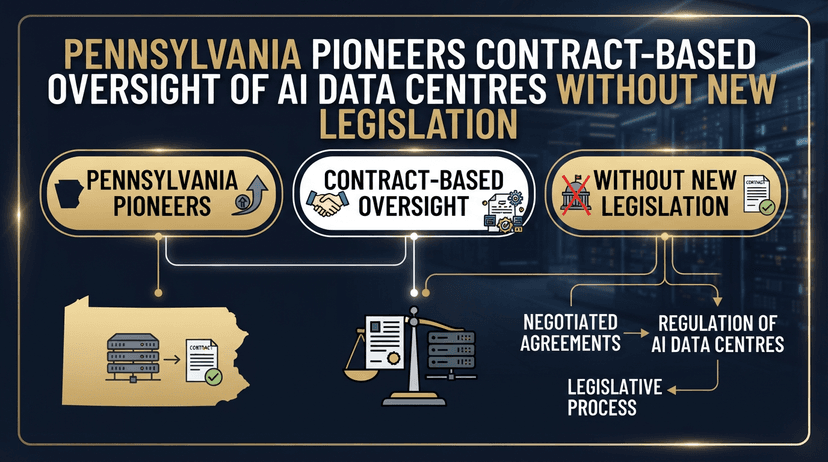
AI data centre oversight in the United States has taken a significant step forward in Pennsylvania, where the governor has used existing environmental permitting powers to impose binding conditions on new AI facilities—without the legislature passing a new statute. Policy experts say the approach could become a template for other states looking to manage the rapid expansion of AI infrastructure while broader federal legislation is still pending. Governor’s Order Creates a Contract-Based Regime According to reporting from AI News, the Pennsylvania model is built around a new executive order that changes how the state’s Department of Environmental Protection (DEP) handles permit applications from proposed data centres. Under the order, DEP will review applications only when developers have: Committed to the Governor’s Responsible Infrastructure Development (GRID) Requirements via a formal Consent Order and Agreement. Already secured local approval for the project. The consent agreement functions as a legally enforceable contract between the data centre operator and the state, locking in a defined set of obligations on issues such as environmental impact, community engagement, and transparency. The order took effect immediately and now applies to all new relevant permit applications, meaning that in practice, AI data centre regulation in Pennsylvania “begins with a signature.” Crucially, the governor did not seek new legislation to create this framework. Instead, the order relies on permitting authority the state already holds under existing environmental and land-use laws. Analysts argue that this makes the Pennsylvania order a potentially portable template for other jurisdictions that have similar permitting powers but lack political consensus for new statutes. Why AI Data Centres Are Under Scrutiny The Pennsylvania order arrives amid growing concern over the pace and impact of AI data centre construction nationwide. A recent tracker of AI data centre legislation in the United States lists 16 bills across eight states , including measures focused on environmental accountability, energy disclosure, and even temporary moratoriums on new builds. As AI workloads surge, these facilities can draw huge amounts of electricity and water, raising questions about grid stability, climate goals, and local resources. At the federal level, multiple bills seek to address these pressures. The proposed AI Data Center Site Selection Transparency Act of 2026 would require developers of AI-focused data centres to disclose their planned locations and expected energy and water use at least 180 days before taking “definitive” steps to establish a facility. Other proposals, such as the Artificial Intelligence Data Center Moratorium Act , aim to pause new AI data centre construction until laws are in place to protect communities, prevent environmental harm, and bar government subsidies for AI centres that do not meet strict safeguards. In parallel, a broader federal roadmap on “responsible innovation” has floated ideas like a Data Center Tax Accountability and Disclosure Act of 2026 , which would mandate detailed reporting on energy and water consumption, funnel data into annual public reports, and allow the Department of Energy and Environmental Protection Agency to fine operators that fail to comply. Taken together, these efforts underscore how AI infrastructure has become a focal point in debates over climate policy, industrial strategy, and AI governance. How the Pennsylvania Template Works in Practice By conditioning permit review on a signed GRID consent agreement, Pennsylvania effectively front-loads regulatory control into the earliest stages of AI data centre development. Before DEP even opens a file, the developer must accept a pre-defined package of requirements, which can cover: Commitments on energy efficiency and renewable sourcing. Limits or reporting obligations on water use. Community benefit agreements or local hiring targets. Procedures for ongoing monitoring and enforcement. While the specific GRID requirements are detailed in a template agreement released alongside the order, AI News reports that the mechanism is intentionally designed to be replicable: it uses standard consent order tools familiar to environmental regulators, applied to the new context of AI data centres. Because consent orders are already widely used to enforce pollution controls and remediation plans, regulators can adapt established legal practices rather than invent entirely new structures. The order also requires that local approval be secured before state environmental permitting proceeds. This sequencing gives municipalities leverage and ensures that local land-use decisions are not overridden by state-level enthusiasm for AI investment. In effect, communities gain a veto point early in the process, aligning with demands from activists and local officials who have pushed for stronger say over major infrastructure projects. A Contrast With Moratorium and Tax-Based Approaches Pennsylvania’s approach differs sharply from the federal moratorium proposals now before Congress. The Artificial Intelligence Data Center Moratorium Act and companion House legislation would halt construction or upgrading of AI data centres until new national safeguards are enacted, including guarantees that communities can approve or reject projects, that facilities do not raise utility bills or exacerbate climate risks, and that no government subsidies support non-compliant centres. Those bills aim to reset the entire legal landscape around AI infrastructure, but they require full congressional passage. By contrast, Pennsylvania’s template works within existing law, targeting the permitting gate rather than construction itself. It does not stop AI data centres outright, but it binds them to pre-negotiated obligations that can be updated administratively. For states wary of freezing economic development but concerned about environmental and social impacts, this may appear more politically feasible than a blanket moratorium. The federal tax-and-disclosure proposals, including the Data Center Tax Accountability and Disclosure concept, would add another layer by requiring detailed reporting and adjusting tax treatment for AI data centre property, potentially diverting funds to a workforce transition program. Observers suggest that a future regulatory environment could combine all three elements: contract-based state permitting models like Pennsylvania’s, national disclosure mandates, and targeted fiscal measures to balance local costs and benefits. Implications for Other States and the AI Industry Policy commentators at Age for AI and AI Business note that the key innovation in Pennsylvania is less about the substance of the GRID requirements and more about the procedural tactic: using existing permitting authority and consent agreements as a lever to regulate AI data centres immediately. Because no new law was required, the state could act quickly, setting conditions for all new applications from the day the order was issued. Other states with strong environmental permitting regimes could adopt similar templates, tailoring their consent orders to local priorities such as drought risk, grid reliability, or community benefits. For AI companies and cloud providers, this implies a patchwork of contract-based obligations that may vary by state—even as federal lawmakers debate broader rules. Industry leaders are watching closely. While many companies have voluntarily announced plans to power data centres with renewable energy and improve efficiency, the Pennsylvania order transforms such commitments into enforceable requirements tied to the right to build. As more states experiment with similar tools, developers may face escalating demands for transparency and accountability as the price of continued expansion of AI infrastructure. With AI data centres now central to the global digital economy, Pennsylvania’s move offers a concrete, immediately deployable model for governments seeking to manage their growth rather than simply observe it. Whether other states follow this template—or opt for stronger measures like moratoriums—will shape how and where the next wave of AI infrastructure is built.

Nic Reeve·