
allnewscastallnewscast
Breaking News
AI & Tech

AI News: Anthropic and OpenAI Spark a New Race to Cut Model Costs

Nic Reeve5 min read
AI News: Anthropic and OpenAI Spark a New Race to Cut Model Costs

Anthropic and OpenAI unveiled cheaper models on September 22, 2026, intensifying a price battle with lower-cost AI developers and giving business customers new alternatives. The releases are central to the latest AI news: Anthropic launched Claude Opus 5.5, while OpenAI added GPT-6 Sol and GPT-6 Luna to its model family.

What did Anthropic release?

Anthropic introduced Claude Opus 5.5 on September 22, 2026, positioning it as a less expensive option that can approach the performance of its top model. The company said the system matches Claude Fable 5.1 on most tasks, while independent reporting focused on lower token prices and reduced operating costs.

  • According to Business Standard, 2026: Claude Opus 5.5 costs $4 per million input tokens and $20 per million output tokens.
  • According to The Korea Economic Daily’s English report, 2026: those prices are below Opus 5’s $5 input and $25 output rates.
  • According to Anthropic’s claims reported by Fortune, 2026: Opus 5.5 performs at the level of Fable 5.1 and costs about 40% less to run than Opus 5 in practical use.

Anthropic’s pricing distinction matters because a token rate does not capture the full cost of an AI task. A model that produces fewer unnecessary tokens or uses computing resources more efficiently can reduce a customer’s final bill even when the headline API price tells only part of the story.

How did OpenAI respond?

OpenAI announced GPT-6 Sol and GPT-6 Luna within hours of Anthropic’s release. The two systems target different workloads. Sol is aimed at more demanding tasks such as coding, while Luna is designed for high-volume jobs including document summarization and information extraction.

  • According to CNBC, 2026: OpenAI cut API prices for GPT-6 Sol and GPT-6 Luna by 50% compared with promotional pricing for GPT-5.6.
  • According to OpenAI’s statement quoted by Tech.co, 2026: improvements in caching and inference enabled the company to serve the models at a lower cost.
  • According to CNBC, 2026: GPT-6 Sol sits below OpenAI’s GPT-6 Astra model in the company’s lineup.

The split reflects a practical change in how providers package advanced systems. Instead of offering one premium model for every job, companies are creating tiers for coding, reasoning, extraction, summarization and other workloads with different cost and speed requirements.

Why are the new models cheaper?

The companies point to efficiency rather than a simple reduction in capability. Anthropic said Opus 5.5 uses computing resources more effectively and produces less verbose responses. OpenAI attributed its lower pricing to caching and inference improvements, which affect how much computing power is needed when a customer sends a request.

  • According to National Technology, 2026: Anthropic priced Opus 5.5 20% below Opus 5 on a per-token basis.
  • According to National Technology, 2026: Anthropic said practical running costs fall by about 40% because of efficiency gains and lower output volume.
  • According to The Korea Economic Daily’s English report, 2026: Opus 5.5 scored higher than Fable 5.1 on some coding and knowledge-work benchmarks, according to Anthropic.

Those figures come from company claims and should not be treated as a universal price comparison. The final expense depends on prompt length, response length, caching, usage volume, latency targets and the way a customer integrates a model into its software.

Who is affected by the price cuts?

Businesses that process large volumes of text or code stand to gain the most immediately. Lower inference costs can change the economics of customer-service agents, search tools, coding assistants, document systems and internal knowledge applications. Developers also gain more freedom to assign routine work to cheaper models while reserving premium systems for difficult requests.

  • High-volume users can benefit from Luna’s focus on extraction and summarization, according to CNBC, 2026.
  • Software teams working on code can evaluate GPT-6 Sol and Opus 5.5 against higher-priced frontier models, based on the product descriptions reported by CNBC and Business Standard, 2026.
  • Customers comparing providers must assess total task cost rather than API prices alone, because efficiency and output length affect the final bill.

Cheaper access may also increase experimentation. A startup that could not justify frequent use of a premium model may now test automated workflows, provided the model meets its accuracy, privacy and reliability requirements.

Is this a response to cheaper rivals?

Yes. Reporting from CNBC, NDTV and other outlets links the releases to growing pressure from lower-cost and open-weight models, particularly from China and other cost-conscious markets. The competitive question is no longer only which model performs best. It is also which provider can deliver acceptable results at a price that supports large-scale deployment.

Open-weight systems add a different kind of pressure because customers can run them on their own infrastructure or through competing hosting services. Closed providers such as Anthropic and OpenAI retain advantages in model access, managed infrastructure and integrated tools, but price-sensitive buyers can compare more options than before.

What happens next?

Anthropic said it expects to release Sonnet 5.5 and Haiku 5.5 in the coming weeks. That planned expansion would give customers additional choices below or alongside Opus 5.5. OpenAI’s GPT-6 Sol and Luna releases also suggest that the company is building a broader range of models around its GPT-6 platform.

  • According to Fortune, 2026: Anthropic expects Sonnet 5.5 and Haiku 5.5 to arrive in the following weeks.
  • According to The Peninsula, 2026: the releases came days after officials from both companies had called for a slowdown in AI development.
  • According to TechXplore, 2026: the cheaper launches arrived amid continuing concerns about the safety of rapidly advancing AI systems.

That timing creates a clear tension. Company leaders can call for caution around frontier development while their businesses continue releasing models designed to win more workloads. For customers, the immediate result is a wider field of systems with different trade-offs among price, capability, speed and safeguards.

Sources

  1. 1.cnbc.com
  2. 2.thepeninsulaqatar.com
  3. 3.business-standard.com
  4. 4.en.sedaily.com
  5. 5.ua.news
  6. 6.techxplore.com
  7. 7.news.abs-cbn.com
  8. 8.chosun.com
  9. 9.fortune.com
  10. 10.nationaltechnology.co.uk
  11. 11.ndtv.com
  12. 12.tekedia.com
  13. 13.inc42.com
  14. 14.tech.co
  15. 15.siliconangle.com

Read more →

Related Articles

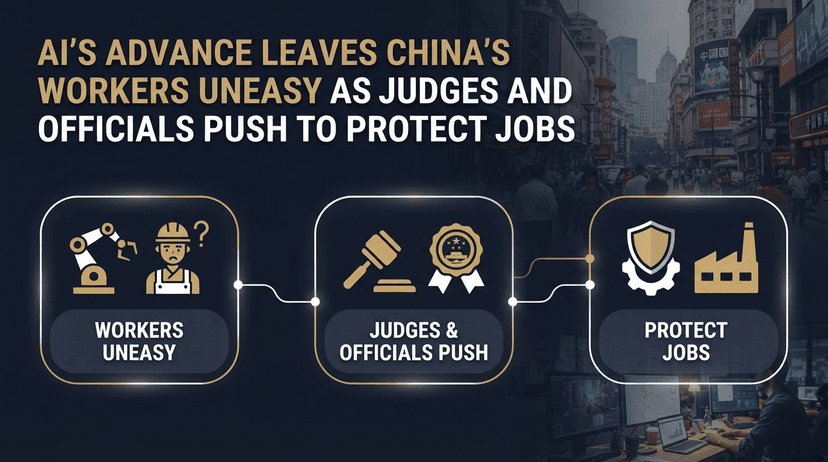
AI’s Advance Leaves China’s Workers Uneasy as Judges and Officials Push to Protect Jobs
AI & Tech

AI’s Advance Leaves China’s Workers Uneasy as Judges and Officials Push to Protect Jobs

Across China, workers from factory floors to tech startups are increasingly anxious that artificial intelligence could cost them their livelihoods, even as they scramble to adapt to new tools reshaping their jobs. The rapid spread of generative AI and automation is transforming work processes faster than many employees can upskill, intensifying concerns about job security in a slowing economy. Surveys and official data suggest that anxiety is broad-based and acute. A 2025 survey of around 11,800 professionals conducted by the Cheung Kong Graduate School of Business in Beijing found that 85.5% of respondents believed they could face unemployment within three years because of AI replacing human work. Separate research cited by international media indicates that while many Chinese workers see productivity benefits from AI, more than a quarter of those who expect positive impacts also fear that technology might ultimately replace them. Automation Quietly Reshapes the Labor Market China’s companies are adopting AI at speed, often without public announcements of job cuts. Analysts describe a pattern of “quiet layoffs”, where headcount is reduced as AI tools take over routine tasks in sectors such as customer service, editing, visual design and data processing, allowing firms to maintain output with fewer staff. Recruitment platform data reported by Chinese media shows that hiring demand for several white-collar roles fell sharply in early 2026: editing jobs dropped 29%, customer service positions 23% and visual designers 21% year-on-year, while demand for AI-related skills jumped 73% over the same period. A recent Citibank estimate suggested that about 9.6% of all jobs in China—roughly 70 million positions—are at high risk of AI-driven displacement , with the risk rising to 13.6% among workers in their twenties. Individual stories illustrate the shifting landscape. One data analyst in the AI industry told Chinese business media that she helped automate many of her own repetitive tasks, only to later be laid off when her employer concluded the work could be done with fewer people. She subsequently took a significant pay cut to move into a more traditional sector, remarking that “no industry can hide from AI”, a sentiment echoed across online discussion forums and social platforms. From Factory Workers to Coders: Anxiety Spreads AI’s impact is not limited to white-collar roles. Government-linked commentary notes that workers from assembly-line operators to designers and translators are already feeling pressure from automation and algorithmic management tools. Gig workers and service employees, including delivery drivers and content creators, expressed fear in recent interviews that recommendation algorithms, robotics and generative content systems could dramatically reduce demand for human labor or erode pay. At the same time, highly educated workers in tech and media say they are being asked to use AI to increase output without corresponding increases in pay or job security. According to detailed reporting by Caixin, AI often compresses multiple tasks into a single role rather than eliminating jobs outright, leading remaining staff to shoulder heavier workloads while colleagues are quietly let go. This dynamic, combined with already elevated youth unemployment, is intensifying frustration among recent graduates. International wire reports describe programmers, copywriters and office clerks who now rely on AI chatbots and coding assistants, yet fear those same systems could soon make their roles redundant. Some workers interviewed said they have started learning new skills in machine learning or data labeling, while others are exploring career shifts into fields seen as less easily automated, such as hands-on manufacturing or certain service jobs. Courts Push Back on AI-Driven Layoffs China’s legal system has begun to respond to mounting tension over AI-related redundancies. In late 2025 and early 2026, several courts and arbitration panels ruled that replacing an employee with AI software is not, by itself, a valid reason for termination under existing labor law. Employers were told they must first explore contract renegotiation, retraining or internal reassignment before resorting to layoffs on the grounds of automation. In one widely reported case, a Chinese court found that a technology company had illegally dismissed a worker after substituting his role with AI, ordering compensation and signaling that similar dismissals could face legal challenges. Media coverage in August 2026 highlighted a growing number of rulings in favor of employees displaced by AI, describing them as a significant victory for worker rights—but noting that anxiety about the future of work remains widespread. Labor officials in Beijing have also indicated that AI replacement alone should not justify firing an employee in arbitration proceedings, further underlining the government’s concern about social stability in the face of rapid technological change. Official Response: Shield Jobs, Guide Innovation China’s leadership continues to promote aggressive AI development as a pillar of economic modernization, but has increasingly paired this agenda with explicit commitments to protect employment. Policy documents issued since 2025 under the “AI+” banner include directives to strengthen employment risk assessments for AI applications, guide innovation toward sectors with greater job-creation potential and reduce negative impacts on jobs. At national political meetings, officials and legislators have floated an “AI + Employment” framework featuring tax incentives, reskilling schemes, wage subsidies and possible limits on automation in certain sensitive occupations. One representative of the National People’s Congress proposed a dedicated “AI unemployment insurance” fund to support workers most vulnerable to automation, a suggestion echoed in subsequent commentary on state-linked platforms. The Ministry of Human Resources and Social Security has pledged targeted employment support for key industries and expanded vocational training to help workers adapt to an AI-centric labor market. In early 2026, labor authorities announced plans for a dedicated policy package addressing AI’s impact on employment, promising measures for job stabilization, expansion and quality improvement. China’s official trade union newspaper, Workers’ Daily, has called for regulators to improve labor standards and strengthen oversight of AI algorithms, including mechanisms to ensure workers and unions have a greater say in how AI is deployed in workplaces. Economists interviewed by government outlets argue that AI is more likely to restructure the labor market than eradicate jobs outright, drawing parallels with earlier technological revolutions that ultimately created new professions even as they destroyed old ones. Adapting to an Uncertain Future Despite emerging legal protections and policy initiatives, many Chinese workers remain unsure how to prepare for an AI-driven future. Researchers at the Chinese Academy of Social Sciences warn that rapid advances in large language models and automation technologies could hit both younger and older workers particularly hard, and have urged authorities to pursue a “U-shaped” human-capital strategy focused on early childhood education and lifelong retraining. For now, employees across sectors are experimenting with strategies ranging from embracing AI tools to maximize their own productivity, to seeking roles that involve uniquely human skills, to exploring entrepreneurial ventures built on AI applications rather than competing against them. As one white-collar worker told a reporter, using AI at work has become unavoidable—but the question of who ultimately benefits from that productivity remains unresolved.

Nic Reeve·
UK seeks global governance role in latest AInews
AI & Tech

UK seeks global governance role in latest AInews

Prime Minister Andy Burnham announced on September 22, 2026, that the United Kingdom will attempt to broker a worldwide agreement on artificial intelligence during its upcoming G20 presidency. This AInews development follows the Prime Minister's visit to the United Nations General Assembly in New York, where he positioned the British government as a central diplomatic mediator for technological safety. What is the UK's plan for global AI governance? The British government aims to establish a single, unified set of global principles to govern the development of artificial intelligence. By advocating for standardized transparency and access protocols, the United Kingdom intends to create a baseline of accountability for major technology companies that operate across international borders. According to Streamlinefeed , the Prime Minister argued that fragmented regulatory regimes will inevitably create loopholes that malicious actors can exploit. He emphasized that the global community must align on safety standards to prevent the rapid advancement of machine learning from becoming a multiplier of geopolitical risk. Burnham suggested that governments must move beyond voluntary approaches. He called for oversight mechanisms that require developers to prove their systems are safe before they are deployed in public or commercial spaces. Why does the UK believe it can lead this effort? The Prime Minister believes the United Kingdom is uniquely positioned to act as an "honest broker" due to its specific diplomatic relationships and technical expertise. The UK maintains strong ties with the European Union, the United States, and China, which are the primary actors in the technological landscape. According to Politico Europe , Burnham cited the country's expertise, including the work of the AI Security Institute, as a key reason why the nation can lead. This technical capability allows the UK to bridge the gap between different regulatory philosophies. The strategy relies on London's ability to negotiate a consensus that balances technological innovation with necessary security constraints. Burnham intends to use the UK's special access to American models to facilitate these high-level negotiations. When will the G20 summit take place? The United Kingdom will assume the G20 presidency in 2027, taking over the role from the United States. The transition occurs following the G20 Summit in Miami, which is scheduled for December 2026. According to Unite.AI , the flagship Leaders' Summit will be held in Manchester in November 2027. This event will convene major global economic players to address acute challenges, including the regulation of rapidly changing technologies. Preparations for the Manchester summit are expected to intensify in the autumn of 2026. The UK presidency is intended to be a year-long endeavor that brings G20 events to various regions across the country. Where will the G20 summit be held? Manchester has been confirmed as the host city for the 2027 G20 Leaders' Summit. The city was selected earlier in 2026 after several months of evaluating potential host locations. The Prime Minister's Office noted that Manchester was chosen due to its cultural heritage. According to Unite.AI , hundreds of local people are expected to be involved in the summit, ranging from security roles to various cultural showcases. Who is involved in the UK's diplomatic mission? Prime Minister Andy Burnham is leading the diplomatic push, accompanied by Kanishka Narayan, the UK's minister for artificial intelligence. The Prime Minister's itinerary in New York focuses heavily on technological diplomacy and international security. Burnham is scheduled to meet with US President Donald Trump to discuss a measured approach to technology. According to The Next Web , this meeting marks the first encounter between the two leaders since Burnham became Prime Minister. The Prime Minister also intends to meet with various world leaders to discuss the conflict in Ukraine and the Middle East. He is expected to co-host a high-level event on the two-state solution in Israel and Palestine alongside President Macron and other international officials. How does the UK plan to work with the United States? The United Kingdom and the United States are launching a new AI and Autonomy partnership. This collaboration is designed to protect critical national infrastructure, such as air space and sea lanes, by detecting and deterring potential threats. The partnership involves the UK Ministry of Defence’s Rapid AI Delivery Taskforce and the US Department of War’s Chief Digital and Artificial Intelligence Office. According to Unite.AI , the goal is to deliver interoperable capabilities that enhance the technological edge of both nations. This work builds upon the existing AUKUS partnership, which focuses on submarine technology and undersea autonomous capabilities. Recent tests under AUKUS included a live firing of a heavyweight torpedo launched from an undersea drone named Excalibur. What are the risks of unregulated artificial intelligence? The Prime Minister has identified several critical risks, ranging from geopolitical instability to the erosion of democratic institutions. He warned that unchecked machine learning systems could act as a multiplier for existing global tensions. According to Streamlinefeed , Burnham specifically highlighted the danger of state actors, such as Russia, using AI to conduct disinformation campaigns. These operations are designed to undermine democracy and manipulate public discourse through artificially generated content. The Prime Minister argued that establishing binding safety rules is a fundamental requirement for protecting the integrity of global democratic systems against hybrid warfare. What is the Finland-led declaration? The Finnish declaration is a regulatory framework that demands artificial intelligence remain under strict human control. It mandates rigorous pre-release testing for all advanced models to ensure safety before they reach the public. According to Streamlinefeed , more than 20 countries have already supported this declaration, including Germany, Canada, and Ireland. While the declaration has gained momentum, the United States and China have not signed it. This creates a significant gap in the proposed global regulatory framework that the UK must navigate. Is there domestic pressure on the Prime Minister? Yes, the Prime Minister faces pressure from within his own political circles to act more decisively. Some leaders believe the UK should align more closely with the existing Finnish-led regulatory movement. According to Streamlinefeed , former cabinet minister Darren Jones has publicly urged Burnham to sign the declaration. Jones argued that the signatories represent Britain's natural allies. Jones suggested that the UK should use this political momentum to broker an agreement with Washington. This would potentially solidify the United Kingdom's role as a leader in technological regulation. How does the UK view the US-China divide? The British government views the technological rivalry between the United States and China as a primary challenge to global stability. Because neither superpower has signed the Finnish declaration, creating a unified rulebook is complicated by this divide. Burnham intends to use the UK's strategic position to bridge this gap. He believes the UK has the necessary influence to negotiate a consensus that works for both sides of the technological competition. The Prime Minister's goal is to find a middle ground that allows for innovation while maintaining strict security constraints. This requires managing the interests of both the US and China through careful diplomacy. What role will AI play in the Prime Minister's agenda? Artificial intelligence is expected to be a dominant theme in the Prime Minister's diplomatic meetings. Downing Street has stated that the technology will play a central role in his discussions with world leaders in New York. According to Unite.AI , Burnham intends to use the technology for two main purposes: ensuring it is used as a force for good and maximizing its ability to deliver safety and security for citizens. In his speech to the General Assembly, the Prime Minister argued that AI could help drive down the cost of living and support a more stable world. He aims to demonstrate leadership similar to the UK's role during the global financial crisis. What happens after the UN General Assembly? The focus will shift toward the formal preparations for the G20 presidency. The UK will move from high-level diplomatic discussions in New York toward the implementation of a strategic roadmap for technological governance. The Prime Minister's government intends to make AI safety standards a central pillar of its leadership agenda throughout 2027. This will involve a structured timeline for negotiating the final components of a global rulebook. As the UK prepares to take over the presidency from the US in late 2026, the emphasis will remain on creating a framework that prevents malicious actors from exploiting regulatory loopholes. The ultimate goal is to reach a consensus during the Manchester summit.

Nic Reeve·
AInews: Bullish Steps Into AI Hardware Lending With $100M USD.AI Facility
AI & Tech

AInews: Bullish Steps Into AI Hardware Lending With $100M USD.AI Facility

AInews: Bullish Steps Into AI Hardware Lending With $100M USD.AI Facility On August 28, 2026, crypto exchange Bullish announced a $100 million stablecoin debt facility for USD.AI, marking its formal expansion from digital asset trading into AI infrastructure lending and putting the AInews spotlight on GPU-backed loans for high‑performance computing. What exactly did Bullish agree to do with USD.AI? Bullish committed a $100 million stablecoin-based liquidity facility that USD.AI will draw on to originate non‑recourse loans secured by GPU hardware and other AI compute equipment. The capital comes from Bullish’s balance sheet and exchange liquidity, channeling on‑chain funds directly into physical AI infrastructure. According to Bullish’s August 28, 2026 announcement, the firm will provide up to $100 million in stablecoins to USD.AI, an on‑chain protocol that finances AI data centers by lending against graphics processing units (GPUs) and related servers. USD.AI describes its loans as “non‑recourse” and “asset‑backed,” meaning borrowers pledge the hardware itself, not wider corporate assets, as collateral for the debt. Facility size: $100 million in stablecoins, according to Bullish and USD.AI on August 28, 2026. Collateral: NVIDIA GPUs and other high‑performance computing hardware used for AI workloads, according to CoinMarketCap’s update from August 28, 2026. Loan structure: On‑chain, non‑recourse loans where the hardware backs the debt, according to USD.AI and The Defiant. Purpose: Funding the “AI buildout” by providing capital directly to AI infrastructure operators, according to USD.AI’s social posts on August 28, 2026. Bullish framed the move as a strategic entry into “middle‑market AI infrastructure financing,” pairing its crypto capital markets expertise with USD.AI’s on‑chain lending technology. The arrangement connects stablecoin liquidity with demand from AI data centers that struggle to fund expensive GPU clusters quickly through traditional bank channels. How does USD.AI’s GPU-backed lending model work in practice? USD.AI originates loans where AI data center operators pledge GPU hardware as collateral. If borrowers default, USD.AI’s protocol can liquidate the equipment or associated cash flows. The Bullish facility increases the protocol’s capacity to fund new loans and expand its on‑chain balance sheet. USD.AI positions itself as an “on‑chain platform for AI infrastructure financing” that locks up real‑world computing gear inside crypto‑native loan structures. According to USD.AI and CoinMarketCap, the protocol focuses on NVIDIA GPU rigs that power training and inference for large models, treating the hardware’s resale value and generated revenue as the economic foundation for the loans. Loan origination: USD.AI issues non‑recourse loans directly to AI infrastructure operators, according to Unite.AI’s August 28, 2026 report. Collateral management: GPU servers and associated computing assets are pledged on‑chain and can be liquidated if the borrower fails, according to The Defiant. Protocol scale: Cointelegraph reported on August 28, 2026 that USD.AI had “over $225 million” in total value locked at the time of the Bullish facility. Token ecosystem: USD.AI issues sUSDai, a yield‑bearing staked dollar token linked to protocol revenues, according to Unite.AI and Stock Titan. This structure aims to speed up capital formation for AI hardware deployments by reducing the reliance on long underwriting cycles and conventional secured lending that often require broader corporate guarantees. Instead, USD.AI uses programmable smart contracts and crypto liquidity to move funding faster, while Bullish supplies the stablecoin capital pool. Why is Bullish moving from pure crypto trading into AI infrastructure lending? Bullish argues that demand for AI computing capacity is outstripping traditional financing channels. By tying stablecoin liquidity directly to GPU assets, the firm hopes to capture growth in AI capital expenditure while leveraging its exchange, balance sheet and market‑making capabilities. The August 28, 2026 announcement describes the facility as Bullish’s “strategic entry” into middle‑market AI infrastructure financing, a new line of business beyond its core exchange operations. MarketBeat’s coverage of the deal notes that the company is seeking exposure to rising demand for GPU capacity while accepting lending risk linked to the underlying hardware and borrowers’ performance. Strategic rationale: Connect digital asset capital markets with physical AI compute demand, according to Stock Titan’s summary of Bullish’s press release. Risk profile: Lending against volatile hardware prices and AI operator cash flows, as highlighted by MarketBeat’s August 30, 2026 analysis. Market reaction: Bullish shares on the NYSE ticker BLSH drew investor attention after the announcement, according to MarketBeat’s news page dated August 30, 2026. Crypto analysts quoted by Cointelegraph and CoinDesk social posts described the arrangement as a step toward linking “crypto capital markets directly to physical AI compute,” using GPUs as loan collateral and turning a previously niche lending model into a more institutional product. What role does the sUSDai token play in the Bullish–USD.AI arrangement? sUSDai is USD.AI’s staked dollar token that represents claims on protocol revenues and underlying assets. Bullish plans to list sUSDai across multiple trading pairs and run a market‑making program aimed at improving liquidity, price discovery and funding efficiency for GPU‑backed debt. Unite.AI reported that Bullish will “onboard sUSDai” on its exchange, offering several trading pairs backed by an internal market‑making desk. Stock Titan’s reading of the press release adds that this initiative is designed to improve “secondary liquidity and price discovery for GPU‑backed debt,” effectively turning slices of infrastructure loans into tradable on‑chain instruments. Token type: Yield‑bearing staked dollar representing protocol exposure, according to Unite.AI’s August 28, 2026 article. Exchange listing: Planned listing on Bullish with multiple trading pairs and a dedicated market‑making program, according to Stock Titan and CoinMarketCap. Capital recycling: As sUSDai gains deeper liquidity, USD.AI can originate more loans and roll over existing exposure, according to Unite.AI. The Defiant reported that USD.AI said Bullish would “mint $100 million of sUSDai” as part of the facility, using that capital pool as fuel for a larger pipeline of GPU‑backed loans tied to the ongoing AI buildout. That structure turns Bullish into both lender and major token holder in USD.AI’s ecosystem. How does this deal build on Bullish’s earlier investment in USD.AI? Bullish first invested $4 million in USD.AI in September 2025, calling it its first post‑IPO venture bet. The new $100 million facility extends that relationship from minority equity to core financing partner for USD.AI’s lending operations. According to a Bullish news release dated September 22, 2025, the exchange committed $4 million to USD.AI as its first investment after listing on the New York Stock Exchange under ticker BLSH. Bullish described USD.AI at the time as “the on‑chain platform for AI infrastructure financing,” signalling interest in the intersection of digital assets and AI hardware before the larger debt facility was conceived. Initial equity commitment: $4 million investment announced September 22, 2025, according to Bullish and USD.AI social posts. Strategic intent in 2025: Explore AI infrastructure financing using on‑chain tools, according to Bullish’s corporate statement. 2026 escalation: A twenty‑five‑fold increase in capital commitment via the $100 million stablecoin facility, according to the August 28, 2026 press release. The continuity between the 2025 equity stake and the 2026 debt facility shows a calculated move rather than a sudden pivot. Bullish has spent roughly a year deepening ties with USD.AI’s team and technology before committing a nine‑figure lending facility. Who stands to benefit from this AI hardware lending expansion? The primary beneficiaries are AI infrastructure operators that need capital for GPU clusters, along with investors seeking exposure to AI hardware economics via on‑chain instruments. Bullish aims to capture trading and lending fees, while USD.AI expands its loan book and protocol revenues. USD.AI’s model targets data center operators, model‑hosting providers and specialized GPU cloud platforms that face steep upfront hardware costs. According to CoinMarketCap and Unite.AI, the protocol’s loans can finance “high‑performance computing assets” directly, reducing reliance on general corporate credit. The Bullish facility enlarges the pool of available capital for this segment. Borrowers: Middle‑market AI compute firms and infrastructure providers, according to Bullish’s description of the new business line. Token holders: sUSDai holders gain exposure to GPU‑backed lending returns and protocol fees, according to Unite.AI. Exchange users: Bullish customers get new trading pairs and an asset class tied to AI hardware performance, according to Stock Titan. Cointelegraph and CoinDesk coverage emphasise that the deal creates a bridge between crypto liquidity providers and the real‑world AI buildout, potentially giving smaller AI firms more options than conventional bank loans or equity dilution. What risks and unanswered questions surround this new lending model? The structure introduces exposure to hardware price swings, borrower defaults and smart contract vulnerabilities. MarketBeat notes that while investors welcomed Bullish’s entry into AI financing, the company is now directly tied to the economics and operational risks of GPU‑heavy infrastructure. AI hardware prices can move sharply as new GPU generations arrive or demand cycles change. CoinMarketCap’s commentary on the facility warns that using NVIDIA GPUs as collateral ties loans to both technology refresh cycles and secondary market liquidity for used equipment. If resale values fall faster than expected, recovery on defaulted loans could be lower. Credit risk: AI operators may struggle if customer demand or model economics weaken, affecting their ability to service loans, according to MarketBeat’s August 30, 2026 note. Market risk: Collateral value depends on ongoing demand for GPUs and AI compute, according to CoinMarketCap. Protocol risk: On‑chain structures rely on smart contracts and oracle data, which could fail or be attacked, a concern raised in DeFi‑focused coverage by The Defiant. At the same time, cryptorank.io and Cointelegraph coverage frames the facility as a test case for whether crypto‑native lending can safely support real‑world capex in high‑growth sectors. The coming quarters will reveal whether hardware‑backed stablecoin lending scales beyond this initial $100 million commitment. What happens next for Bullish, USD.AI and AI infrastructure financing? The two firms plan joint research into capital formation models for AI hardware, broader sUSDai integration on Bullish, and further scaling of GPU‑backed loans. Future steps may include expanding facility size, onboarding more borrowers and refining risk management as the protocol matures. Stock Titan’s summary of Bullish’s press release says the partners intend to “expand joint research on capital formation models for AI CapEx,” linking on‑chain liquidity tools with the financing needs of machine learning infrastructure. The Defiant reports that USD.AI is already using newly minted sUSDai to fund more GPU loans, suggesting an active pipeline of deals. Near‑term focus: Deploying the full $100 million facility into GPU‑backed loans, according to Unite.AI. Token rollout: Listing sUSDai pairs and building a liquid secondary market for AI hardware‑linked debt, according to Stock Titan and CoinMarketCap. Potential expansion: MarketBeat and Cointelegraph commentary hint that, if the model works, Bullish could increase the facility or replicate it with other AI infrastructure protocols. How regulators and traditional lenders respond to crypto‑funded AI hardware lending remains unclear. For now, Bullish and USD.AI are positioning themselves as early movers at the intersection of digital asset markets, tokenised debt and the physical machines driving contemporary AI systems.

Nic Reeve·