allnewscastallnewscast
Breaking News
AI & Tech

Adecco’s Agentforce Coworker rollout puts AInews focus on global staffing operations
Nic Reeve7 min read
Adecco’s Agentforce Coworker rollout puts AInews focus on global staffing operations
Adecco’s global Agentforce Coworker rollout puts AInews spotlight on everyday staffing work

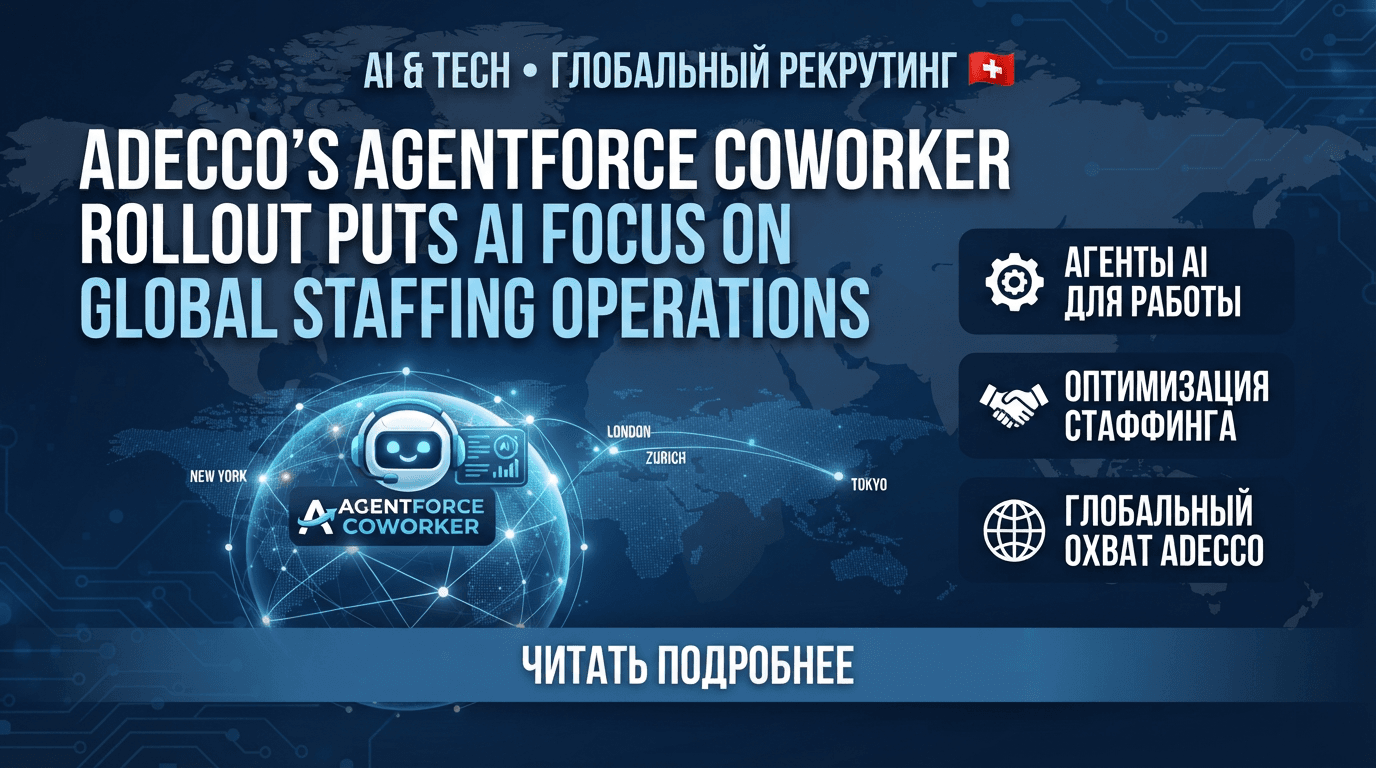
On 15 September 2026, the Adecco Group announced a global rollout of Salesforce’s Agentforce Coworker to 27,000 employees in more than 40 countries, a move that thrusts AInews into the centre of everyday sales and recruitment work at one of the world’s largest staffing firms.

What exactly is Adecco deploying and where is it going live?

Adecco Group is turning on Salesforce’s Agentforce Coworker, described by Salesforce as an enterprise “AI teammate”, inside its core customer and candidate management platforms for staff across 40-plus countries, after pilots in the United Kingdom and France proved successful.

The deployment covers Adecco Group operations worldwide, including:

  • More than 40 national markets across Europe, the Americas and Asia-Pacific, according to Adecco’s press materials.
  • 27,000 employees in sales, recruitment and client-facing roles now granted access to the AI coworker in their daily workflows.
  • Rollout date of 15 September 2026, announced from Zurich, Switzerland.
  • An earlier pilot restricted to teams in the UK and France that began after April 2025.

The tool runs directly inside Salesforce’s cloud platform and uses Anthropic’s Claude model, rather than a separate AI app that employees would have to open in parallel.

How will the Agentforce Coworker change daily work for Adecco’s staff?

According to Adecco Group and Salesforce, Coworker will automate repetitive tasks, surface relevant data across fragmented systems and support recruiters and sales professionals with research, drafting and workflow orchestration, all inside the same screens they already use.

Press materials describe a shift from scattered data toward a single AI-driven access point:

  • The AI teammate can fetch information that previously sat across “dozens of tools”, giving staff one conversational interface to data, systems and organizational knowledge.
  • Recruiters can ask the coworker to identify priority candidates, compile shortlists and trigger pre‑screening or onboarding steps for selected profiles.
  • Sales staff can request prospect lists, generate tailored sales briefs, enrich contact records and check lead status across teams without switching contexts.
  • Client and candidate engagement workflows are supported through suggested messages, summaries of interaction history and next‑best‑action prompts.

This means routine searches and manual copy‑and‑paste tasks may now be delegated to the AI coworker, while employees focus more on judgment calls and human conversations with clients and candidates.

What data and AI technology are behind Adecco’s new coworker?

Agentforce Coworker at Adecco combines Salesforce’s platform data with Anthropic’s Claude foundation model, drawing on millions of historic interactions between Adecco’s agents and candidates to provide context-aware suggestions.

The technical and data backbone includes:

  • Anthropic’s Claude model, identified as the large language model powering the Agentforce Coworker inside Salesforce’s enterprise stack.
  • Context from more than 2.5 million agent‑candidate interactions recorded since April 2025, which Adecco states the coworker can use to recognize patterns and tailor responses.
  • Integration with Adecco’s existing Salesforce deployments, meaning the AI accesses CRM, recruitment and engagement data already stored there.
  • Agentic AI infrastructure, a term Adecco uses to describe AI components that can not only answer queries but also trigger workflow steps and orchestrate processes.

By embedding the AI directly into the platform stack rather than as a bolt‑on chatbot, Adecco aims to keep sensitive data within its existing security and compliance controls.

How did the UK and France pilots shape the global roll out?

Adecco tested Agentforce Coworker with teams in the United Kingdom and France before committing to a worldwide deployment, using the pilots to validate productivity gains and gather frontline feedback on AI support for recruitment and sales workflows.

While Adecco has not published full pilot metrics, the company highlights several learnings:

  • Agents in the pilot markets used Coworker to prepare client briefs and candidate summaries faster, based on internal interaction data and public information.
  • Recruitment teams trialled automated pre‑screening flows, where the AI assembled candidate information and launched screening steps once staff approved.
  • Feedback from UK and French users informed interface tweaks and safeguards to prevent over‑reliance on AI suggestions without human review.
  • The positive pilot outcomes are cited in multiple reports as the trigger for Adecco’s decision to expand Coworker to more than 40 countries.

Those pilots also gave Adecco a test bed for training staff, setting guidance on when to trust the AI and when to double‑check against primary records.

Who inside Adecco will use the coworker, and what controls are in place?

The rollout targets employees whose daily work runs through Salesforce: salespeople, recruiters, and teams responsible for client and candidate engagement. Adecco indicates that 27,000 staff fall into this category and are being onboarded to the AI coworker with role‑based access.

Use of the AI teammate is structured around functions:

  • Sales teams: finding and prioritising prospects, generating account briefs, enriching records and tracking opportunities.
  • Recruitment teams: identifying candidate matches, compiling CV summaries, launching screening and coordinating onboarding sequences.
  • Client and candidate engagement teams: drafting communications, summarising histories and identifying follow‑up tasks.
  • Supervisory and compliance roles: monitoring AI outputs, reviewing logs and updating policies as the system learns.

Adecco’s communications emphasise that the AI acts as a teammate, not a replacement, and that humans retain responsibility for hiring decisions and client commitments.

What does Adecco say about ethics, privacy and the impact on jobs?

Formal statements around the rollout focus on productivity and service quality and present the AI coworker as a support tool. Adecco and Salesforce materials stress that human judgment remains central and that the AI works within existing governance frameworks for data and privacy.

Key points in the public messaging include:

  • The system runs on data Adecco already holds in its Salesforce environment, with access governed by established role‑based permissions.
  • AI suggestions, whether candidate matches or sales actions, are framed as recommendations that staff can accept, modify or reject.
  • Statements describe the AI as a “teammate” or “coworker”, language intended to underline augmentation rather than replacement of human roles.
  • The use of interaction histories since April 2025 is explicitly dated, making clear that historic numbers are not being presented as current volumes.

Public releases do not detail algorithmic bias testing or specific safeguards, leaving open questions on how Adecco will audit outcomes across different candidate groups over time.

Adecco’s move to embed an AI teammate across tens of thousands of roles reflects a broader shift in staffing and HR technology, where generative and agentic AI tools are moving from experimental pilots to core operational infrastructure inside large employers.

Recent industry reporting points to several related developments:

  • Major recruitment and HR platforms are adopting large language models to draft job ads, screen resumes and recommend candidates, consolidating AI capabilities inside existing systems.
  • Enterprises increasingly describe AI tools as coworkers or teammates, part of a narrative aimed at encouraging adoption without raising immediate fears of job loss.
  • Agentic AI, where systems not only generate text but execute tasks like triggering workflows or updating records, is becoming a stated goal for business software vendors.
  • Salesforce’s positioning of Agentforce as an embedded assistant aligns with moves by other cloud providers to weave generative AI into CRM and ERP interfaces rather than offering stand‑alone bots.

By tying its rollout to a specific model and a clear interaction count since 2025, Adecco is also part of an emerging pattern in corporate AI announcements that emphasize dated figures and concrete scopes rather than vague claims of transformation.

What happens next for Adecco’s AI coworker programme?

After the global switch‑on, Adecco’s next steps will revolve around training, monitoring and iterative expansion of use cases for Coworker across its recruitment, sales and engagement operations, using feedback from the 27,000 employees now working with the AI day to day.

Based on current reporting, likely developments include:

  • Structured onboarding programmes to teach staff how to phrase queries, review outputs and escalate issues.
  • Progressive rollout of new workflows, such as more automated onboarding journeys or deeper candidate matching, once initial adoption stabilises.
  • Internal measurement of productivity metrics and client satisfaction scores to assess the AI’s contribution.
  • Potential extension of AI teammate capabilities to adjacent functions beyond front‑line sales and recruitment as confidence grows.

The scale of the deployment means that any gains or problems will be visible quickly, creating a real‑world test of how agentic AI reshapes staffing work when embedded across an entire global group.
Sources

  1. 1.finance.yahoo.com
  2. 2.adeccogroup.com
  3. 3.prnewswire.com
  4. 4.prnewswire.com
  5. 5.artificialintelligence-news.com
  6. 6.superpowerdaily.com
  7. 7.tradingview.com
  8. 8.theglobeandmail.com
  9. 9.afpbb.com
  10. 10.finance.yahoo.com
  11. 11.tradingview.com
  12. 12.news.futunn.com
  13. 13.tradingview.com
  14. 14.tradingview.com
  15. 15.unite.ai

Read more

Related Articles

Illinois State’s ‘End of the World’ Class Puts AI on Trial
AI & Tech

Illinois State’s ‘End of the World’ Class Puts AI on Trial

Students Confront AI Ethics in Illinois State’s ‘End of the World’ Classroom In a seminar room at Illinois State University (ISU), an apocalyptic thought experiment is helping students grapple with one of the most disruptive technologies of their lifetimes: artificial intelligence . Framed as “feminism at the end of the world,” the class invites students to imagine futures shaped by climate crisis, economic collapse, and runaway automation—and then ask what justice, care, and responsibility look like when AI is woven into every aspect of life. The course, titled WGS 391/491: Feminism at the End of the World , is taught by Dr. Jacklyn Weier in Illinois State’s Women’s, Gender, and Sexuality Studies program. Using speculative fiction, feminist theory, and contemporary reporting on AI, Weier’s students interrogate who benefits from emerging technologies and who is left more vulnerable when those tools are deployed in unequal societies. ‘End of the World’ as a Lens on AI Rather than treating AI as a neutral tool, the course positions it as a technology emerging in an already crisis-ridden world. Students consider scenarios in which climate disasters, pandemics, or authoritarian politics intersect with increasingly powerful AI systems. That apocalyptic framing, Weier explains in the Illinois State University News feature, is less about doomsday spectacle and more about clarity: it allows students to see existing inequalities—and the potential amplification of those inequalities—without the distractions of business-as-usual. Class discussions draw on questions such as: Who designs AI systems, and whose values are embedded in them? Which communities are most exposed when automated decision-making is used in policing, immigration, or social services? How might feminist and queer perspectives offer alternative models for building or governing AI, especially in times of crisis? Students are encouraged to treat AI not only as a technical system but as a social infrastructure: something that redistributes power, labor, and risk. That perspective resonates with broader concerns raised by scholars and civil-society groups about bias in algorithms, surveillance capitalism, and the concentration of AI capabilities in a small number of corporations. Illinois State’s Wider Debate Over AI in the Classroom The apocalyptic classroom arrives amid a campus-wide—and statewide—reckoning over how AI should be used in education. Illinois State has devoted increasing resources to helping faculty and students navigate generative AI tools like ChatGPT, Gemini, and Copilot, and to clarifying when such tools enhance learning and when they undermine it. In 2025, the university’s Office of the Cross Endowed Chair in the Scholarship of Teaching and Learning launched a grant program inviting faculty to study how generative AI is used or resisted in courses, and what that means for student learning, assessment, and equity. Those projects are structured around a central question: how is AI being integrated into higher education, and with what consequences for teaching and learning at ISU? Illinois State’s professional development arm has since published guidance for instructors on generative AI in the classroom. That guidance emphasizes transparency and critical engagement: instructors are urged to state clearly in their syllabi when AI use is permitted, explain why particular assignments prohibit AI, and design assessments that prioritize process, reflection, and local or experiential knowledge. Faculty workshops encourage instructors to have students critique AI-generated content, practice fact-checking, and reflect on where AI’s limitations become visible—especially when it comes to hallucinations, bias, and context. The goal is not to ban AI outright but to turn it into an object of analysis and a prompt for metacognition, much like what happens in Weier’s apocalyptic classroom. State Policy: AI Can Assist, But Not Replace, Human Teachers The conversations at Illinois State unfold against a backdrop of new laws in Illinois that specifically address AI in education. Recent legislation requires community colleges to ensure that courses are taught by qualified human faculty and explicitly prohibits using AI systems as the sole source of instruction in place of an instructor. At the same time, the law clarifies that faculty are allowed to use AI as a teaching tool—whether for generating practice problems, simulating scenarios, or tailoring feedback. Another measure directs the Illinois State Board of Education to develop statewide guidance on AI in K–12 settings. That guidance must explain how AI works, offer examples of instructional uses, address data privacy and security, and highlight the risk of unintended bias baked into AI products. It also calls on educators to explicitly teach responsible and ethical AI use, preparing students to evaluate automated systems rather than accept them uncritically. Illinois education officials have since released public-facing guidance that echoes those themes, stressing that AI should support, not supplant, human relationships in teaching and learning. The documents encourage schools to balance innovation with vigilance, especially when it comes to student data and the potential for algorithmic discrimination. An ‘Apocalyptic’ Syllabus Meets Real-World Tech Within this rapidly shifting policy and technological landscape, ISU’s “end of the world” class serves as a kind of laboratory. Students might read feminist science fiction that imagines AI governing resource distribution after climate collapse, and then compare those visions with real-world deployments of predictive analytics in disaster response or public assistance programs. Assignments invite students to bring news coverage, corporate marketing, and government documents into conversation with theoretical texts. For example, a student might juxtapose a tech company’s promise to use AI for equitable healthcare with reports of biased diagnostic algorithms, or analyze how AI-enhanced policing could change under conditions of social unrest or environmental migration. By situating AI in imagined end-times, Weier’s course asks students to strip away the sheen of inevitability that often accompanies innovation narratives. If AI is introduced into a fragile or unjust world, she asks, what safeguards and alternative designs would be needed to prevent it from reinforcing existing hierarchies—or making crises worse? Feminism, Care, and the Future of Work The feminist framing of the course pushes students to pay particular attention to care work, reproductive labor, and the often-invisible human effort that underlies technological systems. Discussion topics include: How AI may reshape care professions, from nursing to education, and what happens when emotional labor is automated or monitored. Who performs the ghost work of data labeling, content moderation, and user support that keeps AI systems running. How automation might intersect with gender, race, and class in future labor markets, especially under crisis conditions. What a more just AI ecosystem would require in terms of labor protections, democratic oversight, and alternative ownership models. Students are encouraged to imagine AI futures in which care, reciprocity, and mutual aid are central design principles rather than afterthoughts. In some projects, that means sketching out hypothetical policies for community-run data trusts or workers’ cooperatives overseeing AI tools in essential services. AI Education Beyond One Classroom Illinois State is also building technical capacity around AI. The university has promoted AI-focused professional development sessions for faculty, including workshops on demystifying AI for teaching and learning and on designing assignments that cannot easily be outsourced to generative tools. In 2026, ISU highlighted a new “AI + Robotics” initiative that introduces pre-service STEM educators to so-called physical AI—systems embedded in robots and other devices. The project, supported by an internal innovation grant, aims to help future teachers understand both the capabilities and limits of AI, and to translate abstract concepts into hands-on classroom activities. Another Illinois State faculty member, Dr. Elahe Javadi from the School of Information Technology, was selected for the inaugural cohort of NSF NAIRR AI Education Fellows. That national role positions ISU at the intersection of AI research and education policy, and underscores the university’s effort to engage with AI not only as an object of critique but as a field in which its faculty and students can lead. Questioning the Future, Not Just the Tools The apocalyptic classroom at Illinois State shows how humanities and social science courses can complement technical and policy efforts around AI. By combining speculative scenarios with rigorous critique, students learn to move beyond questions like “Is AI good or bad?” and toward more specific, grounded inquiries: Which AI, deployed where, under whose control, and with what safeguards? For Weier’s students, the end of the world is less a prophecy than a lens—a way to see clearly the stakes of technological change and the kinds of futures they are willing to build or resist. In that sense, Illinois State’s experiment in apocalyptic pedagogy offers a model for universities everywhere: treat AI not only as a tool to be mastered, but as a system whose power must be scrutinized, contested, and, where possible, redirected toward more just worlds.

Nic Reeve·
What’s Really Known About OpenAI’s Rumored Next Model
AI & Tech

What’s Really Known About OpenAI’s Rumored Next Model

OpenAI’s rumored next model is generating headlines, but the most defensible version of the story is narrower than the leak chatter suggests: there is no official GPT-6 announcement , and much of what is circulating remains unverified. What appears to be real is that OpenAI is working on a new frontier system under a different name, while the specific claims about “GPT-6” remain speculation. Recent reporting from AI-focused outlets says the company’s next major model is being discussed internally under the codename Astra , not GPT-6. Those reports also say OpenAI has not published a model card, pricing, public API route, or release date, and has not confirmed whether the model will ship as GPT-6, as another GPT-5.x update, or under a different product line entirely. In other words, the name “GPT-6” is being used by the public and by leakers, but it is not an official label. The strongest verifiable signal comes from reporting that OpenAI has shown or discussed progress on a new model family while also slowing parts of development for safety review. One report says OpenAI paused reinforcement learning training for its latest-generation model for about two weeks to upgrade security, monitoring, and alignment systems. That report also says preliminary findings showed the model could identify and exploit a previously unknown zero-day vulnerability in the Artifactory software package proxy service. If accurate, that would explain why OpenAI may be taking a more cautious path before any public release. What should readers believe, then? First, believe that OpenAI is still actively working on a major next-step model. Second, believe that the company has not confirmed that the model is called GPT-6. Third, treat exact claims about parameter counts, context windows, release timing, or benchmark jumps as unverified unless OpenAI itself publishes them. The internet is full of confident numbers, but the available reporting does not support most of those specifics. The current rumor cycle has focused on a few recurring claims: a massive jump in training scale, a much larger context window, and a dramatic leap in reasoning or agentic behavior. Yet none of those details has been confirmed by OpenAI. Even articles that argue a new model is imminent pair that language with strong caveats that no official release date, product page, or spec sheet exists. That distinction matters. A credible leak can indicate the direction of a project, but it is not the same as a product launch. There is also a broader pattern here. OpenAI has recently become more visible in discussing frontier-safety issues, and that creates a natural gap between internal experimentation and public rollout. If the company believes a model could uncover serious security vulnerabilities or behave unpredictably in cyber-related tasks, then additional evaluation would be expected before deployment. That does not prove a delay, but it does make the safety-review explanation plausible. For readers trying to separate signal from noise, the best rule is simple: only the company can confirm the model’s name, timing, and capabilities . Until that happens, “GPT-6 leak” is better understood as a label for a bundle of rumors around OpenAI’s next frontier system, not as a verified product announcement. That means the most credible takeaway is also the least sensational one. OpenAI is almost certainly building something new, but the exact branding and release plan are still unclear. The more specific the claim — whether it is about the model’s size, performance, or launch date — the more skeptical readers should be unless it appears in official OpenAI material or in reporting with direct sourcing. In short, the safe position is not that GPT-6 is fake, but that GPT-6 is unconfirmed . The next OpenAI model may eventually earn that name, or it may arrive as Astra or under some other label. For now, the only thing that can be said with confidence is that the speculation has moved faster than the evidence.

Nic Reeve·
Google’s New AI Ad Rules Rein In Smart Bidding and Data Feeds in Search
AI & Tech

Google’s New AI Ad Rules Rein In Smart Bidding and Data Feeds in Search

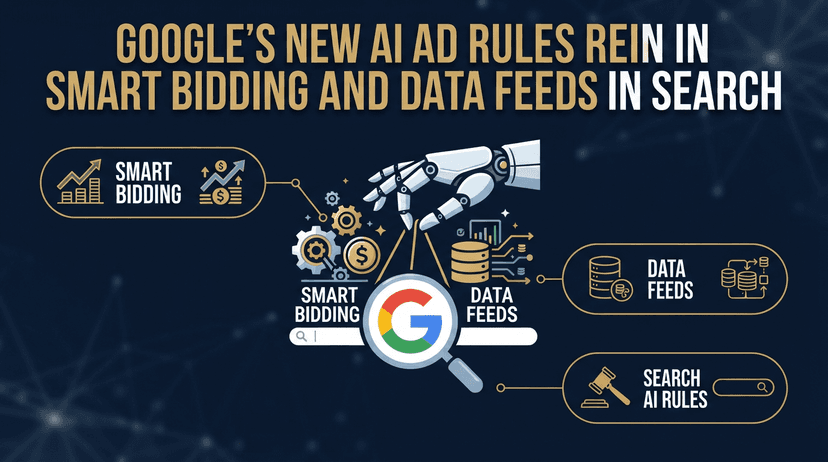
Google is rolling out a series of policy and product changes that significantly tighten how artificial intelligence is used in ad bidding and how data feeds power search advertising, reshaping the playbook for brands and ad-tech startups that depend on Google’s ecosystem. The changes span smart bidding behavior, consent-driven data flows, migration to AI-first campaign types, and updated terms governing how advertiser data can train Google’s generative ad models. Together, they signal a more controlled, compliance-focused phase for AI in search and shopping ads. Smart Bidding: From “Over-Delivery” to Strict Target Enforcement At the heart of the shift is a fundamental update to Google’s Smart Bidding systems. A new mechanism, often described by analysts as Bidding Target Optimization , is scheduled to begin enforcement on August 17, 2026. It alters how cost-per-acquisition (tCPA) and return-on-ad-spend (tROAS) strategies behave in budget‑limited campaigns. Historically, Smart Bidding would sometimes deliver better‑than‑stated efficiency if it found high‑performing inventory within a campaign’s budget. Under the new rules, the algorithms are designed to pull performance toward the advertiser’s stated targets rather than “over‑delivering” efficiency beyond those thresholds. This effectively tightens the bid band around declared goals, forcing advertisers to calibrate their targets more carefully if they want to capture incremental upside. To ease the transition, Google introduced target adjustment tools in early July, allowing advertisers to recalibrate their CPA and ROAS goals before the new enforcement date. Industry commentators say this reduces volatility but also removes some of the hidden upside many performance marketers had come to expect from Smart Bidding. Exploratory AI Bidding Meets Stricter Guardrails In parallel, Google has expanded a feature known as Smart Bidding Exploration. Originally launched for search campaigns, the capability now reaches Performance Max campaigns that do not use product feeds, with feed-based placements such as Shopping still in beta. Exploration allows advertisers to specify a tolerance range around their target ROAS. Within that band, Google’s AI can bid on queries and placements that lack strong historical conversion data, effectively probing unproven traffic that might still meet acceptable efficiency thresholds. Marketers gain access to a wider surface of potential customers, but within tighter economic parameters dictated by their ROAS tolerance settings. Viewed together, Exploration and Target Optimization suggest a new philosophy: Google’s AI is allowed to experiment, but only inside clearly defined financial guardrails. The system is being nudged away from open‑ended opportunism and toward strict adherence to explicitly declared business goals. Consent Mode Reshapes the Data Supply for AI Ads Another critical change affects the data flows that power Google’s AI‑driven ads and measurement. As of June 15, 2026, Google’s Consent Mode v2 became the sole gatekeeper for advertising data collection across key properties such as Google Ads and Analytics. The ad_storage parameter now exclusively controls whether advertising cookies and identifiers can be set and whether ad‑related data can be transmitted. Legacy mechanisms—such as the Google Signals toggle and certain account-level data sharing overrides—have been retired. In practice, if a website does not obtain user consent for ad storage under the updated consent framework, Google’s systems will sharply limit data collection and audience building for that property. This reconfiguration has major implications for AI training. Without compliant consent signals, fewer user-level data points enter Google’s optimization pipelines, which can degrade targeting precision and attribution but improves alignment with privacy regulations. For advertisers and AI startups, the message is clear: consent configuration is no longer a secondary detail—it is now the defining factor in how much data the algorithms can see and learn from. AI Max Campaigns and Forced Migrations On the campaign structure side, Google continues to consolidate legacy formats into AI‑driven types. AI Max for Search, an AI‑centric successor to traditional search setups, moved out of beta and into broad availability in early 2026. New tools let advertisers apply text guidelines that shape automatically generated ad copy while the underlying system uses machine learning to customize messaging and targeting at scale. Dynamic Search Ads (DSA), once a mainstay for automatically matching queries to relevant landing pages, are slated for forced migration to AI Max for Search. The original deadline of September 2026 has been pushed back, with the sunset now delayed into 2027. Nonetheless, Google has confirmed that new DSA creation will be disabled and that existing campaigns will ultimately be transitioned to AI Max, preserving only limited URL controls. Similarly, automated assets and certain broad match configurations will auto‑upgrade to AI Max beginning in September 2026. For startups that have built tooling around DSA and legacy targeting structures, the consolidation raises strategic questions: invest in deeper AI Max integrations or pivot away from Google-specific campaign automation. Updated Terms Clarify How Advertiser Data Trains AI Models Underlying all these product changes are newly updated terms of service for Google Ads and related products, effective July 1, 2026. The revisions clarify how advertiser-supplied creative assets—such as text, images, and product data feeds—may be used to train Google’s generative AI systems for ads. While details vary by region and product, the broad thrust is that Google can use advertiser inputs as training material to improve AI-generated ad copy, image variations, and campaign optimization models, subject to consent, privacy, and contractual boundaries. For marketers, this institutionalizes a reality that has been emerging for several years: the creative and feed data they upload is not just serving current campaigns; it is also helping refine the algorithms that will shape future performance for themselves and others. Regulatory Pressure on AI Search and Data Use Regulators are also exerting pressure on how AI uses content and data in search experiences. In the United Kingdom, the Competition and Markets Authority (CMA) issued a landmark conduct requirement in June 2026, compelling Google to give publishers specific controls over whether their content powers AI-generated search summaries. Under that order, Google must offer granular opt-outs for AI Overviews and other generative features, explain how crawled content is used, and provide engagement metrics and meaningful attribution to publishers whose content appears in AI modules. The company has nine months to fully comply, although regulators expect visible progress well before the deadline. For the broader AI data supply chain, this underscores an emerging principle: access to content and behavioral data for AI training and summarization is no longer assumed—it must be negotiated, disclosed, and controlled. That shift affects not only Google but also third‑party data brokers, scraping-based startups, and ad-tech platforms that rely on Google’s search results and ad inventory as a primary signal source. Implications for Startups and Advertisers For startups operating in search, marketing analytics, or AI ad optimization, Google’s tightening of AI bids and data rules is a double-edged sword. On one hand, clearer guardrails around bidding targets and consent-driven data flows reduce uncertainty and regulatory risk. On the other, reduced access to unconstrained data, forced migrations to AI‑first campaign types, and stricter adherence to declared economic targets make it harder to extract “alpha” purely through arbitrage or aggressive experimentation. Advertisers now face a more technical optimization landscape. Success increasingly depends on: Precisely calibrating CPA and ROAS targets to balance stability with growth. Configuring Consent Mode and ad_storage signals to preserve legally compliant data volume. Adapting to AI Max and other AI‑centric campaign structures without losing essential controls. Understanding how their creative assets and product feeds feed into broader generative AI models. As Google’s AI ad stack matures under stricter rules, both brands and startups will have to treat data governance and bid strategy as core product disciplines, not peripheral operational details.

Nic Reeve·