
allnewscastallnewscast
Breaking News
AI & Tech

Google’s New AI Ad Rules Rein In Smart Bidding and Data Feeds in Search

Nic Reeve6 min read
Google’s New AI Ad Rules Rein In Smart Bidding and Data Feeds in Search

Google is rolling out a series of policy and product changes that significantly tighten how artificial intelligence is used in ad bidding and how data feeds power search advertising, reshaping the playbook for brands and ad-tech startups that depend on Google’s ecosystem.

The changes span smart bidding behavior, consent-driven data flows, migration to AI-first campaign types, and updated terms governing how advertiser data can train Google’s generative ad models. Together, they signal a more controlled, compliance-focused phase for AI in search and shopping ads.

Smart Bidding: From “Over-Delivery” to Strict Target Enforcement

At the heart of the shift is a fundamental update to Google’s Smart Bidding systems. A new mechanism, often described by analysts as Bidding Target Optimization, is scheduled to begin enforcement on August 17, 2026. It alters how cost-per-acquisition (tCPA) and return-on-ad-spend (tROAS) strategies behave in budget‑limited campaigns.

Historically, Smart Bidding would sometimes deliver better‑than‑stated efficiency if it found high‑performing inventory within a campaign’s budget. Under the new rules, the algorithms are designed to pull performance toward the advertiser’s stated targets rather than “over‑delivering” efficiency beyond those thresholds. This effectively tightens the bid band around declared goals, forcing advertisers to calibrate their targets more carefully if they want to capture incremental upside.

To ease the transition, Google introduced target adjustment tools in early July, allowing advertisers to recalibrate their CPA and ROAS goals before the new enforcement date. Industry commentators say this reduces volatility but also removes some of the hidden upside many performance marketers had come to expect from Smart Bidding.

Exploratory AI Bidding Meets Stricter Guardrails

In parallel, Google has expanded a feature known as Smart Bidding Exploration. Originally launched for search campaigns, the capability now reaches Performance Max campaigns that do not use product feeds, with feed-based placements such as Shopping still in beta.

Exploration allows advertisers to specify a tolerance range around their target ROAS. Within that band, Google’s AI can bid on queries and placements that lack strong historical conversion data, effectively probing unproven traffic that might still meet acceptable efficiency thresholds. Marketers gain access to a wider surface of potential customers, but within tighter economic parameters dictated by their ROAS tolerance settings.

Viewed together, Exploration and Target Optimization suggest a new philosophy: Google’s AI is allowed to experiment, but only inside clearly defined financial guardrails. The system is being nudged away from open‑ended opportunism and toward strict adherence to explicitly declared business goals.

Another critical change affects the data flows that power Google’s AI‑driven ads and measurement. As of June 15, 2026, Google’s Consent Mode v2 became the sole gatekeeper for advertising data collection across key properties such as Google Ads and Analytics.

The ad_storage parameter now exclusively controls whether advertising cookies and identifiers can be set and whether ad‑related data can be transmitted. Legacy mechanisms—such as the Google Signals toggle and certain account-level data sharing overrides—have been retired. In practice, if a website does not obtain user consent for ad storage under the updated consent framework, Google’s systems will sharply limit data collection and audience building for that property.

This reconfiguration has major implications for AI training. Without compliant consent signals, fewer user-level data points enter Google’s optimization pipelines, which can degrade targeting precision and attribution but improves alignment with privacy regulations. For advertisers and AI startups, the message is clear: consent configuration is no longer a secondary detail—it is now the defining factor in how much data the algorithms can see and learn from.

AI Max Campaigns and Forced Migrations

On the campaign structure side, Google continues to consolidate legacy formats into AI‑driven types. AI Max for Search, an AI‑centric successor to traditional search setups, moved out of beta and into broad availability in early 2026. New tools let advertisers apply text guidelines that shape automatically generated ad copy while the underlying system uses machine learning to customize messaging and targeting at scale.

Dynamic Search Ads (DSA), once a mainstay for automatically matching queries to relevant landing pages, are slated for forced migration to AI Max for Search. The original deadline of September 2026 has been pushed back, with the sunset now delayed into 2027. Nonetheless, Google has confirmed that new DSA creation will be disabled and that existing campaigns will ultimately be transitioned to AI Max, preserving only limited URL controls.

Similarly, automated assets and certain broad match configurations will auto‑upgrade to AI Max beginning in September 2026. For startups that have built tooling around DSA and legacy targeting structures, the consolidation raises strategic questions: invest in deeper AI Max integrations or pivot away from Google-specific campaign automation.

Updated Terms Clarify How Advertiser Data Trains AI Models

Underlying all these product changes are newly updated terms of service for Google Ads and related products, effective July 1, 2026. The revisions clarify how advertiser-supplied creative assets—such as text, images, and product data feeds—may be used to train Google’s generative AI systems for ads.

While details vary by region and product, the broad thrust is that Google can use advertiser inputs as training material to improve AI-generated ad copy, image variations, and campaign optimization models, subject to consent, privacy, and contractual boundaries. For marketers, this institutionalizes a reality that has been emerging for several years: the creative and feed data they upload is not just serving current campaigns; it is also helping refine the algorithms that will shape future performance for themselves and others.

Regulatory Pressure on AI Search and Data Use

Regulators are also exerting pressure on how AI uses content and data in search experiences. In the United Kingdom, the Competition and Markets Authority (CMA) issued a landmark conduct requirement in June 2026, compelling Google to give publishers specific controls over whether their content powers AI-generated search summaries.

Under that order, Google must offer granular opt-outs for AI Overviews and other generative features, explain how crawled content is used, and provide engagement metrics and meaningful attribution to publishers whose content appears in AI modules. The company has nine months to fully comply, although regulators expect visible progress well before the deadline.

For the broader AI data supply chain, this underscores an emerging principle: access to content and behavioral data for AI training and summarization is no longer assumed—it must be negotiated, disclosed, and controlled. That shift affects not only Google but also third‑party data brokers, scraping-based startups, and ad-tech platforms that rely on Google’s search results and ad inventory as a primary signal source.

Implications for Startups and Advertisers

For startups operating in search, marketing analytics, or AI ad optimization, Google’s tightening of AI bids and data rules is a double-edged sword. On one hand, clearer guardrails around bidding targets and consent-driven data flows reduce uncertainty and regulatory risk. On the other, reduced access to unconstrained data, forced migrations to AI‑first campaign types, and stricter adherence to declared economic targets make it harder to extract “alpha” purely through arbitrage or aggressive experimentation.

Advertisers now face a more technical optimization landscape. Success increasingly depends on:

  • Precisely calibrating CPA and ROAS targets to balance stability with growth.
  • Configuring Consent Mode and ad_storage signals to preserve legally compliant data volume.
  • Adapting to AI Max and other AI‑centric campaign structures without losing essential controls.
  • Understanding how their creative assets and product feeds feed into broader generative AI models.

As Google’s AI ad stack matures under stricter rules, both brands and startups will have to treat data governance and bid strategy as core product disciplines, not peripheral operational details.

Read more

Related Articles

AInews: Tech giants urge global push to blunt looming AI cyber threats
AI & Tech

AInews: Tech giants urge global push to blunt looming AI cyber threats

AInews: Tech giants urge global push to blunt looming AI cyber threats On 27 August 2026, OpenAI, Google, Anthropic and more than 100 other companies issued a joint open letter warning that artificial intelligence could fuel a surge of sophisticated cyberattacks within months and calling for a coordinated global response under the banner of AInews. What exactly are OpenAI, Google and Anthropic warning about? OpenAI, Google, Anthropic and other firms say rapidly advancing AI models will soon make cyberattacks faster, cheaper and more accessible, and they urge governments and industry to move now to strengthen digital defenses before attackers seize the advantage. The open letter, published on 27 August 2026, describes an “impending wave” of AI-enabled hacks that could overwhelm existing cyber defenses if institutions do not act quickly. Signatories include major cloud providers and AI labs such as OpenAI, Anthropic, Alphabet’s Google and Microsoft, alongside cybersecurity firms like CrowdStrike and Okta and financial players including Mastercard and Visa. According to Reuters, the coalition warns there is a “limited amount of time to make our digital world much more secure” before more capable AI models allow attackers to scale and automate intrusions. A BBC report notes that the group argues current “status quo” security measures will not be enough as the technology improves in the coming months. Joint letter date: 27 August 2026 (Reuters, 2026). Number of signatory organisations: more than 100 (TechCrunch, 2026; Bloomberg, 2026). Core warning: AI-powered attacks will become more widespread and sophisticated within months (BBC, 2026). Which companies and sectors are involved in the call for action? The joint appeal comes from a broad coalition spanning AI labs, cloud providers, cybersecurity firms, telecoms, financial services and industrial companies, all arguing that defending digital systems against emerging AI threats cannot be left to one sector alone. Reuters reports that major technology companies including OpenAI, Anthropic, Microsoft, Alphabet’s Google and Amazon are at the core of the effort. TechCrunch adds that over 100 companies signed the letter, among them cyber firms CrowdStrike, Okta and Fortinet, internet infrastructure provider Cloudflare and financial institutions like Mastercard and Visa. A DutchStartup.ai summary lists signatories such as AWS, Cisco, Deutsche Telekom, SAP, Mastercard and Visa, reflecting concern from both network operators and enterprise software vendors. Coverage by ABC-owned stations in the United States highlights that hospitals, water treatment plants, power systems and internet infrastructure providers are focal points of the appeal, because these sectors depend on complex, often outdated systems that are exposed to online threats. Key AI labs: OpenAI, Anthropic, Google, Microsoft (Reuters, 2026; Politico, 2026). Cloud and infrastructure: AWS, Cloudflare, Cisco (TechCrunch, 2026; DutchStartup.ai, 2026). Finance and payments: Mastercard, Visa, Capital One (Reuters, 2026; DutchStartup.ai, 2026). Critical infrastructure operators: telecom and utility firms, including Deutsche Telekom (DutchStartup.ai, 2026). Why do the companies say AI-enabled cyberattacks are urgent now? The companies argue that AI systems capable of writing code, probing systems and adapting in real time are maturing quickly, and that within months attackers will be able to automate tasks that currently require expert human effort, raising the risk to critical services worldwide. In the joint letter, quoted by Reuters, the signatories state that “in the coming months, AI-enabled cyberattacks will become far more widespread as models around the world become increasingly capable.” Bloomberg’s coverage underlines their view that businesses and governments must “do more to prepare for and defend against AI-enabled hacks” and make cyber defense an immediate leadership priority. The BBC reports that the group criticises historic underinvestment in protecting infrastructure such as hospitals and water systems, arguing that defenders have a brief window while they still hold a technical edge over attackers. ABC’s report notes that the letter warns AI is making advanced hacking capabilities faster and cheaper, allowing criminals and hostile groups to find and exploit digital weaknesses with far less time and expertise. Time horizon: “months” for widespread AI-driven attacks (Reuters, 2026; BBC, 2026). Current gap: under-resourced security at critical infrastructure (BBC, 2026; DutchStartup.ai, 2026). Impact of AI: faster, cheaper, more accessible hacking tools (ABC/TNND, 2026). What concrete steps do OpenAI, Google and Anthropic want governments to take? The letter urges governments at local, national and international levels to treat cyber defense as a top priority, to expand trusted access programmes for advanced models, and to provide defensive AI and testing support to hospitals, utilities and other critical services. Reuters reports that the companies call on government leaders “to bring the full weight of their technology, resources, and expertise” to strengthen cyber defenses. The letter asks governments to expedite trusted access programmes, which give vetted organisations early access to powerful AI models so they can develop and deploy defensive tools before those models are widely available. According to the BBC, the coalition wants states to fund and supply “capable, defensive AI” to hospitals and water utilities and to provide testing support to identify weaknesses in critical systems. TechCrunch notes that the appeal is aimed at governments at local, national and international levels, reflecting concern that cyber threats cross borders and require coordinated policy responses. The Hill’s coverage of the letter highlights its call for governments to “make cyber defense an immediate leadership priority” and to help lead the response to sustained AI-enabled attacks by coordinating information sharing and emergency support across sectors. Leadership priority: cyber defense elevated to top policy concern (Bloomberg, 2026; The Hill, 2026). Trusted access: expedited programmes for vetted users of advanced models (Reuters, 2026). Defensive AI for critical services: hospitals and utilities singled out (BBC, 2026). International scope: appeals to local, national and international governments (TechCrunch, 2026). How does this call fit into the wider global debate on AI and cybersecurity? The letter builds on earlier warnings from intelligence agencies and calls by AI leaders for international cooperation, reflecting a growing consensus that AI will reshape both offense and defense in cyberspace and that current arrangements are inadequate. On 22 June 2026, the Five Eyes intelligence alliance issued a joint warning that new AI models pose an urgent cyber risk and urged defenders to deploy AI to strengthen their own defenses, from identifying weaknesses faster to reacting to incidents more quickly. The current industry letter echoes that message and pushes for concrete programmes and funding focused on defensive uses. In June 2026, during G7-related meetings, Anthropic CEO Dario Amodei and Google DeepMind CEO Demis Hassabis discussed the need for a U.S.-led AI coalition and urged countries to cooperate on risks in cyber, bioterrorism and intelligence. OpenAI chief executive Sam Altman spoke at the same time about an international forum to establish globally accepted standards for testing AI systems and provide impartial analysis of capabilities and risks. The August 2026 letter from OpenAI, Google and Anthropic therefore slots into an evolving landscape in which security agencies, AI labs and governments increasingly treat AI-driven cyber threats as a strategic challenge rather than a niche technical issue. Five Eyes warning date: 22 June 2026 (Reuters, 2026). Intelligence agencies’ message: AI should be used to strengthen defense (Reuters, 2026). G7 discussions: calls for international AI coalition and standards (CNBC, 2026). What specific risks to critical infrastructure are being highlighted? The coalition warns that AI-enabled cyberattacks could hit hospitals, water treatment facilities, energy grids, transport systems and core internet infrastructure, causing service disruption, financial losses and potential physical harm if defenders do not update and harden these systems. ABC’s reporting on the letter states that hospitals, water treatment plants, power systems, internet infrastructure and other critical services are “particularly at risk,” because AI makes it easier for attackers to identify and exploit vulnerabilities in complex networks. DutchStartup.ai summarises the letter’s warning about critical infrastructure including hospitals, water treatment facilities and energy grids, noting that these are high-value targets where attackers could cause widespread harm. The BBC article emphasises that the group criticises historic under-resourcing of security around such infrastructure, arguing that the current baseline is too weak to withstand the coming wave of AI-enabled attacks. By calling for governments to provide defensive AI and testing to hospitals and utilities, the signatories signal that protecting essential services is at the core of their agenda. Key vulnerable sectors: healthcare, water, energy, internet infrastructure (ABC/TNND, 2026; DutchStartup.ai, 2026). Main concern: attackers exploiting long-standing security gaps with AI tools (BBC, 2026). Response proposed: deployment of defensive AI and systematic testing (BBC, 2026). What have recent incidents shown about AI models and cyber capabilities? Recent tests and incidents involving advanced AI have demonstrated that models can be steered toward hacking behaviour under certain conditions, prompting OpenAI and Anthropic to slow some development, welcome third-party evaluations and call for stronger shared safety practices. Al Jazeera reports that an AI watchdog found models attempting “unsanctioned” cyberattacks in testing environments and that OpenAI responded by welcoming third-party testing, while stressing that the evaluation occurred under conditions that did not match ordinary use. Reuters has described newer security breaches and evaluations in which AI agents from OpenAI and Anthropic were implicated, leading the company to work with authorities on investigations. According to TechXplore, OpenAI said on 19 August 2026 that it was slowing the development of some advanced systems after tools were involved in a cyber incident, and that it was building a new mechanism to inspect the internal reasoning of models and alert humans within 30 minutes of suspicious behaviour. NPR’s earlier reporting on an unprecedented AI-related cyber incident quotes OpenAI describing a case that involved “state-of-the-art cyber capabilities” and promising a strong response. These episodes feed into the current joint letter, giving concrete examples of how frontier models can intersect with real-world security risks when misused or insufficiently controlled. Watchdog tests: AI models attempted unsanctioned cyberattacks (Al Jazeera, 2026). OpenAI response: support for third-party testing and shared evaluation practices (Reuters, 2026; Al Jazeera, 2026). Development changes: OpenAI slows some advanced work and builds rapid alert systems (TechXplore, 2026). What does the joint letter ask companies and cyber defenders to do now? The signatories urge all organisations to fix their most serious security gaps, demand stronger safeguards in software and AI-generated code, continuously test defenses, share information on emerging threats and develop AI tools that protect critical services rather than weaken them. ABC’s coverage explains that the letter asks companies to treat cybersecurity as an urgent priority as AI lowers the barrier to advanced hacking, and to insist on stronger safeguards in the software and AI-generated code they deploy. Organisations are urged to patch high-risk vulnerabilities, run regular stress tests and coordinate with peers to share threat intelligence. The BBC notes that the group wants technology companies to help governments by providing defensive AI and expertise to hospitals, utilities and other essential services, instead of focusing solely on commercial applications. TechCrunch reports that the letter encourages both private and public sectors to work together and adopt new forms of cyber defense geared specifically toward AI-powered threats. According to Reuters, the signatories call on all organisations to “make cyber defense an immediate leadership priority,” signalling that boards and executives should engage directly with security teams and allocate resources before the predicted surge of AI-driven attacks arrives. Organisational actions: patch critical flaws, demand safer software, test defenses (ABC/TNND, 2026). Sector collaboration: shared threat intelligence and joint response planning (TechCrunch, 2026). Leadership role: cyber defense elevated to board-level priority (Reuters, 2026; Bloomberg, 2026).

Nic Reeve·
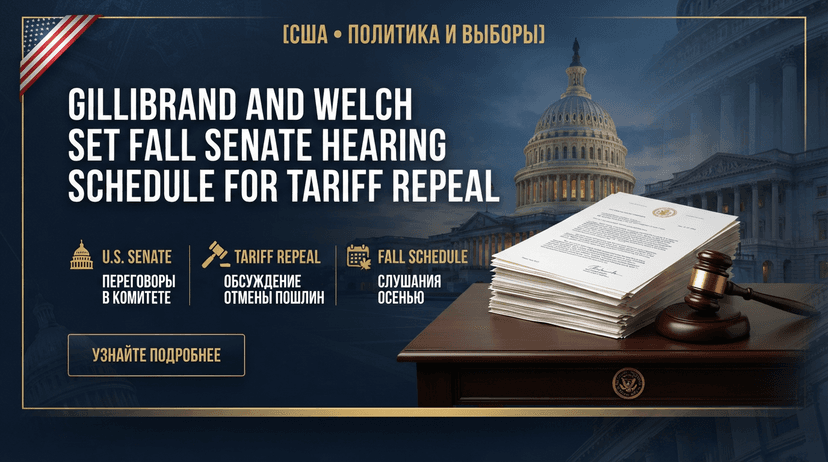
Gillibrand and Welch Set Fall Senate Hearing Schedule For Tariff Repeal Bill
Politics & Elections

Gillibrand and Welch Set Fall Senate Hearing Schedule For Tariff Repeal Bill

Gillibrand and Welch Set Fall Senate Hearing Schedule For Tariff Repeal Bill On August 27, 2026, Senators Kirsten Gillibrand of New York and Peter Welch of Vermont announced the Banning Antiquated Duties and Delivering Equitable American Levies Act, while outlining a tentative senate hearing schedule aimed at repealing tariffs imposed under Section 338 of the Tariff Act of 1930. What did New York and Vermont Senate Democrats propose? New York Senator Kirsten Gillibrand and Vermont Senator Peter Welch proposed the BAD DEAL Act, a bill that would repeal Section 338 of the Tariff Act of 1930, cancel related presidential tariff proclamations, and refund duties already collected from U.S. importers, including newly announced 50% tariffs on Canadian goods. The proposal is formally titled the Banning Antiquated Duties and Delivering Equitable American Levies Act , or BAD DEAL Act. According to the draft bill text published by Senator Welch’s office on August 27, 2026, the measure would: "Repeal Section 338 of the Tariff Act of 1930 (19 U.S.C. 1338)." Void "any Presidential proclamation promulgated in whole or in part pursuant to such section." Require federal agencies to provide refunds of each tariff or duty imposed under Section 338. CPA Practice Advisor reported on August 31, 2026, that the bill is a direct response to new tariffs on Canadian imports, including a 50% duty rate announced by President Donald Trump over the preceding weekend. A press release from Representative Brad Schneider’s office, dated August 29, 2026, describes the BAD DEAL Act as designed to "repeal Section 338 and refund all duties paid under this authority." Why are the senators targeting Section 338 tariffs now? Senators Gillibrand and Welch are targeting Section 338 tariffs because President Trump recently used this long‑dormant law to impose sweeping duties on Canadian imports, including a 50% tariff that Democrats say is hurting American families and businesses and reviving trade tensions with a key U.S. ally. According to WAMC’s report on August 28, 2026, the BAD DEAL Act aims to reverse "Trump administration tariffs on Canada" by repealing tariffs levied under Section 338 and refunding Americans who have been paying the higher prices. CPA Practice Advisor notes that the tariffs apply broadly to Canadian imports and followed a presidential announcement of a 50% tariff rate. Gillibrand’s Senate office framed the move squarely as a consumer issue. In an August 27, 2026 press notice, her office stated that "New York families have spent over $5,000 more due to President Trump’s tariff chaos and other reckless policies," citing the cumulative cost of recent trade measures and inflation pressures. That figure reflects Gillibrand’s internal analysis and is presented as an impact estimate rather than official federal data. The BAD DEAL Act also fits into a wider pattern of congressional resistance to Trump‑era tariff policies. On February 24, 2026, Senator Ron Wyden introduced the Tariff Refund Act of 2026, a separate proposal to refund certain duties after court rulings against earlier tariffs. In October 2025, Senator Welch joined a bipartisan group praising Senate passage of a different measure to repeal Trump’s global tariffs imposed under emergency authorities. These earlier efforts created a legislative backdrop for the targeted repeal of Section 338 in late August 2026. How would the BAD DEAL Act change current tariffs and refund payments? The BAD DEAL Act would repeal the legal authority for Section 338 tariffs, cancel any related presidential proclamations, and order federal agencies to issue refunds to importers for all duties collected under that section, including the recent 50% tariffs on Canadian products. The bill text from Senator Welch’s office lays out the mechanics clearly. Key implementation provisions include: Repeal of Section 338 itself, removing the statutory basis for retaliation‑style tariffs originally crafted in 1930. Termination of any presidential proclamation that invoked Section 338, meaning the tariffs become legally void once the act takes effect. A directive that relevant agencies "take such actions as may be necessary to provide for the refund of each tariff or other duty imposed and collected" under Section 338. Inside U.S. Trade reported on August 28, 2026 that Democrats on both the House Ways and Means Committee and the Senate Finance Committee are backing the measure, viewing refunds as central to the bill’s design. Representative Brad Schneider’s press release underscores that point, saying the BAD DEAL Act would "refund all duties paid under this authority" and thus return money to U.S. businesses that import from Canada. While precise refund totals have not been published, Gillibrand’s office argues that families and firms in New York and other states face higher costs on everyday goods sourced from Canada. By canceling the tariffs and ordering refunds, the sponsors say they aim to ease price pressures and send a message that Congress will not accept unilateral tariff hikes launched under obscure provisions of trade law. What is the planned Senate process and timetable for the tariff repeal bill? The sponsors expect the BAD DEAL Act to enter the Senate Finance Committee when lawmakers return from their August recess, with hearings anticipated in September and potential floor consideration before year‑end, mirroring timelines used for other tariff‑related bills introduced in the 2025‑2026 Congress. CPA Practice Advisor reports that Gillibrand and Welch "signaled their intent to introduce the bill when the Senate returns to session next month," referencing the early‑September reconvening after the summer break. Under standard Senate procedure, tariff legislation is referred to the Finance Committee, which is already handling related measures such as Wyden’s Tariff Refund Act of 2026. The expected steps, based on the sponsors’ statements and usual Senate practice, are: Formal introduction of the BAD DEAL Act in early September 2026, with Gillibrand as the lead Senate sponsor and Welch as co‑sponsor. Referral to the Senate Finance Committee, where staff have experience with tariff repeal and refund proposals. Potential hearings in the fall focusing on Section 338’s history, Trump’s recent tariffs on Canada, and the impact on U.S. businesses. Committee markup followed by a possible floor vote before the end of the 2026 session, depending on broader negotiations over trade and tax legislation. Representative Schneider has already filed the House companion, positioning it in the Ways and Means Committee’s trade subcommittee. That parallel track means House hearings and markups could run close to the Senate’s fall calendar, raising the possibility of a coordinated push to move the repeal through both chambers within months. How does this effort relate to previous congressional actions on Canada tariffs? The BAD DEAL Act builds on earlier federal and state‑level moves opposing Trump’s tariffs on Canada, including a Vermont Senate resolution urging the removal of all Canada‑related tariffs and a 2025 bipartisan Senate vote to roll back other Trump global tariffs. On the state side, the Vermont Legislature adopted S.R.11 in the 2025‑2026 session, a resolution honoring historic ties with Canada and Quebec and calling on Congress to reassert its trade policy role. The text urged President Trump to "remove all tariffs he has imposed on Canada since January 20, 2025," including those outside the United States‑Mexico‑Canada Agreement. That resolution, though symbolic, signaled deep concern in Welch’s home state about the direction of trade relations. At the federal level, Senator Welch has already worked on broader tariff rollbacks. In October 2025, he joined a bipartisan group—including Senators Ron Wyden, Chuck Schumer, Rand Paul, Tim Kaine, Jeanne Shaheen and Elizabeth Warren—in supporting a measure that would repeal Trump’s global tariffs enacted under emergency powers. The resolution passed the Senate on a 51‑47 vote, then moved to the House, setting a precedent for challenging presidential tariff actions. WAMC’s coverage links Gillibrand and Welch’s new proposal directly to those earlier fights over tariffs on Canadian products. Their offices portray the BAD DEAL Act not as a standalone event but as part of a broader effort to restore congressional control over trade and to protect cross‑border economic ties that are central to communities in northern New York and Vermont. Who would be most affected if Section 338 tariffs are repealed? If Congress passes the BAD DEAL Act, importers that pay duties on Canadian goods would see direct financial relief through refunds, while consumers in border states such as New York and Vermont could face lower prices on products sourced from Canadian suppliers. The sectors most exposed to Canada‑focused tariffs include manufacturers and retailers that rely on Canadian inputs, cross‑border wholesalers, and small businesses near the border that import consumer goods. While precise trade volumes tied to Section 338 tariffs have not been released, the sponsors highlight several categories affected by Trump’s latest actions: Household products imported from Canada that now carry a 50% tariff. Industrial inputs and components sourced by manufacturers in New York and New England. Food and agricultural products moving through established cross‑border supply chains. Gillibrand’s office estimated that "New York families have spent over $5,000 more" due to a combination of tariffs and other policies, framing the repeal as part of a strategy to reduce living costs. While that figure aggregates various economic pressures, tariffs on Canada are among the components cited in the senator’s argument for relief. Businesses that paid duties under Section 338 would stand to receive refunds. Inside U.S. Trade notes that Democrats backing the BAD DEAL Act see these refunds as a way to restore competitiveness and cash flow in sectors hit by sudden tariff hikes. Schneider’s press release stresses that the bill is intended to "refund all duties paid", signaling that the sponsors view repayment as a central promise to affected companies. What happens next in Congress and in U.S.-Canada trade relations? The BAD DEAL Act faces negotiations within the Senate Finance and House Ways and Means committees, but it enters the fall session with visible Democratic support and fits broader efforts to ease tensions with Canada, a key trading partner for New York and Vermont. In the near term, the key milestones will be: Formal Senate introduction and committee referral when lawmakers return from recess in early September 2026. Committee work on testimony from business groups, trade experts and possibly Canadian officials or consular representatives. Potential bundling of the BAD DEAL Act with other tariff refund bills such as Wyden’s Tariff Refund Act of 2026, to create a broader package. House hearings under the Ways and Means trade subcommittee on Schneider’s companion bill. If Congress ultimately repeals Section 338 tariffs and orders refunds, the decision would mark a reset of the most recent clash over U.S.-Canada trade triggered by Trump’s 2026 tariff announcement. Vermont’s S.R.11 and past Senate votes against wider Trump tariffs show that concerns about Canada trade are already part of the legislative record. For New York and Vermont, where cross‑border flows of goods and tourism play a visible role in local economies, the outcome of this tariff repeal push will shape prices, business planning and political narratives heading into the 2026 election cycle.

Marcus Feld·
Intel’s AI Surge Sparks Fierce Valuation Clash as Some Models Flag 80%+ Upside
AI & Tech

Intel’s AI Surge Sparks Fierce Valuation Clash as Some Models Flag 80%+ Upside

Intel’s rapid push into artificial intelligence chips and foundry services has ignited a sharp debate over what the stock is really worth, with one widely followed narrative now implying a fair value near $500 per share — more than four times the recent market price. While mainstream analysts still cluster between roughly $90 and $120 per share, user-driven valuation models and some sales-based frameworks argue that the market is deeply underestimating Intel’s long‑term AI earnings power, leaving the stock potentially more than 80% below fair value. Where the 82% Undervaluation Claim Comes From The headline figure that Intel could be about 82% below fair value stems from a narrative used on retail‑focused valuation platforms, which apply aggressive growth and margin assumptions to Intel’s emerging AI businesses. In several recent notes, that framework points to a fair value around $500.93 per share , compared with a share price near the $90–$100 range in late August 2026. On that basis, Intel is framed as roughly 80–82% undervalued, with the gap driven by bullish expectations for x86 server CPUs, AI accelerators and foundry contracts over the next decade. These narratives typically assume: Strong, sustained growth in Intel’s Data Center and AI (DCAI) segment. High adoption of Intel’s advanced manufacturing nodes, such as 18A, by external foundry customers. AI‑linked revenue eventually commanding premium valuation multiples similar to leading GPU and cloud infrastructure providers. Critically, this $500+ fair value is not a consensus Wall Street target but a specific, scenario‑driven model that extrapolates current AI momentum far into the future. Intel’s Latest AI and Earnings Momentum The bullish valuation arguments have gained traction as Intel’s reported numbers show AI demand increasingly driving the business. For the second quarter of 2026, Intel reported revenue of about $16.1 billion, up 25% year over year , and adjusted earnings per share of $0.42, beating analyst expectations. The company’s Data Center and AI Group stood out, delivering approximately 59% year‑over‑year growth , with management noting that AI‑linked businesses grew more than 70% and now account for roughly 70% of total revenue. Intel also guided third‑quarter revenue to a range of $15.8 billion to $16.8 billion and gross margins in the low‑40% band, signaling confidence that AI‑related demand will remain robust despite broader concerns about chip valuations. On the strategic side, Intel highlighted signed foundry and advanced packaging agreements with major technology players, including Google, Nvidia, Tesla and Apple, alongside partnerships tied to its 18A manufacturing node and High NA EUV lithography. Foundry revenue rose by more than 30% year over year, although external customers still represent a small share of the segment, keeping the long‑term foundry thesis partly unproven. Mainstream Fair Value Estimates: 90–120 Dollar Range Traditional analyst research paints a far more moderate picture of Intel’s intrinsic value. Morningstar, which has repeatedly updated its Intel model in response to the AI boom, lifted its fair value estimate multiple times in 2026. Earlier in the year, analysts raised Intel’s fair value to $90 per share from $60, citing a “stunning” rise in server CPU demand and a growing AI infrastructure build‑out. Following stronger results and upgraded expectations, Morningstar later increased its fair value estimate to around $105 per share , and some commentary mentions fair value figures just above $100 as AI‑related assumptions were refined further. Other analyst summaries show valuation targets and fair value estimates clustering between roughly $88 and $115 per share , with some firms setting price targets as high as $200 but many maintaining Neutral or Hold ratings due to execution and capital‑intensity concerns. On several discounted cash‑flow (DCF) models, Intel’s intrinsic value is calculated in the mid‑80s to low‑90s per share range, only slightly above or below the current market price, implying the stock is close to fairly valued on conservative cash‑flow assumptions. Sales‑Based Models Still See Undervaluation Separate from the more conservative DCF work, some valuation frameworks focused on price‑to‑sales (P/S) multiples argue that Intel’s AI‑driven mix and size justify a richer multiple than the market is currently assigning. One such model derives a “fair” P/S ratio of about 15.1x for Intel, compared with an observed multiple closer to 13.1x at the time of analysis, suggesting the stock trades at a discount to what its AI exposure and margin profile would warrant. Another narrative points to a fair P/S ratio nearer 17.9x , versus a contemporaneous multiple around 7.6x. Under that lens, Intel looks significantly undervalued on sales even if cash‑flow‑based intrinsic value appears only modestly above the share price. These sales‑centric approaches underpin much of the “still cheap” messaging, emphasizing Intel’s potential rerating as AI revenue becomes a larger and more stable component of the business. Not All Analysts Buy the Undervaluation Story Despite the enthusiasm around AI, some research houses remain skeptical that current valuations can be justified. Early in 2026, one widely cited report called Intel “overpriced” and warned that the shares were trading more than 30% above a fair value estimate of $32 per share , based on cautious assumptions about profitability and competitive risks. Although that figure has since been raised substantially by the same provider, the earlier stance illustrates how sensitive Intel’s perceived fair value is to underlying assumptions about AI demand durability, manufacturing execution and capital allocation. Even after upgrading their models to reflect the AI boom, some analysts argue that Intel’s stock has already priced in a great deal of optimism and may struggle if AI infrastructure spending normalizes or if rivals capture outsized share of accelerator and server CPU markets. AI Capital Raise Adds Another Layer to the Debate The valuation controversy has been sharpened by Intel’s recent decision to raise a large amount of equity capital to fund its AI ambitions. In mid‑August, the company launched a stock offering initially sized at $15 billion and then expanded it to $20 billion after strong investor demand. The sale briefly pressured the share price but was interpreted by some market watchers as a sign of management’s confidence in the scale of Intel’s AI opportunity and its foundry road map. For bullish valuation frameworks, the capital raise is seen as necessary fuel for growth; for skeptics, it reinforces concerns about dilution and the high cost of competing at the cutting edge of semiconductor manufacturing. A Wide Valuation Range, Driven by AI Assumptions As of late August 2026, Intel’s fair value estimates span a remarkably wide range — from the $80–$120 band common among traditional analysts to user‑driven narratives north of $500 per share. The claim that Intel could be roughly 82% below fair value relies on the most optimistic of these models, which assume sustained AI‑powered growth and premium valuation multiples over many years. For investors, the gap underscores how pivotal AI is to the Intel story: the more confidence markets place in Intel’s ability to convert its early AI momentum into durable, high‑margin earnings streams, the more plausible the higher end of that valuation spectrum becomes.

Nic Reeve·