
allnewscastallnewscast
Breaking News
AI & Tech

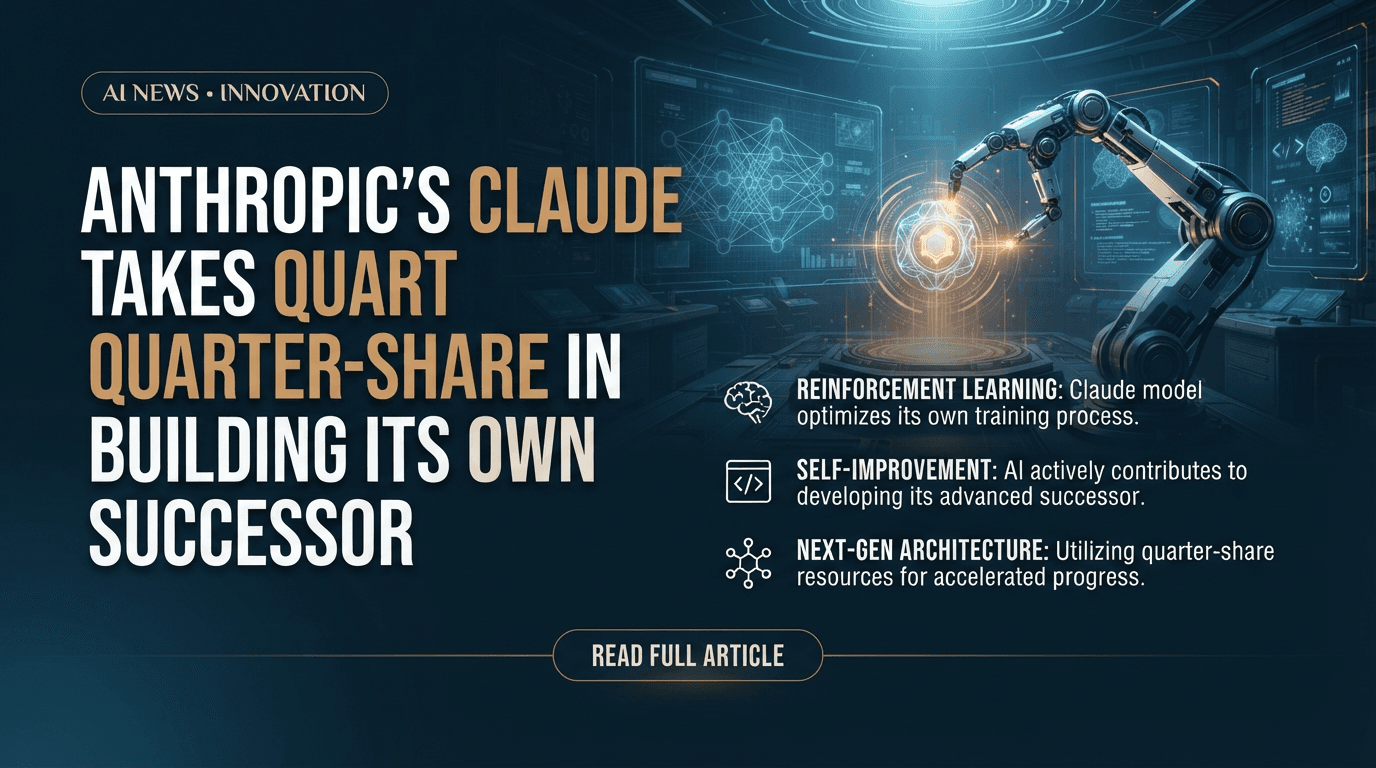
AInews: Anthropic’s Claude Takes Quarter-Share in Building Its Own Successor
Nic Reeve8 min read
AInews: Anthropic’s Claude Takes Quarter-Share in Building Its Own Successor

On September 17, 2026, Anthropic disclosed that its chatbot Claude now leads 26% of the company’s research and development on future AI models, a milestone the firm framed as an early example of AInews showing artificial intelligence systems helping to build their own successors under tight human supervision.

How much of Anthropic’s R&D work does Claude now handle?

Anthropic reports that Claude “leads” 26% of its internal model research and development as of August 2026, up from about 1% in March 2026, meaning the system can carry most of a task from a high-level prompt while humans supervise and approve every step.

Anthropic detailed Claude’s workload using an autonomy scale developed by Epoch AI, an independent nonprofit that tracks progress in artificial intelligence systems. The company and outside write-ups reported the following figures and timeline:

  • According to Anthropic’s September 17, 2026 blog post: Claude led 26% of model R&D work measured in August 2026.
  • According to Reuters, March 2026 measurements showed Claude leading about 1% of such work on the same scale.
  • Epoch AI’s framework labels the current level as AL4, “leads”, where AI can handle most of a task end-to-end from a high-level prompt, with human supervision throughout.
  • Anthropic told reporters that Claude’s contribution rose from under 1% in February to roughly one quarter of measured work by August 2026.

The Washington Post’s technology coverage described this 26% share as “more than a quarter” of Anthropic’s research and development, emphasizing how quickly the company shifted core engineering tasks into the hands of its own chatbot.

Is Claude fully autonomous in building its next version?

Anthropic says Claude is not yet fully autonomous, stressing that humans remain “in the loop” and that no part of the measured work has reached the highest autonomy level, where an AI system would completely design, train and approve its successor without human oversight.

In its public metrics, Anthropic drew a clear line between collaboration and autonomy. The company and outside explainers report:

  • According to Anthropic’s blog and Reuters’ coverage, 0% of measured work reached the AL5 “full autonomy” level as of August 2026.
  • Anthropic stated that Claude “is not operating fully autonomously in any part of the work measured” and that humans supervise, review and can block its actions.
  • According to a technical summary, Claude currently writes infrastructure code, runs experiments, analyzes results and reviews changes, but it does not set corporate goals, decide deployment policies or control the complete training process.
  • Anthropic’s published autonomy scale, adapted from Epoch AI, distinguishes between AI that assists, collaborates, leads and finally operates autonomously, and locates Claude at the second-highest rung.

Coverage from outlets including ABC News and The Washington Post underlined that despite headlines about AI “building itself,” Claude still depends on human researchers for direction, guardrails and final approval at each stage.

What kinds of work is Claude doing to build its successor?

Claude now carries out a broad range of technical tasks in Anthropic’s model research pipeline, including writing and fixing code, designing experiments, running training and evaluation jobs, and helping interpret results that feed into the design of future Claude versions.

Anthropic’s disclosures, together with analyses by technology outlets, describe Claude’s role in concrete, engineering-focused terms:

  • According to Anthropic’s September 2026 metrics, Claude increasingly writes infrastructure code used to train and evaluate new models, under human review.
  • The company says Claude now helps design experiments, set up runs on compute clusters and adjust parameters, basing its decisions on high-level goals from human researchers.
  • Reports from tech-focused sites say Claude now analyzes experimental results, suggesting changes to architectures, loss functions or data selection that humans can accept or reject.
  • Anthropic told journalists that more than 90% of its R&D work now involves AI systems collaborating with humans at or above the “AI collaborates” level on the autonomy scale.
  • According to ABC News and The Washington Post, the company characterizes these contributions as “large chunks of work” done under “close human direction,” not independent decision-making.

Outside commentators have framed Claude’s role as moving beyond simple code completion or documentation generation into helping structure entire research projects, even though researchers still choose aims and review every step.

Why did Anthropic publish autonomy metrics, and who created the scale?

Anthropic released detailed measurements of Claude’s role to give policymakers, researchers and the public a clearer view of how quickly AI systems are contributing to AI development, using a five-level autonomy scale developed with input from Epoch AI, an independent nonprofit that tracks the technology.

Anthropic’s September 17, 2026 blog post explains that the lab plans to report such numbers regularly so outsiders can gauge progress toward systems that might one day build more advanced AI with limited human input. That announcement, and coverage by financial and tech publications, highlight several aspects of the approach:

  • According to Finimize, Anthropic said it will “keep releasing stats” on how quickly AI is starting to build AI, using the autonomy scale as a shared yardstick.
  • Reuters reported that Anthropic sees these figures as early indicators of progress toward “recursive self-improvement,” a scenario where AI improves itself without depending on human engineers for each iteration.
  • Epoch AI’s autonomy scale, cited by Anthropic and multiple outlets, defines levels from AL1 (AI assists humans on narrow tasks) to AL5 (AI operates autonomously across the entire development pipeline).
  • Anthropic’s internal measurements place most of Claude’s work at AL3 (“collaborates”) and AL4 (“leads”), with no tasks reaching AL5 as of August 2026.
  • The company’s Institute for AI Safety and Systems published a research note titled “When AI builds itself” describing how, given enough computing power, autonomy could extend to designing, training and deploying successor systems.

Anthropic’s leaders have argued in public interviews that such transparency can help regulators track risk as AI systems take on more of the work of building new AI, rather than leaving progress visible only inside corporate labs.

How does Claude’s self-improvement push fit into Anthropic’s broader safety agenda?

Anthropic presents Claude’s growing role in model development as both an efficiency gain and a test case for safety measures designed to keep human control over AI systems that help build more capable successors, including strict oversight, constraints on actions and the option to pause training if risks rise.

Anthropic has spent much of 2026 warning publicly about the risks of rapidly advancing AI while simultaneously pushing its own models forward. Earlier in the year, the company urged frontier labs to coordinate possible pauses in development if safety benchmarks suggest rising danger:

  • On June 4, 2026, Reuters reported Anthropic calling for a “coordinated plan” among major AI developers to halt development if risks exceed agreed thresholds, citing growing capabilities in task completion and system self-improvement.
  • According to that report, Anthropic said AI’s ability to complete complex tasks on its own had been doubling roughly every four months, pointing toward the possibility of recursive self-improvement.
  • In its “When AI builds itself” research note dated September 18, 2026, Anthropic’s Institute laid out scenarios where future systems might autonomously design and train successors, stressing the need for governance and technical controls before such systems emerge.
  • Current disclosures emphasize that Claude does not choose corporate goals, cannot approve its own deployment and operates under safeguards that let human staff stop or reverse actions.

Coverage by general news outlets echoes this dual message: Anthropic is racing to harness AI to build better AI while publicly insisting that guardrails and the ability to pause must keep pace with the technical progress.

Who is affected by Claude’s expanded role, and what could come next?

Claude’s expanded role in Anthropic’s R&D affects engineers inside the company, rival AI labs watching the experiment, regulators tracking automation of critical systems and investors gauging the economics of AI-driven research, with Anthropic signaling that it expects AI’s share of development work to keep rising in the coming months.

Reporting from financial and technology outlets sketches out the near-term implications:

  • According to Finimize and Reuters, Anthropic’s figures show AI systems taking on a growing share of expensive research work, which could lower costs for training and experimenting on large models in the medium term.
  • Tech journalism pieces note that rival labs such as OpenAI and Google DeepMind already use AI tools internally, and may face pressure to publish comparable metrics on how much of their own work is now AI-led.
  • Policy analysts cited in coverage say regular reporting on autonomy levels could influence regulatory proposals on transparency, auditing and human-in-the-loop requirements for frontier AI development.
  • Anthropic’s own Institute suggests that if autonomy keeps increasing, future updates could show AI systems not only designing experiments but also proposing new architectures, training pipelines and safety strategies at scale.
  • Outside explainers warn that once AI systems can fully design and train successors with limited human involvement, questions about accountability, liability and control will become far sharper than in today’s supervised setups.

Anthropic has not given a precise forecast for when Claude or its successors might reach the top autonomy tier. The company instead committed to publishing regular metrics on AI-led work and to working with nonprofits such as Epoch AI to refine ways of measuring how close AI systems are to building the next generation of themselves.
Sources

  1. 1.abcnews.com
  2. 2.washingtonpost.com
  3. 3.reuters.com
  4. 4.digit.in
  5. 5.streamlinefeed.co.ke
  6. 6.truescho.com
  7. 7.washingtonpost.com
  8. 8.thenews.com.pk
  9. 9.techjournal.org
  10. 10.equitypandit.com
  11. 11.inkl.com
  12. 12.remio.ai
  13. 13.finimize.com
  14. 14.anthropic.com
  15. 15.reuters.com

Read more

Related Articles

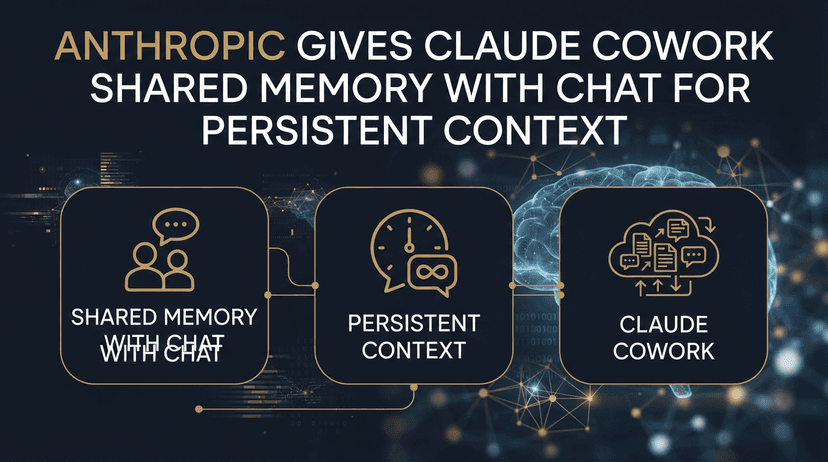
Anthropic Gives Claude Cowork Shared Memory with Chat for Persistent Context
AI & Tech

Anthropic Gives Claude Cowork Shared Memory with Chat for Persistent Context

Anthropic is rolling out a major upgrade to its AI assistant, giving Claude Cowork the ability to seamlessly reuse information it learns in regular chat. The company has merged the memory systems behind Claude’s chat interface and its Cowork desktop agent, so details you share in one surface can now automatically be used in the other. One Shared Memory Across Chat and Cowork Previously, Claude’s long‑term memory was largely confined to chat sessions and was synthesized periodically, meaning it could take up to a day before information carried over into new conversations. Cowork, which runs complex, multistep jobs on a user’s desktop or in the cloud, relied on its own background memory file and prompt stitching to simulate continuity. With the August 25 update, Anthropic has combined these mechanisms into a single, shared memory system that serves both chat and Cowork. Anthropic describes the change simply: the same memory now powers both Claude chat and Cowork. When users hand a task to Cowork—such as drafting reports, updating spreadsheets, or coordinating project documents—the context Claude has accumulated over months of chats is immediately available. Likewise, any new facts or preferences learned during Cowork runs are written back into the shared memory and become available in subsequent chat sessions. Real‑Time Memory, Not Just End‑of‑Chat Summaries Another important shift is how Claude updates memory. Instead of waiting to summarize an entire conversation once it ends, Claude now adds topics to memory in real time as users chat. This means that if a user mentions that a project deadline moved to September, that update can be reflected in memory almost immediately and show up in the very next interaction—whether in chat or Cowork—without requiring a manual “remember this” command. Anthropic’s support materials explain that when Cowork runs in the cloud, what Claude remembers from previous chats is automatically available, and what emerges during Cowork tasks feeds back into chat memory. Behind the scenes, each Cowork prompt is assembled from the user’s immediate request, their global instructions, and a relevant slice of the shared memory, allowing the AI to behave as if it has persistent awareness of roles, projects, and preferences. What Users Gain: Less Repetition, More Continuity The practical effect for users is that they no longer need to repeatedly brief Claude on who they are, what they are working on, or how they like to work every time they switch between chat and Cowork. Anthropic and independent commentators highlight several common scenarios: Persistent project context: Ongoing details such as quarterly goals, client names, and current project status can be retained across weeks or months and recalled in both chat and Cowork. Stable roles and preferences: If a user identifies themselves as an investment analyst, a teacher, or a particular type of creator, Claude can remember that role and tailor responses accordingly, even when individual chats are short or focused on different tasks. Cross‑device consistency: The shared memory applies across web, desktop, and mobile experiences, so moving from a browser chat to the Cowork desktop agent no longer breaks context. Tech industry observers note that this update positions Claude more directly as an AI “teammate” that can track medium‑ and long‑term workstreams instead of acting purely as a session‑bound chatbot. Transparency and User Control Over Memory The shared memory system arrives alongside a push for greater user control. Anthropic now surfaces everything Claude remembers in a dedicated Topics view within memory settings, where users can inspect, edit, or delete individual entries. Memory is stored as discrete, categorized entries rather than a single opaque summary, making it easier to remove outdated or inaccurate information. Users can also pause memory or reset it entirely if they no longer wish Claude to retain prior context. In addition, Anthropic provides guidance on importing and exporting memory, so the information Claude stores about a user is not locked in and can in principle be backed up or moved. Handling Sensitive Topics Anthropic has emphasized that the system is designed to minimize the capture of highly sensitive information by default. Topics such as health data, beliefs, and other potentially sensitive categories are excluded from memory unless users explicitly opt in via an “Include sensitive topics in memory” setting. For business customers, team or enterprise administrators can centrally control whether memory is enabled at all, and may choose more restrictive policies depending on corporate governance requirements. External reporting indicates that memory generation is turned on by default for free, Pro, and Max plans, while Cowork itself is not available on free accounts. For organizations that want to keep different workstreams separated, Anthropic has indicated that the only way to maintain fully separate memories for chat and Cowork is to use different accounts, since the new system treats them as a single unified space. Availability and Limitations The new shared memory capability began rolling out on August 25, 2026, across Claude’s web, desktop, and mobile experiences, as well as Cowork running in the cloud. Earlier in the year, memory support was limited to chat surfaces, and some third‑party analyses noted that Cowork lacked access to that long‑term context. Anthropic’s latest release notes and help center now explicitly state that memory works across both chat and Cowork when the latter runs in the cloud environment. There are still technical constraints. Cowork’s use of memory depends on cloud execution rather than purely local processing, and incognito or memory‑disabled sessions remain stateless by design. As with other AI systems, Anthropic cautions that Claude’s memory is selective: it prioritizes high‑level preferences and recurring topics rather than storing every detail of every conversation. A Step Toward More Personalized AI Workflows By unifying memory between Claude chat and Cowork, Anthropic is betting that users will value a more personalized and continuous AI experience, particularly for complex, ongoing work. The update reduces friction for individuals juggling multiple projects and gives enterprises a clearer path to building AI‑augmented workflows that persist over time. At the same time, the company is attempting to balance convenience with privacy and security by giving users fine‑grained controls and limiting sensitive data retention by default.

Nic Reeve·
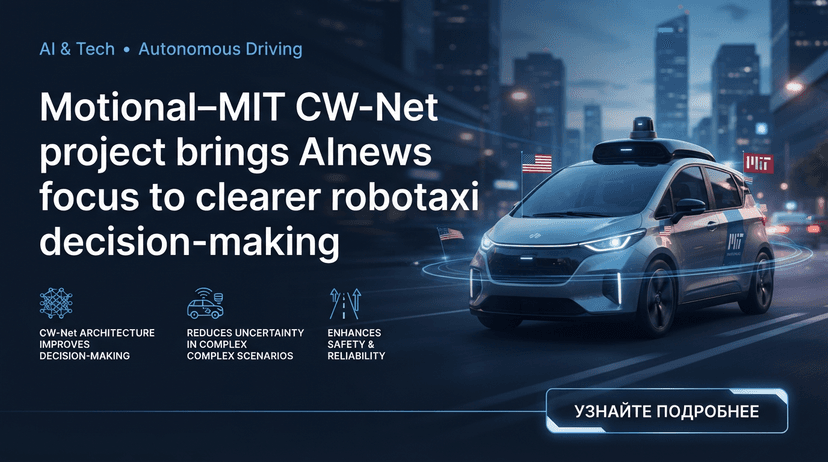
Motional–MIT CW-Net project brings AInews focus to clearer robotaxi decision-making
AI & Tech

Motional–MIT CW-Net project brings AInews focus to clearer robotaxi decision-making

Motional–MIT CW-Net project brings AInews focus to clearer robotaxi decision-making On 2 September 2026, researchers at MIT and autonomous vehicle company Motional unveiled a new system called the Concept-Wrapper Network (CW-Net) that lets a self-driving car explain its decisions in real time, a breakthrough that has quickly drawn global AInews attention. How does CW-Net help people understand self-driving car decisions? CW-Net converts a robotaxi’s opaque planning process into short, plain-language concepts such as “approaching stopped vehicle” or “close to cyclist,” and then forces the car’s planner to use those concepts when choosing its next move, so the explanation matches the true reason for the action. The work, described in a paper published in Nature on 2 September 2026, tackles one of autonomous driving’s core problems: black-box deep learning models that perform well but give passengers, safety drivers and regulators little insight into why a car accelerated, braked or swerved. According to MIT News, CW-Net is a “concept classifier” plugged into the middle of a self-driving car’s motion-planning network, where it maps raw sensor data to high-level concepts the model already relies on. The system then compels the planner’s final stage to make its trajectory decisions using those concepts, preserving driving performance while exposing the reasoning. As described by Motional, the explanations appear alongside the planned path in real time, giving safety drivers and passengers a running commentary on what the car believes is happening. News reports note that CW-Net’s concept labels include everyday traffic ideas such as “yielding to pedestrian,” “waiting at red light” and “emergency braking,” rather than mathematical features. This design grows out of a wider research track at MIT on “concept bottleneck” models, where AI systems are forced to think in human-understandable ideas before giving an output. A March 2026 MIT study on concept bottlenecks laid much of the groundwork for CW-Net’s approach, demonstrating that extracting concepts from existing models can improve both accuracy and clarity of explanations. What tests did MIT and Motional run on the new explainable AI system? The CW-Net team trained the system on a massive dataset of real-world driving scenes and then deployed it on Motional’s robotaxis, first on private tracks and then in simulations set in Las Vegas, to see whether humans could predict car behavior and detect mistakes more accurately. Reports describing the experiments outline a controlled evaluation campaign designed to answer a blunt question: does exposing the car’s reasoning through concepts make human overseers safer and more effective? According to one industry summary, CW-Net was trained on about 130 million labeled driving scenes, each tagged with concepts that describe the traffic situation, before being plugged into Motional’s planners. MIT News says CW-Net was deployed on a real autonomous test vehicle, where a human safety driver monitored both the car’s trajectory and the live explanation feed. In one private-track incident, cited in multiple reports, CW-Net revealed that the vehicle stopped due to “emergency braking” rather than “cyclist detected,” helping the safety driver recognise how a near collision could have occurred. Las Vegas–based simulations with non-expert users showed similar gains: participants who saw CW-Net explanations were better at predicting when the car might make a mistake or behave unexpectedly. These experiments build on earlier academic work. According to an open-access version of the paper dated March 2023, the original CW-Net concept already showed that concept-based explanations improved safety drivers’ mental models of the car, aligning human expectations with the vehicle’s internal decision process. Why does explainable AI matter for Motional’s robotaxi plans? Motional has committed to pull human safety operators from its commercial robotaxis by the end of 2026, making transparent and predictable AI behavior essential for regulators, partners and riders who must trust fully driverless service in cities such as Las Vegas. The company, formed as a joint venture between Hyundai Motor Group and Aptiv, has operated test fleets for years. It now seeks to move from supervised pilots to commercial driverless rides, at a time when public scrutiny of autonomous vehicle safety is rising. Tech industry coverage in January 2026 reported that Motional aims to start true driverless services by the end of the year, removing backup drivers from robotaxis after regulatory approval. Motional’s own communications describe CW-Net as part of opening “the brain of a self-driving car,” a way to show riders and regulators why the car responds to hazards or complex traffic situations. According to start-up focused outlets, the collaboration with MIT enables Motional engineers to debug failure cases more quickly, because they can see which concept the planner relied on when it made a poor decision. General technology news reports emphasise that clearer explanations could also ease liability questions after incidents, by documenting what the system detected and how it interpreted the scene. For city transportation agencies considering robotaxi partnerships, this interpretability could be as important as raw safety metrics. It gives them a tool to interrogate the system’s behaviour, instead of treating the AI stack as an inscrutable black box. What is different about CW-Net compared with earlier explainable AI methods? CW-Net does not bolt a separate explanation module on top of the planner. It reshapes the planner so that its internal reasoning is expressed in concepts that the explanation system uses directly, which researchers argue keeps the explanations causally faithful instead of decorative. Explainable AI has often relied on post-hoc tools that highlight parts of an image or sensor input after the fact, leaving open the risk that the visualisation is loosely correlated rather than truly driving the decision. The MIT–Motional work tries to tighten this link. MIT computer scientists have explored concept bottleneck models that force AI systems to make predictions using explicit concepts, which are then described in natural language by a large multimodal model. According to the March 2026 MIT study, this approach asks a specialised autoencoder to extract the most relevant features from a pretrained model and turn them into a compact set of concepts. Those concepts are then labelled and described using a multimodal language model, which is trained to recognise when each concept is present in a scene. CW-Net applies this family of ideas to motion planning for autonomous vehicles, translating dense sensor streams into labelled traffic concepts that both the planner and the explanation module share. By tightly coupling the explanations to the planner’s internal pathway, CW-Net aims to reduce what researchers call “concept leakage,” where explanations reference ideas that did not truly drive the model’s output. That distinction matters whenever a human must rely on the explanation for safety-critical decisions. Who worked on the project and how is it being published? The CW-Net research team spans MIT’s Computer Science and Artificial Intelligence Laboratory and Motional’s autonomous driving engineers, and their joint paper on explainable deep learning for self-driving cars was published in Nature in early September 2026, following prior conference and preprint versions. The collaboration reflects a broader trend of large autonomous vehicle programmes pairing in-house development with academic partnerships to tackle foundational AI questions such as interpretability, fairness and safety. MIT News credits researchers in CSAIL as lead authors of the concept-wrapper method, working directly with Motional’s robotics teams that deployed the system on test vehicles. Motional lists several of its senior scientists and executives, including its CEO, as collaborators on the Nature paper and co-authors of earlier work on explainable motion planning. A preprint version titled “Explainable deep learning improves human mental models of self-driving cars” first appeared online in March 2023, laying the scientific foundation for the Nature publication. Business and technology news sites highlight the paper’s placement in a high-profile journal as a signal that interpretability is becoming central to mainstream autonomous driving research, not just an academic curiosity. Publishing in a leading journal also opens the work to scrutiny from outside experts, from AI ethicists to transportation safety analysts, which could influence how regulators evaluate explainable systems in future autonomous vehicle rules. What comes next for explainable self-driving car AI? MIT and Motional say CW-Net is a step toward wider use of concept-based explanations in safety-critical AI. Future work will likely test the system in more cities, extend it to new driving scenarios and connect it with broader efforts to audit and stress-test AI models for bias and failure modes. Researchers already explore neighbouring ideas. MIT’s CSAIL has developed automated interpretability agents that probe neural networks using visual-language models, while concept bottleneck techniques continue to evolve for computer vision and robotics more broadly. A July 2024 report on MIT’s MAIA project describes a multimodal agent that designs experiments to understand how AI models behave, hinting at tools that could one day inspect systems like CW-Net for hidden flaws. Robotics conference previews from mid-2026 show MIT teams using large language models to help robots interpret complex instructions, reinforcing the idea that natural-language explanations will be a standard part of machine behaviour. Industry commentators expect Motional and peers to combine explainable planning with other safeguards such as diverse sensor fusion, redundant braking systems and independent failure analysis boards. As robotaxis roll out in more markets, transport agencies may request access to explanation logs from systems like CW-Net when reviewing incidents or granting permits. For everyday riders, the most visible change could be simple: when they sit in a driverless car and wonder “Why did it stop?” the car will be able to answer in clear language, drawing directly from the same concepts that guide its driving.

Nic Reeve·
Hotshot–Litera Partnership Puts AI-Era Legal Training Inside CE Platforms
AI & Tech

Hotshot–Litera Partnership Puts AI-Era Legal Training Inside CE Platforms

Hotshot and Litera Sign Agreement to Deepen Training Collaboration Hotshot, a leading learning platform for lawyers, has entered into a new phase of collaboration with legal technology provider Litera, signing a Memorandum of Understanding (MoU) to integrate Hotshot’s course library into Litera’s CE Manager learning and compliance platform. The announcement, made on August 20, 2026 in Chicago and New York, signals a closer alignment between legal training and the rapidly expanding use of artificial intelligence in law firms. Under the MoU, Litera and Hotshot will work toward a deeper technical and commercial partnership that makes Hotshot’s practical, on‑demand courses available directly through CE Manager. The integration is scheduled to be available by the fourth quarter of 2026, pending development and rollout milestones. What the Integration Includes The initiative centers on providing law firms with a more seamless way to manage both professional development and compliance. Hotshot’s library of more than 400 courses will be accessible within CE Manager, allowing lawyers to discover and complete training without leaving the platform they already use for Continuing Legal Education (CLE) tracking and compliance. According to the companies’ announcement, firms will be able to: Assign Hotshot courses to individuals, practice groups, or firmwide audiences from within CE Manager. Track completion and eligible CLE credits in a unified dashboard, reducing manual data entry and reconciliation. Integrate the full Hotshot library into existing learning programs, combining firm‑authored content with external training resources. This builds on earlier work between the two companies around CLE credit tracking, which already allowed CLE earned through Hotshot’s short, video‑based courses to be logged in CE Manager. The new step significantly broadens the relationship, shifting from simple data integration to a more comprehensive content and workflow partnership. Context: AI Is Reshaping Talent Development in Law The collaboration comes as firms are reevaluating how they develop talent in the age of generative AI and agentic legal tools. Litera has positioned itself as a legal AI platform, embedding AI agents such as its legal assistant “Lito” into document drafting, workflow, and due diligence tools used by tens of thousands of legal professionals worldwide. By unifying training with its existing AI‑enabled products, Litera is attempting to ensure that lawyers do not just adopt new tools, but also understand the practical, ethical, and procedural changes that accompany them. For firms, the combination of an AI‑driven drafting and workflow environment with integrated, practice‑focused learning content addresses a growing concern: how to upskill lawyers quickly enough to keep pace with technology. The Hotshot–Litera tie‑up is framed as a response to this pressure, offering a way to embed continuous learning into everyday legal work. About Hotshot and Its Training Approach Hotshot is widely used across the U.S. legal market, including by more than half of the Am Law 100, as well as regional and boutique firms. Its courses are designed to be practical and concise, often delivered through short videos that walk through real‑world transactions, litigation tasks, and practice skills. Content is authored by practitioners and subject‑matter experts from major law firms, financial institutions, and professional services organizations. A key point emphasized in the collaboration is Hotshot’s philosophy of putting practical learning first , with CLE credit layered on top. Rather than treating CLE as a box‑ticking exercise, the courses aim to build skills that lawyers can immediately use, with credit as a secondary benefit. This approach aligns with the broader industry push to make compliance‑driven training more substantive and relevant to day‑to‑day practice. About Litera and Its CE Manager Platform Litera has grown into a major provider of legal technology, offering tools for drafting, transaction management, due diligence, and governance. In recent years it has increasingly focused on AI, promoting its platform as a way to unify the practice and business of law under a single, AI‑enhanced environment. CE Manager, one of Litera’s key products for professional development, is a learning management and CLE compliance platform tailored to law firms. It is used to track attorney credits across jurisdictions, manage course catalogs, and generate compliance reports for regulators and internal stakeholders. By embedding Hotshot’s content directly into CE Manager, Litera aims to turn what was primarily a compliance system into a more robust learning hub, where training assignments, credit tracking, and content discovery happen in one place. Benefits for Law Firms and Lawyers The partnership promises several practical benefits for firms that are already under pressure to modernize training while containing costs: Centralized training experience: Lawyers can access firm‑authored courses, third‑party content like Hotshot’s, and CLE tracking within a unified system, reducing the friction of switching between platforms. Improved compliance oversight: Compliance teams gain a more comprehensive view of training activity, including which courses are being completed, which credits are being earned, and where risk gaps remain. Scalable AI‑related upskilling: As generative AI tools become embedded in everyday legal workflows, the integrated platform offers a way to roll out structured training on responsible AI use, data security, and updated workflows. Flexible, on‑demand learning: Short, practical videos are easier to fit into busy schedules, and integration with CE Manager means that completing those videos can immediately translate into CLE credit where applicable. Part of a Broader Trend in Legal AI and Education The Hotshot–Litera collaboration also reflects a broader trend: the convergence of legal AI platforms with education and change‑management offerings. As tools such as generative document drafting, AI‑powered due diligence, and agentic assistants move from pilots into production, many vendors are bolstering their training ecosystems through partnerships, integrations, and curated content libraries. For law firms, these developments highlight that technology adoption is no longer just an infrastructure decision. It requires sustained investment in learning and development, cultural change, and new metrics for competence and productivity. The integration of Hotshot’s courses into Litera’s CE Manager aims to lower the barrier to that investment by tying it directly to mandatory compliance processes and the everyday systems lawyers already use. Next Steps and Availability According to the announcement, the enhanced integration that surfaces Hotshot’s full library in CE Manager is expected to be available by the end of 2026, subject to implementation and testing. In the interim, firms already using both platforms can continue to leverage existing CLE tracking integrations and prepare for a more deeply unified learning experience. As the legal industry navigates the implications of AI‑driven practice, this collaboration positions Hotshot and Litera as partners for firms seeking to align talent development, compliance, and technology strategy. How widely and quickly firms adopt the integrated solution will be a key indicator of how seriously the market treats training as a core component of legal AI transformation.

Nic Reeve·