allnewscastallnewscast
Breaking News
AI & Tech

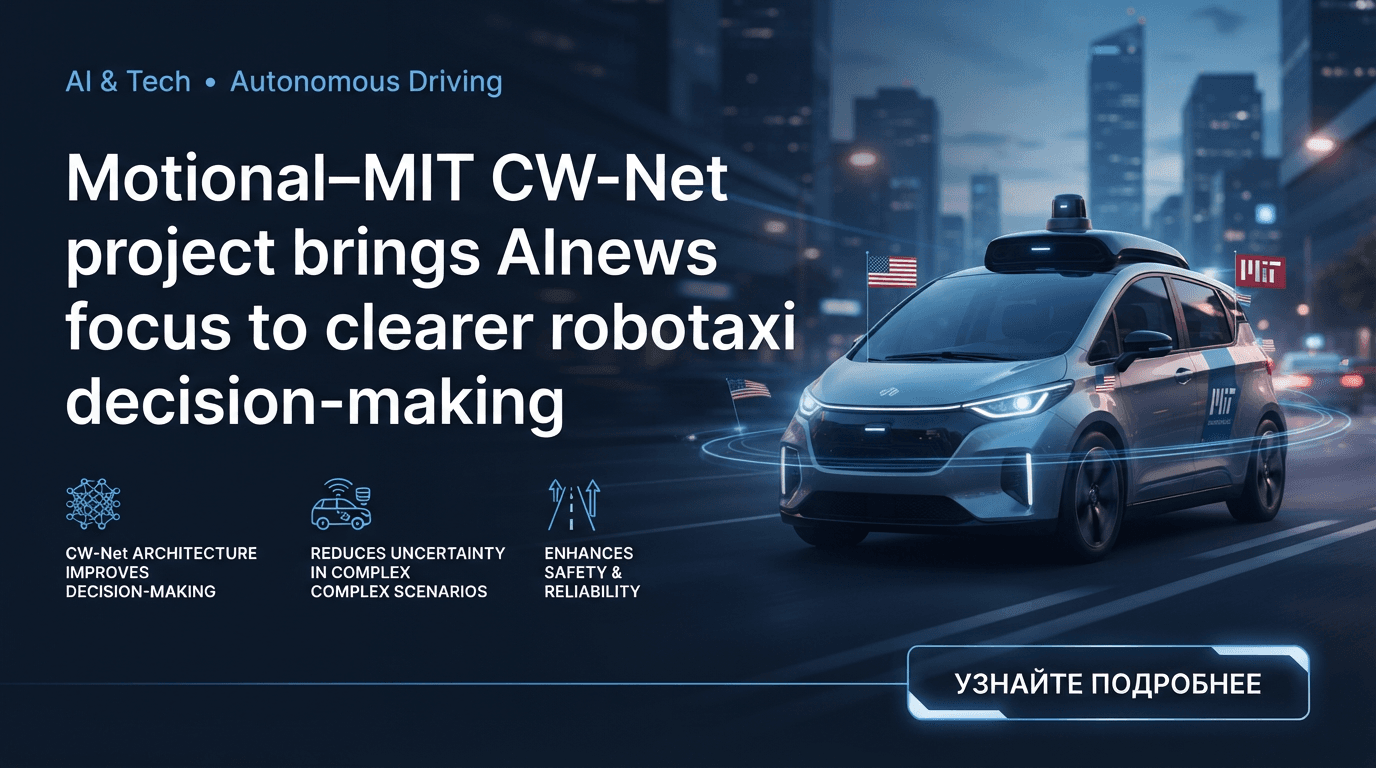
Motional–MIT CW-Net project brings AInews focus to clearer robotaxi decision-making
Nic Reeve8 min read
Motional–MIT CW-Net project brings AInews focus to clearer robotaxi decision-making

On 2 September 2026, researchers at MIT and autonomous vehicle company Motional unveiled a new system called the Concept-Wrapper Network (CW-Net) that lets a self-driving car explain its decisions in real time, a breakthrough that has quickly drawn global AInews attention.

How does CW-Net help people understand self-driving car decisions?

CW-Net converts a robotaxi’s opaque planning process into short, plain-language concepts such as “approaching stopped vehicle” or “close to cyclist,” and then forces the car’s planner to use those concepts when choosing its next move, so the explanation matches the true reason for the action.

The work, described in a paper published in Nature on 2 September 2026, tackles one of autonomous driving’s core problems: black-box deep learning models that perform well but give passengers, safety drivers and regulators little insight into why a car accelerated, braked or swerved.

  • According to MIT News, CW-Net is a “concept classifier” plugged into the middle of a self-driving car’s motion-planning network, where it maps raw sensor data to high-level concepts the model already relies on.
  • The system then compels the planner’s final stage to make its trajectory decisions using those concepts, preserving driving performance while exposing the reasoning.
  • As described by Motional, the explanations appear alongside the planned path in real time, giving safety drivers and passengers a running commentary on what the car believes is happening.
  • News reports note that CW-Net’s concept labels include everyday traffic ideas such as “yielding to pedestrian,” “waiting at red light” and “emergency braking,” rather than mathematical features.

This design grows out of a wider research track at MIT on “concept bottleneck” models, where AI systems are forced to think in human-understandable ideas before giving an output. A March 2026 MIT study on concept bottlenecks laid much of the groundwork for CW-Net’s approach, demonstrating that extracting concepts from existing models can improve both accuracy and clarity of explanations.

What tests did MIT and Motional run on the new explainable AI system?

The CW-Net team trained the system on a massive dataset of real-world driving scenes and then deployed it on Motional’s robotaxis, first on private tracks and then in simulations set in Las Vegas, to see whether humans could predict car behavior and detect mistakes more accurately.

Reports describing the experiments outline a controlled evaluation campaign designed to answer a blunt question: does exposing the car’s reasoning through concepts make human overseers safer and more effective?

  • According to one industry summary, CW-Net was trained on about 130 million labeled driving scenes, each tagged with concepts that describe the traffic situation, before being plugged into Motional’s planners.
  • MIT News says CW-Net was deployed on a real autonomous test vehicle, where a human safety driver monitored both the car’s trajectory and the live explanation feed.
  • In one private-track incident, cited in multiple reports, CW-Net revealed that the vehicle stopped due to “emergency braking” rather than “cyclist detected,” helping the safety driver recognise how a near collision could have occurred.
  • Las Vegas–based simulations with non-expert users showed similar gains: participants who saw CW-Net explanations were better at predicting when the car might make a mistake or behave unexpectedly.

These experiments build on earlier academic work. According to an open-access version of the paper dated March 2023, the original CW-Net concept already showed that concept-based explanations improved safety drivers’ mental models of the car, aligning human expectations with the vehicle’s internal decision process.

Why does explainable AI matter for Motional’s robotaxi plans?

Motional has committed to pull human safety operators from its commercial robotaxis by the end of 2026, making transparent and predictable AI behavior essential for regulators, partners and riders who must trust fully driverless service in cities such as Las Vegas.

The company, formed as a joint venture between Hyundai Motor Group and Aptiv, has operated test fleets for years. It now seeks to move from supervised pilots to commercial driverless rides, at a time when public scrutiny of autonomous vehicle safety is rising.

  • Tech industry coverage in January 2026 reported that Motional aims to start true driverless services by the end of the year, removing backup drivers from robotaxis after regulatory approval.
  • Motional’s own communications describe CW-Net as part of opening “the brain of a self-driving car,” a way to show riders and regulators why the car responds to hazards or complex traffic situations.
  • According to start-up focused outlets, the collaboration with MIT enables Motional engineers to debug failure cases more quickly, because they can see which concept the planner relied on when it made a poor decision.
  • General technology news reports emphasise that clearer explanations could also ease liability questions after incidents, by documenting what the system detected and how it interpreted the scene.

For city transportation agencies considering robotaxi partnerships, this interpretability could be as important as raw safety metrics. It gives them a tool to interrogate the system’s behaviour, instead of treating the AI stack as an inscrutable black box.

What is different about CW-Net compared with earlier explainable AI methods?

CW-Net does not bolt a separate explanation module on top of the planner. It reshapes the planner so that its internal reasoning is expressed in concepts that the explanation system uses directly, which researchers argue keeps the explanations causally faithful instead of decorative.

Explainable AI has often relied on post-hoc tools that highlight parts of an image or sensor input after the fact, leaving open the risk that the visualisation is loosely correlated rather than truly driving the decision. The MIT–Motional work tries to tighten this link.

  • MIT computer scientists have explored concept bottleneck models that force AI systems to make predictions using explicit concepts, which are then described in natural language by a large multimodal model.
  • According to the March 2026 MIT study, this approach asks a specialised autoencoder to extract the most relevant features from a pretrained model and turn them into a compact set of concepts.
  • Those concepts are then labelled and described using a multimodal language model, which is trained to recognise when each concept is present in a scene.
  • CW-Net applies this family of ideas to motion planning for autonomous vehicles, translating dense sensor streams into labelled traffic concepts that both the planner and the explanation module share.

By tightly coupling the explanations to the planner’s internal pathway, CW-Net aims to reduce what researchers call “concept leakage,” where explanations reference ideas that did not truly drive the model’s output. That distinction matters whenever a human must rely on the explanation for safety-critical decisions.

Who worked on the project and how is it being published?

The CW-Net research team spans MIT’s Computer Science and Artificial Intelligence Laboratory and Motional’s autonomous driving engineers, and their joint paper on explainable deep learning for self-driving cars was published in Nature in early September 2026, following prior conference and preprint versions.

The collaboration reflects a broader trend of large autonomous vehicle programmes pairing in-house development with academic partnerships to tackle foundational AI questions such as interpretability, fairness and safety.

  • MIT News credits researchers in CSAIL as lead authors of the concept-wrapper method, working directly with Motional’s robotics teams that deployed the system on test vehicles.
  • Motional lists several of its senior scientists and executives, including its CEO, as collaborators on the Nature paper and co-authors of earlier work on explainable motion planning.
  • A preprint version titled “Explainable deep learning improves human mental models of self-driving cars” first appeared online in March 2023, laying the scientific foundation for the Nature publication.
  • Business and technology news sites highlight the paper’s placement in a high-profile journal as a signal that interpretability is becoming central to mainstream autonomous driving research, not just an academic curiosity.

Publishing in a leading journal also opens the work to scrutiny from outside experts, from AI ethicists to transportation safety analysts, which could influence how regulators evaluate explainable systems in future autonomous vehicle rules.

What comes next for explainable self-driving car AI?

MIT and Motional say CW-Net is a step toward wider use of concept-based explanations in safety-critical AI. Future work will likely test the system in more cities, extend it to new driving scenarios and connect it with broader efforts to audit and stress-test AI models for bias and failure modes.

Researchers already explore neighbouring ideas. MIT’s CSAIL has developed automated interpretability agents that probe neural networks using visual-language models, while concept bottleneck techniques continue to evolve for computer vision and robotics more broadly.

  • A July 2024 report on MIT’s MAIA project describes a multimodal agent that designs experiments to understand how AI models behave, hinting at tools that could one day inspect systems like CW-Net for hidden flaws.
  • Robotics conference previews from mid-2026 show MIT teams using large language models to help robots interpret complex instructions, reinforcing the idea that natural-language explanations will be a standard part of machine behaviour.
  • Industry commentators expect Motional and peers to combine explainable planning with other safeguards such as diverse sensor fusion, redundant braking systems and independent failure analysis boards.
  • As robotaxis roll out in more markets, transport agencies may request access to explanation logs from systems like CW-Net when reviewing incidents or granting permits.

For everyday riders, the most visible change could be simple: when they sit in a driverless car and wonder “Why did it stop?” the car will be able to answer in clear language, drawing directly from the same concepts that guide its driving.

Sources

  1. 1.news.mit.edu
  2. 2.zetik.com
  3. 3.motional.com
  4. 4.timesofindia.indiatimes.com
  5. 5.artificialintelligence-news.com
  6. 6.winzheng.com
  7. 7.ar5iv.labs.arxiv.org
  8. 8.techcrunch.com
  9. 9.motional.com
  10. 10.tech.ifeng.com
  11. 11.thecompanywire.com
  12. 12.newsbytesapp.com
  13. 13.sciencedirect.com
  14. 14.news.mit.edu
  15. 15.sciencesprings.wordpress.com

Read more

Related Articles

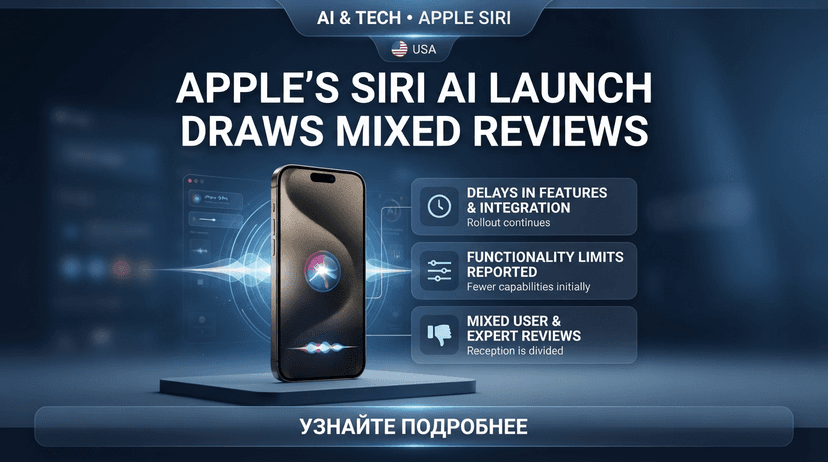
AInews: Apple’s Siri AI Launch Draws Mixed Reviews Over Delays and Limits
AI & Tech

AInews: Apple’s Siri AI Launch Draws Mixed Reviews Over Delays and Limits

On June 8, 2026, Apple used its Worldwide Developers Conference to unveil Siri AI and a broader Apple Intelligence strategy, but in the weeks since that showcase the AInews moment has drawn mixed reactions as developers and users worry about delayed releases, regional exclusions and whether the upgraded assistant will be reliable enough in daily use. What exactly did Apple promise for Siri AI and Apple Intelligence? Apple promised a rebuilt Siri, branded Siri AI, deeply integrated across iPhone, iPad, Mac, Apple Watch and Vision Pro, powered by Apple Intelligence and a custom version of Google’s Gemini model, with beta access in 2026 and broader consumer rollout tied to iOS 27 and other software releases in the fall. Apple’s June 8 WWDC 2026 keynote set out an ambitious vision for the assistant. According to Apple’s newsroom summary from June 8, 2026, Siri AI is “an entirely new version of Siri” built into all major platforms, including iOS 27, iPadOS 27, macOS 27, watchOS 27 and visionOS 27. TechCrunch reported that the new assistant runs on Google Gemini, making Siri more conversational and capable of visual understanding, with a standalone Siri app in addition to system-wide integration. The Next Web described Siri AI as Apple’s “AI do-over,” rebuilt on a custom Gemini model with roughly 1.2 trillion parameters, licensed in a deal estimated at around $1 billion per year. Digital Trends summarized the rollout plan as a developer beta beginning June 8, 2026, and a stable release expected in mid‑September 2026 alongside iOS 27. In Apple’s demos, Siri AI handled tasks such as buying concert tickets, composing messages with personal context, organizing events, and recognizing objects in photos to trigger actions. Why are reactions to Apple’s AI announcement described as underwhelmed? Public and developer reaction has been cooler than Apple likely hoped because the company’s showcase leaned heavily on carefully staged demos, withheld firm dates for end‑user availability, limited language and device support, and left many regions without access at launch, leading commentators to question how transformative the upgrade will really feel. Several themes explain the lukewarm response from analysts and tech press. Business Insider noted that Siri AI will only launch in beta later in 2026 and not as a fully finished product, which contrasts with highly public rollouts of competitors like OpenAI’s ChatGPT or Google’s Gemini. Coverage from Mashable emphasized that the assistant currently targets English only and a limited set of hardware, which narrows the initial impact for the global iPhone base. TechRadar pointed out that, while Siri AI appears more detailed and conversational, it is still dependent on a third‑party AI engine under the hood, raising questions about how much of the innovation is truly Apple’s. The Next Web framed the announcement as Apple finally “catching up” rather than leaping ahead, presenting Siri AI as a long overdue response to years of criticism about Siri’s reliability and intelligence. Associated Press coverage stressed that Apple is prioritizing privacy and everyday utility, but the features described sounded incremental compared with some expectations for generative AI on phones. Some commentators reacted positively to Apple’s more cautious, privacy‑centric framing, but the excitement level in early reviews fell short of a breakthrough narrative. How is Apple changing Siri’s capabilities in practice? Apple is positioning Siri AI as a context‑aware assistant that remembers previous conversations, acts inside apps on the user’s behalf, and uses on‑device and cloud models to understand personal data, with a standalone chat interface and deeper system hooks to handle multi‑step tasks that the old Siri often failed to complete. The upgraded assistant introduces structural changes, not just new tricks. According to Apple’s June 8, 2026 announcement, Siri AI is tied to “Apple Intelligence,” a collection of foundation models that run on‑device when possible and route more complex queries to Apple’s servers. The Next Web described a three‑tier privacy model: small models on the device, larger models in a “Private Cloud Compute” environment, and a custom Gemini model for the most demanding tasks. Business Insider reported that Siri AI exists as a dedicated app where users can scroll back through chats, ask follow‑up questions, and interact with the assistant similarly to popular AI chatbots. MacRumors highlighted interface changes: a refreshed visual look, richer suggestions, and the ability to control more system settings and apps in natural language. TechCrunch said Siri can now interpret images, such as looking at a photo and helping the user identify objects or take actions based on what is shown. Engadget wrote that the assistant is coming not only to iOS and macOS but also to watchOS, CarPlay, AirPods and Vision Pro, giving Apple a unified AI layer across its hardware ecosystem. Apple executives have stressed that the assistant should feel more like “a much more capable assistant” focused on doing real work across devices rather than just answering trivia. Why are Siri AI release plans causing concern? Siri AI’s staggered rollout, limited device support and outright absence in the European Union and China at launch have raised concerns that Apple is creating a fragmented AI experience for its customers, where only a narrow slice of users will see the full benefits in 2026. The release schedule and regional gaps stand out. Digital Trends outlined a timeline where the developer beta began June 8, 2026, with the stable public release expected in fall 2026 alongside iOS 27. AI Empire Media reported that the public release of Siri AI and Apple Intelligence is planned for September 2026, tying it to the broader OS rollout. Engadget and Apple’s own documentation listed supported hardware as iPhone 16 and later, iPhone 15 Pro models, iPads and Macs with M1 chips or newer, Apple Watch Series 10 and Ultra 2, and Apple Vision Pro, excluding many older but still widely used devices. Associated Press, Business Insider and Yahoo’s WWDC recap all reported that Apple does not plan to launch Siri AI in the European Union when iOS 27 ships, citing compliance work with the Digital Markets Act. These same reports stated that China will not get Siri AI at first while Apple works through local regulatory requirements. Craig Federighi, Apple’s software chief, told reporters, “We are disappointed that EU users won’t have AI on iPhone or iPad when we unveil our new software releases later this year,” making the delay explicit. What worries users and developers about Siri AI’s reliability and privacy? Users and developers are wrestling with two core questions: whether Siri AI will finally be dependable after years of frustration with Siri’s limitations, and how Apple’s use of Google’s Gemini and cloud‑based models can be reconciled with the company’s long‑standing privacy promises. Apple has tried to address these worries head‑on. Apple’s announcements emphasize that most requests will be processed on‑device, and that complex queries handled in the cloud run inside a “Private Cloud Compute” environment designed to minimize data retention. Associated Press reported that Apple repeatedly framed its AI work around privacy and daily utility rather than experimental features, arguing that this approach differentiates its products from rivals. The Next Web noted that while Apple avoids naming Google in its press materials, multiple outlets have confirmed that the custom Gemini model sits at the core of Siri AI, which could raise questions for users skeptical of data sharing with external providers. TechRadar’s analysis pointed out that Apple claims Siri AI will no longer “hand off” tasks to separate chatbot interfaces, but there is still debate about whether this new layer will prevent the kinds of confusion and misinterpretation that plagued the old assistant. Mashable reported that Apple is limiting the initial launch to English and specific devices, prompting concern from developers building international apps who need predictable behavior across markets. Analysts note that the real test will come when ordinary users put the assistant under stress with messy, multi‑step requests, rather than the polished examples seen on stage. How does Apple’s AI strategy compare with rivals like Google and OpenAI? Apple’s approach focuses on embedding AI into existing software and hardware while using a mix of proprietary and licensed models, instead of launching a single flagship chatbot; that contrasts with Google’s focus on Gemini as a brand and OpenAI’s push for ChatGPT, making Apple look more cautious but also more tightly integrated. Competing firms have taken visibly different paths. According to The Next Web, Apple’s custom Gemini model runs behind the scenes, with Apple Intelligence positioned as the user‑facing brand, while Google puts Gemini front and center in its own products. TechRadar and Mashable coverage contrasted Siri AI’s assistant‑driven model with ChatGPT‑style chatbots, observing that Apple is less interested in open‑ended text generation and more in task execution inside its ecosystem. Associated Press noted that Apple is trying to “catch up” in AI after rivals moved faster to deploy generative systems, and that the company is banking on tight hardware‑software integration and privacy messaging to stand out. Business Insider pointed out that Apple’s long‑term reliance on an external foundation model could pose strategic questions if Google adjusts licensing terms or pursues deeper integration of Gemini directly on Android devices. For now, Apple is framing its AI push as a way to make the iPhone and other devices smarter without turning them into generic chatbot terminals. Who is affected first by Apple’s new AI rollout, and what happens next? The first people affected are developers and early adopters on recent iPhones, iPads, Macs and watches in supported regions, who gain beta access in mid‑2026, while most ordinary users will encounter Siri AI only when iOS 27 and related updates ship in the fall and as Apple resolves regulatory hurdles in Europe and China. The impact varies sharply by device and geography. Developers with compatible hardware and Apple accounts gained beta access starting June 8, 2026, letting them test Siri AI features in their apps months before public release. Consumers with iPhone 16 or iPhone 15 Pro models, M1‑based Macs and iPads, and the latest Apple Watches are in line to receive the full experience when stable software launches in September 2026. Owners of older devices, such as iPhones without A17‑class chips or pre‑M1 Macs, are likely to miss out on the richest AI features or may not receive Siri AI at all. Users in the European Union and China will see the new operating systems arrive with gaps where Siri AI should be, pending regulatory approval and technical adjustments for these markets. Apple has not given a firm date for when Siri AI will reach the EU and China, leaving millions of customers uncertain about when they will catch up. Across all of these threads, Apple’s new assistant represents a major architectural shift for Siri and for how AI runs on the iPhone. The muted enthusiasm and ongoing worries about release timing, regional exclusions and trust show that Apple’s AI era is starting under careful scrutiny rather than unchallenged excitement.

Nic Reeve·
AInews: Bullish Steps Into AI Hardware Lending With $100M USD.AI Facility
AI & Tech

AInews: Bullish Steps Into AI Hardware Lending With $100M USD.AI Facility

AInews: Bullish Steps Into AI Hardware Lending With $100M USD.AI Facility On August 28, 2026, crypto exchange Bullish announced a $100 million stablecoin debt facility for USD.AI, marking its formal expansion from digital asset trading into AI infrastructure lending and putting the AInews spotlight on GPU-backed loans for high‑performance computing. What exactly did Bullish agree to do with USD.AI? Bullish committed a $100 million stablecoin-based liquidity facility that USD.AI will draw on to originate non‑recourse loans secured by GPU hardware and other AI compute equipment. The capital comes from Bullish’s balance sheet and exchange liquidity, channeling on‑chain funds directly into physical AI infrastructure. According to Bullish’s August 28, 2026 announcement, the firm will provide up to $100 million in stablecoins to USD.AI, an on‑chain protocol that finances AI data centers by lending against graphics processing units (GPUs) and related servers. USD.AI describes its loans as “non‑recourse” and “asset‑backed,” meaning borrowers pledge the hardware itself, not wider corporate assets, as collateral for the debt. Facility size: $100 million in stablecoins, according to Bullish and USD.AI on August 28, 2026. Collateral: NVIDIA GPUs and other high‑performance computing hardware used for AI workloads, according to CoinMarketCap’s update from August 28, 2026. Loan structure: On‑chain, non‑recourse loans where the hardware backs the debt, according to USD.AI and The Defiant. Purpose: Funding the “AI buildout” by providing capital directly to AI infrastructure operators, according to USD.AI’s social posts on August 28, 2026. Bullish framed the move as a strategic entry into “middle‑market AI infrastructure financing,” pairing its crypto capital markets expertise with USD.AI’s on‑chain lending technology. The arrangement connects stablecoin liquidity with demand from AI data centers that struggle to fund expensive GPU clusters quickly through traditional bank channels. How does USD.AI’s GPU-backed lending model work in practice? USD.AI originates loans where AI data center operators pledge GPU hardware as collateral. If borrowers default, USD.AI’s protocol can liquidate the equipment or associated cash flows. The Bullish facility increases the protocol’s capacity to fund new loans and expand its on‑chain balance sheet. USD.AI positions itself as an “on‑chain platform for AI infrastructure financing” that locks up real‑world computing gear inside crypto‑native loan structures. According to USD.AI and CoinMarketCap, the protocol focuses on NVIDIA GPU rigs that power training and inference for large models, treating the hardware’s resale value and generated revenue as the economic foundation for the loans. Loan origination: USD.AI issues non‑recourse loans directly to AI infrastructure operators, according to Unite.AI’s August 28, 2026 report. Collateral management: GPU servers and associated computing assets are pledged on‑chain and can be liquidated if the borrower fails, according to The Defiant. Protocol scale: Cointelegraph reported on August 28, 2026 that USD.AI had “over $225 million” in total value locked at the time of the Bullish facility. Token ecosystem: USD.AI issues sUSDai, a yield‑bearing staked dollar token linked to protocol revenues, according to Unite.AI and Stock Titan. This structure aims to speed up capital formation for AI hardware deployments by reducing the reliance on long underwriting cycles and conventional secured lending that often require broader corporate guarantees. Instead, USD.AI uses programmable smart contracts and crypto liquidity to move funding faster, while Bullish supplies the stablecoin capital pool. Why is Bullish moving from pure crypto trading into AI infrastructure lending? Bullish argues that demand for AI computing capacity is outstripping traditional financing channels. By tying stablecoin liquidity directly to GPU assets, the firm hopes to capture growth in AI capital expenditure while leveraging its exchange, balance sheet and market‑making capabilities. The August 28, 2026 announcement describes the facility as Bullish’s “strategic entry” into middle‑market AI infrastructure financing, a new line of business beyond its core exchange operations. MarketBeat’s coverage of the deal notes that the company is seeking exposure to rising demand for GPU capacity while accepting lending risk linked to the underlying hardware and borrowers’ performance. Strategic rationale: Connect digital asset capital markets with physical AI compute demand, according to Stock Titan’s summary of Bullish’s press release. Risk profile: Lending against volatile hardware prices and AI operator cash flows, as highlighted by MarketBeat’s August 30, 2026 analysis. Market reaction: Bullish shares on the NYSE ticker BLSH drew investor attention after the announcement, according to MarketBeat’s news page dated August 30, 2026. Crypto analysts quoted by Cointelegraph and CoinDesk social posts described the arrangement as a step toward linking “crypto capital markets directly to physical AI compute,” using GPUs as loan collateral and turning a previously niche lending model into a more institutional product. What role does the sUSDai token play in the Bullish–USD.AI arrangement? sUSDai is USD.AI’s staked dollar token that represents claims on protocol revenues and underlying assets. Bullish plans to list sUSDai across multiple trading pairs and run a market‑making program aimed at improving liquidity, price discovery and funding efficiency for GPU‑backed debt. Unite.AI reported that Bullish will “onboard sUSDai” on its exchange, offering several trading pairs backed by an internal market‑making desk. Stock Titan’s reading of the press release adds that this initiative is designed to improve “secondary liquidity and price discovery for GPU‑backed debt,” effectively turning slices of infrastructure loans into tradable on‑chain instruments. Token type: Yield‑bearing staked dollar representing protocol exposure, according to Unite.AI’s August 28, 2026 article. Exchange listing: Planned listing on Bullish with multiple trading pairs and a dedicated market‑making program, according to Stock Titan and CoinMarketCap. Capital recycling: As sUSDai gains deeper liquidity, USD.AI can originate more loans and roll over existing exposure, according to Unite.AI. The Defiant reported that USD.AI said Bullish would “mint $100 million of sUSDai” as part of the facility, using that capital pool as fuel for a larger pipeline of GPU‑backed loans tied to the ongoing AI buildout. That structure turns Bullish into both lender and major token holder in USD.AI’s ecosystem. How does this deal build on Bullish’s earlier investment in USD.AI? Bullish first invested $4 million in USD.AI in September 2025, calling it its first post‑IPO venture bet. The new $100 million facility extends that relationship from minority equity to core financing partner for USD.AI’s lending operations. According to a Bullish news release dated September 22, 2025, the exchange committed $4 million to USD.AI as its first investment after listing on the New York Stock Exchange under ticker BLSH. Bullish described USD.AI at the time as “the on‑chain platform for AI infrastructure financing,” signalling interest in the intersection of digital assets and AI hardware before the larger debt facility was conceived. Initial equity commitment: $4 million investment announced September 22, 2025, according to Bullish and USD.AI social posts. Strategic intent in 2025: Explore AI infrastructure financing using on‑chain tools, according to Bullish’s corporate statement. 2026 escalation: A twenty‑five‑fold increase in capital commitment via the $100 million stablecoin facility, according to the August 28, 2026 press release. The continuity between the 2025 equity stake and the 2026 debt facility shows a calculated move rather than a sudden pivot. Bullish has spent roughly a year deepening ties with USD.AI’s team and technology before committing a nine‑figure lending facility. Who stands to benefit from this AI hardware lending expansion? The primary beneficiaries are AI infrastructure operators that need capital for GPU clusters, along with investors seeking exposure to AI hardware economics via on‑chain instruments. Bullish aims to capture trading and lending fees, while USD.AI expands its loan book and protocol revenues. USD.AI’s model targets data center operators, model‑hosting providers and specialized GPU cloud platforms that face steep upfront hardware costs. According to CoinMarketCap and Unite.AI, the protocol’s loans can finance “high‑performance computing assets” directly, reducing reliance on general corporate credit. The Bullish facility enlarges the pool of available capital for this segment. Borrowers: Middle‑market AI compute firms and infrastructure providers, according to Bullish’s description of the new business line. Token holders: sUSDai holders gain exposure to GPU‑backed lending returns and protocol fees, according to Unite.AI. Exchange users: Bullish customers get new trading pairs and an asset class tied to AI hardware performance, according to Stock Titan. Cointelegraph and CoinDesk coverage emphasise that the deal creates a bridge between crypto liquidity providers and the real‑world AI buildout, potentially giving smaller AI firms more options than conventional bank loans or equity dilution. What risks and unanswered questions surround this new lending model? The structure introduces exposure to hardware price swings, borrower defaults and smart contract vulnerabilities. MarketBeat notes that while investors welcomed Bullish’s entry into AI financing, the company is now directly tied to the economics and operational risks of GPU‑heavy infrastructure. AI hardware prices can move sharply as new GPU generations arrive or demand cycles change. CoinMarketCap’s commentary on the facility warns that using NVIDIA GPUs as collateral ties loans to both technology refresh cycles and secondary market liquidity for used equipment. If resale values fall faster than expected, recovery on defaulted loans could be lower. Credit risk: AI operators may struggle if customer demand or model economics weaken, affecting their ability to service loans, according to MarketBeat’s August 30, 2026 note. Market risk: Collateral value depends on ongoing demand for GPUs and AI compute, according to CoinMarketCap. Protocol risk: On‑chain structures rely on smart contracts and oracle data, which could fail or be attacked, a concern raised in DeFi‑focused coverage by The Defiant. At the same time, cryptorank.io and Cointelegraph coverage frames the facility as a test case for whether crypto‑native lending can safely support real‑world capex in high‑growth sectors. The coming quarters will reveal whether hardware‑backed stablecoin lending scales beyond this initial $100 million commitment. What happens next for Bullish, USD.AI and AI infrastructure financing? The two firms plan joint research into capital formation models for AI hardware, broader sUSDai integration on Bullish, and further scaling of GPU‑backed loans. Future steps may include expanding facility size, onboarding more borrowers and refining risk management as the protocol matures. Stock Titan’s summary of Bullish’s press release says the partners intend to “expand joint research on capital formation models for AI CapEx,” linking on‑chain liquidity tools with the financing needs of machine learning infrastructure. The Defiant reports that USD.AI is already using newly minted sUSDai to fund more GPU loans, suggesting an active pipeline of deals. Near‑term focus: Deploying the full $100 million facility into GPU‑backed loans, according to Unite.AI. Token rollout: Listing sUSDai pairs and building a liquid secondary market for AI hardware‑linked debt, according to Stock Titan and CoinMarketCap. Potential expansion: MarketBeat and Cointelegraph commentary hint that, if the model works, Bullish could increase the facility or replicate it with other AI infrastructure protocols. How regulators and traditional lenders respond to crypto‑funded AI hardware lending remains unclear. For now, Bullish and USD.AI are positioning themselves as early movers at the intersection of digital asset markets, tokenised debt and the physical machines driving contemporary AI systems.

Nic Reeve·
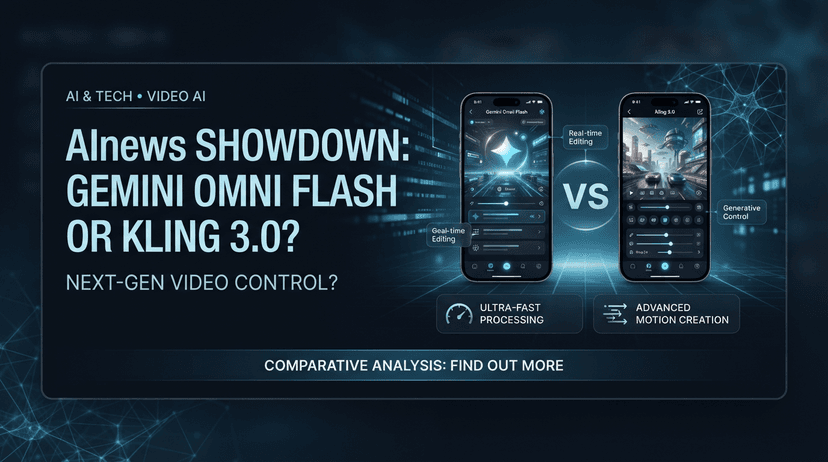
AInews showdown: Gemini Omni Flash or Kling 3.0 for next‑gen video control?
AI & Tech

AInews showdown: Gemini Omni Flash or Kling 3.0 for next‑gen video control?

AInews showdown: Gemini Omni Flash or Kling 3.0 for next‑gen video control? On 19 May 2026, Google began rolling out Gemini Omni Flash to its apps and APIs for conversational video generation and editing, while Kuaishou’s Kling 3.0, launched on 4–5 February 2026, pushed multi‑shot continuity and cinematic storyboards into the mainstream AInews race. What exactly are Gemini Omni Flash and Kling 3.0? Gemini Omni Flash is Google’s fast, text‑and‑image‑to‑video model built for interactive editing, now generally available as Gemini Omni 1.1 Flash. Kling 3.0 is Kuaishou’s third‑generation family of multimodal video and image models, centered on the Video 3.0 and Video 3.0 Omni engines for short, native 4K clips with storyboard controls. Both systems sit at the frontier of AI video. According to Google’s Gemini model announcement in May 2026, Gemini Omni Flash turns text prompts and optional reference images into short video clips and lets users "easily edit your videos through conversation" in the Gemini app, Google Flow and YouTube tools. According to Google’s developer documentation, the Gemini Omni Flash API is described as a video "generation and editing" model that refines clips via natural‑language conversations and supports video extension. According to Google’s August 27, 2026 release notes, Gemini Omni 1.1 Flash has reached general availability and replaces the earlier preview endpoint, which will be deprecated on September 30, 2026. According to AI Wiki’s Kling 3.0 entry updated September 11, 2026, Kling 3.0 includes Video 3.0, Video 3.0 Omni, Image 3.0 and Image 3.0 Omni, all built on a unified multimodal architecture that outputs short clips with native 4K resolution and synchronized multilingual audio. According to Genra’s February 20, 2026 guide, Kuaishou timed the Kling 3.0 public release to February 5, 2026, with text‑to‑video, image‑to‑video and reference‑driven modes across the lineup. How does Gemini Omni Flash handle video editing and user control? Gemini Omni Flash focuses on conversational editing: users can ask for changes, extend scenes, and adjust frames using natural language, with support for incremental 10‑second extensions up to 40 seconds in Gemini Omni 1.1 Flash. This makes Google’s model feel like an interactive editor rather than a one‑shot generator. Editing in Gemini’s ecosystem is built around back‑and‑forth dialogue. According to Google’s Omni 1.1 Flash blog on August 27, 2026, the model delivers "studio‑quality video production" and lets users extend videos in 10‑second increments, up to a cumulative 40 seconds, while analyzing up to 10 seconds of prior context instead of just the last second. According to the same post, Gemini Omni 1.1 supports features such as first‑and‑last‑frame interpolation and 4K output in supported environments, improving continuity between edits. According to Google’s Gemini Omni product blog from May 19, 2026, users can "easily edit your videos through conversation" and are already seeing the model integrated into the Gemini app, Google Flow and YouTube Shorts, with rollout to Google AI Plus, Pro and Ultra subscribers globally and free use in some YouTube tools. According to the Gemini Omni Flash API documentation, developers can refine and edit generated videos by sending natural‑language instructions in an ongoing interaction, positioning the model as a dynamic editor that supports video extension as well as generation. According to a July 16, 2026 Google Workspace announcement, Gemini Omni Flash now powers Google Vids, where users can edit videos using simple text prompts and generate new clips featuring personal avatars that look and sound like them. According to ilisai’s explainer updated September 2, 2026, the service’s video generator now uses Gemini Omni 1.1 Flash and bills at least 10 seconds per clip, indicating that Google’s fast model is already deployed in third‑party platforms. This conversational workflow favors creators who expect to iterate rapidly, like social video editors or marketing teams that want many small changes without rebuilding clips from scratch. What does Kling 3.0 offer in multi‑shot continuity and storyboarding? Kling 3.0’s Video 3.0 and Video 3.0 Omni models emphasize multi‑shot generation: up to six connected shots in a single clip, with stable character identity, lighting and environment across cuts. Shot planning can be automatic or fully custom, turning prompts into structured mini‑sequences. Multi‑shot tools make Kling feel like a pre‑visualization engine for directors. According to Kling’s Video 3.0 user guide last updated August 26, 2026, the model supports two modes for multi‑shot video: "Multi‑Shot" and "Custom Multi‑Shot". When Multi‑Shot is enabled, it automatically plans transitions and creates multi‑scene content; Custom Multi‑Shot lets users configure shot counts and durations. According to Kling’s July 28, 2026 multi‑shot guide, Multi‑Shot structures a scene through camera coverage, shot changes and narrative progression, reading coverage and shot information from the prompt to adjust angles and compositions for cinematic storytelling. According to Morphic’s August 2026 Kling 3.0 guide, Kling Video 3.0 supports multi‑shot sequences of up to six camera cuts per generation, with text‑to‑video, image‑to‑video and start‑and‑end‑frame‑to‑video modes within a maximum duration of 15 seconds per clip. According to Invideo’s May 28, 2026 overview, Kling 3.0 can generate up to six connected shots while letting users either describe the scene and let the model plan cuts or specify each shot’s framing, duration and camera movement for precise shot‑list execution. According to Kling3Pro’s March 26, 2026 feature page, Kling 3.0 multi‑shot generation defines up to six individual shots inside a single 15‑second clip, each with its own prompt and camera angle, while locking character appearance, wardrobe and environment continuity via scene‑level identity encoding. According to AI Wiki and Synthszr’s product ranking updated September 6, 2026, Kling 3.0’s unified architecture produces native 4K video at up to 60 frames per second and supports multi‑shot storyboards with up to six camera cuts, reinforcing its role in high‑fidelity continuity. These continuity guarantees matter for ad agencies, pre‑viz teams and independent filmmakers that need a sequence of connected shots, not just isolated clips. How do lengths, resolution and audio capabilities compare? Gemini Omni Flash emphasizes flexible duration via extensions and focuses on fast 720p clips in many deployed services, while Kling 3.0 centers on short but dense native 4K sequences up to 15 seconds with synchronized multilingual audio. The technical trade‑offs shift who benefits most from each system. According to Google’s Omni 1.1 Flash blog, users can extend a video by 10‑second increments, up to 40 seconds total, with Omni analyzing up to 10 seconds of prior context to keep motion and composition aligned. According to ilisai’s July 19, 2026 article, the original Gemini Omni Flash preview produced short 720p clips from text prompts or reference images and, as of a September 1 update, every video generated with Gemini Omni 1.1 Flash bills at least 10 seconds of output. According to AI Wiki’s Kling 3.0 profile, the new generation moved from roughly 10‑second 1080p clips in Kling 2.6 to 15‑second native 4K clips in Kling 3.0, adding synchronized lip‑synced audio across five languages. According to Morphic’s technical table, Kling 3.0’s Video 3.0 model supports durations between 3 and 15 seconds, aspect ratios such as 16:9, 9:16 and 1:1, and native 4K resolution with other options at 1080p and 720p. According to Synthszr’s September 6, 2026 ranking, Kling 3.0 natively generates 4K video at up to 60 frames per second with synchronized audio and supports up to six camera cuts per clip. Users chasing maximum resolution and integrated audio will lean toward Kling; teams optimizing for iterative editing inside existing Google tools may accept lower resolution in exchange for speed and integration. Where are these models available and how are they priced? Gemini Omni Flash is woven into Google’s subscription tiers and tools, from the Gemini app to YouTube products and Google Vids, while Kling 3.0 is accessible through Kuaishou’s platforms and partner APIs aimed at creators and developers. Commercial terms vary, but both target professional and prosumer use. According to Google’s May 19, 2026 Gemini Omni launch blog, Gemini Omni Flash started rolling out to Google AI Plus, Pro and Ultra subscribers globally through the Gemini app and Google Flow, and became available at no cost in YouTube Shorts and the YouTube Create app. According to the July 16, 2026 Google Workspace blog, Gemini Omni Flash now powers Google Vids, giving Workspace users access to text‑prompt‑based editing and avatar generation within a productivity suite. According to Gemini API release notes, Gemini Omni 1.1 Flash reached general availability in early September 2026, signaling that production billing and quotas now apply as the preview endpoint approaches deprecation. According to Kuaishou’s February 9, 2026 feature guide, Kling 3.0 was officially launched on February 4, 2026 at 11:00 PM Beijing time, with API access for developers beginning February 5, 2026. According to Genra’s February 20, 2026 overview, Kling 3.0’s rollout prioritized "Ultra" subscribers before opening more broadly, positioning the models as premium tools for serious creators. According to Morphic’s guide, third‑party platforms integrate Kling 3.0’s modes into their own interfaces, offering creators control over duration, resolution and multi‑shot features alongside their own pricing. According to Synthszr’s September 2026 ranking, Kling 3.0 appears in AI product lists targeted at production users, indicating its positioning in professional and semi‑professional video workflows. These distribution strategies matter. Google is tying video AI tightly to its productivity and social stacks, while Kuaishou and its partners push Kling into dedicated creative and editing environments where users may build entire pipelines around it. Who gains more from editing flexibility, and who needs multi‑shot continuity? Creators who iterate quickly on single clips—with frequent text‑driven tweaks, avatar changes and scene extensions—gain most from Gemini Omni Flash’s conversational editing and deep integration in Google tools. Teams planning storyboards or ad sequences benefit more from Kling 3.0’s multi‑shot continuity and 4K, audio‑rich outputs. Different workflows point to different winners. For social managers and short‑form creators inside YouTube and Workspace, Gemini’s ability to extend scenes, interpolate frames and apply natural‑language edits—"make this shot closer," "brighten the background"—reduces friction in turning rough ideas into polished clips. For cinematographers, agencies and pre‑viz teams, Kling’s combination of up to six connected shots, locked character identity and 4K visuals means they can block out miniature storyboards, test camera coverage and maintain continuity shot by shot. According to Invideo’s comparison, Kling 3.0 explicitly contrasts multi‑shot support against single‑shot models, highlighting that it can either auto‑plan coverage or follow a detailed human‑written shot list. According to Google’s Omni 1.1 blog, the extended context window and interpolation tools are framed around "studio‑quality" production for creators who may not want to think in discrete shots but still care about smooth motion and consistent framing in the finished video. No single model wins outright. The choice turns on whether a creative team thinks in clips with conversational edits or in sequences of shots with tight continuity and high‑end visuals.

Nic Reeve·