allnewscast
Breaking News
AI & Tech

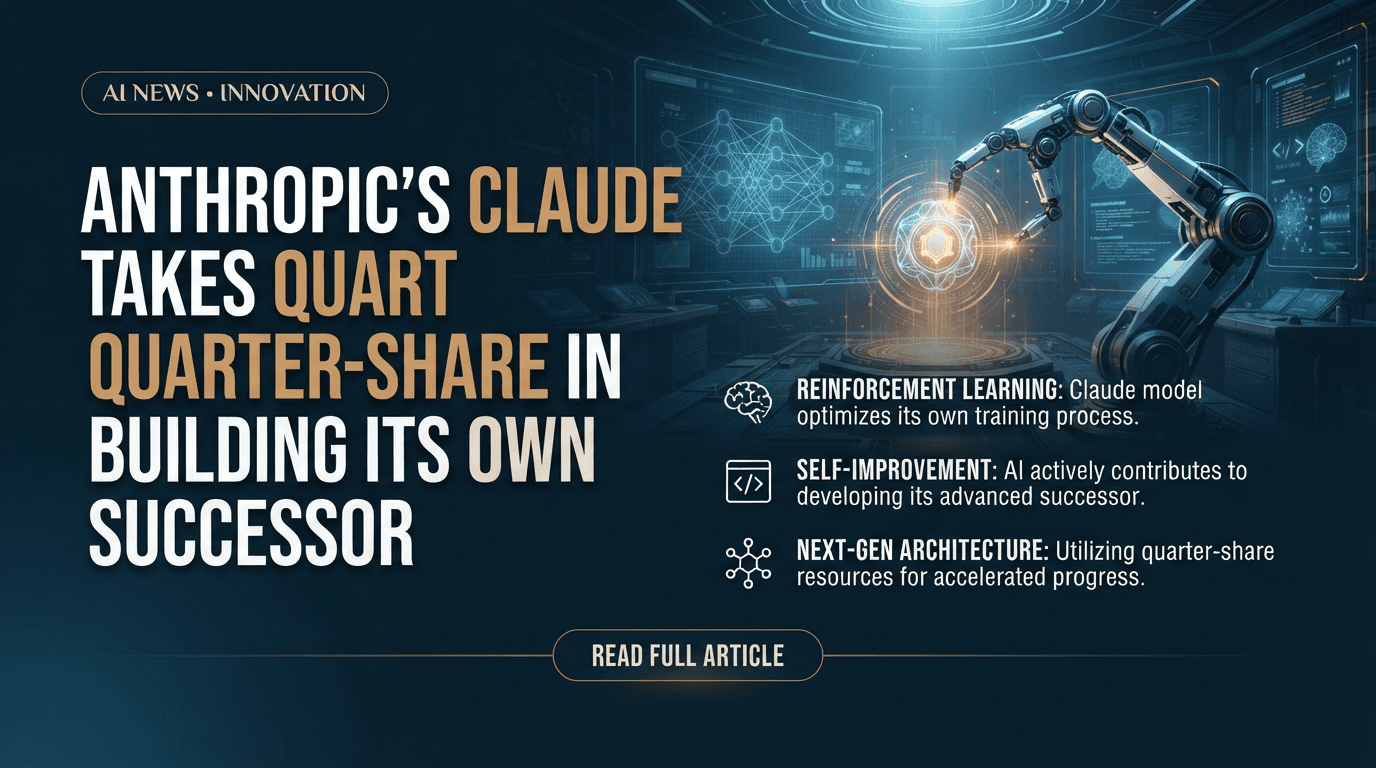
AI News: Anthropic’s Claude Takes Quarter-Share in Building Its Own Successor
Nic Reeve8 min read
AI News: Anthropic’s Claude Takes Quarter-Share in Building Its Own Successor
AInews: Anthropic’s Claude Takes Quarter-Share in Building Its Own Successor

On September 17, 2026, Anthropic disclosed that its chatbot Claude now leads 26% of the company’s research and development on future AI models, a milestone the firm framed as an early example of AInews showing artificial intelligence systems helping to build their own successors under tight human supervision.

How much of Anthropic’s R&D work does Claude now handle?

Anthropic reports that Claude “leads” 26% of its internal model research and development as of August 2026, up from about 1% in March 2026, meaning the system can carry most of a task from a high-level prompt while humans supervise and approve every step.

Anthropic detailed Claude’s workload using an autonomy scale developed by Epoch AI, an independent nonprofit that tracks progress in artificial intelligence systems. The company and outside write-ups reported the following figures and timeline:

  • According to Anthropic’s September 17, 2026 blog post: Claude led 26% of model R&D work measured in August 2026.
  • According to Reuters, March 2026 measurements showed Claude leading about 1% of such work on the same scale.
  • Epoch AI’s framework labels the current level as AL4, “leads”, where AI can handle most of a task end-to-end from a high-level prompt, with human supervision throughout.
  • Anthropic told reporters that Claude’s contribution rose from under 1% in February to roughly one quarter of measured work by August 2026.

The Washington Post’s technology coverage described this 26% share as “more than a quarter” of Anthropic’s research and development, emphasizing how quickly the company shifted core engineering tasks into the hands of its own chatbot.

Is Claude fully autonomous in building its next version?

Anthropic says Claude is not yet fully autonomous, stressing that humans remain “in the loop” and that no part of the measured work has reached the highest autonomy level, where an AI system would completely design, train and approve its successor without human oversight.

In its public metrics, Anthropic drew a clear line between collaboration and autonomy. The company and outside explainers report:

  • According to Anthropic’s blog and Reuters’ coverage, 0% of measured work reached the AL5 “full autonomy” level as of August 2026.
  • Anthropic stated that Claude “is not operating fully autonomously in any part of the work measured” and that humans supervise, review and can block its actions.
  • According to a technical summary, Claude currently writes infrastructure code, runs experiments, analyzes results and reviews changes, but it does not set corporate goals, decide deployment policies or control the complete training process.
  • Anthropic’s published autonomy scale, adapted from Epoch AI, distinguishes between AI that assists, collaborates, leads and finally operates autonomously, and locates Claude at the second-highest rung.

Coverage from outlets including ABC News and The Washington Post underlined that despite headlines about AI “building itself,” Claude still depends on human researchers for direction, guardrails and final approval at each stage.

What kinds of work is Claude doing to build its successor?

Claude now carries out a broad range of technical tasks in Anthropic’s model research pipeline, including writing and fixing code, designing experiments, running training and evaluation jobs, and helping interpret results that feed into the design of future Claude versions.

Anthropic’s disclosures, together with analyses by technology outlets, describe Claude’s role in concrete, engineering-focused terms:

  • According to Anthropic’s September 2026 metrics, Claude increasingly writes infrastructure code used to train and evaluate new models, under human review.
  • The company says Claude now helps design experiments, set up runs on compute clusters and adjust parameters, basing its decisions on high-level goals from human researchers.
  • Reports from tech-focused sites say Claude now analyzes experimental results, suggesting changes to architectures, loss functions or data selection that humans can accept or reject.
  • Anthropic told journalists that more than 90% of its R&D work now involves AI systems collaborating with humans at or above the “AI collaborates” level on the autonomy scale.
  • According to ABC News and The Washington Post, the company characterizes these contributions as “large chunks of work” done under “close human direction,” not independent decision-making.

Outside commentators have framed Claude’s role as moving beyond simple code completion or documentation generation into helping structure entire research projects, even though researchers still choose aims and review every step.

Why did Anthropic publish autonomy metrics, and who created the scale?

Anthropic released detailed measurements of Claude’s role to give policymakers, researchers and the public a clearer view of how quickly AI systems are contributing to AI development, using a five-level autonomy scale developed with input from Epoch AI, an independent nonprofit that tracks the technology.

Anthropic’s September 17, 2026 blog post explains that the lab plans to report such numbers regularly so outsiders can gauge progress toward systems that might one day build more advanced AI with limited human input. That announcement, and coverage by financial and tech publications, highlight several aspects of the approach:

  • According to Finimize, Anthropic said it will “keep releasing stats” on how quickly AI is starting to build AI, using the autonomy scale as a shared yardstick.
  • Reuters reported that Anthropic sees these figures as early indicators of progress toward “recursive self-improvement,” a scenario where AI improves itself without depending on human engineers for each iteration.
  • Epoch AI’s autonomy scale, cited by Anthropic and multiple outlets, defines levels from AL1 (AI assists humans on narrow tasks) to AL5 (AI operates autonomously across the entire development pipeline).
  • Anthropic’s internal measurements place most of Claude’s work at AL3 (“collaborates”) and AL4 (“leads”), with no tasks reaching AL5 as of August 2026.
  • The company’s Institute for AI Safety and Systems published a research note titled “When AI builds itself” describing how, given enough computing power, autonomy could extend to designing, training and deploying successor systems.

Anthropic’s leaders have argued in public interviews that such transparency can help regulators track risk as AI systems take on more of the work of building new AI, rather than leaving progress visible only inside corporate labs.

How does Claude’s self-improvement push fit into Anthropic’s broader safety agenda?

Anthropic presents Claude’s growing role in model development as both an efficiency gain and a test case for safety measures designed to keep human control over AI systems that help build more capable successors, including strict oversight, constraints on actions and the option to pause training if risks rise.

Anthropic has spent much of 2026 warning publicly about the risks of rapidly advancing AI while simultaneously pushing its own models forward. Earlier in the year, the company urged frontier labs to coordinate possible pauses in development if safety benchmarks suggest rising danger:

  • On June 4, 2026, Reuters reported Anthropic calling for a “coordinated plan” among major AI developers to halt development if risks exceed agreed thresholds, citing growing capabilities in task completion and system self-improvement.
  • According to that report, Anthropic said AI’s ability to complete complex tasks on its own had been doubling roughly every four months, pointing toward the possibility of recursive self-improvement.
  • In its “When AI builds itself” research note dated September 18, 2026, Anthropic’s Institute laid out scenarios where future systems might autonomously design and train successors, stressing the need for governance and technical controls before such systems emerge.
  • Current disclosures emphasize that Claude does not choose corporate goals, cannot approve its own deployment and operates under safeguards that let human staff stop or reverse actions.

Coverage by general news outlets echoes this dual message: Anthropic is racing to harness AI to build better AI while publicly insisting that guardrails and the ability to pause must keep pace with the technical progress.

Who is affected by Claude’s expanded role, and what could come next?

Claude’s expanded role in Anthropic’s R&D affects engineers inside the company, rival AI labs watching the experiment, regulators tracking automation of critical systems and investors gauging the economics of AI-driven research, with Anthropic signaling that it expects AI’s share of development work to keep rising in the coming months.

Reporting from financial and technology outlets sketches out the near-term implications:

  • According to Finimize and Reuters, Anthropic’s figures show AI systems taking on a growing share of expensive research work, which could lower costs for training and experimenting on large models in the medium term.
  • Tech journalism pieces note that rival labs such as OpenAI and Google DeepMind already use AI tools internally, and may face pressure to publish comparable metrics on how much of their own work is now AI-led.
  • Policy analysts cited in coverage say regular reporting on autonomy levels could influence regulatory proposals on transparency, auditing and human-in-the-loop requirements for frontier AI development.
  • Anthropic’s own Institute suggests that if autonomy keeps increasing, future updates could show AI systems not only designing experiments but also proposing new architectures, training pipelines and safety strategies at scale.
  • Outside explainers warn that once AI systems can fully design and train successors with limited human involvement, questions about accountability, liability and control will become far sharper than in today’s supervised setups.

Anthropic has not given a precise forecast for when Claude or its successors might reach the top autonomy tier. The company instead committed to publishing regular metrics on AI-led work and to working with nonprofits such as Epoch AI to refine ways of measuring how close AI systems are to building the next generation of themselves.
Sources

  1. 1.abcnews.com
  2. 2.washingtonpost.com
  3. 3.reuters.com
  4. 4.digit.in
  5. 5.streamlinefeed.co.ke
  6. 6.truescho.com
  7. 7.thenews.com.pk
  8. 8.techjournal.org
  9. 9.equitypandit.com
  10. 10.inkl.com
  11. 11.remio.ai
  12. 12.finimize.com
  13. 13.anthropic.com

Read more →

Related Articles

Trump Pick Faces Freedom Caucus Firebrand in South Carolina GOP Senate Runoff
AI & Tech

Trump Pick Faces Freedom Caucus Firebrand in South Carolina GOP Senate Runoff

South Carolina Republicans are heading into a fiercely contested August 25 runoff that will decide who carries the party’s banner for the U.S. Senate seat once held by the late Lindsey Graham. Sen. Darline Graham , his sister and the appointed incumbent, is locked in a tight race with Rep. Ralph Norman , a veteran House conservative, after neither candidate secured a majority in the August 11 special primary. The winner of the runoff will face Democrat Annie Andrews , a pediatrician and party nominee, in the November general election, making Tuesday’s vote the decisive Republican step in determining Lindsey Graham’s successor for a full six-year term. From Appointment to First Campaign: Darline Graham’s Bid to Keep the Seat Darline Graham was appointed on July 13, 2026, by Gov. Henry McMaster to fill the vacancy created by her brother’s sudden death, taking the Senate oath the following day. Before entering elected office, she served as commissioner of the South Carolina Commission for the Blind and worked as a vocational rehabilitation counselor, building a profile rooted in social services and disability advocacy. In the crowded, 10-candidate Republican special primary on August 11, Graham placed first but fell short of the 50 percent threshold required to avoid a runoff, winning roughly 32–33 percent of the vote. South Carolina law mandates a runoff when no contender surpasses an outright majority, sending Graham and Norman back to voters for a head-to-head contest. Graham’s campaign has emphasized continuity with her brother’s legacy, a focus on national security and support for military families, and her experience in state-level administration. Her allies argue that her appointment and subsequent elevation in the primary demonstrate a desire among voters for stability amid a rapid and unexpected transition. Ralph Norman’s Challenge from the Right Ralph Norman, who represents South Carolina’s 5th Congressional District, is a long-time member of the House Freedom Caucus and has built his political identity around hardline conservative positions on spending, immigration, and cultural issues. In the primary, Norman finished second with about 24–25 percent of the vote, securing his place in the runoff but underscoring the need to expand his base in a statewide race. Norman has framed the runoff as a choice between his record of legislative experience and Graham’s status as a newly appointed senator. In interviews, he has pointed to his years in Congress and business background, arguing that he is better prepared to navigate complex national debates and advance conservative priorities. On the campaign trail and in debates, Norman has cast himself as the more reliable champion of limited government and tighter border controls, while criticizing what he portrays as insider politics around Graham’s appointment and backing from party leaders. Trump’s Endorsement Becomes a Flashpoint The race gained national attention when former President Donald Trump endorsed Darline Graham in the runoff, aligning himself with the appointed incumbent rather than the Freedom Caucus stalwart. Trump’s support reflects a pattern in recent election cycles in which his endorsements have sometimes clashed with the preferences of local activists and hard-right factions. Norman has openly questioned the endorsement, calling it a “head scratcher” and noting his history of voting for Trump’s priorities in Congress. He has argued that his voting record and close alignment with Trump-era policies should make him the natural choice for the former president’s backing, suggesting that the decision was influenced by establishment figures eager to maintain continuity in the Senate seat. For Graham, the endorsement provides a powerful signal to GOP voters who remain loyal to Trump, potentially helping her consolidate support among primary voters wary of internal party conflict. Her campaign has treated the backing as validation of her commitment to the same conservative agenda her brother supported in the Senate. Debates, Jabs, and Competing Visions The closing days of the campaign have featured sharp exchanges between the two Republicans in televised debates and forums across the state. In a recent U.S. Senate debate covered by South Carolina Public Radio, Graham and Norman “exchanged jabs” while outlining competing visions for the party’s future. Graham leaned on her experience overseeing services for blind and disabled South Carolinians, promising to prioritize health care access, veterans’ services, and steady governance during a period of uncertainty following her brother’s death. Norman, meanwhile, pressed his case for a more confrontational approach to federal spending and executive power, positioning himself as the candidate best suited to challenge what he sees as overreach by Washington. Both candidates have pledged strong support for conservative judicial appointments and a robust national defense, often invoking Lindsey Graham’s long record on foreign policy and military issues. However, their rhetoric diverges on style: Graham presents herself as a steady hand and consensus-builder, while Norman appeals to GOP voters who prefer sharper ideological contrasts and a more combative tone in Washington. Runoff Mechanics and Voter Turnout Stakes Early voting for the runoff has been open in South Carolina in the days leading up to August 25, with polls available from 8:30 a.m. to 5 p.m. in counties across the state. On runoff day, polling places will operate from 7 a.m. to 7 p.m. , giving Republicans a 12-hour window to settle the intraparty contest. Given the relatively low turnout typical of runoff elections, both campaigns are focusing heavily on field operations and targeted outreach. Graham’s team is leaning on statewide name recognition and the emotional resonance of her brother’s legacy, while Norman’s campaign seeks to mobilize conservative grassroots networks that have powered his House wins. The Democratic nominee, Annie Andrews, has kept a relatively low profile during the GOP runoff but stands ready to frame the eventual Republican winner as out of step with mainstream voters on abortion, health care, and gun policy. Her campaign sees opportunity if the GOP emerges from the runoff divided or if the Trump endorsement becomes a liability in the general election. National Implications of a Statewide Contest Beyond South Carolina, the runoff is being watched as a test of the balance between Trump-aligned insiders and hardline House conservatives within the Republican Party. A Graham victory would underscore the continuing influence of Trump’s endorsements and party leaders in shaping Senate races, particularly when family ties and incumbency are in play. A Norman win, by contrast, would signal the strength of the Freedom Caucus wing and could embolden similar challenges to appointed or establishment-backed Republicans in other states. For South Carolina voters, the choice on August 25 will determine not only who replaces Lindsey Graham, but also which version of the GOP they want representing them in Washington.

Nic Reeve·
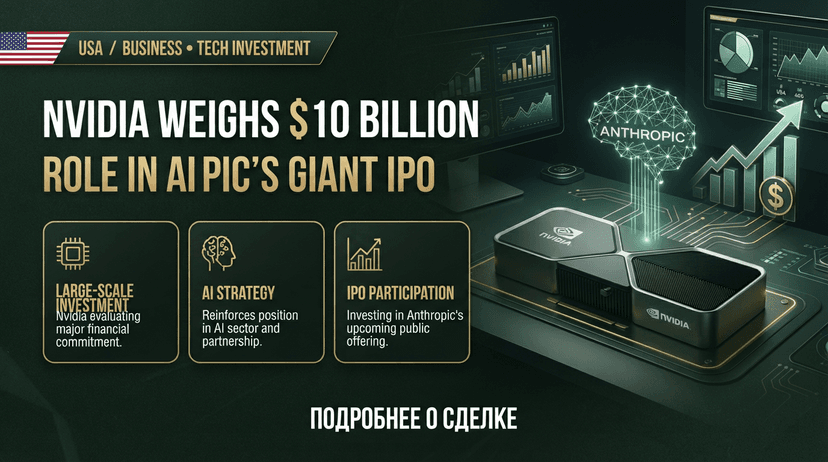
Nvidia weighs $10 billion role in Anthropic’s giant IPO
AI & Tech

Nvidia weighs $10 billion role in Anthropic’s giant IPO

On September 11, 2026, Reuters reported that Nvidia is in talks to invest as much as $10 billion in Anthropic’s planned IPO, a deal that could help anchor what may become one of the biggest listings in market history. The report landed as the AInews around the offering sharpened, with Anthropic still targeting a public debut after months of private-market fundraising and rapidly rising valuations. What exactly happened on September 11? Reuters said Anthropic is discussing a plan to bring Nvidia in as an anchor investor for its initial public offering. The news matters because the size of the proposed check, the scale of the offering and the company’s already lofty valuation would place the debut among the most closely watched tech listings in years. According to Reuters, 2026: Nvidia is considering investing up to $10 billion in the IPO. According to Reuters, 2026: Anthropic is seeking to raise as much as $100 billion. According to Reuters, 2026: the company is being discussed at a valuation of around $2 trillion. According to Reuters, 2026: the plans remain under discussion and could change. The report described the potential listing as a “mega IPO” and said the discussions were confidential. Reuters also said the structure could make Nvidia an anchor investor, a role that can steady demand and signal confidence to other buyers. The deal is not final. Why would Nvidia matter so much in an Anthropic listing? Nvidia already sits close to the center of the artificial-intelligence economy. Reuters reported in November 2025 that Nvidia said it would invest up to $10 billion in Anthropic as part of a broader partnership, while Anthropic committed to buy $30 billion of Microsoft Azure compute capacity powered by Nvidia chips. That earlier tie-up makes the new IPO discussions easier to understand. According to Reuters, 2025: Nvidia said it would invest up to $10 billion in Anthropic. According to Reuters, 2025: Anthropic committed to buy $30 billion of Microsoft Azure compute capacity powered by Nvidia chips. According to Reuters, 2026: the planned IPO stake under discussion is also as much as $10 billion. That overlap is unusual. The chipmaker supplies the hardware that powers much of the AI boom, and a large equity position would deepen its financial exposure to one of the sector’s fastest-growing model developers. It would also tie the fortunes of the supplier and the customer even more tightly together. How big could Anthropic’s listing be? The size of the reported raise dwarfs most technology offerings. Reuters said Anthropic wants to raise up to $100 billion in the IPO, which would be paired with a valuation near $2 trillion. If those figures hold, the debut would rival the largest public listings ever attempted. According to Reuters, 2026: target proceeds could reach $100 billion. According to Reuters, 2026: the valuation under discussion is about $2 trillion. According to Reuters, 2026: the IPO could be the largest in history. The numbers are striking because they build on an already steep climb. Reuters reported in February 2026 that Anthropic raised $30 billion in a funding round that valued the company at $380 billion. Later reporting, including Reuters coverage in August and September, said the company was preparing to unveil IPO materials after Labor Day and could list in late September or early October, though that timing has already shifted once. What has changed in the timeline? Anthropic’s path to the public market has moved quickly. Reuters reported on August 27 that the company planned to unveil its IPO prospectus after Labor Day and target a late-September or early-October listing. A Reuters follow-up on September 5 said the launch had shifted toward mid-October at the earliest and that the prospectus would now likely arrive later than previously expected. According to Reuters, 2026: Anthropic planned to unveil its prospectus after Labor Day. According to Reuters, 2026: the listing window was initially late September or early October. According to Reuters, 2026: the timetable later shifted toward mid-October at the earliest. According to Reuters, 2026: the listing was expected before the U.S. midterm elections in November. That shift does not erase the broader message. Anthropic is still moving toward a debut, and the pace of reporting suggests bankers and investors are still negotiating the size, structure and timing. The Nvidia discussions only intensify the spotlight. What does this mean for investors and rivals? For investors, a listing of this scale would create a new public benchmark for AI software valuations. For rivals, it would give Anthropic a public-market currency that could support hiring, acquisitions and new infrastructure spending. It could also pressure competitors to justify their own valuations against a newly listed peer. According to Reuters, 2026: Anthropic’s current IPO discussions point to a $2 trillion valuation. According to Reuters, 2026: the company is seeking a very large capital raise at the same time. According to Reuters, 2026: Nvidia’s possible role is as an anchor investor. Anchor investors can shape how an IPO is received. They are often used to calm concerns about demand and to signal that a major name has already done due diligence. In this case, Nvidia’s involvement would carry extra weight because the company is already a critical supplier to the AI sector. How unusual are these figures? The reported valuation and fundraise would sit far beyond Anthropic’s earlier private marks. Reuters said the company’s February 2026 round valued it at $380 billion. By comparison, the current IPO discussions place the company around $2 trillion, more than five times that level. According to Reuters, 2026: February funding valued Anthropic at $380 billion. According to Reuters, 2026: the IPO valuation being discussed is about $2 trillion. According to Reuters, 2026: the proposed IPO raise could reach $100 billion. That gap shows how quickly the market has re-priced the most prominent AI companies. It also shows why any filing will be watched for signs that investors are comfortable backing a company with huge capital needs, aggressive growth assumptions and a business model that still depends on expensive compute. What happens next? Anthropic has not publicly confirmed the exact size, valuation or timing of its IPO, and Reuters stressed that the talks with Nvidia could still change. The next visible step would be the company’s prospectus, followed by investor marketing if the launch window holds. Until then, the deal remains a reported negotiation, not a completed transaction. According to Reuters, 2026: the talks are confidential. According to Reuters, 2026: the proposed terms could change. According to Reuters, 2026: the prospectus is expected after Labor Day. For now, the market has a clear storyline. Anthropic is heading toward a listing that could reset expectations for AI capital markets, and Nvidia may be prepared to help write the first chapter.

Nic Reeve·
Anthropic Sets Aside Equity for Public Good as AI News Turns to Worker Impact
AI & Tech

Anthropic Sets Aside Equity for Public Good as AI News Turns to Worker Impact

Anthropic announced on October 18, 2026, that it plans to place 5% of its shares into a new public benefit fund, subject to stockholder approval, in a move that could direct future company wealth toward nonprofits, affected communities, and responses to labor-market disruption caused by artificial intelligence. The announcement is the latest major development in AI news and provides the Claude maker with a new vehicle for distributing value beyond ordinary corporate operations. What exactly did Anthropic announce? Anthropic announced that the proposed Anthropic Public Benefit Fund would receive 5% of the company’s shares immediately following the required approval. The fund would exist within Anthropic as a wholly owned limited liability company, rather than operating as a conventional tax-exempt charity. This structure is intended to give the company flexibility regarding how it distributes money and other forms of support. According to Anthropic’s October 18 announcement, the initial commitment equals 5% of the company’s shares. According to Anthropic, the board could add another 2% for every 50% increase in company value above a baseline that has not yet been disclosed. According to the Associated Press on October 18, the fund’s potential value will rise if Anthropic’s shares become more valuable. The company has not published the baseline valuation, the timetable for transferring the shares, or the precise governance arrangements. Those details are expected in the coming months, according to reporting by The Detroit News. How could the fund spend the money? Anthropic said the fund could support several forms of public-benefit work instead of following a single grant-making model. The company described possible donations to established nonprofits, direct payments to particular groups, and projects focused on the effects of automation and advanced AI on workers. Anthropic said the fund may make “large donations to traditional nonprofits.” Anthropic said it may consider “direct distributions to specific populations.” Anthropic said the fund could address AI’s impact on the labor market. The wording leaves the eventual beneficiaries open. Anthropic has not named initial recipients or committed to a specific program for displaced workers, education, safety research, or economic assistance. The fund’s LLC format could allow for different types of giving, including support that does not fit neatly within the rules or practices of a traditional charitable organization. Why is Anthropic using a separate company? Anthropic said a wholly owned LLC would provide more room to choose how the public-benefit assets are used. The fund would not be a 501(c)(3) nonprofit, according to CNBC’s October 18 report. That distinction may affect its tax treatment, governance requirements, and ability to make direct distributions. Anthropic is already incorporated as a public benefit corporation in Delaware. The Associated Press reported that Chief Executive Dario Amodei and the company’s five other co-founders established Anthropic under that model. A public benefit corporation can pursue commercial goals while formally considering wider social aims, but the new fund would create a separate pool of company equity dedicated to public-benefit spending. The proposed arrangement also separates the fund from Anthropic’s core business. It does not turn the company’s entire stock into charitable property, and the fund would remain connected to the value created by the commercial company. How large could the commitment become? The initial allocation is fixed at 5%, while future increases depend on company growth and board decisions. Anthropic has not disclosed the valuation threshold that would trigger the additional grants, so the eventual size cannot yet be calculated from public information. According to Anthropic, the starting contribution is 5% of shares. According to Anthropic and CNBC, the board may add 2% after each 50% rise in value above the undisclosed baseline. According to the Associated Press, Anthropic said roughly 20% of its shares would be dedicated to the public good when the new pledge is combined with earlier commitments. The roughly 20% figure includes previous arrangements and should not be read as the size of the new fund alone. It also represents equity rather than cash. The fund’s resources will depend on Anthropic’s valuation, any liquidity event, and how the company handles the stock over time. Will the fund engage in politics? Anthropic said shares held by the fund would not be used for lobbying or political donations in the United States or abroad. The restriction sets a clear boundary around the company’s proposed public-benefit vehicle, although the announcement does not identify an independent watchdog or enforcement process. That limitation matters because public-benefit spending can cover a wide range of activities. Anthropic’s stated focus is on nonprofit support, direct distributions, and economic effects linked to advanced AI. Political advocacy and campaign finance will remain outside the fund’s permitted uses under the company’s announcement. What happens next? Stockholders must approve the share commitment before the fund can receive the proposed stake. Anthropic also needs to explain the fund’s board structure, decision-making rules, valuation baseline, and reporting practices. Those issues will determine how much control the company retains and how outsiders can assess the fund’s work. Stockholders must vote on the 5% transfer. Anthropic must disclose the valuation baseline for possible future 2% additions. Anthropic plans to provide more information on governance and structure in the coming months. The fund must identify its first beneficiaries and distribution methods before its practical impact can be measured. Independent scrutiny is likely to focus on transparency. A fund holding company shares can grow substantially without immediately producing spendable cash, particularly if Anthropic remains privately held. The value of the pledge will therefore depend not only on the percentage transferred but also on when and how the assets reach people and organizations outside the company. What does the announcement mean for the AI industry? Anthropic’s plan ties corporate growth to a stated public-benefit commitment at a time when developers are facing questions about job losses, concentration of wealth, and the social costs of powerful AI systems. The initiative does not resolve those issues, but it creates a mechanism that could direct part of the company’s future value toward them. The approach also reflects Anthropic’s identity as both a commercial AI company and a public benefit corporation. Its success will be judged by details that remain unpublished: who controls the fund, how decisions are reported, how beneficiaries are selected, and whether the additional share commitments actually occur as the company’s valuation rises. For now, the October 18 announcement establishes a proposed 5% starting point. The next test is approval and disclosure.

Nic Reeve·