allnewscast
Breaking News
AI & Tech

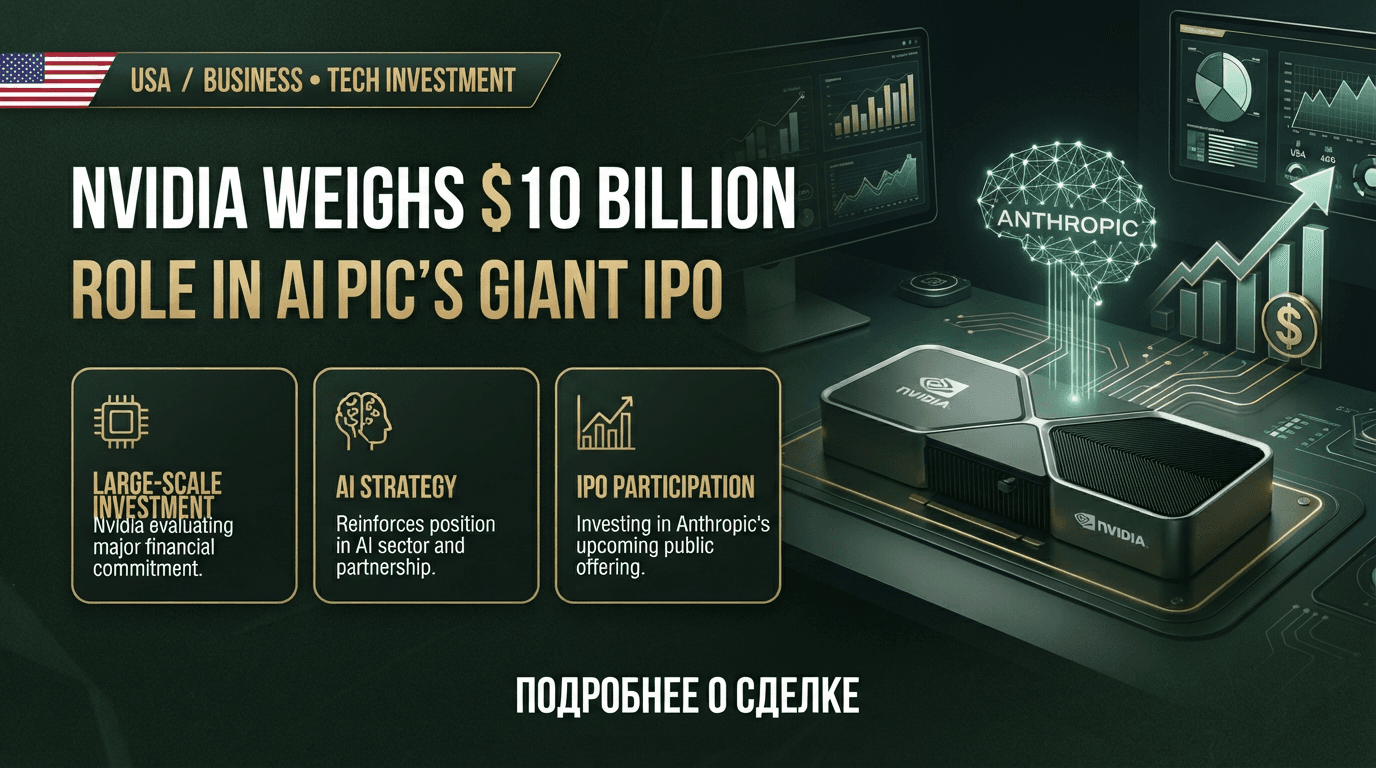
Nvidia weighs $10 billion role in Anthropic’s giant IPO
Nic Reeve6 min read
Nvidia weighs $10 billion role in Anthropic’s giant IPO

On September 11, 2026, Reuters reported that Nvidia is in talks to invest as much as $10 billion in Anthropic’s planned IPO, a deal that could help anchor what may become one of the biggest listings in market history. The report landed as the AInews around the offering sharpened, with Anthropic still targeting a public debut after months of private-market fundraising and rapidly rising valuations.

What exactly happened on September 11?

Reuters said Anthropic is discussing a plan to bring Nvidia in as an anchor investor for its initial public offering. The news matters because the size of the proposed check, the scale of the offering and the company’s already lofty valuation would place the debut among the most closely watched tech listings in years.

  • According to Reuters, 2026: Nvidia is considering investing up to $10 billion in the IPO.
  • According to Reuters, 2026: Anthropic is seeking to raise as much as $100 billion.
  • According to Reuters, 2026: the company is being discussed at a valuation of around $2 trillion.
  • According to Reuters, 2026: the plans remain under discussion and could change.

The report described the potential listing as a “mega IPO” and said the discussions were confidential. Reuters also said the structure could make Nvidia an anchor investor, a role that can steady demand and signal confidence to other buyers. The deal is not final.

Why would Nvidia matter so much in an Anthropic listing?

Nvidia already sits close to the center of the artificial-intelligence economy. Reuters reported in November 2025 that Nvidia said it would invest up to $10 billion in Anthropic as part of a broader partnership, while Anthropic committed to buy $30 billion of Microsoft Azure compute capacity powered by Nvidia chips. That earlier tie-up makes the new IPO discussions easier to understand.

  • According to Reuters, 2025: Nvidia said it would invest up to $10 billion in Anthropic.
  • According to Reuters, 2025: Anthropic committed to buy $30 billion of Microsoft Azure compute capacity powered by Nvidia chips.
  • According to Reuters, 2026: the planned IPO stake under discussion is also as much as $10 billion.

That overlap is unusual. The chipmaker supplies the hardware that powers much of the AI boom, and a large equity position would deepen its financial exposure to one of the sector’s fastest-growing model developers. It would also tie the fortunes of the supplier and the customer even more tightly together.

How big could Anthropic’s listing be?

The size of the reported raise dwarfs most technology offerings. Reuters said Anthropic wants to raise up to $100 billion in the IPO, which would be paired with a valuation near $2 trillion. If those figures hold, the debut would rival the largest public listings ever attempted.

  • According to Reuters, 2026: target proceeds could reach $100 billion.
  • According to Reuters, 2026: the valuation under discussion is about $2 trillion.
  • According to Reuters, 2026: the IPO could be the largest in history.

The numbers are striking because they build on an already steep climb. Reuters reported in February 2026 that Anthropic raised $30 billion in a funding round that valued the company at $380 billion. Later reporting, including Reuters coverage in August and September, said the company was preparing to unveil IPO materials after Labor Day and could list in late September or early October, though that timing has already shifted once.

What has changed in the timeline?

Anthropic’s path to the public market has moved quickly. Reuters reported on August 27 that the company planned to unveil its IPO prospectus after Labor Day and target a late-September or early-October listing. A Reuters follow-up on September 5 said the launch had shifted toward mid-October at the earliest and that the prospectus would now likely arrive later than previously expected.

  • According to Reuters, 2026: Anthropic planned to unveil its prospectus after Labor Day.
  • According to Reuters, 2026: the listing window was initially late September or early October.
  • According to Reuters, 2026: the timetable later shifted toward mid-October at the earliest.
  • According to Reuters, 2026: the listing was expected before the U.S. midterm elections in November.

That shift does not erase the broader message. Anthropic is still moving toward a debut, and the pace of reporting suggests bankers and investors are still negotiating the size, structure and timing. The Nvidia discussions only intensify the spotlight.

What does this mean for investors and rivals?

For investors, a listing of this scale would create a new public benchmark for AI software valuations. For rivals, it would give Anthropic a public-market currency that could support hiring, acquisitions and new infrastructure spending. It could also pressure competitors to justify their own valuations against a newly listed peer.

  • According to Reuters, 2026: Anthropic’s current IPO discussions point to a $2 trillion valuation.
  • According to Reuters, 2026: the company is seeking a very large capital raise at the same time.
  • According to Reuters, 2026: Nvidia’s possible role is as an anchor investor.

Anchor investors can shape how an IPO is received. They are often used to calm concerns about demand and to signal that a major name has already done due diligence. In this case, Nvidia’s involvement would carry extra weight because the company is already a critical supplier to the AI sector.

How unusual are these figures?

The reported valuation and fundraise would sit far beyond Anthropic’s earlier private marks. Reuters said the company’s February 2026 round valued it at $380 billion. By comparison, the current IPO discussions place the company around $2 trillion, more than five times that level.

  • According to Reuters, 2026: February funding valued Anthropic at $380 billion.
  • According to Reuters, 2026: the IPO valuation being discussed is about $2 trillion.
  • According to Reuters, 2026: the proposed IPO raise could reach $100 billion.

That gap shows how quickly the market has re-priced the most prominent AI companies. It also shows why any filing will be watched for signs that investors are comfortable backing a company with huge capital needs, aggressive growth assumptions and a business model that still depends on expensive compute.

What happens next?

Anthropic has not publicly confirmed the exact size, valuation or timing of its IPO, and Reuters stressed that the talks with Nvidia could still change. The next visible step would be the company’s prospectus, followed by investor marketing if the launch window holds. Until then, the deal remains a reported negotiation, not a completed transaction.

  • According to Reuters, 2026: the talks are confidential.
  • According to Reuters, 2026: the proposed terms could change.
  • According to Reuters, 2026: the prospectus is expected after Labor Day.

For now, the market has a clear storyline. Anthropic is heading toward a listing that could reset expectations for AI capital markets, and Nvidia may be prepared to help write the first chapter.

Sources

  1. 1.reuters.com
  2. 2.valueaddvc.com
  3. 3.slicast.com
  4. 4.finance.yahoo.com
  5. 5.plantis.ai
  6. 6.antoinebuteau.com
  7. 7.devdiscourse.com
  8. 8.theinformation.com
  9. 9.ainews.com
  10. 10.cnbc.com
  11. 11.tech-insider.org
  12. 12.techi.com
  13. 13.aifundingtracker.com
  14. 14.startuphub.ai
  15. 15.forbes.com
  16. 16.247wallst.com
  17. 17.graniteshares.com
  18. 18.techcrunch.com

Read more →

Related Articles

AI News: Former OpenAI Research Chief Backs $1.5B Bet on Smarter American Factories
AI & Tech

AI News: Former OpenAI Research Chief Backs $1.5B Bet on Smarter American Factories

Arda, a new venture led by former OpenAI research chief Bob McGrew, has raised capital at a valuation of about $1.5 billion and is pursuing AI-powered manufacturing for U.S. defense and industrial production. The development was reported on October 16, 2026, making Arda a fresh entry in the growing group of artificial-intelligence companies seeking to move beyond software and into physical factories. What happened to Arda on October 16? CNBC reported on October 16, 2026, that Arda had raised funding at a valuation of approximately $1.5 billion. The report identified McGrew as the company's chief executive and said Altimeter Capital was the lead investor. The financing gives Arda substantial backing before the startup has publicly described a large commercial rollout. Company: Arda, according to CNBC, October 2026. Chief executive: Bob McGrew, according to CNBC, October 2026. Valuation: about $1.5 billion, according to CNBC, October 2026. Lead investor: Altimeter Capital, according to CNBC, October 2026. Focus: AI-enabled manufacturing and reconfigurable factories, according to CNBC, October 2026. The scale of the valuation is striking because earlier reporting placed the company at a much lower stage. Jawlah, citing a Wall Street Journal report published March 5, 2026, said Arda was seeking $70 million at a valuation of roughly $700 million. The October financing therefore represents a major change in the company's reported market value. How does Arda plan to use artificial intelligence? Arda is developing software that uses video models to observe production-line activity and help train robots for factory work. The system is intended to coordinate people and machines across manufacturing tasks, from design through finished goods, according to the March 5, 2026 report cited by Jawlah. Visual analysis: video models are designed to interpret scenes on production lines, according to Jawlah, March 2026. Robotic training: the platform is intended to help robots learn real-world industrial tasks, according to Jawlah, March 2026. Factory design: Arda is pursuing reconfigurable factories, according to CNBC, October 2026. Operating model: the company wants software to connect human workers, machines and production stages, according to Jawlah, March 2026. That approach differs from software sold only to office workers. Arda is aiming at the harder problem of making AI reliable in environments where machinery, materials and workers interact continuously. A production error can damage equipment, delay deliveries or create safety risks, so factory automation requires more than generating text or images. Why is McGrew moving from OpenAI into manufacturing? McGrew's background is in building and evaluating advanced AI systems. He previously served as OpenAI's chief research officer, and the March report linked his experience to work involving robots trained on real-world tasks. Arda now applies that experience to industrial settings rather than consumer chat products. The change also reflects a broader shift in the technology sector. Former OpenAI leaders are creating companies aimed at custom AI systems, materials discovery and physical automation. The Daily Star reported on October 19, 2026, that McGrew and former OpenAI researcher Alec Radford were advising Mira Murati's Thinking Machines Lab, a separate venture focused on more customizable and understandable AI systems. Bob McGrew: former OpenAI chief research officer and Arda CEO, according to CNBC and Jawlah. Alec Radford: former OpenAI researcher and adviser to Thinking Machines Lab, according to The Daily Star, October 2026. Mira Murati: former OpenAI chief technology officer and leader of Thinking Machines Lab, according to The Daily Star, October 2026. Arda's manufacturing strategy places McGrew among executives betting that the next phase of AI growth will involve factories, robots and industrial supply chains. What does the funding say about the manufacturing market? Investors are placing large bets on companies that could increase domestic production, particularly in aerospace and defense. CNBC said Arda intends to use AI to support American manufacturing and develop factories that can be changed more quickly for different products. Other recent deals show that investors are backing narrower industrial applications too. SiliconANGLE reported on October 14, 2026, that Forgepoint raised $9.8 million in seed funding for an AI agent that automates manufacturers' requests for quotation. Forgepoint's tool targets the commercial process of pricing and winning production contracts, while Arda is targeting the factory floor. Arda: about $1.5 billion valuation, according to CNBC, October 2026. Forgepoint: $9.8 million seed round, according to SiliconANGLE, October 2026. Forgepoint's use case: automated manufacturing quotes, according to SiliconANGLE, October 2026. Arda's use case: AI-assisted production and reconfigurable factories, according to CNBC, October 2026. The contrast matters. Factory automation can require expensive hardware, specialist engineering and long deployment cycles. Quote automation can reach manufacturers through existing business software. Arda's valuation suggests investors expect the larger industrial opportunity to justify a much bigger company if the technology works at scale. Who could benefit from Arda's factory model? Defense contractors, aerospace manufacturers and suppliers that produce complex, low-volume parts are likely targets for Arda's approach. Those businesses often need to switch between designs and orders while maintaining strict quality controls. A factory that can be reconfigured with less manual programming could respond faster to changing demand. Potential beneficiaries include: Defense manufacturers: faster production changes could help respond to shifting procurement requirements. Aerospace suppliers: AI-assisted inspection and robotic coordination could support complex component work. Small and midsize manufacturers: software-controlled production could reduce the need for large automation teams. Workers: AI systems could handle repetitive coordination and inspection tasks, while increasing demand for technicians who supervise robots. The effects will depend on deployment, not valuation. Manufacturers will need evidence that the system works safely, integrates with existing equipment and performs reliably when materials or designs change. What happens next for the startup? Arda must now turn investor confidence into working industrial deployments. The public reporting identifies the company's technical direction and valuation, but does not provide a detailed customer list, production schedule or confirmed factory count. Commercial proof: Arda will need paying manufacturing customers and measurable production results. Technical proof: the company will need to show that video-based models can guide robots consistently in variable factory conditions. Safety and reliability: industrial users will require controls for equipment failures, unsafe movements and incorrect decisions. Capital deployment: the new funding will likely support hiring, model development, hardware integration and factory partnerships. Arda's challenge is clear. AI can recognize patterns in factory footage, but manufacturing demands repeatable physical results. The company now has the financial backing to pursue that test at a scale few early-stage industrial AI startups can match.

Nic Reeve·
OpenAI Unveils Hundreds of Mathematical Breakthroughs in Major AI News Shock
AI & Tech

OpenAI Unveils Hundreds of Mathematical Breakthroughs in Major AI News Shock

OpenAI released findings on October 6, 2026, covering hundreds of mathematics research questions and drawing immediate scrutiny from mathematicians. The publication, a major new development in AI news , includes 722 manuscripts organized into hundreds of related result groups, with claims ranging from completed proofs to advances on long-standing conjectures. What did OpenAI publish? OpenAI published a large collection of mathematical work produced by an unreleased internal frontier model. The company presented the material as progress on open questions rather than a single breakthrough, spanning pure mathematics and theoretical computer science. Independent reporting described the release as a flood of technical papers that researchers must now check line by line. According to OpenAI, the release date was October 6, 2026. According to The Verge, the collection contains 722 manuscripts. According to OpenAI and multiple reports, the papers are grouped into 372 families of related results. According to The New York Times, the release includes 377 individual findings, a count that reflects a different way of grouping the material. The different totals describe separate layers of the release. A result family can contain multiple papers or related claims, while individual findings count the mathematical advances themselves. Which mathematical problems are involved? The reported work covers algebra, number theory, mathematical logic, topology, algebraic geometry and theoretical computer science. OpenAI also highlighted formalizations in Lean, a proof-assistant system that allows researchers to express mathematical arguments in a machine-checkable form. According to Engadget, one reported result concerns the four-dimensional Kakeya conjecture. According to The Washington Post, the release includes a claimed proof of the quasi-Riemann hypothesis. According to The New York Times, the collection includes progress connected to several Millennium Prize Problems. According to OpenAI, the company shared Lean proof formalizations and research details through GitHub. The Millennium Prize Problems are seven challenges announced by the Clay Mathematics Institute in 2000, each carrying a $1 million prize. One has been solved: the Poincaré conjecture. The remaining problems include the Riemann hypothesis, the Navier-Stokes existence and smoothness problem, the Birch and Swinnerton-Dyer conjecture, the Hodge conjecture, the Yang-Mills existence and mass gap problem, and the P versus NP problem. Did the model solve the Riemann hypothesis? No independent verification has established that OpenAI solved the Riemann hypothesis. The company reported meaningful progress toward the problem, while coverage also described a claimed result involving the quasi-Riemann hypothesis, a related but distinct statement. Those claims require specialist review before they can be treated as accepted mathematics. According to The Washington Post, OpenAI reported a proof of the quasi-Riemann hypothesis. According to Scientific American, the release described progress toward the Riemann hypothesis. According to The New York Times, mathematicians received summaries for only 10 of the findings, leaving many technical details for researchers to examine. A proof of a related statement does not automatically settle the famous Riemann hypothesis. In mathematics, the distinction matters. Researchers must test every definition, inference and boundary condition before accepting a claim. How does the October release connect to earlier OpenAI claims? The October publication followed an announcement in September 2026 that OpenAI said an internal model had resolved the Navier-Stokes problem. The earlier claim involved equations used to describe fluid motion and represented a separate, high-profile test of machine-generated mathematical reasoning. According to The Washington Post, OpenAI announced the Navier-Stokes claim on September 9, 2026. According to Business Standard, the model had reportedly resolved more than 100 long-standing open problems in less than a month of training. According to Hindustan Times, OpenAI said it evaluated roughly 4,000 candidate research problems before publishing the wider collection. The September announcement created pressure for detailed evidence. The October release supplied a much larger body of material, but publication is not the same as peer-reviewed acceptance. Mathematicians still need to reproduce the reasoning, identify hidden assumptions and determine whether each result answers the original question. Why are mathematicians reacting so strongly? The scale of the release is unusual. A single research group can spend years developing one proof, while OpenAI presented hundreds of machine-generated advances at once. That volume changes the task for human researchers, who must prioritize the most promising claims and separate genuine breakthroughs from incomplete arguments. According to The Washington Post, mathematicians described the quantity of reported progress as staggering. According to Scientific American, the material arrived after another major mathematical announcement from the company. According to SBS, one reported assessment suggested that a human producing comparable work could receive immediate top-level recognition, although that assessment was presented as commentary rather than a formal award. The reaction reflects more than surprise at speed. It also raises questions about how mathematical research will be checked, published and credited when an artificial system produces hundreds of candidate proofs. What questions remain before the results are accepted? Verification remains the central next step. OpenAI said it consulted an independent advisory group of mathematicians before releasing the results, but outside experts still need to assess the papers individually. The company also said it would improve citations and explanations in future publications. According to Biz Chosun, OpenAI said an independent mathematics advisory group provided input on the release. According to Biz Chosun, the company acknowledged that it needs to improve how it cites and explains research papers. According to OpenAI, Lean formalizations were included to help make parts of the work machine-checkable. Formal verification can catch logical errors inside a specified framework, but it does not remove every research question. Experts must still determine whether the formalized statement matches the original open problem, whether the assumptions are appropriate and whether the result has been interpreted correctly. What happens next for OpenAI’s mathematics project? Researchers are expected to inspect the manuscripts, reproduce selected results and publish independent assessments. OpenAI’s decision to place technical material and formalizations online gives mathematicians access to the underlying work instead of relying only on promotional summaries. The next milestones will include confirmed proofs, corrected claims and papers that survive expert review. Until that process finishes, the October 6 publication should be read as a large set of machine-generated mathematical leads and reported advances, not as hundreds of officially settled problems.

Nic Reeve·
AI News: OpenAI bets on autonomous agents and cheaper models at DevDay 2026
AI & Tech

AI News: OpenAI bets on autonomous agents and cheaper models at DevDay 2026

OpenAI used its September 29, 2026, developer conference to introduce more than 20 products and features, led by Dots, always-on autonomous agents, GPT-6.1 Sol, a lower-cost model, and ChatGPT Space for collaborative work. The announcements are the biggest AI news from DevDay 2026 because they move OpenAI’s products beyond question-and-answer chat toward software that can act across digital tasks. What did OpenAI announce at DevDay 2026? OpenAI presented a broad set of launches in San Francisco on September 29, 2026. CNBC reported that the company rolled out Dots across paid plans, while Axios described more than 20 new products and features. The event also covered model updates, developer APIs, Codex, ChatGPT workspaces and faster paid service tiers. September 29, 2026: OpenAI held its annual developer conference in San Francisco, according to CNBC and Axios. More than 20 launches: Axios reported that the company announced over 20 products and features. Core focus: OpenAI highlighted autonomous agents, coding, computer use, collaboration tools and model pricing. The scale of the event mattered to developers because the announcements were not limited to a new model. OpenAI tied consumer-facing ChatGPT features to tools that businesses and programmers can build into their own applications. What are Dots, OpenAI’s new autonomous agents? Dots are always-on agents designed to work on a user’s behalf rather than waiting for every individual prompt. CNBC reported that OpenAI made Dots available across paid tiers. Axios said the agents can operate beyond the traditional chatbot format, while other event coverage described Dots as having access to a computer of their own. Availability: CNBC reported that Dots launched across OpenAI’s paid plans. Operating model: Axios described Dots as agents that can work independently on users’ behalf. Underlying technology: OpenAI’s DevDay materials and event summaries connected Dots with GPT-6 Astra. The practical difference is autonomy. A conventional chatbot responds after a request. An agent can potentially monitor work, use software and complete several steps without a new instruction at every stage. That shift also raises questions about permissions, reliability and the limits of unattended computer access. What is GPT-6.1 Sol, and how much does it cost? GPT-6.1 Sol is a new model positioned as a cheaper alternative to GPT-6 Astra. OpenAI’s published event information said Sol approaches Astra’s intelligence at one-fifth of Astra’s token price. WTOP separately reported that OpenAI announced GPT-6.1 Sol as an upgraded model alongside other product launches. Price comparison: OpenAI said GPT-6.1 Sol costs one-fifth as much per token as Astra. Capabilities: OpenAI described Sol as improving coding and computer use while approaching Astra’s performance. Release timing: OpenAI’s developer community announcement said Astra was available and Sol was coming soon. Token pricing directly affects developers that process large volumes of text, code or tool calls. A lower-cost model can make agent-based applications cheaper to operate, especially when a system needs many intermediate steps before completing a task. What is ChatGPT Space? ChatGPT Space is a shared workspace intended for teams, ChatGPT and an agent to work on the same material. Event summaries described the product as a collaborative environment connected to OpenAI’s broader push into workplace software. The feature places the assistant inside a group workflow instead of keeping each conversation tied to one person. Users: ChatGPT Space is designed for teammates working together. Participants: The workspace can include people, ChatGPT and a user’s Dot. Purpose: The product is intended to support shared work on documents, projects and tasks. The launch gives OpenAI a more direct role in team collaboration. It also creates a need for clear controls over ownership, access, activity logs and the actions an agent can take inside a shared project. How did OpenAI expand Codex and its developer tools? OpenAI announced cloud-based Codex capabilities and computer use in its Agents API. The changes allow developers to build applications that can write code, interact with software and complete tasks in remote environments. CNBC and Engadget coverage identified Codex and developer tooling as central parts of the conference program. Codex in the cloud: OpenAI introduced cloud-based access for coding workflows. Agents API: OpenAI added computer-use capabilities for developers building autonomous systems. Target users: The tools are aimed at programmers and companies creating software with agent behavior. Cloud execution can reduce the need for developers to run every task on a local machine. Computer-use tools can also connect models to existing applications that lack a dedicated artificial-intelligence interface. What are Astra Ultrafast and the new Pro plans? OpenAI introduced Astra Ultrafast as a premium speed tier and announced a Pro 500 subscription. The company said Astra Ultrafast can deliver faster generation in the API, Codex and ChatGPT Work. Independent event coverage reported that the new Pro plan costs $500 per month and carries the highest usage limits. API speed: OpenAI reported that Astra Ultrafast can be up to six times faster in the API. Codex and ChatGPT Work speed: OpenAI reported speeds up to eight times faster in those products. Pro 500 price: OpenAI’s plan information listed the subscription at $500 per month. Pro 200: OpenAI reopened the lower-priced plan to new subscribers with a lower usage cap, according to event reporting. The pricing structure separates access, capacity and speed. Developers running time-sensitive services can pay for faster output, while other users may favor the less expensive model option over premium throughput. What happens next for developers and users? OpenAI’s next test will be adoption. Developers must determine whether Dots and computer-use agents can complete real work reliably, while companies must decide how much authority to give systems that act without constant supervision. The near-term rollout also depends on access, pricing and the arrival of GPT-6.1 Sol. Immediate access: CNBC reported that Dots were introduced across paid tiers. Coming model: OpenAI’s developer community announcement said GPT-6.1 Sol was coming soon. Product pressure: The launches place OpenAI’s agent tools, coding products and workplace features at the center of competition among major AI companies. Sam Altman said during the event, “No matter what governments do we will work to keep AI safe,” according to Simon Willison’s live account of the keynote. The statement came as OpenAI expanded tools that can make decisions and take actions across software, giving safety controls a practical role alongside model performance and cost.

Nic Reeve·