AI News: Former OpenAI Research Chief Backs $1.5B Bet on Smarter American Factories
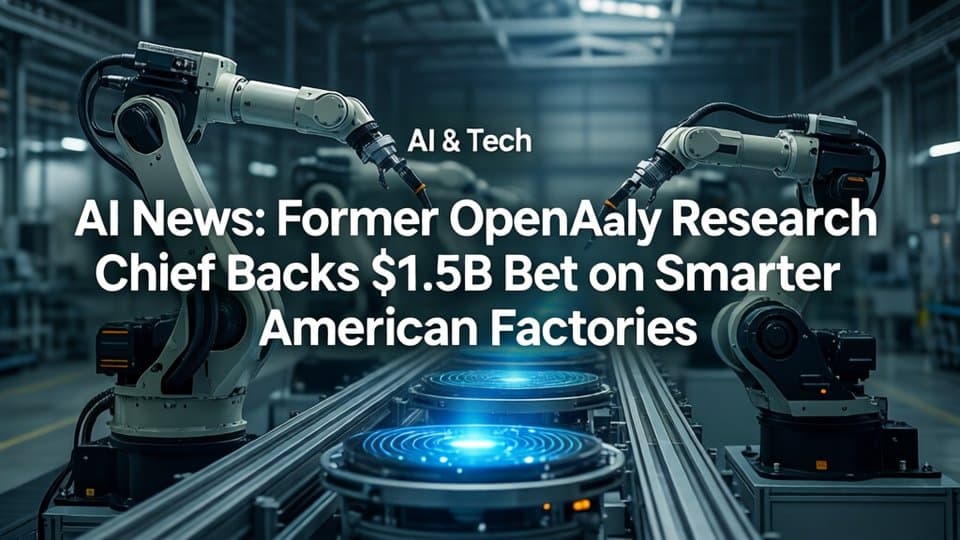
Arda, a new venture led by former OpenAI research chief Bob McGrew, has raised capital at a valuation of about $1.5 billion and is pursuing AI-powered manufacturing for U.S. defense and industrial production. The development was reported on October 16, 2026, making Arda a fresh entry in the growing group of artificial-intelligence companies seeking to move beyond software and into physical factories.
What happened to Arda on October 16?
CNBC reported on October 16, 2026, that Arda had raised funding at a valuation of approximately $1.5 billion. The report identified McGrew as the company's chief executive and said Altimeter Capital was the lead investor. The financing gives Arda substantial backing before the startup has publicly described a large commercial rollout.
- Company: Arda, according to CNBC, October 2026.
- Chief executive: Bob McGrew, according to CNBC, October 2026.
- Valuation: about $1.5 billion, according to CNBC, October 2026.
- Lead investor: Altimeter Capital, according to CNBC, October 2026.
- Focus: AI-enabled manufacturing and reconfigurable factories, according to CNBC, October 2026.
The scale of the valuation is striking because earlier reporting placed the company at a much lower stage. Jawlah, citing a Wall Street Journal report published March 5, 2026, said Arda was seeking $70 million at a valuation of roughly $700 million. The October financing therefore represents a major change in the company's reported market value.
How does Arda plan to use artificial intelligence?
Arda is developing software that uses video models to observe production-line activity and help train robots for factory work. The system is intended to coordinate people and machines across manufacturing tasks, from design through finished goods, according to the March 5, 2026 report cited by Jawlah.
- Visual analysis: video models are designed to interpret scenes on production lines, according to Jawlah, March 2026.
- Robotic training: the platform is intended to help robots learn real-world industrial tasks, according to Jawlah, March 2026.
- Factory design: Arda is pursuing reconfigurable factories, according to CNBC, October 2026.
- Operating model: the company wants software to connect human workers, machines and production stages, according to Jawlah, March 2026.
That approach differs from software sold only to office workers. Arda is aiming at the harder problem of making AI reliable in environments where machinery, materials and workers interact continuously. A production error can damage equipment, delay deliveries or create safety risks, so factory automation requires more than generating text or images.
Why is McGrew moving from OpenAI into manufacturing?
McGrew's background is in building and evaluating advanced AI systems. He previously served as OpenAI's chief research officer, and the March report linked his experience to work involving robots trained on real-world tasks. Arda now applies that experience to industrial settings rather than consumer chat products.
The change also reflects a broader shift in the technology sector. Former OpenAI leaders are creating companies aimed at custom AI systems, materials discovery and physical automation. The Daily Star reported on October 19, 2026, that McGrew and former OpenAI researcher Alec Radford were advising Mira Murati's Thinking Machines Lab, a separate venture focused on more customizable and understandable AI systems.
- Bob McGrew: former OpenAI chief research officer and Arda CEO, according to CNBC and Jawlah.
- Alec Radford: former OpenAI researcher and adviser to Thinking Machines Lab, according to The Daily Star, October 2026.
- Mira Murati: former OpenAI chief technology officer and leader of Thinking Machines Lab, according to The Daily Star, October 2026.
Arda's manufacturing strategy places McGrew among executives betting that the next phase of AI growth will involve factories, robots and industrial supply chains.
What does the funding say about the manufacturing market?
Investors are placing large bets on companies that could increase domestic production, particularly in aerospace and defense. CNBC said Arda intends to use AI to support American manufacturing and develop factories that can be changed more quickly for different products.
Other recent deals show that investors are backing narrower industrial applications too. SiliconANGLE reported on October 14, 2026, that Forgepoint raised $9.8 million in seed funding for an AI agent that automates manufacturers' requests for quotation. Forgepoint's tool targets the commercial process of pricing and winning production contracts, while Arda is targeting the factory floor.
- Arda: about $1.5 billion valuation, according to CNBC, October 2026.
- Forgepoint: $9.8 million seed round, according to SiliconANGLE, October 2026.
- Forgepoint's use case: automated manufacturing quotes, according to SiliconANGLE, October 2026.
- Arda's use case: AI-assisted production and reconfigurable factories, according to CNBC, October 2026.
The contrast matters. Factory automation can require expensive hardware, specialist engineering and long deployment cycles. Quote automation can reach manufacturers through existing business software. Arda's valuation suggests investors expect the larger industrial opportunity to justify a much bigger company if the technology works at scale.
Who could benefit from Arda's factory model?
Defense contractors, aerospace manufacturers and suppliers that produce complex, low-volume parts are likely targets for Arda's approach. Those businesses often need to switch between designs and orders while maintaining strict quality controls. A factory that can be reconfigured with less manual programming could respond faster to changing demand.
Potential beneficiaries include:
- Defense manufacturers: faster production changes could help respond to shifting procurement requirements.
- Aerospace suppliers: AI-assisted inspection and robotic coordination could support complex component work.
- Small and midsize manufacturers: software-controlled production could reduce the need for large automation teams.
- Workers: AI systems could handle repetitive coordination and inspection tasks, while increasing demand for technicians who supervise robots.
The effects will depend on deployment, not valuation. Manufacturers will need evidence that the system works safely, integrates with existing equipment and performs reliably when materials or designs change.
What happens next for the startup?
Arda must now turn investor confidence into working industrial deployments. The public reporting identifies the company's technical direction and valuation, but does not provide a detailed customer list, production schedule or confirmed factory count.
- Commercial proof: Arda will need paying manufacturing customers and measurable production results.
- Technical proof: the company will need to show that video-based models can guide robots consistently in variable factory conditions.
- Safety and reliability: industrial users will require controls for equipment failures, unsafe movements and incorrect decisions.
- Capital deployment: the new funding will likely support hiring, model development, hardware integration and factory partnerships.
Arda's challenge is clear. AI can recognize patterns in factory footage, but manufacturing demands repeatable physical results. The company now has the financial backing to pursue that test at a scale few early-stage industrial AI startups can match.