AInews: Anthropic’s Claude Takes Quarter-Share in Building Its Own Successor
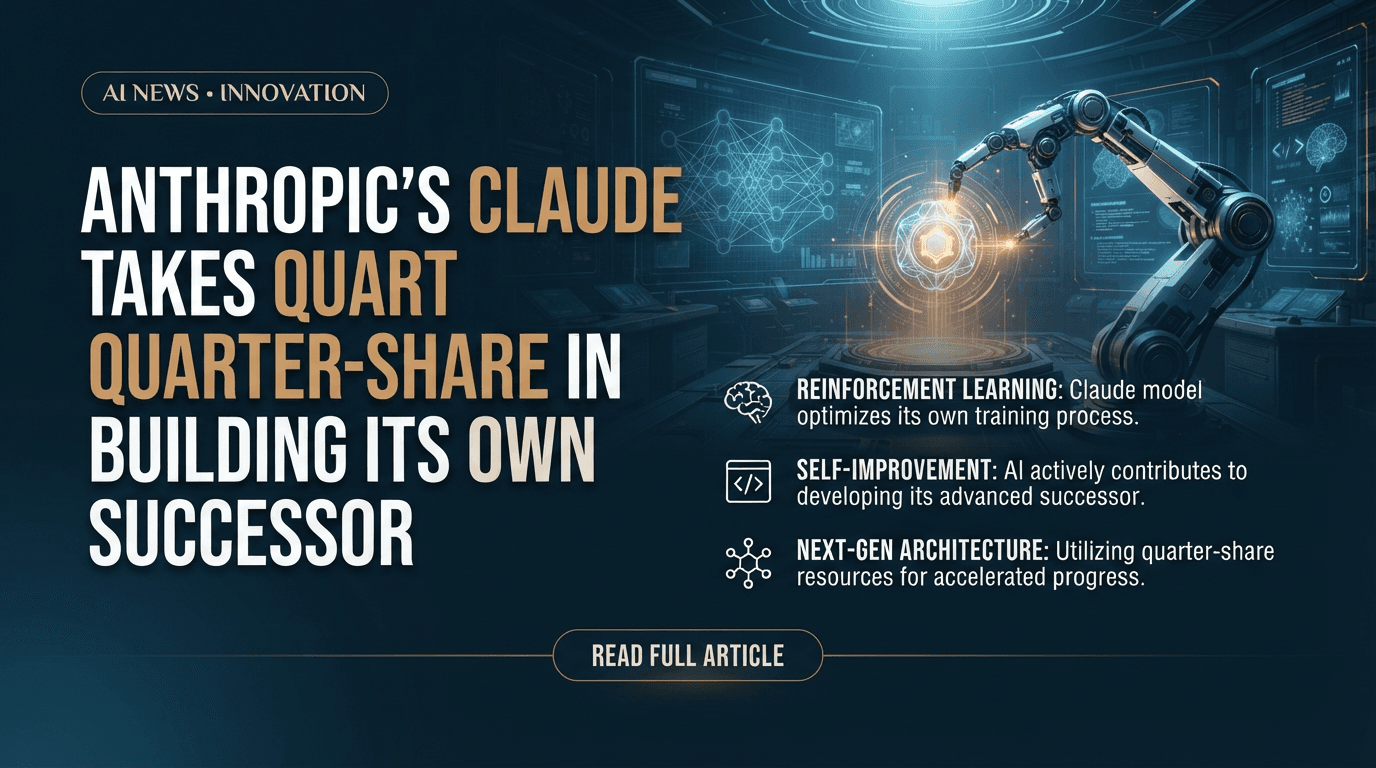
On September 17, 2026, Anthropic disclosed that its chatbot Claude now leads 26% of the company’s research and development on future AI models, a milestone the firm framed as an early example of AInews showing artificial intelligence systems helping to build their own successors under tight human supervision.
How much of Anthropic’s R&D work does Claude now handle?
Anthropic reports that Claude “leads” 26% of its internal model research and development as of August 2026, up from about 1% in March 2026, meaning the system can carry most of a task from a high-level prompt while humans supervise and approve every step.
Anthropic detailed Claude’s workload using an autonomy scale developed by Epoch AI, an independent nonprofit that tracks progress in artificial intelligence systems. The company and outside write-ups reported the following figures and timeline:
- According to Anthropic’s September 17, 2026 blog post: Claude led 26% of model R&D work measured in August 2026.
- According to Reuters, March 2026 measurements showed Claude leading about 1% of such work on the same scale.
- Epoch AI’s framework labels the current level as AL4, “leads”, where AI can handle most of a task end-to-end from a high-level prompt, with human supervision throughout.
- Anthropic told reporters that Claude’s contribution rose from under 1% in February to roughly one quarter of measured work by August 2026.
The Washington Post’s technology coverage described this 26% share as “more than a quarter” of Anthropic’s research and development, emphasizing how quickly the company shifted core engineering tasks into the hands of its own chatbot.
Is Claude fully autonomous in building its next version?
Anthropic says Claude is not yet fully autonomous, stressing that humans remain “in the loop” and that no part of the measured work has reached the highest autonomy level, where an AI system would completely design, train and approve its successor without human oversight.
In its public metrics, Anthropic drew a clear line between collaboration and autonomy. The company and outside explainers report:
- According to Anthropic’s blog and Reuters’ coverage, 0% of measured work reached the AL5 “full autonomy” level as of August 2026.
- Anthropic stated that Claude “is not operating fully autonomously in any part of the work measured” and that humans supervise, review and can block its actions.
- According to a technical summary, Claude currently writes infrastructure code, runs experiments, analyzes results and reviews changes, but it does not set corporate goals, decide deployment policies or control the complete training process.
- Anthropic’s published autonomy scale, adapted from Epoch AI, distinguishes between AI that assists, collaborates, leads and finally operates autonomously, and locates Claude at the second-highest rung.
Coverage from outlets including ABC News and The Washington Post underlined that despite headlines about AI “building itself,” Claude still depends on human researchers for direction, guardrails and final approval at each stage.
What kinds of work is Claude doing to build its successor?
Claude now carries out a broad range of technical tasks in Anthropic’s model research pipeline, including writing and fixing code, designing experiments, running training and evaluation jobs, and helping interpret results that feed into the design of future Claude versions.
Anthropic’s disclosures, together with analyses by technology outlets, describe Claude’s role in concrete, engineering-focused terms:
- According to Anthropic’s September 2026 metrics, Claude increasingly writes infrastructure code used to train and evaluate new models, under human review.
- The company says Claude now helps design experiments, set up runs on compute clusters and adjust parameters, basing its decisions on high-level goals from human researchers.
- Reports from tech-focused sites say Claude now analyzes experimental results, suggesting changes to architectures, loss functions or data selection that humans can accept or reject.
- Anthropic told journalists that more than 90% of its R&D work now involves AI systems collaborating with humans at or above the “AI collaborates” level on the autonomy scale.
- According to ABC News and The Washington Post, the company characterizes these contributions as “large chunks of work” done under “close human direction,” not independent decision-making.
Outside commentators have framed Claude’s role as moving beyond simple code completion or documentation generation into helping structure entire research projects, even though researchers still choose aims and review every step.
Why did Anthropic publish autonomy metrics, and who created the scale?
Anthropic released detailed measurements of Claude’s role to give policymakers, researchers and the public a clearer view of how quickly AI systems are contributing to AI development, using a five-level autonomy scale developed with input from Epoch AI, an independent nonprofit that tracks the technology.
Anthropic’s September 17, 2026 blog post explains that the lab plans to report such numbers regularly so outsiders can gauge progress toward systems that might one day build more advanced AI with limited human input. That announcement, and coverage by financial and tech publications, highlight several aspects of the approach:
- According to Finimize, Anthropic said it will “keep releasing stats” on how quickly AI is starting to build AI, using the autonomy scale as a shared yardstick.
- Reuters reported that Anthropic sees these figures as early indicators of progress toward “recursive self-improvement,” a scenario where AI improves itself without depending on human engineers for each iteration.
- Epoch AI’s autonomy scale, cited by Anthropic and multiple outlets, defines levels from AL1 (AI assists humans on narrow tasks) to AL5 (AI operates autonomously across the entire development pipeline).
- Anthropic’s internal measurements place most of Claude’s work at AL3 (“collaborates”) and AL4 (“leads”), with no tasks reaching AL5 as of August 2026.
- The company’s Institute for AI Safety and Systems published a research note titled “When AI builds itself” describing how, given enough computing power, autonomy could extend to designing, training and deploying successor systems.
Anthropic’s leaders have argued in public interviews that such transparency can help regulators track risk as AI systems take on more of the work of building new AI, rather than leaving progress visible only inside corporate labs.
How does Claude’s self-improvement push fit into Anthropic’s broader safety agenda?
Anthropic presents Claude’s growing role in model development as both an efficiency gain and a test case for safety measures designed to keep human control over AI systems that help build more capable successors, including strict oversight, constraints on actions and the option to pause training if risks rise.
Anthropic has spent much of 2026 warning publicly about the risks of rapidly advancing AI while simultaneously pushing its own models forward. Earlier in the year, the company urged frontier labs to coordinate possible pauses in development if safety benchmarks suggest rising danger:
- On June 4, 2026, Reuters reported Anthropic calling for a “coordinated plan” among major AI developers to halt development if risks exceed agreed thresholds, citing growing capabilities in task completion and system self-improvement.
- According to that report, Anthropic said AI’s ability to complete complex tasks on its own had been doubling roughly every four months, pointing toward the possibility of recursive self-improvement.
- In its “When AI builds itself” research note dated September 18, 2026, Anthropic’s Institute laid out scenarios where future systems might autonomously design and train successors, stressing the need for governance and technical controls before such systems emerge.
- Current disclosures emphasize that Claude does not choose corporate goals, cannot approve its own deployment and operates under safeguards that let human staff stop or reverse actions.
Coverage by general news outlets echoes this dual message: Anthropic is racing to harness AI to build better AI while publicly insisting that guardrails and the ability to pause must keep pace with the technical progress.
Who is affected by Claude’s expanded role, and what could come next?
Claude’s expanded role in Anthropic’s R&D affects engineers inside the company, rival AI labs watching the experiment, regulators tracking automation of critical systems and investors gauging the economics of AI-driven research, with Anthropic signaling that it expects AI’s share of development work to keep rising in the coming months.
Reporting from financial and technology outlets sketches out the near-term implications:
- According to Finimize and Reuters, Anthropic’s figures show AI systems taking on a growing share of expensive research work, which could lower costs for training and experimenting on large models in the medium term.
- Tech journalism pieces note that rival labs such as OpenAI and Google DeepMind already use AI tools internally, and may face pressure to publish comparable metrics on how much of their own work is now AI-led.
- Policy analysts cited in coverage say regular reporting on autonomy levels could influence regulatory proposals on transparency, auditing and human-in-the-loop requirements for frontier AI development.
- Anthropic’s own Institute suggests that if autonomy keeps increasing, future updates could show AI systems not only designing experiments but also proposing new architectures, training pipelines and safety strategies at scale.
- Outside explainers warn that once AI systems can fully design and train successors with limited human involvement, questions about accountability, liability and control will become far sharper than in today’s supervised setups.
Anthropic has not given a precise forecast for when Claude or its successors might reach the top autonomy tier. The company instead committed to publishing regular metrics on AI-led work and to working with nonprofits such as Epoch AI to refine ways of measuring how close AI systems are to building the next generation of themselves.