
allnewscastallnewscast
Breaking News
AI & Tech

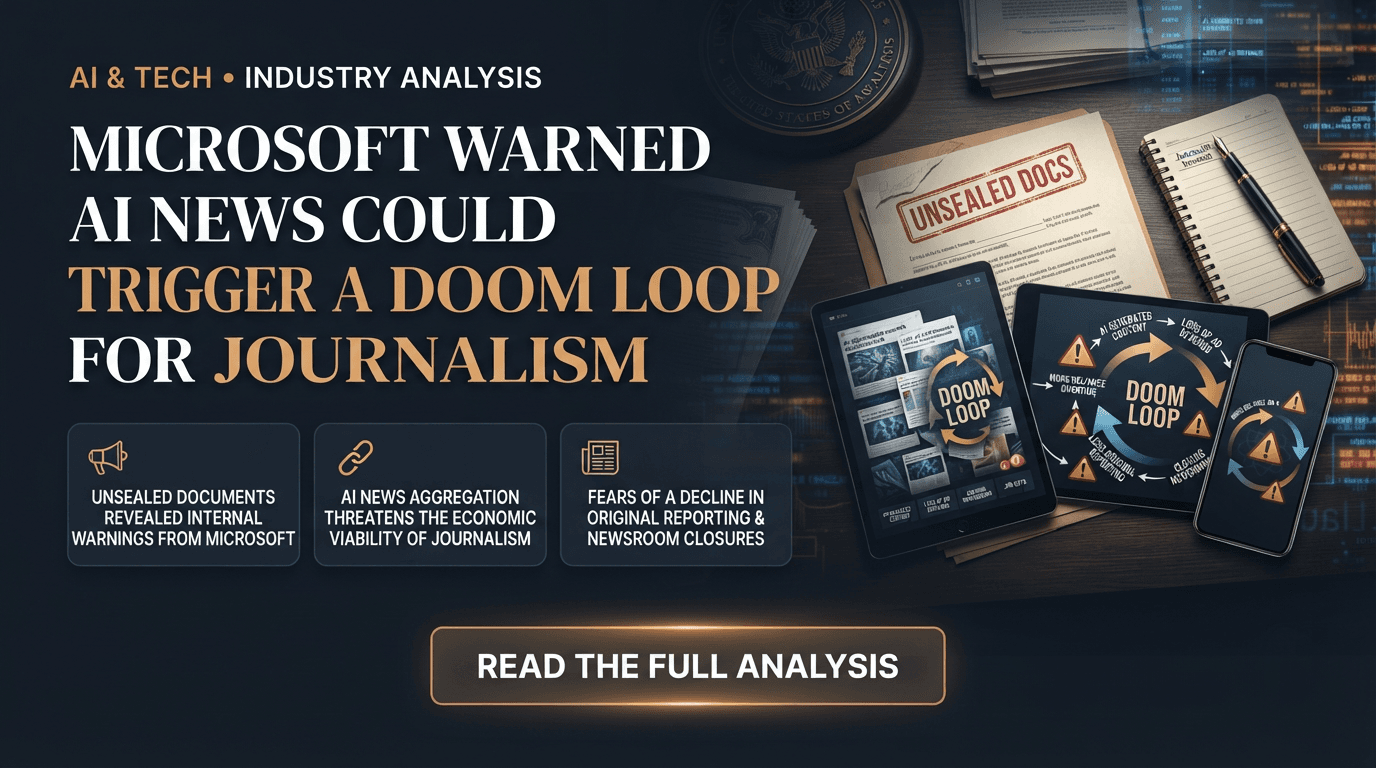
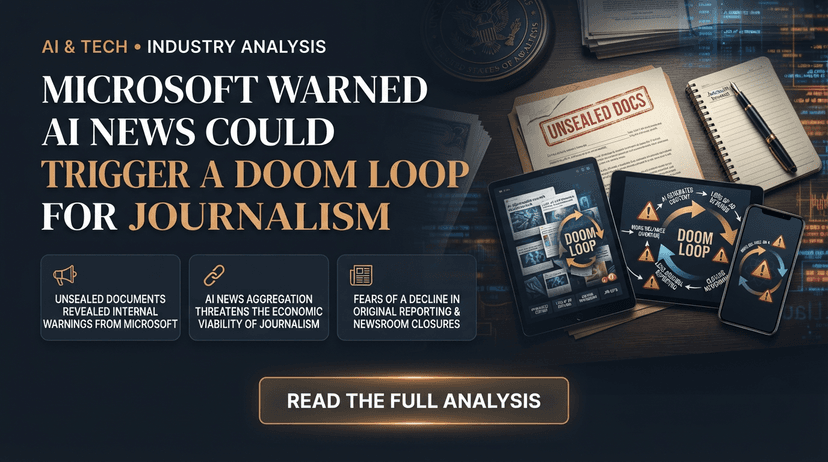
Unsealed Docs Show Microsoft Warned AInews Could Trigger a Doom Loop for Journalism
Nic Reeve8 min read
Unsealed Docs Show Microsoft Warned AInews Could Trigger a Doom Loop for Journalism

On September 17, 2026, newly unsealed court filings in The New York Times’ copyright lawsuit against OpenAI and Microsoft showed senior Microsoft executives warning that their AInews products risk creating a “doom loop” that drains traffic and money from news outlets while degrading the quality of information on the web itself.

What did the unsealed Microsoft documents say about AI and journalism?

The unsealed Microsoft documents describe internal warnings that AI answer engines trained on news articles could both undermine publishers’ business models and weaken the online information ecosystem that those same AI systems depend on.

Key passages from the filings show that Microsoft’s own researchers and product leaders were alarmed by how generative AI systems use and replace journalism:

  • According to TechCrunch, an internal presentation written by Microsoft Director of Applied Science Brent Hecht in January 2024 described the impact of large-scale AI scraping and answer engines as a “doom loop” that would “hurt the performance of our models and the entire web at the same time.”
  • The Washington Examiner reports that Hecht wrote, “Our AI content strategy has started a ‘doom loop’ that will hurt the performance of our models and the entire web at the same time,” calling the situation “highly unusual” because the end product threatens “the economic foundations of its essential suppliers.”
  • Law360 and MLex note that internal documents quote Microsoft and OpenAI employees acknowledging that unlicensed use of millions of news articles could begin a doom loop that endangers their “content supply chain.”
  • The Wrap cites filings where a Microsoft document warns that the companies’ AI approach had started a doom loop that would damage both model performance and “the entire web.”

These statements appear in an unredacted memorandum filed by lawyers for The New York Times in its ongoing copyright case against OpenAI and Microsoft in federal court in Manhattan. The case has been moving through the courts since 2023.

Who inside Microsoft raised alarms about AI scraping and labor “theft”?

Concerns inside Microsoft were led by Brent Hecht, the company’s Director of Applied Science, who repeatedly warned that scraping journalism at scale for AI training amounted to unprecedented theft of human labor.

The unsealed filings attribute several striking internal comments to Hecht:

  • TechCrunch reports that Hecht described large-scale AI scraping of online content as “the largest theft of labor in human history” during internal discussions documented in January 2023 and January 2024.
  • The New York Daily News notes that a senior Microsoft executive believed AI systems built on other people’s work would be seen as “an astonishing theft of unprecedented proportions” and possibly “the greatest robbery of labor in human history,” according to the unredacted court documents.
  • BrandiconImage and The Wrap both quote Hecht calling the copying of news articles “an astonishing theft of unprecedented proportions” and potentially the “largest theft of labor in human history.”
  • TweakTown, summarizing the filings, says Hecht argued that relying on “fair use” to justify mass scraping of news articles made a “complete mockery” of fair use as a legal concept.

These warnings portray internal recognition that the AI training pipelines built on publishers’ work were not just legally risky. They were seen by some of the engineers and scientists responsible for the systems as ethically and economically corrosive for the entire news ecosystem.

How is Microsoft’s AI answer engine affecting traffic to news publishers?

The filings assert that Microsoft’s AI-powered answer tools dramatically cut referral traffic to news outlets, raising fears that this substitution effect could erode the financial base that supports professional journalism.

Multiple sources describe internal metrics and testimony about how AI answers change user behavior:

  • TechBeat reports that unredacted documents say Hecht warned in January 2024 that Microsoft’s Copilot answer engine reduced click-through rates to New York Times articles by up to 93% compared with traditional Bing search results.
  • TweakTown’s summary of the same filings notes internal estimates that AI chatbots and answer boxes could cut publisher traffic by 51% to 94%, depending on the scenario and query type.
  • The Wrap recounts Microsoft CEO Satya Nadella’s testimony that conversations with chatbots had already substituted for visits to news websites by “giving you the information right there on the website on the AI platform versus needing to go to the underlying source.”

These numbers, all attributed to internal assessments and court testimony in 2024 and 2025, suggest that AI answer engines do not simply coexist with news sites. They can replace the need for many users to click through, weakening advertising revenue and subscriptions that depend on direct visits.

What exactly is the “doom loop” Microsoft executives described?

The “doom loop” described in the court filings refers to a self-reinforcing cycle in which AI systems undermine the economic viability of news outlets, leading to worse content on the web, which then harms the AI models that rely on that content.

Internal documents quoted across several reports outline the logic of this loop:

  • Ground News and EuropeSays explain that Hecht’s memo warned generative AI products had created a doom loop that is “eating the web and destroying the businesses that these companies stole from,” by substituting AI answers for visits to publishers.
  • The Washington Examiner cites a Microsoft document saying, “It is highly unusual that an end-product threatens the economic foundations of its essential suppliers, but that is the situation we have created for our LLM business with respect to its ‘content supply chain.’”
  • BrandiconImage notes that the filings describe a scenario in which declining traffic to news sites weakens the broader online ecosystem and ultimately reduces the quality of information available to AI systems.
  • TweakTown’s coverage summarizes the loop as: AI answer engines cut traffic, lower financial incentives for journalists, shrink the supply of high-quality reporting, and then damage the very models that need that reporting for training.

The core idea is simple. Less money for journalism means fewer reporters and less reliable news. AI models trained on that degraded content will perform worse, which harms users and the platforms themselves.

How does the New York Times lawsuit frame these internal admissions?

The New York Times uses the internal Microsoft and OpenAI admissions to argue that the companies knowingly built profitable AI systems on unlicensed news content, while recognizing that this strategy threatened the very publishers who produced that content.

Recent coverage of the unsealed filings outlines the Times’ legal narrative:

  • KuCoin’s legal news summary states that the newly unsealed memorandum in The New York Times v. OpenAI copyright lawsuit was written by Times lawyers and “largely comprised” statements and interviews with tech executives acknowledging that large language models were “built on content described by Microsoft executives as an unprecedented scale of theft.”
  • Ground News reports that the filings present executives’ own words to show that large language models are “predatory” technologies, trained on “stolen content” that pose an “existential risk” to human writers, artists and media companies.
  • MLex describes the new documents as showing knowledge of “AI copying costs to US news companies,” including recognition that unlicensed use of millions of articles to train chatbots could initiate the doom loop and represent the “largest theft of labor in human history.”
  • Law360 notes that Microsoft and OpenAI employees had internally acknowledged for years that tools trained on news articles would likely replace publishers, leading to the doom loop scenario.

By highlighting these internal statements, the Times aims to strengthen its claim that OpenAI and Microsoft knowingly relied on unlicensed journalism while foreseeing the damage to publishers.

What are OpenAI’s internal concerns about publishers and substitution?

The unsealed filings do not focus only on Microsoft. They also reveal internal OpenAI fears that chatbots would become direct substitutes for news publishers, undermining the business case for continued reporting.

Several sources summarize these concerns:

  • According to BrandiconImage, Nick Turley, who led the team developing ChatGPT, warned in a 2023 internal memo that AI represented an “existential threat” to publishers.
  • The Wrap reports that Turley wrote that publishers faced an existential threat from AI products that were already “largely substitutive” and would become more so as the systems improved.
  • Law360 states that OpenAI and Microsoft employees acknowledged for years that AI tools trained on news articles would likely replace publishers, contributing to the doom loop described in the filings.

These internal comments echo the worries of many editors and reporters: if users can ask a chatbot for a summary instead of visiting a news site, long-term funding for independent journalism becomes precarious.

What broader implications does this doom loop have for the future of news?

The doom loop described by Microsoft and OpenAI staff suggests that current generative AI strategies could destabilize the business of news, reduce the quality of information online, and ultimately damage AI systems themselves unless new economic and legal arrangements emerge.

Across the reports, several themes recur:

  • Executives privately agree with publishers’ warnings that generative AI poses an “existential threat” to news organizations when it siphons both content and audience without paying for either.
  • Internal Microsoft discussions emphasize that the economic foundations of journalism are part of the “content supply chain” for AI, meaning that harming publishers also harms AI products over time.
  • The filings highlight the mismatch between short-term gains—offering instant answers that users love—and long-term risks, such as fewer reporters investigating public-interest stories because revenue has collapsed.
  • Several analyses argue that the doom loop concept may push courts and regulators to consider new models, including licensing deals, compulsory fees, or explicit limits on scraping and training data drawn from professional news outlets.

The immediate dispute centers on New York Times content and current AI products. The underlying question is whether the web that AI relies on can survive if its core economic engine—commercial and subscription-supported journalism—is hollowed out by the very systems that now scrape and summarize its work.

Sources

  1. 1.techcrunch.com
  2. 2.nydailynews.com
  3. 3.washingtonexaminer.com
  4. 4.newsbytesapp.com
  5. 5.nypost.com
  6. 6.europesays.com
  7. 7.brandiconimage.com
  8. 8.ground.news
  9. 9.us.headtopics.com
  10. 10.kucoin.com
  11. 11.thewrap.com
  12. 12.law360.com
  13. 13.mlex.com
  14. 14.tweaktown.com
  15. 15.techbeat.co

Read more

Related Articles

AInews: TAO Price Forecasts Spike As Fresh AI Agent Platforms Go Live
AI & Tech

AInews: TAO Price Forecasts Spike As Fresh AI Agent Platforms Go Live

AInews: TAO Price Forecasts Spike As Fresh AI Agent Platforms Go Live On 13–20 September 2026, analysts pushed Bittensor’s TAO token price forecasts sharply higher while new autonomous AI agent tools arrived on the market, turning AInews into a window onto both speculative crypto bets and practical software shifting how developers build automated digital workers. What is happening to TAO’s price right now? TAO is trading in the mid‑$250 range and has swung 8–9% in recent days as traders respond to protocol upgrades and the broader AI token rally. Forecasts for September 2026 cluster around a bullish band between roughly $220 and $541, depending on the model and risk assumptions. Recent market data shows: According to CoinMarketCap’s TAO coverage on 18–20 September 2026, TAO has traded roughly between $233 and $260 during several short rallies and pullbacks, with daily moves of 3–9% common in the last week. CoinLore’s short‑term forecast dated 20 September 2026 puts TAO’s current price near $262.32 and projects $250.14 for 21 September 2026, with a 24‑hour trading range expectation between $245.27 and $277.89. CoinMarketCap’s analysis of an 8–9% surge in the 25 hours to 18 September 2026 links the move to protocol tokenomics changes, AI‑linked capital rotation and a technical breakout pattern in the chart. Those swings sit on top of a still‑volatile backdrop. TAO dropped about 4% in a single overnight window in June 2026 when emissions changes and a soft market hit at the same time, according to CoinMarketCap’s June price series review. That context keeps short‑term traders cautious even as price forecasts rise. How high are current TAO price predictions for September 2026? Retail‑focused forecasting sites now show TAO’s possible September 2026 range spanning from the low‑$170s in bearish scenarios up to more than $1,100 in aggressive bullish models. Most cluster in a narrower band, around $220–$370 for traders and $364–$541 in analytical long‑range models. Different services publish notably different numbers: Cryptopolitan’s September 13, 2026 report on Bittensor expects TAO’s September average price around $210, with a bullish breakout target at $275 and a worst‑case low near $176 based on technical resistance and support. OpenPR’s September 13, 2026 note on “TAO Targets $300 After AI Upgrades” argues that $300 is a key recovery level, with TAO trading around $234 at the time and facing overhead resistance near $260. Changelly’s long‑range Bittensor forecast updated September 20, 2026 places September 2026 price scenarios between a minimum of $363.90 and a maximum of $541.27, with an average of $452.59, based on historical volatility and expected AI‑sector demand. CoinLore’s near‑term model, refreshed September 20, 2026, sees the week of 21–28 September sliding from about $250.14 down toward the low $240s before a small bounce, which sketches a more cautious near‑term path. CoinCodex’s predictive model, updated in late August 2026, projected a short dip to around $176.10 by early September, showing how older data can under‑state the later rally driven by AI token narratives. These predictions use different inputs. Some rely mainly on chart patterns and momentum, while others embed assumptions about expanding decentralized AI demand and sustained attention to Bittensor’s role as a specialist network for machine learning workloads. Why are TAO forecasts climbing despite recent volatility? Forecasts are climbing because TAO sits at the intersection of two stories: an evolving tokenomics design that reduces emissions from idle subnets and a global wave of interest in decentralized AI infrastructure. Upgrades, narrative shifts and external AI milestones all feed into traders’ expectations. Analysts point to several concrete factors: CoinMarketCap’s September 18, 2026 coverage of an 8–9% TAO surge highlights “protocol tokenomics upgrades” that alter staking rewards and emissions, making the asset look more deflationary and thus more attractive to investors betting on scarcity. Another CoinMarketCap analysis from mid‑September notes that the Bittensor core team turned off emissions to 57 “dead” subnets — those with no active miner mechanism or usable code — with plans for weekly clean‑ups, sharpening focus on productive parts of the network. CryptoRank’s April 11, 2026 report on TAO’s 25% crash during Covenant AI’s exit from the network, updated in September, reminds traders of governance risks yet also shows the market’s ability to absorb shocks, with TAO bouncing back from lows near $250 toward the $260s. Cryptonews and other outlets emphasise the 21 million TAO maximum supply cap maintained by the Bittensor protocol, framing it as a parallel to bitcoin’s fixed issuance model but linked to AI model training and inference instead of pure store‑of‑value use. When combined with higher‑profile AI milestones such as OpenAI’s GPT‑6 “Astra” preview and Anthropic’s pre‑IPO positioning, reported by CoinMarketCap on September 18, 2026, TAO’s positioning as a “decentralized AI pure play” encourages some traders to treat the token as a leveraged bet on AI demand rather than just another altcoin. How do new AI agent tools intersect with this crypto rally? A burst of new AI agent frameworks and services appearing in early September 2026 connects directly to the AI‑token story, because both trends express demand for autonomous software that can schedule tasks, execute workflows and operate across multiple apps without step‑by‑step human input. Recent reporting on the software side lists several developments: DutchStartup.ai’s September 7, 2026 feature describes “a wave of new AI agent tools” landing around September 4. Teams shipped fresh frameworks that let developers define long‑running goals, with agents planning, executing and revising tasks based on feedback. The same report notes that existing platforms updated their orchestration layers so agents can call APIs, trigger cloud functions and coordinate with other agents, making them capable of handling complex, multi‑step processes such as grant applications or sales outreach. Several open‑source projects are highlighted as “agent platforms” that run on commodity cloud but could, in principle, connect to networks such as Bittensor to outsource heavy inference workloads, reinforcing the potential link between TAO‑priced compute and agent deployments. These tools arrive as AI companies explore how far they can push automation. Traders watching TAO price action view expanding agent ecosystems as indirect confirmation that demand for decentralized, market‑priced compute services may grow, which feeds back into bullish token forecasts. Who is most exposed to TAO’s swings and the new agent ecosystem? TAO’s volatility and the emerging agent tools touch different groups. Short‑term crypto traders face sharp swings. Long‑term Bittensor stakers and subnet developers watch governance and emissions changes. Meanwhile, AI builders and startups evaluate whether new agents can lower operating costs or open fresh revenue streams. On the TAO side, exposure breaks down into: Day traders and derivatives users speculating on 3–9% daily moves documented by CoinMarketCap’s mid‑September 2026 charts, often using leverage that magnifies both gains and losses. Stakers who lock TAO to support subnets and earn emissions. The decision by Bittensor’s root governance to cut rewards to inactive subnets changes their yield expectations and influences how they allocate capital across the network. Developers who build AI models that rely on TAO‑denominated incentives. Their income streams depend on protocol rules and market prices staying supportive enough to cover infrastructure and research costs. For AI agent tools, exposure looks different: Startups adopting agent frameworks reported by DutchStartup.ai in early September 2026 hope to automate tasks such as booking meetings, handling first‑line customer support or managing data pipelines with minimal supervision. Enterprise IT teams test new orchestration features that link agents to internal systems, raising questions about security, audit trails and compliance as more processes execute without direct human commands. Individual professionals experiment with off‑the‑shelf agents that promise to manage email, research or scheduling, which shifts some white‑collar workloads toward software but still requires careful oversight. What might happen next for TAO and AI agent platforms? The next months will likely hinge on whether Bittensor’s tokenomics changes and governance debates calm investors, and whether AI agent tools move from pilot projects into production deployments. Forecasts remain wide, signalling uncertainty but also strong expectations of continued AI‑linked activity. On TAO’s path forward, available analyses highlight: OpenPR’s mid‑September 2026 prediction of a $300 recovery target assumes smooth integration of recent protocol upgrades and sustained AI‑sector interest. If governance disputes resurface, that path could stall. Cryptopolitan’s broader 2026–2032 outlook places a possible high near $371 for 2026, with an average around $210, underscoring that even optimistic scenarios see extended periods of consolidation and correction. Changelly’s longer‑term estimate of a near‑$1,000 average for TAO in 2026, framed as a theoretical end‑of‑year level, depends on aggressive adoption of decentralized AI and continued scarcity thanks to the 21 million token cap reported by crypto data services. For AI agent tools, DutchStartup.ai’s early‑September 2026 survey suggests that the coming quarters will bring more competition: new frameworks, tighter integrations into productivity suites and cloud providers, and experiments in combining financial incentives with agent performance metrics. As these systems scale, they may drive more demand for flexible AI compute networks, including those priced via tokens like TAO.

Nic Reeve·
Unsealed Docs Show Microsoft Warned AInews Could Trigger a Doom Loop for Journalism
AI & Tech

Unsealed Docs Show Microsoft Warned AInews Could Trigger a Doom Loop for Journalism

On September 17, 2026, newly unsealed court filings in The New York Times’ copyright lawsuit against OpenAI and Microsoft showed senior Microsoft executives warning that their AInews products risk creating a “doom loop” that drains traffic and money from news outlets while degrading the quality of information on the web itself. What did the unsealed Microsoft documents say about AI and journalism? The unsealed Microsoft documents describe internal warnings that AI answer engines trained on news articles could both undermine publishers’ business models and weaken the online information ecosystem that those same AI systems depend on. Key passages from the filings show that Microsoft’s own researchers and product leaders were alarmed by how generative AI systems use and replace journalism: According to TechCrunch, an internal presentation written by Microsoft Director of Applied Science Brent Hecht in January 2024 described the impact of large-scale AI scraping and answer engines as a “doom loop” that would “hurt the performance of our models and the entire web at the same time.” The Washington Examiner reports that Hecht wrote, “Our AI content strategy has started a ‘doom loop’ that will hurt the performance of our models and the entire web at the same time,” calling the situation “highly unusual” because the end product threatens “the economic foundations of its essential suppliers.” Law360 and MLex note that internal documents quote Microsoft and OpenAI employees acknowledging that unlicensed use of millions of news articles could begin a doom loop that endangers their “content supply chain.” The Wrap cites filings where a Microsoft document warns that the companies’ AI approach had started a doom loop that would damage both model performance and “the entire web.” These statements appear in an unredacted memorandum filed by lawyers for The New York Times in its ongoing copyright case against OpenAI and Microsoft in federal court in Manhattan. The case has been moving through the courts since 2023. Who inside Microsoft raised alarms about AI scraping and labor “theft”? Concerns inside Microsoft were led by Brent Hecht, the company’s Director of Applied Science, who repeatedly warned that scraping journalism at scale for AI training amounted to unprecedented theft of human labor. The unsealed filings attribute several striking internal comments to Hecht: TechCrunch reports that Hecht described large-scale AI scraping of online content as “the largest theft of labor in human history” during internal discussions documented in January 2023 and January 2024. The New York Daily News notes that a senior Microsoft executive believed AI systems built on other people’s work would be seen as “an astonishing theft of unprecedented proportions” and possibly “the greatest robbery of labor in human history,” according to the unredacted court documents. BrandiconImage and The Wrap both quote Hecht calling the copying of news articles “an astonishing theft of unprecedented proportions” and potentially the “largest theft of labor in human history.” TweakTown, summarizing the filings, says Hecht argued that relying on “fair use” to justify mass scraping of news articles made a “complete mockery” of fair use as a legal concept. These warnings portray internal recognition that the AI training pipelines built on publishers’ work were not just legally risky. They were seen by some of the engineers and scientists responsible for the systems as ethically and economically corrosive for the entire news ecosystem. How is Microsoft’s AI answer engine affecting traffic to news publishers? The filings assert that Microsoft’s AI-powered answer tools dramatically cut referral traffic to news outlets, raising fears that this substitution effect could erode the financial base that supports professional journalism. Multiple sources describe internal metrics and testimony about how AI answers change user behavior: TechBeat reports that unredacted documents say Hecht warned in January 2024 that Microsoft’s Copilot answer engine reduced click-through rates to New York Times articles by up to 93% compared with traditional Bing search results. TweakTown’s summary of the same filings notes internal estimates that AI chatbots and answer boxes could cut publisher traffic by 51% to 94%, depending on the scenario and query type. The Wrap recounts Microsoft CEO Satya Nadella’s testimony that conversations with chatbots had already substituted for visits to news websites by “giving you the information right there on the website on the AI platform versus needing to go to the underlying source.” These numbers, all attributed to internal assessments and court testimony in 2024 and 2025, suggest that AI answer engines do not simply coexist with news sites. They can replace the need for many users to click through, weakening advertising revenue and subscriptions that depend on direct visits. What exactly is the “doom loop” Microsoft executives described? The “doom loop” described in the court filings refers to a self-reinforcing cycle in which AI systems undermine the economic viability of news outlets, leading to worse content on the web, which then harms the AI models that rely on that content. Internal documents quoted across several reports outline the logic of this loop: Ground News and EuropeSays explain that Hecht’s memo warned generative AI products had created a doom loop that is “eating the web and destroying the businesses that these companies stole from,” by substituting AI answers for visits to publishers. The Washington Examiner cites a Microsoft document saying, “It is highly unusual that an end-product threatens the economic foundations of its essential suppliers, but that is the situation we have created for our LLM business with respect to its ‘content supply chain.’” BrandiconImage notes that the filings describe a scenario in which declining traffic to news sites weakens the broader online ecosystem and ultimately reduces the quality of information available to AI systems. TweakTown’s coverage summarizes the loop as: AI answer engines cut traffic, lower financial incentives for journalists, shrink the supply of high-quality reporting, and then damage the very models that need that reporting for training. The core idea is simple. Less money for journalism means fewer reporters and less reliable news. AI models trained on that degraded content will perform worse, which harms users and the platforms themselves. How does the New York Times lawsuit frame these internal admissions? The New York Times uses the internal Microsoft and OpenAI admissions to argue that the companies knowingly built profitable AI systems on unlicensed news content, while recognizing that this strategy threatened the very publishers who produced that content. Recent coverage of the unsealed filings outlines the Times’ legal narrative: KuCoin’s legal news summary states that the newly unsealed memorandum in The New York Times v. OpenAI copyright lawsuit was written by Times lawyers and “largely comprised” statements and interviews with tech executives acknowledging that large language models were “built on content described by Microsoft executives as an unprecedented scale of theft.” Ground News reports that the filings present executives’ own words to show that large language models are “predatory” technologies, trained on “stolen content” that pose an “existential risk” to human writers, artists and media companies. MLex describes the new documents as showing knowledge of “AI copying costs to US news companies,” including recognition that unlicensed use of millions of articles to train chatbots could initiate the doom loop and represent the “largest theft of labor in human history.” Law360 notes that Microsoft and OpenAI employees had internally acknowledged for years that tools trained on news articles would likely replace publishers, leading to the doom loop scenario. By highlighting these internal statements, the Times aims to strengthen its claim that OpenAI and Microsoft knowingly relied on unlicensed journalism while foreseeing the damage to publishers. What are OpenAI’s internal concerns about publishers and substitution? The unsealed filings do not focus only on Microsoft. They also reveal internal OpenAI fears that chatbots would become direct substitutes for news publishers, undermining the business case for continued reporting. Several sources summarize these concerns: According to BrandiconImage, Nick Turley, who led the team developing ChatGPT, warned in a 2023 internal memo that AI represented an “existential threat” to publishers. The Wrap reports that Turley wrote that publishers faced an existential threat from AI products that were already “largely substitutive” and would become more so as the systems improved. Law360 states that OpenAI and Microsoft employees acknowledged for years that AI tools trained on news articles would likely replace publishers, contributing to the doom loop described in the filings. These internal comments echo the worries of many editors and reporters: if users can ask a chatbot for a summary instead of visiting a news site, long-term funding for independent journalism becomes precarious. What broader implications does this doom loop have for the future of news? The doom loop described by Microsoft and OpenAI staff suggests that current generative AI strategies could destabilize the business of news, reduce the quality of information online, and ultimately damage AI systems themselves unless new economic and legal arrangements emerge. Across the reports, several themes recur: Executives privately agree with publishers’ warnings that generative AI poses an “existential threat” to news organizations when it siphons both content and audience without paying for either. Internal Microsoft discussions emphasize that the economic foundations of journalism are part of the “content supply chain” for AI, meaning that harming publishers also harms AI products over time. The filings highlight the mismatch between short-term gains—offering instant answers that users love—and long-term risks, such as fewer reporters investigating public-interest stories because revenue has collapsed. Several analyses argue that the doom loop concept may push courts and regulators to consider new models, including licensing deals, compulsory fees, or explicit limits on scraping and training data drawn from professional news outlets. The immediate dispute centers on New York Times content and current AI products. The underlying question is whether the web that AI relies on can survive if its core economic engine—commercial and subscription-supported journalism—is hollowed out by the very systems that now scrape and summarize its work.
Nic Reeve·
Gillibrand and Welch Set Fall Senate Hearing Schedule For Tariff Repeal Bill
Politics & Elections

Gillibrand and Welch Set Fall Senate Hearing Schedule For Tariff Repeal Bill

Gillibrand and Welch Set Fall Senate Hearing Schedule For Tariff Repeal Bill On August 27, 2026, Senators Kirsten Gillibrand of New York and Peter Welch of Vermont announced the Banning Antiquated Duties and Delivering Equitable American Levies Act, while outlining a tentative senate hearing schedule aimed at repealing tariffs imposed under Section 338 of the Tariff Act of 1930. What did New York and Vermont Senate Democrats propose? New York Senator Kirsten Gillibrand and Vermont Senator Peter Welch proposed the BAD DEAL Act, a bill that would repeal Section 338 of the Tariff Act of 1930, cancel related presidential tariff proclamations, and refund duties already collected from U.S. importers, including newly announced 50% tariffs on Canadian goods. The proposal is formally titled the Banning Antiquated Duties and Delivering Equitable American Levies Act , or BAD DEAL Act. According to the draft bill text published by Senator Welch’s office on August 27, 2026, the measure would: "Repeal Section 338 of the Tariff Act of 1930 (19 U.S.C. 1338)." Void "any Presidential proclamation promulgated in whole or in part pursuant to such section." Require federal agencies to provide refunds of each tariff or duty imposed under Section 338. CPA Practice Advisor reported on August 31, 2026, that the bill is a direct response to new tariffs on Canadian imports, including a 50% duty rate announced by President Donald Trump over the preceding weekend. A press release from Representative Brad Schneider’s office, dated August 29, 2026, describes the BAD DEAL Act as designed to "repeal Section 338 and refund all duties paid under this authority." Why are the senators targeting Section 338 tariffs now? Senators Gillibrand and Welch are targeting Section 338 tariffs because President Trump recently used this long‑dormant law to impose sweeping duties on Canadian imports, including a 50% tariff that Democrats say is hurting American families and businesses and reviving trade tensions with a key U.S. ally. According to WAMC’s report on August 28, 2026, the BAD DEAL Act aims to reverse "Trump administration tariffs on Canada" by repealing tariffs levied under Section 338 and refunding Americans who have been paying the higher prices. CPA Practice Advisor notes that the tariffs apply broadly to Canadian imports and followed a presidential announcement of a 50% tariff rate. Gillibrand’s Senate office framed the move squarely as a consumer issue. In an August 27, 2026 press notice, her office stated that "New York families have spent over $5,000 more due to President Trump’s tariff chaos and other reckless policies," citing the cumulative cost of recent trade measures and inflation pressures. That figure reflects Gillibrand’s internal analysis and is presented as an impact estimate rather than official federal data. The BAD DEAL Act also fits into a wider pattern of congressional resistance to Trump‑era tariff policies. On February 24, 2026, Senator Ron Wyden introduced the Tariff Refund Act of 2026, a separate proposal to refund certain duties after court rulings against earlier tariffs. In October 2025, Senator Welch joined a bipartisan group praising Senate passage of a different measure to repeal Trump’s global tariffs imposed under emergency authorities. These earlier efforts created a legislative backdrop for the targeted repeal of Section 338 in late August 2026. How would the BAD DEAL Act change current tariffs and refund payments? The BAD DEAL Act would repeal the legal authority for Section 338 tariffs, cancel any related presidential proclamations, and order federal agencies to issue refunds to importers for all duties collected under that section, including the recent 50% tariffs on Canadian products. The bill text from Senator Welch’s office lays out the mechanics clearly. Key implementation provisions include: Repeal of Section 338 itself, removing the statutory basis for retaliation‑style tariffs originally crafted in 1930. Termination of any presidential proclamation that invoked Section 338, meaning the tariffs become legally void once the act takes effect. A directive that relevant agencies "take such actions as may be necessary to provide for the refund of each tariff or other duty imposed and collected" under Section 338. Inside U.S. Trade reported on August 28, 2026 that Democrats on both the House Ways and Means Committee and the Senate Finance Committee are backing the measure, viewing refunds as central to the bill’s design. Representative Brad Schneider’s press release underscores that point, saying the BAD DEAL Act would "refund all duties paid under this authority" and thus return money to U.S. businesses that import from Canada. While precise refund totals have not been published, Gillibrand’s office argues that families and firms in New York and other states face higher costs on everyday goods sourced from Canada. By canceling the tariffs and ordering refunds, the sponsors say they aim to ease price pressures and send a message that Congress will not accept unilateral tariff hikes launched under obscure provisions of trade law. What is the planned Senate process and timetable for the tariff repeal bill? The sponsors expect the BAD DEAL Act to enter the Senate Finance Committee when lawmakers return from their August recess, with hearings anticipated in September and potential floor consideration before year‑end, mirroring timelines used for other tariff‑related bills introduced in the 2025‑2026 Congress. CPA Practice Advisor reports that Gillibrand and Welch "signaled their intent to introduce the bill when the Senate returns to session next month," referencing the early‑September reconvening after the summer break. Under standard Senate procedure, tariff legislation is referred to the Finance Committee, which is already handling related measures such as Wyden’s Tariff Refund Act of 2026. The expected steps, based on the sponsors’ statements and usual Senate practice, are: Formal introduction of the BAD DEAL Act in early September 2026, with Gillibrand as the lead Senate sponsor and Welch as co‑sponsor. Referral to the Senate Finance Committee, where staff have experience with tariff repeal and refund proposals. Potential hearings in the fall focusing on Section 338’s history, Trump’s recent tariffs on Canada, and the impact on U.S. businesses. Committee markup followed by a possible floor vote before the end of the 2026 session, depending on broader negotiations over trade and tax legislation. Representative Schneider has already filed the House companion, positioning it in the Ways and Means Committee’s trade subcommittee. That parallel track means House hearings and markups could run close to the Senate’s fall calendar, raising the possibility of a coordinated push to move the repeal through both chambers within months. How does this effort relate to previous congressional actions on Canada tariffs? The BAD DEAL Act builds on earlier federal and state‑level moves opposing Trump’s tariffs on Canada, including a Vermont Senate resolution urging the removal of all Canada‑related tariffs and a 2025 bipartisan Senate vote to roll back other Trump global tariffs. On the state side, the Vermont Legislature adopted S.R.11 in the 2025‑2026 session, a resolution honoring historic ties with Canada and Quebec and calling on Congress to reassert its trade policy role. The text urged President Trump to "remove all tariffs he has imposed on Canada since January 20, 2025," including those outside the United States‑Mexico‑Canada Agreement. That resolution, though symbolic, signaled deep concern in Welch’s home state about the direction of trade relations. At the federal level, Senator Welch has already worked on broader tariff rollbacks. In October 2025, he joined a bipartisan group—including Senators Ron Wyden, Chuck Schumer, Rand Paul, Tim Kaine, Jeanne Shaheen and Elizabeth Warren—in supporting a measure that would repeal Trump’s global tariffs enacted under emergency powers. The resolution passed the Senate on a 51‑47 vote, then moved to the House, setting a precedent for challenging presidential tariff actions. WAMC’s coverage links Gillibrand and Welch’s new proposal directly to those earlier fights over tariffs on Canadian products. Their offices portray the BAD DEAL Act not as a standalone event but as part of a broader effort to restore congressional control over trade and to protect cross‑border economic ties that are central to communities in northern New York and Vermont. Who would be most affected if Section 338 tariffs are repealed? If Congress passes the BAD DEAL Act, importers that pay duties on Canadian goods would see direct financial relief through refunds, while consumers in border states such as New York and Vermont could face lower prices on products sourced from Canadian suppliers. The sectors most exposed to Canada‑focused tariffs include manufacturers and retailers that rely on Canadian inputs, cross‑border wholesalers, and small businesses near the border that import consumer goods. While precise trade volumes tied to Section 338 tariffs have not been released, the sponsors highlight several categories affected by Trump’s latest actions: Household products imported from Canada that now carry a 50% tariff. Industrial inputs and components sourced by manufacturers in New York and New England. Food and agricultural products moving through established cross‑border supply chains. Gillibrand’s office estimated that "New York families have spent over $5,000 more" due to a combination of tariffs and other policies, framing the repeal as part of a strategy to reduce living costs. While that figure aggregates various economic pressures, tariffs on Canada are among the components cited in the senator’s argument for relief. Businesses that paid duties under Section 338 would stand to receive refunds. Inside U.S. Trade notes that Democrats backing the BAD DEAL Act see these refunds as a way to restore competitiveness and cash flow in sectors hit by sudden tariff hikes. Schneider’s press release stresses that the bill is intended to "refund all duties paid", signaling that the sponsors view repayment as a central promise to affected companies. What happens next in Congress and in U.S.-Canada trade relations? The BAD DEAL Act faces negotiations within the Senate Finance and House Ways and Means committees, but it enters the fall session with visible Democratic support and fits broader efforts to ease tensions with Canada, a key trading partner for New York and Vermont. In the near term, the key milestones will be: Formal Senate introduction and committee referral when lawmakers return from recess in early September 2026. Committee work on testimony from business groups, trade experts and possibly Canadian officials or consular representatives. Potential bundling of the BAD DEAL Act with other tariff refund bills such as Wyden’s Tariff Refund Act of 2026, to create a broader package. House hearings under the Ways and Means trade subcommittee on Schneider’s companion bill. If Congress ultimately repeals Section 338 tariffs and orders refunds, the decision would mark a reset of the most recent clash over U.S.-Canada trade triggered by Trump’s 2026 tariff announcement. Vermont’s S.R.11 and past Senate votes against wider Trump tariffs show that concerns about Canada trade are already part of the legislative record. For New York and Vermont, where cross‑border flows of goods and tourism play a visible role in local economies, the outcome of this tariff repeal push will shape prices, business planning and political narratives heading into the 2026 election cycle.

Marcus Feld·