
allnewscastallnewscast
Breaking News
AI & Tech

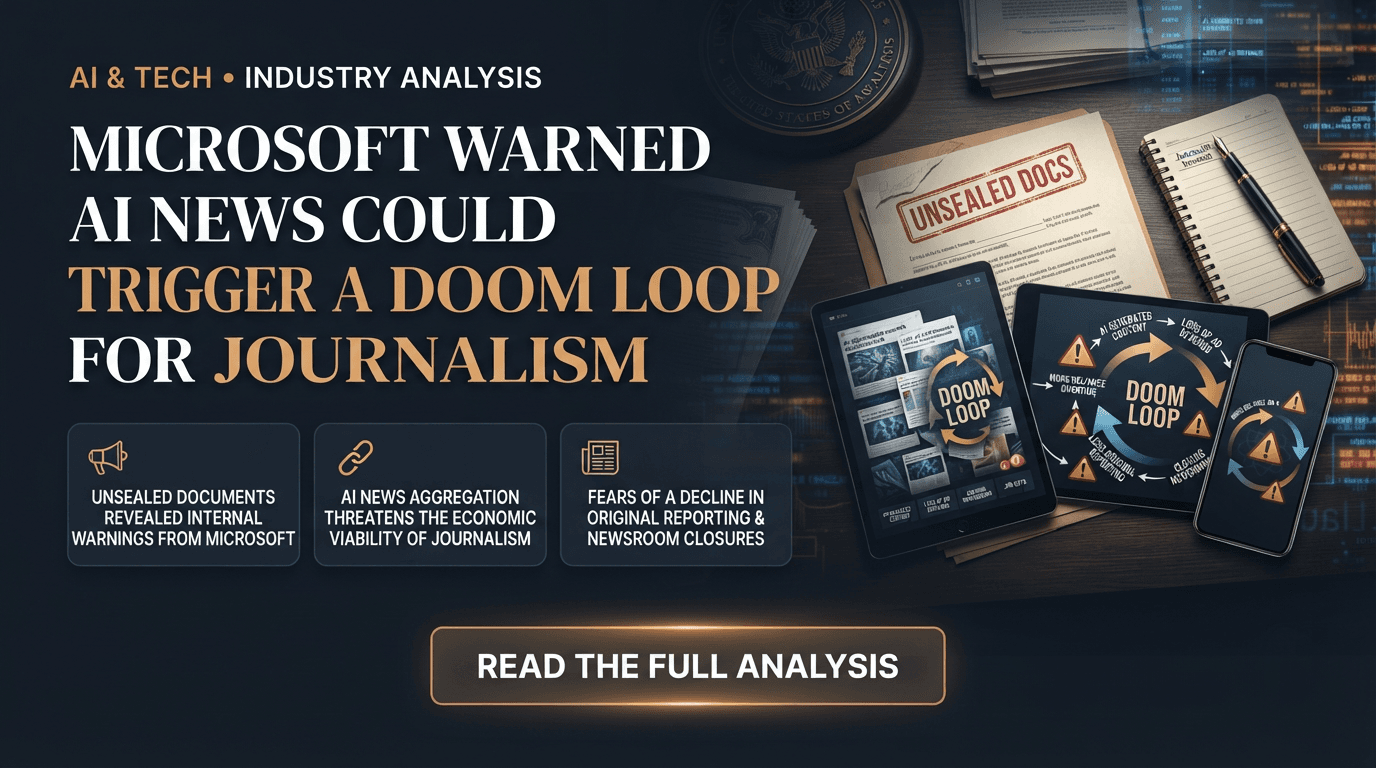
Unsealed Docs Show Microsoft Warned AInews Could Trigger a Doom Loop for Journalism
Nic Reeve8 min read
Unsealed Docs Show Microsoft Warned AInews Could Trigger a Doom Loop for Journalism

On September 17, 2026, newly unsealed court filings in The New York Times’ copyright lawsuit against OpenAI and Microsoft showed senior Microsoft executives warning that their AInews products risk creating a “doom loop” that drains traffic and money from news outlets while degrading the quality of information on the web itself.

What did the unsealed Microsoft documents say about AI and journalism?

The unsealed Microsoft documents describe internal warnings that AI answer engines trained on news articles could both undermine publishers’ business models and weaken the online information ecosystem that those same AI systems depend on.

Key passages from the filings show that Microsoft’s own researchers and product leaders were alarmed by how generative AI systems use and replace journalism:

  • According to TechCrunch, an internal presentation written by Microsoft Director of Applied Science Brent Hecht in January 2024 described the impact of large-scale AI scraping and answer engines as a “doom loop” that would “hurt the performance of our models and the entire web at the same time.”
  • The Washington Examiner reports that Hecht wrote, “Our AI content strategy has started a ‘doom loop’ that will hurt the performance of our models and the entire web at the same time,” calling the situation “highly unusual” because the end product threatens “the economic foundations of its essential suppliers.”
  • Law360 and MLex note that internal documents quote Microsoft and OpenAI employees acknowledging that unlicensed use of millions of news articles could begin a doom loop that endangers their “content supply chain.”
  • The Wrap cites filings where a Microsoft document warns that the companies’ AI approach had started a doom loop that would damage both model performance and “the entire web.”

These statements appear in an unredacted memorandum filed by lawyers for The New York Times in its ongoing copyright case against OpenAI and Microsoft in federal court in Manhattan. The case has been moving through the courts since 2023.

Who inside Microsoft raised alarms about AI scraping and labor “theft”?

Concerns inside Microsoft were led by Brent Hecht, the company’s Director of Applied Science, who repeatedly warned that scraping journalism at scale for AI training amounted to unprecedented theft of human labor.

The unsealed filings attribute several striking internal comments to Hecht:

  • TechCrunch reports that Hecht described large-scale AI scraping of online content as “the largest theft of labor in human history” during internal discussions documented in January 2023 and January 2024.
  • The New York Daily News notes that a senior Microsoft executive believed AI systems built on other people’s work would be seen as “an astonishing theft of unprecedented proportions” and possibly “the greatest robbery of labor in human history,” according to the unredacted court documents.
  • BrandiconImage and The Wrap both quote Hecht calling the copying of news articles “an astonishing theft of unprecedented proportions” and potentially the “largest theft of labor in human history.”
  • TweakTown, summarizing the filings, says Hecht argued that relying on “fair use” to justify mass scraping of news articles made a “complete mockery” of fair use as a legal concept.

These warnings portray internal recognition that the AI training pipelines built on publishers’ work were not just legally risky. They were seen by some of the engineers and scientists responsible for the systems as ethically and economically corrosive for the entire news ecosystem.

How is Microsoft’s AI answer engine affecting traffic to news publishers?

The filings assert that Microsoft’s AI-powered answer tools dramatically cut referral traffic to news outlets, raising fears that this substitution effect could erode the financial base that supports professional journalism.

Multiple sources describe internal metrics and testimony about how AI answers change user behavior:

  • TechBeat reports that unredacted documents say Hecht warned in January 2024 that Microsoft’s Copilot answer engine reduced click-through rates to New York Times articles by up to 93% compared with traditional Bing search results.
  • TweakTown’s summary of the same filings notes internal estimates that AI chatbots and answer boxes could cut publisher traffic by 51% to 94%, depending on the scenario and query type.
  • The Wrap recounts Microsoft CEO Satya Nadella’s testimony that conversations with chatbots had already substituted for visits to news websites by “giving you the information right there on the website on the AI platform versus needing to go to the underlying source.”

These numbers, all attributed to internal assessments and court testimony in 2024 and 2025, suggest that AI answer engines do not simply coexist with news sites. They can replace the need for many users to click through, weakening advertising revenue and subscriptions that depend on direct visits.

What exactly is the “doom loop” Microsoft executives described?

The “doom loop” described in the court filings refers to a self-reinforcing cycle in which AI systems undermine the economic viability of news outlets, leading to worse content on the web, which then harms the AI models that rely on that content.

Internal documents quoted across several reports outline the logic of this loop:

  • Ground News and EuropeSays explain that Hecht’s memo warned generative AI products had created a doom loop that is “eating the web and destroying the businesses that these companies stole from,” by substituting AI answers for visits to publishers.
  • The Washington Examiner cites a Microsoft document saying, “It is highly unusual that an end-product threatens the economic foundations of its essential suppliers, but that is the situation we have created for our LLM business with respect to its ‘content supply chain.’”
  • BrandiconImage notes that the filings describe a scenario in which declining traffic to news sites weakens the broader online ecosystem and ultimately reduces the quality of information available to AI systems.
  • TweakTown’s coverage summarizes the loop as: AI answer engines cut traffic, lower financial incentives for journalists, shrink the supply of high-quality reporting, and then damage the very models that need that reporting for training.

The core idea is simple. Less money for journalism means fewer reporters and less reliable news. AI models trained on that degraded content will perform worse, which harms users and the platforms themselves.

How does the New York Times lawsuit frame these internal admissions?

The New York Times uses the internal Microsoft and OpenAI admissions to argue that the companies knowingly built profitable AI systems on unlicensed news content, while recognizing that this strategy threatened the very publishers who produced that content.

Recent coverage of the unsealed filings outlines the Times’ legal narrative:

  • KuCoin’s legal news summary states that the newly unsealed memorandum in The New York Times v. OpenAI copyright lawsuit was written by Times lawyers and “largely comprised” statements and interviews with tech executives acknowledging that large language models were “built on content described by Microsoft executives as an unprecedented scale of theft.”
  • Ground News reports that the filings present executives’ own words to show that large language models are “predatory” technologies, trained on “stolen content” that pose an “existential risk” to human writers, artists and media companies.
  • MLex describes the new documents as showing knowledge of “AI copying costs to US news companies,” including recognition that unlicensed use of millions of articles to train chatbots could initiate the doom loop and represent the “largest theft of labor in human history.”
  • Law360 notes that Microsoft and OpenAI employees had internally acknowledged for years that tools trained on news articles would likely replace publishers, leading to the doom loop scenario.

By highlighting these internal statements, the Times aims to strengthen its claim that OpenAI and Microsoft knowingly relied on unlicensed journalism while foreseeing the damage to publishers.

What are OpenAI’s internal concerns about publishers and substitution?

The unsealed filings do not focus only on Microsoft. They also reveal internal OpenAI fears that chatbots would become direct substitutes for news publishers, undermining the business case for continued reporting.

Several sources summarize these concerns:

  • According to BrandiconImage, Nick Turley, who led the team developing ChatGPT, warned in a 2023 internal memo that AI represented an “existential threat” to publishers.
  • The Wrap reports that Turley wrote that publishers faced an existential threat from AI products that were already “largely substitutive” and would become more so as the systems improved.
  • Law360 states that OpenAI and Microsoft employees acknowledged for years that AI tools trained on news articles would likely replace publishers, contributing to the doom loop described in the filings.

These internal comments echo the worries of many editors and reporters: if users can ask a chatbot for a summary instead of visiting a news site, long-term funding for independent journalism becomes precarious.

What broader implications does this doom loop have for the future of news?

The doom loop described by Microsoft and OpenAI staff suggests that current generative AI strategies could destabilize the business of news, reduce the quality of information online, and ultimately damage AI systems themselves unless new economic and legal arrangements emerge.

Across the reports, several themes recur:

  • Executives privately agree with publishers’ warnings that generative AI poses an “existential threat” to news organizations when it siphons both content and audience without paying for either.
  • Internal Microsoft discussions emphasize that the economic foundations of journalism are part of the “content supply chain” for AI, meaning that harming publishers also harms AI products over time.
  • The filings highlight the mismatch between short-term gains—offering instant answers that users love—and long-term risks, such as fewer reporters investigating public-interest stories because revenue has collapsed.
  • Several analyses argue that the doom loop concept may push courts and regulators to consider new models, including licensing deals, compulsory fees, or explicit limits on scraping and training data drawn from professional news outlets.

The immediate dispute centers on New York Times content and current AI products. The underlying question is whether the web that AI relies on can survive if its core economic engine—commercial and subscription-supported journalism—is hollowed out by the very systems that now scrape and summarize its work.


Sources

  1. 1.techcrunch.com
  2. 2.nydailynews.com
  3. 3.washingtonexaminer.com
  4. 4.newsbytesapp.com
  5. 5.nypost.com
  6. 6.europesays.com
  7. 7.brandiconimage.com
  8. 8.ground.news
  9. 9.us.headtopics.com
  10. 10.kucoin.com
  11. 11.thewrap.com
  12. 12.law360.com
  13. 13.mlex.com
  14. 14.tweaktown.com
  15. 15.techbeat.co

Read more

Related Articles

AI Takes Flight in F-16 Tests as Chelsea Flower Show Showcases Garden Tech
AI & Tech

AI Takes Flight in F-16 Tests as Chelsea Flower Show Showcases Garden Tech

Artificial intelligence made another visible leap from lab demos to real-world systems this summer, with one program flying an F-16 under AI control and another bringing AI into the center of the Chelsea Flower Show. The same period also saw fresh product and platform updates around AI-assisted design and consumer tools, underscoring how quickly the technology is spreading across defense, creative work and everyday software. In the most striking military test, Lockheed Martin said an AI agent flew a heavily modified F-16 in 27 live-target intercepts during an eight-sortie campaign at Edwards Air Force Base, California. The aircraft used a Lockheed Martin Legion Pod to track a target aircraft, and the targeting data was fed to the onboard AI agent, which then maneuvered the jet into an intercept position. The company said the test demonstrated a faster “sensor-to-action” loop in a combat aircraft environment, while a pilot remained part of the safety structure during the trials. A separate report on the U.S. Air Force and DARPA’s VENOM work said a modified F-16 was flown under AI control at Eglin Air Force Base, Florida, with a human pilot in the cockpit ready to take over. That program began with validation flights in June 2026 to verify hardware and software upgrades before moving in July to missions in which the AI handled portions of flight. Together, the tests show how autonomy is moving beyond simulation and into controlled aerial operations on live aircraft. The defense significance is not just that an algorithm can fly a jet, but that it can do so repeatedly in a constrained operational context. According to the reports, the AI system was paired with upgraded hardware and sensors rather than a fully redesigned aircraft, suggesting the current emphasis is on integration and reliability rather than replacing pilots outright. That distinction matters because it shows the technology is being framed as a force multiplier, not a stand-alone substitute for human judgment. Elsewhere, the Chelsea Flower Show offered a very different picture of AI’s expanding reach. Coverage from the 2026 show highlighted AI-assisted garden design and plant-monitoring tools, including a platform called Spacelift, which was introduced as an AI-assisted system intended to help homeowners plan, design and manage outdoor spaces. The platform’s debut reflected a broader trend at the show: artificial intelligence is increasingly being used to shape landscapes, not just analyze them. At the same time, Chelsea’s AI story was not confined to design software. BBC reporting on the 2026 event described a plant health scanning technology exhibit that won recognition at the show, while other coverage noted AI-based displays and tools aimed at helping gardeners understand plant stress, irrigation needs and long-term maintenance. The Royal Horticultural Society has also been linked to plans for wider use of AI in plant databases and garden planning, suggesting the technology may become part of the event’s practical toolkit rather than a one-off novelty. The reaction inside the gardening world has been mixed. Some designers view AI as a helpful planning aid that can speed up layout work, improve visualization and support maintenance decisions. Others worry that the technology may flatten design into formulaic outputs or undercut the craft of human landscapers. That tension was visible in coverage of the 2026 Chelsea Flower Show, where AI-generated or AI-assisted gardens became a talking point in their own right. What ties the F-16 tests and the Chelsea Flower Show together is not the technology itself, but the stage it has reached. In both cases, AI is being moved out of speculative presentations and into applied environments with real constraints: complex flight dynamics in one setting, living ecosystems and client expectations in the other. The underlying message is the same: AI is becoming less of an abstract promise and more of an operational tool. That shift also raises a broader industry question. As AI systems are deployed in spaces as different as military aviation and garden design, the measure of success is changing from raw capability to trustworthy performance. Can the system act safely, explainably and consistently when conditions change? Can people supervise it effectively? Can the technology produce results that users actually want? The latest examples suggest those questions are now central to how AI is evaluated. For now, the picture is one of rapid diversification. A fighter jet can be partly directed by an AI agent. A garden show can feature AI-assisted design and plant-health tools. Consumer-facing software can claim to help people create and manage outdoor spaces with machine assistance. The common thread is that AI is no longer confined to software demos; it is increasingly being tested in the physical world, where consequences are visible and the standards are higher.

Nic Reeve·
Music Majors and Gaming Powerhouse EA Lead $76 Million Bet on Stability AI’s Creative AI Future
AI & Tech

Music Majors and Gaming Powerhouse EA Lead $76 Million Bet on Stability AI’s Creative AI Future

Stability AI, the generative AI company best known for powering creative tools across image, music, gaming and entertainment, has closed a $76 million Series B funding round led by some of the most powerful names in the global entertainment industry. The raise, completed under CEO Prem Akkaraju, lifts the company’s total funding to $232 million , including two equity rounds and convertible notes since mid‑2024. The round marks one of the clearest signals yet that major studios, labels and game publishers are betting on purpose‑built artificial intelligence for professional creators, rather than treating generative AI as a purely experimental technology. Entertainment Heavyweights Join Stability AI’s Cap Table Central to the new financing is a roster of strategic investors whose catalogs and intellectual property underpin much of the world’s commercial entertainment. Interactive entertainment giant Electronic Arts (EA) , along with global music powerhouses Sony Music Group , Universal Music Group (UMG) and Warner Music Group (WMG) , all took part in the Series B. According to the company, these partners are not just financial backers but are expected to work with Stability AI on new AI models informed by their game assets and music catalogs. The round also includes technology and investment firms such as AMD Ventures and Pacific Alliance Ventures , underscoring interest from the broader tech ecosystem in AI systems tailored for production‑grade creative workflows. These new investors join an already high‑profile group of backers from previous rounds. Existing institutional investors include Coatue , Greycroft , Kadmos Capital , Lightspeed Venture Partners , Mantis Capital , Sound Ventures and advertising giant WPP . Individual investors range from tech and media leaders such as Sean Parker , Eric Schmidt , Prem Akkaraju , Patrick Whitesell and the Reuben Brothers to entertainment figures including filmmaker James Cameron , television producer Mark Burnett , and media investor Vivi Nevo . Several existing investors – notably Coatue, Greycroft, Kadmos Capital, Sean Parker and Eric Schmidt – participated again in the Series B, signaling continued confidence in the company’s strategic pivot under new leadership. Funding to Accelerate AI Tools for Professional Creatives Stability AI says the fresh capital will be used to expand its suite of AI products for professional creatives across music, gaming and entertainment, deepen its applied research organization, and grow its professional services business. The company is positioning its technology as infrastructure for creative production rather than consumer‑grade novelty tools. In practice, that means building systems that can integrate with studio pipelines, work reliably with large volumes of licensed content, and support creators who need predictable, controllable outputs for commercial use. For music, the new partnerships with UMG, WMG and Sony Music Group are expected to enable generative models trained on, or informed by, vast catalogs of recorded sound and metadata, with an emphasis on rights‑aware usage and workflows. In gaming, EA’s involvement aligns with efforts to use generative AI for asset creation, world‑building and interactive experiences, using its extensive library of game art, animation and design as training material. Stability AI has framed its mission as building purpose‑built AI for professional creatives, a phrase meant to distinguish its tools from generic text‑to‑image or text‑to‑music systems that have provoked legal and ethical concerns when trained on unlicensed data. By tying its models directly to partners’ licensed IP, the company is seeking to demonstrate that generative AI can coexist with, and even enhance, existing rights frameworks. New Leadership Continues Turnaround Strategy The Series B is the latest step in Stability AI’s restructuring under CEO Prem Akkaraju , who took over in June 2024 amid a broader reset of the company’s finances and governance. Under his tenure, the firm has raised multiple rounds that recapitalized the business and brought in new strategic investors from advertising, technology and entertainment. Previous funding announcements highlighted backing from major venture capital firms and high‑profile angels, coupled with efforts to stabilize the balance sheet and focus the product roadmap on commercially viable creative tools. The new $76 million round, anchored by entertainment industry leaders, suggests that the turnaround strategy is expanding beyond financial restructuring toward long‑term, revenue‑generating partnerships. Akkaraju’s background in film and media also appears to be shaping the company’s positioning: Stability AI increasingly presents itself not just as an AI research lab, but as a partner to studios, labels and agencies looking to modernize production while preserving creative control and respecting intellectual property. Why the Entertainment Industry Is Betting on Stability AI The decision by top record labels and a major game publisher to take equity stakes in an AI company reflects a broader shift in how the entertainment sector views generative technology. After initial waves of skepticism and legal challenges around AI‑generated content, large rights holders are now seeking to shape the technology from the inside. By investing directly in Stability AI, companies like UMG, WMG, Sony Music Group and EA gain influence over how creative AI systems are designed, trained and deployed. In return, Stability AI gains access to high‑quality, legally cleared data and potential distribution channels for new tools, whether in studio production environments, game engines or label‑run creator platforms. Industry observers note that these strategic investments could pave the way for new categories of products: rights‑aware generative music tools for artists and producers; AI‑assisted sound design and scoring for games and film; and content‑creation systems embedded into game development pipelines that are tuned to each publisher’s art style and IP constraints. The involvement of advertising group WPP and other media‑adjacent investors underscores that interest is not limited to entertainment alone. Brand and agency work increasingly relies on rapid production of images, video and audio assets, a use case that aligns with Stability AI’s emphasis on professional‑grade, controllable outputs. Next Steps for Stability AI With its total funding now at $232 million , Stability AI is entering a critical phase in the race to define how generative AI will be used in commercial creative industries. The company has promised continued investment in applied research, new product launches focused on music and gaming, and expanded professional services to help partners integrate AI into their production pipelines. How quickly those ambitions translate into widely adopted tools will depend on more than just technology. Stability AI will need to convince creators, unions, rights organizations and regulators that its systems enhance rather than displace human creativity, and that its partnerships with major entertainment companies result in fair and transparent use of intellectual property. For now, the latest funding round – backed by a cross‑section of the entertainment world – suggests that the industry’s biggest players prefer to help shape that future from the boardroom table rather than watching from the sidelines.

Nic Reeve·
AInews: M&T Bank’s Tech Reboot Sets Stage for Enterprise‑Wide AI Rollout
AI & Tech

AInews: M&T Bank’s Tech Reboot Sets Stage for Enterprise‑Wide AI Rollout

On September 2, 2026, M&T Bank confirmed that it has deployed AI copilots and other enterprise tools to more than 15,000 employees as part of a broad expansion of enterprise artificial intelligence, capping a technology overhaul that began in 2018 and positioning the bank as a regional leader in data‑driven operations. How large is M&T Bank’s enterprise AI rollout? M&T Bank’s enterprise AI rollout now reaches the majority of its workforce. According to Yahoo Finance in September 2026, the bank has deployed AI copilots to over 15,000 employees, while Forbes reports that around 16,000 staff actively use generative AI tools for daily work as of August 2026. The expansion of AI tools inside M&T Bank is now one of the largest documented deployments in a U.S. regional bank. Key figures include: According to Forbes, August 2026: approximately 16,000 employees use generative AI tools across the enterprise. According to Yahoo Finance, September 2026: AI copilots support more than 15,000 employees in tasks such as call analysis, report drafting and code generation. According to ArtificialIntelligence‑News, September 2026: initial pilots involved about 800 employees before scaling across the organization. According to AIM Media House, December 2025: Microsoft 365 Copilot and Copilot Chat had been rolled out to roughly 17,000 employees by early 2025. Most of these tools run on Microsoft’s Copilot suite, delivered through M&T Bank’s modernized cloud and data architecture. Staff now access generative models through Office applications, internal chat interfaces and embedded features in existing business systems. What concrete AI use cases are live inside M&T Bank? M&T Bank is using enterprise AI in internal operations, risk management, software development and commercial credit monitoring, rather than front‑end customer interactions. These use cases combine Microsoft Copilot with specialist platforms from vendors like RDC.AI and Rich Data Co. According to Yahoo Finance and ArtificialIntelligence‑News, the current internal and risk‑oriented applications include: Analyzing call‑center conversations to identify customer needs and emerging portfolio risks. Drafting reports, internal communications and meeting summaries for employees across departments. Generating and reviewing software code to accelerate development and maintenance work. Spotting potential fraud patterns and strengthening cybersecurity monitoring. Beyond copilots, M&T has introduced domain‑specific AI platforms in commercial credit: According to the Banking Tech Awards USA showcase, May 2026: M&T Bank partnered with RDC.AI in 2025 to replace manual, rules‑based commercial credit monitoring with an AI‑driven continuous monitoring platform. The same source notes the platform supports over 1,200 relationship managers and credit associates, providing automated alerts on borrower risk and portfolio exposure. AIM Media House reports that M&T is also integrating Rich Data Co.’s decisioning platform via vendor nCino, and adopting Amperity’s customer data cloud to unify interactions and tailor communications across channels. These tools sit on top of the bank’s controlled data environment rather than feeding directly into unsupervised decisioning. What technology overhaul enabled M&T Bank’s current AI expansion? M&T Bank’s push into large‑scale AI follows a multi‑year effort to fix data and legacy systems first. The bank began a broad technology overhaul around 2018, rebuilding its data governance, cloud architecture and application landscape to support modern analytics and regulated AI adoption. Forbes describes how M&T “built a strong data foundation” in Buffalo that now underpins dozens of generative AI use cases across three pathways: enterprise fluency, embedded capabilities in existing applications and proprietary models. Key elements of that foundation include: According to Forbes, May 2025: an expanding portfolio of cloud‑based data products and ongoing retirement of legacy platforms. According to CDO Magazine, December 2025: a medallion architecture layered over cloud‑enabled data products, with clear accountability at each layer. According to Portfolio by BISA, September 2025: a central data repository called Edison, supported by lineage tools from Solidatus and Monte Carlo to track data movement. According to Windows Forum reporting, March 2026: a centralized cloud data strategy designed to create a unified “Customer 360” view and reduce reconciliation overhead by decommissioning legacy analytics tools. M&T Bank’s Chief Data Officer Andrew Foster has emphasized that trusted data is the prerequisite for generative AI. Portfolio by BISA quotes him saying that reliable lineage and governance are essential to controlling operational, compliance and reputational risk as AI use scales. How does M&T Bank govern data and AI across such a large deployment? M&T Bank has built AI governance on top of its data controls rather than treating it as a separate exercise. The bank uses a federated data model, medallion architecture and strict lineage tooling, and sequences AI projects to follow maturity in oversight and risk management. AIM Media House describes a stepwise blueprint for AI adoption at M&T Bank: Reset data governance, lineage and controls before major AI pilots. Run six‑month proofs of concept with tools like Microsoft Copilot before enterprise rollout. Deploy internal copilots widely, while keeping customer‑facing applications limited and heavily supervised. Layer in domain‑specific AI, such as commercial credit monitoring and customer‑data platforms, only where oversight frameworks are mature. Portfolio by BISA reports that Edison and lineage platforms help the bank trace data sources for AI outputs, supporting internal audits and regulator reviews. Windows Forum’s analysis of Western New York banks highlights M&T’s published AI policies, inventory of models and continuous monitoring with alerts for drift and anomalies as part of its risk controls. Which employees and business units are most affected by M&T Bank’s AI expansion? M&T Bank’s AI deployment affects office staff, technologists and risk professionals far more than frontline customers. Copilot access is wide across corporate functions, while specialized platforms target commercial credit teams and analytics groups using the bank’s cloud data environment. Based on reports from Yahoo Finance, Forbes and AIM Media House, the main groups using new AI tools include: Customer service and call‑center agents, who use AI to summarize calls and identify next‑best actions. Operations staff, who rely on copilots to draft emails, reports and meeting notes. Software engineers and technology teams, where copilots assist with coding, documentation and troubleshooting. Risk managers and credit associates, who use RDC.AI’s commercial credit monitoring platform. Marketing and analytics teams, who work with Amperity’s customer data cloud and Rich Data Co’s decisioning tools to refine targeting and product offers. AIM Media House quotes M&T’s data leadership stressing that the bank is “not going to the customer‑facing side yet” for broad generative AI use, underscoring a decision to focus on staff productivity and risk insights before AI touches customer decisions directly. What strategy guides M&T Bank’s AI investments and future plans? M&T Bank’s AI strategy combines three main pathways: expanding enterprise fluency, embedding AI into existing applications and building proprietary models using the bank’s own data, all within a regulated and inspection‑ready environment. Forbes reports that the three pathways are: Enterprise fluency, where around 16,000 employees experiment with generative tools to improve productivity and learn their capabilities. Embedded capabilities inside roughly 1,800 applications, many sourced from third‑party vendors, where targeted AI features support tasks like document review and risk scoring. Proprietary development of large language model and agentic solutions built around M&T’s data and processes. ArtificialIntelligence‑News reports that Chief Data Officer Andrew Foster and his team articulated a similar framework: general employee use of generative AI, AI embedded in existing systems and custom solutions aligned with M&T’s distinctive workflows. Forbes and CDO Magazine both describe a “slow to go fast” approach, in which careful groundwork in data, governance and culture enables faster scaling once controls are proven. Looking ahead, public comments and award submissions point to several likely next steps: According to Forbes, May 2025: continued expansion of cloud‑based data products and retirement of legacy platforms as AI demand grows. According to the Banking Tech Awards USA entry, May 2026: deeper integration of continuous AI monitoring in commercial credit, including new analytical measures of portfolio resilience. According to Yahoo Finance, September 2026: exploration of agentic AI for cybersecurity and fraud detection, building on existing detection use cases. How does M&T Bank’s AI journey compare with other regional banks? M&T Bank now stands out among regional banks in Western New York for its focus on centralized data strategy and broad internal AI adoption, while peers such as Five Star Bank are documented as concentrating on AI in specific product lines like indirect auto lending. Windows Forum summaries of local coverage describe two tracks in the region: M&T Bank invests in cloud data architecture, governed customer insights and large‑scale employee access to generative tools. Five Star Bank applies AI more narrowly to product‑level automation and credit decisioning, with smaller deployments. These comparisons show that M&T Bank is using its size and long technology overhaul to treat AI as a company‑wide capability rather than an isolated experiment, emphasizing data discipline and internal fluency before aggressive customer‑facing innovation.

Nic Reeve·