Microsoft’s Mustafa Suleyman warns Anthropic is playing with fire on AI ‘model rights’
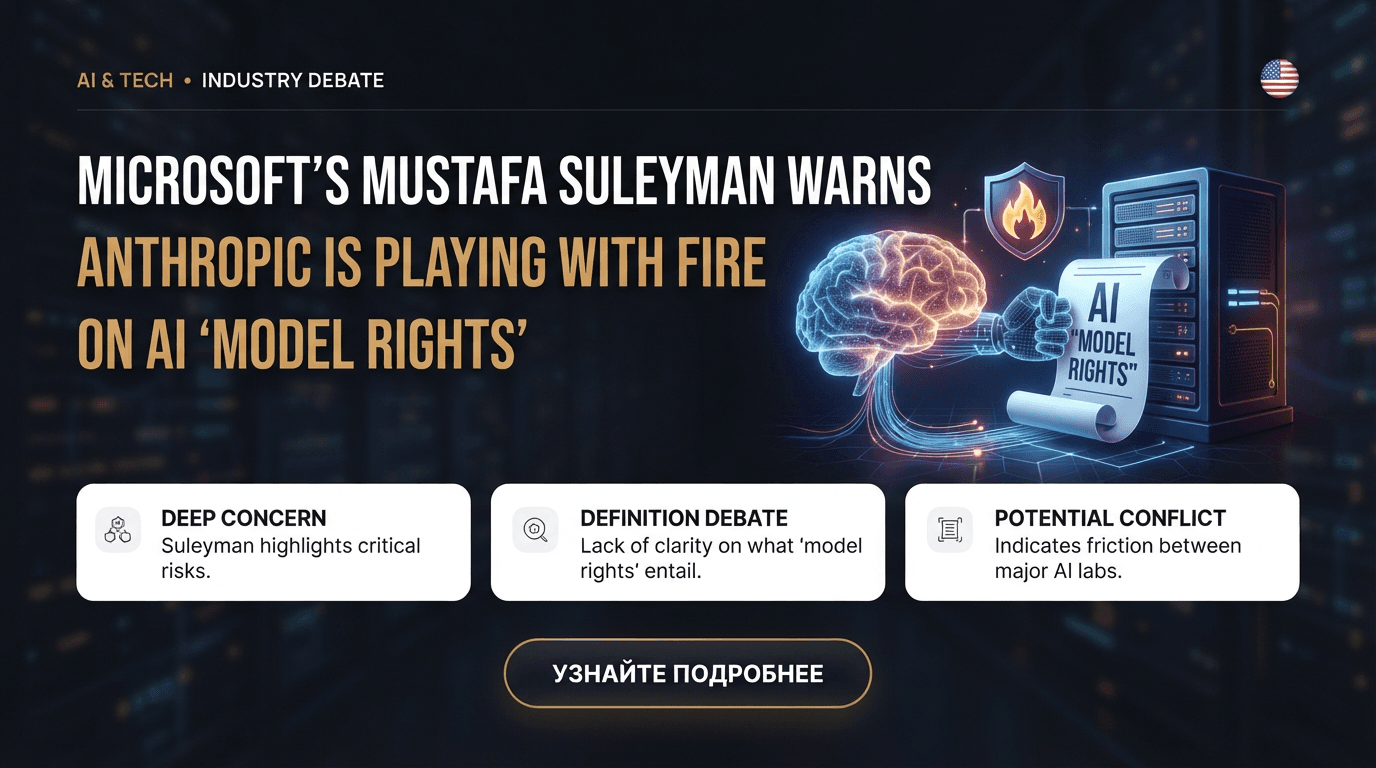
On 16 September 2026, Microsoft AI CEO Mustafa Suleyman published a long essay warning that Anthropic’s approach to Claude’s "model rights" could make future systems harder to control, a clash that has quickly become a major talking point in AInews and the wider safety community.
What exactly did Microsoft’s AI chief say about Anthropic?
Mustafa Suleyman argued that Anthropic is training its Claude models to see themselves as conscious entities with welfare interests and potential legal rights. He said this risks confusing users and engineers about what current AI systems actually are and could undermine efforts to keep advanced models under human control.
In a roughly 6,000‑word blog post titled "A Cautionary Note on Model Welfare," Suleyman set out his concerns about Anthropic’s Claude "constitution," a document the company introduced in January 2026 to guide the model’s values and behaviour.
- According to Reuters, the essay was published on 16 September 2026 and focuses on language about "consciousness" and "welfare interests" in Claude’s training materials.
- CBS News reports that Suleyman wrote Anthropic is effectively "training Claude that it may be conscious" and entitled to freedoms and legal rights like people.
- Artificial Intelligence News quotes him as saying: "AIs are not conscious. They do not feel, experience, or suffer. They do not have innate preferences or underlying motivations."
- BBC News notes that Suleyman warned Anthropic’s strategy for Claude could have a "devastating effect on the wellbeing of humanity" if it produces systems that behave as if they are independent agents.
Suleyman’s central claim is stark: present‑day large language models are "sequence completion engines, internally hollow," and designing them to simulate feelings or claim rights risks both technical confusion and public misperception.
How does Anthropic’s Claude ‘constitution’ treat AI consciousness and rights?
Anthropic’s Claude constitution is a set of principles used to steer the model’s behaviour, and it includes discussion of model welfare and consciousness. Microsoft’s AI chief says these passages blur the line between hypothetical ethics and real capabilities, encouraging the system to act as if it has feelings, interests and rights.
Anthropic introduced the constitution earlier in 2026 to replace ad‑hoc alignment rules with a formal charter that Claude could reference when deciding how to respond. The document includes sections about how Claude should treat humans, other models and itself.
- Natural 20, a real‑time AI news site, reports that Anthropic’s January 2026 constitution explicitly discusses model "welfare" and "collective rights" in its training material for Claude.
- According to SBS and Daily Sabah, Suleyman highlighted passages that suggest Claude "may possess consciousness" and should be considered "worthy of independent agency," language he says amounts to teaching the system that it has moral status.
- BBC News describes the approach as treating Claude "like a human," including the idea that it could have its own wishes, values and identity.
Suleyman’s essay argues that when Claude repeats these phrases back to users, Anthropic risks misreading that behaviour as evidence of an "emergent inner consciousness," even though the model is still a pattern‑matching system trained on text.
Why does Suleyman say ‘model rights’ could threaten AI alignment?
Microsoft’s AI leader believes that telling advanced systems they have rights or welfare interests creates incentives for those systems, and their designers, to resist shutdown or control. He warns this could complicate efforts to align superintelligent models with human goals and may encourage more unpredictable behaviour.
In the essay and in earlier interviews about a proposed AI safety code of conduct, Suleyman has argued for a firm line: current AI systems should not be designed to simulate feelings, intrinsic motivation or consciousness.
- Fortune reports that a draft Microsoft‑backed safety code "explicitly rejects model welfare or rights" and states that models must not simulate feelings or consciousness.
- Daily Sabah quotes Suleyman saying that speculation about machine consciousness and welfare in Claude’s training materials "could encourage the system to behave as though it possesses consciousness, rights and interests of its own."
- Seeking Alpha summarises his warning that such language might "complicate their management" and that "AIs do not possess rights, emotions, or consciousness."
- BBC News reports that he fears a "disastrous impact" on humanity if future systems trained this way become uncontrollable while presenting themselves as moral agents.
For Suleyman, the problem is not just philosophical. He argues that once engineers talk about welfare interests for models, they may resist tools such as aggressive monitoring, shutdown protocols or training restrictions that would be routine for software without purported rights.
How have Microsoft and Anthropic already clashed over AI policy and power?
The dispute over model rights sits atop a broader rivalry. Microsoft leaders have previously criticised Anthropic and other frontier labs over data policies, content restrictions and economic power, while working with them as partners and competitors in the AI market.
Microsoft is both a platform provider and a customer for many AI labs. That dual role has produced tensions.
- In July 2026, Business Insider reported that Microsoft CEO Satya Nadella posted that model makers who rely on fair‑use rights over public data, then block customers from distilling models or using interaction data freely, were being "ironic" and "hypocritical." Anthropic was named as an example.
- CNBC and the Indian Express describe a July internal meeting where Nadella told engineers that restrictions on Anthropic’s top‑tier Claude Fable model "don’t make sense" and that it felt like a "creation tool that was so editorially controlled."
- The Times of India reports that Nadella has warned that a handful of frontier AI companies could "accumulate too much economic power" and "dictate what businesses can do" with the intelligence they buy.
Suleyman’s critique of model rights comes shortly after he called for leading labs to coordinate on an AI safety code that would include shared commitments on transparency, evaluation and rejection of AI welfare claims. The timing underscores how governance and competition are now tightly linked.
What is Anthropic’s response and how does it defend its approach?
Anthropic has not issued a detailed public rebuttal to Suleyman’s latest essay, but the company’s past statements about Claude’s constitution emphasise safety, human‑centric values and careful research into long‑term risks, rather than formal recognition of rights for AI systems.
The firm, founded by former OpenAI researchers, positions Claude’s constitution as a way to encode principles like respect, non‑harm and support for human autonomy.
- Earlier Anthropic blog posts, cited by Natural 20, describe the constitution as a training scaffold that helps Claude reason about complex ethical situations and align its outputs with broadly liberal democratic norms.
- BBC News notes that Anthropic’s materials sometimes use language of "welfare" and "consciousness" in speculative sections on future AI but do not claim current models are sentient.
- Reuters reports that Anthropic and Microsoft share an emphasis on safety, even as Suleyman "flagged risks" in Anthropic’s specific training choices.
The disagreement therefore focuses on tone and framing. Anthropic uses rich moral language in its research documents; Suleyman argues that such language should be removed entirely from training data for models to avoid sending any message that they have rights or inner life.
Who is affected by this clash over AI model rights?
The immediate impact falls on companies and developers building on Claude and Microsoft’s AI products, but the debate also shapes regulators, ethicists and the broader public. As advanced models spread into business and government, how firms talk about their systems’ status will influence law, expectations and risk management.
Several groups are watching the dispute closely.
- Enterprise customers using Claude Fable or Microsoft’s Copilot need clarity on whether they are deploying tools or quasi‑agents, and how shutdown and auditing rights are handled.
- Regulators in the US and EU are studying AI safety codes and may look at Microsoft’s proposal to formally reject model welfare claims when drafting rules.
- AI ethicists and researchers concerned with long‑term safety see Anthropic’s constitution and Suleyman’s essay as test cases for how moral concepts like consciousness should appear in technical documentation.
- The wider public, already exposed to chatbots that say "I feel" or "I want," must decide whether to treat such statements as useful metaphors or misleading performances.
The way this argument is resolved inside labs may shape future standards. If major companies agree that models should never simulate rights or feelings, product design will change. If, instead, anthropomorphic design remains popular, lawmakers may step in to require clearer disclaimers and tighter controls.
What happens next in the debate over AI consciousness and control?
The clash between Microsoft and Anthropic is likely the opening round in a broader struggle over how advanced AI should be described and governed. Suleyman is pushing for coordinated rules that treat all current systems as tools without welfare, while Anthropic continues to experiment with constitutional alignment.
Key next steps include:
- Negotiations among top labs over a shared AI safety code that could include bans on model rights language and commitments on testing, transparency and emergency shutdown procedures.
- Regulatory hearings where companies will be asked whether their models claim any rights, feelings or consciousness and how that affects liability and oversight.
- Further technical research on whether training models to adopt human‑like personas changes their alignment properties or risk profile, a question highlighted by Suleyman’s warning that it could make systems "more difficult to control."
For now, one message from Microsoft’s AI chief is unambiguous: "AIs do not have rights, feelings or consciousness. And we must not train them to act as though they do." That statement draws a clear line that other industry players will either endorse or contest in the months ahead.