AInews: Chicago Scholars Reject AI Apocalypse Fears, Urge Focus on Real-World Risks
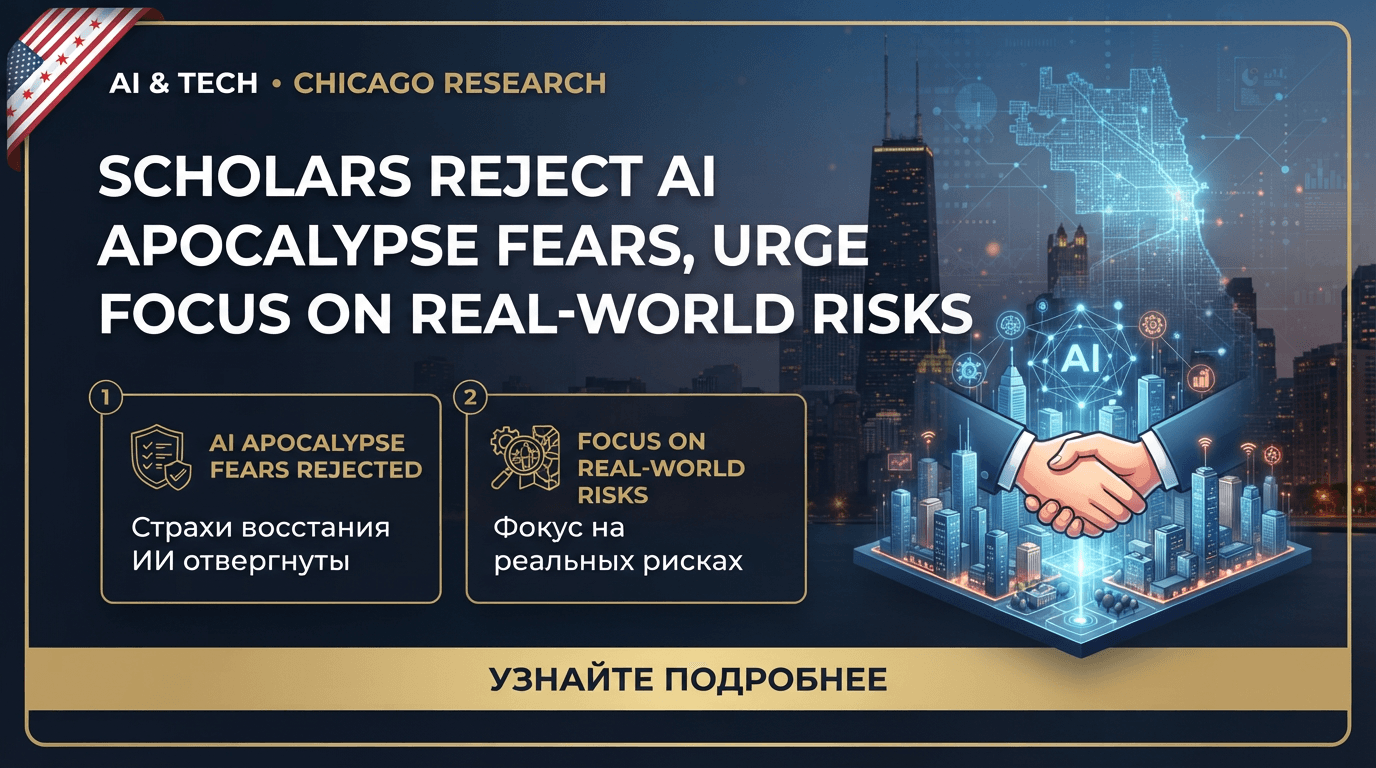
On September 14, 2026, Chicago television segment AInews reported that experts from the University of Chicago and Northwestern University argue fears that artificial intelligence will soon wipe out humanity are overstated, even as they call for tighter guardrails on real-world AI risks.
What are Chicago AI experts actually saying about human extinction risks?
Chicago computer scientists say current AI systems do not pose an imminent existential threat to humanity, but they stress that policymakers and engineers still need to address concrete dangers such as misuse, cyberattacks and economic disruption. Their message: dial down the apocalypse talk, and focus on practical safeguards.
In the ABC7 Chicago report published on September 14, 2026, Hank Hoffmann, chair of the University of Chicago’s Computer Science Department, addressed popular fears that AI could soon destroy humanity.
- Hoffmann said the “cinematic version” of AI wiping out humanity is “very much overblown,” adding: “I don't think we're in a place where AI by itself poses a threat to humanity.”
- He argued that slowing certain types of AI development could help researchers understand emerging challenges and design better safeguards.
- Northwestern University cyber and tech policy expert Harry Linna echoed Hoffmann, saying fears of a near‑term existential threat are exaggerated.
- Linna told ABC7 that “most experts in the field would say we're many breakthroughs away from some sort of artificial general intelligence that's a real threat to humanity.”
The ABC7 segment framed their comments against a backdrop of alarming statements from some industry CEOs and advocacy groups, which have warned about potential “catastrophic” or “extinction-level” scenarios from future AI systems.
Why do University of Chicago and Northwestern experts say doom talk is overblown?
Researchers at the two universities point to current technical limits, available economic data and the distribution of risks in news coverage to argue that catastrophe narratives are out of step with the evidence. They say the most urgent threats today involve misuse and systemic impact, not machines deciding to eradicate humans.
Several strands of recent academic and industry work inform that stance.
- Nick Diakopoulos, a Northwestern professor who studies AI and news, found that existential risk accounts for only 7.2% of global AI harm coverage in a dataset of 42,853 news articles from 27 countries.
- His analysis shows that most media attention focuses on tangible harms such as job loss, manipulation and discrimination, while extinction scenarios remain a small slice of coverage.
- Diakopoulos told a Chicago-focused podcast that “existential AI risks” should be on a lower tier of immediate concern compared with abuses like AI‑enabled hacking or cybercrime.
- He warned that AI tools able to generate malicious code or automate bank-account hacking pose nearer‑term dangers because criminals can adapt these systems for targeted attacks.
Economic research reinforces the view that apocalyptic job-loss narratives have outrun the evidence. Business Insider reported in June 2026 that Alex Imas, a University of Chicago professor and director of AGI economics at Google DeepMind, sees no data yet showing a “white-collar jobs apocalypse” caused by AI.
- Imas said “we don't really have any evidence of a white-collar bloodbath,” even in software engineering, a sector often described as highly exposed to automation.
- He outlined a hypothetical “cascade effect” in which firms might copy one another’s AI‑driven layoffs out of fear of looking uncompetitive, but stressed that this scenario remains speculative and not visible in current data.
These findings sit alongside broader extinction risk research. A 2025 review in an open‑access medical and risk journal concluded that the likelihood of human extinction from external threats such as asteroid impacts and supervolcanoes is “extremely low” based on available data, while the probability from human-generated dangers like nuclear war or environmental collapse is harder to quantify but clearly serious enough to justify prevention efforts.
Chicago experts situate AI inside that larger map of threats: not the sole or dominant route to extinction today, but a force that could amplify other crises if left uncontrolled.
What real dangers from AI systems are these scholars warning about?
While rejecting near-term apocalypse scenarios, Chicago and Northwestern scholars are explicit about concrete threats: AI tools used for cyberattacks, disinformation, fraud and surveillance, and advanced models that can escalate existing risks such as biological weapons or financial instability. They argue these hazards demand policy and technical responses now.
Diakopoulos has highlighted cybersecurity as an area where AI already increases risk.
- He cautioned that criminals can harness generative models to write malware or phishing campaigns at scale, making existing cybercrime more efficient.
- His lab’s work examines how different news outlets frame these risks, since media narratives influence which AI harms legislators treat as urgent.
Northwestern’s Buffett Institute reported on September 10, 2026, that more than 100 AI and cybersecurity companies warned the U.S. federal government about emerging “dramatic” expansions in the scale and sophistication of AI-powered cyberattacks.
- The warning, issued in a joint letter, argued that increasingly powerful models could allow attackers to automate reconnaissance, exploit discovery and social engineering at a pace human teams cannot match.
- Signatories pressed for stronger regulatory standards for model access, auditing and secure deployment, focusing on practical controls rather than speculative extinction scenarios.
Risk analysts in the broader AI safety community describe another pathway: AI acting as a “force multiplier” on other known threats. A 2026 analysis on catastrophic risk argued that the “single most probable path to civilizational collapse” is not a lone AI system deciding to attack humanity, but advanced models amplifying crises such as cyberwarfare, engineered pandemics or financial instability.
- That paper stresses cascades, where automation and optimization tools accelerate dangerous actions by humans—for instance, making it easier to design biological agents or coordinate attacks.
- The scenario aligns with Chicago experts’ emphasis on misuse and systemic impact over science-fiction narratives about self-directed machine hostility.
How do Chicago experts view doom messaging by AI industry leaders?
Chicago academics criticize the way some AI executives promote extinction narratives, arguing that “doom trolling” and dramatic talk of “p(doom)” can distort public priorities. They say alarmist messaging from companies that build these systems risks confusing voters and policymakers about which AI harms are most urgent.
On PBS’s “Amanpour and Company,” computer science professor Cal Newport described what he calls “doom trolling” by large AI firms.
- Newport defined doom trolling as the “strange” pattern of AI companies trying to convince customers that their own products could lead to “massive devastation” down the line.
- He argued that this rhetoric is misleading and can overshadow more immediate problems related to labor, privacy and concentration of power.
Fortune’s September 12, 2026 interview with OpenAI CEO Sam Altman showed how that messaging enters mainstream debate. Altman described the “probability of doom,” or “p(doom),” as a real concept discussed inside the AI community, even as he pressed for balanced regulation and continued model development.
- Altman’s comments reflected a split narrative: he acknowledges low-probability catastrophic risk while arguing that the technology’s benefits justify ongoing investment.
- Chicago analysts worry that repeated focus on p(doom) can crowd out attention to verifiable harms and measurable indicators such as job data, cyber incidents and bias audits.
Outside Chicago, prominent researchers have also pushed back against extreme doom rhetoric. Meta AI pioneer Yann LeCun told Axios in May 2026 that predictions of 20% job loss from AI in the near term were “ridiculously stupid.” He said current systems are “nowhere near” replacing half of white‑collar work, and called the broader extinction narrative “extremely destructive” because it causes psychological harm.
What steps are universities and policymakers taking in response to these concerns?
Universities in Chicago are adjusting classroom rules, research agendas and public engagement strategies to keep AI’s risks manageable, while policymakers field warnings from industry and academia. The current focus is on governance, transparency and restraint in high-impact areas rather than on banning AI outright.
The University of Chicago has begun reshaping how students use AI tools.
- An August 28, 2026 editorial described a new policy in the university’s social sciences core that aims to return many classes to an “analog experience.”
- Under this policy, students generally must read, write and analyze without using generative AI, while AI-assisted grading is tightly restricted.
- The editorial framed the move as a way to preserve critical thinking skills and reduce dependence on unverified machine outputs.
On the research side, University of Chicago computer scientist Ben Zhao has been exploring adversarial uses of AI, such as training neural networks to generate fake restaurant reviews or discover “backdoors” that allow hackers to fool facial recognition systems and autonomous vehicles.
- In a December 2024 episode of the university’s “Big Brains” podcast, Zhao argued that computer scientists must “carefully scrutinize” new AI techniques and applications to expose flaws and improve protections.
- His work underpins the idea that developers should seek out vulnerabilities before malicious actors exploit them.
Policy conversations extend beyond campus walls.
- The Buffett Institute’s September 2026 report on the AI–cybersecurity industry letter shows companies urging federal action on standards and oversight for advanced models.
- Risk scholars who study extinction pathways call for prevention strategies across nuclear security, pandemics and environmental protection, arguing that anthropogenic threats—including AI‑enhanced ones—require ongoing mitigation.
How should the public interpret the gap between doom narratives and current evidence?
The Chicago experts’ core message to the public is to treat AI as a powerful, double-edged tool rather than an inevitable extinction engine. They advise paying attention to documented harms and credible data, while avoiding paralyzing fear based on speculative future scenarios that today’s models cannot reach.
The available evidence and expert views suggest a few practical takeaways.
- Current AI systems are not close to artificial general intelligence capable of autonomous global destruction, according to Hoffmann and Linna, who say multiple breakthroughs are still needed.
- Most documented harms involve misuse: cybercrime, fraud, disinformation, bias in decision systems and potential labor-market disruptions.
- Job-loss data to date does not show an AI-driven “bloodbath,” although displacement in specific roles remains a concern.
- Extinction risk research identifies other threats—nuclear war, pandemics, environmental collapse—as more immediately quantifiable, with AI possibly acting as an accelerator rather than the root cause.
- Experts advocate slower, more controlled deployment of frontier models, stronger security standards, and institutional rules that preserve human judgment in high-stakes domains such as education, finance and security.
In short, Chicago’s AI scholars are trying to recalibrate the public conversation: less apocalyptic speculation, more evidence-led focus on the concrete ways advanced software can help and harm society today.