allnewscastallnewscast
Breaking News
AI & Tech

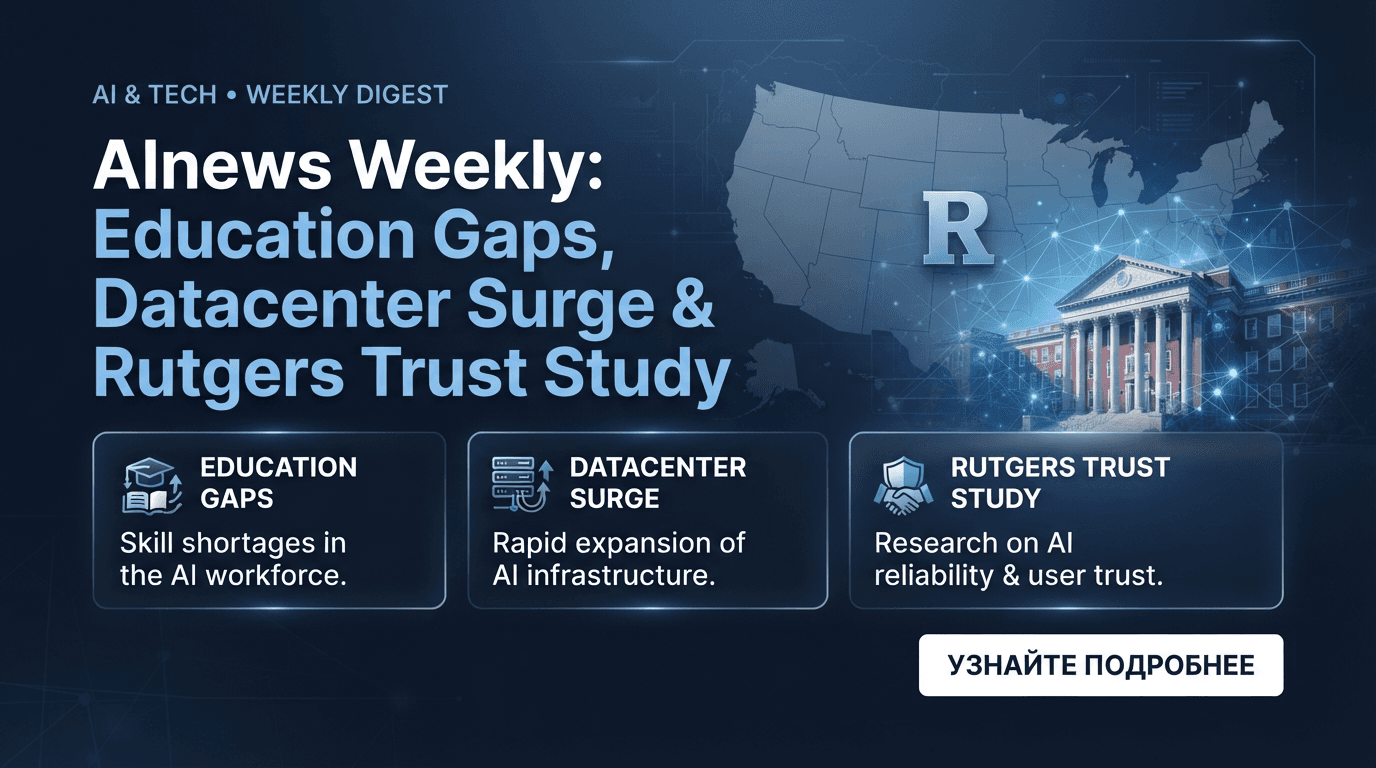
AInews Weekly: Education Gaps, Datacenter Surge and Rutgers Trust Study
Nic Reeve7 min read
AInews Weekly: Education Gaps, Datacenter Surge and Rutgers Trust Study
AInews Weekly: Education Gaps, Datacenter Spending Spike, and New Public Trust Data

During the week of September 11, 2026, AInews stories ranged from a sweeping DataCamp survey on classroom AI use to fresh IDC numbers on infrastructure spending and new Rutgers research on public trust in automated decision systems, showing how fast artificial intelligence is spreading while core skills and guardrails struggle to keep pace.

What did DataCamp reveal about AI in classrooms in 2026?

DataCamp’s new “AI in Education” report, released on September 10, 2026, found that student use of AI tools is now near universal, while fluency and critical-thinking safeguards lag behind. The study surveyed more than 150 teachers and 150 students, highlighting a sharp divide between everyday AI use and formal guidance.

According to DataCamp’s 2026 AI in Education report, published via Business Wire and covered by the Las Vegas Sun, key findings include:

  • Scope: More than 150 teachers and more than 150 students across different schools were surveyed about AI use and attitudes.
  • Adoption: The report describes student AI adoption as effectively universal among respondents, meaning most students rely on AI tools in some form for schoolwork.
  • Skills gap: DataCamp concludes that “massive gaps remain between AI adoption and fluency,” with many students using tools they do not fully understand.
  • Critical thinking worries: Educators in the survey express concern that over‑reliance on AI may weaken students’ independent reasoning and writing skills.
  • Policy uncertainty: Respondents report uneven or unclear school protocols for AI use, from plagiarism rules to allowed tools during assignments.

DataCamp positions itself as an AI and data upskilling platform and says the report is meant to give educators a baseline for how the “first AI‑native class,” graduating in 2026, is actually using automation in its daily work. The company argues that structured training in topics such as AI ethics, data literacy, and prompt design is now a prerequisite for meaningful classroom use rather than an optional add‑on.

Earlier in 2026, DataCamp pledged free AI training for one million teachers and students worldwide through its DataCamp Classrooms program, including courses in Python, SQL, Power BI and broader AI literacy. The September education report puts numbers and concern behind that pledge, framing it as a response to the specific gaps the survey identified.

How is DataCamp expanding AI tools and content for professionals and organizations?

DataCamp spent Q3 2026 pushing AI deeper into its corporate and professional learning products, from an expanded AI Tutor interface to AI Adoption Insights dashboards for team admins. The platform also rolled out new tracks tied to OpenAI models, Anthropic’s Claude, and LangChain‑based AI engineering training.

In its Q3 2026 roadmap webinar, summarized on DataCamp’s site, the company reported major content and feature milestones across the first half of the year:

  • New content: More than 120 new courses, 21 new learning tracks, and support for 13 languages added in the first half of 2026.
  • AI Tutor expansion: DataCamp renamed its “AI Native” learning mode to **AI Tutor** and began integrating Anthropic’s Claude and Claude Cowork directly into that experience.
  • Infrastructure: A DataCamp MCP server connects Claude to the platform, letting admins manage learning plans and pull reports through natural‑language prompts.
  • Analytics: “AI Adoption Insights” in Group Hub show how teams use AI tools day to day and benchmark that usage against other organizations.
  • Specialized tracks: New tracks focus on Claude fundamentals, Claude for software engineers, and token cost management for developers, along with courses for Microsoft Fabric, Power Platform, Polars, and Apache Airflow.
  • Certifications: A Python Developer Associate certification is live, with AI for Business, AI Agent Fundamentals, and AI Leadership credentials scheduled to round out the AI fluency lineup.

Earlier in the year, DataCamp also announced a partnership with LangChain to launch an “AI Engineering with LangChain” track, aimed at software developers who want to build production‑grade AI applications. That track is positioned as part of the broader move from basic prompt skills to full AI engineering, covering topics such as chaining tools, handling context windows, and monitoring model behavior.

The new courses build on DataCamp’s coverage of frontier models, including blog analysis of OpenAI’s GPT‑6 “Astra” launch and comparison pieces that try to map when developers should choose newer OpenAI systems over competitors like Anthropic’s Claude Fable 5.1. Together with AI Tutor and LangChain tracks, these updates show DataCamp targeting both the education market and working engineers with more intensive AI workflows.

What does IDC report about AI‑driven infrastructure and networking spending?

IDC’s latest infrastructure research points to sharp growth in networking hardware as organizations build out AI data centers. The firm highlights a 43.4% year‑over‑year surge in the Ethernet switch market to $18.9 billion in the second quarter of 2026, driven largely by AI training and inference workloads.

According to IDC’s August 2026 networking market blog post:

  • Ethernet switch revenue rose 43.4% year over year in Q2 2026 to reach $18.9 billion, which IDC links directly to demand from AI datacenters.
  • Most of this growth comes from high‑end switches deployed in hyperscale and large enterprise facilities running GPU‑dense AI clusters.
  • IDC analysts argue that AI workloads are changing network design, pushing vendors toward higher port densities and new designs optimized for large‑scale parallel processing.
  • The report suggests that spending on AI infrastructure is no longer experimental and is instead driving record‑level datacenter budgets across sectors.

Alongside networking, IDC’s resource center has highlighted moves such as NVIDIA’s acquisition of Hugging Face as part of a broader trend toward enterprise adoption of open models, with vendors racing to package open‑source and proprietary AI systems into consumable platforms. These combined trends show the business side of AI evolving beyond model releases into large hardware purchases, mergers and acquisitions, and long‑term infrastructure planning.

How is Rutgers working with AI in libraries, research, and public sentiment?

Rutgers University spent early September 2026 pushing both practical AI guidance and new research on public attitudes. The institution launched workshops through Rutgers Libraries on navigating AI tools and supported a Tech Xplore‑reported survey showing discomfort when AI makes decisions about people rather than simply assisting them.

Rutgers’ official IT site describes a growing university‑wide AI initiative, spanning healthcare, data science, and library services. Within that framework, Rutgers Libraries announced “Navigating AI” workshops on September 2, 2026, with goals that include:

  • Teaching students and staff how to evaluate AI tools and outputs for reliability and bias.
  • Explaining how generative models handle data, privacy, and attribution.
  • Showing library users how to blend AI search or summarization tools with traditional academic research methods.

On September 9, 2026, Tech Xplore reported new Rutgers‑linked survey research into American attitudes toward artificial intelligence. The article states that:

  • Survey participants are broadly comfortable with AI when it works as a tool they control, such as autocorrect or recommendation engines.
  • Comfort levels drop sharply when AI shifts from assistance to decision‑making about people, for example in credit scoring, hiring, or predictive policing.
  • Respondents express concern about transparency and fairness when AI systems make high‑stakes choices, even if they value the efficiency gains.

Rutgers’ Wireless Information Network Laboratory (WINLAB) is also using September to host back‑to‑back technical workshops focused on advanced networking testbeds, including COSMOS3 on September 17, 2026, where AI‑driven optimization and traffic management form part of the agenda. While infrastructure workshops may seem distant from public‑trust surveys and library training, they illustrate how AI work at Rutgers spans basic research, user education, and social impact.

What other notable AI developments rounded out this week’s landscape?

The broader AI week around September 11 included frontier‑model debates, open‑model consolidation, and new tools for monitoring how organizations actually use AI. These events connect the education stories from DataCamp, the infrastructure spike identified by IDC, and the trust questions raised by Rutgers.

Across various sources, notable developments included:

  • Model launches: Commentators summarized the early September release of OpenAI’s GPT‑6 “Astra,” noting how the model’s arrival intensified discussion around data sovereignty and control in AI infrastructure.
  • Marketplace consolidation: IDC’s coverage of NVIDIA’s move to acquire Hugging Face underscores how hardware vendors are seeking stronger positions in open‑model ecosystems used by enterprises.
  • Usage analytics: DataCamp’s AI Adoption Insights aim to show organizations where AI is truly embedded in daily workflows, not just in pilot projects.
  • Ethical guidance: Rutgers’ combination of public‑sentiment research and practical workshops highlight a growing institutional push to give ordinary users tools to judge when AI is being used appropriately.

The original weekly round‑up published by Solutions Review on September 12, 2026, framed these updates as a snapshot of how fast AI is moving into mainstream systems while educators, IT teams, and researchers scramble to manage its consequences. By pulling together survey data, infrastructure spending figures, and new teaching programs, this week’s news shows the spread of AI across technical, social, and institutional lines—and how far formal governance still has to go.

Sources

  1. 1.datacamp.com
  2. 2.lasvegassun.com
  3. 3.datacamp.com
  4. 4.it.rutgers.edu
  5. 5.businesswire.com
  6. 6.businesswire.com
  7. 7.datacamp.com
  8. 8.datacamp.com
  9. 9.winlab.rutgers.edu
  10. 10.solutionsreview.com
  11. 11.x.com
  12. 12.it.rutgers.edu
  13. 13.idc.com
  14. 14.techxplore.com
  15. 15.nathanmzumara.com

Read more →

Related Articles

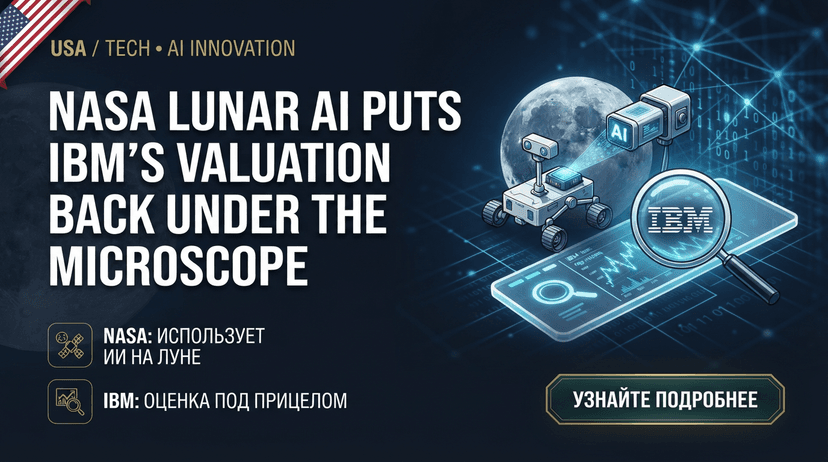
NASA lunar AI puts IBM’s valuation back under the microscope
AI & Tech

NASA lunar AI puts IBM’s valuation back under the microscope

On September 10, 2026, IBM and NASA unveiled the open‑source NASA‑IBM Lunar Foundation Model, putting the project at the center of AInews coverage and renewing attention on how IBM’s expanding artificial intelligence portfolio should be reflected in its market valuation. What exactly did IBM and NASA launch on September 10, 2026? IBM and NASA released an open‑source foundation model built specifically for lunar science, trained on decades of Moon observation data and made publicly available through open repositories. The model is designed to help researchers identify ice deposits, craters and volcanic terrain and to support plans for a sustained human presence on the Moon. According to IBM’s newsroom on September 10, 2026, the NASA‑IBM Lunar Foundation Model is "one of the first publicly available foundation models for scientific exploration of the Moon," trained on an extensive dataset curated jointly by IBM and NASA researchers. NASA’s science office states that the model is hosted on public machine learning platforms with the full codebase on developer repositories so that any scientist can download, test and adapt it. Release date: September 10, 2026, announced jointly by IBM and NASA. Scope: Lunar ice, craters, volcanic history and surface mapping. Access: Model weights under an open license with code available for fine‑tuning and experimentation. Partners: IBM Research, NASA Science and academic collaborators. Wire coverage from Reuters describes the system as an open‑source AI tool designed to analyze decades of lunar observation data and help support a long‑term human presence on the Moon. Tech and science outlets emphasise that researchers can use the model to pinpoint likely buried ice in permanently shadowed craters, map craters at coarse resolution, and explore the Moon’s volcanic history more accurately than earlier methods. How much better is the NASA‑IBM lunar model than existing methods? Independent reports on the NASA‑IBM Lunar Foundation Model say it improves feature detection on the Moon’s surface by a little over twenty percent compared with widely used approaches, using less labeled data to achieve that performance. That uplift in accuracy is one reason investors are re‑examining IBM’s AI capabilities when discussing valuation. Reuters cites NASA and IBM as saying that in benchmark tests the lunar model identified key features on the Moon’s surface up to 23% more accurately than widely used methods. Tech‑focused coverage reports that predictions of buried ice in shadowed polar craters come with 22% less error than the best available dedicated algorithms, while crater mapping at coarse resolution reaches 19% better accuracy while using only half as much labeled training data. Ice prediction error: According to TechTimes on September 11, 2026, error rates are reduced by 22% compared with the best prior algorithm. Crater mapping accuracy: The same report cites a 19% improvement at coarse resolution. Overall feature identification: Reuters reports up to 23% higher accuracy than widely used methods in benchmark tests. Labeled data usage: TechTimes notes the lunar AI model reached its gains with only half as much labeled training data. A technology analysis piece on the model states that NASA’s science team confirmed the system is available on public AI platforms with the complete codebase on code hosting sites, mirroring the distribution approach IBM used for the earlier Prithvi Earth‑observation foundation models. Those earlier models, introduced in 2023 to work on Harmonized Landsat Sentinel‑2 data, were reported by IBM to deliver about a 15% improvement over state‑of‑the‑art techniques in flood and burn‑scar mapping using half the labeled data. This pattern of releasing geospatial models with clear performance gains and open access has helped establish IBM as a reference player in scientific AI, which is now feeding into analyst and investor conversations about the company’s earnings power and valuation multiples. How does this lunar AI fit into IBM’s broader artificial intelligence strategy? The lunar foundation model extends IBM’s strategy of building domain‑specific foundation models under its watsonx portfolio and collaborating with public institutions on open geospatial AI. That strategy now spans Earth observation, weather, environmental intelligence and lunar science, and is increasingly cited in research coverage of IBM’s stock. IBM’s August 3, 2023 announcement of its geospatial foundation model described training a large AI system on one year of Harmonized Landsat Sentinel‑2 satellite data across the continental United States, with fine‑tuning for tasks such as flood and burn scar mapping. According to IBM, that Earth‑focused model delivered a 15% improvement over state‑of‑the‑art techniques using half the labeled data, and a commercial version was slated to be integrated into the IBM Environmental Intelligence Suite, part of the broader watsonx ecosystem. Foundation model family: IBM and NASA’s models join the Prithvi family of geospatial and weather foundation models highlighted in coverage of the lunar release. Commercialisation path: IBM’s geospatial model is linked to the Environmental Intelligence Suite, showing how scientific AI is tied to revenue‑producing software. Open science strategy: NASA and IBM host weights and code under open licenses, encouraging global research use. Brand positioning: IBM’s newsroom clusters the lunar model under its artificial intelligence press releases, presenting it as part of its AI leadership narrative. NASA’s coverage of the lunar foundation model emphasises collaboration not only with IBM but with academic partners, reinforcing IBM’s position as a scientific computing partner rather than simply a commercial vendor. For investors, that dual role matters because it shapes perceptions of IBM’s long‑term relevance in high‑impact domains such as space exploration and climate science. Why is IBM’s stock valuation “back in focus” following the lunar AI launch? Recent analyst reports show renewed attention on IBM’s earnings potential from AI and quantum initiatives, with the lunar model serving as a high‑visibility example of IBM’s technical depth. Consensus targets point to modest upside, and some coverage links positive sentiment directly to IBM’s AI collaborations and product roadmaps. A stock analysis article dated September 12, 2026 reports that Wall Street holds an overall Buy consensus on IBM shares, citing data that 25 analysts have set a 12‑month price target of USD 245.35, about 4.8% above IBM’s September 10 closing price of USD 234.02. The same coverage references other compilations indicating a Moderate Buy consensus and an average target price around USD 265.90, which would imply stronger upside from trading levels near USD 243. Closing price reference: TheStreet coverage cited by ad‑hoc news puts IBM’s closing price on September 10, 2026 at USD 234.02. Analyst count: 25 analysts in that survey with a 12‑month target of USD 245.35, according to TheStreet via ad‑hoc. Consensus descriptor: Separate market data services describe a Moderate Buy rating with an average target of USD 265.90. Valuation metrics: Seeking Alpha’s snapshot on around September 10 lists a forward non‑GAAP price/earnings ratio of 20.22, a GAAP trailing P/E of 22.15, and a price/book multiple of 6.81. The Seeking Alpha figures also show an enterprise value to sales ratio of 4.22 and an enterprise value to EBITDA of 17.72 for IBM, framing the company as a mature technology firm with premium valuation compared with many legacy peers but trading at a discount to some faster‑growing AI‑focused companies. Market commentary links that profile to IBM’s mix of stable infrastructure revenue and emerging growth in AI and quantum computing. Coverage describing IBM stock gains on quantum bets and AI mentions that, despite a legal probe referenced in passing, investor appetite for exposure to IBM’s advanced computing initiatives has remained strong. In that context, the lunar foundation model is cited as a showcase of IBM’s ability to collaborate with agencies such as NASA on cutting‑edge AI, reinforcing the argument that current valuation metrics may underestimate future cash flows from AI‑enabled products and services. Who is affected by the NASA‑IBM lunar AI, beyond IBM’s shareholders? The lunar model directly affects planetary scientists and engineers working on NASA’s Artemis program, while indirectly shaping vendors and partners involved in lunar infrastructure planning. It also influences academic researchers, AI developers and policy discussions about open scientific data and public‑private cooperation in space exploration. NASA’s material on the lunar foundation model points out that the AI system was trained primarily on data from the Lunar Reconnaissance Orbiter and other instruments, creating a unified dataset suitable for machine learning. IBM’s description of the project explains that the two organisations built what they describe as the first open‑source dataset that consolidates decades of lunar data in a format tuned for AI research. NASA Artemis planners: TechTimes notes that the system can help pick landing sites near the lunar south pole, where ice could support water, oxygen and fuel for onward missions to Mars. Planetary science community: NASA and technology outlets say any researcher worldwide can download and adapt the model for fresh studies of lunar phenomena. Academic partners: NASA references several universities involved in the collaboration, extending access to students and early‑career scientists. Space industry vendors: Clearer maps of ice and terrain support companies working on habitats, mining and resource use on the Moon. For AI developers, the lunar model demonstrates how foundation models can be adapted to domains beyond language and mainstream computer vision. For policymakers, the open‑license approach raises questions about how publicly funded data and private sector technology should be shared when they shape future resource extraction and national presence on the Moon. What happens next for IBM’s AI portfolio and valuation story? Commentary from science and market sources suggests several next steps: wider scientific use of the lunar model, commercial spin‑offs through IBM’s software suites, and ongoing analyst reassessment of IBM’s AI and quantum computing earnings potential. The outcome will influence whether current price targets move higher or stabilise as projects like the lunar AI mature. Technology coverage points out that the lunar foundation model follows the pattern IBM and NASA established with the Prithvi models: open weights, open code, and community‑driven fine‑tuning on public platforms. That history makes it likely that new versions will appear, trained on expanded datasets or adapted to related planetary bodies as agencies gather more remote‑sensing data. Scientific roadmap: NASA’s long‑term goal of a sustained human presence on the Moon gives the lunar AI a central role in mission planning. Commercial potential: IBM’s prior geospatial AI has already been linked to its Environmental Intelligence Suite, hinting that similar integration could follow for lunar or broader space‑data products. Valuation drivers: Analyst targets compiled by market data services will likely evolve as IBM reports concrete revenue tied to its AI models and quantum offerings. Risk factors: Legal probes and competitive pressure from other AI vendors are mentioned in stock coverage as counterweights to growth expectations. As those threads unfold, IBM’s collaboration with NASA on the Lunar Foundation Model stands as a visible test of how cutting‑edge, open scientific AI projects can translate into commercial demand and, in turn, into the valuation numbers that investors scrutinise every quarter.

Nic Reeve·
AI Takes Flight in F-16 Tests as Chelsea Flower Show Showcases Garden Tech
AI & Tech

AI Takes Flight in F-16 Tests as Chelsea Flower Show Showcases Garden Tech

Artificial intelligence made another visible leap from lab demos to real-world systems this summer, with one program flying an F-16 under AI control and another bringing AI into the center of the Chelsea Flower Show. The same period also saw fresh product and platform updates around AI-assisted design and consumer tools, underscoring how quickly the technology is spreading across defense, creative work and everyday software. In the most striking military test, Lockheed Martin said an AI agent flew a heavily modified F-16 in 27 live-target intercepts during an eight-sortie campaign at Edwards Air Force Base, California. The aircraft used a Lockheed Martin Legion Pod to track a target aircraft, and the targeting data was fed to the onboard AI agent, which then maneuvered the jet into an intercept position. The company said the test demonstrated a faster “sensor-to-action” loop in a combat aircraft environment, while a pilot remained part of the safety structure during the trials. A separate report on the U.S. Air Force and DARPA’s VENOM work said a modified F-16 was flown under AI control at Eglin Air Force Base, Florida, with a human pilot in the cockpit ready to take over. That program began with validation flights in June 2026 to verify hardware and software upgrades before moving in July to missions in which the AI handled portions of flight. Together, the tests show how autonomy is moving beyond simulation and into controlled aerial operations on live aircraft. The defense significance is not just that an algorithm can fly a jet, but that it can do so repeatedly in a constrained operational context. According to the reports, the AI system was paired with upgraded hardware and sensors rather than a fully redesigned aircraft, suggesting the current emphasis is on integration and reliability rather than replacing pilots outright. That distinction matters because it shows the technology is being framed as a force multiplier, not a stand-alone substitute for human judgment. Elsewhere, the Chelsea Flower Show offered a very different picture of AI’s expanding reach. Coverage from the 2026 show highlighted AI-assisted garden design and plant-monitoring tools, including a platform called Spacelift, which was introduced as an AI-assisted system intended to help homeowners plan, design and manage outdoor spaces. The platform’s debut reflected a broader trend at the show: artificial intelligence is increasingly being used to shape landscapes, not just analyze them. At the same time, Chelsea’s AI story was not confined to design software. BBC reporting on the 2026 event described a plant health scanning technology exhibit that won recognition at the show, while other coverage noted AI-based displays and tools aimed at helping gardeners understand plant stress, irrigation needs and long-term maintenance. The Royal Horticultural Society has also been linked to plans for wider use of AI in plant databases and garden planning, suggesting the technology may become part of the event’s practical toolkit rather than a one-off novelty. The reaction inside the gardening world has been mixed. Some designers view AI as a helpful planning aid that can speed up layout work, improve visualization and support maintenance decisions. Others worry that the technology may flatten design into formulaic outputs or undercut the craft of human landscapers. That tension was visible in coverage of the 2026 Chelsea Flower Show, where AI-generated or AI-assisted gardens became a talking point in their own right. What ties the F-16 tests and the Chelsea Flower Show together is not the technology itself, but the stage it has reached. In both cases, AI is being moved out of speculative presentations and into applied environments with real constraints: complex flight dynamics in one setting, living ecosystems and client expectations in the other. The underlying message is the same: AI is becoming less of an abstract promise and more of an operational tool. That shift also raises a broader industry question. As AI systems are deployed in spaces as different as military aviation and garden design, the measure of success is changing from raw capability to trustworthy performance. Can the system act safely, explainably and consistently when conditions change? Can people supervise it effectively? Can the technology produce results that users actually want? The latest examples suggest those questions are now central to how AI is evaluated. For now, the picture is one of rapid diversification. A fighter jet can be partly directed by an AI agent. A garden show can feature AI-assisted design and plant-health tools. Consumer-facing software can claim to help people create and manage outdoor spaces with machine assistance. The common thread is that AI is no longer confined to software demos; it is increasingly being tested in the physical world, where consequences are visible and the standards are higher.

Nic Reeve·
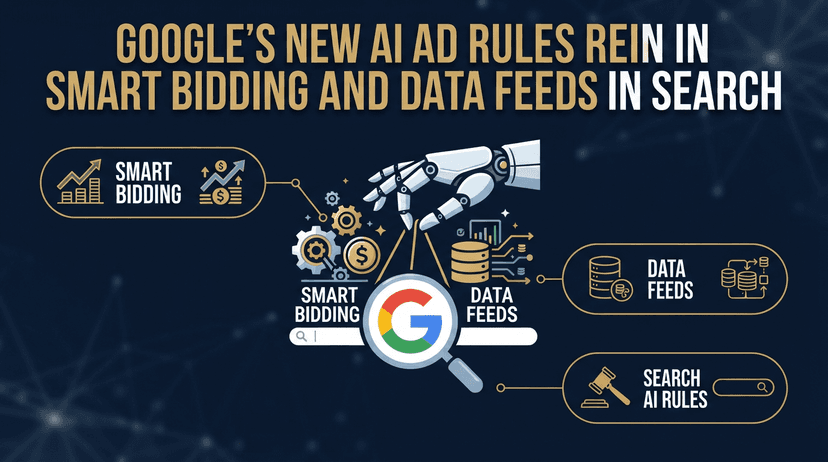
Google’s New AI Ad Rules Rein In Smart Bidding and Data Feeds in Search
AI & Tech

Google’s New AI Ad Rules Rein In Smart Bidding and Data Feeds in Search

Google is rolling out a series of policy and product changes that significantly tighten how artificial intelligence is used in ad bidding and how data feeds power search advertising, reshaping the playbook for brands and ad-tech startups that depend on Google’s ecosystem. The changes span smart bidding behavior, consent-driven data flows, migration to AI-first campaign types, and updated terms governing how advertiser data can train Google’s generative ad models. Together, they signal a more controlled, compliance-focused phase for AI in search and shopping ads. Smart Bidding: From “Over-Delivery” to Strict Target Enforcement At the heart of the shift is a fundamental update to Google’s Smart Bidding systems. A new mechanism, often described by analysts as Bidding Target Optimization , is scheduled to begin enforcement on August 17, 2026. It alters how cost-per-acquisition (tCPA) and return-on-ad-spend (tROAS) strategies behave in budget‑limited campaigns. Historically, Smart Bidding would sometimes deliver better‑than‑stated efficiency if it found high‑performing inventory within a campaign’s budget. Under the new rules, the algorithms are designed to pull performance toward the advertiser’s stated targets rather than “over‑delivering” efficiency beyond those thresholds. This effectively tightens the bid band around declared goals, forcing advertisers to calibrate their targets more carefully if they want to capture incremental upside. To ease the transition, Google introduced target adjustment tools in early July, allowing advertisers to recalibrate their CPA and ROAS goals before the new enforcement date. Industry commentators say this reduces volatility but also removes some of the hidden upside many performance marketers had come to expect from Smart Bidding. Exploratory AI Bidding Meets Stricter Guardrails In parallel, Google has expanded a feature known as Smart Bidding Exploration. Originally launched for search campaigns, the capability now reaches Performance Max campaigns that do not use product feeds, with feed-based placements such as Shopping still in beta. Exploration allows advertisers to specify a tolerance range around their target ROAS. Within that band, Google’s AI can bid on queries and placements that lack strong historical conversion data, effectively probing unproven traffic that might still meet acceptable efficiency thresholds. Marketers gain access to a wider surface of potential customers, but within tighter economic parameters dictated by their ROAS tolerance settings. Viewed together, Exploration and Target Optimization suggest a new philosophy: Google’s AI is allowed to experiment, but only inside clearly defined financial guardrails. The system is being nudged away from open‑ended opportunism and toward strict adherence to explicitly declared business goals. Consent Mode Reshapes the Data Supply for AI Ads Another critical change affects the data flows that power Google’s AI‑driven ads and measurement. As of June 15, 2026, Google’s Consent Mode v2 became the sole gatekeeper for advertising data collection across key properties such as Google Ads and Analytics. The ad_storage parameter now exclusively controls whether advertising cookies and identifiers can be set and whether ad‑related data can be transmitted. Legacy mechanisms—such as the Google Signals toggle and certain account-level data sharing overrides—have been retired. In practice, if a website does not obtain user consent for ad storage under the updated consent framework, Google’s systems will sharply limit data collection and audience building for that property. This reconfiguration has major implications for AI training. Without compliant consent signals, fewer user-level data points enter Google’s optimization pipelines, which can degrade targeting precision and attribution but improves alignment with privacy regulations. For advertisers and AI startups, the message is clear: consent configuration is no longer a secondary detail—it is now the defining factor in how much data the algorithms can see and learn from. AI Max Campaigns and Forced Migrations On the campaign structure side, Google continues to consolidate legacy formats into AI‑driven types. AI Max for Search, an AI‑centric successor to traditional search setups, moved out of beta and into broad availability in early 2026. New tools let advertisers apply text guidelines that shape automatically generated ad copy while the underlying system uses machine learning to customize messaging and targeting at scale. Dynamic Search Ads (DSA), once a mainstay for automatically matching queries to relevant landing pages, are slated for forced migration to AI Max for Search. The original deadline of September 2026 has been pushed back, with the sunset now delayed into 2027. Nonetheless, Google has confirmed that new DSA creation will be disabled and that existing campaigns will ultimately be transitioned to AI Max, preserving only limited URL controls. Similarly, automated assets and certain broad match configurations will auto‑upgrade to AI Max beginning in September 2026. For startups that have built tooling around DSA and legacy targeting structures, the consolidation raises strategic questions: invest in deeper AI Max integrations or pivot away from Google-specific campaign automation. Updated Terms Clarify How Advertiser Data Trains AI Models Underlying all these product changes are newly updated terms of service for Google Ads and related products, effective July 1, 2026. The revisions clarify how advertiser-supplied creative assets—such as text, images, and product data feeds—may be used to train Google’s generative AI systems for ads. While details vary by region and product, the broad thrust is that Google can use advertiser inputs as training material to improve AI-generated ad copy, image variations, and campaign optimization models, subject to consent, privacy, and contractual boundaries. For marketers, this institutionalizes a reality that has been emerging for several years: the creative and feed data they upload is not just serving current campaigns; it is also helping refine the algorithms that will shape future performance for themselves and others. Regulatory Pressure on AI Search and Data Use Regulators are also exerting pressure on how AI uses content and data in search experiences. In the United Kingdom, the Competition and Markets Authority (CMA) issued a landmark conduct requirement in June 2026, compelling Google to give publishers specific controls over whether their content powers AI-generated search summaries. Under that order, Google must offer granular opt-outs for AI Overviews and other generative features, explain how crawled content is used, and provide engagement metrics and meaningful attribution to publishers whose content appears in AI modules. The company has nine months to fully comply, although regulators expect visible progress well before the deadline. For the broader AI data supply chain, this underscores an emerging principle: access to content and behavioral data for AI training and summarization is no longer assumed—it must be negotiated, disclosed, and controlled. That shift affects not only Google but also third‑party data brokers, scraping-based startups, and ad-tech platforms that rely on Google’s search results and ad inventory as a primary signal source. Implications for Startups and Advertisers For startups operating in search, marketing analytics, or AI ad optimization, Google’s tightening of AI bids and data rules is a double-edged sword. On one hand, clearer guardrails around bidding targets and consent-driven data flows reduce uncertainty and regulatory risk. On the other, reduced access to unconstrained data, forced migrations to AI‑first campaign types, and stricter adherence to declared economic targets make it harder to extract “alpha” purely through arbitrage or aggressive experimentation. Advertisers now face a more technical optimization landscape. Success increasingly depends on: Precisely calibrating CPA and ROAS targets to balance stability with growth. Configuring Consent Mode and ad_storage signals to preserve legally compliant data volume. Adapting to AI Max and other AI‑centric campaign structures without losing essential controls. Understanding how their creative assets and product feeds feed into broader generative AI models. As Google’s AI ad stack matures under stricter rules, both brands and startups will have to treat data governance and bid strategy as core product disciplines, not peripheral operational details.

Nic Reeve·