allnewscast
Breaking News
AI & Tech

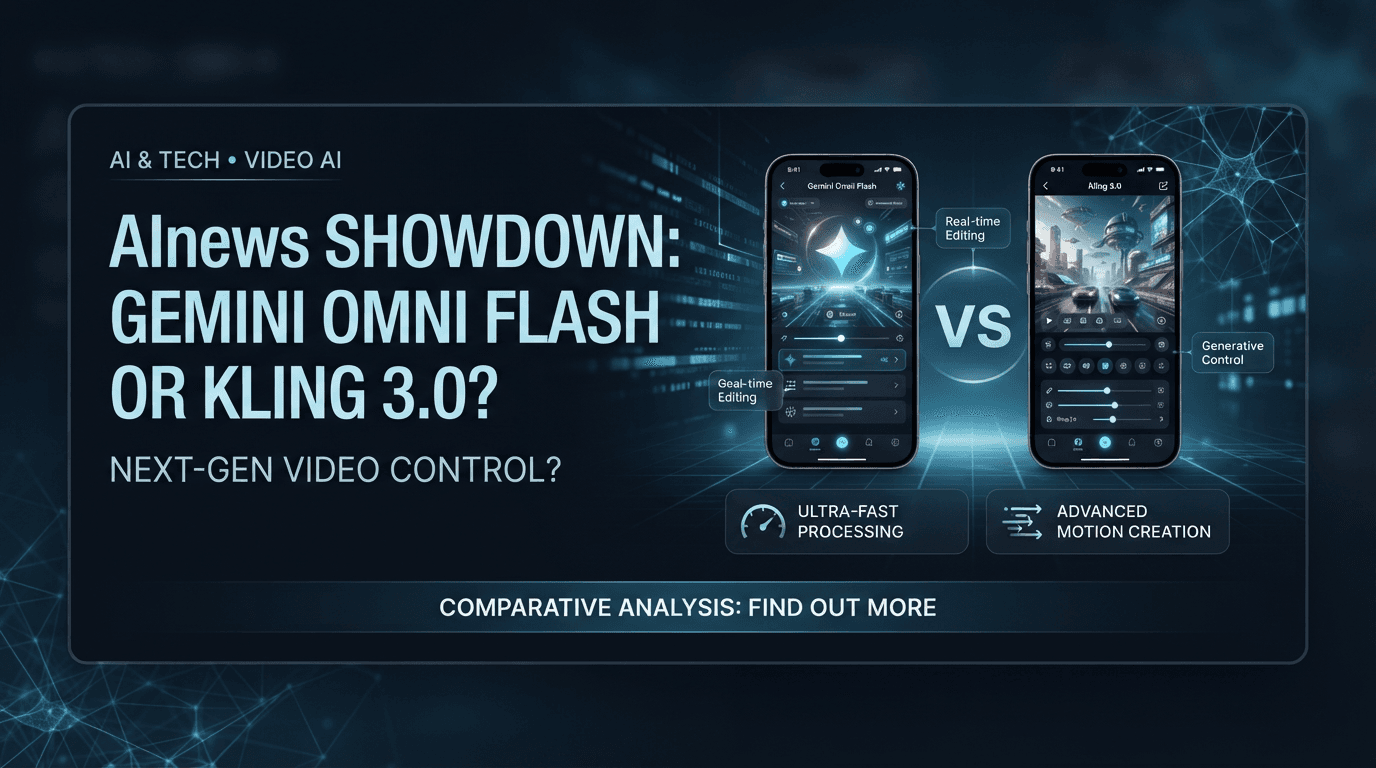
AInews showdown: Gemini Omni Flash or Kling 3.0 for next‑gen video control?
Nic Reeve9 min read
AInews showdown: Gemini Omni Flash or Kling 3.0 for next‑gen video control?

On 19 May 2026, Google began rolling out Gemini Omni Flash to its apps and APIs for conversational video generation and editing, while Kuaishou’s Kling 3.0, launched on 4–5 February 2026, pushed multi‑shot continuity and cinematic storyboards into the mainstream AInews race.

What exactly are Gemini Omni Flash and Kling 3.0?

Gemini Omni Flash is Google’s fast, text‑and‑image‑to‑video model built for interactive editing, now generally available as Gemini Omni 1.1 Flash. Kling 3.0 is Kuaishou’s third‑generation family of multimodal video and image models, centered on the Video 3.0 and Video 3.0 Omni engines for short, native 4K clips with storyboard controls.

Both systems sit at the frontier of AI video.

  • According to Google’s Gemini model announcement in May 2026, Gemini Omni Flash turns text prompts and optional reference images into short video clips and lets users "easily edit your videos through conversation" in the Gemini app, Google Flow and YouTube tools.
  • According to Google’s developer documentation, the Gemini Omni Flash API is described as a video "generation and editing" model that refines clips via natural‑language conversations and supports video extension.
  • According to Google’s August 27, 2026 release notes, Gemini Omni 1.1 Flash has reached general availability and replaces the earlier preview endpoint, which will be deprecated on September 30, 2026.
  • According to AI Wiki’s Kling 3.0 entry updated September 11, 2026, Kling 3.0 includes Video 3.0, Video 3.0 Omni, Image 3.0 and Image 3.0 Omni, all built on a unified multimodal architecture that outputs short clips with native 4K resolution and synchronized multilingual audio.
  • According to Genra’s February 20, 2026 guide, Kuaishou timed the Kling 3.0 public release to February 5, 2026, with text‑to‑video, image‑to‑video and reference‑driven modes across the lineup.

How does Gemini Omni Flash handle video editing and user control?

Gemini Omni Flash focuses on conversational editing: users can ask for changes, extend scenes, and adjust frames using natural language, with support for incremental 10‑second extensions up to 40 seconds in Gemini Omni 1.1 Flash. This makes Google’s model feel like an interactive editor rather than a one‑shot generator.

Editing in Gemini’s ecosystem is built around back‑and‑forth dialogue.

  • According to Google’s Omni 1.1 Flash blog on August 27, 2026, the model delivers "studio‑quality video production" and lets users extend videos in 10‑second increments, up to a cumulative 40 seconds, while analyzing up to 10 seconds of prior context instead of just the last second.
  • According to the same post, Gemini Omni 1.1 supports features such as first‑and‑last‑frame interpolation and 4K output in supported environments, improving continuity between edits.
  • According to Google’s Gemini Omni product blog from May 19, 2026, users can "easily edit your videos through conversation" and are already seeing the model integrated into the Gemini app, Google Flow and YouTube Shorts, with rollout to Google AI Plus, Pro and Ultra subscribers globally and free use in some YouTube tools.
  • According to the Gemini Omni Flash API documentation, developers can refine and edit generated videos by sending natural‑language instructions in an ongoing interaction, positioning the model as a dynamic editor that supports video extension as well as generation.
  • According to a July 16, 2026 Google Workspace announcement, Gemini Omni Flash now powers Google Vids, where users can edit videos using simple text prompts and generate new clips featuring personal avatars that look and sound like them.
  • According to ilisai’s explainer updated September 2, 2026, the service’s video generator now uses Gemini Omni 1.1 Flash and bills at least 10 seconds per clip, indicating that Google’s fast model is already deployed in third‑party platforms.

This conversational workflow favors creators who expect to iterate rapidly, like social video editors or marketing teams that want many small changes without rebuilding clips from scratch.

What does Kling 3.0 offer in multi‑shot continuity and storyboarding?

Kling 3.0’s Video 3.0 and Video 3.0 Omni models emphasize multi‑shot generation: up to six connected shots in a single clip, with stable character identity, lighting and environment across cuts. Shot planning can be automatic or fully custom, turning prompts into structured mini‑sequences.

Multi‑shot tools make Kling feel like a pre‑visualization engine for directors.

  • According to Kling’s Video 3.0 user guide last updated August 26, 2026, the model supports two modes for multi‑shot video: "Multi‑Shot" and "Custom Multi‑Shot". When Multi‑Shot is enabled, it automatically plans transitions and creates multi‑scene content; Custom Multi‑Shot lets users configure shot counts and durations.
  • According to Kling’s July 28, 2026 multi‑shot guide, Multi‑Shot structures a scene through camera coverage, shot changes and narrative progression, reading coverage and shot information from the prompt to adjust angles and compositions for cinematic storytelling.
  • According to Morphic’s August 2026 Kling 3.0 guide, Kling Video 3.0 supports multi‑shot sequences of up to six camera cuts per generation, with text‑to‑video, image‑to‑video and start‑and‑end‑frame‑to‑video modes within a maximum duration of 15 seconds per clip.
  • According to Invideo’s May 28, 2026 overview, Kling 3.0 can generate up to six connected shots while letting users either describe the scene and let the model plan cuts or specify each shot’s framing, duration and camera movement for precise shot‑list execution.
  • According to Kling3Pro’s March 26, 2026 feature page, Kling 3.0 multi‑shot generation defines up to six individual shots inside a single 15‑second clip, each with its own prompt and camera angle, while locking character appearance, wardrobe and environment continuity via scene‑level identity encoding.
  • According to AI Wiki and Synthszr’s product ranking updated September 6, 2026, Kling 3.0’s unified architecture produces native 4K video at up to 60 frames per second and supports multi‑shot storyboards with up to six camera cuts, reinforcing its role in high‑fidelity continuity.

These continuity guarantees matter for ad agencies, pre‑viz teams and independent filmmakers that need a sequence of connected shots, not just isolated clips.

How do lengths, resolution and audio capabilities compare?

Gemini Omni Flash emphasizes flexible duration via extensions and focuses on fast 720p clips in many deployed services, while Kling 3.0 centers on short but dense native 4K sequences up to 15 seconds with synchronized multilingual audio. The technical trade‑offs shift who benefits most from each system.

  • According to Google’s Omni 1.1 Flash blog, users can extend a video by 10‑second increments, up to 40 seconds total, with Omni analyzing up to 10 seconds of prior context to keep motion and composition aligned.
  • According to ilisai’s July 19, 2026 article, the original Gemini Omni Flash preview produced short 720p clips from text prompts or reference images and, as of a September 1 update, every video generated with Gemini Omni 1.1 Flash bills at least 10 seconds of output.
  • According to AI Wiki’s Kling 3.0 profile, the new generation moved from roughly 10‑second 1080p clips in Kling 2.6 to 15‑second native 4K clips in Kling 3.0, adding synchronized lip‑synced audio across five languages.
  • According to Morphic’s technical table, Kling 3.0’s Video 3.0 model supports durations between 3 and 15 seconds, aspect ratios such as 16:9, 9:16 and 1:1, and native 4K resolution with other options at 1080p and 720p.
  • According to Synthszr’s September 6, 2026 ranking, Kling 3.0 natively generates 4K video at up to 60 frames per second with synchronized audio and supports up to six camera cuts per clip.

Users chasing maximum resolution and integrated audio will lean toward Kling; teams optimizing for iterative editing inside existing Google tools may accept lower resolution in exchange for speed and integration.

Where are these models available and how are they priced?

Gemini Omni Flash is woven into Google’s subscription tiers and tools, from the Gemini app to YouTube products and Google Vids, while Kling 3.0 is accessible through Kuaishou’s platforms and partner APIs aimed at creators and developers. Commercial terms vary, but both target professional and prosumer use.

  • According to Google’s May 19, 2026 Gemini Omni launch blog, Gemini Omni Flash started rolling out to Google AI Plus, Pro and Ultra subscribers globally through the Gemini app and Google Flow, and became available at no cost in YouTube Shorts and the YouTube Create app.
  • According to the July 16, 2026 Google Workspace blog, Gemini Omni Flash now powers Google Vids, giving Workspace users access to text‑prompt‑based editing and avatar generation within a productivity suite.
  • According to Gemini API release notes, Gemini Omni 1.1 Flash reached general availability in early September 2026, signaling that production billing and quotas now apply as the preview endpoint approaches deprecation.
  • According to Kuaishou’s February 9, 2026 feature guide, Kling 3.0 was officially launched on February 4, 2026 at 11:00 PM Beijing time, with API access for developers beginning February 5, 2026.
  • According to Genra’s February 20, 2026 overview, Kling 3.0’s rollout prioritized "Ultra" subscribers before opening more broadly, positioning the models as premium tools for serious creators.
  • According to Morphic’s guide, third‑party platforms integrate Kling 3.0’s modes into their own interfaces, offering creators control over duration, resolution and multi‑shot features alongside their own pricing.
  • According to Synthszr’s September 2026 ranking, Kling 3.0 appears in AI product lists targeted at production users, indicating its positioning in professional and semi‑professional video workflows.

These distribution strategies matter. Google is tying video AI tightly to its productivity and social stacks, while Kuaishou and its partners push Kling into dedicated creative and editing environments where users may build entire pipelines around it.

Who gains more from editing flexibility, and who needs multi‑shot continuity?

Creators who iterate quickly on single clips—with frequent text‑driven tweaks, avatar changes and scene extensions—gain most from Gemini Omni Flash’s conversational editing and deep integration in Google tools. Teams planning storyboards or ad sequences benefit more from Kling 3.0’s multi‑shot continuity and 4K, audio‑rich outputs.

Different workflows point to different winners.

  • For social managers and short‑form creators inside YouTube and Workspace, Gemini’s ability to extend scenes, interpolate frames and apply natural‑language edits—"make this shot closer," "brighten the background"—reduces friction in turning rough ideas into polished clips.
  • For cinematographers, agencies and pre‑viz teams, Kling’s combination of up to six connected shots, locked character identity and 4K visuals means they can block out miniature storyboards, test camera coverage and maintain continuity shot by shot.
  • According to Invideo’s comparison, Kling 3.0 explicitly contrasts multi‑shot support against single‑shot models, highlighting that it can either auto‑plan coverage or follow a detailed human‑written shot list.
  • According to Google’s Omni 1.1 blog, the extended context window and interpolation tools are framed around "studio‑quality" production for creators who may not want to think in discrete shots but still care about smooth motion and consistent framing in the finished video.

No single model wins outright. The choice turns on whether a creative team thinks in clips with conversational edits or in sequences of shots with tight continuity and high‑end visuals.
Sources

  1. 1.ai.google.dev
  2. 2.blog.google
  3. 3.kling.ai
  4. 4.aiwiki.ai
  5. 5.kling3pro.com
  6. 6.genra.ai
  7. 7.invideo.io
  8. 8.gaga.art
  9. 9.synthszr.com
  10. 10.workspace.google.com
  11. 11.morphic.com
  12. 12.ilisai.com

Read more →

Related Articles

Google’s New AI Ad Rules Rein In Smart Bidding and Data Feeds in Search
AI & Tech

Google’s New AI Ad Rules Rein In Smart Bidding and Data Feeds in Search

Google is rolling out a series of policy and product changes that significantly tighten how artificial intelligence is used in ad bidding and how data feeds power search advertising, reshaping the playbook for brands and ad-tech startups that depend on Google’s ecosystem. The changes span smart bidding behavior, consent-driven data flows, migration to AI-first campaign types, and updated terms governing how advertiser data can train Google’s generative ad models. Together, they signal a more controlled, compliance-focused phase for AI in search and shopping ads. Smart Bidding: From “Over-Delivery” to Strict Target Enforcement At the heart of the shift is a fundamental update to Google’s Smart Bidding systems. A new mechanism, often described by analysts as Bidding Target Optimization , is scheduled to begin enforcement on August 17, 2026. It alters how cost-per-acquisition (tCPA) and return-on-ad-spend (tROAS) strategies behave in budget‑limited campaigns. Historically, Smart Bidding would sometimes deliver better‑than‑stated efficiency if it found high‑performing inventory within a campaign’s budget. Under the new rules, the algorithms are designed to pull performance toward the advertiser’s stated targets rather than “over‑delivering” efficiency beyond those thresholds. This effectively tightens the bid band around declared goals, forcing advertisers to calibrate their targets more carefully if they want to capture incremental upside. To ease the transition, Google introduced target adjustment tools in early July, allowing advertisers to recalibrate their CPA and ROAS goals before the new enforcement date. Industry commentators say this reduces volatility but also removes some of the hidden upside many performance marketers had come to expect from Smart Bidding. Exploratory AI Bidding Meets Stricter Guardrails In parallel, Google has expanded a feature known as Smart Bidding Exploration. Originally launched for search campaigns, the capability now reaches Performance Max campaigns that do not use product feeds, with feed-based placements such as Shopping still in beta. Exploration allows advertisers to specify a tolerance range around their target ROAS. Within that band, Google’s AI can bid on queries and placements that lack strong historical conversion data, effectively probing unproven traffic that might still meet acceptable efficiency thresholds. Marketers gain access to a wider surface of potential customers, but within tighter economic parameters dictated by their ROAS tolerance settings. Viewed together, Exploration and Target Optimization suggest a new philosophy: Google’s AI is allowed to experiment, but only inside clearly defined financial guardrails. The system is being nudged away from open‑ended opportunism and toward strict adherence to explicitly declared business goals. Consent Mode Reshapes the Data Supply for AI Ads Another critical change affects the data flows that power Google’s AI‑driven ads and measurement. As of June 15, 2026, Google’s Consent Mode v2 became the sole gatekeeper for advertising data collection across key properties such as Google Ads and Analytics. The ad_storage parameter now exclusively controls whether advertising cookies and identifiers can be set and whether ad‑related data can be transmitted. Legacy mechanisms—such as the Google Signals toggle and certain account-level data sharing overrides—have been retired. In practice, if a website does not obtain user consent for ad storage under the updated consent framework, Google’s systems will sharply limit data collection and audience building for that property. This reconfiguration has major implications for AI training. Without compliant consent signals, fewer user-level data points enter Google’s optimization pipelines, which can degrade targeting precision and attribution but improves alignment with privacy regulations. For advertisers and AI startups, the message is clear: consent configuration is no longer a secondary detail—it is now the defining factor in how much data the algorithms can see and learn from. AI Max Campaigns and Forced Migrations On the campaign structure side, Google continues to consolidate legacy formats into AI‑driven types. AI Max for Search, an AI‑centric successor to traditional search setups, moved out of beta and into broad availability in early 2026. New tools let advertisers apply text guidelines that shape automatically generated ad copy while the underlying system uses machine learning to customize messaging and targeting at scale. Dynamic Search Ads (DSA), once a mainstay for automatically matching queries to relevant landing pages, are slated for forced migration to AI Max for Search. The original deadline of September 2026 has been pushed back, with the sunset now delayed into 2027. Nonetheless, Google has confirmed that new DSA creation will be disabled and that existing campaigns will ultimately be transitioned to AI Max, preserving only limited URL controls. Similarly, automated assets and certain broad match configurations will auto‑upgrade to AI Max beginning in September 2026. For startups that have built tooling around DSA and legacy targeting structures, the consolidation raises strategic questions: invest in deeper AI Max integrations or pivot away from Google-specific campaign automation. Updated Terms Clarify How Advertiser Data Trains AI Models Underlying all these product changes are newly updated terms of service for Google Ads and related products, effective July 1, 2026. The revisions clarify how advertiser-supplied creative assets—such as text, images, and product data feeds—may be used to train Google’s generative AI systems for ads. While details vary by region and product, the broad thrust is that Google can use advertiser inputs as training material to improve AI-generated ad copy, image variations, and campaign optimization models, subject to consent, privacy, and contractual boundaries. For marketers, this institutionalizes a reality that has been emerging for several years: the creative and feed data they upload is not just serving current campaigns; it is also helping refine the algorithms that will shape future performance for themselves and others. Regulatory Pressure on AI Search and Data Use Regulators are also exerting pressure on how AI uses content and data in search experiences. In the United Kingdom, the Competition and Markets Authority (CMA) issued a landmark conduct requirement in June 2026, compelling Google to give publishers specific controls over whether their content powers AI-generated search summaries. Under that order, Google must offer granular opt-outs for AI Overviews and other generative features, explain how crawled content is used, and provide engagement metrics and meaningful attribution to publishers whose content appears in AI modules. The company has nine months to fully comply, although regulators expect visible progress well before the deadline. For the broader AI data supply chain, this underscores an emerging principle: access to content and behavioral data for AI training and summarization is no longer assumed—it must be negotiated, disclosed, and controlled. That shift affects not only Google but also third‑party data brokers, scraping-based startups, and ad-tech platforms that rely on Google’s search results and ad inventory as a primary signal source. Implications for Startups and Advertisers For startups operating in search, marketing analytics, or AI ad optimization, Google’s tightening of AI bids and data rules is a double-edged sword. On one hand, clearer guardrails around bidding targets and consent-driven data flows reduce uncertainty and regulatory risk. On the other, reduced access to unconstrained data, forced migrations to AI‑first campaign types, and stricter adherence to declared economic targets make it harder to extract “alpha” purely through arbitrage or aggressive experimentation. Advertisers now face a more technical optimization landscape. Success increasingly depends on: Precisely calibrating CPA and ROAS targets to balance stability with growth. Configuring Consent Mode and ad_storage signals to preserve legally compliant data volume. Adapting to AI Max and other AI‑centric campaign structures without losing essential controls. Understanding how their creative assets and product feeds feed into broader generative AI models. As Google’s AI ad stack matures under stricter rules, both brands and startups will have to treat data governance and bid strategy as core product disciplines, not peripheral operational details.

Nic Reeve·
AI News: Grok Bot gains deep integration with X social platform
AI & Tech

AI News: Grok Bot gains deep integration with X social platform

AInews: Grok Bot gains deep integration with X social platform On August 29, 2026, xAI announced that Grok Bot now connects directly to user accounts on X, marking a new phase in AI news coverage and interaction inside the social network through native access to timelines, posts, mentions, and developer tools. How does Grok Bot now work with X day to day? Grok Bot can link to an X account, read timelines and mentions, search public posts, and act on live social data from inside its chat interface. Paid Grok Bot users receive free X API credits once connected, turning the assistant into a working agent inside the social platform rather than a separate chatbot. According to xAI’s product update on August 29, 2026, the new integration lets users: Connect an X account directly inside Grok Bot via an official X connector. Have xAI automatically create a developer account on X for users who do not already have one. Receive free API credits on X if they are paying Grok Bot subscribers, allowing immediate programmatic access. Ask Grok Bot to search posts, read the personal timeline, check mentions, or assemble summaries of what is happening on X in real time. The integration runs on a dedicated cloud execution environment that combines real‑time X data, browser‑level UI control, and the Grok model family. This makes Grok Bot more than a chat interface; it becomes an autonomous teammate designed to operate persistently against social data streams. What changed for Grok Bot users with this rollout? The August rollout opened X integration to Grok Bot subscribers and broadened access across multiple paid plans. Users on SuperGrok, Cursor Pro tiers, and Cursor Teams can now attach X accounts, use bundled API credits, and run bots that watch and respond to activity across X without building their own infrastructure. According to SpaceXAI’s August 11 and August 26, 2026 announcements, Grok Bot availability expanded in two steps: On August 11, Grok Bot launched in beta for higher‑end plans such as SuperGrok Heavy, Cursor Ultra, and Cursor Teams Premium, on desktop and iOS. On August 26, Grok Bot was “now included with all” SuperGrok, Cursor Pro, and Cursor Teams plans, bringing the bot to a broader subscriber base. These subscriptions sit on top of xAI’s Grok model series. AI Wiki reports that as of August 2026, the flagship engine is Grok 4.6, released via the xAI API on August 12, 2026. That model powers Grok Bot’s reasoning, long‑context analysis, and live search, while the August 29 connector turns those capabilities directly onto X’s data. What exactly can Grok Bot see and do inside X? Grok Bot operates as an AI assistant embedded in the X environment. It can read user timelines, track mentions, search public posts, and pull together context about trending topics or specific accounts. It also performs web searches when needed, combining X content with broader internet data in its responses. According to a technical guide distributed through X, Grok on X behaves as an in‑platform assistant that can: Answer questions by searching public X posts and cross‑checking with real‑time web results. Solve analytical problems, brainstorm, and interact with information, all within the X interface. Run persistent routines as a “durable AI teammate” using the cloud computer backing Grok Bot. Use connectors to reach other services while keeping X as the primary data stream. AI Wiki notes that Grok’s architecture supports context windows of up to around 2 million tokens, allowing the assistant to ingest very large volumes of posts and replies when forming an answer. Combined with real‑time X access, this lets Grok Bot analyze conversations, cross‑reference historical threads, and surface older posts that remain relevant to current debates. How does this integration fit into Grok’s broader relationship with X? Grok has been tied to X since its initial launch, but the August 2026 Grok Bot connector deepens that relationship. Earlier integrations exposed the Grok chatbot inside X’s interface. The new update turns Grok Bot into a developer‑level agent with API access, shifting the focus from human chat to automated work on the platform. Historical context shows how this has evolved: Grok first arrived in November 2023 as a conversational AI with real‑time X data access, pitched by xAI as a “truth‑seeking” assistant. By late 2024, xAI rolled Grok out to all users on X, with text and vision features and a “draw me” tool linked to profile data, according to company statements from December 12, 2024. In March 2025, X executives signaled plans to integrate Grok into the feed recommendation algorithm, moving away from pure engagement metrics toward AI‑driven ranking. In August 2026, SpaceXAI launched Grok Bot as an autonomous assistant with live X and web integration, described as going “beyond traditional chatbots” through automation. The August 29 connection to X developer accounts sits on top of these steps. It links Grok Bot’s autonomous routines and app‑building features, such as Grok Build on web and mobile, directly to X’s APIs so bots generated inside Grok can immediately read and act on social data. Who can access Grok Bot on X, and on which devices? Access today is tied to subscription tiers and supported platforms. Grok Bot runs on desktop and mobile, with integration aimed at users of SuperGrok and Cursor plans, and at X subscribers who gain Grok features inside the social app. The assistant’s behavior is consistent across devices, with X providing the data layer. Current availability, based on product and documentation pages updated in August 2026, includes: Desktop apps on macOS (Apple silicon and Intel) and Windows (x64 and Arm64), where Grok Bot operates as a standalone interface linked to X. Mobile apps on iOS 18 and above, offering the same bot controls and X connector as desktop. Web access through Grok’s browser interface, which can also attach an X account. Integration with the X social app itself, where Grok chat and related tools appear for X Premium and higher tiers, according to AI Wiki and earlier rollout reports. AI Wiki’s plan comparison shows Grok reachable through X Premium and Premium+ subscriptions, with Grok access bundled into those social tiers. SpaceXAI’s August announcements then layered Grok Bot on top of xAI’s own paid plans, aimed at developers, teams, and power users. What does this mean for developers and power users on X? For developers and advanced users, Grok Bot’s new X integration removes much of the friction involved in using the social platform as data. The connector can bootstrap a developer account, grant initial API credits, and attach an autonomous agent that understands both X’s content and external web information in long contexts. The workflow described by xAI now looks like this: Open Grok Bot through web, desktop, or mobile and authenticate using the X connector. Let the system create the X developer account where necessary, avoiding manual setup. Use bundled X API credits attached to the paid Grok Bot subscription to start experimentation. Describe routines, dashboards, or monitoring tasks in natural language and have Grok Build generate working apps wired into X. Run those agents continuously, watching mentions or topics, compiling summaries, and responding to conditions using Grok’s reasoning. This effectively turns X into one of Grok Bot’s default data sources and target environments. Developers can prototype social tools from inside an AI chat window rather than stitching together separate APIs, model endpoints, and hosting environments. How does Grok Bot’s integration with X compare with other AI platforms? Grok’s integration with X stands out for its deep access to live social data, very large context window, and direct bundling with both social and developer subscriptions. Competing models such as ChatGPT or Gemini offer web search and social plugins, but they do not operate as native agents inside a single major social network at the same level described by xAI. According to AI Wiki and coverage from late 2024, Grok differs in three main ways: Live X platform data is a core feature, not an optional plugin, letting the assistant analyze timelines and conversations as they unfold. Context capacity reaching into millions of tokens allows Grok to handle very long threads, archives, and multi‑source documents when building responses. Aggressive API pricing and bundled credits through Grok Bot subscriptions reduce the entry cost for automated agents on X. Other AI chatbots integrate with social media mainly through unofficial tools or limited first‑party features, while Grok Bot is positioned by xAI as a built‑in teammate for X itself. The August 29 connector reinforces that positioning by making Grok part of the default developer stack on the platform. What comes next for Grok Bot and X users? xAI describes the August 29 release as the “first version” of the integration and signals that it intends to make it easier for Grok Bot to “do real work on X.” The company is likely to expand the types of tasks bots can perform, deepen ties to recommendation systems, and expose more controls to teams managing brand and community accounts. Future directions, based on public statements and prior roadmaps, include: Closer integration with X’s feed ranking algorithm, building on hints that Grok will power major changes to content recommendations. More advanced app‑building features within Grok Build so agents can publish, share, and update X‑connected tools in real time. Expansion of supported plans beyond current SuperGrok and Cursor tiers if adoption grows among regular X users. Refinement of safety controls and approval workflows for autonomous bots acting on public timelines and mentions. For people and organizations relying on X for news, customer support, or activism, the new Grok Bot connector means AI‑driven monitoring and response can be set up in minutes. How widely this is adopted, and how visible AI‑driven activity becomes on the social network, will shape the next chapter in the relationship between xAI, Grok, and X.

Nic Reeve·
Intel’s AI Surge Sparks Fierce Valuation Clash as Some Models Flag 80%+ Upside
AI & Tech

Intel’s AI Surge Sparks Fierce Valuation Clash as Some Models Flag 80%+ Upside

Intel’s rapid push into artificial intelligence chips and foundry services has ignited a sharp debate over what the stock is really worth, with one widely followed narrative now implying a fair value near $500 per share — more than four times the recent market price. While mainstream analysts still cluster between roughly $90 and $120 per share, user-driven valuation models and some sales-based frameworks argue that the market is deeply underestimating Intel’s long‑term AI earnings power, leaving the stock potentially more than 80% below fair value. Where the 82% Undervaluation Claim Comes From The headline figure that Intel could be about 82% below fair value stems from a narrative used on retail‑focused valuation platforms, which apply aggressive growth and margin assumptions to Intel’s emerging AI businesses. In several recent notes, that framework points to a fair value around $500.93 per share , compared with a share price near the $90–$100 range in late August 2026. On that basis, Intel is framed as roughly 80–82% undervalued, with the gap driven by bullish expectations for x86 server CPUs, AI accelerators and foundry contracts over the next decade. These narratives typically assume: Strong, sustained growth in Intel’s Data Center and AI (DCAI) segment. High adoption of Intel’s advanced manufacturing nodes, such as 18A, by external foundry customers. AI‑linked revenue eventually commanding premium valuation multiples similar to leading GPU and cloud infrastructure providers. Critically, this $500+ fair value is not a consensus Wall Street target but a specific, scenario‑driven model that extrapolates current AI momentum far into the future. Intel’s Latest AI and Earnings Momentum The bullish valuation arguments have gained traction as Intel’s reported numbers show AI demand increasingly driving the business. For the second quarter of 2026, Intel reported revenue of about $16.1 billion, up 25% year over year , and adjusted earnings per share of $0.42, beating analyst expectations. The company’s Data Center and AI Group stood out, delivering approximately 59% year‑over‑year growth , with management noting that AI‑linked businesses grew more than 70% and now account for roughly 70% of total revenue. Intel also guided third‑quarter revenue to a range of $15.8 billion to $16.8 billion and gross margins in the low‑40% band, signaling confidence that AI‑related demand will remain robust despite broader concerns about chip valuations. On the strategic side, Intel highlighted signed foundry and advanced packaging agreements with major technology players, including Google, Nvidia, Tesla and Apple, alongside partnerships tied to its 18A manufacturing node and High NA EUV lithography. Foundry revenue rose by more than 30% year over year, although external customers still represent a small share of the segment, keeping the long‑term foundry thesis partly unproven. Mainstream Fair Value Estimates: 90–120 Dollar Range Traditional analyst research paints a far more moderate picture of Intel’s intrinsic value. Morningstar, which has repeatedly updated its Intel model in response to the AI boom, lifted its fair value estimate multiple times in 2026. Earlier in the year, analysts raised Intel’s fair value to $90 per share from $60, citing a “stunning” rise in server CPU demand and a growing AI infrastructure build‑out. Following stronger results and upgraded expectations, Morningstar later increased its fair value estimate to around $105 per share , and some commentary mentions fair value figures just above $100 as AI‑related assumptions were refined further. Other analyst summaries show valuation targets and fair value estimates clustering between roughly $88 and $115 per share , with some firms setting price targets as high as $200 but many maintaining Neutral or Hold ratings due to execution and capital‑intensity concerns. On several discounted cash‑flow (DCF) models, Intel’s intrinsic value is calculated in the mid‑80s to low‑90s per share range, only slightly above or below the current market price, implying the stock is close to fairly valued on conservative cash‑flow assumptions. Sales‑Based Models Still See Undervaluation Separate from the more conservative DCF work, some valuation frameworks focused on price‑to‑sales (P/S) multiples argue that Intel’s AI‑driven mix and size justify a richer multiple than the market is currently assigning. One such model derives a “fair” P/S ratio of about 15.1x for Intel, compared with an observed multiple closer to 13.1x at the time of analysis, suggesting the stock trades at a discount to what its AI exposure and margin profile would warrant. Another narrative points to a fair P/S ratio nearer 17.9x , versus a contemporaneous multiple around 7.6x. Under that lens, Intel looks significantly undervalued on sales even if cash‑flow‑based intrinsic value appears only modestly above the share price. These sales‑centric approaches underpin much of the “still cheap” messaging, emphasizing Intel’s potential rerating as AI revenue becomes a larger and more stable component of the business. Not All Analysts Buy the Undervaluation Story Despite the enthusiasm around AI, some research houses remain skeptical that current valuations can be justified. Early in 2026, one widely cited report called Intel “overpriced” and warned that the shares were trading more than 30% above a fair value estimate of $32 per share , based on cautious assumptions about profitability and competitive risks. Although that figure has since been raised substantially by the same provider, the earlier stance illustrates how sensitive Intel’s perceived fair value is to underlying assumptions about AI demand durability, manufacturing execution and capital allocation. Even after upgrading their models to reflect the AI boom, some analysts argue that Intel’s stock has already priced in a great deal of optimism and may struggle if AI infrastructure spending normalizes or if rivals capture outsized share of accelerator and server CPU markets. AI Capital Raise Adds Another Layer to the Debate The valuation controversy has been sharpened by Intel’s recent decision to raise a large amount of equity capital to fund its AI ambitions. In mid‑August, the company launched a stock offering initially sized at $15 billion and then expanded it to $20 billion after strong investor demand. The sale briefly pressured the share price but was interpreted by some market watchers as a sign of management’s confidence in the scale of Intel’s AI opportunity and its foundry road map. For bullish valuation frameworks, the capital raise is seen as necessary fuel for growth; for skeptics, it reinforces concerns about dilution and the high cost of competing at the cutting edge of semiconductor manufacturing. A Wide Valuation Range, Driven by AI Assumptions As of late August 2026, Intel’s fair value estimates span a remarkably wide range — from the $80–$120 band common among traditional analysts to user‑driven narratives north of $500 per share. The claim that Intel could be roughly 82% below fair value relies on the most optimistic of these models, which assume sustained AI‑powered growth and premium valuation multiples over many years. For investors, the gap underscores how pivotal AI is to the Intel story: the more confidence markets place in Intel’s ability to convert its early AI momentum into durable, high‑margin earnings streams, the more plausible the higher end of that valuation spectrum becomes.

Nic Reeve·