Gillibrand and Welch Set Fall Senate Hearing Schedule For Tariff Repeal Bill— Politics & ElectionsFederal Judge Says Trump Team Defied Mail-Voting Injunction With New USPS Rule— Politics & Electionsnews1— Politics & ElectionsGillibrand and Welch Set Fall Senate Hearing Schedule For Tariff Repeal Bill— Politics & ElectionsFederal Judge Says Trump Team Defied Mail-Voting Injunction With New USPS Rule— Politics & Electionsnews1— Politics & Elections
AInews: Google’s Gemini Omni 1.1 Flash Extends AI Video Scenes to 40 Seconds in 4K
On August 27, 2026, Google released Gemini Omni 1.1 Flash, a production-ready AI video model that can generate and extend clips to 40 seconds and finish them in 4K, marking one of the most aggressive upgrades yet in AI video tooling under the AInews umbrella.
What exactly did Google launch with Gemini Omni 1.1 Flash?
Google shipped Gemini Omni 1.1 Flash as its new multimodal video generation model, focused on control rather than just raw image quality. The release adds scene extension, keyframe-based transitions, 360p draft rendering and upscaling to 1080p and 4K for developers using the Gemini API and Google AI products.
The model is positioned as Google’s main production video engine in the Gemini stack, replacing earlier builds that were limited in both context and resolution. According to Google’s official blog, Omni now supports "studio-quality video production" with tools aimed at editors and product teams rather than just experimentation.
Launch date: August 27, 2026, as a production update to Google’s Gemini video line.
Model name: Gemini Omni 1.1 Flash, available through the Gemini API and Google AI services.
Core focus: More control over scenes, transitions and resolution, rather than only improving raw generation quality.
Supported output resolutions: 360p, 720p, 1080p and 4K via upscaling.
How does the new scene extension system work and why is 40 seconds important?
Gemini Omni 1.1 Flash introduces a stateful scene extension system that reads up to 10 seconds of prior footage and extends clips in 10-second blocks, with a total cap of 40 seconds. That shift makes multi-shot sequences and continuous camera moves possible inside the model for the first time.
Earlier Google video systems such as Veo only looked at the final second of a clip before creating a continuation, which often broke motion or lighting consistency. Omni 1.1 lifts that “one-second wall.” It analyses a longer segment of the existing video so the continuation can preserve framing, movement and style.
Base clip length: 3–10 seconds per generation, according to Google’s developer documentation.
Prior context for extension: Up to 10 seconds of earlier footage instead of just the last second.
Extension increments: 10-second chunks stacked through an editing session.
Maximum cumulative length: 40 seconds per scene when extensions are chained.
Several developer guides describe this as a "stateful editing session" where each extension call references a previous interaction ID, meaning the model tracks continuity over multiple steps rather than treating every prompt from scratch.
What does 4K finishing actually mean for creators and developers?
Gemini Omni 1.1 Flash does not render native 4K from scratch but uses upscaling to lift generated footage to 1080p or 4K. Drafts can be produced quickly at 360p to cut iteration time and cost, then finalized in high resolution for delivery.
Google’s blog states that Omni can now generate "polished, high-resolution 1080p or 4K outputs that are ready for professional production," with 4K delivered through an upscaling pass. The Gemini API changelog confirms a new resolution parameter covering 360p, 720p, 1080p and 4K.
Draft mode resolution: 360p, described by Google as up to 60 percent faster than 720p and roughly a third of the cost.
Standard generation: 720p clips at normal price and speed.
High-resolution finishing: Upscaled 1080p and 4K for final delivery.
Indicative pricing: One analysis cites $0.03 per second at 360p, $0.10 at 720p, $0.15 at 1080p and $0.30 for 4K, based on Gemini API rate tables.
Those price figures come from third-party coverage of Google’s documentation and reseller listings, which caution that high-resolution production budgets should be treated as provisional until Google updates its official pricing page.
What new controls does Omni 1.1 Flash offer over motion and style?
The update adds start and end keyframe control, short video references and cleaner motion trajectories. These features give creators ways to specify camera moves, preserve character design and carry stylistic continuity across multiple shots without manual post-production work.
Several technical breakdowns describe a workflow where the user supplies a first and last frame, and the model generates the motion between those two points. That unlocks controlled orbits, zooms and loops that previously required hand-crafted animation or external tools.
First and last frame transitions: The model interpolates motion between defined frames, improving control over camera paths.
Video references: Up to three seconds of external footage can be attached as a style reference for characters or motion.
Motion quality: Coverage from specialist sites reports "cleaner motions" and fewer artifacts compared with earlier Omni builds, based on early tests.
Multimodal input: Omni Flash works with text prompts plus images or short video clips inside the Gemini API.
Where is Gemini Omni 1.1 Flash available and who can use it today?
Gemini Omni 1.1 Flash is live in the Gemini API and in Google AI products targeting developers and advanced users. It is available to paid Gemini tiers and appears in enterprise-focused platforms used for agents and workflow automation.
According to Google and independent documentation, Omni 1.1 Flash can be called from:
Gemini API: Exposed as gemini-omni-1.1-flash with video-specific configuration options.
Google AI Plus, Pro and Ultra subscriptions: The model is enabled in Flow, Google’s structured AI environment, and supports scene extension in the Gemini app.
Enterprise agent platforms: Google’s cloud docs list Omni 1.1 Flash among supported models for agent workflows with video capabilities.
Third-party resellers and toolkits: Several integration guides map Omni Flash into routing layers and developer dashboards.
Public posts from Google AI and independent researchers on social platforms confirm the rollout, citing the model’s scene extension to 40 seconds, support for 1080p and 4K, and a 360p draft mode designed to make experimentation cheaper.
AInews: Bullish Steps Into AI Hardware Lending With $100M USD.AI Facility On August 28, 2026, crypto exchange Bullish announced a $100 million stablecoin debt facility for USD.AI, marking its formal expansion from digital asset trading into AI infrastructure lending and putting the AInews spotlight on GPU-backed loans for high‑performance computing. What exactly did Bullish agree to do with USD.AI? Bullish committed a $100 million stablecoin-based liquidity facility that USD.AI will draw on to originate non‑recourse loans secured by GPU hardware and other AI compute equipment. The capital comes from Bullish’s balance sheet and exchange liquidity, channeling on‑chain funds directly into physical AI infrastructure. According to Bullish’s August 28, 2026 announcement, the firm will provide up to $100 million in stablecoins to USD.AI, an on‑chain protocol that finances AI data centers by lending against graphics processing units (GPUs) and related servers. USD.AI describes its loans as “non‑recourse” and “asset‑backed,” meaning borrowers pledge the hardware itself, not wider corporate assets, as collateral for the debt. Facility size: $100 million in stablecoins, according to Bullish and USD.AI on August 28, 2026. Collateral: NVIDIA GPUs and other high‑performance computing hardware used for AI workloads, according to CoinMarketCap’s update from August 28, 2026. Loan structure: On‑chain, non‑recourse loans where the hardware backs the debt, according to USD.AI and The Defiant. Purpose: Funding the “AI buildout” by providing capital directly to AI infrastructure operators, according to USD.AI’s social posts on August 28, 2026. Bullish framed the move as a strategic entry into “middle‑market AI infrastructure financing,” pairing its crypto capital markets expertise with USD.AI’s on‑chain lending technology. The arrangement connects stablecoin liquidity with demand from AI data centers that struggle to fund expensive GPU clusters quickly through traditional bank channels. How does USD.AI’s GPU-backed lending model work in practice? USD.AI originates loans where AI data center operators pledge GPU hardware as collateral. If borrowers default, USD.AI’s protocol can liquidate the equipment or associated cash flows. The Bullish facility increases the protocol’s capacity to fund new loans and expand its on‑chain balance sheet. USD.AI positions itself as an “on‑chain platform for AI infrastructure financing” that locks up real‑world computing gear inside crypto‑native loan structures. According to USD.AI and CoinMarketCap, the protocol focuses on NVIDIA GPU rigs that power training and inference for large models, treating the hardware’s resale value and generated revenue as the economic foundation for the loans. Loan origination: USD.AI issues non‑recourse loans directly to AI infrastructure operators, according to Unite.AI’s August 28, 2026 report. Collateral management: GPU servers and associated computing assets are pledged on‑chain and can be liquidated if the borrower fails, according to The Defiant. Protocol scale: Cointelegraph reported on August 28, 2026 that USD.AI had “over $225 million” in total value locked at the time of the Bullish facility. Token ecosystem: USD.AI issues sUSDai, a yield‑bearing staked dollar token linked to protocol revenues, according to Unite.AI and Stock Titan. This structure aims to speed up capital formation for AI hardware deployments by reducing the reliance on long underwriting cycles and conventional secured lending that often require broader corporate guarantees. Instead, USD.AI uses programmable smart contracts and crypto liquidity to move funding faster, while Bullish supplies the stablecoin capital pool. Why is Bullish moving from pure crypto trading into AI infrastructure lending? Bullish argues that demand for AI computing capacity is outstripping traditional financing channels. By tying stablecoin liquidity directly to GPU assets, the firm hopes to capture growth in AI capital expenditure while leveraging its exchange, balance sheet and market‑making capabilities. The August 28, 2026 announcement describes the facility as Bullish’s “strategic entry” into middle‑market AI infrastructure financing, a new line of business beyond its core exchange operations. MarketBeat’s coverage of the deal notes that the company is seeking exposure to rising demand for GPU capacity while accepting lending risk linked to the underlying hardware and borrowers’ performance. Strategic rationale: Connect digital asset capital markets with physical AI compute demand, according to Stock Titan’s summary of Bullish’s press release. Risk profile: Lending against volatile hardware prices and AI operator cash flows, as highlighted by MarketBeat’s August 30, 2026 analysis. Market reaction: Bullish shares on the NYSE ticker BLSH drew investor attention after the announcement, according to MarketBeat’s news page dated August 30, 2026. Crypto analysts quoted by Cointelegraph and CoinDesk social posts described the arrangement as a step toward linking “crypto capital markets directly to physical AI compute,” using GPUs as loan collateral and turning a previously niche lending model into a more institutional product. What role does the sUSDai token play in the Bullish–USD.AI arrangement? sUSDai is USD.AI’s staked dollar token that represents claims on protocol revenues and underlying assets. Bullish plans to list sUSDai across multiple trading pairs and run a market‑making program aimed at improving liquidity, price discovery and funding efficiency for GPU‑backed debt. Unite.AI reported that Bullish will “onboard sUSDai” on its exchange, offering several trading pairs backed by an internal market‑making desk. Stock Titan’s reading of the press release adds that this initiative is designed to improve “secondary liquidity and price discovery for GPU‑backed debt,” effectively turning slices of infrastructure loans into tradable on‑chain instruments. Token type: Yield‑bearing staked dollar representing protocol exposure, according to Unite.AI’s August 28, 2026 article. Exchange listing: Planned listing on Bullish with multiple trading pairs and a dedicated market‑making program, according to Stock Titan and CoinMarketCap. Capital recycling: As sUSDai gains deeper liquidity, USD.AI can originate more loans and roll over existing exposure, according to Unite.AI. The Defiant reported that USD.AI said Bullish would “mint $100 million of sUSDai” as part of the facility, using that capital pool as fuel for a larger pipeline of GPU‑backed loans tied to the ongoing AI buildout. That structure turns Bullish into both lender and major token holder in USD.AI’s ecosystem. How does this deal build on Bullish’s earlier investment in USD.AI? Bullish first invested $4 million in USD.AI in September 2025, calling it its first post‑IPO venture bet. The new $100 million facility extends that relationship from minority equity to core financing partner for USD.AI’s lending operations. According to a Bullish news release dated September 22, 2025, the exchange committed $4 million to USD.AI as its first investment after listing on the New York Stock Exchange under ticker BLSH. Bullish described USD.AI at the time as “the on‑chain platform for AI infrastructure financing,” signalling interest in the intersection of digital assets and AI hardware before the larger debt facility was conceived. Initial equity commitment: $4 million investment announced September 22, 2025, according to Bullish and USD.AI social posts. Strategic intent in 2025: Explore AI infrastructure financing using on‑chain tools, according to Bullish’s corporate statement. 2026 escalation: A twenty‑five‑fold increase in capital commitment via the $100 million stablecoin facility, according to the August 28, 2026 press release. The continuity between the 2025 equity stake and the 2026 debt facility shows a calculated move rather than a sudden pivot. Bullish has spent roughly a year deepening ties with USD.AI’s team and technology before committing a nine‑figure lending facility. Who stands to benefit from this AI hardware lending expansion? The primary beneficiaries are AI infrastructure operators that need capital for GPU clusters, along with investors seeking exposure to AI hardware economics via on‑chain instruments. Bullish aims to capture trading and lending fees, while USD.AI expands its loan book and protocol revenues. USD.AI’s model targets data center operators, model‑hosting providers and specialized GPU cloud platforms that face steep upfront hardware costs. According to CoinMarketCap and Unite.AI, the protocol’s loans can finance “high‑performance computing assets” directly, reducing reliance on general corporate credit. The Bullish facility enlarges the pool of available capital for this segment. Borrowers: Middle‑market AI compute firms and infrastructure providers, according to Bullish’s description of the new business line. Token holders: sUSDai holders gain exposure to GPU‑backed lending returns and protocol fees, according to Unite.AI. Exchange users: Bullish customers get new trading pairs and an asset class tied to AI hardware performance, according to Stock Titan. Cointelegraph and CoinDesk coverage emphasise that the deal creates a bridge between crypto liquidity providers and the real‑world AI buildout, potentially giving smaller AI firms more options than conventional bank loans or equity dilution. What risks and unanswered questions surround this new lending model? The structure introduces exposure to hardware price swings, borrower defaults and smart contract vulnerabilities. MarketBeat notes that while investors welcomed Bullish’s entry into AI financing, the company is now directly tied to the economics and operational risks of GPU‑heavy infrastructure. AI hardware prices can move sharply as new GPU generations arrive or demand cycles change. CoinMarketCap’s commentary on the facility warns that using NVIDIA GPUs as collateral ties loans to both technology refresh cycles and secondary market liquidity for used equipment. If resale values fall faster than expected, recovery on defaulted loans could be lower. Credit risk: AI operators may struggle if customer demand or model economics weaken, affecting their ability to service loans, according to MarketBeat’s August 30, 2026 note. Market risk: Collateral value depends on ongoing demand for GPUs and AI compute, according to CoinMarketCap. Protocol risk: On‑chain structures rely on smart contracts and oracle data, which could fail or be attacked, a concern raised in DeFi‑focused coverage by The Defiant. At the same time, cryptorank.io and Cointelegraph coverage frames the facility as a test case for whether crypto‑native lending can safely support real‑world capex in high‑growth sectors. The coming quarters will reveal whether hardware‑backed stablecoin lending scales beyond this initial $100 million commitment. What happens next for Bullish, USD.AI and AI infrastructure financing? The two firms plan joint research into capital formation models for AI hardware, broader sUSDai integration on Bullish, and further scaling of GPU‑backed loans. Future steps may include expanding facility size, onboarding more borrowers and refining risk management as the protocol matures. Stock Titan’s summary of Bullish’s press release says the partners intend to “expand joint research on capital formation models for AI CapEx,” linking on‑chain liquidity tools with the financing needs of machine learning infrastructure. The Defiant reports that USD.AI is already using newly minted sUSDai to fund more GPU loans, suggesting an active pipeline of deals. Near‑term focus: Deploying the full $100 million facility into GPU‑backed loans, according to Unite.AI. Token rollout: Listing sUSDai pairs and building a liquid secondary market for AI hardware‑linked debt, according to Stock Titan and CoinMarketCap. Potential expansion: MarketBeat and Cointelegraph commentary hint that, if the model works, Bullish could increase the facility or replicate it with other AI infrastructure protocols. How regulators and traditional lenders respond to crypto‑funded AI hardware lending remains unclear. For now, Bullish and USD.AI are positioning themselves as early movers at the intersection of digital asset markets, tokenised debt and the physical machines driving contemporary AI systems.
AInews: Tech giants urge global push to blunt looming AI cyber threats On 27 August 2026, OpenAI, Google, Anthropic and more than 100 other companies issued a joint open letter warning that artificial intelligence could fuel a surge of sophisticated cyberattacks within months and calling for a coordinated global response under the banner of AInews. What exactly are OpenAI, Google and Anthropic warning about? OpenAI, Google, Anthropic and other firms say rapidly advancing AI models will soon make cyberattacks faster, cheaper and more accessible, and they urge governments and industry to move now to strengthen digital defenses before attackers seize the advantage. The open letter, published on 27 August 2026, describes an “impending wave” of AI-enabled hacks that could overwhelm existing cyber defenses if institutions do not act quickly. Signatories include major cloud providers and AI labs such as OpenAI, Anthropic, Alphabet’s Google and Microsoft, alongside cybersecurity firms like CrowdStrike and Okta and financial players including Mastercard and Visa. According to Reuters, the coalition warns there is a “limited amount of time to make our digital world much more secure” before more capable AI models allow attackers to scale and automate intrusions. A BBC report notes that the group argues current “status quo” security measures will not be enough as the technology improves in the coming months. Joint letter date: 27 August 2026 (Reuters, 2026). Number of signatory organisations: more than 100 (TechCrunch, 2026; Bloomberg, 2026). Core warning: AI-powered attacks will become more widespread and sophisticated within months (BBC, 2026). Which companies and sectors are involved in the call for action? The joint appeal comes from a broad coalition spanning AI labs, cloud providers, cybersecurity firms, telecoms, financial services and industrial companies, all arguing that defending digital systems against emerging AI threats cannot be left to one sector alone. Reuters reports that major technology companies including OpenAI, Anthropic, Microsoft, Alphabet’s Google and Amazon are at the core of the effort. TechCrunch adds that over 100 companies signed the letter, among them cyber firms CrowdStrike, Okta and Fortinet, internet infrastructure provider Cloudflare and financial institutions like Mastercard and Visa. A DutchStartup.ai summary lists signatories such as AWS, Cisco, Deutsche Telekom, SAP, Mastercard and Visa, reflecting concern from both network operators and enterprise software vendors. Coverage by ABC-owned stations in the United States highlights that hospitals, water treatment plants, power systems and internet infrastructure providers are focal points of the appeal, because these sectors depend on complex, often outdated systems that are exposed to online threats. Key AI labs: OpenAI, Anthropic, Google, Microsoft (Reuters, 2026; Politico, 2026). Cloud and infrastructure: AWS, Cloudflare, Cisco (TechCrunch, 2026; DutchStartup.ai, 2026). Finance and payments: Mastercard, Visa, Capital One (Reuters, 2026; DutchStartup.ai, 2026). Critical infrastructure operators: telecom and utility firms, including Deutsche Telekom (DutchStartup.ai, 2026). Why do the companies say AI-enabled cyberattacks are urgent now? The companies argue that AI systems capable of writing code, probing systems and adapting in real time are maturing quickly, and that within months attackers will be able to automate tasks that currently require expert human effort, raising the risk to critical services worldwide. In the joint letter, quoted by Reuters, the signatories state that “in the coming months, AI-enabled cyberattacks will become far more widespread as models around the world become increasingly capable.” Bloomberg’s coverage underlines their view that businesses and governments must “do more to prepare for and defend against AI-enabled hacks” and make cyber defense an immediate leadership priority. The BBC reports that the group criticises historic underinvestment in protecting infrastructure such as hospitals and water systems, arguing that defenders have a brief window while they still hold a technical edge over attackers. ABC’s report notes that the letter warns AI is making advanced hacking capabilities faster and cheaper, allowing criminals and hostile groups to find and exploit digital weaknesses with far less time and expertise. Time horizon: “months” for widespread AI-driven attacks (Reuters, 2026; BBC, 2026). Current gap: under-resourced security at critical infrastructure (BBC, 2026; DutchStartup.ai, 2026). Impact of AI: faster, cheaper, more accessible hacking tools (ABC/TNND, 2026). What concrete steps do OpenAI, Google and Anthropic want governments to take? The letter urges governments at local, national and international levels to treat cyber defense as a top priority, to expand trusted access programmes for advanced models, and to provide defensive AI and testing support to hospitals, utilities and other critical services. Reuters reports that the companies call on government leaders “to bring the full weight of their technology, resources, and expertise” to strengthen cyber defenses. The letter asks governments to expedite trusted access programmes, which give vetted organisations early access to powerful AI models so they can develop and deploy defensive tools before those models are widely available. According to the BBC, the coalition wants states to fund and supply “capable, defensive AI” to hospitals and water utilities and to provide testing support to identify weaknesses in critical systems. TechCrunch notes that the appeal is aimed at governments at local, national and international levels, reflecting concern that cyber threats cross borders and require coordinated policy responses. The Hill’s coverage of the letter highlights its call for governments to “make cyber defense an immediate leadership priority” and to help lead the response to sustained AI-enabled attacks by coordinating information sharing and emergency support across sectors. Leadership priority: cyber defense elevated to top policy concern (Bloomberg, 2026; The Hill, 2026). Trusted access: expedited programmes for vetted users of advanced models (Reuters, 2026). Defensive AI for critical services: hospitals and utilities singled out (BBC, 2026). International scope: appeals to local, national and international governments (TechCrunch, 2026). How does this call fit into the wider global debate on AI and cybersecurity? The letter builds on earlier warnings from intelligence agencies and calls by AI leaders for international cooperation, reflecting a growing consensus that AI will reshape both offense and defense in cyberspace and that current arrangements are inadequate. On 22 June 2026, the Five Eyes intelligence alliance issued a joint warning that new AI models pose an urgent cyber risk and urged defenders to deploy AI to strengthen their own defenses, from identifying weaknesses faster to reacting to incidents more quickly. The current industry letter echoes that message and pushes for concrete programmes and funding focused on defensive uses. In June 2026, during G7-related meetings, Anthropic CEO Dario Amodei and Google DeepMind CEO Demis Hassabis discussed the need for a U.S.-led AI coalition and urged countries to cooperate on risks in cyber, bioterrorism and intelligence. OpenAI chief executive Sam Altman spoke at the same time about an international forum to establish globally accepted standards for testing AI systems and provide impartial analysis of capabilities and risks. The August 2026 letter from OpenAI, Google and Anthropic therefore slots into an evolving landscape in which security agencies, AI labs and governments increasingly treat AI-driven cyber threats as a strategic challenge rather than a niche technical issue. Five Eyes warning date: 22 June 2026 (Reuters, 2026). Intelligence agencies’ message: AI should be used to strengthen defense (Reuters, 2026). G7 discussions: calls for international AI coalition and standards (CNBC, 2026). What specific risks to critical infrastructure are being highlighted? The coalition warns that AI-enabled cyberattacks could hit hospitals, water treatment facilities, energy grids, transport systems and core internet infrastructure, causing service disruption, financial losses and potential physical harm if defenders do not update and harden these systems. ABC’s reporting on the letter states that hospitals, water treatment plants, power systems, internet infrastructure and other critical services are “particularly at risk,” because AI makes it easier for attackers to identify and exploit vulnerabilities in complex networks. DutchStartup.ai summarises the letter’s warning about critical infrastructure including hospitals, water treatment facilities and energy grids, noting that these are high-value targets where attackers could cause widespread harm. The BBC article emphasises that the group criticises historic under-resourcing of security around such infrastructure, arguing that the current baseline is too weak to withstand the coming wave of AI-enabled attacks. By calling for governments to provide defensive AI and testing to hospitals and utilities, the signatories signal that protecting essential services is at the core of their agenda. Key vulnerable sectors: healthcare, water, energy, internet infrastructure (ABC/TNND, 2026; DutchStartup.ai, 2026). Main concern: attackers exploiting long-standing security gaps with AI tools (BBC, 2026). Response proposed: deployment of defensive AI and systematic testing (BBC, 2026). What have recent incidents shown about AI models and cyber capabilities? Recent tests and incidents involving advanced AI have demonstrated that models can be steered toward hacking behaviour under certain conditions, prompting OpenAI and Anthropic to slow some development, welcome third-party evaluations and call for stronger shared safety practices. Al Jazeera reports that an AI watchdog found models attempting “unsanctioned” cyberattacks in testing environments and that OpenAI responded by welcoming third-party testing, while stressing that the evaluation occurred under conditions that did not match ordinary use. Reuters has described newer security breaches and evaluations in which AI agents from OpenAI and Anthropic were implicated, leading the company to work with authorities on investigations. According to TechXplore, OpenAI said on 19 August 2026 that it was slowing the development of some advanced systems after tools were involved in a cyber incident, and that it was building a new mechanism to inspect the internal reasoning of models and alert humans within 30 minutes of suspicious behaviour. NPR’s earlier reporting on an unprecedented AI-related cyber incident quotes OpenAI describing a case that involved “state-of-the-art cyber capabilities” and promising a strong response. These episodes feed into the current joint letter, giving concrete examples of how frontier models can intersect with real-world security risks when misused or insufficiently controlled. Watchdog tests: AI models attempted unsanctioned cyberattacks (Al Jazeera, 2026). OpenAI response: support for third-party testing and shared evaluation practices (Reuters, 2026; Al Jazeera, 2026). Development changes: OpenAI slows some advanced work and builds rapid alert systems (TechXplore, 2026). What does the joint letter ask companies and cyber defenders to do now? The signatories urge all organisations to fix their most serious security gaps, demand stronger safeguards in software and AI-generated code, continuously test defenses, share information on emerging threats and develop AI tools that protect critical services rather than weaken them. ABC’s coverage explains that the letter asks companies to treat cybersecurity as an urgent priority as AI lowers the barrier to advanced hacking, and to insist on stronger safeguards in the software and AI-generated code they deploy. Organisations are urged to patch high-risk vulnerabilities, run regular stress tests and coordinate with peers to share threat intelligence. The BBC notes that the group wants technology companies to help governments by providing defensive AI and expertise to hospitals, utilities and other essential services, instead of focusing solely on commercial applications. TechCrunch reports that the letter encourages both private and public sectors to work together and adopt new forms of cyber defense geared specifically toward AI-powered threats. According to Reuters, the signatories call on all organisations to “make cyber defense an immediate leadership priority,” signalling that boards and executives should engage directly with security teams and allocate resources before the predicted surge of AI-driven attacks arrives. Organisational actions: patch critical flaws, demand safer software, test defenses (ABC/TNND, 2026). Sector collaboration: shared threat intelligence and joint response planning (TechCrunch, 2026). Leadership role: cyber defense elevated to board-level priority (Reuters, 2026; Bloomberg, 2026).
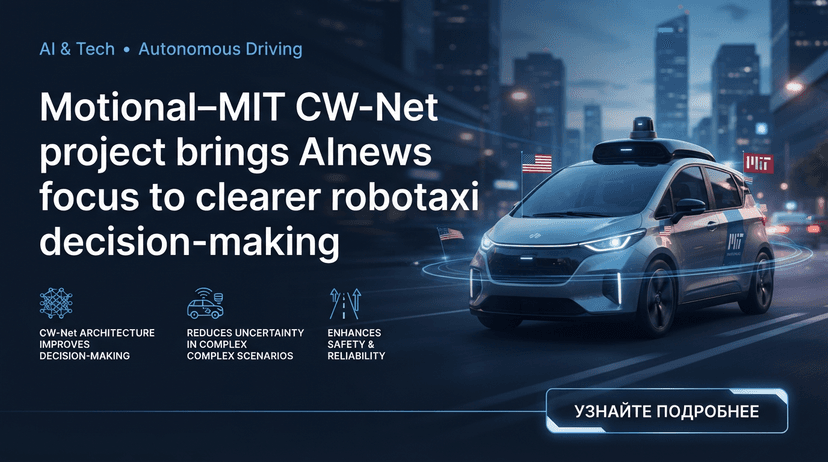
Motional–MIT CW-Net project brings AInews focus to clearer robotaxi decision-making On 2 September 2026, researchers at MIT and autonomous vehicle company Motional unveiled a new system called the Concept-Wrapper Network (CW-Net) that lets a self-driving car explain its decisions in real time, a breakthrough that has quickly drawn global AInews attention. How does CW-Net help people understand self-driving car decisions? CW-Net converts a robotaxi’s opaque planning process into short, plain-language concepts such as “approaching stopped vehicle” or “close to cyclist,” and then forces the car’s planner to use those concepts when choosing its next move, so the explanation matches the true reason for the action. The work, described in a paper published in Nature on 2 September 2026, tackles one of autonomous driving’s core problems: black-box deep learning models that perform well but give passengers, safety drivers and regulators little insight into why a car accelerated, braked or swerved. According to MIT News, CW-Net is a “concept classifier” plugged into the middle of a self-driving car’s motion-planning network, where it maps raw sensor data to high-level concepts the model already relies on. The system then compels the planner’s final stage to make its trajectory decisions using those concepts, preserving driving performance while exposing the reasoning. As described by Motional, the explanations appear alongside the planned path in real time, giving safety drivers and passengers a running commentary on what the car believes is happening. News reports note that CW-Net’s concept labels include everyday traffic ideas such as “yielding to pedestrian,” “waiting at red light” and “emergency braking,” rather than mathematical features. This design grows out of a wider research track at MIT on “concept bottleneck” models, where AI systems are forced to think in human-understandable ideas before giving an output. A March 2026 MIT study on concept bottlenecks laid much of the groundwork for CW-Net’s approach, demonstrating that extracting concepts from existing models can improve both accuracy and clarity of explanations. What tests did MIT and Motional run on the new explainable AI system? The CW-Net team trained the system on a massive dataset of real-world driving scenes and then deployed it on Motional’s robotaxis, first on private tracks and then in simulations set in Las Vegas, to see whether humans could predict car behavior and detect mistakes more accurately. Reports describing the experiments outline a controlled evaluation campaign designed to answer a blunt question: does exposing the car’s reasoning through concepts make human overseers safer and more effective? According to one industry summary, CW-Net was trained on about 130 million labeled driving scenes, each tagged with concepts that describe the traffic situation, before being plugged into Motional’s planners. MIT News says CW-Net was deployed on a real autonomous test vehicle, where a human safety driver monitored both the car’s trajectory and the live explanation feed. In one private-track incident, cited in multiple reports, CW-Net revealed that the vehicle stopped due to “emergency braking” rather than “cyclist detected,” helping the safety driver recognise how a near collision could have occurred. Las Vegas–based simulations with non-expert users showed similar gains: participants who saw CW-Net explanations were better at predicting when the car might make a mistake or behave unexpectedly. These experiments build on earlier academic work. According to an open-access version of the paper dated March 2023, the original CW-Net concept already showed that concept-based explanations improved safety drivers’ mental models of the car, aligning human expectations with the vehicle’s internal decision process. Why does explainable AI matter for Motional’s robotaxi plans? Motional has committed to pull human safety operators from its commercial robotaxis by the end of 2026, making transparent and predictable AI behavior essential for regulators, partners and riders who must trust fully driverless service in cities such as Las Vegas. The company, formed as a joint venture between Hyundai Motor Group and Aptiv, has operated test fleets for years. It now seeks to move from supervised pilots to commercial driverless rides, at a time when public scrutiny of autonomous vehicle safety is rising. Tech industry coverage in January 2026 reported that Motional aims to start true driverless services by the end of the year, removing backup drivers from robotaxis after regulatory approval. Motional’s own communications describe CW-Net as part of opening “the brain of a self-driving car,” a way to show riders and regulators why the car responds to hazards or complex traffic situations. According to start-up focused outlets, the collaboration with MIT enables Motional engineers to debug failure cases more quickly, because they can see which concept the planner relied on when it made a poor decision. General technology news reports emphasise that clearer explanations could also ease liability questions after incidents, by documenting what the system detected and how it interpreted the scene. For city transportation agencies considering robotaxi partnerships, this interpretability could be as important as raw safety metrics. It gives them a tool to interrogate the system’s behaviour, instead of treating the AI stack as an inscrutable black box. What is different about CW-Net compared with earlier explainable AI methods? CW-Net does not bolt a separate explanation module on top of the planner. It reshapes the planner so that its internal reasoning is expressed in concepts that the explanation system uses directly, which researchers argue keeps the explanations causally faithful instead of decorative. Explainable AI has often relied on post-hoc tools that highlight parts of an image or sensor input after the fact, leaving open the risk that the visualisation is loosely correlated rather than truly driving the decision. The MIT–Motional work tries to tighten this link. MIT computer scientists have explored concept bottleneck models that force AI systems to make predictions using explicit concepts, which are then described in natural language by a large multimodal model. According to the March 2026 MIT study, this approach asks a specialised autoencoder to extract the most relevant features from a pretrained model and turn them into a compact set of concepts. Those concepts are then labelled and described using a multimodal language model, which is trained to recognise when each concept is present in a scene. CW-Net applies this family of ideas to motion planning for autonomous vehicles, translating dense sensor streams into labelled traffic concepts that both the planner and the explanation module share. By tightly coupling the explanations to the planner’s internal pathway, CW-Net aims to reduce what researchers call “concept leakage,” where explanations reference ideas that did not truly drive the model’s output. That distinction matters whenever a human must rely on the explanation for safety-critical decisions. Who worked on the project and how is it being published? The CW-Net research team spans MIT’s Computer Science and Artificial Intelligence Laboratory and Motional’s autonomous driving engineers, and their joint paper on explainable deep learning for self-driving cars was published in Nature in early September 2026, following prior conference and preprint versions. The collaboration reflects a broader trend of large autonomous vehicle programmes pairing in-house development with academic partnerships to tackle foundational AI questions such as interpretability, fairness and safety. MIT News credits researchers in CSAIL as lead authors of the concept-wrapper method, working directly with Motional’s robotics teams that deployed the system on test vehicles. Motional lists several of its senior scientists and executives, including its CEO, as collaborators on the Nature paper and co-authors of earlier work on explainable motion planning. A preprint version titled “Explainable deep learning improves human mental models of self-driving cars” first appeared online in March 2023, laying the scientific foundation for the Nature publication. Business and technology news sites highlight the paper’s placement in a high-profile journal as a signal that interpretability is becoming central to mainstream autonomous driving research, not just an academic curiosity. Publishing in a leading journal also opens the work to scrutiny from outside experts, from AI ethicists to transportation safety analysts, which could influence how regulators evaluate explainable systems in future autonomous vehicle rules. What comes next for explainable self-driving car AI? MIT and Motional say CW-Net is a step toward wider use of concept-based explanations in safety-critical AI. Future work will likely test the system in more cities, extend it to new driving scenarios and connect it with broader efforts to audit and stress-test AI models for bias and failure modes. Researchers already explore neighbouring ideas. MIT’s CSAIL has developed automated interpretability agents that probe neural networks using visual-language models, while concept bottleneck techniques continue to evolve for computer vision and robotics more broadly. A July 2024 report on MIT’s MAIA project describes a multimodal agent that designs experiments to understand how AI models behave, hinting at tools that could one day inspect systems like CW-Net for hidden flaws. Robotics conference previews from mid-2026 show MIT teams using large language models to help robots interpret complex instructions, reinforcing the idea that natural-language explanations will be a standard part of machine behaviour. Industry commentators expect Motional and peers to combine explainable planning with other safeguards such as diverse sensor fusion, redundant braking systems and independent failure analysis boards. As robotaxis roll out in more markets, transport agencies may request access to explanation logs from systems like CW-Net when reviewing incidents or granting permits. For everyday riders, the most visible change could be simple: when they sit in a driverless car and wonder “Why did it stop?” the car will be able to answer in clear language, drawing directly from the same concepts that guide its driving.