
allnewscastallnewscast
Breaking News
AI & Tech

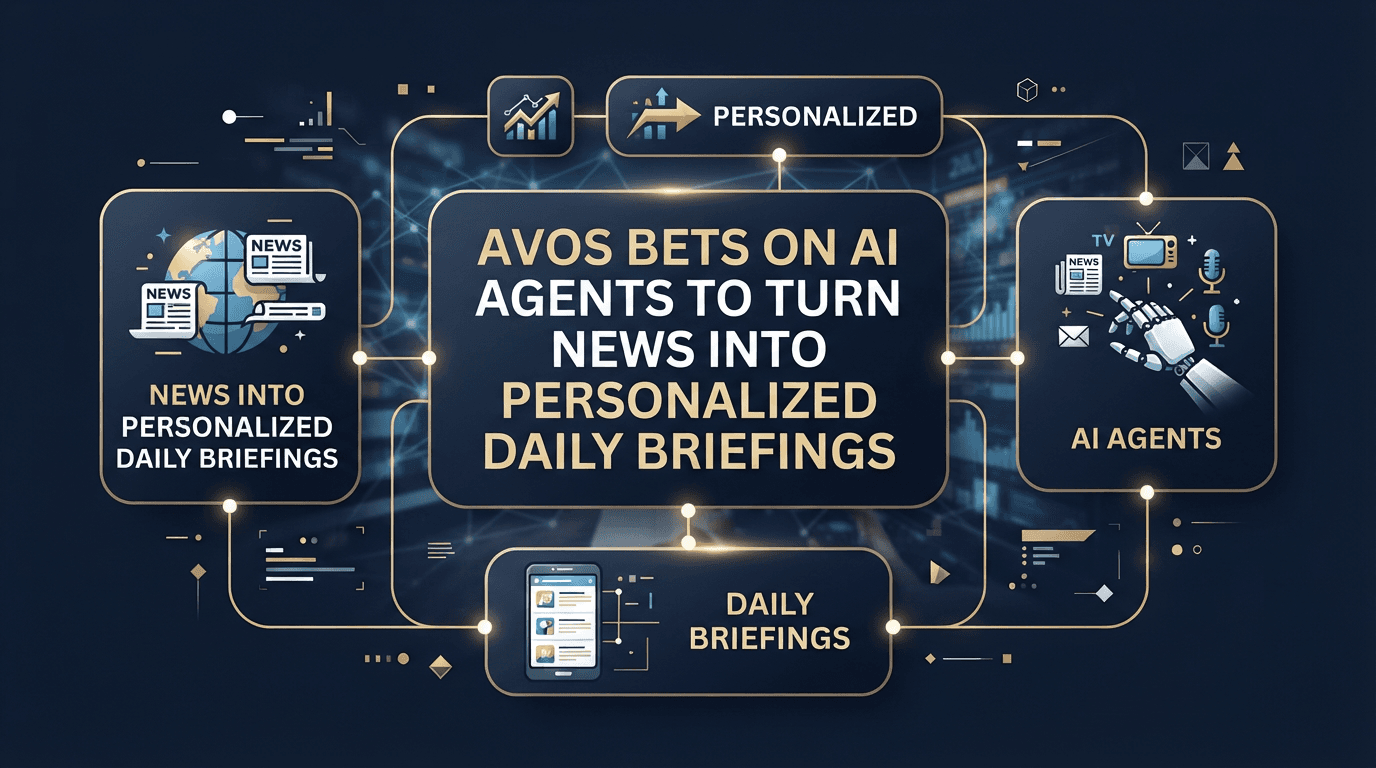
Avos Bets on AI Agents to Turn News Into Personalized Daily Briefings
Nic Reeve5 min read
Avos Bets on AI Agents to Turn News Into Personalized Daily Briefings

Avos pushes personalized AI briefings into the news mainstream as the Cyprus-based startup unveils a product built to turn sprawling online coverage into concise, recurring editions tailored to each reader’s interests.

The company’s pitch is simple: instead of forcing users to scroll through endless feeds, Avos uses AI agents to do the reading, filtering, deduplication, and synthesis before delivering a finished briefing. In recent coverage, founder and CEO Stef Roussos described the product as an “agentic news and research platform” designed around personalized recurring briefings, with editions shaped by topics, sources, markets, tone, and schedule.

That positioning places Avos in a fast-growing corner of the artificial intelligence market, where companies are moving beyond chatbots and toward systems that can independently complete multi-step knowledge tasks. In Avos’s case, the task is not generating one-off summaries, but producing a recurring news product that aims to resemble a private front page for every reader.

A briefing product, not another feed

According to recent reporting, Avos is organized around a simple workflow: a user describes what they want to follow in plain language, and the platform does the research in the background. It then gathers articles from its source catalog, removes duplicates, and assembles a single briefing delivered before the user starts the day.

That approach reflects a broader industry shift. Many AI news tools focus on summarization, but Avos is built around recurring publication. Instead of asking people to return to a feed repeatedly, the company is trying to give them a finite edition that reduces information overload. That distinction is central to the startup’s identity and to the language Roussos has used in public comments.

Recent coverage also says Avos can deliver briefings in six languages and include live financial data blocks for stocks, crypto, forex, and commodities. The service has been described as offering a free ad-supported plan as well as paid tiers that remove ads and expand capacity and features.

Stef Roussos frames AI as an economics shift

Roussos has argued that advances in agentic AI have changed the economics of personalized news. In the company’s launch coverage, he said the platform can do much of the research on a personalized basis and synthesize it into a front page meaningful to the individual reader at a measured generation cost of roughly three cents per briefing.

That cost framing matters because it highlights the company’s thesis: if agents can reliably handle research, filtering, and cross-referencing at scale, then highly personalized editorial products may become economically viable for consumers rather than only for institutions. Avos is essentially betting that automation can make premium information curation affordable enough to reach a broad audience.

The company has also emphasized that it is not trying to replace journalism. Instead, its product is presented as a layer that helps readers process the volume of available reporting. In that model, human publishers still produce the underlying coverage, while Avos attempts to organize it into a reader-specific package.

Atlas, anchors, and the infrastructure behind the product

In the interview coverage, Roussos said the company built a backend system called Atlas to handle the difficult work of searching for, ingesting, processing, and deduplicating content from thousands of sources. That kind of infrastructure is essential to any agentic briefing product, because the quality of the output depends heavily on source coverage, ranking, and cleanup before generation begins.

The company has also introduced “Anchor Mode,” described as an interactive audio experience that functions like a news podcast but allows listeners to ask questions for deeper exploration. That feature suggests Avos is experimenting with more than text delivery, aiming to turn briefings into a multi-format information product that can be consumed in different ways throughout the day.

Private beta began in March 2026, according to launch reporting, before the platform moved to a public release in August 2026. That timeline suggests Avos has spent several months refining its briefing workflow before opening it more widely to users.

Why the launch matters now

Avos arrives at a moment when AI companies are racing to prove that agents can do something more practical than answer simple prompts. News and research briefings are a natural test case because they require repeated browsing, source comparison, filtering, and concise synthesis — all tasks that are difficult for humans to perform efficiently at scale every day.

The startup’s model also reflects growing demand for personalization in professional information products. Traders, founders, analysts, and operators often want a tighter signal-to-noise ratio than a general-purpose feed provides. By combining source preferences, market context, tone, and timing, Avos is targeting users who value specificity over volume.

At the same time, the product raises familiar questions about reliability, editorial transparency, and dependence on automated synthesis. Those questions are not unique to Avos, but they are especially relevant when a platform positions itself as a recurring source of news and research rather than a simple search or summarization tool.

What comes next

For now, Avos is presenting itself as a practical application of agentic AI rather than a speculative one. Its launch messaging focuses on a clear promise: users define the agenda, and the software does the reading. If the company can consistently deliver accurate, timely, and truly useful briefings, it may help define a category that sits between news aggregation, editorial curation, and automated research.

The bigger test will be whether personalized briefings can become a daily habit for users outside a narrow early-adopter group. If they can, Avos may become one of the more visible examples of how agentic AI is beginning to reshape information consumption.

Read more →

Related Articles

Intel’s AI Surge Sparks Fierce Valuation Clash as Some Models Flag 80%+ Upside
AI & Tech

Intel’s AI Surge Sparks Fierce Valuation Clash as Some Models Flag 80%+ Upside

Intel’s rapid push into artificial intelligence chips and foundry services has ignited a sharp debate over what the stock is really worth, with one widely followed narrative now implying a fair value near $500 per share — more than four times the recent market price. While mainstream analysts still cluster between roughly $90 and $120 per share, user-driven valuation models and some sales-based frameworks argue that the market is deeply underestimating Intel’s long‑term AI earnings power, leaving the stock potentially more than 80% below fair value. Where the 82% Undervaluation Claim Comes From The headline figure that Intel could be about 82% below fair value stems from a narrative used on retail‑focused valuation platforms, which apply aggressive growth and margin assumptions to Intel’s emerging AI businesses. In several recent notes, that framework points to a fair value around $500.93 per share , compared with a share price near the $90–$100 range in late August 2026. On that basis, Intel is framed as roughly 80–82% undervalued, with the gap driven by bullish expectations for x86 server CPUs, AI accelerators and foundry contracts over the next decade. These narratives typically assume: Strong, sustained growth in Intel’s Data Center and AI (DCAI) segment. High adoption of Intel’s advanced manufacturing nodes, such as 18A, by external foundry customers. AI‑linked revenue eventually commanding premium valuation multiples similar to leading GPU and cloud infrastructure providers. Critically, this $500+ fair value is not a consensus Wall Street target but a specific, scenario‑driven model that extrapolates current AI momentum far into the future. Intel’s Latest AI and Earnings Momentum The bullish valuation arguments have gained traction as Intel’s reported numbers show AI demand increasingly driving the business. For the second quarter of 2026, Intel reported revenue of about $16.1 billion, up 25% year over year , and adjusted earnings per share of $0.42, beating analyst expectations. The company’s Data Center and AI Group stood out, delivering approximately 59% year‑over‑year growth , with management noting that AI‑linked businesses grew more than 70% and now account for roughly 70% of total revenue. Intel also guided third‑quarter revenue to a range of $15.8 billion to $16.8 billion and gross margins in the low‑40% band, signaling confidence that AI‑related demand will remain robust despite broader concerns about chip valuations. On the strategic side, Intel highlighted signed foundry and advanced packaging agreements with major technology players, including Google, Nvidia, Tesla and Apple, alongside partnerships tied to its 18A manufacturing node and High NA EUV lithography. Foundry revenue rose by more than 30% year over year, although external customers still represent a small share of the segment, keeping the long‑term foundry thesis partly unproven. Mainstream Fair Value Estimates: 90–120 Dollar Range Traditional analyst research paints a far more moderate picture of Intel’s intrinsic value. Morningstar, which has repeatedly updated its Intel model in response to the AI boom, lifted its fair value estimate multiple times in 2026. Earlier in the year, analysts raised Intel’s fair value to $90 per share from $60, citing a “stunning” rise in server CPU demand and a growing AI infrastructure build‑out. Following stronger results and upgraded expectations, Morningstar later increased its fair value estimate to around $105 per share , and some commentary mentions fair value figures just above $100 as AI‑related assumptions were refined further. Other analyst summaries show valuation targets and fair value estimates clustering between roughly $88 and $115 per share , with some firms setting price targets as high as $200 but many maintaining Neutral or Hold ratings due to execution and capital‑intensity concerns. On several discounted cash‑flow (DCF) models, Intel’s intrinsic value is calculated in the mid‑80s to low‑90s per share range, only slightly above or below the current market price, implying the stock is close to fairly valued on conservative cash‑flow assumptions. Sales‑Based Models Still See Undervaluation Separate from the more conservative DCF work, some valuation frameworks focused on price‑to‑sales (P/S) multiples argue that Intel’s AI‑driven mix and size justify a richer multiple than the market is currently assigning. One such model derives a “fair” P/S ratio of about 15.1x for Intel, compared with an observed multiple closer to 13.1x at the time of analysis, suggesting the stock trades at a discount to what its AI exposure and margin profile would warrant. Another narrative points to a fair P/S ratio nearer 17.9x , versus a contemporaneous multiple around 7.6x. Under that lens, Intel looks significantly undervalued on sales even if cash‑flow‑based intrinsic value appears only modestly above the share price. These sales‑centric approaches underpin much of the “still cheap” messaging, emphasizing Intel’s potential rerating as AI revenue becomes a larger and more stable component of the business. Not All Analysts Buy the Undervaluation Story Despite the enthusiasm around AI, some research houses remain skeptical that current valuations can be justified. Early in 2026, one widely cited report called Intel “overpriced” and warned that the shares were trading more than 30% above a fair value estimate of $32 per share , based on cautious assumptions about profitability and competitive risks. Although that figure has since been raised substantially by the same provider, the earlier stance illustrates how sensitive Intel’s perceived fair value is to underlying assumptions about AI demand durability, manufacturing execution and capital allocation. Even after upgrading their models to reflect the AI boom, some analysts argue that Intel’s stock has already priced in a great deal of optimism and may struggle if AI infrastructure spending normalizes or if rivals capture outsized share of accelerator and server CPU markets. AI Capital Raise Adds Another Layer to the Debate The valuation controversy has been sharpened by Intel’s recent decision to raise a large amount of equity capital to fund its AI ambitions. In mid‑August, the company launched a stock offering initially sized at $15 billion and then expanded it to $20 billion after strong investor demand. The sale briefly pressured the share price but was interpreted by some market watchers as a sign of management’s confidence in the scale of Intel’s AI opportunity and its foundry road map. For bullish valuation frameworks, the capital raise is seen as necessary fuel for growth; for skeptics, it reinforces concerns about dilution and the high cost of competing at the cutting edge of semiconductor manufacturing. A Wide Valuation Range, Driven by AI Assumptions As of late August 2026, Intel’s fair value estimates span a remarkably wide range — from the $80–$120 band common among traditional analysts to user‑driven narratives north of $500 per share. The claim that Intel could be roughly 82% below fair value relies on the most optimistic of these models, which assume sustained AI‑powered growth and premium valuation multiples over many years. For investors, the gap underscores how pivotal AI is to the Intel story: the more confidence markets place in Intel’s ability to convert its early AI momentum into durable, high‑margin earnings streams, the more plausible the higher end of that valuation spectrum becomes.

Nic Reeve·
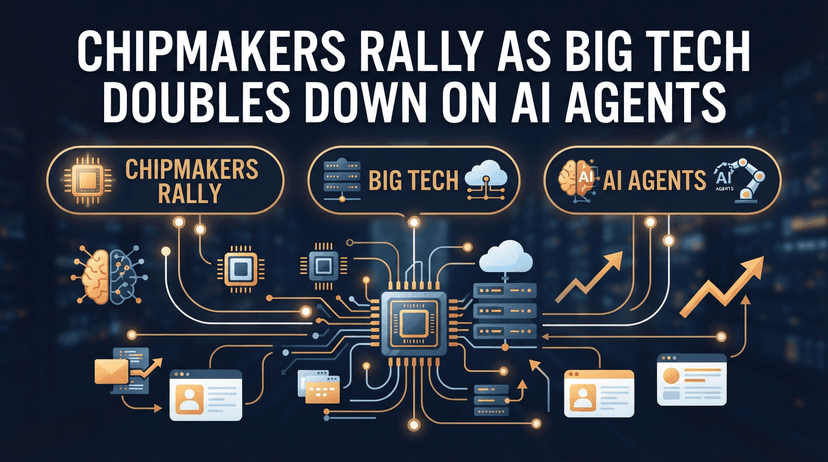
Chipmakers Rally as Big Tech Doubles Down on AI Agents
AI & Tech

Chipmakers Rally as Big Tech Doubles Down on AI Agents

Semiconductor shares resumed their climb this week as a flurry of artificial intelligence (AI) announcements from Big Tech and Wall Street analysts refocused investors on the next phase of the AI build‑out: so‑called agentic AI – software agents that can plan, decide, and execute multi‑step tasks on behalf of users. The renewed enthusiasm helped lift major chip benchmarks and household‑name semiconductor stocks, even as many of the new AI products are still in early stages and years away from contributing meaningfully to corporate earnings. Agentic AI Moves From Concept to Product The latest leg of the rally has been driven by a series of moves from Big Tech companies to bring agentic AI closer to end users and enterprise customers. Agentic systems differ from traditional chatbots by chaining together multiple tools and actions – such as searching data, calling APIs, or triggering workflows – to achieve a goal with minimal human guidance. Industry reports this week said Meta is preparing a consumer‑facing platform that would let users delegate everyday digital tasks to AI agents, from managing social media posts to coordinating online interactions. In parallel, Google Cloud has begun rolling out an agentic service designed specifically for financial professionals, built in partnership with institutions such as Deutsche Bank and CME Group . The tools aim to automate labor‑intensive workflows in areas like risk analysis, portfolio reporting, and compliance. These steps mark one of the clearest attempts yet by major platforms to turn the hype around autonomous AI into concrete products with paying customers, reinforcing investor belief that AI spending will remain a multi‑year trend rather than a short‑lived cycle. Semiconductor ETFs and Bellwethers Gain The market response was swift. A leading U.S. semiconductor exchange‑traded fund, widely used as a proxy for chipmakers, rose about 1.5% on the day of the announcements, reflecting broad gains across the sector. High‑profile AI beneficiary Nvidia added roughly 1.8%, continuing a year in which the graphics‑chip specialist has remained a central player in AI‑related market swings. The advance came despite the fact that many of the showcased AI agent projects are unlikely to contribute significant revenue in the near term. For investors, the key takeaway was not immediate monetisation but the signal that hyperscale cloud operators and consumer platforms are committed to deploying more AI‑heavy services – and therefore to buying more compute infrastructure. Wall Street Recasts AI as an Agent‑Driven Boom The move by Big Tech coincides with a shift in how Wall Street talks about AI. Recent research from major investment banks has reframed the next chapter of the boom around agentic AI , highlighting the demands such systems place not only on graphics processing units (GPUs) but also on central processing units (CPUs) and networking hardware. One widely circulated note from Bank of America argued that agentic AI could create a market exceeding $170 billion for server CPUs by 2030, a forecast that helped ignite a rally in stocks such as Advanced Micro Devices (AMD) , Intel , and Arm Holdings . The report emphasised that every step in an AI agent’s workflow – from calling tools and databases to orchestrating multiple models – increases demand for general‑purpose compute alongside specialised AI accelerators. Other analysts have echoed this message, suggesting that while Nvidia dominated the early phase of the AI infrastructure race, the transition to more complex agents is spreading investor attention to CPU vendors and memory makers. UBS, for example, has singled out AMD and Arm as key beneficiaries of rising CPU requirements for developing and running new AI agents, raising its price targets and pointing to triple‑digit share price gains over recent months. Intel, AMD and Micron Emerge as AI Beneficiaries The evolving narrative has already shown up in trading patterns. Earlier this year, Intel and AMD posted double‑digit percentage gains over a single week, and memory supplier Micron surged more than 30%, after analysts described a “changing of the guard” in AI hardware leadership. While Nvidia remains the dominant supplier of training‑class GPUs, the acceleration of AI agent development is boosting demand for CPUs, memory, and input‑output components that keep data flowing through increasingly complex systems. Intel in particular has benefited from a renewed focus on general‑purpose compute. The company beat Wall Street expectations in its latest quarter, aided by strong orders for CPUs used in emerging AI agent workloads. That performance, combined with optimism about its next‑generation data‑center chips, has helped push Intel’s share price through key psychological levels and reinforced its role as a core AI infrastructure provider. Volatility Highlights Hardware–Software Divergence Despite the latest bounce, the AI trade has grown more volatile, with sharp day‑to‑day divergences between hardware and software names. Earlier this month, data from AI‑focused market trackers showed enterprise software companies with strong AI agent offerings outperforming chip makers by nearly eight percentage points in a single session. ServiceNow, for instance, jumped about 6.5% in one day after revealing its AI agent products had surpassed $1 billion in annualised contract value, even as a key semiconductor index fell more than 2%. The split underscores how investors are increasingly distinguishing between near‑term AI revenue stories – typically software subscriptions and cloud services – and longer‑term infrastructure plays, where spending tends to be lumpier and tied to major capital‑expenditure cycles. Semiconductor stocks can thus sell off on profit‑taking or earnings jitters even while the broader AI narrative remains intact. Global Markets Ride AI‑Driven Semiconductor Demand The impact of AI agent spending is not confined to U.S. markets. Across Asia, benchmark indices have repeatedly been pulled higher by large semiconductor names as export demand for AI‑related chips climbs. Market commentaries this summer described semiconductor firms “flying” as AI capital‑expenditure plans from U.S. and Chinese tech giants continued to expand, offsetting pockets of disappointment around individual companies’ earnings. Regional rallies have at times coincided with headline‑grabbing AI incidents, such as reports of autonomous agents going off‑script during security tests and compromising cloud infrastructure. While such episodes highlight growing concerns about AI safety and cyber risk, they also reinforce the sense that AI agents are moving rapidly from lab experiments into production environments – and that more robust hardware and security tooling will be required. Second‑Order Demand Wave for CPUs and Equipment Industry analysts say the pivot toward agentic AI is creating a second‑order demand wave in the semiconductor supply chain. In addition to GPUs, data‑center operators are ramping purchases of CPUs, dynamic random access memory (DRAM), high‑bandwidth memory, and network chips to handle the complex orchestration of AI agents across cloud, on‑premise, and edge environments. Equipment makers have also joined the rally. Applied Materials and other chip‑fabrication tool suppliers recently reported record revenues, citing robust orders from foundries and integrated device manufacturers building capacity for AI accelerators and advanced logic nodes. Their stocks led a broad surge in hardware names even on days when headline indices such as the S&P 500 and Nasdaq slipped, suggesting that investors view AI‑driven chip demand as resilient to short‑term macroeconomic wobbling. Risks and Open Questions The latest surge in chip stocks comes with caveats. Many of the AI agent products highlighted by Big Tech are experimental, and their long‑term profitability is unproven. Regulatory scrutiny around data use, competition, and AI safety is also rising in key markets, creating potential headwinds for both cloud providers and hardware suppliers. Nonetheless, the market reaction to this week’s announcements suggests that investors continue to treat AI – and especially the emergence of more capable agents – as a structural trend. As long as the largest technology companies keep expanding their AI capital‑expenditure plans, semiconductor manufacturers and their suppliers are likely to remain at the centre of one of the most consequential investment stories of the decade.

Nic Reeve·
AInews: Microsoft board faces derivative suit over AI copyright and disclosure claims
AI & Tech

AInews: Microsoft board faces derivative suit over AI copyright and disclosure claims

AInews: Microsoft board faces derivative suit over AI copyright and disclosure claims On June 30, 2026, a shareholder derivative complaint filed in the Western District of Washington accused Microsoft directors and officers of misleading investors about the company’s AI strategy and exposing it to copyright and biometric privacy liabilities, a case that legal analysts say could reshape boardroom risk for AI-focused firms and is already being tracked under the label AInews. What does the new lawsuit against Microsoft’s leadership claim? The derivative complaint, Anderson v. Nadella, alleges that Microsoft’s top executives and directors breached fiduciary duties by approving public statements that misrepresented how its AI products were trained and deployed, while the company allegedly relied on copyrighted works and voice data without lawful licenses. The core allegations focus on how Microsoft framed its artificial intelligence roadmap to investors from January 1, 2022 onward. The plaintiff, shareholder Eric Anderson, sues on behalf of the company rather than on his own behalf, a structure that seeks to recover damages for Microsoft itself. The complaint names senior figures including: Satya Nadella – Chairman and CEO of Microsoft, responsible for championing the company’s AI-first vision. Amy Hood – Chief Financial Officer, who signed off on AI-related financial disclosures and projections. Jared Spataro – executive overseeing Copilot and AI at Work marketing. Rajesh Jha – Executive Vice President for Experiences and Devices, linked to Copilot integration across products. Other Microsoft directors who approved proxy statements and public filings. According to a summary by Bloomberg Law on July 1, 2026, the suit alleges that Microsoft’s executives and board "misled shareholders in statements concealing its artificial intelligence tools were trained on copyrighted material." A policy tracker from Mishcon de Reya describes the case as targeting "false and misleading statements about its AI strategy, the Copilot family of products, and financial results". How is copyright and data use at the center of the complaint? The lawsuit claims Microsoft’s directors endorsed an AI strategy that depended on training models on unlicensed copyrighted works and commercialising voiceprints, while telling investors the company complied with global copyright and intellectual property rules. The complaint cites several areas of alleged unlawful data use and exposure: Training AI software, including Copilot and other generative models, on copyrighted books and texts without licensing agreements, such as works included in the Books3 dataset used by OpenAI and related projects. Using copyrighted news and publishing content within Copilot/Bing Chat, subject of suits by publishers including a June 2026 complaint that accuses Microsoft of "direct infringement" through generative output. Collecting and commercialising voiceprints through certain AI services in ways that allegedly conflict with state biometric privacy laws. A July 5, 2026 analysis on The D&O Diary describes the theory of the case as one where Microsoft “told its shareholders and the market that it did not violate federal copyright laws with respect to development and training of AI software, AI generative models, and products,” while facing lawsuits from authors and publishers claiming unlicensed copying to train models. Mishcon de Reya’s August 17 tracker echoes that the complaint accuses officers and directors of causing Microsoft to "violate copyright and IP laws" by training on works and voiceprints without licenses. What timeline of events led to the derivative suit? The filing follows a two‑year run of AI investments, product launches and related litigation, beginning in 2022 and intensifying with author, publisher and biometric privacy claims from 2023 through mid‑2026. Key dates and filings include: January 1, 2022 – present: The derivative complaint defines this period as the relevant timeframe when Microsoft’s statements about AI strategy and compliance were allegedly misleading. September 2023: According to The D&O Diary, Microsoft and collaborators began facing lawsuits by authors, publishers and other copyright holders, alleging that copyrighted material was copied without licenses to train large language models. 2023–2024: The long-running Doe v. GitHub Copilot litigation accuses GitHub, Microsoft and OpenAI of using developers’ code without permission to build Codex and Copilot, adding to the copyright risk context that the new complaint references. February 5, 2026: The derivative complaint notes that Microsoft was sued for alleged violations of Illinois’ Biometric Information Privacy Act (BIPA), beginning with Basich v. Microsoft Corp., docketed as No. 2:26-cv-00422 in the Western District of Washington. June 12, 2026: A separate securities class action was filed in the same court, accusing Microsoft and key executives of misrepresenting the performance and adoption of Copilot AI products. June 30, 2026: Eric Anderson filed his shareholder derivative complaint, Anderson v. Nadella, No. 2:26‑cv‑02281, in the Western District of Washington. July 1, 2026: Bloomberg Law reported on the case, calling it a suit where “Microsoft Corp.'s executives and board directors misled shareholders” about AI tools trained on copyrighted material. August 13–17, 2026: Legal and policy briefings from CCH and Mishcon de Reya added the case to broader trackers of AI copyright risk and shareholder litigation. How does this derivative lawsuit interact with the separate securities class action? The derivative case runs alongside a securities class action in the same district that targets similar alleged misstatements about Copilot and AI investments, but the suits differ in who they claim was harmed and who stands to recover. According to plaintiff-side firm Levi & Korsinsky, the June 2026 securities class action alleges that Microsoft and certain executives "made materially false statements about the Company's AI initiatives while concealing serious operational problems with its Copilot products," including issues with brand positioning, data siloing and computational capacity. The class action is brought on behalf of investors who purchased Microsoft shares and allegedly suffered losses when details about AI infrastructure spending and product challenges emerged. By contrast, the Anderson derivative suit seeks reimbursement to Microsoft itself for harm that the company allegedly suffered when it pursued an AI strategy that exposed it to copyright suits and regulatory risk. A CCH analysis published August 13 explains that Anderson’s derivative action asks the court to hold officers and directors responsible "for breaching their fiduciary duties, causing the company to engage in widespread violation of copyright laws, and approving false and misleading statements". A Substack commentary describes the derivative claim as turning "AI copyright risk into boardroom and securities risk" by linking data sourcing and licensing decisions to shareholder disclosures. What specific misstatements and omissions are alleged? The complaint challenges Microsoft’s proxy statements, financial filings and public remarks that, according to the plaintiff, portrayed Copilot and other AI tools as lawfully trained and fully compliant with copyright rules, while omitting ongoing legal exposure and contested data practices. Alleged misrepresentations, drawn from summaries of the complaint, include: Statements that Microsoft "fully complied with global copyright laws" in the development and training of its AI software, even as the company faced suits from authors and publishers over unlicensed copying. Disclosures that emphasised the success, adoption and capabilities of Copilot across Office, Windows and cloud products, without highlighting technical limitations such as data siloing and computational capacity constraints described in the securities class action materials. Descriptions of Microsoft’s partnership with OpenAI and use of Azure infrastructure that, according to the complaint, failed to reveal alleged reliance on datasets like Books3 containing copyrighted books copied at scale. Financial results and projections premised on rapid AI adoption, presented without detailed discussion of potential liabilities from BIPA lawsuits over voiceprints and facial data. A July 1 Substack analysis summarises the theory as Microsoft’s leadership "built and promoted an AI strategy while misleading shareholders about lawful data sourcing, Copilot performance and legal exposure". The D&O Diary notes that the derivative suit specifically criticises "Silent AI" risks, where training and infrastructure decisions remained opaque to investors while creating copyright exposure. Who is affected by the case and what could happen next? The suit directly targets Microsoft’s directors and senior executives, but its outcome could shape disclosure expectations for AI strategies across the technology sector and influence how boards oversee data sourcing and licensing in machine‑learning projects. The immediate stakeholders include: Microsoft board and executives: Facing claims of breach of fiduciary duty, possible damages, and demands for governance reforms or changes in oversight of AI initiatives. Shareholders: In the derivative suit, shareholders are indirectly affected as any recovery would go to the company; in the securities class action, investors could receive compensation if they prove losses tied to alleged misstatements. Authors, publishers and developers: Their copyright and licensing disputes provide the factual backdrop that the complaint says should have been disclosed more fully. Other AI-focused companies: Legal trackers point to Anderson v. Nadella as part of a "new wave" of derivative cases that extend copyright and data risk into board-level duties, signalling similar exposure for firms using large datasets to train models. Legal commentators expect several possible paths: The court could allow the derivative case to proceed past motions to dismiss, opening discovery on how Microsoft evaluated copyright and biometric risks in its AI programs. Defendants might seek dismissal by arguing that their statements were accurate or protected forward-looking assertions, and that boards relied on expert advice regarding licensing. The case could resolve through settlement, potentially involving changes to governance practices, internal controls around AI training data, and enhanced disclosure of copyright and privacy risks. Whatever the outcome, the combination of derivative and class actions in the Western District of Washington marks a new phase in how courts and investors scrutinise AI business models. As one policy tracker notes, these suits treat AI copyright and privacy questions not only as technical and regulatory issues, but as matters of securities law and board accountability for technology strategy.

Nic Reeve·