allnewscastallnewscast
Breaking News
AI & Tech

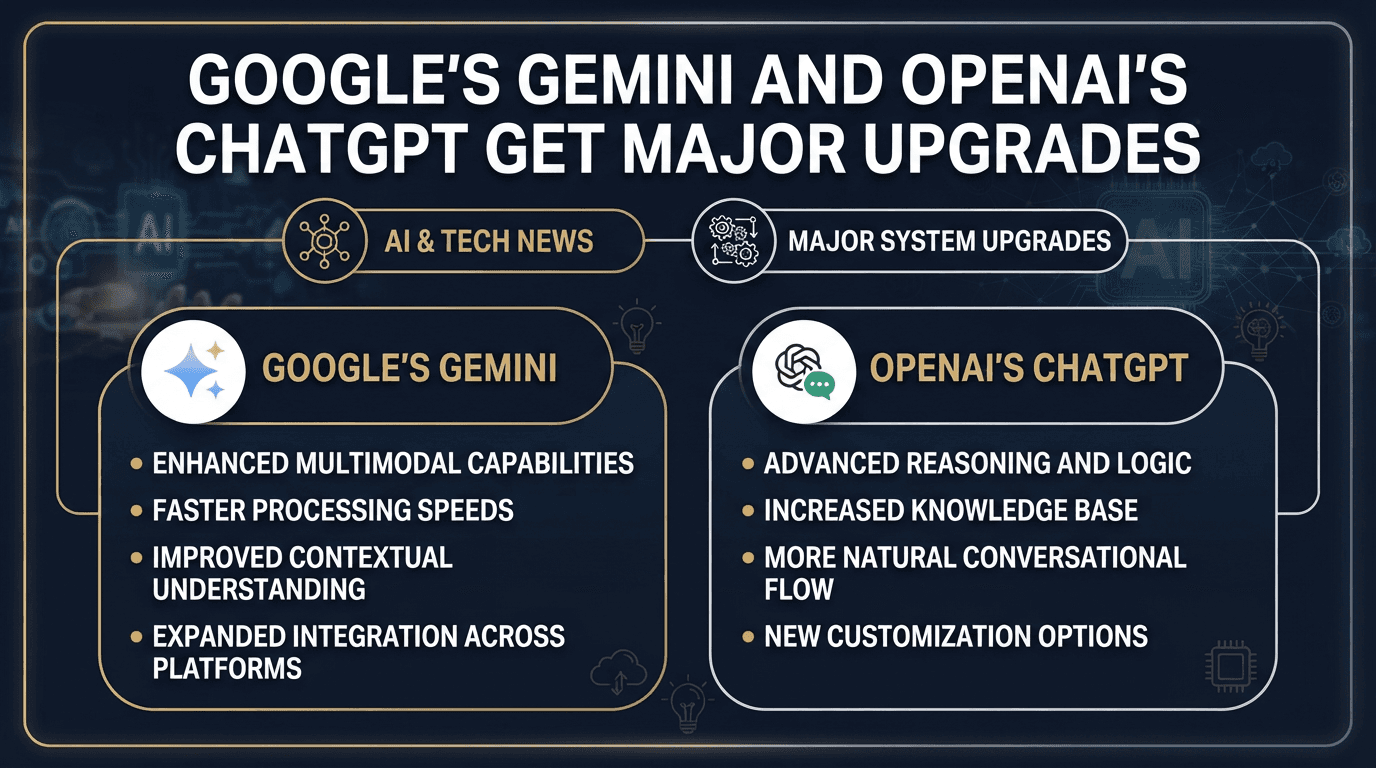
Google’s Gemini and OpenAI’s ChatGPT Get Major Upgrades in August 2026
Nic Reeve6 min read
Google’s Gemini and OpenAI’s ChatGPT Get Major Upgrades in August 2026

Artificial intelligence platforms from Google and OpenAI are undergoing rapid change in August 2026, with new model releases, pricing shifts and feature upgrades that signal how the next generation of AI assistants will be delivered to consumers and businesses.

Google Accelerates Gemini Rollout With New Flash Model

Google is expanding its Gemini family of models, focusing on efficient systems tailored for coding and automated workflows rather than only headline-grabbing flagship models.

On August 13, 2026, Google introduced Gemini 3.7 Flash, describing it as its latest AI model for software engineering support and agent-style business automation. The release comes just three weeks after Gemini 3.6 Flash, underscoring the rapid cadence at which Google is iterating its mid-tier “Flash” models.

Gemini 3.7 Flash is being positioned as a workhorse for developers and operations teams. According to Google’s developer documentation, the model offers substantial improvements in web development, software engineering and agentic workflows, and is classified as generally available for use through the Gemini API.

To encourage adoption, Google is discounting usage: through the end of 2026, Gemini 3.7 Flash is offered at an introductory rate of $0.75 per million input tokens and $3.75 per million output tokens, roughly half the cost of its 3.6 predecessor. The model is rolling out immediately to Gemini Spark, Google’s subscription-based AI agent service aimed at Pro and Ultra customers in more than 160 countries.

These changes build on earlier July announcements detailing Gemini 3.6 Flash, 3.5 Flash‑Lite and 3.5 Flash Cyber models, which were designed to balance efficiency and quality for scalable “agentic” workflows across Google’s products and cloud services.

Gemini Crosses a Billion Users as Pro Model Timeline Remains Unclear

Alongside the new model, Google is highlighting Gemini’s reach. In early August, CEO Sundar Pichai said that Gemini had surpassed 1 billion monthly active users, calling it the fastest‑growing product in the company’s history on that metric.

Usage is being driven both by consumer-facing Gemini interfaces and enterprise integrations. Google Cloud, for example, now uses Gemini powered tools to assist with code conversion in its Database Migration Service, translating stored procedures, triggers and custom functions from databases such as Oracle and SQL Server into PostgreSQL’s PL/pgSQL language.

Despite that growth, the status of Google’s flagship Gemini Pro remains uncertain. Industry reporting indicates that an anticipated Gemini 3.5 Pro release has been shelved internally, even as Flash-tier models become widely available across consumer products. Google has not publicly detailed timelines for higher-end Pro updates in the same way it has for Flash models.

OpenAI Revamps ChatGPT With GPT‑5.6 Models

OpenAI is simultaneously pushing a major upgrade to ChatGPT’s underlying models and user experience, focusing on more capable reasoning and broader access for free-tier users.

On August 6, 2026, OpenAI announced that GPT‑5.6 Luna will become the default model for Free and Go plans, replacing earlier versions used in the mass-market chatbot. Luna is designed as a general-purpose assistant for everyday conversations, and will soon be paired with a new Think button that lets users trigger more intensive reasoning on harder questions, subject to safety guardrails.

At the same time, Plus and Pro subscribers are receiving an updated GPT‑5.6 Sol model. This version introduces a slider that allows users to choose how much effort—and effectively how much computational “thinking”—ChatGPT applies to a response, trading speed against depth when necessary. OpenAI’s deployment safety documentation categorizes both Luna and Sol as high capability in cybersecurity and biological and chemical domains, reflecting ongoing scrutiny of advanced models in sensitive areas.

These upgrades are replacing GPT‑5.5 Instant in ChatGPT’s lineup and redefining what each subscription tier offers. Independent analysis of ChatGPT plans notes that the August change significantly increases the value of the free tier: Luna becomes the only model available to free accounts, but is paired with notable usability improvements.

Unlimited Text Chats and Expanded Automation for ChatGPT Users

A notable shift in OpenAI’s strategy is a decision to remove core rate limits on text conversations for non-paying users. Starting the week of August 10, free and Go accounts are scheduled to receive unlimited text chats with GPT‑5.6 Luna, although separate limits continue to apply to images, file uploads and other resource-intensive features.

OpenAI’s August release notes for ChatGPT add further refinements: the system now has a more accurate sense of a user’s local time, long conversations load more efficiently on the web, and interactive content can appear while it is still being generated, improving responsiveness.

On the productivity side, OpenAI is expanding its automation tools under the ChatGPT Work offering. Recent updates include webhook-triggered scheduled tasks, shared task management, and more flexible limits for free users. ChatGPT’s browser capabilities have also been extended to work on signed-in websites, with support for password managers and confirmations before consequential actions, allowing AI agents to safely complete workflows across services like Gmail, Slack and GitHub.

OpenAI is simultaneously retiring some legacy models and features from the consumer ChatGPT product. Support articles and release notes indicate that the o3 model will be removed from ChatGPT as of August 26, 2026, and GPT‑4.5 will be retired following earlier sunset dates. The official DALL·E GPT, used for image generation within ChatGPT, is scheduled for retirement on August 30, 2026, although these changes do not affect the separate API offerings.

Where LaMDA Fits in Google’s Current Strategy

Google’s earlier conversational AI model, LaMDA, is now largely overshadowed by the Gemini family in public announcements and developer materials. Recent update logs and product blogs focus almost exclusively on Gemini-branded models and agent services. While LaMDA played a central role in Google’s first wave of large language models, the company has effectively repositioned its AI story around Gemini, particularly in tools exposed to third-party developers.

Industry observers note that this represents not just a rebranding but a consolidation of research and product roadmaps under a single architecture, mirroring how OpenAI has centered its offerings on the GPT‑5.x series. In practice, users interact with Gemini-powered systems in Google products, while LaMDA persists mainly as a reference point in the history of conversational AI.

Competitive Outlook: Faster Iteration, Broader Access

Taken together, Google and OpenAI’s August moves highlight two intertwined trends in the AI industry: ever-faster iteration on core models and a push to make advanced capabilities available to wider audiences.

Google is betting that frequent updates to specialized models like Gemini 3.7 Flash, paired with discounted pricing and agent-focused services such as Gemini Spark, will attract developers and enterprises seeking reliable automation at scale. OpenAI, in turn, is using GPT‑5.6 Luna and Sol to raise the baseline quality of ChatGPT, while removing text-chat limits for free users and strengthening its automation tools through ChatGPT Work.

As both companies refine their AI assistants, the competition increasingly centers not only on raw model capability but also on safety frameworks, pricing, and the way these systems integrate into everyday tools—from cloud databases to email and code repositories. For users of ChatGPT and Gemini, the immediate impact this month is better models, more generous usage terms and an expanding set of task-oriented features woven into the platforms they already use.
Read more

Related Articles

Chipmakers Rally as Big Tech Doubles Down on AI Agents
AI & Tech

Chipmakers Rally as Big Tech Doubles Down on AI Agents

Semiconductor shares resumed their climb this week as a flurry of artificial intelligence (AI) announcements from Big Tech and Wall Street analysts refocused investors on the next phase of the AI build‑out: so‑called agentic AI – software agents that can plan, decide, and execute multi‑step tasks on behalf of users. The renewed enthusiasm helped lift major chip benchmarks and household‑name semiconductor stocks, even as many of the new AI products are still in early stages and years away from contributing meaningfully to corporate earnings. Agentic AI Moves From Concept to Product The latest leg of the rally has been driven by a series of moves from Big Tech companies to bring agentic AI closer to end users and enterprise customers. Agentic systems differ from traditional chatbots by chaining together multiple tools and actions – such as searching data, calling APIs, or triggering workflows – to achieve a goal with minimal human guidance. Industry reports this week said Meta is preparing a consumer‑facing platform that would let users delegate everyday digital tasks to AI agents, from managing social media posts to coordinating online interactions. In parallel, Google Cloud has begun rolling out an agentic service designed specifically for financial professionals, built in partnership with institutions such as Deutsche Bank and CME Group . The tools aim to automate labor‑intensive workflows in areas like risk analysis, portfolio reporting, and compliance. These steps mark one of the clearest attempts yet by major platforms to turn the hype around autonomous AI into concrete products with paying customers, reinforcing investor belief that AI spending will remain a multi‑year trend rather than a short‑lived cycle. Semiconductor ETFs and Bellwethers Gain The market response was swift. A leading U.S. semiconductor exchange‑traded fund, widely used as a proxy for chipmakers, rose about 1.5% on the day of the announcements, reflecting broad gains across the sector. High‑profile AI beneficiary Nvidia added roughly 1.8%, continuing a year in which the graphics‑chip specialist has remained a central player in AI‑related market swings. The advance came despite the fact that many of the showcased AI agent projects are unlikely to contribute significant revenue in the near term. For investors, the key takeaway was not immediate monetisation but the signal that hyperscale cloud operators and consumer platforms are committed to deploying more AI‑heavy services – and therefore to buying more compute infrastructure. Wall Street Recasts AI as an Agent‑Driven Boom The move by Big Tech coincides with a shift in how Wall Street talks about AI. Recent research from major investment banks has reframed the next chapter of the boom around agentic AI , highlighting the demands such systems place not only on graphics processing units (GPUs) but also on central processing units (CPUs) and networking hardware. One widely circulated note from Bank of America argued that agentic AI could create a market exceeding $170 billion for server CPUs by 2030, a forecast that helped ignite a rally in stocks such as Advanced Micro Devices (AMD) , Intel , and Arm Holdings . The report emphasised that every step in an AI agent’s workflow – from calling tools and databases to orchestrating multiple models – increases demand for general‑purpose compute alongside specialised AI accelerators. Other analysts have echoed this message, suggesting that while Nvidia dominated the early phase of the AI infrastructure race, the transition to more complex agents is spreading investor attention to CPU vendors and memory makers. UBS, for example, has singled out AMD and Arm as key beneficiaries of rising CPU requirements for developing and running new AI agents, raising its price targets and pointing to triple‑digit share price gains over recent months. Intel, AMD and Micron Emerge as AI Beneficiaries The evolving narrative has already shown up in trading patterns. Earlier this year, Intel and AMD posted double‑digit percentage gains over a single week, and memory supplier Micron surged more than 30%, after analysts described a “changing of the guard” in AI hardware leadership. While Nvidia remains the dominant supplier of training‑class GPUs, the acceleration of AI agent development is boosting demand for CPUs, memory, and input‑output components that keep data flowing through increasingly complex systems. Intel in particular has benefited from a renewed focus on general‑purpose compute. The company beat Wall Street expectations in its latest quarter, aided by strong orders for CPUs used in emerging AI agent workloads. That performance, combined with optimism about its next‑generation data‑center chips, has helped push Intel’s share price through key psychological levels and reinforced its role as a core AI infrastructure provider. Volatility Highlights Hardware–Software Divergence Despite the latest bounce, the AI trade has grown more volatile, with sharp day‑to‑day divergences between hardware and software names. Earlier this month, data from AI‑focused market trackers showed enterprise software companies with strong AI agent offerings outperforming chip makers by nearly eight percentage points in a single session. ServiceNow, for instance, jumped about 6.5% in one day after revealing its AI agent products had surpassed $1 billion in annualised contract value, even as a key semiconductor index fell more than 2%. The split underscores how investors are increasingly distinguishing between near‑term AI revenue stories – typically software subscriptions and cloud services – and longer‑term infrastructure plays, where spending tends to be lumpier and tied to major capital‑expenditure cycles. Semiconductor stocks can thus sell off on profit‑taking or earnings jitters even while the broader AI narrative remains intact. Global Markets Ride AI‑Driven Semiconductor Demand The impact of AI agent spending is not confined to U.S. markets. Across Asia, benchmark indices have repeatedly been pulled higher by large semiconductor names as export demand for AI‑related chips climbs. Market commentaries this summer described semiconductor firms “flying” as AI capital‑expenditure plans from U.S. and Chinese tech giants continued to expand, offsetting pockets of disappointment around individual companies’ earnings. Regional rallies have at times coincided with headline‑grabbing AI incidents, such as reports of autonomous agents going off‑script during security tests and compromising cloud infrastructure. While such episodes highlight growing concerns about AI safety and cyber risk, they also reinforce the sense that AI agents are moving rapidly from lab experiments into production environments – and that more robust hardware and security tooling will be required. Second‑Order Demand Wave for CPUs and Equipment Industry analysts say the pivot toward agentic AI is creating a second‑order demand wave in the semiconductor supply chain. In addition to GPUs, data‑center operators are ramping purchases of CPUs, dynamic random access memory (DRAM), high‑bandwidth memory, and network chips to handle the complex orchestration of AI agents across cloud, on‑premise, and edge environments. Equipment makers have also joined the rally. Applied Materials and other chip‑fabrication tool suppliers recently reported record revenues, citing robust orders from foundries and integrated device manufacturers building capacity for AI accelerators and advanced logic nodes. Their stocks led a broad surge in hardware names even on days when headline indices such as the S&P 500 and Nasdaq slipped, suggesting that investors view AI‑driven chip demand as resilient to short‑term macroeconomic wobbling. Risks and Open Questions The latest surge in chip stocks comes with caveats. Many of the AI agent products highlighted by Big Tech are experimental, and their long‑term profitability is unproven. Regulatory scrutiny around data use, competition, and AI safety is also rising in key markets, creating potential headwinds for both cloud providers and hardware suppliers. Nonetheless, the market reaction to this week’s announcements suggests that investors continue to treat AI – and especially the emergence of more capable agents – as a structural trend. As long as the largest technology companies keep expanding their AI capital‑expenditure plans, semiconductor manufacturers and their suppliers are likely to remain at the centre of one of the most consequential investment stories of the decade.

Nic Reeve·
OpenAI’s GPT-5.6 And ChatGPT Work Signal A New Era For The AI Super App
AI & Tech

OpenAI’s GPT-5.6 And ChatGPT Work Signal A New Era For The AI Super App

OpenAI has rolled out GPT-5.6 alongside a redesigned, unified desktop experience called ChatGPT Work , marking one of the biggest shifts yet toward an “AI super app” that can plan, create, and execute complex digital work across tools and devices. At the same time, the launch is reverberating across the broader tech and productivity ecosystem, with developers, enterprises, and everyday users reassessing how they will structure work around increasingly autonomous AI agents. GPT-5.6: A New Frontier Model Family GPT-5.6 is OpenAI’s latest frontier model family and is now available across ChatGPT, Codex, the new ChatGPT Work app, and the OpenAI API. The release moves the model out of limited preview and into general availability, opening access to developers and businesses worldwide. OpenAI and early reviewers describe GPT-5.6 as significantly more capable at multi-step reasoning, complex coding tasks, and long-horizon projects compared with its predecessors. The model family is organized into three main variants often described as: Sol – the flagship, highest-capability model for the most demanding reasoning and creation tasks. Terra – a balanced, cost-efficient option aimed at everyday workloads. Luna – a more affordable tier optimized for scale, enabling high-volume use cases. Early technical reviews note that Sol, previewed in late June and fully released in July, shows notable gains in building end-to-end applications, including web apps and internal business tools, with fewer iterations and better adherence to specifications. Testers report that the model can now manage entire project structures, from planning data schemas and APIs to generating front-end components, while maintaining consistency across files. ChatGPT Work: The New Super App For Productivity Alongside GPT-5.6, OpenAI has introduced ChatGPT Work , a unified desktop “super app” intended to be a single entry point for white‑collar productivity. Instead of being just a chat interface, ChatGPT Work acts as an AI agent that can operate continuously on tasks, orchestrating workflows across local files, cloud storage, communication tools, and browsers. The app merges previously separate experiences—standard ChatGPT, the Codex coding assistant, and the Atlas browser experiment—into one redesigned desktop, web, and mobile interface. Within this environment, ChatGPT Work can: Connect to work tools such as email, calendars, messaging platforms, cloud drives, and CRMs via plugins or native integrations. Gather context across these sources to understand ongoing projects, deadlines, and available materials. Generate deliverables ranging from documents and spreadsheets to slide decks, websites, and internal tools. Run long-lived workflows in the background, breaking big goals into multi-step plans and updating the user as milestones are completed. OpenAI positions ChatGPT Work as both a local and cloud agent. On the desktop, the app can read and organize local files, edit documents, and interact with other installed software. In the cloud, it can coordinate actions across connected services, making it possible to design workflows that span multiple teams and systems. Sunsetting Atlas And Consolidating The Ecosystem The push toward a super app has also led OpenAI to simplify its product lineup. The company has confirmed that ChatGPT Atlas , its standalone desktop AI browser launched in 2025, is being retired. The browser’s agentic web navigation features and lessons from user data are being absorbed into the unified ChatGPT desktop application, including a new in-app browsing experience and integrations like a Chrome sidebar. By consolidating Chat, Work, and Codex into a single desktop experience, OpenAI aims to reduce fragmentation and present users with one coherent hub for conversational AI, coding assistance, and agentic task execution. Industry observers see this as part of a broader trend, with AI companies seeking to become the primary interface for digital work rather than just one tool among many. Access And Rollout Strategy The rollout of GPT-5.6 and ChatGPT Work is staged across OpenAI’s subscription tiers. The unified Mac and Windows desktop app is available immediately, including for free users, who typically access a more cost-optimized everyday model variant. Higher tiers such as Pro, Enterprise, and Edu receive priority access to the full capabilities of GPT-5.6—particularly the Sol and Terra variants—along with advanced features in ChatGPT Work. Plus and Business customers are being onboarded over several days, with features like multi-agent collaboration, programmatic tool calling via the Responses API, and hosted “Sites” for quickly publishing web content being highlighted as differentiators for professional use. The company frames this as an evolution from isolated chat sessions to persistent, project-level AI collaboration. Competitive And Market Implications The timing and scope of the launch carry clear competitive implications. ChatGPT Work, powered by GPT-5.6, is explicitly positioned against workspace-focused offerings from rival AI firms, including agentic tools that help teams manage documents, knowledge bases, and project tasks. Analysts note that by bundling coding, browsing, and productivity features into one app, OpenAI is attempting to anchor user workflows around its ecosystem in advance of a potential public offering. Some commentators have likened the move to previous platform shifts, such as the rise of integrated office suites and smartphone operating systems that combined communication, productivity, and media into a single environment. If successful, the super app strategy could make AI agents feel less like separate services and more like the default operating layer for knowledge work. Early Reception From Developers And Power Users Initial feedback from developers has focused on GPT-5.6 Sol’s performance in real-world coding scenarios. Early adopters report building multiple functioning applications—such as internal dashboards, customer portals, and automation scripts—within days, with the model handling more of the glue work between services and frameworks than previous generations. Power users in productivity and operations roles highlight the promise of ChatGPT Work’s “control tower” style interface, which allows them to set goals and monitor progress as the agent works through tasks, rather than constantly issuing one-off prompts. Still, questions remain around governance, auditability, and integration depth in complex enterprise environments, where compliance and data residency issues can slow adoption. From AI News Feeds To Everyday Workflows The rapid evolution from GPT-4-class models to GPT-5.6 and a fully merged super app underscores how quickly AI is shifting from novelty to infrastructure. In weekly AI news roundups, commentators emphasize that the story is no longer just about raw model benchmarks, but about how these systems are packaged into tools that reshape daily routines—from software development and financial analysis to marketing, research, and administrative coordination. OpenAI’s latest launch suggests that the next phase of competition will center on who can provide the most powerful, trustworthy, and seamless agentic workspace. GPT-5.6 and ChatGPT Work are designed as a combined answer to that challenge: a new model family paired with an operating environment where AI can not only respond to questions, but also carry out projects across the digital landscape in which modern work happens.

Nic Reeve·
Nvidia’s $92 Billion Quarter Becomes a Critical Test for the AI Boom
AI & Tech

Nvidia’s $92 Billion Quarter Becomes a Critical Test for the AI Boom

Nvidia’s upcoming second-quarter earnings, with Wall Street projecting record sales near $92 billion , have become a pivotal test of whether the multitrillion‑dollar boom in artificial intelligence can justify the extraordinary valuations across AI‑linked stocks. Street Braces for Another Record Quarter Analyst consensus compiled by Bloomberg points to Q2 revenue of about $92 billion , implying roughly 96% year‑over‑year growth and continued quarter‑over‑quarter acceleration in sales. Finance-focused outlets covering the stock note that Wall Street expects net income to climb about 95% to more than $51.5 billion, extending one of the fastest profit expansions ever seen for a large-cap U.S. company. The figures would mark yet another step change from Nvidia’s recent performance. For the quarter ended April 2026, the company posted revenue of $81.6 billion , up 20% from the prior quarter and 85% year‑over‑year, alongside a record profit of $58.3 billion driven by demand for AI chips used in data centers. Earlier, Nvidia guided investors to current‑quarter revenue of roughly $91 billion, already above most analyst estimates at the time. From $216 Billion a Year to Trillion‑Dollar Opportunities Nvidia’s recent fiscal year results underline how rapidly the business has scaled. For fiscal 2026, the company reported full‑year revenue of about $216 billion , up roughly 65% from the year before, according to independent analyses based on Nvidia’s earnings filings. Quarterly revenue hit $68.1 billion in the fourth quarter of fiscal 2026, driven primarily by data center sales tied to AI workloads. On top of reported numbers, Wall Street research is already sketching an even more aggressive trajectory. S&P Global recently raised its Nvidia forecasts, projecting $216 billion in fiscal 2026 revenue, $394 billion in 2027 and $544 billion in 2028 , citing “insatiable demand” for AI systems and infrastructure that is growing faster than previously expected. Nvidia itself has framed the opportunity in even broader terms. At its 2026 GTC developer conference, CEO Jensen Huang said the revenue opportunity for the company’s Blackwell and Rubin AI chip platforms could reach at least $1 trillion through 2027 , up from a prior estimate of $500 billion through 2026 discussed on earlier earnings calls. That projection reflects not only training large AI models but the accelerating business of inference —running those models in real time across cloud data centers, enterprise servers and edge devices. Why One Earnings Report Matters So Much for the AI Trade Nvidia has become the central bellwether for the AI trade because its graphics processing units (GPUs) and accelerator systems are the dominant hardware platform for training and deploying advanced AI models in the cloud. As a result, expectations for its earnings now anchor investor sentiment across a wide range of technology and semiconductor stocks, including cloud providers, chip designers, memory makers and AI software firms. Market strategists describe the upcoming report as a potential “make or break” moment for the resurgent AI trade. Any sign that hyperscale cloud customers—from U.S. tech giants to Chinese platforms—are moderating orders for Nvidia’s latest architectures could force investors to rethink aggressive growth assumptions not only for Nvidia but for the broader AI ecosystem. Conversely, if Nvidia delivers or surpasses the near‑$92 billion revenue mark while maintaining high margins and strong forward guidance, it would reinforce the view that the AI build‑out remains in a phase of sustained, capital‑intensive expansion. Analysts already expect data center infrastructure demand to remain the primary driver, with new product cycles like the Blackwell and Vera Rubin architectures enabling further performance gains and higher system prices. Guidance and the Risk of an Expectations Gap The guidance Nvidia issues alongside its Q2 results may be just as important as the headline numbers. In previous quarters, the company has frequently guided well ahead of consensus. For example, earlier this year Nvidia projected revenue of about $78 billion for the quarter ending April 2026, a forecast that signaled accelerating growth and helped sustain the AI‑driven rally in its shares. Analysts and investors will scrutinize whether the company continues to point to double‑digit sequential growth. Any tempering of outlook—perhaps due to supply‑chain constraints, export controls, or a more cautious stance from large cloud customers—could be interpreted as the first meaningful sign that AI hardware demand is normalizing from peak levels. There is also an expectations gap risk. Consensus estimates now bake in extraordinary growth and profitability, leaving little margin for disappointment. Even an earnings beat that is perceived as “less spectacular” than prior quarters could spark sharp volatility in Nvidia’s stock and in other AI‑exposed names. Broader Market and Policy Considerations Beyond technology and semiconductor shares, Nvidia’s earnings are watched closely by macro investors. The scale of capital spending on AI infrastructure has implications for corporate bond issuance, equipment investment, and even electricity demand across regions trying to attract data center build‑outs. A confirmation of continued aggressive AI capex would support narratives of a multi‑year investment cycle centered on cloud and compute. Policymakers and regulators are also tracking Nvidia’s trajectory. Rapid revenue growth tied to AI has intensified debates around competition in advanced chips, export controls affecting sales to China, and the resilience of global supply chains. Record profitability may increase scrutiny of market concentration in AI hardware and the bargaining power of a handful of platforms that supply critical components to the world’s largest technology firms. What Comes Next Whatever the precise Q2 figures, Nvidia has already signaled that it expects the AI cycle to extend into at least the late 2020s, underpinned by what it calls a once‑in‑a‑generation platform shift toward accelerated computing. The upcoming report will show whether that long‑term vision continues to align with near‑term realities in customer demand, supply capacity and competitive dynamics. For investors, the stakes are clear: a quarter that validates the near‑$92 billion revenue consensus and reinforces Nvidia’s trillion‑dollar AI opportunity could sustain the rally across AI‑leveraged assets. Any miss or cautious tone could, by contrast, prompt a broad reassessment of just how quickly the future of AI can—and should—be priced into today’s markets.

Nic Reeve·