
allnewscastallnewscast
Breaking News
AI & Tech

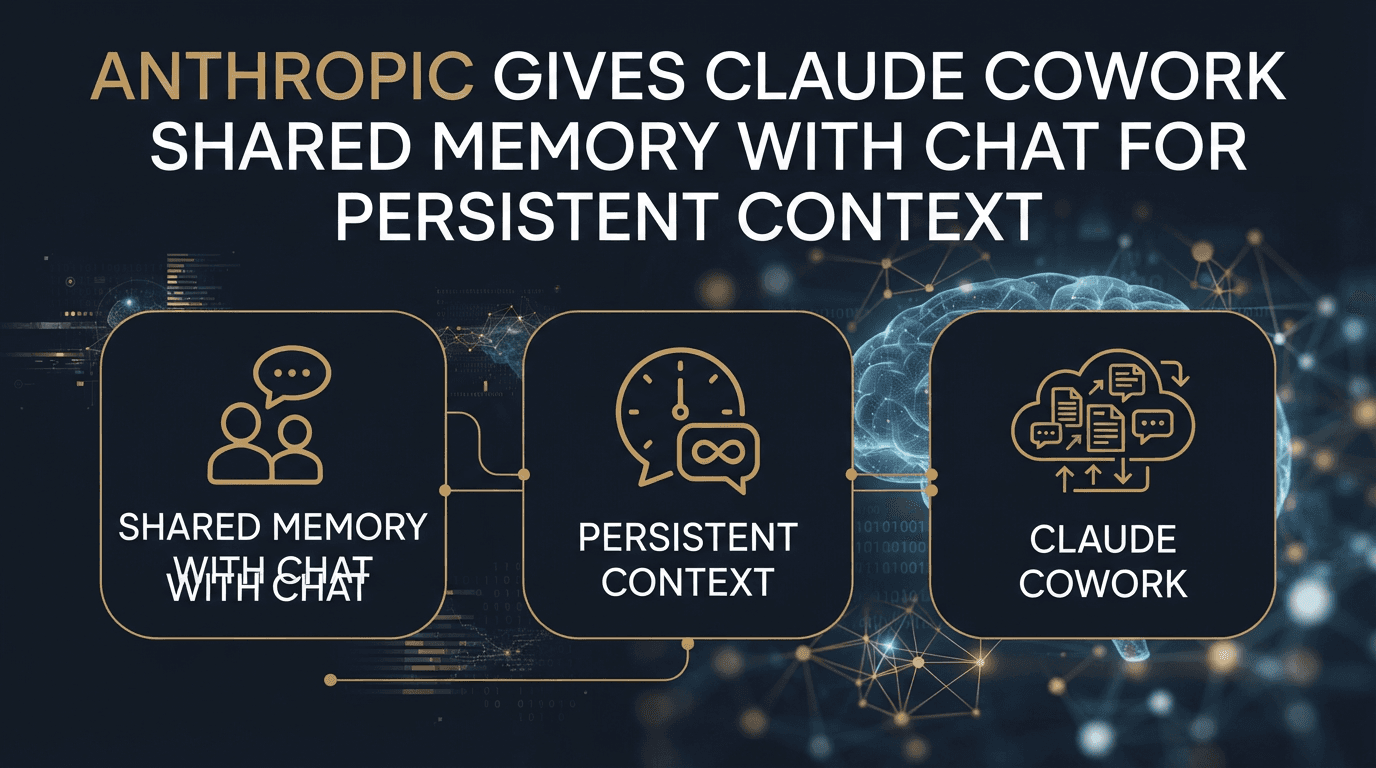
Anthropic Gives Claude Cowork Shared Memory with Chat for Persistent Context
Nic Reeve5 min read
Anthropic Gives Claude Cowork Shared Memory with Chat for Persistent Context

Anthropic is rolling out a major upgrade to its AI assistant, giving Claude Cowork the ability to seamlessly reuse information it learns in regular chat. The company has merged the memory systems behind Claude’s chat interface and its Cowork desktop agent, so details you share in one surface can now automatically be used in the other.

One Shared Memory Across Chat and Cowork

Previously, Claude’s long‑term memory was largely confined to chat sessions and was synthesized periodically, meaning it could take up to a day before information carried over into new conversations. Cowork, which runs complex, multistep jobs on a user’s desktop or in the cloud, relied on its own background memory file and prompt stitching to simulate continuity. With the August 25 update, Anthropic has combined these mechanisms into a single, shared memory system that serves both chat and Cowork.

Anthropic describes the change simply: the same memory now powers both Claude chat and Cowork. When users hand a task to Cowork—such as drafting reports, updating spreadsheets, or coordinating project documents—the context Claude has accumulated over months of chats is immediately available. Likewise, any new facts or preferences learned during Cowork runs are written back into the shared memory and become available in subsequent chat sessions.

Real‑Time Memory, Not Just End‑of‑Chat Summaries

Another important shift is how Claude updates memory. Instead of waiting to summarize an entire conversation once it ends, Claude now adds topics to memory in real time as users chat. This means that if a user mentions that a project deadline moved to September, that update can be reflected in memory almost immediately and show up in the very next interaction—whether in chat or Cowork—without requiring a manual “remember this” command.

Anthropic’s support materials explain that when Cowork runs in the cloud, what Claude remembers from previous chats is automatically available, and what emerges during Cowork tasks feeds back into chat memory. Behind the scenes, each Cowork prompt is assembled from the user’s immediate request, their global instructions, and a relevant slice of the shared memory, allowing the AI to behave as if it has persistent awareness of roles, projects, and preferences.

What Users Gain: Less Repetition, More Continuity

The practical effect for users is that they no longer need to repeatedly brief Claude on who they are, what they are working on, or how they like to work every time they switch between chat and Cowork. Anthropic and independent commentators highlight several common scenarios:

  • Persistent project context: Ongoing details such as quarterly goals, client names, and current project status can be retained across weeks or months and recalled in both chat and Cowork.
  • Stable roles and preferences: If a user identifies themselves as an investment analyst, a teacher, or a particular type of creator, Claude can remember that role and tailor responses accordingly, even when individual chats are short or focused on different tasks.
  • Cross‑device consistency: The shared memory applies across web, desktop, and mobile experiences, so moving from a browser chat to the Cowork desktop agent no longer breaks context.

Tech industry observers note that this update positions Claude more directly as an AI “teammate” that can track medium‑ and long‑term workstreams instead of acting purely as a session‑bound chatbot.

Transparency and User Control Over Memory

The shared memory system arrives alongside a push for greater user control. Anthropic now surfaces everything Claude remembers in a dedicated Topics view within memory settings, where users can inspect, edit, or delete individual entries. Memory is stored as discrete, categorized entries rather than a single opaque summary, making it easier to remove outdated or inaccurate information.

Users can also pause memory or reset it entirely if they no longer wish Claude to retain prior context. In addition, Anthropic provides guidance on importing and exporting memory, so the information Claude stores about a user is not locked in and can in principle be backed up or moved.

Handling Sensitive Topics

Anthropic has emphasized that the system is designed to minimize the capture of highly sensitive information by default. Topics such as health data, beliefs, and other potentially sensitive categories are excluded from memory unless users explicitly opt in via an “Include sensitive topics in memory” setting. For business customers, team or enterprise administrators can centrally control whether memory is enabled at all, and may choose more restrictive policies depending on corporate governance requirements.

External reporting indicates that memory generation is turned on by default for free, Pro, and Max plans, while Cowork itself is not available on free accounts. For organizations that want to keep different workstreams separated, Anthropic has indicated that the only way to maintain fully separate memories for chat and Cowork is to use different accounts, since the new system treats them as a single unified space.

Availability and Limitations

The new shared memory capability began rolling out on August 25, 2026, across Claude’s web, desktop, and mobile experiences, as well as Cowork running in the cloud. Earlier in the year, memory support was limited to chat surfaces, and some third‑party analyses noted that Cowork lacked access to that long‑term context. Anthropic’s latest release notes and help center now explicitly state that memory works across both chat and Cowork when the latter runs in the cloud environment.

There are still technical constraints. Cowork’s use of memory depends on cloud execution rather than purely local processing, and incognito or memory‑disabled sessions remain stateless by design. As with other AI systems, Anthropic cautions that Claude’s memory is selective: it prioritizes high‑level preferences and recurring topics rather than storing every detail of every conversation.

A Step Toward More Personalized AI Workflows

By unifying memory between Claude chat and Cowork, Anthropic is betting that users will value a more personalized and continuous AI experience, particularly for complex, ongoing work. The update reduces friction for individuals juggling multiple projects and gives enterprises a clearer path to building AI‑augmented workflows that persist over time. At the same time, the company is attempting to balance convenience with privacy and security by giving users fine‑grained controls and limiting sensitive data retention by default.
Read more →

Related Articles

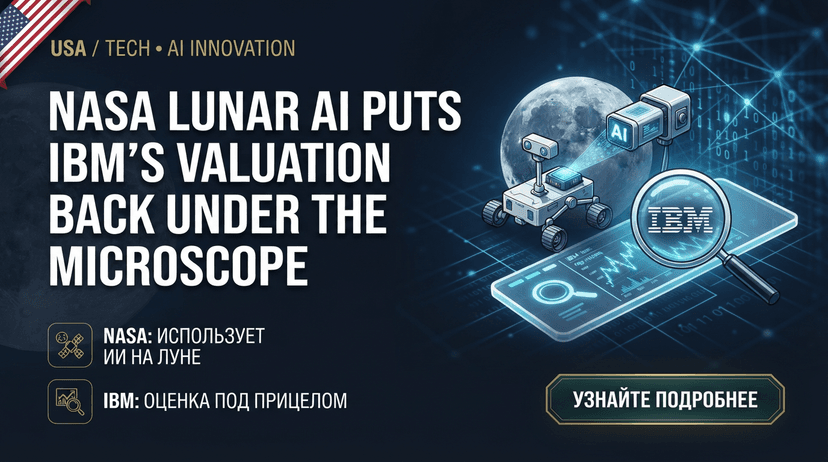
NASA lunar AI puts IBM’s valuation back under the microscope
AI & Tech

NASA lunar AI puts IBM’s valuation back under the microscope

On September 10, 2026, IBM and NASA unveiled the open‑source NASA‑IBM Lunar Foundation Model, putting the project at the center of AInews coverage and renewing attention on how IBM’s expanding artificial intelligence portfolio should be reflected in its market valuation. What exactly did IBM and NASA launch on September 10, 2026? IBM and NASA released an open‑source foundation model built specifically for lunar science, trained on decades of Moon observation data and made publicly available through open repositories. The model is designed to help researchers identify ice deposits, craters and volcanic terrain and to support plans for a sustained human presence on the Moon. According to IBM’s newsroom on September 10, 2026, the NASA‑IBM Lunar Foundation Model is "one of the first publicly available foundation models for scientific exploration of the Moon," trained on an extensive dataset curated jointly by IBM and NASA researchers. NASA’s science office states that the model is hosted on public machine learning platforms with the full codebase on developer repositories so that any scientist can download, test and adapt it. Release date: September 10, 2026, announced jointly by IBM and NASA. Scope: Lunar ice, craters, volcanic history and surface mapping. Access: Model weights under an open license with code available for fine‑tuning and experimentation. Partners: IBM Research, NASA Science and academic collaborators. Wire coverage from Reuters describes the system as an open‑source AI tool designed to analyze decades of lunar observation data and help support a long‑term human presence on the Moon. Tech and science outlets emphasise that researchers can use the model to pinpoint likely buried ice in permanently shadowed craters, map craters at coarse resolution, and explore the Moon’s volcanic history more accurately than earlier methods. How much better is the NASA‑IBM lunar model than existing methods? Independent reports on the NASA‑IBM Lunar Foundation Model say it improves feature detection on the Moon’s surface by a little over twenty percent compared with widely used approaches, using less labeled data to achieve that performance. That uplift in accuracy is one reason investors are re‑examining IBM’s AI capabilities when discussing valuation. Reuters cites NASA and IBM as saying that in benchmark tests the lunar model identified key features on the Moon’s surface up to 23% more accurately than widely used methods. Tech‑focused coverage reports that predictions of buried ice in shadowed polar craters come with 22% less error than the best available dedicated algorithms, while crater mapping at coarse resolution reaches 19% better accuracy while using only half as much labeled training data. Ice prediction error: According to TechTimes on September 11, 2026, error rates are reduced by 22% compared with the best prior algorithm. Crater mapping accuracy: The same report cites a 19% improvement at coarse resolution. Overall feature identification: Reuters reports up to 23% higher accuracy than widely used methods in benchmark tests. Labeled data usage: TechTimes notes the lunar AI model reached its gains with only half as much labeled training data. A technology analysis piece on the model states that NASA’s science team confirmed the system is available on public AI platforms with the complete codebase on code hosting sites, mirroring the distribution approach IBM used for the earlier Prithvi Earth‑observation foundation models. Those earlier models, introduced in 2023 to work on Harmonized Landsat Sentinel‑2 data, were reported by IBM to deliver about a 15% improvement over state‑of‑the‑art techniques in flood and burn‑scar mapping using half the labeled data. This pattern of releasing geospatial models with clear performance gains and open access has helped establish IBM as a reference player in scientific AI, which is now feeding into analyst and investor conversations about the company’s earnings power and valuation multiples. How does this lunar AI fit into IBM’s broader artificial intelligence strategy? The lunar foundation model extends IBM’s strategy of building domain‑specific foundation models under its watsonx portfolio and collaborating with public institutions on open geospatial AI. That strategy now spans Earth observation, weather, environmental intelligence and lunar science, and is increasingly cited in research coverage of IBM’s stock. IBM’s August 3, 2023 announcement of its geospatial foundation model described training a large AI system on one year of Harmonized Landsat Sentinel‑2 satellite data across the continental United States, with fine‑tuning for tasks such as flood and burn scar mapping. According to IBM, that Earth‑focused model delivered a 15% improvement over state‑of‑the‑art techniques using half the labeled data, and a commercial version was slated to be integrated into the IBM Environmental Intelligence Suite, part of the broader watsonx ecosystem. Foundation model family: IBM and NASA’s models join the Prithvi family of geospatial and weather foundation models highlighted in coverage of the lunar release. Commercialisation path: IBM’s geospatial model is linked to the Environmental Intelligence Suite, showing how scientific AI is tied to revenue‑producing software. Open science strategy: NASA and IBM host weights and code under open licenses, encouraging global research use. Brand positioning: IBM’s newsroom clusters the lunar model under its artificial intelligence press releases, presenting it as part of its AI leadership narrative. NASA’s coverage of the lunar foundation model emphasises collaboration not only with IBM but with academic partners, reinforcing IBM’s position as a scientific computing partner rather than simply a commercial vendor. For investors, that dual role matters because it shapes perceptions of IBM’s long‑term relevance in high‑impact domains such as space exploration and climate science. Why is IBM’s stock valuation “back in focus” following the lunar AI launch? Recent analyst reports show renewed attention on IBM’s earnings potential from AI and quantum initiatives, with the lunar model serving as a high‑visibility example of IBM’s technical depth. Consensus targets point to modest upside, and some coverage links positive sentiment directly to IBM’s AI collaborations and product roadmaps. A stock analysis article dated September 12, 2026 reports that Wall Street holds an overall Buy consensus on IBM shares, citing data that 25 analysts have set a 12‑month price target of USD 245.35, about 4.8% above IBM’s September 10 closing price of USD 234.02. The same coverage references other compilations indicating a Moderate Buy consensus and an average target price around USD 265.90, which would imply stronger upside from trading levels near USD 243. Closing price reference: TheStreet coverage cited by ad‑hoc news puts IBM’s closing price on September 10, 2026 at USD 234.02. Analyst count: 25 analysts in that survey with a 12‑month target of USD 245.35, according to TheStreet via ad‑hoc. Consensus descriptor: Separate market data services describe a Moderate Buy rating with an average target of USD 265.90. Valuation metrics: Seeking Alpha’s snapshot on around September 10 lists a forward non‑GAAP price/earnings ratio of 20.22, a GAAP trailing P/E of 22.15, and a price/book multiple of 6.81. The Seeking Alpha figures also show an enterprise value to sales ratio of 4.22 and an enterprise value to EBITDA of 17.72 for IBM, framing the company as a mature technology firm with premium valuation compared with many legacy peers but trading at a discount to some faster‑growing AI‑focused companies. Market commentary links that profile to IBM’s mix of stable infrastructure revenue and emerging growth in AI and quantum computing. Coverage describing IBM stock gains on quantum bets and AI mentions that, despite a legal probe referenced in passing, investor appetite for exposure to IBM’s advanced computing initiatives has remained strong. In that context, the lunar foundation model is cited as a showcase of IBM’s ability to collaborate with agencies such as NASA on cutting‑edge AI, reinforcing the argument that current valuation metrics may underestimate future cash flows from AI‑enabled products and services. Who is affected by the NASA‑IBM lunar AI, beyond IBM’s shareholders? The lunar model directly affects planetary scientists and engineers working on NASA’s Artemis program, while indirectly shaping vendors and partners involved in lunar infrastructure planning. It also influences academic researchers, AI developers and policy discussions about open scientific data and public‑private cooperation in space exploration. NASA’s material on the lunar foundation model points out that the AI system was trained primarily on data from the Lunar Reconnaissance Orbiter and other instruments, creating a unified dataset suitable for machine learning. IBM’s description of the project explains that the two organisations built what they describe as the first open‑source dataset that consolidates decades of lunar data in a format tuned for AI research. NASA Artemis planners: TechTimes notes that the system can help pick landing sites near the lunar south pole, where ice could support water, oxygen and fuel for onward missions to Mars. Planetary science community: NASA and technology outlets say any researcher worldwide can download and adapt the model for fresh studies of lunar phenomena. Academic partners: NASA references several universities involved in the collaboration, extending access to students and early‑career scientists. Space industry vendors: Clearer maps of ice and terrain support companies working on habitats, mining and resource use on the Moon. For AI developers, the lunar model demonstrates how foundation models can be adapted to domains beyond language and mainstream computer vision. For policymakers, the open‑license approach raises questions about how publicly funded data and private sector technology should be shared when they shape future resource extraction and national presence on the Moon. What happens next for IBM’s AI portfolio and valuation story? Commentary from science and market sources suggests several next steps: wider scientific use of the lunar model, commercial spin‑offs through IBM’s software suites, and ongoing analyst reassessment of IBM’s AI and quantum computing earnings potential. The outcome will influence whether current price targets move higher or stabilise as projects like the lunar AI mature. Technology coverage points out that the lunar foundation model follows the pattern IBM and NASA established with the Prithvi models: open weights, open code, and community‑driven fine‑tuning on public platforms. That history makes it likely that new versions will appear, trained on expanded datasets or adapted to related planetary bodies as agencies gather more remote‑sensing data. Scientific roadmap: NASA’s long‑term goal of a sustained human presence on the Moon gives the lunar AI a central role in mission planning. Commercial potential: IBM’s prior geospatial AI has already been linked to its Environmental Intelligence Suite, hinting that similar integration could follow for lunar or broader space‑data products. Valuation drivers: Analyst targets compiled by market data services will likely evolve as IBM reports concrete revenue tied to its AI models and quantum offerings. Risk factors: Legal probes and competitive pressure from other AI vendors are mentioned in stock coverage as counterweights to growth expectations. As those threads unfold, IBM’s collaboration with NASA on the Lunar Foundation Model stands as a visible test of how cutting‑edge, open scientific AI projects can translate into commercial demand and, in turn, into the valuation numbers that investors scrutinise every quarter.

Nic Reeve¡
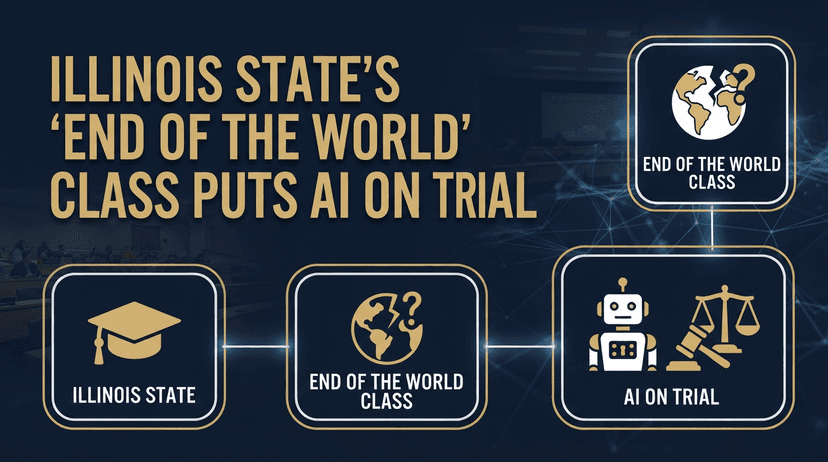
Illinois State’s ‘End of the World’ Class Puts AI on Trial
AI & Tech

Illinois State’s ‘End of the World’ Class Puts AI on Trial

Students Confront AI Ethics in Illinois State’s ‘End of the World’ Classroom In a seminar room at Illinois State University (ISU), an apocalyptic thought experiment is helping students grapple with one of the most disruptive technologies of their lifetimes: artificial intelligence . Framed as “feminism at the end of the world,” the class invites students to imagine futures shaped by climate crisis, economic collapse, and runaway automation—and then ask what justice, care, and responsibility look like when AI is woven into every aspect of life. The course, titled WGS 391/491: Feminism at the End of the World , is taught by Dr. Jacklyn Weier in Illinois State’s Women’s, Gender, and Sexuality Studies program. Using speculative fiction, feminist theory, and contemporary reporting on AI, Weier’s students interrogate who benefits from emerging technologies and who is left more vulnerable when those tools are deployed in unequal societies. ‘End of the World’ as a Lens on AI Rather than treating AI as a neutral tool, the course positions it as a technology emerging in an already crisis-ridden world. Students consider scenarios in which climate disasters, pandemics, or authoritarian politics intersect with increasingly powerful AI systems. That apocalyptic framing, Weier explains in the Illinois State University News feature, is less about doomsday spectacle and more about clarity: it allows students to see existing inequalities—and the potential amplification of those inequalities—without the distractions of business-as-usual. Class discussions draw on questions such as: Who designs AI systems, and whose values are embedded in them? Which communities are most exposed when automated decision-making is used in policing, immigration, or social services? How might feminist and queer perspectives offer alternative models for building or governing AI, especially in times of crisis? Students are encouraged to treat AI not only as a technical system but as a social infrastructure: something that redistributes power, labor, and risk. That perspective resonates with broader concerns raised by scholars and civil-society groups about bias in algorithms, surveillance capitalism, and the concentration of AI capabilities in a small number of corporations. Illinois State’s Wider Debate Over AI in the Classroom The apocalyptic classroom arrives amid a campus-wide—and statewide—reckoning over how AI should be used in education. Illinois State has devoted increasing resources to helping faculty and students navigate generative AI tools like ChatGPT, Gemini, and Copilot, and to clarifying when such tools enhance learning and when they undermine it. In 2025, the university’s Office of the Cross Endowed Chair in the Scholarship of Teaching and Learning launched a grant program inviting faculty to study how generative AI is used or resisted in courses, and what that means for student learning, assessment, and equity. Those projects are structured around a central question: how is AI being integrated into higher education, and with what consequences for teaching and learning at ISU? Illinois State’s professional development arm has since published guidance for instructors on generative AI in the classroom. That guidance emphasizes transparency and critical engagement: instructors are urged to state clearly in their syllabi when AI use is permitted, explain why particular assignments prohibit AI, and design assessments that prioritize process, reflection, and local or experiential knowledge. Faculty workshops encourage instructors to have students critique AI-generated content, practice fact-checking, and reflect on where AI’s limitations become visible—especially when it comes to hallucinations, bias, and context. The goal is not to ban AI outright but to turn it into an object of analysis and a prompt for metacognition, much like what happens in Weier’s apocalyptic classroom. State Policy: AI Can Assist, But Not Replace, Human Teachers The conversations at Illinois State unfold against a backdrop of new laws in Illinois that specifically address AI in education. Recent legislation requires community colleges to ensure that courses are taught by qualified human faculty and explicitly prohibits using AI systems as the sole source of instruction in place of an instructor. At the same time, the law clarifies that faculty are allowed to use AI as a teaching tool—whether for generating practice problems, simulating scenarios, or tailoring feedback. Another measure directs the Illinois State Board of Education to develop statewide guidance on AI in K–12 settings. That guidance must explain how AI works, offer examples of instructional uses, address data privacy and security, and highlight the risk of unintended bias baked into AI products. It also calls on educators to explicitly teach responsible and ethical AI use, preparing students to evaluate automated systems rather than accept them uncritically. Illinois education officials have since released public-facing guidance that echoes those themes, stressing that AI should support, not supplant, human relationships in teaching and learning. The documents encourage schools to balance innovation with vigilance, especially when it comes to student data and the potential for algorithmic discrimination. An ‘Apocalyptic’ Syllabus Meets Real-World Tech Within this rapidly shifting policy and technological landscape, ISU’s “end of the world” class serves as a kind of laboratory. Students might read feminist science fiction that imagines AI governing resource distribution after climate collapse, and then compare those visions with real-world deployments of predictive analytics in disaster response or public assistance programs. Assignments invite students to bring news coverage, corporate marketing, and government documents into conversation with theoretical texts. For example, a student might juxtapose a tech company’s promise to use AI for equitable healthcare with reports of biased diagnostic algorithms, or analyze how AI-enhanced policing could change under conditions of social unrest or environmental migration. By situating AI in imagined end-times, Weier’s course asks students to strip away the sheen of inevitability that often accompanies innovation narratives. If AI is introduced into a fragile or unjust world, she asks, what safeguards and alternative designs would be needed to prevent it from reinforcing existing hierarchies—or making crises worse? Feminism, Care, and the Future of Work The feminist framing of the course pushes students to pay particular attention to care work, reproductive labor, and the often-invisible human effort that underlies technological systems. Discussion topics include: How AI may reshape care professions, from nursing to education, and what happens when emotional labor is automated or monitored. Who performs the ghost work of data labeling, content moderation, and user support that keeps AI systems running. How automation might intersect with gender, race, and class in future labor markets, especially under crisis conditions. What a more just AI ecosystem would require in terms of labor protections, democratic oversight, and alternative ownership models. Students are encouraged to imagine AI futures in which care, reciprocity, and mutual aid are central design principles rather than afterthoughts. In some projects, that means sketching out hypothetical policies for community-run data trusts or workers’ cooperatives overseeing AI tools in essential services. AI Education Beyond One Classroom Illinois State is also building technical capacity around AI. The university has promoted AI-focused professional development sessions for faculty, including workshops on demystifying AI for teaching and learning and on designing assignments that cannot easily be outsourced to generative tools. In 2026, ISU highlighted a new “AI + Robotics” initiative that introduces pre-service STEM educators to so-called physical AI—systems embedded in robots and other devices. The project, supported by an internal innovation grant, aims to help future teachers understand both the capabilities and limits of AI, and to translate abstract concepts into hands-on classroom activities. Another Illinois State faculty member, Dr. Elahe Javadi from the School of Information Technology, was selected for the inaugural cohort of NSF NAIRR AI Education Fellows. That national role positions ISU at the intersection of AI research and education policy, and underscores the university’s effort to engage with AI not only as an object of critique but as a field in which its faculty and students can lead. Questioning the Future, Not Just the Tools The apocalyptic classroom at Illinois State shows how humanities and social science courses can complement technical and policy efforts around AI. By combining speculative scenarios with rigorous critique, students learn to move beyond questions like “Is AI good or bad?” and toward more specific, grounded inquiries: Which AI, deployed where, under whose control, and with what safeguards? For Weier’s students, the end of the world is less a prophecy than a lens—a way to see clearly the stakes of technological change and the kinds of futures they are willing to build or resist. In that sense, Illinois State’s experiment in apocalyptic pedagogy offers a model for universities everywhere: treat AI not only as a tool to be mastered, but as a system whose power must be scrutinized, contested, and, where possible, redirected toward more just worlds.

Nic Reeve¡
Unsealed Docs Show Microsoft Warned AInews Could Trigger a Doom Loop for Journalism
AI & Tech

Unsealed Docs Show Microsoft Warned AInews Could Trigger a Doom Loop for Journalism

On September 17, 2026, newly unsealed court filings in The New York Times’ copyright lawsuit against OpenAI and Microsoft showed senior Microsoft executives warning that their AInews products risk creating a “doom loop” that drains traffic and money from news outlets while degrading the quality of information on the web itself. What did the unsealed Microsoft documents say about AI and journalism? The unsealed Microsoft documents describe internal warnings that AI answer engines trained on news articles could both undermine publishers’ business models and weaken the online information ecosystem that those same AI systems depend on. Key passages from the filings show that Microsoft’s own researchers and product leaders were alarmed by how generative AI systems use and replace journalism: According to TechCrunch, an internal presentation written by Microsoft Director of Applied Science Brent Hecht in January 2024 described the impact of large-scale AI scraping and answer engines as a “doom loop” that would “hurt the performance of our models and the entire web at the same time.” The Washington Examiner reports that Hecht wrote, “Our AI content strategy has started a ‘doom loop’ that will hurt the performance of our models and the entire web at the same time,” calling the situation “highly unusual” because the end product threatens “the economic foundations of its essential suppliers.” Law360 and MLex note that internal documents quote Microsoft and OpenAI employees acknowledging that unlicensed use of millions of news articles could begin a doom loop that endangers their “content supply chain.” The Wrap cites filings where a Microsoft document warns that the companies’ AI approach had started a doom loop that would damage both model performance and “the entire web.” These statements appear in an unredacted memorandum filed by lawyers for The New York Times in its ongoing copyright case against OpenAI and Microsoft in federal court in Manhattan. The case has been moving through the courts since 2023. Who inside Microsoft raised alarms about AI scraping and labor “theft”? Concerns inside Microsoft were led by Brent Hecht, the company’s Director of Applied Science, who repeatedly warned that scraping journalism at scale for AI training amounted to unprecedented theft of human labor. The unsealed filings attribute several striking internal comments to Hecht: TechCrunch reports that Hecht described large-scale AI scraping of online content as “the largest theft of labor in human history” during internal discussions documented in January 2023 and January 2024. The New York Daily News notes that a senior Microsoft executive believed AI systems built on other people’s work would be seen as “an astonishing theft of unprecedented proportions” and possibly “the greatest robbery of labor in human history,” according to the unredacted court documents. BrandiconImage and The Wrap both quote Hecht calling the copying of news articles “an astonishing theft of unprecedented proportions” and potentially the “largest theft of labor in human history.” TweakTown, summarizing the filings, says Hecht argued that relying on “fair use” to justify mass scraping of news articles made a “complete mockery” of fair use as a legal concept. These warnings portray internal recognition that the AI training pipelines built on publishers’ work were not just legally risky. They were seen by some of the engineers and scientists responsible for the systems as ethically and economically corrosive for the entire news ecosystem. How is Microsoft’s AI answer engine affecting traffic to news publishers? The filings assert that Microsoft’s AI-powered answer tools dramatically cut referral traffic to news outlets, raising fears that this substitution effect could erode the financial base that supports professional journalism. Multiple sources describe internal metrics and testimony about how AI answers change user behavior: TechBeat reports that unredacted documents say Hecht warned in January 2024 that Microsoft’s Copilot answer engine reduced click-through rates to New York Times articles by up to 93% compared with traditional Bing search results. TweakTown’s summary of the same filings notes internal estimates that AI chatbots and answer boxes could cut publisher traffic by 51% to 94%, depending on the scenario and query type. The Wrap recounts Microsoft CEO Satya Nadella’s testimony that conversations with chatbots had already substituted for visits to news websites by “giving you the information right there on the website on the AI platform versus needing to go to the underlying source.” These numbers, all attributed to internal assessments and court testimony in 2024 and 2025, suggest that AI answer engines do not simply coexist with news sites. They can replace the need for many users to click through, weakening advertising revenue and subscriptions that depend on direct visits. What exactly is the “doom loop” Microsoft executives described? The “doom loop” described in the court filings refers to a self-reinforcing cycle in which AI systems undermine the economic viability of news outlets, leading to worse content on the web, which then harms the AI models that rely on that content. Internal documents quoted across several reports outline the logic of this loop: Ground News and EuropeSays explain that Hecht’s memo warned generative AI products had created a doom loop that is “eating the web and destroying the businesses that these companies stole from,” by substituting AI answers for visits to publishers. The Washington Examiner cites a Microsoft document saying, “It is highly unusual that an end-product threatens the economic foundations of its essential suppliers, but that is the situation we have created for our LLM business with respect to its ‘content supply chain.’” BrandiconImage notes that the filings describe a scenario in which declining traffic to news sites weakens the broader online ecosystem and ultimately reduces the quality of information available to AI systems. TweakTown’s coverage summarizes the loop as: AI answer engines cut traffic, lower financial incentives for journalists, shrink the supply of high-quality reporting, and then damage the very models that need that reporting for training. The core idea is simple. Less money for journalism means fewer reporters and less reliable news. AI models trained on that degraded content will perform worse, which harms users and the platforms themselves. How does the New York Times lawsuit frame these internal admissions? The New York Times uses the internal Microsoft and OpenAI admissions to argue that the companies knowingly built profitable AI systems on unlicensed news content, while recognizing that this strategy threatened the very publishers who produced that content. Recent coverage of the unsealed filings outlines the Times’ legal narrative: KuCoin’s legal news summary states that the newly unsealed memorandum in The New York Times v. OpenAI copyright lawsuit was written by Times lawyers and “largely comprised” statements and interviews with tech executives acknowledging that large language models were “built on content described by Microsoft executives as an unprecedented scale of theft.” Ground News reports that the filings present executives’ own words to show that large language models are “predatory” technologies, trained on “stolen content” that pose an “existential risk” to human writers, artists and media companies. MLex describes the new documents as showing knowledge of “AI copying costs to US news companies,” including recognition that unlicensed use of millions of articles to train chatbots could initiate the doom loop and represent the “largest theft of labor in human history.” Law360 notes that Microsoft and OpenAI employees had internally acknowledged for years that tools trained on news articles would likely replace publishers, leading to the doom loop scenario. By highlighting these internal statements, the Times aims to strengthen its claim that OpenAI and Microsoft knowingly relied on unlicensed journalism while foreseeing the damage to publishers. What are OpenAI’s internal concerns about publishers and substitution? The unsealed filings do not focus only on Microsoft. They also reveal internal OpenAI fears that chatbots would become direct substitutes for news publishers, undermining the business case for continued reporting. Several sources summarize these concerns: According to BrandiconImage, Nick Turley, who led the team developing ChatGPT, warned in a 2023 internal memo that AI represented an “existential threat” to publishers. The Wrap reports that Turley wrote that publishers faced an existential threat from AI products that were already “largely substitutive” and would become more so as the systems improved. Law360 states that OpenAI and Microsoft employees acknowledged for years that AI tools trained on news articles would likely replace publishers, contributing to the doom loop described in the filings. These internal comments echo the worries of many editors and reporters: if users can ask a chatbot for a summary instead of visiting a news site, long-term funding for independent journalism becomes precarious. What broader implications does this doom loop have for the future of news? The doom loop described by Microsoft and OpenAI staff suggests that current generative AI strategies could destabilize the business of news, reduce the quality of information online, and ultimately damage AI systems themselves unless new economic and legal arrangements emerge. Across the reports, several themes recur: Executives privately agree with publishers’ warnings that generative AI poses an “existential threat” to news organizations when it siphons both content and audience without paying for either. Internal Microsoft discussions emphasize that the economic foundations of journalism are part of the “content supply chain” for AI, meaning that harming publishers also harms AI products over time. The filings highlight the mismatch between short-term gains—offering instant answers that users love—and long-term risks, such as fewer reporters investigating public-interest stories because revenue has collapsed. Several analyses argue that the doom loop concept may push courts and regulators to consider new models, including licensing deals, compulsory fees, or explicit limits on scraping and training data drawn from professional news outlets. The immediate dispute centers on New York Times content and current AI products. The underlying question is whether the web that AI relies on can survive if its core economic engine—commercial and subscription-supported journalism—is hollowed out by the very systems that now scrape and summarize its work.

Nic Reeve¡