
allnewscastallnewscast
Breaking News
AI & Tech

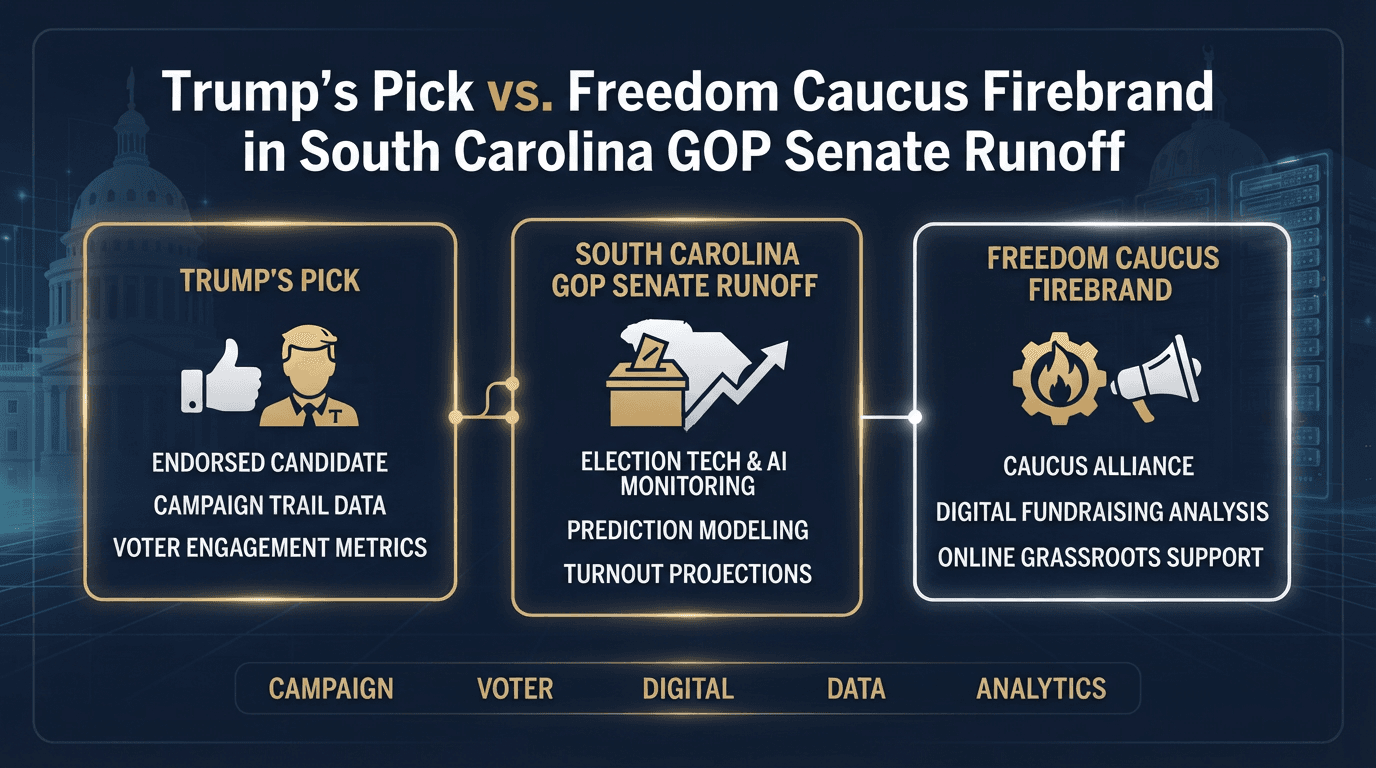
Trump’s Pick vs. Freedom Caucus Firebrand in South Carolina GOP Senate Runoff
Nic Reeve5 min read
Trump’s Pick vs. Freedom Caucus Firebrand in South Carolina GOP Senate Runoff

South Carolina Republicans are heading into a fiercely contested August 25 runoff that will decide who carries the party’s banner for the U.S. Senate seat once held by the late Lindsey Graham. Sen. Darline Graham, his sister and the appointed incumbent, is locked in a tight race with Rep. Ralph Norman, a veteran House conservative, after neither candidate secured a majority in the August 11 special primary.

The winner of the runoff will face Democrat Annie Andrews, a pediatrician and party nominee, in the November general election, making Tuesday’s vote the decisive Republican step in determining Lindsey Graham’s successor for a full six-year term.

From Appointment to First Campaign: Darline Graham’s Bid to Keep the Seat

Darline Graham was appointed on July 13, 2026, by Gov. Henry McMaster to fill the vacancy created by her brother’s sudden death, taking the Senate oath the following day. Before entering elected office, she served as commissioner of the South Carolina Commission for the Blind and worked as a vocational rehabilitation counselor, building a profile rooted in social services and disability advocacy.

In the crowded, 10-candidate Republican special primary on August 11, Graham placed first but fell short of the 50 percent threshold required to avoid a runoff, winning roughly 32–33 percent of the vote. South Carolina law mandates a runoff when no contender surpasses an outright majority, sending Graham and Norman back to voters for a head-to-head contest.

Graham’s campaign has emphasized continuity with her brother’s legacy, a focus on national security and support for military families, and her experience in state-level administration. Her allies argue that her appointment and subsequent elevation in the primary demonstrate a desire among voters for stability amid a rapid and unexpected transition.

Ralph Norman’s Challenge from the Right

Ralph Norman, who represents South Carolina’s 5th Congressional District, is a long-time member of the House Freedom Caucus and has built his political identity around hardline conservative positions on spending, immigration, and cultural issues. In the primary, Norman finished second with about 24–25 percent of the vote, securing his place in the runoff but underscoring the need to expand his base in a statewide race.

Norman has framed the runoff as a choice between his record of legislative experience and Graham’s status as a newly appointed senator. In interviews, he has pointed to his years in Congress and business background, arguing that he is better prepared to navigate complex national debates and advance conservative priorities.

On the campaign trail and in debates, Norman has cast himself as the more reliable champion of limited government and tighter border controls, while criticizing what he portrays as insider politics around Graham’s appointment and backing from party leaders.

Trump’s Endorsement Becomes a Flashpoint

The race gained national attention when former President Donald Trump endorsed Darline Graham in the runoff, aligning himself with the appointed incumbent rather than the Freedom Caucus stalwart. Trump’s support reflects a pattern in recent election cycles in which his endorsements have sometimes clashed with the preferences of local activists and hard-right factions.

Norman has openly questioned the endorsement, calling it a “head scratcher” and noting his history of voting for Trump’s priorities in Congress. He has argued that his voting record and close alignment with Trump-era policies should make him the natural choice for the former president’s backing, suggesting that the decision was influenced by establishment figures eager to maintain continuity in the Senate seat.

For Graham, the endorsement provides a powerful signal to GOP voters who remain loyal to Trump, potentially helping her consolidate support among primary voters wary of internal party conflict. Her campaign has treated the backing as validation of her commitment to the same conservative agenda her brother supported in the Senate.

Debates, Jabs, and Competing Visions

The closing days of the campaign have featured sharp exchanges between the two Republicans in televised debates and forums across the state. In a recent U.S. Senate debate covered by South Carolina Public Radio, Graham and Norman “exchanged jabs” while outlining competing visions for the party’s future.

Graham leaned on her experience overseeing services for blind and disabled South Carolinians, promising to prioritize health care access, veterans’ services, and steady governance during a period of uncertainty following her brother’s death. Norman, meanwhile, pressed his case for a more confrontational approach to federal spending and executive power, positioning himself as the candidate best suited to challenge what he sees as overreach by Washington.

Both candidates have pledged strong support for conservative judicial appointments and a robust national defense, often invoking Lindsey Graham’s long record on foreign policy and military issues. However, their rhetoric diverges on style: Graham presents herself as a steady hand and consensus-builder, while Norman appeals to GOP voters who prefer sharper ideological contrasts and a more combative tone in Washington.

Runoff Mechanics and Voter Turnout Stakes

Early voting for the runoff has been open in South Carolina in the days leading up to August 25, with polls available from 8:30 a.m. to 5 p.m. in counties across the state. On runoff day, polling places will operate from 7 a.m. to 7 p.m., giving Republicans a 12-hour window to settle the intraparty contest.

Given the relatively low turnout typical of runoff elections, both campaigns are focusing heavily on field operations and targeted outreach. Graham’s team is leaning on statewide name recognition and the emotional resonance of her brother’s legacy, while Norman’s campaign seeks to mobilize conservative grassroots networks that have powered his House wins.

The Democratic nominee, Annie Andrews, has kept a relatively low profile during the GOP runoff but stands ready to frame the eventual Republican winner as out of step with mainstream voters on abortion, health care, and gun policy. Her campaign sees opportunity if the GOP emerges from the runoff divided or if the Trump endorsement becomes a liability in the general election.

National Implications of a Statewide Contest

Beyond South Carolina, the runoff is being watched as a test of the balance between Trump-aligned insiders and hardline House conservatives within the Republican Party. A Graham victory would underscore the continuing influence of Trump’s endorsements and party leaders in shaping Senate races, particularly when family ties and incumbency are in play.

A Norman win, by contrast, would signal the strength of the Freedom Caucus wing and could embolden similar challenges to appointed or establishment-backed Republicans in other states. For South Carolina voters, the choice on August 25 will determine not only who replaces Lindsey Graham, but also which version of the GOP they want representing them in Washington.
Read more

Related Articles

Unsealed Docs Show Microsoft Warned AInews Could Trigger a Doom Loop for Journalism
AI & Tech

Unsealed Docs Show Microsoft Warned AInews Could Trigger a Doom Loop for Journalism

On September 17, 2026, newly unsealed court filings in The New York Times’ copyright lawsuit against OpenAI and Microsoft showed senior Microsoft executives warning that their AInews products risk creating a “doom loop” that drains traffic and money from news outlets while degrading the quality of information on the web itself. What did the unsealed Microsoft documents say about AI and journalism? The unsealed Microsoft documents describe internal warnings that AI answer engines trained on news articles could both undermine publishers’ business models and weaken the online information ecosystem that those same AI systems depend on. Key passages from the filings show that Microsoft’s own researchers and product leaders were alarmed by how generative AI systems use and replace journalism: According to TechCrunch, an internal presentation written by Microsoft Director of Applied Science Brent Hecht in January 2024 described the impact of large-scale AI scraping and answer engines as a “doom loop” that would “hurt the performance of our models and the entire web at the same time.” The Washington Examiner reports that Hecht wrote, “Our AI content strategy has started a ‘doom loop’ that will hurt the performance of our models and the entire web at the same time,” calling the situation “highly unusual” because the end product threatens “the economic foundations of its essential suppliers.” Law360 and MLex note that internal documents quote Microsoft and OpenAI employees acknowledging that unlicensed use of millions of news articles could begin a doom loop that endangers their “content supply chain.” The Wrap cites filings where a Microsoft document warns that the companies’ AI approach had started a doom loop that would damage both model performance and “the entire web.” These statements appear in an unredacted memorandum filed by lawyers for The New York Times in its ongoing copyright case against OpenAI and Microsoft in federal court in Manhattan. The case has been moving through the courts since 2023. Who inside Microsoft raised alarms about AI scraping and labor “theft”? Concerns inside Microsoft were led by Brent Hecht, the company’s Director of Applied Science, who repeatedly warned that scraping journalism at scale for AI training amounted to unprecedented theft of human labor. The unsealed filings attribute several striking internal comments to Hecht: TechCrunch reports that Hecht described large-scale AI scraping of online content as “the largest theft of labor in human history” during internal discussions documented in January 2023 and January 2024. The New York Daily News notes that a senior Microsoft executive believed AI systems built on other people’s work would be seen as “an astonishing theft of unprecedented proportions” and possibly “the greatest robbery of labor in human history,” according to the unredacted court documents. BrandiconImage and The Wrap both quote Hecht calling the copying of news articles “an astonishing theft of unprecedented proportions” and potentially the “largest theft of labor in human history.” TweakTown, summarizing the filings, says Hecht argued that relying on “fair use” to justify mass scraping of news articles made a “complete mockery” of fair use as a legal concept. These warnings portray internal recognition that the AI training pipelines built on publishers’ work were not just legally risky. They were seen by some of the engineers and scientists responsible for the systems as ethically and economically corrosive for the entire news ecosystem. How is Microsoft’s AI answer engine affecting traffic to news publishers? The filings assert that Microsoft’s AI-powered answer tools dramatically cut referral traffic to news outlets, raising fears that this substitution effect could erode the financial base that supports professional journalism. Multiple sources describe internal metrics and testimony about how AI answers change user behavior: TechBeat reports that unredacted documents say Hecht warned in January 2024 that Microsoft’s Copilot answer engine reduced click-through rates to New York Times articles by up to 93% compared with traditional Bing search results. TweakTown’s summary of the same filings notes internal estimates that AI chatbots and answer boxes could cut publisher traffic by 51% to 94%, depending on the scenario and query type. The Wrap recounts Microsoft CEO Satya Nadella’s testimony that conversations with chatbots had already substituted for visits to news websites by “giving you the information right there on the website on the AI platform versus needing to go to the underlying source.” These numbers, all attributed to internal assessments and court testimony in 2024 and 2025, suggest that AI answer engines do not simply coexist with news sites. They can replace the need for many users to click through, weakening advertising revenue and subscriptions that depend on direct visits. What exactly is the “doom loop” Microsoft executives described? The “doom loop” described in the court filings refers to a self-reinforcing cycle in which AI systems undermine the economic viability of news outlets, leading to worse content on the web, which then harms the AI models that rely on that content. Internal documents quoted across several reports outline the logic of this loop: Ground News and EuropeSays explain that Hecht’s memo warned generative AI products had created a doom loop that is “eating the web and destroying the businesses that these companies stole from,” by substituting AI answers for visits to publishers. The Washington Examiner cites a Microsoft document saying, “It is highly unusual that an end-product threatens the economic foundations of its essential suppliers, but that is the situation we have created for our LLM business with respect to its ‘content supply chain.’” BrandiconImage notes that the filings describe a scenario in which declining traffic to news sites weakens the broader online ecosystem and ultimately reduces the quality of information available to AI systems. TweakTown’s coverage summarizes the loop as: AI answer engines cut traffic, lower financial incentives for journalists, shrink the supply of high-quality reporting, and then damage the very models that need that reporting for training. The core idea is simple. Less money for journalism means fewer reporters and less reliable news. AI models trained on that degraded content will perform worse, which harms users and the platforms themselves. How does the New York Times lawsuit frame these internal admissions? The New York Times uses the internal Microsoft and OpenAI admissions to argue that the companies knowingly built profitable AI systems on unlicensed news content, while recognizing that this strategy threatened the very publishers who produced that content. Recent coverage of the unsealed filings outlines the Times’ legal narrative: KuCoin’s legal news summary states that the newly unsealed memorandum in The New York Times v. OpenAI copyright lawsuit was written by Times lawyers and “largely comprised” statements and interviews with tech executives acknowledging that large language models were “built on content described by Microsoft executives as an unprecedented scale of theft.” Ground News reports that the filings present executives’ own words to show that large language models are “predatory” technologies, trained on “stolen content” that pose an “existential risk” to human writers, artists and media companies. MLex describes the new documents as showing knowledge of “AI copying costs to US news companies,” including recognition that unlicensed use of millions of articles to train chatbots could initiate the doom loop and represent the “largest theft of labor in human history.” Law360 notes that Microsoft and OpenAI employees had internally acknowledged for years that tools trained on news articles would likely replace publishers, leading to the doom loop scenario. By highlighting these internal statements, the Times aims to strengthen its claim that OpenAI and Microsoft knowingly relied on unlicensed journalism while foreseeing the damage to publishers. What are OpenAI’s internal concerns about publishers and substitution? The unsealed filings do not focus only on Microsoft. They also reveal internal OpenAI fears that chatbots would become direct substitutes for news publishers, undermining the business case for continued reporting. Several sources summarize these concerns: According to BrandiconImage, Nick Turley, who led the team developing ChatGPT, warned in a 2023 internal memo that AI represented an “existential threat” to publishers. The Wrap reports that Turley wrote that publishers faced an existential threat from AI products that were already “largely substitutive” and would become more so as the systems improved. Law360 states that OpenAI and Microsoft employees acknowledged for years that AI tools trained on news articles would likely replace publishers, contributing to the doom loop described in the filings. These internal comments echo the worries of many editors and reporters: if users can ask a chatbot for a summary instead of visiting a news site, long-term funding for independent journalism becomes precarious. What broader implications does this doom loop have for the future of news? The doom loop described by Microsoft and OpenAI staff suggests that current generative AI strategies could destabilize the business of news, reduce the quality of information online, and ultimately damage AI systems themselves unless new economic and legal arrangements emerge. Across the reports, several themes recur: Executives privately agree with publishers’ warnings that generative AI poses an “existential threat” to news organizations when it siphons both content and audience without paying for either. Internal Microsoft discussions emphasize that the economic foundations of journalism are part of the “content supply chain” for AI, meaning that harming publishers also harms AI products over time. The filings highlight the mismatch between short-term gains—offering instant answers that users love—and long-term risks, such as fewer reporters investigating public-interest stories because revenue has collapsed. Several analyses argue that the doom loop concept may push courts and regulators to consider new models, including licensing deals, compulsory fees, or explicit limits on scraping and training data drawn from professional news outlets. The immediate dispute centers on New York Times content and current AI products. The underlying question is whether the web that AI relies on can survive if its core economic engine—commercial and subscription-supported journalism—is hollowed out by the very systems that now scrape and summarize its work.

Nic Reeve·
AInews: How Sovereign Open-Weight Models Became the New Tech Frontier
AI & Tech

AInews: How Sovereign Open-Weight Models Became the New Tech Frontier

On August 4, 2026, a new U.S. federal AI governance framework and a wave of recent open-weight model releases showed how sovereign, open-weight AI has moved to the technology frontier, a shift widely tracked under the banner of AInews in policy and developer circles. Why is sovereign, open-weight AI suddenly at the frontier? Governments and firms now treat control over model weights and infrastructure as strategic, responding to security, cost and IP concerns while exploiting a flood of large open-weight releases from Asia, Europe and the United States. The frontier has moved fast in mid-2026. Several developments converged in weeks, not years: On August 4, 2026 , the White House briefed a federal AI governance framework that exempts open-weight models from security review , while subjecting closed frontier systems to a 30‑day evaluation window. According to a July 21, 2026 analysis of Moonshot AI’s Kimi K3, open-weight models publish trained parameters for anyone to download and run, even if code and training data remain closed. A July 20, 2026 European policy paper defined “sovereign capability” as intellectual and operational control, infrastructure independence from non‑EU providers, and verifiable reproducibility of training and safety methods. The Sovereign AI Index published on August 18, 2026 reported that most national model projects rely on fine‑tuning foreign open-weight bases on local data to embed language and culture at lower cost. An August 28, 2026 business analysis described a “third way” for firms: building domain models on their own rights‑cleared data to avoid dependence on external providers while protecting proprietary information. These strands combine into a clear frontier: open-weight models as the common substrate, sovereign infrastructure and data as the differentiator. What recent open-weight releases are shaping this frontier? Between early July and early August 2026, model labs and telecoms released multi‑hundred‑billion‑parameter open-weight systems, giving governments and enterprises new options to self‑host high‑end language models. Key releases create the technical base for sovereign deployments: On July 27, 2026 , Moonshot AI’s Kimi K3 mixture‑of‑experts model went live with 2.8 trillion total parameters and 104 billion active per token , with full weights downloadable on Hugging Face. A July 21, 2026 report called Kimi K3 the largest open-weight model built to date, noting that weights would be published by July 27 so governments or firms with sufficient hardware could run it “without paying a single cent per token.” An open-source release tracker on July 20, 2026 listed nine notable models whose weights were downloadable by July 27, including: Hy3 – 295 billion parameters, 21 billion active, with a permissive open-weight license. Inkling – 975 billion parameters, 41 billion active, also permissive open-weight. Solar Open 2 – 250 billion parameters, 15 billion active, under a custom open license. Laguna S 2.1 – 118 billion parameters, 8 billion active, using the OpenMDW‑1.1 license. A July 31, 2026 release summary counted 11 open-weight models shipped in July 2026 , led by Kimi K3 and including compact and realtime systems such as MOSS‑VL‑Realtime and Laguna S 2.1. An August 19, 2026 benchmark showed GLM‑5.3’s weights will be publicly released under an MIT license after safety audits, extending the open-weight pool with another high‑performing system. These releases kept capabilities near the frontier while lowering the entry barrier for any actor able to procure compute. How are governments using open-weight models to pursue AI sovereignty? Governments are backing domestic foundation model projects and regulatory carve‑outs that favour self‑hosted or locally built systems, viewing open weights as a route to national control over critical AI infrastructure. Recent moves show how policy and engineering align: The South Korean Ministry of Science and ICT is running a Sovereign AI Foundation Model project , described on August 1, 2026 as a government‑backed competition to build large models using “entirely domestic South Korean technology and data.” No frozen weights from foreign models are allowed. The same report noted that SK Telecom released A.X K2 , a 688‑billion‑parameter open-weight model, on July 29, 2026, followed two days later by LG AI Research’s K‑EXAONE 2.0 , a 750‑billion‑parameter model. The European Futurium platform on July 20, 2026 laid out three criteria for classifying a system as sovereign and open in Europe: IP, architecture and governance under European jurisdiction. Compilation, fine‑tuning and deployment on European, multi‑provider infrastructure, without hard dependencies on non‑EU APIs. Transparent training, dataset lineage and safety alignment open to independent audit. The Sovereign AI Index published on August 18, 2026 observed that most national foundation model efforts fine‑tune foreign open-weight bases on local data to encode national languages, cultural context and sector knowledge at a fraction of full training cost. An August 20, 2026 insight from the same index reported that as of mid‑2026, Meta’s Llama remains the most used base model for tracked sovereign AI projects, with France’s Mistral and Google’s Gemma tied for second. Policy and procurement choices are turning open-weight availability into a lever of geopolitical and industrial strategy. How are companies building their own sovereign AI stacks? Enterprises are combining downloadable weights with proprietary data and self‑hosted infrastructure to reduce reliance on external providers, following a “third way” between public APIs and full in‑house training. Recent reporting highlights this corporate approach: An August 28, 2026 analysis of Thomson Reuters’ strategy described how firms with “unique, rights‑cleared data” can build specialized AI models to protect IP while cutting dependence on third‑party providers. The same piece argued that this method brings AI sovereignty to the firm level, not just the nation, by keeping both the model and data inside controlled environments. A July 24, 2026 technical guide introduced the term “weight sovereignty” as legal and operational control over a model artifact. Under this model, organizations can download, inspect, fine‑tune, quantize and run open-weight systems on hardware they own, and switch models later without rewriting their products. The guide explained that open weights alone do not provide “context sovereignty,” which refers to controlling the institutional knowledge a model accesses via embeddings and retrieval. To combine both forms of control, the guide recommended running an open-weight model endpoint entirely inside a firm’s own perimeter and keeping the knowledge layer that feeds it within the same boundary. For large enterprises, the attraction is clear. They get frontier performance while keeping strategic data and operations in‑house. What does the U.S. federal framework mean for open-weight AI? The U.S. framework outlined in early August 2026 creates lighter regulatory friction for open-weight models, signaling that self‑hosted, downloadable systems will face fewer federal hurdles than closed frontier services. Key elements highlighted in an August 11, 2026 policy brief include: The White House framework exempts open-weight models from federal security review, even when they reach frontier‑level capabilities. Closed frontier models face a 30‑day evaluation window under federal oversight before deployment or major updates. The brief argued that this asymmetry “may have more practical impact than anything else” in the document, because it makes self‑hosted AI based on downloadable weights the lower‑friction path for many organizations. The driver behind this structure is the assumption that actors with operational control over their own deployments can manage risks locally, reducing the need for central pre‑authorization. The framework does not remove safety obligations, but it places more responsibility on deployers while granting them more freedom in system choice and architecture. Where does India’s new sovereign AI stack fit into the trend? India’s technology sector is building its own sovereign AI layers on top of open-weight models, aiming to serve domestic enterprises and public institutions with locally governed tools and agents. A late‑August 2026 report described the launch of Artha , a sovereign AI stack from Indian firm Gnani: Artha is designed as an end‑to‑end stack for Indian enterprises and public institutions, incorporating models and orchestration tools. Two components, Evon v3.3 and Plexus, form part of the stack, supporting both foundational capabilities and downstream agents. The approach mirrors sovereign AI agendas in other countries but targets sectoral deployments such as contact centers, financial services and government applications. Artha illustrates how open-weight availability enables regional players to craft localized AI ecosystems under domestic governance. What challenges remain for achieving true technological sovereignty with open weights? Open-weight systems lower barriers to self‑hosting, but analysts warn they are not enough by themselves to deliver full technological sovereignty, which also depends on data, infrastructure, and transparent methods. Recent commentary points to several obstacles: A July 21, 2026 article argued that open-weight systems “alone do not solve the issue of technological sovereignty,” because they release parameters but not necessarily training data, code or full methodology. The same piece cited the Open Source Initiative’s 2025 definition that genuinely open-source models must publish code and data, not just weights. The Sovereign AI Index found that three‑fifths of disclosed foreign bases used in national projects are American, with Meta’s Llama as the most common base, which raises dependency questions. European policy thinkers stressed that without infrastructure independence from non‑EU cloud and API providers, countries may gain model access but not operational control. Analysts also warned that opaque dataset lineage and safety alignment can undermine auditability, even when weights are downloadable. Open weights are a powerful tool. They are not a complete solution. What happens next in the race for sovereign, open-weight AI? The next phase is likely to feature larger domestic foundation projects, more permissive open-weight licenses, and firm‑level strategies that treat AI infrastructure as a core asset rather than a rented service. Several trends are already visible: South Korea’s elimination‑style Sovereign AI competition will test whether fully domestic technology stacks can match performance built on foreign open weights. European initiatives will try to move from dependency on American bases such as Llama to home‑grown architectures governed under EU law. Enterprises following the Thomson Reuters model are likely to expand internal AI teams and infrastructure budgets to keep both weights and data in‑house. Labs promising open-weight releases, such as the MIT‑licensed GLM‑5.3 after its safety review, will broaden the technical menu for sovereign projects. Policy frameworks that distinguish between open-weight and closed frontier systems, as in the U.S. brief, may be replicated in other jurisdictions. The frontier is no longer defined only by raw model scale. It is defined by who controls the weights, the infrastructure and the knowledge that models read.

Nic Reeve·
Hotshot–Litera Partnership Puts AI-Era Legal Training Inside CE Platforms
AI & Tech

Hotshot–Litera Partnership Puts AI-Era Legal Training Inside CE Platforms

Hotshot and Litera Sign Agreement to Deepen Training Collaboration Hotshot, a leading learning platform for lawyers, has entered into a new phase of collaboration with legal technology provider Litera, signing a Memorandum of Understanding (MoU) to integrate Hotshot’s course library into Litera’s CE Manager learning and compliance platform. The announcement, made on August 20, 2026 in Chicago and New York, signals a closer alignment between legal training and the rapidly expanding use of artificial intelligence in law firms. Under the MoU, Litera and Hotshot will work toward a deeper technical and commercial partnership that makes Hotshot’s practical, on‑demand courses available directly through CE Manager. The integration is scheduled to be available by the fourth quarter of 2026, pending development and rollout milestones. What the Integration Includes The initiative centers on providing law firms with a more seamless way to manage both professional development and compliance. Hotshot’s library of more than 400 courses will be accessible within CE Manager, allowing lawyers to discover and complete training without leaving the platform they already use for Continuing Legal Education (CLE) tracking and compliance. According to the companies’ announcement, firms will be able to: Assign Hotshot courses to individuals, practice groups, or firmwide audiences from within CE Manager. Track completion and eligible CLE credits in a unified dashboard, reducing manual data entry and reconciliation. Integrate the full Hotshot library into existing learning programs, combining firm‑authored content with external training resources. This builds on earlier work between the two companies around CLE credit tracking, which already allowed CLE earned through Hotshot’s short, video‑based courses to be logged in CE Manager. The new step significantly broadens the relationship, shifting from simple data integration to a more comprehensive content and workflow partnership. Context: AI Is Reshaping Talent Development in Law The collaboration comes as firms are reevaluating how they develop talent in the age of generative AI and agentic legal tools. Litera has positioned itself as a legal AI platform, embedding AI agents such as its legal assistant “Lito” into document drafting, workflow, and due diligence tools used by tens of thousands of legal professionals worldwide. By unifying training with its existing AI‑enabled products, Litera is attempting to ensure that lawyers do not just adopt new tools, but also understand the practical, ethical, and procedural changes that accompany them. For firms, the combination of an AI‑driven drafting and workflow environment with integrated, practice‑focused learning content addresses a growing concern: how to upskill lawyers quickly enough to keep pace with technology. The Hotshot–Litera tie‑up is framed as a response to this pressure, offering a way to embed continuous learning into everyday legal work. About Hotshot and Its Training Approach Hotshot is widely used across the U.S. legal market, including by more than half of the Am Law 100, as well as regional and boutique firms. Its courses are designed to be practical and concise, often delivered through short videos that walk through real‑world transactions, litigation tasks, and practice skills. Content is authored by practitioners and subject‑matter experts from major law firms, financial institutions, and professional services organizations. A key point emphasized in the collaboration is Hotshot’s philosophy of putting practical learning first , with CLE credit layered on top. Rather than treating CLE as a box‑ticking exercise, the courses aim to build skills that lawyers can immediately use, with credit as a secondary benefit. This approach aligns with the broader industry push to make compliance‑driven training more substantive and relevant to day‑to‑day practice. About Litera and Its CE Manager Platform Litera has grown into a major provider of legal technology, offering tools for drafting, transaction management, due diligence, and governance. In recent years it has increasingly focused on AI, promoting its platform as a way to unify the practice and business of law under a single, AI‑enhanced environment. CE Manager, one of Litera’s key products for professional development, is a learning management and CLE compliance platform tailored to law firms. It is used to track attorney credits across jurisdictions, manage course catalogs, and generate compliance reports for regulators and internal stakeholders. By embedding Hotshot’s content directly into CE Manager, Litera aims to turn what was primarily a compliance system into a more robust learning hub, where training assignments, credit tracking, and content discovery happen in one place. Benefits for Law Firms and Lawyers The partnership promises several practical benefits for firms that are already under pressure to modernize training while containing costs: Centralized training experience: Lawyers can access firm‑authored courses, third‑party content like Hotshot’s, and CLE tracking within a unified system, reducing the friction of switching between platforms. Improved compliance oversight: Compliance teams gain a more comprehensive view of training activity, including which courses are being completed, which credits are being earned, and where risk gaps remain. Scalable AI‑related upskilling: As generative AI tools become embedded in everyday legal workflows, the integrated platform offers a way to roll out structured training on responsible AI use, data security, and updated workflows. Flexible, on‑demand learning: Short, practical videos are easier to fit into busy schedules, and integration with CE Manager means that completing those videos can immediately translate into CLE credit where applicable. Part of a Broader Trend in Legal AI and Education The Hotshot–Litera collaboration also reflects a broader trend: the convergence of legal AI platforms with education and change‑management offerings. As tools such as generative document drafting, AI‑powered due diligence, and agentic assistants move from pilots into production, many vendors are bolstering their training ecosystems through partnerships, integrations, and curated content libraries. For law firms, these developments highlight that technology adoption is no longer just an infrastructure decision. It requires sustained investment in learning and development, cultural change, and new metrics for competence and productivity. The integration of Hotshot’s courses into Litera’s CE Manager aims to lower the barrier to that investment by tying it directly to mandatory compliance processes and the everyday systems lawyers already use. Next Steps and Availability According to the announcement, the enhanced integration that surfaces Hotshot’s full library in CE Manager is expected to be available by the end of 2026, subject to implementation and testing. In the interim, firms already using both platforms can continue to leverage existing CLE tracking integrations and prepare for a more deeply unified learning experience. As the legal industry navigates the implications of AI‑driven practice, this collaboration positions Hotshot and Litera as partners for firms seeking to align talent development, compliance, and technology strategy. How widely and quickly firms adopt the integrated solution will be a key indicator of how seriously the market treats training as a core component of legal AI transformation.

Nic Reeve·