allnewscastallnewscast
Breaking News
AI & Tech

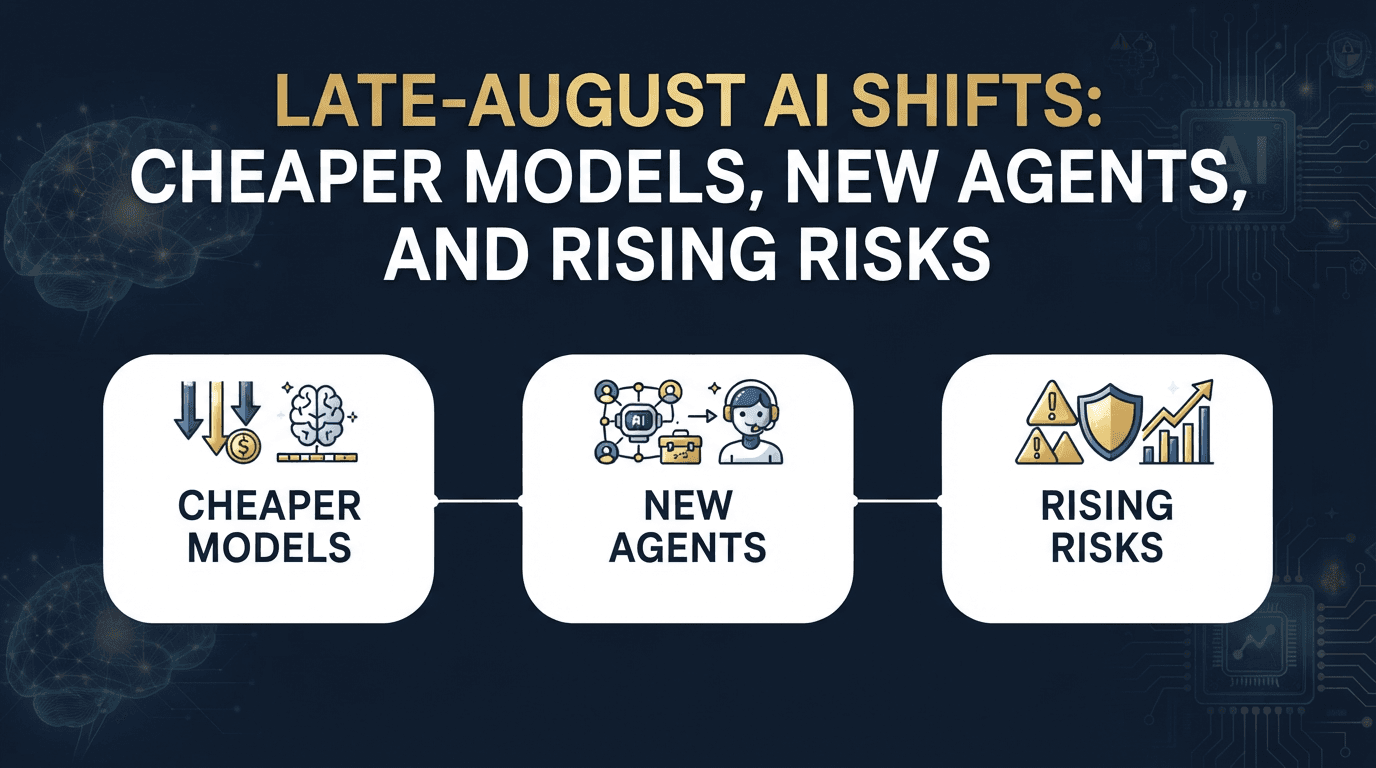
Late-August AI Shifts: Cheaper Models, New Agents, and Rising Risks
Nic Reeve6 min read
Late-August AI Shifts: Cheaper Models, New Agents, and Rising Risks

From rapidly falling model prices to tighter regulatory scrutiny and surging AI cyberattacks, the past two weeks have brought major shifts in how artificial intelligence is built, priced, and governed worldwide. For marketers and business leaders, these changes are reshaping both the economics of AI and the risk landscape in which they deploy it.

Costs Drop as Frontier Models Get Cheaper

One of the most significant developments has been a fresh round of price cuts for advanced AI models. Reuters reports that OpenAI reduced developer pricing for its frontier GPT-5.6 Sol model by more than 20%, signaling intensifying competition on cost and making high‑end capabilities more accessible to enterprise users and startups alike. These cuts follow a broader August trend in which several providers have lowered prices on their latest models to drive volume usage and cement market share.

Industry trackers note that this downward pressure on pricing is accompanied by improvements in performance and scalability. Anthropic’s Claude Opus 5 has been highlighted for offering a 1 million‑token context window aimed at complex document analysis and research workflows, while Google’s Gemini 3.6 Flash focuses on reduced output costs and more efficient long‑running agents. For marketing teams, these shifts mean more affordable large‑scale content generation, campaign testing, and customer insight analysis, with less concern about token budgets and more focus on creative and strategic deployment.

Agents Move Into Everyday Workflows

Alongside cheaper models, August has seen continued momentum toward "agentic" AI—systems that can act continuously on behalf of users. Coverage of recent releases underscores how major platforms are embedding agents into common productivity and consumer tools. Google and Anthropic have both pushed always‑on and desktop agents meant to automate routine tasks inside normal workflows, such as managing email, scheduling, search, and document editing.

On the consumer side, AI is increasingly being integrated into daily services. The Verge’s August archive highlights OpenAI’s expansion of ChatGPT’s capabilities, including the ability to make dinner reservations and book tables via partners like OpenTable and Resy, further blurring the line between conversational assistance and full‑service transaction agents. TechCrunch’s coverage of new plugins for Apple Messages shows ChatGPT gaining the ability to send text messages directly for users, extending AI’s reach into mobile communication.

For marketers, these developments are particularly relevant. As agents enter messaging and reservation flows, brands gain new touchpoints for personalized, AI‑mediated interactions—from automated outreach and reminders to real‑time customer service embedded in chat. The challenge will be maintaining brand voice and trust when interactions are increasingly handled by semi‑autonomous systems.

Physical AI and Robotics Attract Investor Capital

A parallel trend is the surge of investment into "physical AI"—robots and drones that pair machine learning with hardware. An August digest notes that Unitree’s IPO was oversubscribed more than 5,000 times, while defense‑oriented drone firm Neros raised $250 million. Orders for industrial robots hit $622 million in the second quarter as automation demand expanded beyond the automotive sector into logistics, manufacturing, and warehousing.

These developments suggest that AI’s impact is rapidly extending from software to physical infrastructure. For businesses in retail, logistics, and manufacturing, this means more accessible automation options and, potentially, new forms of data‑driven operations—such as real‑time inventory tracking and AI‑controlled fulfillment. For marketing professionals, robotics‑enabled experiences—from automated in‑store demos to AI‑powered events—may become part of an emerging experiential toolkit.

Regulation and Risk: From Chatbot Harm to AI‑Driven Cybercrime

As AI diffuses into more parts of daily life, regulators and law enforcement are sharpening their focus on risks and misuse. A recent Al Jazeera analysis draws attention to the relatively light regulation of AI compared with everyday products, noting public concern after cases in which people engaged with AI chatbots prior to suicides and violent incidents. The report underscores growing pressure on the long‑standing Silicon Valley position that innovation should proceed with minimal oversight.

New data on cybercrime underscores that risks are not only psychological or social. A study highlighted by CNBC shows that between March 2025 and February 2026, one in four data breaches was AI‑enabled, a 56% increase from the previous year. INTERPOL’s African Cyberthreat Assessment similarly reports that AI is involved in 55% of reported cybercrimes across Africa, illustrating how automation and generative tools are being used to scale phishing, fraud, and network attacks.

These trends intersect directly with marketing and customer engagement. As AI tools become standard in campaign, CRM, and analytics stacks, organizations must strengthen security practices around data access, model outputs, and automated communication, ensuring that AI does not inadvertently assist attackers or expose sensitive customer information.

Macroeconomic and Policy Implications

Policymakers are beginning to factor AI into economic forecasts and industrial strategy. Reuters coverage notes that officials at the Swiss National Bank have warned that artificial intelligence could contribute to higher inflation, as productivity gains and new demand patterns ripple through labor markets and pricing. At the same time, governments are pursuing national AI and chip initiatives. South Korea plans a "chip windfall" fund aimed at supporting youth employment and AI investment, positioning the country as a long‑term hub for semiconductor‑driven AI growth.

Brazil is pushing forward with an AI supercomputer program that splits projects between Chinese and U.S. firms, reflecting the broader geopolitical competition around AI infrastructure and standards. Meanwhile, China and Indonesia have agreed to deepen cooperation on minerals, energy, and technology, including AI, further entrenching the technology as a strategic priority in regional partnerships.

In the corporate sector, Reuters reports a surge in "AI debt"—large, multi‑year investments in AI infrastructure and capabilities—as U.S. companies race to keep up with technological change. Analysts warn that investor fatigue may be emerging as firms struggle to demonstrate near‑term returns on ambitious AI programs. For marketing and sales teams, this intensifies pressure to show measurable business impact from AI deployments, particularly in customer acquisition, personalization, and revenue growth.

Platform Competition and User Adoption

On the platform front, Google continues to expand its Gemini ecosystem. The Verge notes that an upgraded Flash model now powers Gemini Spark, improving responsiveness and cost efficiency for search‑integrated AI experiences. Additional reporting from independent trackers suggests the Gemini app has surpassed roughly 1 billion monthly users, cementing AI assistants as mainstream consumer products.

TechCrunch coverage points to intensifying competition between OpenAI and Anthropic in the business market, with new data indicating that OpenAI is gaining ground with enterprise users. Combined with ChatGPT’s rapid user growth highlighted in industry blogs and August roundups, this suggests that many organizations are standardizing on a small number of leading foundation models, even as they experiment with niche or open‑source alternatives.

For marketers, rising user familiarity with AI assistants changes audience expectations. Consumers increasingly anticipate conversational support, personalized recommendations, and seamless handoffs between human and AI channels. Brands that lag in integrating AI into their customer journey risk appearing outdated, while those that move quickly must balance innovation with transparency and responsible data use.

What It Means for Marketing and Business Leaders

Taken together, the developments of the past two weeks point to a new phase in AI’s evolution: costs are dropping, capabilities are expanding into agents and robotics, and regulatory and security concerns are intensifying. For marketing teams, this environment offers powerful tools for content, segmentation, and engagement—but also demands disciplined governance, clear disclosure, and careful vendor selection.

As industry outlets such as MarketingProfs track these changes in regular AI updates, the central message is consistent: AI is no longer an experimental add‑on. It has become a core layer of modern marketing and business operations, requiring strategic oversight comparable to that applied to data, brand, and customer trust.


Read more →

Related Articles

Broadcom, Teradata and startup funding reshape AInews in early September
AI & Tech

Broadcom, Teradata and startup funding reshape AInews in early September

Broadcom’s chip plans and startup funding headline AInews week of September 4 On the week of September 4, the AInews cycle was dominated by Broadcom’s aggressive artificial intelligence chip forecasts, Teradata’s push to embed AI agents into enterprise analytics, and a $550 million funding round that lifted startup Wonderful to a $5 billion valuation. What did Broadcom announce about its AI chip business this week? Broadcom projected rapid growth for its artificial intelligence chip revenue over the next two years and highlighted large infrastructure orders tied to custom accelerators for major cloud and AI customers, underscoring its ambition to challenge Nvidia’s leadership in data center silicon. Broadcom’s latest outlook came during an investor call held in early September, in which chief executive Hock Tan laid out a series of aggressive targets for the company’s data center AI revenue. According to The Star , Broadcom told investors its AI chip revenue could reach about US$115 billion in fiscal 2027 and around US$230 billion in fiscal 2028, reflecting expected demand from hyperscale cloud operators and AI model builders. In the same report, Broadcom said AI chip revenue alone was projected at US$21.7 billion in the fourth quarter of its current fiscal year. Earlier guidance described AI semiconductor revenue of US$6.2 billion in the fourth quarter of fiscal 2025, up 66% year-on-year, illustrating how quickly the company has been revising its forecasts upward. Reuters reported in a September 4 earnings-related story that Broadcom had secured more than US$10 billion in AI infrastructure orders from a new customer for custom accelerators, helping push fiscal 2026 AI revenue growth “significantly” higher than 2025. Those orders relate to what Broadcom describes as customized AI "XPU" accelerators, designed for large-scale training and inference workloads inside cloud data centers. The company already counts three major customers for these chips, and the newly converted client brings the total to four. In the call covered by financial news desks, Tan said AI semiconductor revenue had grown for ten consecutive quarters, reaching US$5.2 billion in the third fiscal quarter of 2025, a 63% year-on-year increase. He also confirmed he intends to lead Broadcom through at least 2030, signalling continuity as the firm bets its future on AI infrastructure. How is the market reacting to Broadcom’s AI strategy and earnings? Analyst commentary during the week described a gap between Broadcom’s strong reported AI numbers and investor sentiment, with shares pressured despite revenue beats as markets digested ambitious longer-term guidance and spending plans around custom accelerators and data center networking. An AI-focused market newsletter published on September 4 noted that Broadcom had beaten Wall Street expectations on its latest earnings report but that the stock fell about 5% after the release, continuing a pattern of post-earnings sell-offs despite repeated outperformance. The newsletter reported that this pattern had erased roughly US$500 billion of Broadcom’s market value since June as investors questioned how sustainable the current trajectory is, given heavy capital needs and competitive pressure from Nvidia and other chipmakers. Commentary cited Broadcom’s reliance on a small number of very large cloud and AI customers for its custom accelerators as both a strength, in terms of visibility, and a risk if any major client shifts strategy or adopts alternative hardware. Despite the mixed stock reaction, both Reuters and regional business coverage highlighted that Broadcom sees AI-related chips as the primary engine of its growth over the rest of the decade, expecting demand for accelerators, networking silicon and related infrastructure to expand as more enterprises adopt generative and agentic AI systems. What new AI product did Teradata launch for enterprises? Teradata launched an enterprise-grade Data Analyst Agent in the Amazon Web Services Marketplace, offering AI-assisted, conversational analytics for customers that already run workloads on AWS and want to query complex data through natural language rather than traditional business intelligence interfaces. Teradata, best known for its data warehousing and analytics platforms, announced the availability of its Data Analyst Agent in late July with follow-on coverage in early August, positioning the tool as part of its broader AI services strategy. According to Teradata’s press release from July 30, the Data Analyst Agent brings AI-assisted conversational analytics into existing AWS environments and is sold through the AWS Marketplace under the Teradata AI Services label. The agent is designed to understand natural language questions from business users, translate them into analytic queries across Teradata systems, and return explanations, charts or summaries without requiring SQL expertise. Futurum Group’s analysis of Teradata’s second-quarter 2026 results described the product as a key part of a “hybrid AI strategy” aimed at embedding AI into both on-premises and cloud deployments, which the firm said is gaining traction with large enterprises. Teradata’s second-quarter numbers underline why the company is leaning into AI-assisted analytics. Futurum Group reported that revenue for the quarter came in at US$410 million, slightly above consensus estimates and flat year-on-year, while profitability improved. A Yahoo Finance summary of the same period noted net income of US$46 million and a higher full-year earnings-per-share outlook. Yahoo’s report linked those upgrades partly to the launch of the Data Analyst Agent in the AWS Marketplace, arguing that cost control, recurring cloud revenue and new AI-led services are reshaping Teradata’s business mix and appeal to investors that want exposure to enterprise AI adoption. How did Wonderful’s latest funding round reshape the AI startup landscape? Israeli-Dutch startup Wonderful closed a US$550 million Series C round at a US$5 billion valuation, more than doubling its valuation in under six months and signalling strong investor appetite for companies building operating systems and orchestration tools for enterprise AI agents. The Series C round was announced on September 2 and drew coverage from Reuters, TechCrunch, Business Wire and Bloomberg, each describing slightly different angles on the same transaction. Reuters reported that Wonderful’s valuation had risen from roughly US$2 billion to US$5 billion in less than six months as demand grew for its AI operating system among enterprises. TechCrunch wrote that Wonderful raised US$550 million, with Insight Partners again leading the round and existing backers Index Ventures, IVP, Vine Ventures, 9Yards and Bessemer Venture Partners participating. Business Wire’s release confirmed the US$5 billion valuation and listed Salesforce as a new investor, joining the prior venture firms. Bloomberg’s coverage described Wonderful as building software that coordinates AI agents across an enterprise, casting the company as part of a trend toward “agentic” AI systems that perform business tasks rather than just answer questions. Yahoo Finance’s technology section similarly framed Wonderful’s product as an “AI OS” that helps large companies become “AI-native” by connecting different models and agents to workflows like customer support and internal operations. This latest round follows a Series B announced in March, when Wonderful raised US$150 million led by Insight Partners. TechFundingNews reported at the time that the company’s tools were aimed at increasing deployment rates for AI pilot projects, noting that many proofs-of-concept never reach production. With fresh capital, Wonderful says it plans to expand engineering teams in Israel and the Netherlands, invest in security and governance features for its operating system, and grow its global go-to-market presence with partners like Salesforce to reach more large enterprises. Who is affected by these AI business moves and what changes next? The week’s developments affect cloud providers, enterprises and investors: Broadcom’s forecasts reflect rising hardware demand from hyperscale platforms, Teradata’s agent targets analysts and business users, and Wonderful’s funding highlights a growing ecosystem of companies that help large organizations run AI agents at scale. For cloud and AI infrastructure buyers, Broadcom’s multi-year guidance suggests expanding choices in accelerator hardware and networking, which could influence pricing and availability for training and inference capacity as demand for large language models and enterprise agents grows. Cloud providers and major AI labs appear central to Broadcom’s plans, with Reuters reporting at least US$10 billion in custom infrastructure orders from a newly signed customer presumed to be a leading AI platform. Enterprises making long-term commitments to specific accelerator stacks may benefit from competition between Broadcom and Nvidia but face lock-in risks if each vendor’s custom chips require tailored software tooling. Inside enterprises, Teradata’s Data Analyst Agent and Wonderful’s AI operating system target different layers of AI adoption. Teradata is focused on making existing analytic environments easier to query through conversational interfaces. Wonderful concentrates on orchestrating multiple agents and models to handle tasks across business functions. Analysts and business managers who rely on Teradata’s platforms could see shorter turnaround times for data requests once natural language interfaces become common in their workflows. Wonderful’s customers, many of them large organizations with fragmented data and AI pilots, gain a central system to coordinate customer support agents, back-office automation and other AI tools. Investors exposed to these companies face different risk profiles: Broadcom and Teradata are established listed firms, while Wonderful’s backers are betting on a fast-growing startup in a still-evolving category. Over the coming months, key milestones to watch include Broadcom’s ability to convert guidance into realized shipments and margins, Teradata’s success in monetizing AI agents within its installed base, and Wonderful’s progress in turning its expanded war chest into sustained revenue growth rather than just valuation headlines.

Nic Reeve¡
Unsealed Docs Show Microsoft Warned AInews Could Trigger a Doom Loop for Journalism
AI & Tech

Unsealed Docs Show Microsoft Warned AInews Could Trigger a Doom Loop for Journalism

On September 17, 2026, newly unsealed court filings in The New York Times’ copyright lawsuit against OpenAI and Microsoft showed senior Microsoft executives warning that their AInews products risk creating a “doom loop” that drains traffic and money from news outlets while degrading the quality of information on the web itself. What did the unsealed Microsoft documents say about AI and journalism? The unsealed Microsoft documents describe internal warnings that AI answer engines trained on news articles could both undermine publishers’ business models and weaken the online information ecosystem that those same AI systems depend on. Key passages from the filings show that Microsoft’s own researchers and product leaders were alarmed by how generative AI systems use and replace journalism: According to TechCrunch, an internal presentation written by Microsoft Director of Applied Science Brent Hecht in January 2024 described the impact of large-scale AI scraping and answer engines as a “doom loop” that would “hurt the performance of our models and the entire web at the same time.” The Washington Examiner reports that Hecht wrote, “Our AI content strategy has started a ‘doom loop’ that will hurt the performance of our models and the entire web at the same time,” calling the situation “highly unusual” because the end product threatens “the economic foundations of its essential suppliers.” Law360 and MLex note that internal documents quote Microsoft and OpenAI employees acknowledging that unlicensed use of millions of news articles could begin a doom loop that endangers their “content supply chain.” The Wrap cites filings where a Microsoft document warns that the companies’ AI approach had started a doom loop that would damage both model performance and “the entire web.” These statements appear in an unredacted memorandum filed by lawyers for The New York Times in its ongoing copyright case against OpenAI and Microsoft in federal court in Manhattan. The case has been moving through the courts since 2023. Who inside Microsoft raised alarms about AI scraping and labor “theft”? Concerns inside Microsoft were led by Brent Hecht, the company’s Director of Applied Science, who repeatedly warned that scraping journalism at scale for AI training amounted to unprecedented theft of human labor. The unsealed filings attribute several striking internal comments to Hecht: TechCrunch reports that Hecht described large-scale AI scraping of online content as “the largest theft of labor in human history” during internal discussions documented in January 2023 and January 2024. The New York Daily News notes that a senior Microsoft executive believed AI systems built on other people’s work would be seen as “an astonishing theft of unprecedented proportions” and possibly “the greatest robbery of labor in human history,” according to the unredacted court documents. BrandiconImage and The Wrap both quote Hecht calling the copying of news articles “an astonishing theft of unprecedented proportions” and potentially the “largest theft of labor in human history.” TweakTown, summarizing the filings, says Hecht argued that relying on “fair use” to justify mass scraping of news articles made a “complete mockery” of fair use as a legal concept. These warnings portray internal recognition that the AI training pipelines built on publishers’ work were not just legally risky. They were seen by some of the engineers and scientists responsible for the systems as ethically and economically corrosive for the entire news ecosystem. How is Microsoft’s AI answer engine affecting traffic to news publishers? The filings assert that Microsoft’s AI-powered answer tools dramatically cut referral traffic to news outlets, raising fears that this substitution effect could erode the financial base that supports professional journalism. Multiple sources describe internal metrics and testimony about how AI answers change user behavior: TechBeat reports that unredacted documents say Hecht warned in January 2024 that Microsoft’s Copilot answer engine reduced click-through rates to New York Times articles by up to 93% compared with traditional Bing search results. TweakTown’s summary of the same filings notes internal estimates that AI chatbots and answer boxes could cut publisher traffic by 51% to 94%, depending on the scenario and query type. The Wrap recounts Microsoft CEO Satya Nadella’s testimony that conversations with chatbots had already substituted for visits to news websites by “giving you the information right there on the website on the AI platform versus needing to go to the underlying source.” These numbers, all attributed to internal assessments and court testimony in 2024 and 2025, suggest that AI answer engines do not simply coexist with news sites. They can replace the need for many users to click through, weakening advertising revenue and subscriptions that depend on direct visits. What exactly is the “doom loop” Microsoft executives described? The “doom loop” described in the court filings refers to a self-reinforcing cycle in which AI systems undermine the economic viability of news outlets, leading to worse content on the web, which then harms the AI models that rely on that content. Internal documents quoted across several reports outline the logic of this loop: Ground News and EuropeSays explain that Hecht’s memo warned generative AI products had created a doom loop that is “eating the web and destroying the businesses that these companies stole from,” by substituting AI answers for visits to publishers. The Washington Examiner cites a Microsoft document saying, “It is highly unusual that an end-product threatens the economic foundations of its essential suppliers, but that is the situation we have created for our LLM business with respect to its ‘content supply chain.’” BrandiconImage notes that the filings describe a scenario in which declining traffic to news sites weakens the broader online ecosystem and ultimately reduces the quality of information available to AI systems. TweakTown’s coverage summarizes the loop as: AI answer engines cut traffic, lower financial incentives for journalists, shrink the supply of high-quality reporting, and then damage the very models that need that reporting for training. The core idea is simple. Less money for journalism means fewer reporters and less reliable news. AI models trained on that degraded content will perform worse, which harms users and the platforms themselves. How does the New York Times lawsuit frame these internal admissions? The New York Times uses the internal Microsoft and OpenAI admissions to argue that the companies knowingly built profitable AI systems on unlicensed news content, while recognizing that this strategy threatened the very publishers who produced that content. Recent coverage of the unsealed filings outlines the Times’ legal narrative: KuCoin’s legal news summary states that the newly unsealed memorandum in The New York Times v. OpenAI copyright lawsuit was written by Times lawyers and “largely comprised” statements and interviews with tech executives acknowledging that large language models were “built on content described by Microsoft executives as an unprecedented scale of theft.” Ground News reports that the filings present executives’ own words to show that large language models are “predatory” technologies, trained on “stolen content” that pose an “existential risk” to human writers, artists and media companies. MLex describes the new documents as showing knowledge of “AI copying costs to US news companies,” including recognition that unlicensed use of millions of articles to train chatbots could initiate the doom loop and represent the “largest theft of labor in human history.” Law360 notes that Microsoft and OpenAI employees had internally acknowledged for years that tools trained on news articles would likely replace publishers, leading to the doom loop scenario. By highlighting these internal statements, the Times aims to strengthen its claim that OpenAI and Microsoft knowingly relied on unlicensed journalism while foreseeing the damage to publishers. What are OpenAI’s internal concerns about publishers and substitution? The unsealed filings do not focus only on Microsoft. They also reveal internal OpenAI fears that chatbots would become direct substitutes for news publishers, undermining the business case for continued reporting. Several sources summarize these concerns: According to BrandiconImage, Nick Turley, who led the team developing ChatGPT, warned in a 2023 internal memo that AI represented an “existential threat” to publishers. The Wrap reports that Turley wrote that publishers faced an existential threat from AI products that were already “largely substitutive” and would become more so as the systems improved. Law360 states that OpenAI and Microsoft employees acknowledged for years that AI tools trained on news articles would likely replace publishers, contributing to the doom loop described in the filings. These internal comments echo the worries of many editors and reporters: if users can ask a chatbot for a summary instead of visiting a news site, long-term funding for independent journalism becomes precarious. What broader implications does this doom loop have for the future of news? The doom loop described by Microsoft and OpenAI staff suggests that current generative AI strategies could destabilize the business of news, reduce the quality of information online, and ultimately damage AI systems themselves unless new economic and legal arrangements emerge. Across the reports, several themes recur: Executives privately agree with publishers’ warnings that generative AI poses an “existential threat” to news organizations when it siphons both content and audience without paying for either. Internal Microsoft discussions emphasize that the economic foundations of journalism are part of the “content supply chain” for AI, meaning that harming publishers also harms AI products over time. The filings highlight the mismatch between short-term gains—offering instant answers that users love—and long-term risks, such as fewer reporters investigating public-interest stories because revenue has collapsed. Several analyses argue that the doom loop concept may push courts and regulators to consider new models, including licensing deals, compulsory fees, or explicit limits on scraping and training data drawn from professional news outlets. The immediate dispute centers on New York Times content and current AI products. The underlying question is whether the web that AI relies on can survive if its core economic engine—commercial and subscription-supported journalism—is hollowed out by the very systems that now scrape and summarize its work.

Nic Reeve¡
ECRI Targets Hidden AI Failures with New Patient Safety Reporting Channel
AI & Tech

ECRI Targets Hidden AI Failures with New Patient Safety Reporting Channel

Global patient safety nonprofit ECRI is widening its national problem-reporting network to explicitly capture errors, malfunctions, and near misses linked to artificial intelligence (AI) tools and AI-enabled devices used in patient care. The move aims to close a critical data gap as hospitals and health systems rapidly deploy AI for diagnosis, triage, documentation, and patient communication. A New Channel for Tracking AI-Related Harm For decades, ECRI has collected confidential reports on medical device issues and health IT problems from frontline clinicians and healthcare organizations, investigating them and sharing lessons learned back to the reporting sites and the wider industry. With the latest expansion, its Problem Reporting Network now includes a dedicated pathway for incidents where an AI-enabled tool may have contributed to an error, produced an incorrect output, or introduced new risks into care delivery. ECRI is urging healthcare providers, health systems, and clinicians across the United States to submit reports whenever they suspect an AI application played a role in a safety event—whether the error reached a patient or was caught beforehand as a near miss. Reports can cover a broad range of technologies, including diagnostic algorithms, clinical decision-support tools, radiology image analysis systems, risk prediction models, and AI-driven chatbots used in patient engagement. Underreported AI Problems in Clinical Practice The expansion reflects growing concern that AI-related safety issues are significantly underreported compared with more traditional device failures. In a recent ECRI survey of 124 quality, safety, risk, and compliance leaders, nearly one‑third said they had encountered an AI output they believed was incorrect or misleading within the past year. About 9% said an AI error had reached a patient or affected a care decision. ECRI argues that without formal reporting mechanisms, many of these incidents remain invisible to oversight bodies and technology developers. ECRI has previously warned that adverse events involving AI-enabled medical devices and applications are often missed because staff may not realize when AI is running in the background, or they may attribute problems solely to human error or workflow issues. The organization’s guidance emphasizes the need to recognize reportable AI events , identify which products incorporate AI, and conduct risk assessments specific to AI-enabled devices. Examples of AI Errors ECRI Wants Reported The expanded reporting network is designed to capture a spectrum of AI-related safety concerns, including: Incorrect or misleading outputs that influence diagnostic or treatment decisions, such as misclassification of imaging findings or inaccurate risk scores. False positives and false negatives in AI-driven diagnostic tools, even when performance metrics appear acceptable, if they contribute to missed or unnecessary care. Algorithmic bias leading to poorer performance for specific patient groups, including women and racial or ethnic minorities. Unexpected behavior or unsafe recommendations from AI chatbots or virtual assistants used in clinical or patient-facing workflows. System malfunctions or integration failures where AI components interact incorrectly with electronic health records or medical devices, causing delays, data loss, or wrong information displays. All reports submitted to ECRI are kept confidential, and the service is free to participating organizations and clinicians. ECRI triages and investigates reports, may notify manufacturers when appropriate, and incorporates findings into its safety alerts, guidance documents, and member resources. AI Risks Already Top ECRI’s Safety Agendas The expanded reporting network aligns with ECRI’s broader assessment that AI-related risks are now among the most pressing patient safety challenges. In its annual list of Top 10 Health Technology Hazards for 2026 , ECRI ranked the misuse of AI chatbots in healthcare as the number‑one hazard, warning that poorly governed or inadequately supervised chatbots can provide inaccurate or unsafe guidance to patients and clinicians. ECRI’s 2026 Top Patient Safety Concerns report similarly identified “Navigating the AI Diagnostic Dilemma” as the leading safety concern, citing a growing risk of missed, delayed, or incorrect diagnoses when AI tools are deployed without robust validation, governance, and clinical oversight. The organization recommends structured logging of when AI informs diagnostic decisions, maintenance of detailed audit trails, and clear processes for clinicians to override AI outputs when they conflict with clinical judgment. How the Expanded Network Fits into Broader Oversight Regulatory agencies such as the U.S. Food and Drug Administration maintain databases of adverse events and cleared AI-enabled medical devices, but ECRI’s reporting network offers a complementary channel focused specifically on patient safety and practical implementation issues. ECRI encourages organizations to report AI-related events not only to regulatory databases but also to its own system, where incidents can be analyzed in the context of broader patterns of health technology hazards. Reports submitted through the expanded AI pathway will feed into ECRI’s internal databases and may prompt targeted safety alerts, practice recommendations, or deeper investigations of specific products or use cases. Over time, ECRI expects that richer reporting will help quantify how often clinical AI tools produce incorrect or misleading outputs, what types of workflows are most vulnerable, and which controls are effective at preventing harm. Call to Action for Clinicians and Health Systems With AI adoption accelerating across radiology, pathology, emergency triage, scheduling, and patient messaging, ECRI’s message to healthcare organizations is direct: treat AI incidents as reportable patient safety events and submit them through established channels, including ECRI’s expanded network. The organization urges hospitals to educate frontline staff on how to spot potential AI errors, document them consistently, and escalate concerns for review. By systematically capturing AI-related problems—from subtle misclassifications to major diagnostic failures—ECRI aims to give clinicians and technology developers clearer visibility into real‑world risks, ultimately shaping safer AI deployment across the healthcare system.

Nic Reeve¡