allnewscastallnewscast
Breaking News
AI & Tech

Mistral’s Agentic Search Aims to Redefine Enterprise AI Retrieval
Nic Reeve6 min read
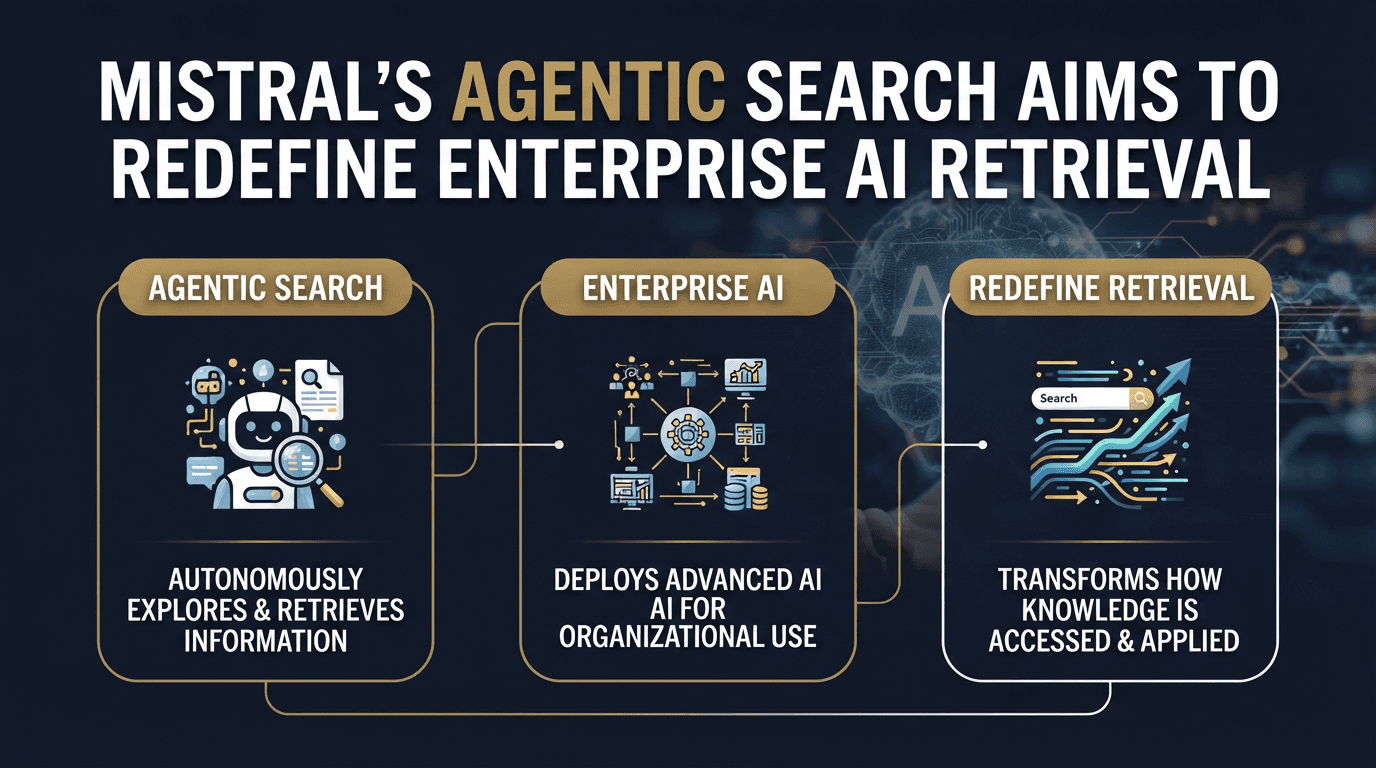
Mistral’s Agentic Search Aims to Redefine Enterprise AI Retrieval

A New Retrieval Layer for Enterprise-Grade AI

Mistral AI has introduced Agentic Search, a new retrieval layer designed to make AI systems markedly more accurate and efficient when working over complex enterprise data. The feature sits between large language models (LLMs) and an organization’s existing indexes, allowing models to actively search, open, navigate and verify information inside lengthy and heterogeneous documents rather than relying on a single retrieval pass.

Unlike conventional retrieval‑augmented generation (RAG), which typically performs one vector or keyword lookup and feeds the top chunks into a model, Agentic Search orchestrates a multi‑step search loop. The model can iteratively refine queries, inspect multiple sources, and gather corroborating evidence before producing an answer, a workflow aimed squarely at the hard cases of enterprise question answering across filings, contracts, scanned PDFs and other long‑form content.

How Agentic Search Works

At the core of Mistral’s approach is a set of file‑style tools that the model can call autonomously during a session. Public documentation describes five primary capabilities exposed to the model:

  • search – find relevant documents across an existing index or corpus.
  • open – select and open a specific document returned by search.
  • navigate – move to a particular page, section or region within the open document.
  • read – retrieve the content at the current location for inspection.
  • grep – search within the open document for exact strings or patterns.

Together, these tools enable a model to behave more like an analyst than a passive text generator. When the first retrieved chunk does not contain the answer, the model can issue a new search, open a more promising file, jump to likely sections based on headings or page numbers, and then scan for precise terminology using in‑document search, all before finalizing its response. Already‑inspected chunks can be excluded, reducing redundancy and cost.

This approach is especially important for questions that require cross‑document reasoning or precise citation of clauses buried deep within long documents. Instead of hoping that chunking and ranking surface the right passages on the first attempt, Agentic Search allows the model to keep looking until it has collected enough evidence.

Benchmark Results: From One‑Shot RAG to Iterative Evidence Gathering

Mistral is positioning Agentic Search as a measurable improvement over traditional RAG pipelines, backing the launch with benchmark data on datasets such as FinanceBench and OfficeQA Pro. According to the company’s published figures, running the full agentic loop – including both iterative search and document navigation – drove a dramatic jump in accuracy on FinanceBench compared with single‑shot RAG.

Public reports summarizing Mistral’s results highlight accuracy gains from roughly the high‑20% range to the mid‑80% range for certain models when moving from one‑shot retrieval to Agentic Search. Iterative search alone contributed the majority of the improvement, with navigation and in‑document tools accounting for several additional percentage points. In other words, allowing the model to keep searching and then move intelligently within documents can more than triple its ability to answer complex financial questions correctly.

The company also reports significant efficiency gains. By avoiding repeated retrieval of the same or irrelevant chunks and focusing only on promising portions of documents, Agentic Search reduces token usage and latency compared with a naive search‑only loop. Mistral’s internal tests indicate reductions in token consumption of around a quarter to a third for evaluated models, alongside double‑digit percentage cuts in tail latency on FinanceBench queries.

On the OfficeQA Pro benchmark, which targets questions about office productivity and business documents, the multi‑step navigation stack similarly lowered token usage and improved responsiveness. These metrics are critical for enterprises deploying AI at scale, where every marginal improvement in latency and token cost can translate into substantial infrastructure savings.

Built Into Mistral’s Search Toolkit, Studio and Vibe

Agentic Search is being shipped as part of the broader Mistral Search Toolkit, a composable framework for building production‑grade search pipelines for AI applications. The toolkit is designed to run in diverse environments, from public cloud to on‑premises infrastructure, giving organizations flexibility over where their data and compute reside.

For developers, Agentic Search is exposed through an SDK that can be integrated into custom agents, workflows and end‑user applications. The company emphasizes that it wraps around existing indexes rather than requiring new fine‑tuning of models or wholesale changes to data infrastructure. Teams can plug the agentic layer into their current search stack and let it handle the multi‑turn retrieval logic.

For users of Mistral’s own products, the feature comes pre‑integrated into the Libraries capability within both the Studio interface and the Vibe agent. That means customers who store their knowledge bases in Libraries can benefit from the multi‑step retrieval loop without writing any additional code; the system automatically allows the model to search, open, navigate and read within the indexed content as it answers questions or executes tasks.

Agentic Search also aligns with Mistral’s broader strategy around agentic AI. The company has previously rolled out an Agents API with web search connectors and continues to expand tools like Vibe for long‑horizon coding and research tasks. In this context, Agentic Search marks a focused push into enterprise knowledge search, complementing those agent capabilities with deeper document‑level understanding.

Target Use Cases: From Filings to Contracts

Mistral is explicitly targeting organizations with large, complex and often messy corpora. Typical examples include regulatory filings, annual reports, internal policy manuals, technical documentation, legal contracts and scanned PDFs produced by legacy workflows. These documents tend to be long, inconsistently formatted, and heavy on domain‑specific language – a challenging environment for standard chunk‑based RAG.

In these scenarios, a user might ask, for example, about how a particular risk is disclosed across several years of a company’s filings, or which clause in a contract governs a specific edge case. Agentic Search allows the model to conduct a multi‑hop investigation: search across the corpus, open the most relevant documents, jump to sections that mention the relevant risk or clause, and cross‑check multiple sources before responding with a grounded, cited answer.

Industry observers note that the approach is distinct from consumer‑oriented web search. Rather than crawling the open internet, Agentic Search is focused on private, high‑value enterprise data where precision and verifiability are more important than breadth. The trade‑off is that the agentic loop can take longer – sometimes running for minutes on especially hard questions – but the resulting accuracy and auditability are intended to justify the added compute.

Competitive and Strategic Implications

The launch of Agentic Search underscores a broader shift in the AI industry toward agentic retrieval, where models are given toolkits and autonomy to orchestrate their own information‑gathering processes. By releasing a production‑ready framework and integrating it into its flagship products, Mistral is positioning itself as a serious contender in enterprise AI, not only on the strength of its base models but also through specialized infrastructure for knowledge‑intensive workloads.

For enterprises, the technology offers a path to move beyond proof‑of‑concept chatbots and into applications where AI systems must routinely answer difficult, regulated or high‑stakes questions. If the reported benchmark gains generalize in real deployments, Agentic Search could enable more reliable AI copilots for finance, legal, compliance and operations teams, while also easing concerns about hallucinations and incomplete retrieval.

As organizations continue to evaluate vendors on both model quality and retrieval performance, Mistral’s agentic layer may become a key differentiator – especially for customers who want the option to run search pipelines on‑premises while still tapping into state‑of‑the‑art agent capabilities.
Read more

Related Articles

Adecco’s Agentforce Coworker rollout puts AInews focus on global staffing operations
AI & Tech

Adecco’s Agentforce Coworker rollout puts AInews focus on global staffing operations

Adecco’s global Agentforce Coworker rollout puts AInews spotlight on everyday staffing work On 15 September 2026, the Adecco Group announced a global rollout of Salesforce’s Agentforce Coworker to 27,000 employees in more than 40 countries, a move that thrusts AInews into the centre of everyday sales and recruitment work at one of the world’s largest staffing firms. What exactly is Adecco deploying and where is it going live? Adecco Group is turning on Salesforce’s Agentforce Coworker, described by Salesforce as an enterprise “AI teammate”, inside its core customer and candidate management platforms for staff across 40-plus countries, after pilots in the United Kingdom and France proved successful. The deployment covers Adecco Group operations worldwide, including: More than 40 national markets across Europe, the Americas and Asia-Pacific, according to Adecco’s press materials. 27,000 employees in sales, recruitment and client-facing roles now granted access to the AI coworker in their daily workflows. Rollout date of 15 September 2026, announced from Zurich, Switzerland. An earlier pilot restricted to teams in the UK and France that began after April 2025. The tool runs directly inside Salesforce’s cloud platform and uses Anthropic’s Claude model, rather than a separate AI app that employees would have to open in parallel. How will the Agentforce Coworker change daily work for Adecco’s staff? According to Adecco Group and Salesforce, Coworker will automate repetitive tasks, surface relevant data across fragmented systems and support recruiters and sales professionals with research, drafting and workflow orchestration, all inside the same screens they already use. Press materials describe a shift from scattered data toward a single AI-driven access point: The AI teammate can fetch information that previously sat across “dozens of tools”, giving staff one conversational interface to data, systems and organizational knowledge. Recruiters can ask the coworker to identify priority candidates, compile shortlists and trigger pre‑screening or onboarding steps for selected profiles. Sales staff can request prospect lists, generate tailored sales briefs, enrich contact records and check lead status across teams without switching contexts. Client and candidate engagement workflows are supported through suggested messages, summaries of interaction history and next‑best‑action prompts. This means routine searches and manual copy‑and‑paste tasks may now be delegated to the AI coworker, while employees focus more on judgment calls and human conversations with clients and candidates. What data and AI technology are behind Adecco’s new coworker? Agentforce Coworker at Adecco combines Salesforce’s platform data with Anthropic’s Claude foundation model, drawing on millions of historic interactions between Adecco’s agents and candidates to provide context-aware suggestions. The technical and data backbone includes: Anthropic’s Claude model, identified as the large language model powering the Agentforce Coworker inside Salesforce’s enterprise stack. Context from more than 2.5 million agent‑candidate interactions recorded since April 2025, which Adecco states the coworker can use to recognize patterns and tailor responses. Integration with Adecco’s existing Salesforce deployments, meaning the AI accesses CRM, recruitment and engagement data already stored there. Agentic AI infrastructure, a term Adecco uses to describe AI components that can not only answer queries but also trigger workflow steps and orchestrate processes. By embedding the AI directly into the platform stack rather than as a bolt‑on chatbot, Adecco aims to keep sensitive data within its existing security and compliance controls. How did the UK and France pilots shape the global roll out? Adecco tested Agentforce Coworker with teams in the United Kingdom and France before committing to a worldwide deployment, using the pilots to validate productivity gains and gather frontline feedback on AI support for recruitment and sales workflows. While Adecco has not published full pilot metrics, the company highlights several learnings: Agents in the pilot markets used Coworker to prepare client briefs and candidate summaries faster, based on internal interaction data and public information. Recruitment teams trialled automated pre‑screening flows, where the AI assembled candidate information and launched screening steps once staff approved. Feedback from UK and French users informed interface tweaks and safeguards to prevent over‑reliance on AI suggestions without human review. The positive pilot outcomes are cited in multiple reports as the trigger for Adecco’s decision to expand Coworker to more than 40 countries. Those pilots also gave Adecco a test bed for training staff, setting guidance on when to trust the AI and when to double‑check against primary records. Who inside Adecco will use the coworker, and what controls are in place? The rollout targets employees whose daily work runs through Salesforce: salespeople, recruiters, and teams responsible for client and candidate engagement. Adecco indicates that 27,000 staff fall into this category and are being onboarded to the AI coworker with role‑based access. Use of the AI teammate is structured around functions: Sales teams: finding and prioritising prospects, generating account briefs, enriching records and tracking opportunities. Recruitment teams: identifying candidate matches, compiling CV summaries, launching screening and coordinating onboarding sequences. Client and candidate engagement teams: drafting communications, summarising histories and identifying follow‑up tasks. Supervisory and compliance roles: monitoring AI outputs, reviewing logs and updating policies as the system learns. Adecco’s communications emphasise that the AI acts as a teammate, not a replacement, and that humans retain responsibility for hiring decisions and client commitments. What does Adecco say about ethics, privacy and the impact on jobs? Formal statements around the rollout focus on productivity and service quality and present the AI coworker as a support tool. Adecco and Salesforce materials stress that human judgment remains central and that the AI works within existing governance frameworks for data and privacy. Key points in the public messaging include: The system runs on data Adecco already holds in its Salesforce environment, with access governed by established role‑based permissions. AI suggestions, whether candidate matches or sales actions, are framed as recommendations that staff can accept, modify or reject. Statements describe the AI as a “teammate” or “coworker”, language intended to underline augmentation rather than replacement of human roles. The use of interaction histories since April 2025 is explicitly dated, making clear that historic numbers are not being presented as current volumes. Public releases do not detail algorithmic bias testing or specific safeguards, leaving open questions on how Adecco will audit outcomes across different candidate groups over time. How does this rollout fit into wider trends in staffing and enterprise AI? Adecco’s move to embed an AI teammate across tens of thousands of roles reflects a broader shift in staffing and HR technology, where generative and agentic AI tools are moving from experimental pilots to core operational infrastructure inside large employers. Recent industry reporting points to several related developments: Major recruitment and HR platforms are adopting large language models to draft job ads, screen resumes and recommend candidates, consolidating AI capabilities inside existing systems. Enterprises increasingly describe AI tools as coworkers or teammates, part of a narrative aimed at encouraging adoption without raising immediate fears of job loss. Agentic AI, where systems not only generate text but execute tasks like triggering workflows or updating records, is becoming a stated goal for business software vendors. Salesforce’s positioning of Agentforce as an embedded assistant aligns with moves by other cloud providers to weave generative AI into CRM and ERP interfaces rather than offering stand‑alone bots. By tying its rollout to a specific model and a clear interaction count since 2025, Adecco is also part of an emerging pattern in corporate AI announcements that emphasize dated figures and concrete scopes rather than vague claims of transformation. What happens next for Adecco’s AI coworker programme? After the global switch‑on, Adecco’s next steps will revolve around training, monitoring and iterative expansion of use cases for Coworker across its recruitment, sales and engagement operations, using feedback from the 27,000 employees now working with the AI day to day. Based on current reporting, likely developments include: Structured onboarding programmes to teach staff how to phrase queries, review outputs and escalate issues. Progressive rollout of new workflows, such as more automated onboarding journeys or deeper candidate matching, once initial adoption stabilises. Internal measurement of productivity metrics and client satisfaction scores to assess the AI’s contribution. Potential extension of AI teammate capabilities to adjacent functions beyond front‑line sales and recruitment as confidence grows. The scale of the deployment means that any gains or problems will be visible quickly, creating a real‑world test of how agentic AI reshapes staffing work when embedded across an entire global group.

Nic Reeve·
AInews Weekly: Education Gaps, Datacenter Surge and Rutgers Trust Study
AI & Tech

AInews Weekly: Education Gaps, Datacenter Surge and Rutgers Trust Study

AInews Weekly: Education Gaps, Datacenter Spending Spike, and New Public Trust Data During the week of September 11, 2026, AInews stories ranged from a sweeping DataCamp survey on classroom AI use to fresh IDC numbers on infrastructure spending and new Rutgers research on public trust in automated decision systems, showing how fast artificial intelligence is spreading while core skills and guardrails struggle to keep pace. What did DataCamp reveal about AI in classrooms in 2026? DataCamp’s new “AI in Education” report, released on September 10, 2026, found that student use of AI tools is now near universal, while fluency and critical-thinking safeguards lag behind. The study surveyed more than 150 teachers and 150 students, highlighting a sharp divide between everyday AI use and formal guidance. According to DataCamp’s 2026 AI in Education report, published via Business Wire and covered by the Las Vegas Sun, key findings include: Scope: More than 150 teachers and more than 150 students across different schools were surveyed about AI use and attitudes. Adoption: The report describes student AI adoption as effectively universal among respondents, meaning most students rely on AI tools in some form for schoolwork. Skills gap: DataCamp concludes that “massive gaps remain between AI adoption and fluency,” with many students using tools they do not fully understand. Critical thinking worries: Educators in the survey express concern that over‑reliance on AI may weaken students’ independent reasoning and writing skills. Policy uncertainty: Respondents report uneven or unclear school protocols for AI use, from plagiarism rules to allowed tools during assignments. DataCamp positions itself as an AI and data upskilling platform and says the report is meant to give educators a baseline for how the “first AI‑native class,” graduating in 2026, is actually using automation in its daily work. The company argues that structured training in topics such as AI ethics, data literacy, and prompt design is now a prerequisite for meaningful classroom use rather than an optional add‑on. Earlier in 2026, DataCamp pledged free AI training for one million teachers and students worldwide through its DataCamp Classrooms program, including courses in Python, SQL, Power BI and broader AI literacy. The September education report puts numbers and concern behind that pledge, framing it as a response to the specific gaps the survey identified. How is DataCamp expanding AI tools and content for professionals and organizations? DataCamp spent Q3 2026 pushing AI deeper into its corporate and professional learning products, from an expanded AI Tutor interface to AI Adoption Insights dashboards for team admins. The platform also rolled out new tracks tied to OpenAI models, Anthropic’s Claude, and LangChain‑based AI engineering training. In its Q3 2026 roadmap webinar, summarized on DataCamp’s site, the company reported major content and feature milestones across the first half of the year: New content: More than 120 new courses, 21 new learning tracks, and support for 13 languages added in the first half of 2026. AI Tutor expansion: DataCamp renamed its “AI Native” learning mode to **AI Tutor** and began integrating Anthropic’s Claude and Claude Cowork directly into that experience. Infrastructure: A DataCamp MCP server connects Claude to the platform, letting admins manage learning plans and pull reports through natural‑language prompts. Analytics: “AI Adoption Insights” in Group Hub show how teams use AI tools day to day and benchmark that usage against other organizations. Specialized tracks: New tracks focus on Claude fundamentals, Claude for software engineers, and token cost management for developers, along with courses for Microsoft Fabric, Power Platform, Polars, and Apache Airflow. Certifications: A Python Developer Associate certification is live, with AI for Business, AI Agent Fundamentals, and AI Leadership credentials scheduled to round out the AI fluency lineup. Earlier in the year, DataCamp also announced a partnership with LangChain to launch an “AI Engineering with LangChain” track, aimed at software developers who want to build production‑grade AI applications. That track is positioned as part of the broader move from basic prompt skills to full AI engineering, covering topics such as chaining tools, handling context windows, and monitoring model behavior. The new courses build on DataCamp’s coverage of frontier models, including blog analysis of OpenAI’s GPT‑6 “Astra” launch and comparison pieces that try to map when developers should choose newer OpenAI systems over competitors like Anthropic’s Claude Fable 5.1. Together with AI Tutor and LangChain tracks, these updates show DataCamp targeting both the education market and working engineers with more intensive AI workflows. What does IDC report about AI‑driven infrastructure and networking spending? IDC’s latest infrastructure research points to sharp growth in networking hardware as organizations build out AI data centers. The firm highlights a 43.4% year‑over‑year surge in the Ethernet switch market to $18.9 billion in the second quarter of 2026, driven largely by AI training and inference workloads. According to IDC’s August 2026 networking market blog post: Ethernet switch revenue rose 43.4% year over year in Q2 2026 to reach $18.9 billion, which IDC links directly to demand from AI datacenters. Most of this growth comes from high‑end switches deployed in hyperscale and large enterprise facilities running GPU‑dense AI clusters. IDC analysts argue that AI workloads are changing network design, pushing vendors toward higher port densities and new designs optimized for large‑scale parallel processing. The report suggests that spending on AI infrastructure is no longer experimental and is instead driving record‑level datacenter budgets across sectors. Alongside networking, IDC’s resource center has highlighted moves such as NVIDIA’s acquisition of Hugging Face as part of a broader trend toward enterprise adoption of open models, with vendors racing to package open‑source and proprietary AI systems into consumable platforms. These combined trends show the business side of AI evolving beyond model releases into large hardware purchases, mergers and acquisitions, and long‑term infrastructure planning. How is Rutgers working with AI in libraries, research, and public sentiment? Rutgers University spent early September 2026 pushing both practical AI guidance and new research on public attitudes. The institution launched workshops through Rutgers Libraries on navigating AI tools and supported a Tech Xplore‑reported survey showing discomfort when AI makes decisions about people rather than simply assisting them. Rutgers’ official IT site describes a growing university‑wide AI initiative, spanning healthcare, data science, and library services. Within that framework, Rutgers Libraries announced “Navigating AI” workshops on September 2, 2026, with goals that include: Teaching students and staff how to evaluate AI tools and outputs for reliability and bias. Explaining how generative models handle data, privacy, and attribution. Showing library users how to blend AI search or summarization tools with traditional academic research methods. On September 9, 2026, Tech Xplore reported new Rutgers‑linked survey research into American attitudes toward artificial intelligence. The article states that: Survey participants are broadly comfortable with AI when it works as a tool they control, such as autocorrect or recommendation engines. Comfort levels drop sharply when AI shifts from assistance to decision‑making about people, for example in credit scoring, hiring, or predictive policing. Respondents express concern about transparency and fairness when AI systems make high‑stakes choices, even if they value the efficiency gains. Rutgers’ Wireless Information Network Laboratory (WINLAB) is also using September to host back‑to‑back technical workshops focused on advanced networking testbeds, including COSMOS3 on September 17, 2026, where AI‑driven optimization and traffic management form part of the agenda. While infrastructure workshops may seem distant from public‑trust surveys and library training, they illustrate how AI work at Rutgers spans basic research, user education, and social impact. What other notable AI developments rounded out this week’s landscape? The broader AI week around September 11 included frontier‑model debates, open‑model consolidation, and new tools for monitoring how organizations actually use AI. These events connect the education stories from DataCamp, the infrastructure spike identified by IDC, and the trust questions raised by Rutgers. Across various sources, notable developments included: Model launches: Commentators summarized the early September release of OpenAI’s GPT‑6 “Astra,” noting how the model’s arrival intensified discussion around data sovereignty and control in AI infrastructure. Marketplace consolidation: IDC’s coverage of NVIDIA’s move to acquire Hugging Face underscores how hardware vendors are seeking stronger positions in open‑model ecosystems used by enterprises. Usage analytics: DataCamp’s AI Adoption Insights aim to show organizations where AI is truly embedded in daily workflows, not just in pilot projects. Ethical guidance: Rutgers’ combination of public‑sentiment research and practical workshops highlight a growing institutional push to give ordinary users tools to judge when AI is being used appropriately. The original weekly round‑up published by Solutions Review on September 12, 2026, framed these updates as a snapshot of how fast AI is moving into mainstream systems while educators, IT teams, and researchers scramble to manage its consequences. By pulling together survey data, infrastructure spending figures, and new teaching programs, this week’s news shows the spread of AI across technical, social, and institutional lines—and how far formal governance still has to go.

Nic Reeve·
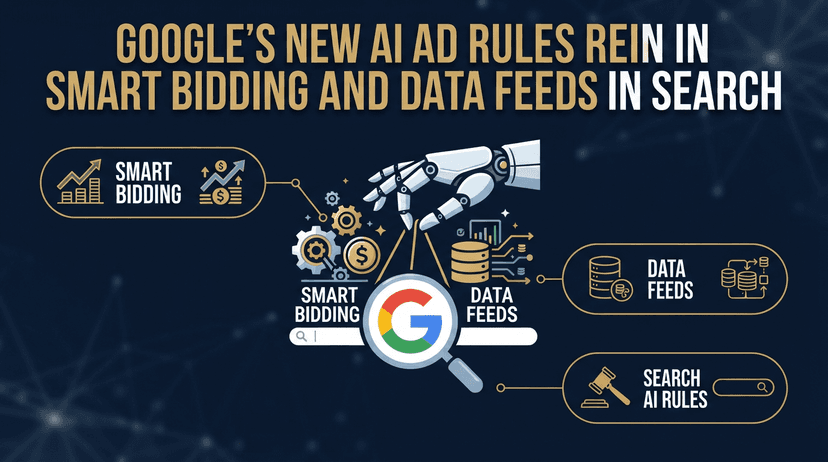
Google’s New AI Ad Rules Rein In Smart Bidding and Data Feeds in Search
AI & Tech

Google’s New AI Ad Rules Rein In Smart Bidding and Data Feeds in Search

Google is rolling out a series of policy and product changes that significantly tighten how artificial intelligence is used in ad bidding and how data feeds power search advertising, reshaping the playbook for brands and ad-tech startups that depend on Google’s ecosystem. The changes span smart bidding behavior, consent-driven data flows, migration to AI-first campaign types, and updated terms governing how advertiser data can train Google’s generative ad models. Together, they signal a more controlled, compliance-focused phase for AI in search and shopping ads. Smart Bidding: From “Over-Delivery” to Strict Target Enforcement At the heart of the shift is a fundamental update to Google’s Smart Bidding systems. A new mechanism, often described by analysts as Bidding Target Optimization , is scheduled to begin enforcement on August 17, 2026. It alters how cost-per-acquisition (tCPA) and return-on-ad-spend (tROAS) strategies behave in budget‑limited campaigns. Historically, Smart Bidding would sometimes deliver better‑than‑stated efficiency if it found high‑performing inventory within a campaign’s budget. Under the new rules, the algorithms are designed to pull performance toward the advertiser’s stated targets rather than “over‑delivering” efficiency beyond those thresholds. This effectively tightens the bid band around declared goals, forcing advertisers to calibrate their targets more carefully if they want to capture incremental upside. To ease the transition, Google introduced target adjustment tools in early July, allowing advertisers to recalibrate their CPA and ROAS goals before the new enforcement date. Industry commentators say this reduces volatility but also removes some of the hidden upside many performance marketers had come to expect from Smart Bidding. Exploratory AI Bidding Meets Stricter Guardrails In parallel, Google has expanded a feature known as Smart Bidding Exploration. Originally launched for search campaigns, the capability now reaches Performance Max campaigns that do not use product feeds, with feed-based placements such as Shopping still in beta. Exploration allows advertisers to specify a tolerance range around their target ROAS. Within that band, Google’s AI can bid on queries and placements that lack strong historical conversion data, effectively probing unproven traffic that might still meet acceptable efficiency thresholds. Marketers gain access to a wider surface of potential customers, but within tighter economic parameters dictated by their ROAS tolerance settings. Viewed together, Exploration and Target Optimization suggest a new philosophy: Google’s AI is allowed to experiment, but only inside clearly defined financial guardrails. The system is being nudged away from open‑ended opportunism and toward strict adherence to explicitly declared business goals. Consent Mode Reshapes the Data Supply for AI Ads Another critical change affects the data flows that power Google’s AI‑driven ads and measurement. As of June 15, 2026, Google’s Consent Mode v2 became the sole gatekeeper for advertising data collection across key properties such as Google Ads and Analytics. The ad_storage parameter now exclusively controls whether advertising cookies and identifiers can be set and whether ad‑related data can be transmitted. Legacy mechanisms—such as the Google Signals toggle and certain account-level data sharing overrides—have been retired. In practice, if a website does not obtain user consent for ad storage under the updated consent framework, Google’s systems will sharply limit data collection and audience building for that property. This reconfiguration has major implications for AI training. Without compliant consent signals, fewer user-level data points enter Google’s optimization pipelines, which can degrade targeting precision and attribution but improves alignment with privacy regulations. For advertisers and AI startups, the message is clear: consent configuration is no longer a secondary detail—it is now the defining factor in how much data the algorithms can see and learn from. AI Max Campaigns and Forced Migrations On the campaign structure side, Google continues to consolidate legacy formats into AI‑driven types. AI Max for Search, an AI‑centric successor to traditional search setups, moved out of beta and into broad availability in early 2026. New tools let advertisers apply text guidelines that shape automatically generated ad copy while the underlying system uses machine learning to customize messaging and targeting at scale. Dynamic Search Ads (DSA), once a mainstay for automatically matching queries to relevant landing pages, are slated for forced migration to AI Max for Search. The original deadline of September 2026 has been pushed back, with the sunset now delayed into 2027. Nonetheless, Google has confirmed that new DSA creation will be disabled and that existing campaigns will ultimately be transitioned to AI Max, preserving only limited URL controls. Similarly, automated assets and certain broad match configurations will auto‑upgrade to AI Max beginning in September 2026. For startups that have built tooling around DSA and legacy targeting structures, the consolidation raises strategic questions: invest in deeper AI Max integrations or pivot away from Google-specific campaign automation. Updated Terms Clarify How Advertiser Data Trains AI Models Underlying all these product changes are newly updated terms of service for Google Ads and related products, effective July 1, 2026. The revisions clarify how advertiser-supplied creative assets—such as text, images, and product data feeds—may be used to train Google’s generative AI systems for ads. While details vary by region and product, the broad thrust is that Google can use advertiser inputs as training material to improve AI-generated ad copy, image variations, and campaign optimization models, subject to consent, privacy, and contractual boundaries. For marketers, this institutionalizes a reality that has been emerging for several years: the creative and feed data they upload is not just serving current campaigns; it is also helping refine the algorithms that will shape future performance for themselves and others. Regulatory Pressure on AI Search and Data Use Regulators are also exerting pressure on how AI uses content and data in search experiences. In the United Kingdom, the Competition and Markets Authority (CMA) issued a landmark conduct requirement in June 2026, compelling Google to give publishers specific controls over whether their content powers AI-generated search summaries. Under that order, Google must offer granular opt-outs for AI Overviews and other generative features, explain how crawled content is used, and provide engagement metrics and meaningful attribution to publishers whose content appears in AI modules. The company has nine months to fully comply, although regulators expect visible progress well before the deadline. For the broader AI data supply chain, this underscores an emerging principle: access to content and behavioral data for AI training and summarization is no longer assumed—it must be negotiated, disclosed, and controlled. That shift affects not only Google but also third‑party data brokers, scraping-based startups, and ad-tech platforms that rely on Google’s search results and ad inventory as a primary signal source. Implications for Startups and Advertisers For startups operating in search, marketing analytics, or AI ad optimization, Google’s tightening of AI bids and data rules is a double-edged sword. On one hand, clearer guardrails around bidding targets and consent-driven data flows reduce uncertainty and regulatory risk. On the other, reduced access to unconstrained data, forced migrations to AI‑first campaign types, and stricter adherence to declared economic targets make it harder to extract “alpha” purely through arbitrage or aggressive experimentation. Advertisers now face a more technical optimization landscape. Success increasingly depends on: Precisely calibrating CPA and ROAS targets to balance stability with growth. Configuring Consent Mode and ad_storage signals to preserve legally compliant data volume. Adapting to AI Max and other AI‑centric campaign structures without losing essential controls. Understanding how their creative assets and product feeds feed into broader generative AI models. As Google’s AI ad stack matures under stricter rules, both brands and startups will have to treat data governance and bid strategy as core product disciplines, not peripheral operational details.

Nic Reeve·