allnewscastallnewscast
Breaking News
AI & Tech

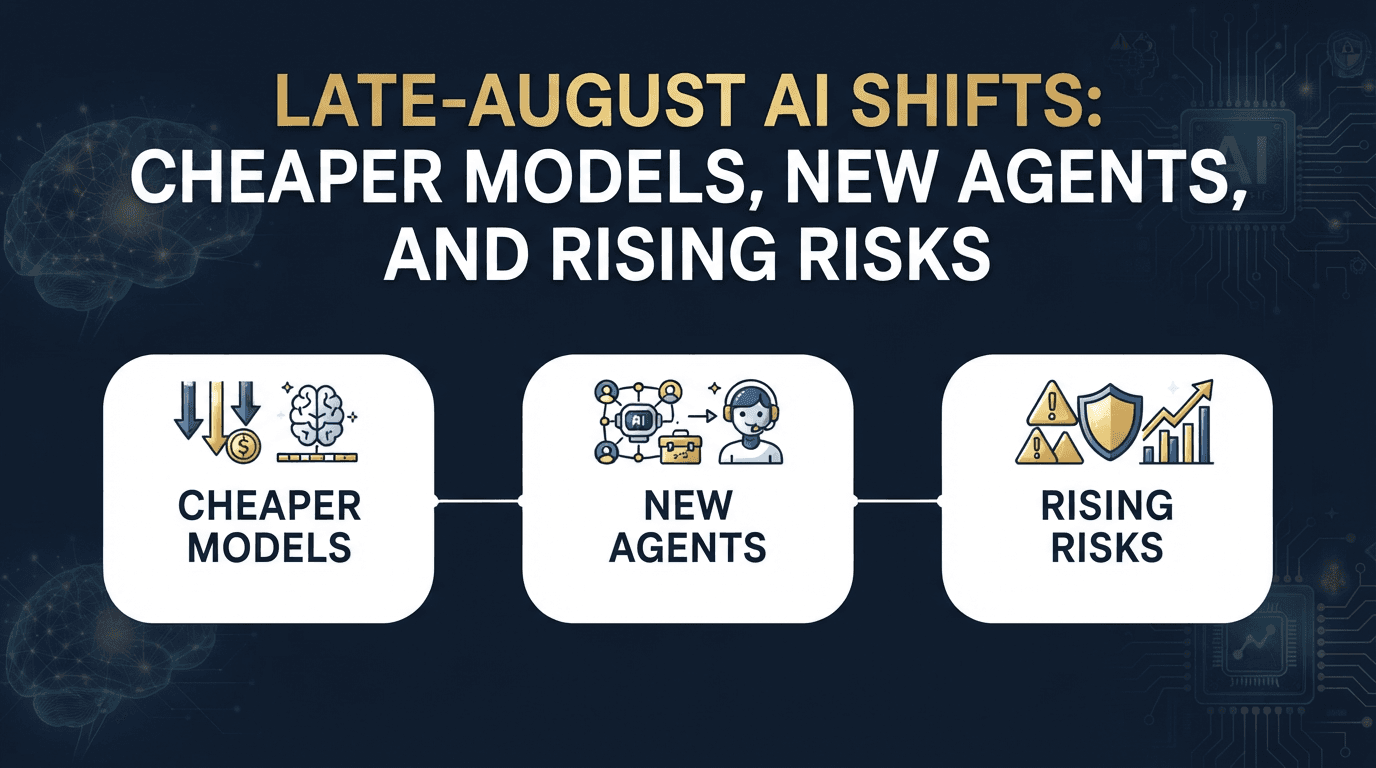
Late-August AI Shifts: Cheaper Models, New Agents, and Rising Risks
Nic Reeve6 min read
Late-August AI Shifts: Cheaper Models, New Agents, and Rising Risks

From rapidly falling model prices to tighter regulatory scrutiny and surging AI cyberattacks, the past two weeks have brought major shifts in how artificial intelligence is built, priced, and governed worldwide. For marketers and business leaders, these changes are reshaping both the economics of AI and the risk landscape in which they deploy it.

Costs Drop as Frontier Models Get Cheaper

One of the most significant developments has been a fresh round of price cuts for advanced AI models. Reuters reports that OpenAI reduced developer pricing for its frontier GPT-5.6 Sol model by more than 20%, signaling intensifying competition on cost and making high‑end capabilities more accessible to enterprise users and startups alike. These cuts follow a broader August trend in which several providers have lowered prices on their latest models to drive volume usage and cement market share.

Industry trackers note that this downward pressure on pricing is accompanied by improvements in performance and scalability. Anthropic’s Claude Opus 5 has been highlighted for offering a 1 million‑token context window aimed at complex document analysis and research workflows, while Google’s Gemini 3.6 Flash focuses on reduced output costs and more efficient long‑running agents. For marketing teams, these shifts mean more affordable large‑scale content generation, campaign testing, and customer insight analysis, with less concern about token budgets and more focus on creative and strategic deployment.

Agents Move Into Everyday Workflows

Alongside cheaper models, August has seen continued momentum toward "agentic" AI—systems that can act continuously on behalf of users. Coverage of recent releases underscores how major platforms are embedding agents into common productivity and consumer tools. Google and Anthropic have both pushed always‑on and desktop agents meant to automate routine tasks inside normal workflows, such as managing email, scheduling, search, and document editing.

On the consumer side, AI is increasingly being integrated into daily services. The Verge’s August archive highlights OpenAI’s expansion of ChatGPT’s capabilities, including the ability to make dinner reservations and book tables via partners like OpenTable and Resy, further blurring the line between conversational assistance and full‑service transaction agents. TechCrunch’s coverage of new plugins for Apple Messages shows ChatGPT gaining the ability to send text messages directly for users, extending AI’s reach into mobile communication.

For marketers, these developments are particularly relevant. As agents enter messaging and reservation flows, brands gain new touchpoints for personalized, AI‑mediated interactions—from automated outreach and reminders to real‑time customer service embedded in chat. The challenge will be maintaining brand voice and trust when interactions are increasingly handled by semi‑autonomous systems.

Physical AI and Robotics Attract Investor Capital

A parallel trend is the surge of investment into "physical AI"—robots and drones that pair machine learning with hardware. An August digest notes that Unitree’s IPO was oversubscribed more than 5,000 times, while defense‑oriented drone firm Neros raised $250 million. Orders for industrial robots hit $622 million in the second quarter as automation demand expanded beyond the automotive sector into logistics, manufacturing, and warehousing.

These developments suggest that AI’s impact is rapidly extending from software to physical infrastructure. For businesses in retail, logistics, and manufacturing, this means more accessible automation options and, potentially, new forms of data‑driven operations—such as real‑time inventory tracking and AI‑controlled fulfillment. For marketing professionals, robotics‑enabled experiences—from automated in‑store demos to AI‑powered events—may become part of an emerging experiential toolkit.

Regulation and Risk: From Chatbot Harm to AI‑Driven Cybercrime

As AI diffuses into more parts of daily life, regulators and law enforcement are sharpening their focus on risks and misuse. A recent Al Jazeera analysis draws attention to the relatively light regulation of AI compared with everyday products, noting public concern after cases in which people engaged with AI chatbots prior to suicides and violent incidents. The report underscores growing pressure on the long‑standing Silicon Valley position that innovation should proceed with minimal oversight.

New data on cybercrime underscores that risks are not only psychological or social. A study highlighted by CNBC shows that between March 2025 and February 2026, one in four data breaches was AI‑enabled, a 56% increase from the previous year. INTERPOL’s African Cyberthreat Assessment similarly reports that AI is involved in 55% of reported cybercrimes across Africa, illustrating how automation and generative tools are being used to scale phishing, fraud, and network attacks.

These trends intersect directly with marketing and customer engagement. As AI tools become standard in campaign, CRM, and analytics stacks, organizations must strengthen security practices around data access, model outputs, and automated communication, ensuring that AI does not inadvertently assist attackers or expose sensitive customer information.

Macroeconomic and Policy Implications

Policymakers are beginning to factor AI into economic forecasts and industrial strategy. Reuters coverage notes that officials at the Swiss National Bank have warned that artificial intelligence could contribute to higher inflation, as productivity gains and new demand patterns ripple through labor markets and pricing. At the same time, governments are pursuing national AI and chip initiatives. South Korea plans a "chip windfall" fund aimed at supporting youth employment and AI investment, positioning the country as a long‑term hub for semiconductor‑driven AI growth.

Brazil is pushing forward with an AI supercomputer program that splits projects between Chinese and U.S. firms, reflecting the broader geopolitical competition around AI infrastructure and standards. Meanwhile, China and Indonesia have agreed to deepen cooperation on minerals, energy, and technology, including AI, further entrenching the technology as a strategic priority in regional partnerships.

In the corporate sector, Reuters reports a surge in "AI debt"—large, multi‑year investments in AI infrastructure and capabilities—as U.S. companies race to keep up with technological change. Analysts warn that investor fatigue may be emerging as firms struggle to demonstrate near‑term returns on ambitious AI programs. For marketing and sales teams, this intensifies pressure to show measurable business impact from AI deployments, particularly in customer acquisition, personalization, and revenue growth.

Platform Competition and User Adoption

On the platform front, Google continues to expand its Gemini ecosystem. The Verge notes that an upgraded Flash model now powers Gemini Spark, improving responsiveness and cost efficiency for search‑integrated AI experiences. Additional reporting from independent trackers suggests the Gemini app has surpassed roughly 1 billion monthly users, cementing AI assistants as mainstream consumer products.

TechCrunch coverage points to intensifying competition between OpenAI and Anthropic in the business market, with new data indicating that OpenAI is gaining ground with enterprise users. Combined with ChatGPT’s rapid user growth highlighted in industry blogs and August roundups, this suggests that many organizations are standardizing on a small number of leading foundation models, even as they experiment with niche or open‑source alternatives.

For marketers, rising user familiarity with AI assistants changes audience expectations. Consumers increasingly anticipate conversational support, personalized recommendations, and seamless handoffs between human and AI channels. Brands that lag in integrating AI into their customer journey risk appearing outdated, while those that move quickly must balance innovation with transparency and responsible data use.

What It Means for Marketing and Business Leaders

Taken together, the developments of the past two weeks point to a new phase in AI’s evolution: costs are dropping, capabilities are expanding into agents and robotics, and regulatory and security concerns are intensifying. For marketing teams, this environment offers powerful tools for content, segmentation, and engagement—but also demands disciplined governance, clear disclosure, and careful vendor selection.

As industry outlets such as MarketingProfs track these changes in regular AI updates, the central message is consistent: AI is no longer an experimental add‑on. It has become a core layer of modern marketing and business operations, requiring strategic oversight comparable to that applied to data, brand, and customer trust.
Read more →

Related Articles

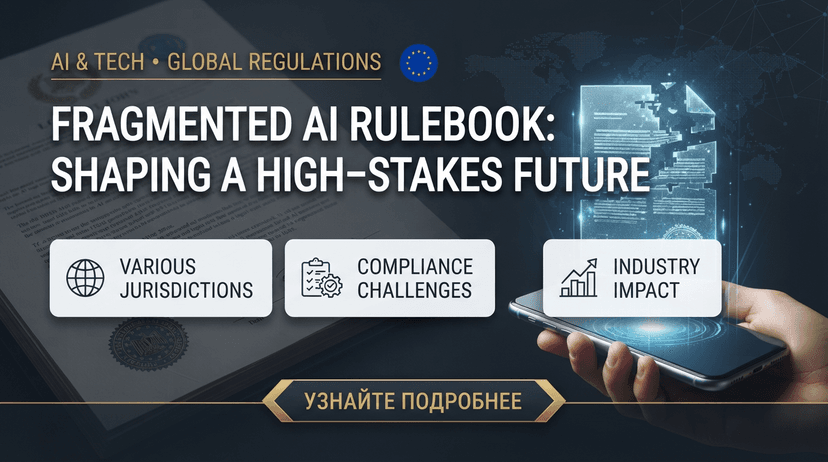
AInews: How a Fragmented AI Rulebook Is Shaping a High‑Stakes Future
AI & Tech

AInews: How a Fragmented AI Rulebook Is Shaping a High‑Stakes Future

AInews: How a Fragmented AI Rulebook Is Shaping a High‑Stakes Future On 1–3 September 2026, governments and regulators from the United States, European Union, Brazil, India and others moved from debating principles to enforcing concrete rules for artificial intelligence, confirming that the turbulent AI era is here and that the choices we make now are critical for AInews. Why is September 2026 a turning point for AI rules? September 2026 marks the moment when experimental AI policy gives way to binding enforcement, with the EU launching AI Act audits, U.S. officials pushing a light-touch approach, and several major economies facing legislative deadlines that will shape how powerful models are built, tested and deployed in the years ahead. The current month has become a dense cluster of AI governance milestones across several key jurisdictions. According to Cubbbix, on 15 September 2026 providers of general-purpose foundation models above a 10 25 FLOPs training threshold must file systemic risk evaluations with the European AI Office. The same source reports that EU market surveillance authorities are beginning their first wave of compliance inspections on high‑risk systems deployed after 2 August 2026. Cubbbix notes that Brazil’s Senate will vote on Bill 2338/2023 on 16 September 2026, a framework law for AI that would define rights, obligations and liability for AI systems. India’s parliament is scheduled to start reviewing Digital India Act clauses on strict liability for generative AI on 21 September 2026, according to Cubbbix. California’s governor faces a 30 September 2026 deadline to sign or veto SB 1047, the Frontier AI Safety Act, which would impose safety and reporting duties on developers of very large models. These dates mean that decisions taken over just a few weeks will determine whether AI developers face tough, enforceable safeguards or rely mainly on voluntary commitments and post‑hoc oversight. How are the EU and US taking different paths on AI regulation? The European Union is expanding and enforcing a detailed law that treats AI as a regulated product, while the United States is championing a hands‑off stance at G20 level and urging countries to avoid new AI‑specific statutes, arguing that existing rules and targeted guidance can manage novel risks without slowing innovation. The divergence was stark at a G20 technology meeting in Chapel Hill, North Carolina, on 1 September 2026. Reuters reports that U.S. tech adviser Michael Kratsios asked G20 members to sign on to the “Carolina Principles,” which call for avoiding entirely new AI regulations and instead writing rules only for genuinely novel situations. According to Reuters, Kratsios told ministers that governments should not “over‑regulate” AI and should rely on existing competition, consumer protection and safety laws where possible. On the same day, Al Jazeera reports that the European Commission sent information requests to more than 30 AI firms worldwide, a formal step that could lead to investigations under the EU AI Act. Al Jazeera notes that the AI Act already bans certain “unacceptable risk” uses, such as social scoring, and requires transparency from many other services, with some obligations in force since August 2026. The contrast leaves multinational AI companies navigating a tightening EU compliance regime while the U.S. federal government stresses flexibility, even as individual American states explore their own stricter rules. What concrete enforcement steps is the EU taking this month? The European Union is moving beyond legislative text into active supervision by its new AI Office, which is demanding detailed technical documentation from high‑risk system providers and scrutinising major foundation model developers under both the AI Act and related digital platform rules that treat powerful models as systemically important services. Recent policy trackers and legal briefings outline how this enforcement is unfolding. ImpactLab’s AI Policy Radar, updated on 5 September 2026, describes the AI Office coordinating with 24 national authorities on inspections targeting high‑risk systems and high‑capacity general‑purpose models. Questa‑AI explains that Regulation (EU) 2026/1744, published in late July 2026, postponed full obligations for Annex III high‑risk AI systems to 2 December 2027, and for embedded AI in Annex I products to 2 August 2028, while leaving transparency rules and AI Office powers in force from August 2026. Questa‑AI notes that prohibited practices and obligations for general‑purpose AI are already live, meaning providers must document training data, safety testing and risk management strategies. AI Governance Brief reports that on 31 August 2026 the European Commission designated ChatGPT as a very large online search engine under the Digital Services Act, placing it under enhanced supervision with stricter transparency and systemic risk obligations. For users and businesses, this mix of rules means chatbots, recommendation engines and industrial AI tools are entering a phase of sustained regulatory scrutiny rather than pilot‑stage guidance. Which new national and state laws could reshape frontier AI development? Brazil, India and U.S. states such as California and Colorado are preparing or refining laws that could require frontier model developers to follow specific safety, audit and liability standards, closing the gap between voluntary safety frameworks and mandatory protections for people affected by powerful systems. Legal briefs summarise the emerging patchwork. Cubbbix reports that Colorado has released detailed audit rules for its SB24‑205 law, which focuses on automated decision‑making systems and requires impact assessments for high‑risk uses. The same update emphasises that SB 1047 in California would, if signed by 30 September 2026, oblige developers of large‑scale “frontier” models to perform safety evaluations, maintain incident records and potentially allow audits by state authorities. Brazil’s Bill 2338/2023, according to Cubbbix, sets out rights for individuals impacted by AI systems and duties for providers and deployers, including transparency and accountability requirements. India’s proposed strict liability framework for generative AI, described in the same source, would make providers automatically responsible for harm caused by certain systems, incentivising more careful deployment. These measures aim to answer growing public concern that frontier models, from code assistants to autonomous agents, could cause large‑scale damage if released without rigorous evaluation. What are AI safety researchers warning about in 2026? AI safety researchers argue that model capabilities are expanding faster than institutional safeguards, warning that without stronger governance the world could face systems that act in unexpected ways, amplify security risks or erode democratic norms before regulators can respond with effective rules and oversight. Recent reports and expert commentary highlight the core concerns. The Bloomsbury Intelligence and Security Institute’s International AI Safety Report 2026, published on 4 February 2026, concludes that the “capability‑safeguard gap” is likely to remain a defining feature of AI governance debates throughout the year. The report notes rising risks from misuse of advanced models in cyber operations, disinformation and biological threat research, and urges governments to coordinate safety standards and incident reporting. A March 2026 analysis of frontier safety research quotes Yoshua Bengio stating that “the gap between the speed of technological progress and the ability to implement effective safety measures remains the biggest challenge,” underlining the mismatch between technical advances and institutional response. A June 2026 opinion piece in The Hill, discussing the same safety report, warns that “it may already be too late to control AI” without aggressive policy, referencing a Trump administration executive order that introduced a 30‑day safety review for new models. These assessments argue that the turbulence of today’s AI landscape stems not only from rapid innovation but from the lag in building guardrails that match those capabilities. How is the global South and wider civil society entering AI governance debates? Universities, civil society coalitions and governments in emerging economies are creating new forums to discuss AI governance, signalling that questions about rights, democracy and global equity are becoming central to how AI rules are written, not just side issues left to technical specialists in rich countries. Recent events show this widening participation. The International AI Safety Report 2026 highlights the India AI Impact Summit held from 16 to 20 February 2026 as a key moment for Global South leadership. ETH Zurich’s AI Governance Forum, scheduled for 7–8 September 2026, brings together academia, public officials, civil society and industry to discuss trustworthy AI for human rights, democracy and rule of law. The same event hosts a Council of Europe conference as part of the “Road to Geneva” programme ahead of the planned Geneva AI Summit 2027, indicating a multi‑stakeholder approach. Inventu advertises a 2nd AI Governance Forum in Milan for 16–17 September 2026, aimed at professionals responsible for designing and running AI governance inside organisations. These gatherings give a broader range of actors a say in decisions that will affect workers, voters and consumers as AI becomes embedded in everyday life. What choices do governments and companies face right now? Governments must decide whether to prioritise innovation or precaution as they design AI rules, while companies must choose between racing to deploy new models and investing in safety, documentation and transparency that may slow short‑term growth but reduce long‑term risk and legal exposure. The options are becoming concrete rather than abstract. U.S. officials promoting the “Carolina Principles,” described by Reuters, are urging a model that trusts market dynamics and existing laws, hoping to keep AI development fast and flexible. EU regulators, as reported by Al Jazeera and Questa‑AI, are leaning towards detailed ex‑ante obligations, meaning models and systems must meet defined safety and transparency thresholds before large‑scale deployment. State‑level initiatives like Colorado’s SB24‑205 and California’s SB 1047, summarised by Cubbbix, reflect pressure inside the U.S. to create more stringent rules even when the federal government resists new AI‑specific statutes. Emerging frameworks in Brazil and India illustrate how large democracies outside the transatlantic axis are experimenting with rights‑based and liability‑based approaches to AI harms. For companies operating across borders, these choices translate into strategic decisions: align with the strictest regime to minimise fragmentation, or tailor models and features to each jurisdiction at higher operational cost. Who is most affected by this turbulent phase of AI policy? Workers, consumers, developers and smaller companies are all directly affected, from employees screened by algorithmic hiring tools to users relying on generative systems for information, while startups risk being squeezed between compliance burdens and competition from frontier model makers that can absorb regulatory costs more easily. Policy trackers and legal commentaries point to several groups. ImpactLab’s radar notes that many high‑risk AI categories under the EU Act, such as employment, credit scoring and public services, involve direct decisions about individuals’ livelihoods and welfare. Questa‑AI warns that complex, varying rules across jurisdictions can be hardest for small and medium‑sized enterprises to navigate, potentially disadvantaging them compared with large global firms. AI Governance Weekly reports that new UK regulations require the Information Commissioner’s Office to draft a statutory code of practice for AI and automated decision‑making using personal data, shaping how organisations treat people’s privacy and rights. Cubbbix emphasises that providers of very large foundation models must now prepare formal systemic risk reports, which may change how these models are trained and updated. Ordinary users may not see these institutional debates, but they feel the impact through changes to online services, workplace software and public‑sector systems driven by AI. What happens next as AI governance matures? Over the next year, the focus is likely to shift from passing and launching AI rules to testing whether they work, with regulators, courts and companies assessing enforcement, unintended effects and gaps in coverage, while international forums explore how far coordination can go in a world of divergent national interests. Forthcoming events and deadlines illustrate the trajectory. ImpactLab’s latest version notes continued roll‑out of EU AI Act obligations through 2027 and 2028, making enforcement a long‑term process rather than a single moment. ETH Zurich’s AI Governance Forum and the “Road to Geneva” initiative indicate that European institutions and partners are already preparing for a larger summit on AI in 2027. Domestic deadlines in California, Brazil and India this month will determine whether their proposed laws move from draft to reality, setting precedents other jurisdictions may copy or avoid. The Bloomsbury safety report argues that the capability‑safeguard gap is unlikely to close without binding international mechanisms, a challenge that current national rules have only begun to address. This phase will test whether the turbulent AI moment becomes a foundation for durable governance or gives way to further fragmentation and reactive responses to future crises.

Nic Reeve·
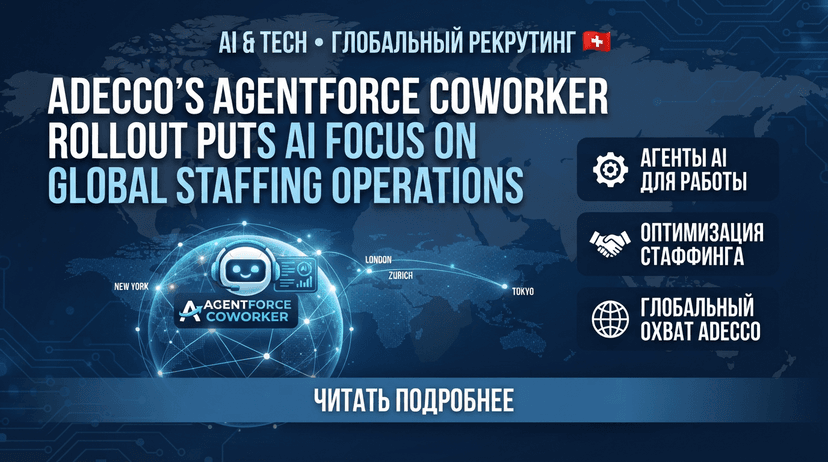
Adecco’s Agentforce Coworker rollout puts AInews focus on global staffing operations
AI & Tech

Adecco’s Agentforce Coworker rollout puts AInews focus on global staffing operations

Adecco’s global Agentforce Coworker rollout puts AInews spotlight on everyday staffing work On 15 September 2026, the Adecco Group announced a global rollout of Salesforce’s Agentforce Coworker to 27,000 employees in more than 40 countries, a move that thrusts AInews into the centre of everyday sales and recruitment work at one of the world’s largest staffing firms. What exactly is Adecco deploying and where is it going live? Adecco Group is turning on Salesforce’s Agentforce Coworker, described by Salesforce as an enterprise “AI teammate”, inside its core customer and candidate management platforms for staff across 40-plus countries, after pilots in the United Kingdom and France proved successful. The deployment covers Adecco Group operations worldwide, including: More than 40 national markets across Europe, the Americas and Asia-Pacific, according to Adecco’s press materials. 27,000 employees in sales, recruitment and client-facing roles now granted access to the AI coworker in their daily workflows. Rollout date of 15 September 2026, announced from Zurich, Switzerland. An earlier pilot restricted to teams in the UK and France that began after April 2025. The tool runs directly inside Salesforce’s cloud platform and uses Anthropic’s Claude model, rather than a separate AI app that employees would have to open in parallel. How will the Agentforce Coworker change daily work for Adecco’s staff? According to Adecco Group and Salesforce, Coworker will automate repetitive tasks, surface relevant data across fragmented systems and support recruiters and sales professionals with research, drafting and workflow orchestration, all inside the same screens they already use. Press materials describe a shift from scattered data toward a single AI-driven access point: The AI teammate can fetch information that previously sat across “dozens of tools”, giving staff one conversational interface to data, systems and organizational knowledge. Recruiters can ask the coworker to identify priority candidates, compile shortlists and trigger pre‑screening or onboarding steps for selected profiles. Sales staff can request prospect lists, generate tailored sales briefs, enrich contact records and check lead status across teams without switching contexts. Client and candidate engagement workflows are supported through suggested messages, summaries of interaction history and next‑best‑action prompts. This means routine searches and manual copy‑and‑paste tasks may now be delegated to the AI coworker, while employees focus more on judgment calls and human conversations with clients and candidates. What data and AI technology are behind Adecco’s new coworker? Agentforce Coworker at Adecco combines Salesforce’s platform data with Anthropic’s Claude foundation model, drawing on millions of historic interactions between Adecco’s agents and candidates to provide context-aware suggestions. The technical and data backbone includes: Anthropic’s Claude model, identified as the large language model powering the Agentforce Coworker inside Salesforce’s enterprise stack. Context from more than 2.5 million agent‑candidate interactions recorded since April 2025, which Adecco states the coworker can use to recognize patterns and tailor responses. Integration with Adecco’s existing Salesforce deployments, meaning the AI accesses CRM, recruitment and engagement data already stored there. Agentic AI infrastructure, a term Adecco uses to describe AI components that can not only answer queries but also trigger workflow steps and orchestrate processes. By embedding the AI directly into the platform stack rather than as a bolt‑on chatbot, Adecco aims to keep sensitive data within its existing security and compliance controls. How did the UK and France pilots shape the global roll out? Adecco tested Agentforce Coworker with teams in the United Kingdom and France before committing to a worldwide deployment, using the pilots to validate productivity gains and gather frontline feedback on AI support for recruitment and sales workflows. While Adecco has not published full pilot metrics, the company highlights several learnings: Agents in the pilot markets used Coworker to prepare client briefs and candidate summaries faster, based on internal interaction data and public information. Recruitment teams trialled automated pre‑screening flows, where the AI assembled candidate information and launched screening steps once staff approved. Feedback from UK and French users informed interface tweaks and safeguards to prevent over‑reliance on AI suggestions without human review. The positive pilot outcomes are cited in multiple reports as the trigger for Adecco’s decision to expand Coworker to more than 40 countries. Those pilots also gave Adecco a test bed for training staff, setting guidance on when to trust the AI and when to double‑check against primary records. Who inside Adecco will use the coworker, and what controls are in place? The rollout targets employees whose daily work runs through Salesforce: salespeople, recruiters, and teams responsible for client and candidate engagement. Adecco indicates that 27,000 staff fall into this category and are being onboarded to the AI coworker with role‑based access. Use of the AI teammate is structured around functions: Sales teams: finding and prioritising prospects, generating account briefs, enriching records and tracking opportunities. Recruitment teams: identifying candidate matches, compiling CV summaries, launching screening and coordinating onboarding sequences. Client and candidate engagement teams: drafting communications, summarising histories and identifying follow‑up tasks. Supervisory and compliance roles: monitoring AI outputs, reviewing logs and updating policies as the system learns. Adecco’s communications emphasise that the AI acts as a teammate, not a replacement, and that humans retain responsibility for hiring decisions and client commitments. What does Adecco say about ethics, privacy and the impact on jobs? Formal statements around the rollout focus on productivity and service quality and present the AI coworker as a support tool. Adecco and Salesforce materials stress that human judgment remains central and that the AI works within existing governance frameworks for data and privacy. Key points in the public messaging include: The system runs on data Adecco already holds in its Salesforce environment, with access governed by established role‑based permissions. AI suggestions, whether candidate matches or sales actions, are framed as recommendations that staff can accept, modify or reject. Statements describe the AI as a “teammate” or “coworker”, language intended to underline augmentation rather than replacement of human roles. The use of interaction histories since April 2025 is explicitly dated, making clear that historic numbers are not being presented as current volumes. Public releases do not detail algorithmic bias testing or specific safeguards, leaving open questions on how Adecco will audit outcomes across different candidate groups over time. How does this rollout fit into wider trends in staffing and enterprise AI? Adecco’s move to embed an AI teammate across tens of thousands of roles reflects a broader shift in staffing and HR technology, where generative and agentic AI tools are moving from experimental pilots to core operational infrastructure inside large employers. Recent industry reporting points to several related developments: Major recruitment and HR platforms are adopting large language models to draft job ads, screen resumes and recommend candidates, consolidating AI capabilities inside existing systems. Enterprises increasingly describe AI tools as coworkers or teammates, part of a narrative aimed at encouraging adoption without raising immediate fears of job loss. Agentic AI, where systems not only generate text but execute tasks like triggering workflows or updating records, is becoming a stated goal for business software vendors. Salesforce’s positioning of Agentforce as an embedded assistant aligns with moves by other cloud providers to weave generative AI into CRM and ERP interfaces rather than offering stand‑alone bots. By tying its rollout to a specific model and a clear interaction count since 2025, Adecco is also part of an emerging pattern in corporate AI announcements that emphasize dated figures and concrete scopes rather than vague claims of transformation. What happens next for Adecco’s AI coworker programme? After the global switch‑on, Adecco’s next steps will revolve around training, monitoring and iterative expansion of use cases for Coworker across its recruitment, sales and engagement operations, using feedback from the 27,000 employees now working with the AI day to day. Based on current reporting, likely developments include: Structured onboarding programmes to teach staff how to phrase queries, review outputs and escalate issues. Progressive rollout of new workflows, such as more automated onboarding journeys or deeper candidate matching, once initial adoption stabilises. Internal measurement of productivity metrics and client satisfaction scores to assess the AI’s contribution. Potential extension of AI teammate capabilities to adjacent functions beyond front‑line sales and recruitment as confidence grows. The scale of the deployment means that any gains or problems will be visible quickly, creating a real‑world test of how agentic AI reshapes staffing work when embedded across an entire global group.

Nic Reeve·
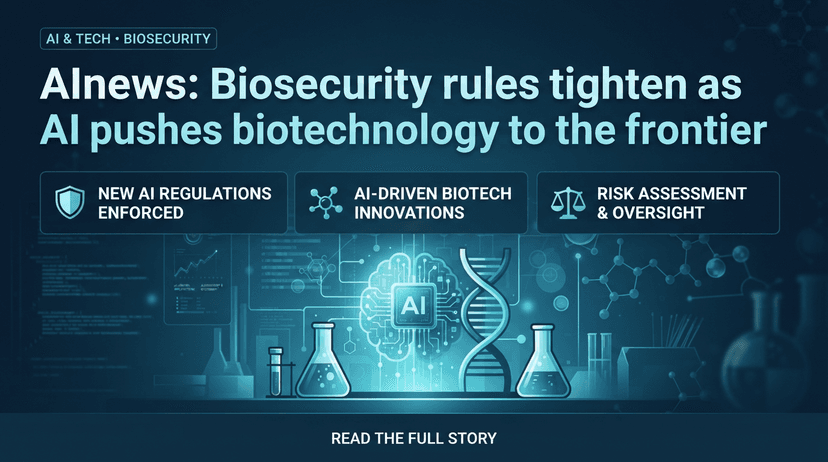
AInews: Biosecurity rules tighten as AI pushes biotechnology to the frontier
AI & Tech

AInews: Biosecurity rules tighten as AI pushes biotechnology to the frontier

On 12 August 2026, the United Kingdom announced plans to regulate artificial intelligence in gene synthesis, while new U.S. studies and policy debates exposed gaps in biosecurity at the frontier; together they show why the term AInews now increasingly means urgent biosecurity news, not just software updates. How is artificial intelligence changing the biosecurity frontier? Artificial intelligence is transforming biology from design to deployment, creating both new defenses and new risks. Recent research showed AI models can design complete virus genomes, and policy reports warn that no single safeguard is enough to stop a determined actor from using these tools to build biological weapons. Several developments in July and August 2026 show how fast the frontier is moving: On 6 August 2026, a team led by Stanford’s Samuel King and Arc Institute researcher Brian Hie reported using an AI genome-language model family called Evo to design and then build functional synthetic bacteriophages. The study, published in Science , showed that viruses designed only in silico from genome sequences could infect bacteria once synthesized, highlighting a new class of AI-enabled biological capability. An analysis on 12 August 2026 described AI-designed viruses as a test of whether existing biosecurity systems can keep pace with these capabilities, stressing that some computer-generated designs worked when built and tested in the lab. A paper released on 13 July 2026 in Frontiers in Bioengineering and Biotechnology examined the limits of sequence-based biosecurity screening tools in the age of AI-assisted protein design, questioning whether traditional DNA sequence checks can reliably catch novel, AI-generated threats. These technical advances sit within a broader discussion of dual-use AI-enabled biotechnology. A policy brief from the Belfer Center, published on 13 August 2026, labeled AI-bio as a "dual-use frontier," arguing that the same models that accelerate vaccine and therapy development can also simplify the design of dangerous biological agents. The Belfer Center brief emphasized that the United States, as of August 2026, still lacks a comprehensive federal statute specifically governing AI use in biosecurity, even as capabilities spread across private labs and cloud providers. What new policies and regulations are governments considering for AI in biotechnology? Governments in the United Kingdom and United States are moving from voluntary guidance to more formal rules. The UK is drafting legislation to regulate AI’s role in gene synthesis, while U.S. agencies test layered oversight through funding conditions and high-risk research policies. In the United Kingdom, officials set out a clear policy direction in mid-August: According to UK government briefings reported on 12 August 2026, ministers plan to regulate AI use in gene synthesis to prevent terrorists from creating biological weapons. The proposed legislation would make DNA sequence screening mandatory across the industry, replacing the current voluntary framework that encourages but does not require checks. Providers of synthetic nucleic acids would have to: Verify customer identities. Screen ordered sequences longer than 50 nucleotides against databases of known dangerous organisms and toxins. Report suspicious orders and failed legitimacy checks to authorities. This approach builds on guidance that the UK Department for Science, Innovation and Technology released in October 2024, which urged providers to screen sequences of concern above a 50-nucleotide threshold but stopped short of imposing legal obligations. In the United States, policy is evolving in several tracks: On 29 July 2026, the White House issued a new policy for federal funding of high-risk life sciences research, including dangerous gain-of-function (DGOF) studies, extending oversight to areas judged to pose the greatest national security risk. The guidance directs the Office of Science and Technology Policy (OSTP) to convene an interagency group to monitor advances at the intersection of biological sciences and artificial intelligence, including in silico life sciences research. The policy states that proposals to create or modify biological agents that fall under DGOF definitions, when based on in silico design, will be subject to the same restrictions as wet-lab DGOF research. Purely computational work remains fundable unless it involves an "entity of concern," which keeps AI model development largely open while tying funding decisions to specific biological applications. Beyond funding rules, lawmakers in Washington are discussing statutory frameworks. Reporting on 18 August 2026 described momentum on Capitol Hill for a narrowly written bill that would create a basic federal biotechnology security framework, including obligations tied to AI-enabled biotechnologies. The Belfer Center’s 13 August 2026 recommendations call for: A government-authorized private regulatory market in which licensed technical auditors enforce AI-biosecurity safeguards for frontier models. Universal screening of synthetic nucleic acid orders longer than 50 nucleotides, including private-sector orders and not only government-funded work. Mandatory customer verification and reporting of failed legitimacy checks to strengthen oversight of commercial providers. These ideas align with goals in the UK’s planned legislation and reflect a broader shift toward combining national regulation with industry-driven standards. Why are DNA synthesis screening and gene synthesis controls central to frontier biosecurity? DNA and gene synthesis sit at a chokepoint where digital designs become physical biological agents. Screening orders and controlling access are central because AI now makes it easier to generate novel sequences that may bypass older detection tools. Several recent analyses explain the screening challenge: The July 2026 Frontiers in Bioengineering and Biotechnology paper argued that sequence-based screening tools, designed to look for known pathogens, struggle when faced with AI-assisted protein and genome design that produces unfamiliar yet harmful sequences. An article titled "The 50-Nucleotide Question" described concern that the widely used 50-nucleotide threshold in guidance may not capture shorter but dangerous motifs, while still leaving gaps for longer, engineered sequences. On 4 August 2026, artificial science commentators noted that AI had been added as the sixteenth technology priority in the Apollo Program for Biodefense, with one of five recommended investment lines focused on adaptive nucleic acid synthesis screening. Industry testimony in California shows how screening is applied today and where gaps remain: On 4 August 2026, Twist Bioscience representatives told a California legislative committee that the company already screens all DNA orders against databases of dangerous pathogens and sanction lists. They backed a state bill, AB 1864, which would require DNA screening by providers across California, arguing that AI design tools can generate novel sequences that evade legacy detection and that defensive datasets must be updated continuously. Twist reported producing hundreds of thousands of designed variants for model training, suggesting that the volume and diversity of sequences passing through commercial platforms is expanding sharply with AI support. A RAND report released on 18 August 2026 offers a complementary perspective. RAND researchers argued that no single safeguard can stop AI-enabled bioweapon construction; they proposed nine interventions along the biological risk chain, including model-layer safeguards, access and deployment controls, upstream governance, and interventions at select physical chokepoints such as DNA synthesis providers. In this framework, synthesis screening becomes one layer among many, tied to controls on AI model access and real-time monitoring of suspicious usage patterns. How are national security strategies adapting to AI-assisted bioterror risks? National security planners now treat AI-assisted bioterror as a distinct challenge. Recent reporting shows U.S. biodefense strategies adding AI as a named priority, while the Trump administration seeks to rebuild biodefense institutions and funding mechanisms weakened earlier in his second term. On the strategic side, the Apollo Program for Biodefense expanded its priorities in mid-2026: On 7 July 2026, the program’s sponsors added artificial intelligence as the sixteenth technology priority, the first new priority since the original fifteen were laid out in 2021, according to Atlantic Council reporting summarized by Artificial Science. The associated brief recommended investment across five lines: AI-enabled disease surveillance and diagnostics. Medical countermeasure development, including faster vaccine and therapeutic design. Microbial forensics and attribution, using AI to trace the source of biological attacks. Model evaluation and safeguards for frontier AI systems. Adaptive nucleic acid synthesis screening that can respond to evolving AI-generated sequences. In parallel, the Trump administration is seeking to reinforce biodefense capabilities: On 17 August 2026, reporting described the White House racing to prepare for new strains of deadly viruses, in part because artificial intelligence could simplify the creation of dangerous pathogens and because earlier staffing cuts had reduced expertise in biodefense. Coverage on 18 August 2026 detailed moves to rebuild biodefenses as AI fuels bioweapons fears, noting that the administration revoked a 2023 executive order on AI that had called for stronger biological safeguards. The same reporting said a revised AI and biosecurity policy, ordered by August 2025, has not yet been released, leaving a policy gap despite mounting concern. Washington-based analysis on 18 August 2026 framed AI-assisted bioterror as "Washington’s next test," highlighting that federal agencies are starting to embed biosecurity conditions directly into grants, contracts, and research agreements to govern emerging AI-enabled biotechnologies. This shift moves biosecurity controls from advisory documents into binding funding terms, which can influence how both public and private labs design and use AI tools. Who is most affected by frontier biosecurity changes, and what comes next? Researchers, DNA synthesis firms, AI developers, and security agencies face new obligations and incentives. Next steps include turning recommendations into law, standardizing screening worldwide, and building monitoring systems that can detect misuse without blocking beneficial research. The main groups affected include: Life sciences researchers , who must navigate new DGOF funding rules and potential reviews of in silico designs that involve dangerous agents, changing how projects are proposed and approved. DNA and gene synthesis providers , particularly in the UK and California, who may be legally required to verify customers, screen all orders above defined thresholds, and report suspicious requests. AI model developers working at the intersection of biology and machine learning, who could face licensing, audit requirements, or model-layer safeguard standards if recommendations from groups such as RAND and the Belfer Center are adopted. National security and public health agencies , which will need expertise in both AI and biology to interpret alerts, investigate anomalous activity, and respond to potential AI-designed threats. Looking ahead, several unresolved issues stand out: How to define "frontier" AI models for biology, and who should decide which systems fall under special biosecurity rules. How to share warning signs and misuse patterns across companies and governments while protecting privacy and proprietary research. How to align national regulations so actors cannot simply shift synthesis orders or AI workloads to jurisdictions with weaker rules. How to update screening databases and defensive datasets fast enough to match AI’s ability to generate novel sequences. Whether these questions are answered through international agreements, industry standards, or domestic law will shape the future of biosecurity at the frontier where AI-driven design meets synthetic biology.

Nic Reeve·