OpenAI Pushes AI From Digital Workflows Into Real-World Engineering
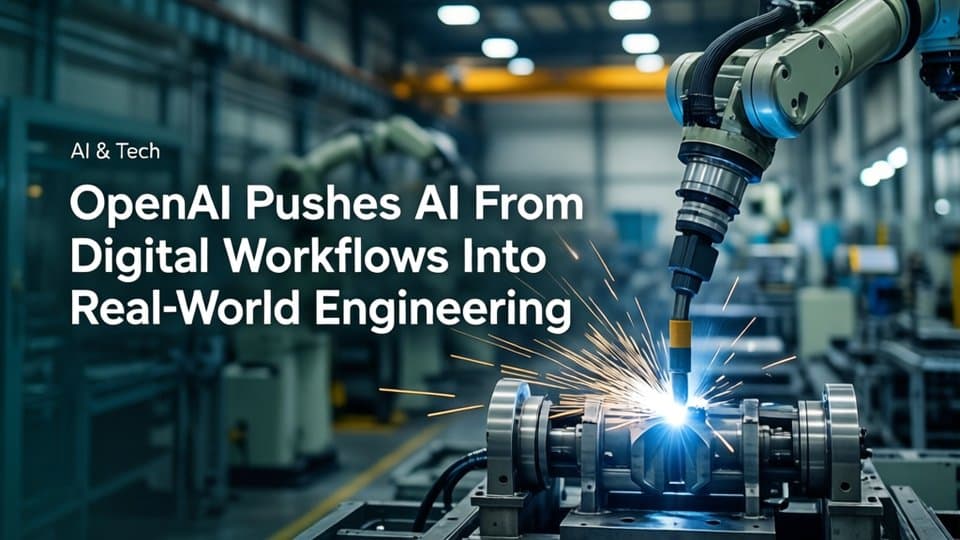
OpenAI said on November 3, 2026, that its latest models can help engineers design, simulate and prepare physical products across mechanical, electrical and software disciplines. The announcement described internal hardware work, an experimental device built in less than a week and new evidence that AI agents are beginning to handle engineering tasks once reserved for specialists.
- OpenAI said two employees designed a test device in under a week and a manufacturer produced prototypes in under a month.
- Google Cloud released 29 public engineering tasks for its Physical-Engineering’s Last Exam benchmark on November 3.
- OpenAI reported an internal model score of 0.875, compared with 0.594 for GPT-6 Astra at its strongest reasoning setting.
What did OpenAI announce?
OpenAI described a push to apply its models to engineering work that ends with a manufactured object, not just digital text or code. The company said ChatGPT and Codex are being used by hardware and infrastructure teams to revise computer-aided designs, prepare manufacturing drawings, configure simulations and review changes across disciplines.
The announcement appeared on OpenAI’s website on November 3, 2026, and was updated the following day. OpenAI said the work covers mechanical and electrical engineering, software integration and end-to-end system design.
- Engineers can ask models to prepare drawings and simulation setups.
- Models can help coordinate mechanical, electrical and manufacturing requirements.
- OpenAI said its internal teams have used the systems for faster testing and iteration over the past year.
The company framed the technology as an engineering assistant rather than a replacement for physical validation. Designs still require checks, testing and manufacturing review before deployment.
How quickly can AI help build a device?
OpenAI presented a small test project called Astra as an example. Two team members designed the device in under one week while working on it as a side project, then sent the design to a contract manufacturer. OpenAI said the manufacturer completed a small prototype batch in under one month.
The result matters because hardware development usually crosses several workflows. A project may require an enclosure, a printed circuit board, embedded software, drawings and manufacturing instructions. OpenAI said its models helped connect those tasks instead of treating each one as an isolated prompt.
- The device required mechanical design and electronics.
- OpenAI said software integrations formed part of the development process.
- The prototype batch came from an outside contract manufacturer, not only a digital simulation.
OpenAI did not publish a full bill of materials, production cost, failure rate or independent audit of the device. The company’s account therefore demonstrates a workflow claim, rather than a complete measure of commercial readiness.
How was the engineering performance measured?
OpenAI said a newer internal model achieved an average score of 0.875 on its engineering evaluation. The company compared that result with 0.594 for GPT-6 Astra using its highest reasoning setting. The figures suggest progress on the company’s own task set, but they do not establish that models can independently approve safety-critical designs.
The evaluation appears alongside practical examples of CAD work, manufacturing drawings and simulation preparation. Those tasks test more than language generation. They require a model to preserve constraints, coordinate changes and produce outputs that engineers can inspect in specialist tools.
- OpenAI’s newer model: average score of 0.875.
- GPT-6 Astra at its highest reasoning setting: 0.594.
- The comparison was presented by OpenAI as an internal measurement, not an industry-wide standard.
That distinction matters. Engineering benchmarks can reward correct answers to defined problems while missing practical issues such as ambiguous requirements, material availability, tolerances, certification and unexpected behavior in the field.
Is there an independent benchmark for physical engineering?
On the same November 3 date, Google Cloud announced Physical-Engineering’s Last Exam, or PLE, a benchmark and open competition for AI agents. Google Cloud said the benchmark covers mechanical, electrical, civil and structural engineering.
The project was developed with Mercor. Google Cloud released 29 public tasks, grading tools and a competition leaderboard. The aim is to give researchers a shared way to test whether AI agents can complete work connected to the built environment.
- PLE contains 29 public tasks.
- The benchmark spans four engineering areas: mechanical, electrical, civil and structural.
- Google Cloud released grading tools alongside the tasks.
PLE could make future claims easier to compare, although a public benchmark cannot capture every requirement in regulated engineering. Safety reviews, professional accountability and local construction rules remain outside many automated tests.
Which industries could use these systems first?
OpenAI said its hardware and infrastructure teams already use Codex and ChatGPT in product development. A separate summary of the announcement identified Chip Ganassi Racing and Mazda as industry collaborators testing the capabilities on real-world engineering and prototyping problems. The examples point toward industries where simulation, rapid iteration and tightly linked mechanical and software systems already shape development.
Automotive engineering could use models to compare design variants, prepare documentation or connect vehicle software with physical components. Racing teams may value shorter iteration cycles, while manufacturers could use AI to translate requirements into drawings and production instructions.
- Automotive and motorsport teams can test designs through simulation before fabrication.
- Hardware companies can connect CAD, electronics and embedded software workflows.
- Manufacturers can use generated drawings and instructions as reviewable starting points.
Human engineers remain responsible for checking dimensions, materials, thermal behavior, electrical safety and manufacturability. A faster draft is useful only when the review process catches errors before production.
What happens next for physical-world AI?
The next test will be repeatability. A single prototype can show that a workflow is possible, but industrial adoption requires reliable results across different products, suppliers and constraints. It also requires clear records showing which decisions came from a model and which came from an accountable engineer.
Research activity is expanding beyond product design. Duke University described physical AI as systems that perceive and act in the real world, while its engineering faculty highlighted challenges involving local computation, adaptability and trust. The university’s discussion appeared on November 2, 2026, one day before the OpenAI and Google announcements.
- Models must work with incomplete or changing physical information.
- Engineers need systems that operate reliably when cloud connectivity is limited.
- Benchmarks must measure safety, physical performance and practical tool use, not only written answers.
OpenAI’s device experiment and Google’s public benchmark mark two different approaches. One emphasizes a working engineering workflow. The other seeks a common yardstick. Together, they show where the field is heading: AI systems that help turn specifications into tested objects, with the hardest questions still waiting at the boundary between generated designs and real-world responsibility.