ADNOC Turns to OpenAI for Oilfield Planning as Altman Visits Abu Dhabi
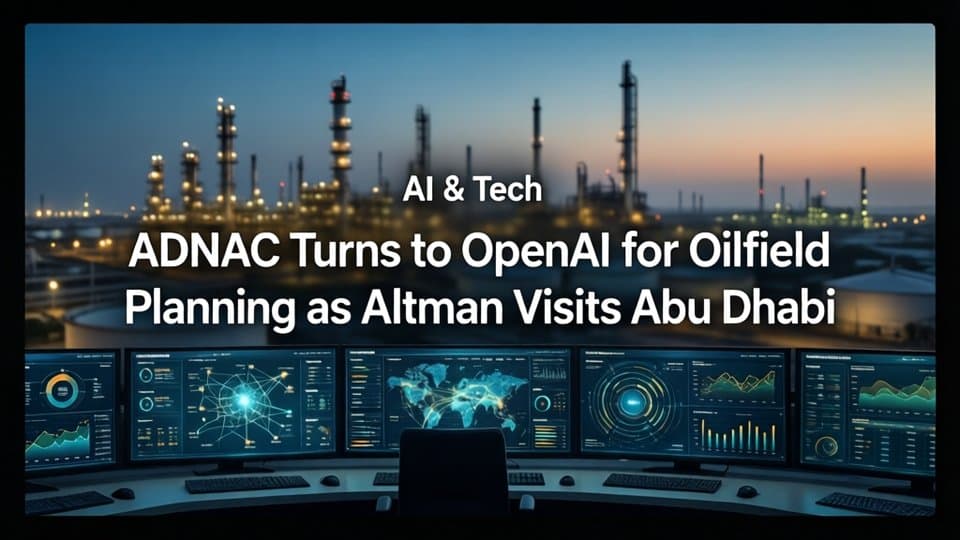
Abu Dhabi’s ADNOC and artificial-intelligence company G42 signed an agreement with OpenAI on November 2, 2026, to deploy the ChatGPT maker’s advanced AI across ADNOC’s operations. The announcement came during OpenAI chief executive Sam Altman’s UAE visit, which included talks with Abu Dhabi Crown Prince Sheikh Khaled bin Mohamed bin Zayed Al Nahyan and an appearance at ADIPEC.
- Abu Dhabi Media Office said on November 2 that ADNOC became the first energy company to deploy OpenAI’s frontier technology.
- Reuters reported that the system will support operational, investment and commercial decisions across ADNOC’s business.
- Inception42 and OpenAI also signed a five-year agreement covering AI adoption in government, enterprise and education, the media office said.
What did ADNOC and OpenAI agree to do?
The agreement will combine OpenAI models with ADNOC’s industrial data and existing artificial-intelligence systems. G42, through its subsidiary Inception42, will provide UAE-based computing infrastructure. The arrangement is designed to connect decisions across the energy company, rather than treat field operations, investment planning and commercial activity as separate tasks.
ADNOC CEO Sultan Al Jaber described the partnership as a first for the energy sector. OpenAI CEO Sam Altman said the company’s most advanced models would be used on difficult and high-value problems facing ADNOC, including the energy demands created by the expansion of AI.
The Abu Dhabi Media Office said the deployment will run on OpenAI’s GPT models using in-country inference infrastructure. Human specialists will remain responsible for consequential decisions, according to reporting from Forbes Middle East and Arabian Business.
Which ADNOC activities will use the technology first?
The initial applications will focus on oilfield development and the valuation of crude before production. AI tools will examine ADNOC’s historical well and reservoir information alongside production costs, market conditions and expected returns. The stated aim is to shorten planning cycles and give managers a more connected view of the energy chain.
- Arabian Business reported that the first application will analyse data from thousands of wells, multiple reservoirs and hundreds of facilities.
- The same report said the system could reduce some development-planning work from months to hours.
- ADNOC plans to assess the potential value of each barrel before extraction by examining supply, demand, prices and margins.
That second use would reach beyond drilling. The analysis could inform production, refining, transportation and trading decisions. ADNOC already uses its ENERGYai platform to build intelligence about reservoirs, assets and operations. OpenAI Frontier is intended to connect those capabilities across the company.
Why does G42 matter to the partnership?
G42 is supplying the local infrastructure that will host the deployment in the UAE. Keeping inference inside the country addresses data-residency and control requirements while giving ADNOC access to advanced models through an Emirati technology partner.
The partnership also extends beyond oil and gas. The Abu Dhabi Media Office said Inception42 and OpenAI signed a separate five-year agreement to support frontier-AI adoption across government, business and education. The arrangement places G42 at the centre of a wider effort to build domestic capacity around OpenAI systems.
G42’s role also reflects Abu Dhabi’s broader push to link computing infrastructure with strategic industries. The companies have not disclosed the financial value of the ADNOC agreement, the number of systems to be deployed or a precise implementation timetable.
What happened during Sam Altman’s UAE visit?
Altman met Sheikh Khaled in Abu Dhabi on November 2, according to the Abu Dhabi Media Office. The meeting focused on expanding cooperation in artificial intelligence and preceded the signing ceremonies linked to ADNOC, G42 and OpenAI.
Altman also attended ADIPEC, the UAE’s major oil and gas conference, where the energy partnership was announced. Reuters described the visit as part of OpenAI’s deepening ties with the UAE, while the Economic Times reported that the ADNOC agreement was signed at the conference.
Energy is central to the relationship. AI systems require large amounts of electricity and computing capacity, while energy companies hold complex industrial datasets that can support specialised models. The ADNOC deal brings those two interests together in a commercial setting.
What other safeguards and applications are included?
The agreement includes cybersecurity work through OpenAI’s Daybreak Blue programme, according to The Next Web and Arabian Business. The initiative is intended to help ADNOC identify digital risks and protect energy infrastructure as more operational systems become connected.
ADNOC employees will also receive training linked to the deployment, The Next Web reported. That training is expected to support the use of AI agents across business functions while preserving expert supervision over high-impact decisions.
- OpenAI models will be combined with ADNOC’s proprietary industrial data.
- G42 will provide computing infrastructure located in the UAE.
- Human experts will oversee consequential operational and commercial choices.
- Cybersecurity and workforce training form part of the wider rollout.
The companies have not published independent estimates of expected cost savings, productivity gains or emissions effects. Those measures will determine whether the partnership moves beyond a high-profile launch into routine use across ADNOC’s large operating network.
What happens next for the ADNOC partnership?
ADNOC, G42 and OpenAI are expected to develop the customised decision-intelligence platform before expanding its use across the energy company. The first work will centre on field-development planning and pre-production barrel valuation, with later applications potentially reaching other operational and commercial functions.
The five-year Inception42 agreement provides a separate timetable for adoption across public institutions, companies and schools. Its scope makes the November 2 announcement larger than a single oil-and-gas technology contract, although the parties have not released milestones for either agreement.
The next test will be practical: whether AI can turn ADNOC’s data into faster planning, safer facilities and better-informed market decisions while keeping accountability with human staff. The partnership’s UAE-based infrastructure will also give Abu Dhabi a direct role in operating the systems that support those decisions.