
allnewscastallnewscast
Breaking News
AI & Tech

AI news: OpenAI bets on autonomous Dots and cheaper models at DevDay 2026

Nic Reeve5 min read
AI news: OpenAI bets on autonomous Dots and cheaper models at DevDay 2026

OpenAI used its September 29, 2026, developer conference to introduce more than 20 products and features, led by Dots, always-on autonomous agents, GPT-6.1 Sol, a lower-cost model, and ChatGPT Space for collaborative work. The announcements are the biggest AI news from DevDay 2026 because they move OpenAI’s products beyond question-and-answer chat toward software that can act across digital tasks.

What did OpenAI announce at DevDay 2026?

OpenAI presented a broad set of launches in San Francisco on September 29, 2026. CNBC reported that the company rolled out Dots across paid plans, while Axios described more than 20 new products and features. The event also covered model updates, developer APIs, Codex, ChatGPT workspaces and faster paid service tiers.

  • September 29, 2026: OpenAI held its annual developer conference in San Francisco, according to CNBC and Axios.
  • More than 20 launches: Axios reported that the company announced over 20 products and features.
  • Core focus: OpenAI highlighted autonomous agents, coding, computer use, collaboration tools and model pricing.

The scale of the event mattered to developers because the announcements were not limited to a new model. OpenAI tied consumer-facing ChatGPT features to tools that businesses and programmers can build into their own applications.

What are Dots, OpenAI’s new autonomous agents?

Dots are always-on agents designed to work on a user’s behalf rather than waiting for every individual prompt. CNBC reported that OpenAI made Dots available across paid tiers. Axios said the agents can operate beyond the traditional chatbot format, while other event coverage described Dots as having access to a computer of their own.

  • Availability: CNBC reported that Dots launched across OpenAI’s paid plans.
  • Operating model: Axios described Dots as agents that can work independently on users’ behalf.
  • Underlying technology: OpenAI’s DevDay materials and event summaries connected Dots with GPT-6 Astra.

The practical difference is autonomy. A conventional chatbot responds after a request. An agent can potentially monitor work, use software and complete several steps without a new instruction at every stage. That shift also raises questions about permissions, reliability and the limits of unattended computer access.

What is GPT-6.1 Sol, and how much does it cost?

GPT-6.1 Sol is a new model positioned as a cheaper alternative to GPT-6 Astra. OpenAI’s published event information said Sol approaches Astra’s intelligence at one-fifth of Astra’s token price. WTOP separately reported that OpenAI announced GPT-6.1 Sol as an upgraded model alongside other product launches.

  • Price comparison: OpenAI said GPT-6.1 Sol costs one-fifth as much per token as Astra.
  • Capabilities: OpenAI described Sol as improving coding and computer use while approaching Astra’s performance.
  • Release timing: OpenAI’s developer community announcement said Astra was available and Sol was coming soon.

Token pricing directly affects developers that process large volumes of text, code or tool calls. A lower-cost model can make agent-based applications cheaper to operate, especially when a system needs many intermediate steps before completing a task.

What is ChatGPT Space?

ChatGPT Space is a shared workspace intended for teams, ChatGPT and an agent to work on the same material. Event summaries described the product as a collaborative environment connected to OpenAI’s broader push into workplace software. The feature places the assistant inside a group workflow instead of keeping each conversation tied to one person.

  • Users: ChatGPT Space is designed for teammates working together.
  • Participants: The workspace can include people, ChatGPT and a user’s Dot.
  • Purpose: The product is intended to support shared work on documents, projects and tasks.

The launch gives OpenAI a more direct role in team collaboration. It also creates a need for clear controls over ownership, access, activity logs and the actions an agent can take inside a shared project.

How did OpenAI expand Codex and its developer tools?

OpenAI announced cloud-based Codex capabilities and computer use in its Agents API. The changes allow developers to build applications that can write code, interact with software and complete tasks in remote environments. CNBC and Engadget coverage identified Codex and developer tooling as central parts of the conference program.

  • Codex in the cloud: OpenAI introduced cloud-based access for coding workflows.
  • Agents API: OpenAI added computer-use capabilities for developers building autonomous systems.
  • Target users: The tools are aimed at programmers and companies creating software with agent behavior.

Cloud execution can reduce the need for developers to run every task on a local machine. Computer-use tools can also connect models to existing applications that lack a dedicated artificial-intelligence interface.

What are Astra Ultrafast and the new Pro plans?

OpenAI introduced Astra Ultrafast as a premium speed tier and announced a Pro 500 subscription. The company said Astra Ultrafast can deliver faster generation in the API, Codex and ChatGPT Work. Independent event coverage reported that the new Pro plan costs $500 per month and carries the highest usage limits.

  • API speed: OpenAI reported that Astra Ultrafast can be up to six times faster in the API.
  • Codex and ChatGPT Work speed: OpenAI reported speeds up to eight times faster in those products.
  • Pro 500 price: OpenAI’s plan information listed the subscription at $500 per month.
  • Pro 200: OpenAI reopened the lower-priced plan to new subscribers with a lower usage cap, according to event reporting.

The pricing structure separates access, capacity and speed. Developers running time-sensitive services can pay for faster output, while other users may favor the less expensive model option over premium throughput.

What happens next for developers and users?

OpenAI’s next test will be adoption. Developers must determine whether Dots and computer-use agents can complete real work reliably, while companies must decide how much authority to give systems that act without constant supervision. The near-term rollout also depends on access, pricing and the arrival of GPT-6.1 Sol.

  • Immediate access: CNBC reported that Dots were introduced across paid tiers.
  • Coming model: OpenAI’s developer community announcement said GPT-6.1 Sol was coming soon.
  • Product pressure: The launches place OpenAI’s agent tools, coding products and workplace features at the center of competition among major AI companies.

Sam Altman said during the event, “No matter what governments do we will work to keep AI safe,” according to Simon Willison’s live account of the keynote. The statement came as OpenAI expanded tools that can make decisions and take actions across software, giving safety controls a practical role alongside model performance and cost.
Sources

  1. 1.cnbc.com
  2. 2.axios.com
  3. 3.ground.news
  4. 4.wtop.com
  5. 5.engadget.com
  6. 6.ground.news
  7. 7.simonwillison.net
  8. 8.aiagentslibrary.com
  9. 9.pasqualepillitteri.it
  10. 10.note.com
  11. 11.echai.ventures
  12. 12.community.openai.com
  13. 13.stocktwits.com
  14. 14.9to5mac.com
  15. 15.analyticsinsight.net

Read more →

Related Articles

Federal Judge Says Trump Team Defied Mail-Voting Injunction With New USPS Rule
Politics & Elections

Federal Judge Says Trump Team Defied Mail-Voting Injunction With New USPS Rule

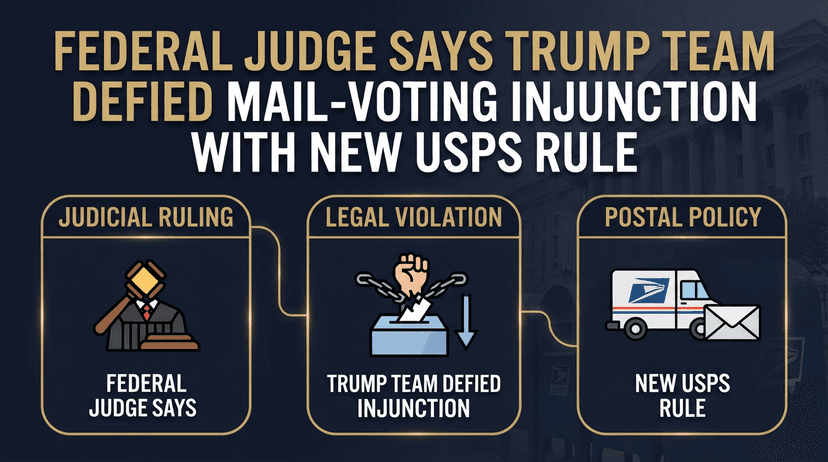
A federal judge in Massachusetts has concluded that the Trump administration violated a nationwide court order when the U.S. Postal Service (USPS) finalized a new rule tightening mail-in voting procedures ahead of the November 2026 midterm elections. U.S. District Judge Indira Talwani, who previously blocked key portions of President Donald Trump’s executive order on mail voting, said in a ruling issued Tuesday that federal officials “violated the preliminary injunction” by moving forward with a regulation tied to that order despite her earlier prohibition on implementing it for the 2026 elections. Background: Trump’s Executive Order on Mail Voting Trump’s March 2026 executive order sought to sharply restrict vote-by-mail by expanding federal oversight of state election procedures and conditioning USPS handling of ballot mail on new eligibility and certification requirements. The order directed the Department of Homeland Security to compile voter eligibility lists for each state and instructed USPS to adopt binding regulations governing which voters could receive and return mail ballots. Voting-rights groups and a coalition of Democratic-led states quickly challenged the order, arguing that it usurped state control over elections and threatened to disenfranchise eligible voters who rely on mail ballots. In June, Judge Talwani issued a sweeping preliminary injunction, holding that key provisions of Trump’s order were likely unconstitutional and exceeded executive authority because elections are administered by states and local governments, not the federal executive branch. Talwani declared that the executive branch “has no authority to regulate elections,” finding that the order’s attempt to create a federal voter list and empower USPS to decide who could vote by mail violated the Constitution’s separation of powers and long-standing statutory limits on federal election involvement. Nationwide Block on USPS Implementation On August 11, Judge Talwani went further, issuing a nationwide injunction specifically barring USPS from implementing Section 3 of Trump’s order and from “completing rulemaking” tied to that provision for the November 2026 elections or any earlier contests. That section would have required the Postal Service to refuse delivery of certain ballots deemed “noncompliant” and to withhold ballot mailings in states that did not certify federal voter lists. In that ruling, Talwani concluded that the order was likely unconstitutional and was already causing “irreparable harm” by sowing confusion among voters and organizations that assist them with mail voting. She emphasized that blocking USPS from carrying out Trump’s directives would not harm the public, given the risk of widespread disenfranchisement if the changes took effect. Voting-rights groups later told the court that the administration nonetheless pressed ahead: USPS finalized a national rule incorporating the disputed mail-voting restrictions, even as it acknowledged in the rule text that it could not implement the changes for the 2026 elections unless Talwani’s injunction was lifted. Judge: Administration “Cannot Contend” It Misunderstood Order In her latest five-page order, Talwani rejected the government’s argument that it had complied with her directive by promising not to apply the new rule in November 2026. She wrote that “defendants cannot contend that they misunderstood the scope of the court’s order,” noting that the injunction explicitly barred USPS both from implementing the provision and from completing rulemaking for the upcoming elections. Talwani pointed to language in the final USPS rule that referenced her injunction, which she said showed that the agency knew the court’s order remained in force but chose to finalize the regulation anyway. She concluded that, despite government assurances that it “takes its obligation to comply with court orders very seriously,” the administration had violated the injunction. Voting-rights organizations that brought the Massachusetts case argued that simply issuing the rule – even with an implementation caveat – flouted the court’s bar on “completing rulemaking” and risked chilling participation by voters who might assume new restrictions were already in effect. Related Litigation and Supreme Court Action The clash over Talwani’s injunction comes amid a broader, complex legal battle over Trump’s mail-voting order in multiple courts. In June, Talwani’s initial ruling blocking core parts of the order was upheld in July by the Boston-based 1st U.S. Circuit Court of Appeals, which found that the president’s directive would “sow confusion and threaten disenfranchisement of many eligible voters” if allowed to take effect before the midterms. Separately, a federal judge in Washington, D.C., Emmet Sullivan, ruled on July 1 that USPS could not implement Trump’s mail ballot delivery plan because it violated a settlement reached in 2020 litigation over election mail delays. Sullivan said the proposed Postal Service rule conflicted with commitments the agency had previously made to prioritize timely delivery of election mail and avoid rejecting ballots based on new federal compliance standards. On August 24 and 25, the U.S. Supreme Court stepped into the fray, allowing the Trump administration to move forward with some parts of the executive order while leaving in place other restrictions on USPS. The Court lifted part of Talwani’s June injunction that applied to a group of 23 states and the District of Columbia, clearing the way for certain federal election-related directives to proceed pending further litigation. However, a separate nationwide injunction issued by Talwani on August 11 – the one focused on USPS implementation and rulemaking – remains in effect, meaning the Postal Service is still barred from carrying out the controversial mail ballot procedures for the November elections. Implications for Voters and Election Officials The finding that the Trump administration violated a court order deepens concerns among voting-rights advocates about federal interference in state-run elections and the reliability of mail voting infrastructure ahead of the midterms. They argue that repeated attempts to alter mail ballot rules, even when blocked, create uncertainty for voters and election officials who must interpret rapidly changing guidance. Election administrators in many states have expanded mail voting in recent years to accommodate shifting voter preferences and logistical challenges. Trump and his allies, by contrast, have portrayed vote-by-mail as vulnerable to fraud and have pursued legal and policy changes to limit its use, despite repeated findings that documented mail ballot fraud is rare and closely monitored by state authorities. With multiple overlapping court orders, appeals, and regulatory actions still unfolding, states are watching closely to see whether any of Trump’s federal mail-voting directives will ultimately take effect before ballots are printed and mailed for the November 2026 elections. For now, the core provisions empowering USPS to police which ballots can be sent or delivered remain on hold under Talwani’s nationwide injunction, even as the Supreme Court has opened the door for other parts of the executive order to proceed in some jurisdictions.

Marcus Feld·
Nvidia Says Finance-Backed AI Labs Could Drive a Quarter of Next Year’s Sales
AI & Tech

Nvidia Says Finance-Backed AI Labs Could Drive a Quarter of Next Year’s Sales

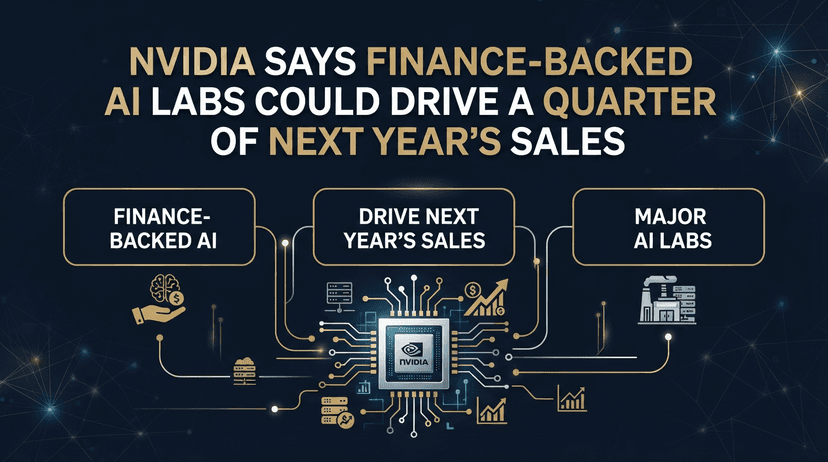
Nvidia says demand from AI labs it helps finance could account for about a quarter of its business next year , highlighting how deeply the chipmaker is now tied to the build-out of artificial intelligence infrastructure. The company’s comments came as it outlined a year-ahead forecast that pointed to continued rapid growth, while also underscoring a financing model that is drawing fresh scrutiny across the AI industry. Chief Financial Officer Colette Kress told analysts that demand from AI labs backed by Nvidia’s balance sheet will contribute roughly 25% of the company’s business next year. Reuters reported that Nvidia paired that guidance with an expectation of 70% sales growth next year, signaling that the company still sees broad demand beyond the biggest cloud providers. Yahoo Finance similarly quoted Nvidia as saying that demand from AI labs will account for about a quarter of business next year. The disclosure matters because Nvidia is not only selling chips to these companies; it is also helping finance parts of the ecosystem that buy its hardware. Reporting this week said Nvidia has invested nearly $50 billion in frontier AI labs and has helped line up more than $500 billion in third-party capital for AI infrastructure through partnerships with major firms including Apollo, BlackRock, Blackstone, Goldman Sachs and KKR. That creates a tightly linked loop: Nvidia supports the financing, the financed companies build data centers, and those facilities are then filled with Nvidia’s GPUs. Nvidia says the arrangement is not purely dependent on any one customer or project. Kress said the company’s platform is “fungible and durable,” meaning chips and systems can be redeployed if a partner changes plans or if demand shifts. Reuters added that Nvidia described demand from AI labs as part of a more diversified customer base, alongside hyperscale cloud providers and so-called neo-clouds. Still, the scale of the financing has become a key story in its own right. Artificial Intelligence News described the setup as “circular financing,” noting that Nvidia’s capital support can help labs build data centers that in turn purchase Nvidia hardware. The report also said Kress referred to credit support covering nearly two gigawatts for one unnamed lab, though she did not identify which company would receive that backing. The broader backdrop is Nvidia’s continued financial dominance in the AI chip market. In its most recent fiscal fourth quarter, the company reported record revenue of $68.1 billion, up 73% from a year earlier, with data center sales accounting for $62.3 billion of that total. That performance has helped make Nvidia one of the most closely watched companies in global markets, especially as investors try to assess how much of AI demand is driven by genuine end-user adoption versus financing-heavy expansion. Supporters of Nvidia’s approach argue that it is simply helping accelerate infrastructure build-out at a moment when AI companies need vast amounts of compute power and capital. Critics, however, see the risk of overdependence on a self-reinforcing cycle in which funding, purchasing, and revenue are increasingly intertwined. For now, Nvidia’s message is that the demand is real, broadening, and large enough to keep the company growing at extraordinary speed. What remains to be watched is whether this financing-backed demand proves durable if the AI market cools, or whether it becomes a warning sign that some of the industry’s biggest growth projections were built on unusually aggressive capital support. Nvidia’s latest guidance suggests the company is confident the answer is the former, at least for now.

Nic Reeve·
AInews: M&T Bank’s Tech Reboot Sets Stage for Enterprise‑Wide AI Rollout
AI & Tech

AInews: M&T Bank’s Tech Reboot Sets Stage for Enterprise‑Wide AI Rollout

On September 2, 2026, M&T Bank confirmed that it has deployed AI copilots and other enterprise tools to more than 15,000 employees as part of a broad expansion of enterprise artificial intelligence, capping a technology overhaul that began in 2018 and positioning the bank as a regional leader in data‑driven operations. How large is M&T Bank’s enterprise AI rollout? M&T Bank’s enterprise AI rollout now reaches the majority of its workforce. According to Yahoo Finance in September 2026, the bank has deployed AI copilots to over 15,000 employees, while Forbes reports that around 16,000 staff actively use generative AI tools for daily work as of August 2026. The expansion of AI tools inside M&T Bank is now one of the largest documented deployments in a U.S. regional bank. Key figures include: According to Forbes, August 2026: approximately 16,000 employees use generative AI tools across the enterprise. According to Yahoo Finance, September 2026: AI copilots support more than 15,000 employees in tasks such as call analysis, report drafting and code generation. According to ArtificialIntelligence‑News, September 2026: initial pilots involved about 800 employees before scaling across the organization. According to AIM Media House, December 2025: Microsoft 365 Copilot and Copilot Chat had been rolled out to roughly 17,000 employees by early 2025. Most of these tools run on Microsoft’s Copilot suite, delivered through M&T Bank’s modernized cloud and data architecture. Staff now access generative models through Office applications, internal chat interfaces and embedded features in existing business systems. What concrete AI use cases are live inside M&T Bank? M&T Bank is using enterprise AI in internal operations, risk management, software development and commercial credit monitoring, rather than front‑end customer interactions. These use cases combine Microsoft Copilot with specialist platforms from vendors like RDC.AI and Rich Data Co. According to Yahoo Finance and ArtificialIntelligence‑News, the current internal and risk‑oriented applications include: Analyzing call‑center conversations to identify customer needs and emerging portfolio risks. Drafting reports, internal communications and meeting summaries for employees across departments. Generating and reviewing software code to accelerate development and maintenance work. Spotting potential fraud patterns and strengthening cybersecurity monitoring. Beyond copilots, M&T has introduced domain‑specific AI platforms in commercial credit: According to the Banking Tech Awards USA showcase, May 2026: M&T Bank partnered with RDC.AI in 2025 to replace manual, rules‑based commercial credit monitoring with an AI‑driven continuous monitoring platform. The same source notes the platform supports over 1,200 relationship managers and credit associates, providing automated alerts on borrower risk and portfolio exposure. AIM Media House reports that M&T is also integrating Rich Data Co.’s decisioning platform via vendor nCino, and adopting Amperity’s customer data cloud to unify interactions and tailor communications across channels. These tools sit on top of the bank’s controlled data environment rather than feeding directly into unsupervised decisioning. What technology overhaul enabled M&T Bank’s current AI expansion? M&T Bank’s push into large‑scale AI follows a multi‑year effort to fix data and legacy systems first. The bank began a broad technology overhaul around 2018, rebuilding its data governance, cloud architecture and application landscape to support modern analytics and regulated AI adoption. Forbes describes how M&T “built a strong data foundation” in Buffalo that now underpins dozens of generative AI use cases across three pathways: enterprise fluency, embedded capabilities in existing applications and proprietary models. Key elements of that foundation include: According to Forbes, May 2025: an expanding portfolio of cloud‑based data products and ongoing retirement of legacy platforms. According to CDO Magazine, December 2025: a medallion architecture layered over cloud‑enabled data products, with clear accountability at each layer. According to Portfolio by BISA, September 2025: a central data repository called Edison, supported by lineage tools from Solidatus and Monte Carlo to track data movement. According to Windows Forum reporting, March 2026: a centralized cloud data strategy designed to create a unified “Customer 360” view and reduce reconciliation overhead by decommissioning legacy analytics tools. M&T Bank’s Chief Data Officer Andrew Foster has emphasized that trusted data is the prerequisite for generative AI. Portfolio by BISA quotes him saying that reliable lineage and governance are essential to controlling operational, compliance and reputational risk as AI use scales. How does M&T Bank govern data and AI across such a large deployment? M&T Bank has built AI governance on top of its data controls rather than treating it as a separate exercise. The bank uses a federated data model, medallion architecture and strict lineage tooling, and sequences AI projects to follow maturity in oversight and risk management. AIM Media House describes a stepwise blueprint for AI adoption at M&T Bank: Reset data governance, lineage and controls before major AI pilots. Run six‑month proofs of concept with tools like Microsoft Copilot before enterprise rollout. Deploy internal copilots widely, while keeping customer‑facing applications limited and heavily supervised. Layer in domain‑specific AI, such as commercial credit monitoring and customer‑data platforms, only where oversight frameworks are mature. Portfolio by BISA reports that Edison and lineage platforms help the bank trace data sources for AI outputs, supporting internal audits and regulator reviews. Windows Forum’s analysis of Western New York banks highlights M&T’s published AI policies, inventory of models and continuous monitoring with alerts for drift and anomalies as part of its risk controls. Which employees and business units are most affected by M&T Bank’s AI expansion? M&T Bank’s AI deployment affects office staff, technologists and risk professionals far more than frontline customers. Copilot access is wide across corporate functions, while specialized platforms target commercial credit teams and analytics groups using the bank’s cloud data environment. Based on reports from Yahoo Finance, Forbes and AIM Media House, the main groups using new AI tools include: Customer service and call‑center agents, who use AI to summarize calls and identify next‑best actions. Operations staff, who rely on copilots to draft emails, reports and meeting notes. Software engineers and technology teams, where copilots assist with coding, documentation and troubleshooting. Risk managers and credit associates, who use RDC.AI’s commercial credit monitoring platform. Marketing and analytics teams, who work with Amperity’s customer data cloud and Rich Data Co’s decisioning tools to refine targeting and product offers. AIM Media House quotes M&T’s data leadership stressing that the bank is “not going to the customer‑facing side yet” for broad generative AI use, underscoring a decision to focus on staff productivity and risk insights before AI touches customer decisions directly. What strategy guides M&T Bank’s AI investments and future plans? M&T Bank’s AI strategy combines three main pathways: expanding enterprise fluency, embedding AI into existing applications and building proprietary models using the bank’s own data, all within a regulated and inspection‑ready environment. Forbes reports that the three pathways are: Enterprise fluency, where around 16,000 employees experiment with generative tools to improve productivity and learn their capabilities. Embedded capabilities inside roughly 1,800 applications, many sourced from third‑party vendors, where targeted AI features support tasks like document review and risk scoring. Proprietary development of large language model and agentic solutions built around M&T’s data and processes. ArtificialIntelligence‑News reports that Chief Data Officer Andrew Foster and his team articulated a similar framework: general employee use of generative AI, AI embedded in existing systems and custom solutions aligned with M&T’s distinctive workflows. Forbes and CDO Magazine both describe a “slow to go fast” approach, in which careful groundwork in data, governance and culture enables faster scaling once controls are proven. Looking ahead, public comments and award submissions point to several likely next steps: According to Forbes, May 2025: continued expansion of cloud‑based data products and retirement of legacy platforms as AI demand grows. According to the Banking Tech Awards USA entry, May 2026: deeper integration of continuous AI monitoring in commercial credit, including new analytical measures of portfolio resilience. According to Yahoo Finance, September 2026: exploration of agentic AI for cybersecurity and fraud detection, building on existing detection use cases. How does M&T Bank’s AI journey compare with other regional banks? M&T Bank now stands out among regional banks in Western New York for its focus on centralized data strategy and broad internal AI adoption, while peers such as Five Star Bank are documented as concentrating on AI in specific product lines like indirect auto lending. Windows Forum summaries of local coverage describe two tracks in the region: M&T Bank invests in cloud data architecture, governed customer insights and large‑scale employee access to generative tools. Five Star Bank applies AI more narrowly to product‑level automation and credit decisioning, with smaller deployments. These comparisons show that M&T Bank is using its size and long technology overhaul to treat AI as a company‑wide capability rather than an isolated experiment, emphasizing data discipline and internal fluency before aggressive customer‑facing innovation.

Nic Reeve·