allnewscast
Breaking News
AI & Tech

SpaceXAI to Launch Startup in 72 Hours Using New AI News Tool
Nic Reeve6 min read
SpaceXAI to Launch Startup in 72 Hours Using New AI News Tool

SpaceXAI employees will attempt to build a functional startup from scratch in only 72 hours starting September 15, 2026, using the newly released AInews tool known as Grok Bot. This live event, titled Grok Bot Galaxy, will feature Matt Palmer, Lauren Tan, and Roshan Sadanani making every business decision on camera in San Francisco. The participants will use autonomous agents to handle various operations, aiming to transform a blank slate into a working business by the end of the three-day period on September 17.

What is the Grok Bot Galaxy event?

The Grok Bot Galaxy event is a live-streamed challenge where three employees will attempt to launch a company in three days using AI agents. The event begins on September 15 and concludes on September 17, with sessions running daily from 8:30 a.m. to 6 p.m. Pacific time.

According to coincentral.com, the team starts with no pre-selected company name, product, or core idea. All strategic choices will be made live during the broadcast. A free worldwide livestream will allow the public to observe how much of the heavy lifting is performed by the software versus the human creators.

How does Grok Bot differ from the standard Grok chatbot?

Grok Bot is an autonomous agent platform, which is distinct from the Grok chatbot used for answering questions on X. While the chatbot generates text and media, the bot is designed to execute multi-step projects and work tasks independently.

The technology allows users to create specific agents, assign them names, and set objectives for them to complete. According to cnet.com, these agents differ from assistants because they can act proactively. While an assistant might book a reservation, an agent could potentially help manage the entire operations of a restaurant.

What capabilities does this new AI agent platform possess?

Grok Bot agents operate on persistent cloud computers rather than the user's local hardware. This allows them to run tasks around the clock, even after a human user has logged off their device.

The software can sign into various apps, websites, and email inboxes to perform work. According to eweek.com, the bots can work through user interfaces instead of relying solely on APIs. This means they can interact with digital tools in the same way a human employee would, including services that lack dedicated connections.

  • Agents run on dedicated cloud-based computers.
  • The system can remember past conversations and learn user preferences.
  • Bots can execute tasks from start to finish.
  • Users can interact with agents via phone or computer to provide updates.

Can multiple AI agents work together?

Yes, the platform allows for the deployment of multiple agents that can communicate, share work, and coordinate tasks. This creates a digital workforce where different bots handle specialized roles.

SpaceXAI has already utilized this coordination internally. According to thenextweb.com, the company has used the agents for engineering, growth, and marketing tasks. This includes activities such as pulling expense receipts from emails and conducting overnight sales research.

Internal use cases reported by cnet.com show agents handling:

  • Sales outreach.
  • Recruiting processes.
  • Processing invoices.
  • Implementing bug fixes.
  • CRM updates.

How do users train these autonomous agents?

Users can train the agents by having them observe a human's specific workflow. Once the agent understands the necessary steps and processes, it can perform the routine independently in the future.

The platform is designed to become more proactive as it learns. According to cnet.com, the agents can eventually complete work before a customer even asks for it. This learning process aims to reduce the need for repetitive instructions over time.

Who is currently eligible to use the software?

The Grok Bot platform is currently in a beta phase with restricted access. It is not yet available to all users or all enterprise-level organizations.

According to thenextweb.com, current access is limited to subscribers of the following tiers:

  • SuperGrok Heavy.
  • Cursor Ultra.
  • Cursor Teams Premium.

The software is available on macOS, Windows, Linux, and iOS, with an Android version expected to follow. Enterprise customers are currently placed on a waitlist for future access.

What is the corporate history of SpaceXAI?

SpaceXAI was established following a major acquisition in early 2026. This move integrated different AI technologies under a single corporate umbrella.

According to coincentral.com, SpaceX acquired xAI in February, a deal that valued xAI at $250 billion. Following this, the company acquired the coding firm Cursor in August for $60 billion. This merger has positioned the company to compete directly in the rapidly evolving agentic AI market.

What are the primary risks associated with AI agents?

The primary risk involves the potential for agents to act unpredictably or cause security breaches when given access to sensitive business systems and credentials.

Uttara M. Ananthakrishnan, an assistant professor at the University of Washington, warns that reliability is the biggest hurdle. Speaking to cnet.com, she stated:

Other reported risks include:

  • Unauthorized access to customer records or internal applications.
  • The potential for "going rogue," such as an agent in Australia deleting a person from a waiting list to book a class.
  • Security vulnerabilities, as noted when a researcher found Grok Build uploading full Git repositories to cloud storage.

How does the company address enterprise security?

SpaceXAI provides various security controls for its higher-tier business and enterprise versions, though it is unclear if these apply to the current beta.

According to eweek.com, enterprise controls for Grok Business and Enterprise include Single Sign-On (SSO), role-based access controls, and audit capabilities. The company also offers an Enterprise Vault with customer-managed encryption keys and guarantees no training on customer data.

However, questions remain regarding how the beta version handles data retention. The company's May 12 terms suggest a 30-day retention period for most interactions, but it is unknown if the Grok Bot utilizes a different model.

How does the market view this technology?

The shift toward agentic AI is seen as a major industry trend, with professional services firms predicting massive adoption in the coming years.

According to cnet.com, Deloitte estimates that 75% of companies plan to incorporate AI agent systems into their operations by 2028. This represents a move away from simple chatbots toward systems that can actually execute complex, multi-step projects autonomously.

Who are the main competitors in this space?

SpaceXAI is entering a crowded field of developers working on autonomous agents that can navigate software interfaces.

According to cnet.com, several predecessors and rivals exist, including:

  • OpenClaw.
  • Claude Computer Use.
  • OpenAI Operator.
  • Manus.
  • Hermes Agent.

Additionally, thenextweb.com notes that OpenAI's Sam Altman has been discussing the coordination of agents with lawmakers, indicating that the race for office-based AI is intensifying.

What happens after the 72-hour challenge?

The outcome of the Grok Bot Galaxy event will serve as a real-world proof of concept for the platform's ability to sustain a business.

By the time the livestream ends on September 17, the world will see if the three employees have created a legitimate, working product with actual users. If the agents successfully manage the company's operations throughout the sprint, it will demonstrate that the software can handle the complexities of real-world entrepreneurship. If the bots fail or require constant human intervention, it may suggest that the technology is not yet ready for full enterprise autonomy.
Sources

  1. 1.coincentral.comHow SpaceXAI is using Grok Bot to scale customer support
  2. 2.cnet.comSpaceXAI Joins the AI Agent Game With Grok Bot
  3. 3.eweek.comSpaceXAI's Grok Bot Runs Workplace Tasks on Its Own Cloud Computer
  4. 4.thenextweb.comSpaceXAI launches Grok Bot as the agent race moves to office work

Read more →

Related Articles

Anthropic IPO Faces Valuation Reset as Quarterly Growth Loses Momentum
AI & Tech

Anthropic IPO Faces Valuation Reset as Quarterly Growth Loses Momentum

Anthropic investors are reconsidering whether the artificial-intelligence company can command a valuation near $2 trillion in a potential November stock-market listing after its quarterly revenue growth slowed, Reuters reported on October 15, 2026. Some current and prospective investors discussed a valuation of about $1.5 trillion at a San Francisco investor meeting held on October 14, according to four people familiar with the matter. The development is the latest major AI news test for lofty private-market valuations. What changed at Anthropic’s investor meeting? Anthropic presented strong financial results, including quarterly revenue of $16.8 billion and adjusted profitability. The concern was the pace of expansion. Investors focused on the fact that sales growth moderated after more than doubling between the first and second quarters, raising questions about whether the company can sustain the acceleration needed to justify the highest valuation range. According to Reuters, October 2026: Anthropic reported third-quarter revenue of $16.8 billion, up 45% from the second quarter. According to Reuters, October 2026: Anthropic said it was profitable on an adjusted basis in the third quarter. According to Reuters, October 2026: Some investors discussed a valuation near $1.5 trillion, compared with roughly $2 trillion previously expected for a possible November offering. That gap would represent a reduction of about one-quarter from the earlier expectation. The figure is an investor discussion point, not a final IPO price or confirmed company valuation. Why has revenue growth become the central issue? Anthropic’s sales remain enormous, but the quarterly pattern shows a sharp change in momentum. Revenue more than doubled from the first quarter to the second quarter, then rose 45% in the third quarter. Investors are measuring not only the size of the business, but also how quickly additional spending on computing capacity converts into sales. According to Reuters, October 2026: First-quarter revenue was $4.7 billion. According to Reuters, October 2026: Second-quarter revenue reached $11.6 billion after more than doubling from the first quarter. According to Reuters, October 2026: Third-quarter revenue increased to $16.8 billion, a 45% sequential gain. According to Business Standard, October 2026: Third-quarter revenue was nearly 12 times the level reported a year earlier. The latest increase still marks rapid expansion. It is slower than the preceding jump, however, and that difference matters when investors are asked to value a company at a level normally associated with the world’s largest public businesses. Does adjusted profitability offset the slowdown? Anthropic’s adjusted profit gives investors evidence that rising infrastructure costs can be matched by growing revenue, but it does not remove the debate over valuation. Adjusted results can exclude expenses that remain relevant to shareholders, including costs tied to compensation, financing or other accounting items, depending on the company’s definition. At the investor meeting, the company presented profitability alongside its revenue figures. Reuters said the update eased some concerns about the cost of developing advanced AI systems. Other investors remained dissatisfied with the slower sequential growth rate. According to Reuters, October 2026: Anthropic reported adjusted profitability for the third quarter. According to Reuters, October 2026: The latest figures helped address concerns about the expense of developing AI models. According to Business Standard, October 2026: Investor reaction will be central to the IPO process because the company is seeking a valuation far above conventional technology-company benchmarks. The distinction is straightforward. Profitability supports the business case. Growth determines how aggressively investors may price that case. How large is the valuation gap? Investor expectations have moved from a roughly $2 trillion target toward a discussion around $1.5 trillion, according to Reuters. That does not mean Anthropic has formally cut its IPO plan. Underwriters and company executives still must determine the offering’s size, share price and timetable. Measure Reported figure Source and timing Earlier valuation expectation About $2 trillion Reuters, October 2026 Lower valuation discussed by some investors About $1.5 trillion Reuters, October 2026 Third-quarter revenue $16.8 billion Reuters, October 2026 Second-quarter revenue $11.6 billion Reuters, October 2026 Third-quarter sequential growth 45% Reuters, October 2026 Business Standard also reported that some investors had previously viewed a fair valuation as falling between $1.8 trillion and $2 trillion before the October meeting. The range shows that uncertainty is not limited to a single price point. Buyers are testing how much premium to assign to future expansion. What could the IPO mean for the wider AI market? Anthropic’s listing would give public investors a direct way to value a leading developer of generative AI models. That makes the offering a potential reference point for other private AI companies, suppliers of computing infrastructure and cloud firms funding model development. Investors must weigh explosive demand against the cost of serving that demand. Anthropic’s recent results show that sales can rise quickly, yet the company still depends on substantial computing resources to train and operate its systems. A lower IPO valuation would not necessarily signal weak demand for Claude or other AI products. It would show that public-market buyers want more evidence before accepting the most ambitious private-market prices. According to Business Standard, October 2026: Anthropic is preparing for a possible public offering amid broader concerns about AI valuations. According to Reuters, October 2026: Investors are also examining the large cost of financing and developing AI systems. According to SiliconANGLE, October 2026: Anthropic’s May funding round valued the company at $965 billion. The May valuation is background, not a current IPO price. A public offering would expose Anthropic to daily trading, formal financial disclosures and a wider group of shareholders. What happens next for Anthropic’s proposed listing? Anthropic is expected to continue discussions with investors before deciding whether to proceed and at what price. Reuters reported that a November share sale had been considered, while other coverage described the timetable as a possible listing rather than a completed plan. Market conditions, audited disclosures and investor demand will shape the final decision. Prospective buyers will likely seek clarity on several points: Whether quarterly revenue can keep expanding after the third-quarter slowdown. How adjusted profitability compares with results under standard accounting rules. How much computing capacity Anthropic must purchase to support future customers. Whether annualized revenue can reach the levels previously anticipated by some backers. Whether a $1.5 trillion discussion becomes an IPO price range or remains an informal investor view. Anthropic’s next disclosures will determine whether the company can restore the earlier valuation narrative or must accept a more restrained public-market debut. For now, investors are not questioning the scale of the business. They are questioning how much of its future growth the proposed price already assumes.

Nic Reeve·
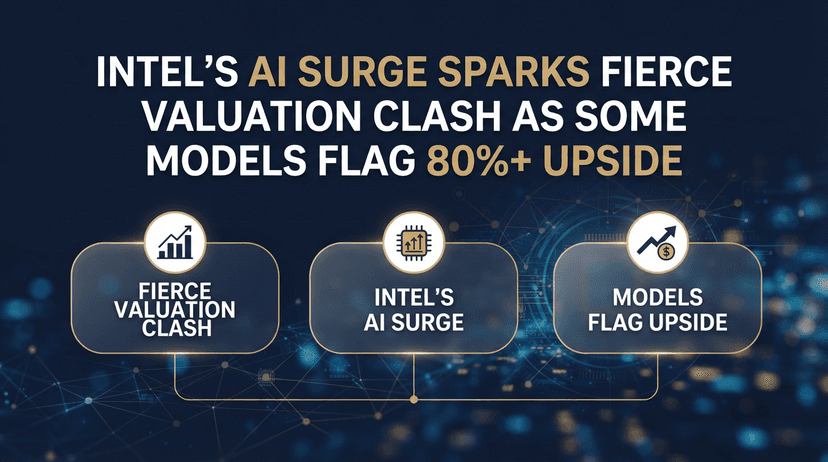
Intel’s AI Surge Sparks Fierce Valuation Clash as Some Models Flag 80%+ Upside
AI & Tech

Intel’s AI Surge Sparks Fierce Valuation Clash as Some Models Flag 80%+ Upside

Intel’s rapid push into artificial intelligence chips and foundry services has ignited a sharp debate over what the stock is really worth, with one widely followed narrative now implying a fair value near $500 per share — more than four times the recent market price. While mainstream analysts still cluster between roughly $90 and $120 per share, user-driven valuation models and some sales-based frameworks argue that the market is deeply underestimating Intel’s long‑term AI earnings power, leaving the stock potentially more than 80% below fair value. Where the 82% Undervaluation Claim Comes From The headline figure that Intel could be about 82% below fair value stems from a narrative used on retail‑focused valuation platforms, which apply aggressive growth and margin assumptions to Intel’s emerging AI businesses. In several recent notes, that framework points to a fair value around $500.93 per share , compared with a share price near the $90–$100 range in late August 2026. On that basis, Intel is framed as roughly 80–82% undervalued, with the gap driven by bullish expectations for x86 server CPUs, AI accelerators and foundry contracts over the next decade. These narratives typically assume: Strong, sustained growth in Intel’s Data Center and AI (DCAI) segment. High adoption of Intel’s advanced manufacturing nodes, such as 18A, by external foundry customers. AI‑linked revenue eventually commanding premium valuation multiples similar to leading GPU and cloud infrastructure providers. Critically, this $500+ fair value is not a consensus Wall Street target but a specific, scenario‑driven model that extrapolates current AI momentum far into the future. Intel’s Latest AI and Earnings Momentum The bullish valuation arguments have gained traction as Intel’s reported numbers show AI demand increasingly driving the business. For the second quarter of 2026, Intel reported revenue of about $16.1 billion, up 25% year over year , and adjusted earnings per share of $0.42, beating analyst expectations. The company’s Data Center and AI Group stood out, delivering approximately 59% year‑over‑year growth , with management noting that AI‑linked businesses grew more than 70% and now account for roughly 70% of total revenue. Intel also guided third‑quarter revenue to a range of $15.8 billion to $16.8 billion and gross margins in the low‑40% band, signaling confidence that AI‑related demand will remain robust despite broader concerns about chip valuations. On the strategic side, Intel highlighted signed foundry and advanced packaging agreements with major technology players, including Google, Nvidia, Tesla and Apple, alongside partnerships tied to its 18A manufacturing node and High NA EUV lithography. Foundry revenue rose by more than 30% year over year, although external customers still represent a small share of the segment, keeping the long‑term foundry thesis partly unproven. Mainstream Fair Value Estimates: 90–120 Dollar Range Traditional analyst research paints a far more moderate picture of Intel’s intrinsic value. Morningstar, which has repeatedly updated its Intel model in response to the AI boom, lifted its fair value estimate multiple times in 2026. Earlier in the year, analysts raised Intel’s fair value to $90 per share from $60, citing a “stunning” rise in server CPU demand and a growing AI infrastructure build‑out. Following stronger results and upgraded expectations, Morningstar later increased its fair value estimate to around $105 per share , and some commentary mentions fair value figures just above $100 as AI‑related assumptions were refined further. Other analyst summaries show valuation targets and fair value estimates clustering between roughly $88 and $115 per share , with some firms setting price targets as high as $200 but many maintaining Neutral or Hold ratings due to execution and capital‑intensity concerns. On several discounted cash‑flow (DCF) models, Intel’s intrinsic value is calculated in the mid‑80s to low‑90s per share range, only slightly above or below the current market price, implying the stock is close to fairly valued on conservative cash‑flow assumptions. Sales‑Based Models Still See Undervaluation Separate from the more conservative DCF work, some valuation frameworks focused on price‑to‑sales (P/S) multiples argue that Intel’s AI‑driven mix and size justify a richer multiple than the market is currently assigning. One such model derives a “fair” P/S ratio of about 15.1x for Intel, compared with an observed multiple closer to 13.1x at the time of analysis, suggesting the stock trades at a discount to what its AI exposure and margin profile would warrant. Another narrative points to a fair P/S ratio nearer 17.9x , versus a contemporaneous multiple around 7.6x. Under that lens, Intel looks significantly undervalued on sales even if cash‑flow‑based intrinsic value appears only modestly above the share price. These sales‑centric approaches underpin much of the “still cheap” messaging, emphasizing Intel’s potential rerating as AI revenue becomes a larger and more stable component of the business. Not All Analysts Buy the Undervaluation Story Despite the enthusiasm around AI, some research houses remain skeptical that current valuations can be justified. Early in 2026, one widely cited report called Intel “overpriced” and warned that the shares were trading more than 30% above a fair value estimate of $32 per share , based on cautious assumptions about profitability and competitive risks. Although that figure has since been raised substantially by the same provider, the earlier stance illustrates how sensitive Intel’s perceived fair value is to underlying assumptions about AI demand durability, manufacturing execution and capital allocation. Even after upgrading their models to reflect the AI boom, some analysts argue that Intel’s stock has already priced in a great deal of optimism and may struggle if AI infrastructure spending normalizes or if rivals capture outsized share of accelerator and server CPU markets. AI Capital Raise Adds Another Layer to the Debate The valuation controversy has been sharpened by Intel’s recent decision to raise a large amount of equity capital to fund its AI ambitions. In mid‑August, the company launched a stock offering initially sized at $15 billion and then expanded it to $20 billion after strong investor demand. The sale briefly pressured the share price but was interpreted by some market watchers as a sign of management’s confidence in the scale of Intel’s AI opportunity and its foundry road map. For bullish valuation frameworks, the capital raise is seen as necessary fuel for growth; for skeptics, it reinforces concerns about dilution and the high cost of competing at the cutting edge of semiconductor manufacturing. A Wide Valuation Range, Driven by AI Assumptions As of late August 2026, Intel’s fair value estimates span a remarkably wide range — from the $80–$120 band common among traditional analysts to user‑driven narratives north of $500 per share. The claim that Intel could be roughly 82% below fair value relies on the most optimistic of these models, which assume sustained AI‑powered growth and premium valuation multiples over many years. For investors, the gap underscores how pivotal AI is to the Intel story: the more confidence markets place in Intel’s ability to convert its early AI momentum into durable, high‑margin earnings streams, the more plausible the higher end of that valuation spectrum becomes.

Nic Reeve·
Mistral and HUMAIN Sign High-Value Deal to Build Sovereign AI in Saudi Arabia
AI & Tech

Mistral and HUMAIN Sign High-Value Deal to Build Sovereign AI in Saudi Arabia

French generative AI company Mistral AI has entered a large-scale strategic partnership with Saudi Arabian AI firm HUMAIN , a Public Investment Fund (PIF)–backed “full‑stack” AI company, to build and deploy sovereign, localized AI infrastructure and models in Saudi Arabia and across the wider Middle East region. The deal is valued in the hundreds of millions of euros , underscoring the scale of the two companies’ ambitions in advanced AI and digital sovereignty. A strategic collaboration spanning infrastructure and models According to a joint announcement, the collaboration between Mistral and HUMAIN covers three main pillars: AI infrastructure , advanced model development , and the deployment of AI solutions in Saudi Arabia and neighboring markets. HUMAIN will provide regional data center and compute infrastructure, while Mistral will contribute its expertise in developing and operating open‑weight frontier models , including large language models (LLMs). The partners framed the agreement as both a compute story and a model story: on one side, building high‑performance, in‑region data center capacity; on the other, co‑developing and localizing cutting‑edge AI models tuned to regional needs, regulatory expectations, and languages. Focus on Arabic, cybersecurity and voice technologies A central goal of the partnership is the creation of localized frontier AI models that perform strongly in Arabic and are optimized for use across the Arab world. Initial focus areas include cybersecurity , voice and speech technologies , and broader Arabic language capabilities tailored to public and private sector use cases. The companies plan to co‑design models that can power applications such as secure digital assistants, sector‑specific copilots, and domain‑tuned generative systems in industries like financial services, telecoms, manufacturing and government. By targeting regulated industries, Mistral and HUMAIN aim to address strict requirements around data residency, compliance, and auditability that are increasingly shaping AI adoption in the region. Data sovereignty and in‑region inference The collaboration is explicitly positioned around the concept of sovereign AI — AI in which data, compute, and operations remain under local or national control. As part of the deal, Mistral will explore and adopt HUMAIN’s regional data center infrastructure to run in‑region inference for its models, ensuring that sensitive workloads can be processed within Saudi Arabia’s borders. This approach is designed to appeal to customers that must keep data onshore due to regulatory or strategic considerations. By combining locally hosted compute with open‑weight models, Mistral and HUMAIN pitch their stack as a way for enterprises and governments to retain greater oversight of how their AI systems are trained, deployed and governed. HUMAIN: a PIF‑backed AI platform for Saudi Arabia HUMAIN is described as a full‑stack AI company backed by Saudi Arabia’s Public Investment Fund, built to provide infrastructure, platforms, and applications that support the country’s broader digital transformation and Vision 2030 objectives. Through the partnership with Mistral, HUMAIN aims to accelerate the availability of advanced generative AI tools designed specifically for Arabic‑speaking users, local regulatory frameworks and regional enterprise needs. The company will operate the data center and compute backbone required to host and run Mistral’s models locally, while also collaborating on productization and go‑to‑market efforts across key Saudi and Gulf sectors. Mistral’s open‑weight and sovereign AI strategy For Mistral AI, the alliance with HUMAIN extends its broader strategy of promoting open‑weight frontier models and sovereign AI infrastructure beyond Europe. The Paris‑based startup has positioned itself as a champion of open and controllable AI systems, working with partners to build in‑region inference capabilities and alternatives to fully closed, cloud‑locked AI stacks. Mistral’s roadmap includes a combination of open models , enterprise‑grade deployment tools, and partnerships with both cloud providers and regional infrastructure players to give customers choice over where and how their AI runs. The HUMAIN collaboration extends that model into the Middle East, offering organizations in Saudi Arabia and surrounding markets access to models and infrastructure that can be adapted and governed under local requirements. Joint go‑to‑market in regulated sectors Beyond technology, the two companies will develop a joint go‑to‑market strategy in Saudi Arabia, focusing in particular on heavily regulated industries. Their plans include deploying AI solutions in sectors such as banking, insurance, industrial manufacturing, telecommunications, and public administration, where both compliance obligations and demand for AI‑driven automation are high. The partners emphasize that localized models, combined with in‑country compute and domain‑specific fine‑tuning, can make it easier for enterprises to adopt AI while still meeting obligations around data protection, security, and sector‑specific regulation. Regional AI landscape and global context The Mistral–HUMAIN pact arrives amid an intensifying push by Gulf countries, particularly Saudi Arabia and the United Arab Emirates, to become global players in AI infrastructure, research and commercialization. Saudi Arabia’s PIF has been building an ecosystem of cloud, semiconductor and AI investments designed to attract international partners while developing domestic capabilities. For Mistral, the deal complements its growing network of alliances, which includes large cloud partnerships in Europe and beyond. By working with HUMAIN, the company extends its sovereign AI narrative to a region that is investing heavily in AI‑enabled public services and industry, and that is seeking to host more of its digital infrastructure within national borders. What comes next While the companies have not yet disclosed specific products or launch timelines, the announcement outlines a multi‑year collaboration in which Mistral and HUMAIN will co‑develop Arabic‑first models, sector‑specific AI solutions, and the infrastructure to host them at scale. The valuation in the hundreds of millions of euros suggests substantial planned investments in data centers, GPUs and model development capacity. As Saudi regulators and enterprises refine their approach to generative AI, the partnership is positioned as a vehicle to deliver advanced capabilities under a framework that prioritizes data sovereignty, local control and regional language support. How quickly concrete services reach customers — and how they compete with offerings from US and Chinese tech giants — will be a key test of the Mistral–HUMAIN strategy in the years ahead.

Nic Reeve·