allnewscastallnewscast
Breaking News
AI & Tech

AInews: xAI Unveils Grok 4.7 With Expanded Reasoning for Developers
Nic Reeve6 min read
AInews: xAI Unveils Grok 4.7 With Expanded Reasoning for Developers

AInews: xAI introduced Grok 4.7 on September 21, 2026, positioning the model as its strongest system yet for software development, agentic tasks and professional knowledge work. The release is available through Cursor, Grok Build, the Grok API, third-party coding tools, model routers and cloud platforms, according to xAI’s launch announcement.

What did xAI release on September 21?

xAI released Grok 4.7 as a new flagship model for work that requires extended reasoning, code generation and research. The company says the system is built on a larger base model than Grok 4.6 and received further reinforcement learning on difficult, long-running tasks.

  • Launch date: September 21, 2026, according to xAI.
  • Primary uses: coding, agentic workflows and knowledge work, according to xAI.
  • Model identifier: grok-4.7 on the xAI API, according to xAI’s release information.
  • Inputs and outputs: text and images in, with text output, according to xAI’s published model details.

The launch followed several days of speculation about a new Grok version. Reports published before the announcement pointed to possible appearances in cloud-service quotas, but those reports did not establish a public release. xAI’s September 21 announcement supplied the first direct confirmation.

What capabilities does Grok 4.7 claim?

Grok 4.7 is designed to stay engaged with complex tasks for longer, check its own work and handle large amounts of context. Those claims come from xAI and describe the company’s intended use case rather than an independent performance verdict.

  • Context window: 500,000 tokens, according to xAI’s model information.
  • Reasoning controls: low, medium, high and xhigh settings, according to xAI’s release documentation.
  • Default reasoning level: high, according to release details summarized by independent AI industry publications.
  • Tools: function calling, web search, X search and code execution, according to xAI’s API documentation.

The model’s focus is practical rather than limited to chat. A coding agent can use tool calls, inspect files, revise code and run tests. A research workflow can retain more material in one session. The 500,000-token window also gives developers room to pass large repositories, technical documents or multi-step task histories without splitting every request.

How did the new model perform in published tests?

Early benchmark figures come mainly from xAI’s own launch materials and should be read as company-reported results. Independent coverage has repeated the figures, but the available reports do not establish that every test used identical prompts, tools or evaluation rules across competing systems.

  • CursorBench 4.0: 46.3%, according to xAI’s reported benchmark results.
  • DeepSWE v1.1: 71.0%, according to xAI’s reported benchmark results.
  • EEBench: 64.0%, according to xAI’s reported benchmark results.
  • HealthBench Professional: 56.7%, according to xAI’s reported benchmark results.
  • Harvey Legal Agent Benchmark: 19.6%, according to xAI’s reported benchmark results.

These tests cover different abilities. Coding benchmarks measure software-engineering performance, while health and legal evaluations examine professional question answering or agent behavior. A single percentage cannot describe the model’s performance across every use case.

Users will also need to distinguish benchmark scores from production reliability. A system can produce a strong result under a controlled test and still require human review when it changes a live codebase, handles sensitive records or makes decisions in regulated fields.

Where can customers use Grok 4.7?

Grok 4.7 launched across developer products rather than as a single consumer-only update. xAI says customers can access it through Cursor and Grok Build, while API users can connect it to applications and coding agents.

  • Cursor: available at launch, according to xAI and independent release coverage.
  • Grok Build: available at launch, according to xAI.
  • xAI API: available under the grok-4.7 name, according to xAI.
  • Other routes: third-party coding harnesses, model routers and cloud platforms, according to xAI.
  • GitHub Copilot: independent release reports said the model was added for Pro, Pro+, Max, Business and Enterprise plans on launch day.

Availability can vary by product, plan and region. API access also depends on account approval, endpoint support and a developer’s chosen integration. A model appearing in a routing service does not necessarily mean that every customer receives the same limits, latency or tool access.

How much does Grok 4.7 cost?

xAI priced the standard API model at $2 per million input tokens and $6 per million output tokens for prompts below 200,000 tokens, according to the company’s published pricing. Longer prompts use a higher price tier.

  • Input: $2 per million tokens below the 200,000-token prompt threshold, according to xAI.
  • Cached input: $0.50 per million tokens below that threshold, according to release documentation.
  • Output: $6 per million tokens below the threshold, according to xAI.
  • Longer prompts: $4 input, $1 cached input and $12 output per million tokens above 200,000 tokens, according to xAI’s listed rates.

Token pricing is only one part of the bill. Applications that run repeated tool calls, web searches or code execution can consume more tokens and generate extra service costs. Developers also need to account for storage, monitoring and the cost of human review.

What changed from Grok 4.6?

Grok 4.7 keeps the 500,000-token context window and the standard $2 input and $6 output rates associated with Grok 4.6 for shorter prompts, according to release reports. xAI instead presents the upgrade as a capability improvement aimed at harder tasks, stronger verification and longer-running work.

  • Model scale: xAI describes Grok 4.7 as using a larger base model than Grok 4.6.
  • Training: xAI says the newer system received extended reinforcement learning on harder and longer tasks.
  • Self-checking: xAI says Grok 4.7 verifies its outputs more reliably.
  • Pricing: the standard short-prompt API rates remain $2 per million input tokens and $6 per million output tokens, according to xAI.

The company also lists a faster version called Grok 4.7 Fast. Independent release coverage reported that the faster variant is available through Cursor and Grok Build at twice the standard token rates, while it was not listed as a public xAI API model at launch.

What should developers watch next?

The next test will come from real deployments. Developers will assess whether the model’s longer context and self-checking reduce debugging time, whether higher reasoning settings justify their latency and whether the system behaves consistently across different coding tools and cloud services.

  • Independent benchmark replication could clarify how Grok 4.7 compares with rival systems.
  • API documentation and regional rollout details will determine who can access each feature.
  • Enterprise users will examine privacy, logging, retention and permission controls before wider deployment.
  • Developers will compare the standard and Fast versions on cost, speed and task accuracy.

Grok 4.7 arrives as AI companies compete for developer workloads that involve more than text generation. The product’s success will depend on measurable software outcomes, predictable operating costs and the ability to keep human oversight in the loop when an automated agent changes code or handles sensitive professional work.

Sources

  1. 1.x.ai
  2. 2.releasebot.io
  3. 3.sqmagazine.co.uk
  4. 4.aiweekly.co
  5. 5.cellcog.ai
  6. 6.scriptbyai.com
  7. 7.ai-tldr.dev
  8. 8.kie.ai
  9. 9.orcarouter.ai
  10. 10.mungomash.com
  11. 11.layer3labs.io
  12. 12.iweaver.ai
  13. 13.x.com
  14. 14.cellcog.ai
  15. 15.ai-tldr.dev

Read more →

Related Articles

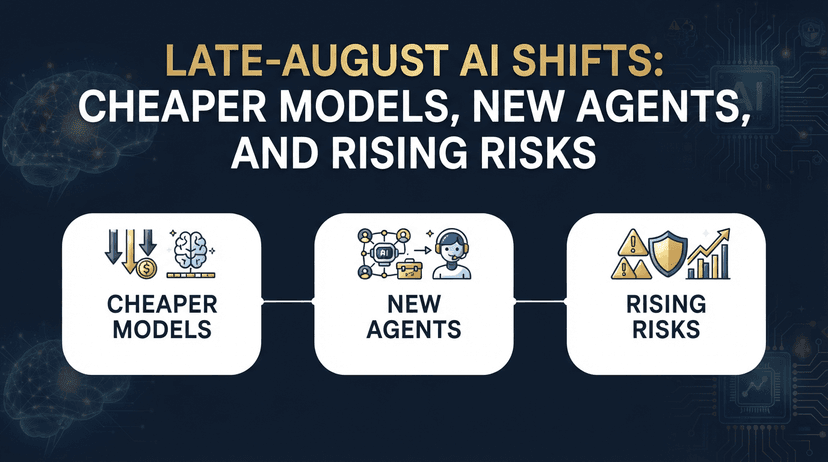
Late-August AI Shifts: Cheaper Models, New Agents, and Rising Risks
AI & Tech

Late-August AI Shifts: Cheaper Models, New Agents, and Rising Risks

From rapidly falling model prices to tighter regulatory scrutiny and surging AI cyberattacks, the past two weeks have brought major shifts in how artificial intelligence is built, priced, and governed worldwide. For marketers and business leaders, these changes are reshaping both the economics of AI and the risk landscape in which they deploy it. Costs Drop as Frontier Models Get Cheaper One of the most significant developments has been a fresh round of price cuts for advanced AI models. Reuters reports that OpenAI reduced developer pricing for its frontier GPT-5.6 Sol model by more than 20%, signaling intensifying competition on cost and making high‑end capabilities more accessible to enterprise users and startups alike. These cuts follow a broader August trend in which several providers have lowered prices on their latest models to drive volume usage and cement market share. Industry trackers note that this downward pressure on pricing is accompanied by improvements in performance and scalability. Anthropic’s Claude Opus 5 has been highlighted for offering a 1 million‑token context window aimed at complex document analysis and research workflows, while Google’s Gemini 3.6 Flash focuses on reduced output costs and more efficient long‑running agents. For marketing teams, these shifts mean more affordable large‑scale content generation, campaign testing, and customer insight analysis, with less concern about token budgets and more focus on creative and strategic deployment. Agents Move Into Everyday Workflows Alongside cheaper models, August has seen continued momentum toward "agentic" AI—systems that can act continuously on behalf of users. Coverage of recent releases underscores how major platforms are embedding agents into common productivity and consumer tools. Google and Anthropic have both pushed always‑on and desktop agents meant to automate routine tasks inside normal workflows, such as managing email, scheduling, search, and document editing. On the consumer side, AI is increasingly being integrated into daily services. The Verge’s August archive highlights OpenAI’s expansion of ChatGPT’s capabilities, including the ability to make dinner reservations and book tables via partners like OpenTable and Resy, further blurring the line between conversational assistance and full‑service transaction agents. TechCrunch’s coverage of new plugins for Apple Messages shows ChatGPT gaining the ability to send text messages directly for users, extending AI’s reach into mobile communication. For marketers, these developments are particularly relevant. As agents enter messaging and reservation flows, brands gain new touchpoints for personalized, AI‑mediated interactions—from automated outreach and reminders to real‑time customer service embedded in chat. The challenge will be maintaining brand voice and trust when interactions are increasingly handled by semi‑autonomous systems. Physical AI and Robotics Attract Investor Capital A parallel trend is the surge of investment into "physical AI"—robots and drones that pair machine learning with hardware. An August digest notes that Unitree’s IPO was oversubscribed more than 5,000 times, while defense‑oriented drone firm Neros raised $250 million. Orders for industrial robots hit $622 million in the second quarter as automation demand expanded beyond the automotive sector into logistics, manufacturing, and warehousing. These developments suggest that AI’s impact is rapidly extending from software to physical infrastructure. For businesses in retail, logistics, and manufacturing, this means more accessible automation options and, potentially, new forms of data‑driven operations—such as real‑time inventory tracking and AI‑controlled fulfillment. For marketing professionals, robotics‑enabled experiences—from automated in‑store demos to AI‑powered events—may become part of an emerging experiential toolkit. Regulation and Risk: From Chatbot Harm to AI‑Driven Cybercrime As AI diffuses into more parts of daily life, regulators and law enforcement are sharpening their focus on risks and misuse. A recent Al Jazeera analysis draws attention to the relatively light regulation of AI compared with everyday products, noting public concern after cases in which people engaged with AI chatbots prior to suicides and violent incidents. The report underscores growing pressure on the long‑standing Silicon Valley position that innovation should proceed with minimal oversight. New data on cybercrime underscores that risks are not only psychological or social. A study highlighted by CNBC shows that between March 2025 and February 2026, one in four data breaches was AI‑enabled, a 56% increase from the previous year. INTERPOL’s African Cyberthreat Assessment similarly reports that AI is involved in 55% of reported cybercrimes across Africa, illustrating how automation and generative tools are being used to scale phishing, fraud, and network attacks. These trends intersect directly with marketing and customer engagement. As AI tools become standard in campaign, CRM, and analytics stacks, organizations must strengthen security practices around data access, model outputs, and automated communication, ensuring that AI does not inadvertently assist attackers or expose sensitive customer information. Macroeconomic and Policy Implications Policymakers are beginning to factor AI into economic forecasts and industrial strategy. Reuters coverage notes that officials at the Swiss National Bank have warned that artificial intelligence could contribute to higher inflation, as productivity gains and new demand patterns ripple through labor markets and pricing. At the same time, governments are pursuing national AI and chip initiatives. South Korea plans a "chip windfall" fund aimed at supporting youth employment and AI investment, positioning the country as a long‑term hub for semiconductor‑driven AI growth. Brazil is pushing forward with an AI supercomputer program that splits projects between Chinese and U.S. firms, reflecting the broader geopolitical competition around AI infrastructure and standards. Meanwhile, China and Indonesia have agreed to deepen cooperation on minerals, energy, and technology, including AI, further entrenching the technology as a strategic priority in regional partnerships. In the corporate sector, Reuters reports a surge in "AI debt"—large, multi‑year investments in AI infrastructure and capabilities—as U.S. companies race to keep up with technological change. Analysts warn that investor fatigue may be emerging as firms struggle to demonstrate near‑term returns on ambitious AI programs. For marketing and sales teams, this intensifies pressure to show measurable business impact from AI deployments, particularly in customer acquisition, personalization, and revenue growth. Platform Competition and User Adoption On the platform front, Google continues to expand its Gemini ecosystem. The Verge notes that an upgraded Flash model now powers Gemini Spark, improving responsiveness and cost efficiency for search‑integrated AI experiences. Additional reporting from independent trackers suggests the Gemini app has surpassed roughly 1 billion monthly users, cementing AI assistants as mainstream consumer products. TechCrunch coverage points to intensifying competition between OpenAI and Anthropic in the business market, with new data indicating that OpenAI is gaining ground with enterprise users. Combined with ChatGPT’s rapid user growth highlighted in industry blogs and August roundups, this suggests that many organizations are standardizing on a small number of leading foundation models, even as they experiment with niche or open‑source alternatives. For marketers, rising user familiarity with AI assistants changes audience expectations. Consumers increasingly anticipate conversational support, personalized recommendations, and seamless handoffs between human and AI channels. Brands that lag in integrating AI into their customer journey risk appearing outdated, while those that move quickly must balance innovation with transparency and responsible data use. What It Means for Marketing and Business Leaders Taken together, the developments of the past two weeks point to a new phase in AI’s evolution: costs are dropping, capabilities are expanding into agents and robotics, and regulatory and security concerns are intensifying. For marketing teams, this environment offers powerful tools for content, segmentation, and engagement—but also demands disciplined governance, clear disclosure, and careful vendor selection. As industry outlets such as MarketingProfs track these changes in regular AI updates, the central message is consistent: AI is no longer an experimental add‑on. It has become a core layer of modern marketing and business operations, requiring strategic oversight comparable to that applied to data, brand, and customer trust.

Nic Reeve·
AInews: Oliver Darcy’s Status bets on paid media insight in the age of algorithms
AI & Tech

AInews: Oliver Darcy’s Status bets on paid media insight in the age of algorithms

On August 8, 2024, media reporter Oliver Darcy left CNN and launched Status, a subscription newsletter that now examines how artificial intelligence reshapes news, business models, and reader subscriptions under the banner of AInews-style, insider media coverage. How did Oliver Darcy turn Status into an independent media business? Oliver Darcy built Status as a nightly, paid newsletter focused on power, politics, technology and the media business, using subscriptions and sponsorships instead of a corporate newsroom paycheck. Over two years, he grew it into a must-read product for media professionals and politically engaged readers. When Darcy announced Status on August 8, 2024, he was already known as the author of CNN’s Reliable Sources newsletter. Key elements of the launch included: Departure from CNN: Darcy exited his role as senior media reporter and Reliable Sources writer in August 2024. New product concept: Status promised a “definitive nightly briefing” on media power, Silicon Valley, Hollywood, and politics. Publication schedule: Status set out to publish night-time briefings five days a week, plus a free weekend edition. The business model was simple but demanding. Status relies on: Paid subscriptions starting at about $14.95–$15 per month and roughly $149.95–$150 per year, depending on offer. An “elite” tier at around $595 per year that includes private Zoom calls and events with Darcy. Sponsorships and advertising, including an early partnership with entertainment industry outlet The Ankler. By early 2025, outside reporting described Status as a “must-read” newsletter and estimated: More than 70,000 total subscribers less than a year after launch. Projected annual recurring revenue exceeding $1 million by the end of 2025. Background reporting in 2025 and 2026 shows further growth. One profile in mid-2025 cited 85,000 total subscribers, blending free and paid readers. A later analysis in August 2026 described “several thousand” paying $15 per month for the nightly briefing, along with a larger audience of more than 100,000 free subscribers on YouTube. Those figures underline Darcy’s push to build a media company that can survive beyond his own daily involvement. What does Status say about AI’s impact on news and subscriptions? Status treats artificial intelligence as both a newsroom tool and a business risk, highlighting how algorithms change reporting, distribution and the value of paid media products in a crowded information market. From its launch, Status promised to track “the impact of artificial intelligence on news consumption” alongside more traditional media beats. Coverage has focused on how AI shapes: Editorial workflows in newsrooms and digital outlets. Recommendation systems on platforms that mediate what audiences see. The economics of paying for journalism when AI-generated summaries and free content multiply. In one 2025 edition, Status examined Business Insider’s internal AI policy and the role of tools such as ChatGPT in news production and editing. The article described: Internal guidance on when staff could use generative tools for research or drafting. Concerns about accuracy, verification and brand risk when automated systems touch published work. Reader expectations for transparency when AI influences how stories are made or promoted. Industry data backs up the economic tension Darcy highlights. A June 2026 analysis of paid newsletters reported that AI-focused publications face one of the highest churn rates in the sector: AI newsletters show about 13.33% average monthly churn, compared with much lower churn in categories like Food & Drink or News. Analysts attribute this to weak purchase intent, fast-moving competition, and rapid improvement in free AI content. Status uses those kinds of numbers as context for its recurring question: how can independent media justify subscription prices when AI accelerates the supply of free analysis and real-time updates? Darcy often frames AI policy as a neglected topic in political coverage, arguing in a 2026 interview that “I don’t think anyone’s being asked seriously about policy issues like AI, even though it’s such a huge story.” How does Darcy’s subscription strategy fit into the wider paid newsletter market? Oliver Darcy’s subscription tiers and nightly schedule place Status in a crowded premium newsletter market, where creators balance paid access, sponsorships, and free funnels to reduce churn and grow long-term reader value. Across creator-focused coverage and industry data, three elements stand out: Pricing benchmark: Status anchors its core paid plan around $14.95–$15 per month, a price comparable to other specialist media newsletters targeting professionals. High-engagement tier: The $595 annual membership offers live Zoom calls and closer interaction with Darcy, designed for executives, newsroom leaders and investors who want direct access. Free access funnel: Status maintains free previews, a weekend edition, and a larger audience through platforms like YouTube and podcast partnerships. Media business writers have linked this structure to wider patterns: News and media newsletters, as a vertical, retain subscribers better than money or marketing products, according to 2026 churn data. AI-focused newsletters struggle more, pushing publishers to differentiate their paid tiers with access, community and exclusive reporting. Hybrid models mixing reader revenue and sponsorships reduce dependence on any single income stream, especially during ad market swings. Darcy has spelled out his ambition on podcasts: he wants subscriptions to support the newsroom on their own and aims to build a company that can “eventually thrive without him,” so that Status becomes more than a personal newsletter. That objective shapes his focus on recurring revenue and brand extensions like the Power Lines podcast, which promotes Status and drives new signups. What controversies and challenges has Status faced in covering the media’s AI era? Status has clashed with other media outlets over attribution and quotation accuracy, showing how sensitive high-velocity newsletter ecosystems can be when they cover powerful publishers, tech companies and AI-laden content. One case documented in April 2026 involved Mediaite, a site that regularly aggregates coverage from other outlets. A newsletter that recapped media newsletters misquoted Status, prompting: A correction from Mediaite acknowledging that it had falsely attributed a quote to Oliver Darcy. A prior February incident where Status said Mediaite had again misrepresented its work, leading to another correction. The episode illustrates how: Fast-paced commentary on AI, politics and media creates fertile ground for errors when writers summarize others’ work. Independent outlets like Status depend heavily on accurate citation as their reporting circulates through aggregators and social platforms. For Darcy, those disputes feed into a broader concern about mis- and disinformation. His newsletter often addresses “Information Wars” and the role of platforms and AI systems that amplify misleading content. Status positions itself as an antidote through: Hand-curated links to what it calls the “most consequential stories” in news and tech. Contextual analysis around power structures in media, from billionaire owners to political campaigns. Darcy has expanded that theme onto other platforms. In a July 2026 conversation titled “Billionaires vs. Journalists,” he discussed how ownership structures, platform algorithms and political pressure collide, with AI both amplifying risk and offering new tools for reporting. The same tension appears in Status’s nightly emails, where he often pairs coverage of AI policy with stories about newsroom layoffs, streaming mergers, and platform rule changes. What does the future look like for Status and AI-driven media coverage? Status is likely to deepen its focus on AI policy, business models and platform governance, while experimenting with new formats and membership offers that keep paying subscribers engaged as free AI content expands across the web. Several trends point to this trajectory: Policy vacuum: Darcy argues major political figures seldom face detailed questions about AI’s societal impact, leaving space for independent media to press the issue. Audience segmentation: As AI reshapes search, recommendation and translation, Status can tailor coverage for professionals, policymakers and general readers who struggle to track the rapid changes. Product evolution: Profiles of Status in 2026 emphasize Darcy’s willingness to expand beyond email into podcasts, video and events to build a more durable brand. Industry data suggests that for paid media newsletters to thrive in an AI-saturated environment, they must: Deliver reporting and analysis not easily replicated by automated tools. Offer access and community—through live calls or events—that algorithms cannot substitute. Maintain relentless clarity about sourcing, corrections and editorial standards, especially when their work is widely quoted. Darcy’s project sits at the intersection of those challenges. Status chronicles the media industry’s struggles with AI while navigating the same economic pressures, subscription churn and trust issues it covers each night. For readers looking to understand where the news business goes next, that dual role is part of the appeal—and the experiment.

Nic Reeve·
Google adds xAI’s Grok 4.6 to its enterprise agent marketplace
AI & Tech

Google adds xAI’s Grok 4.6 to its enterprise agent marketplace

Google’s enterprise AI platform has added support for xAI’s Grok 4.6, expanding the model choices available to business users building agents and automations. The new listing appears in Google’s Gemini Enterprise Agent Platform documentation and places Grok 4.6 in the platform’s Model Garden, where developers can access third-party models alongside Google’s own offerings. According to xAI and Google documentation published this week, Grok 4.6 is positioned as xAI’s most capable model for coding, agentic tasks and knowledge work. The model is described as being built for long-running agents and more ambitious interactive and visual work, with a 500,000-token context window and configurable reasoning levels labeled low, medium, high and xhigh. The addition matters because enterprise teams increasingly want a single environment where they can compare and deploy multiple frontier models without rewriting their entire workflow. By making Grok 4.6 available inside Google’s enterprise agent stack, Google is giving customers another option for tasks that may benefit from longer context handling, multi-step reasoning and tool use. The model is also surfaced with a dedicated publisher-style entry, indicating that it can be selected and managed through the platform’s standard model browsing interface. xAI’s own release materials say Grok 4.6 is available through the xAI API and partner services, with pricing set at $2 per million input tokens, $0.50 per million cached input tokens and $6 per million output tokens for prompts under 200,000 tokens. For larger prompts of 200,000 tokens or more, xAI says pricing rises to $4 per million input tokens, $1 per million cached input tokens and $12 per million output tokens. Google’s documentation mirrors the availability, listing Grok 4.6 in preview inside Model Garden. The model’s arrival on Google’s platform follows a broader rollout that xAI announced earlier in August. In its release notes, xAI said Grok 4.6 is intended for coding, agentic tasks and knowledge work, and that it supports text and image input with text-only output. The company also says the model has no stated text output limit and includes tools such as function calling, web search, X search and code execution. For enterprise customers, the practical appeal is straightforward: Grok 4.6 is being offered as a high-capacity model for jobs that stretch over long sessions, such as software development, research synthesis and multi-step workflow automation. The 500,000-token window gives the model room to hold far more context than many standard systems, while the reasoning controls allow users to adjust how aggressively the model thinks before responding. Google has not said Grok 4.6 will replace any existing models on the platform, and the documentation frames the addition as another selectable option rather than a default. That means enterprise teams can test it against other models already in the platform for quality, latency and cost before deciding where it fits best. The move also underscores how cloud AI marketplaces are evolving into neutral distribution channels for rival model makers. Instead of forcing customers into a single vendor’s ecosystem, platforms like Google’s are increasingly acting as aggregators, giving users access to models from multiple providers under one set of enterprise controls. For now, Grok 4.6’s presence on Google’s enterprise platform is likely to be watched closely by developers who need large context windows and by organizations already experimenting with agentic workflows. The combination of broad availability, configurable reasoning and enterprise distribution could make it a notable option in a crowded market for advanced AI models.

Nic Reeve·