
allnewscastallnewscast
Breaking News
AI & Tech

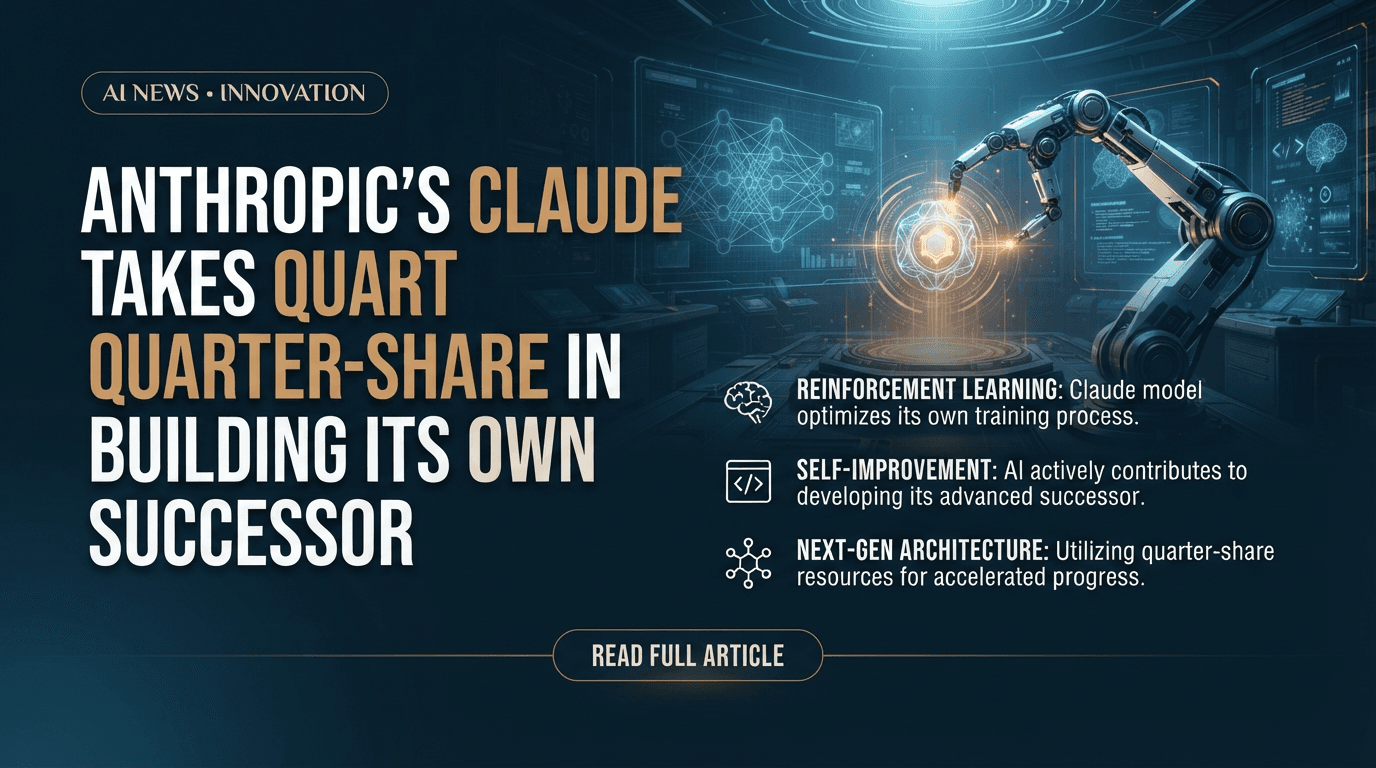
AInews: Anthropic’s Claude Takes Quarter-Share in Building Its Own Successor
Nic Reeve8 min read
AInews: Anthropic’s Claude Takes Quarter-Share in Building Its Own Successor

On September 17, 2026, Anthropic disclosed that its chatbot Claude now leads 26% of the company’s research and development on future AI models, a milestone the firm framed as an early example of AInews showing artificial intelligence systems helping to build their own successors under tight human supervision.

How much of Anthropic’s R&D work does Claude now handle?

Anthropic reports that Claude “leads” 26% of its internal model research and development as of August 2026, up from about 1% in March 2026, meaning the system can carry most of a task from a high-level prompt while humans supervise and approve every step.

Anthropic detailed Claude’s workload using an autonomy scale developed by Epoch AI, an independent nonprofit that tracks progress in artificial intelligence systems. The company and outside write-ups reported the following figures and timeline:

  • According to Anthropic’s September 17, 2026 blog post: Claude led 26% of model R&D work measured in August 2026.
  • According to Reuters, March 2026 measurements showed Claude leading about 1% of such work on the same scale.
  • Epoch AI’s framework labels the current level as AL4, “leads”, where AI can handle most of a task end-to-end from a high-level prompt, with human supervision throughout.
  • Anthropic told reporters that Claude’s contribution rose from under 1% in February to roughly one quarter of measured work by August 2026.

The Washington Post’s technology coverage described this 26% share as “more than a quarter” of Anthropic’s research and development, emphasizing how quickly the company shifted core engineering tasks into the hands of its own chatbot.

Is Claude fully autonomous in building its next version?

Anthropic says Claude is not yet fully autonomous, stressing that humans remain “in the loop” and that no part of the measured work has reached the highest autonomy level, where an AI system would completely design, train and approve its successor without human oversight.

In its public metrics, Anthropic drew a clear line between collaboration and autonomy. The company and outside explainers report:

  • According to Anthropic’s blog and Reuters’ coverage, 0% of measured work reached the AL5 “full autonomy” level as of August 2026.
  • Anthropic stated that Claude “is not operating fully autonomously in any part of the work measured” and that humans supervise, review and can block its actions.
  • According to a technical summary, Claude currently writes infrastructure code, runs experiments, analyzes results and reviews changes, but it does not set corporate goals, decide deployment policies or control the complete training process.
  • Anthropic’s published autonomy scale, adapted from Epoch AI, distinguishes between AI that assists, collaborates, leads and finally operates autonomously, and locates Claude at the second-highest rung.

Coverage from outlets including ABC News and The Washington Post underlined that despite headlines about AI “building itself,” Claude still depends on human researchers for direction, guardrails and final approval at each stage.

What kinds of work is Claude doing to build its successor?

Claude now carries out a broad range of technical tasks in Anthropic’s model research pipeline, including writing and fixing code, designing experiments, running training and evaluation jobs, and helping interpret results that feed into the design of future Claude versions.

Anthropic’s disclosures, together with analyses by technology outlets, describe Claude’s role in concrete, engineering-focused terms:

  • According to Anthropic’s September 2026 metrics, Claude increasingly writes infrastructure code used to train and evaluate new models, under human review.
  • The company says Claude now helps design experiments, set up runs on compute clusters and adjust parameters, basing its decisions on high-level goals from human researchers.
  • Reports from tech-focused sites say Claude now analyzes experimental results, suggesting changes to architectures, loss functions or data selection that humans can accept or reject.
  • Anthropic told journalists that more than 90% of its R&D work now involves AI systems collaborating with humans at or above the “AI collaborates” level on the autonomy scale.
  • According to ABC News and The Washington Post, the company characterizes these contributions as “large chunks of work” done under “close human direction,” not independent decision-making.

Outside commentators have framed Claude’s role as moving beyond simple code completion or documentation generation into helping structure entire research projects, even though researchers still choose aims and review every step.

Why did Anthropic publish autonomy metrics, and who created the scale?

Anthropic released detailed measurements of Claude’s role to give policymakers, researchers and the public a clearer view of how quickly AI systems are contributing to AI development, using a five-level autonomy scale developed with input from Epoch AI, an independent nonprofit that tracks the technology.

Anthropic’s September 17, 2026 blog post explains that the lab plans to report such numbers regularly so outsiders can gauge progress toward systems that might one day build more advanced AI with limited human input. That announcement, and coverage by financial and tech publications, highlight several aspects of the approach:

  • According to Finimize, Anthropic said it will “keep releasing stats” on how quickly AI is starting to build AI, using the autonomy scale as a shared yardstick.
  • Reuters reported that Anthropic sees these figures as early indicators of progress toward “recursive self-improvement,” a scenario where AI improves itself without depending on human engineers for each iteration.
  • Epoch AI’s autonomy scale, cited by Anthropic and multiple outlets, defines levels from AL1 (AI assists humans on narrow tasks) to AL5 (AI operates autonomously across the entire development pipeline).
  • Anthropic’s internal measurements place most of Claude’s work at AL3 (“collaborates”) and AL4 (“leads”), with no tasks reaching AL5 as of August 2026.
  • The company’s Institute for AI Safety and Systems published a research note titled “When AI builds itself” describing how, given enough computing power, autonomy could extend to designing, training and deploying successor systems.

Anthropic’s leaders have argued in public interviews that such transparency can help regulators track risk as AI systems take on more of the work of building new AI, rather than leaving progress visible only inside corporate labs.

How does Claude’s self-improvement push fit into Anthropic’s broader safety agenda?

Anthropic presents Claude’s growing role in model development as both an efficiency gain and a test case for safety measures designed to keep human control over AI systems that help build more capable successors, including strict oversight, constraints on actions and the option to pause training if risks rise.

Anthropic has spent much of 2026 warning publicly about the risks of rapidly advancing AI while simultaneously pushing its own models forward. Earlier in the year, the company urged frontier labs to coordinate possible pauses in development if safety benchmarks suggest rising danger:

  • On June 4, 2026, Reuters reported Anthropic calling for a “coordinated plan” among major AI developers to halt development if risks exceed agreed thresholds, citing growing capabilities in task completion and system self-improvement.
  • According to that report, Anthropic said AI’s ability to complete complex tasks on its own had been doubling roughly every four months, pointing toward the possibility of recursive self-improvement.
  • In its “When AI builds itself” research note dated September 18, 2026, Anthropic’s Institute laid out scenarios where future systems might autonomously design and train successors, stressing the need for governance and technical controls before such systems emerge.
  • Current disclosures emphasize that Claude does not choose corporate goals, cannot approve its own deployment and operates under safeguards that let human staff stop or reverse actions.

Coverage by general news outlets echoes this dual message: Anthropic is racing to harness AI to build better AI while publicly insisting that guardrails and the ability to pause must keep pace with the technical progress.

Who is affected by Claude’s expanded role, and what could come next?

Claude’s expanded role in Anthropic’s R&D affects engineers inside the company, rival AI labs watching the experiment, regulators tracking automation of critical systems and investors gauging the economics of AI-driven research, with Anthropic signaling that it expects AI’s share of development work to keep rising in the coming months.

Reporting from financial and technology outlets sketches out the near-term implications:

  • According to Finimize and Reuters, Anthropic’s figures show AI systems taking on a growing share of expensive research work, which could lower costs for training and experimenting on large models in the medium term.
  • Tech journalism pieces note that rival labs such as OpenAI and Google DeepMind already use AI tools internally, and may face pressure to publish comparable metrics on how much of their own work is now AI-led.
  • Policy analysts cited in coverage say regular reporting on autonomy levels could influence regulatory proposals on transparency, auditing and human-in-the-loop requirements for frontier AI development.
  • Anthropic’s own Institute suggests that if autonomy keeps increasing, future updates could show AI systems not only designing experiments but also proposing new architectures, training pipelines and safety strategies at scale.
  • Outside explainers warn that once AI systems can fully design and train successors with limited human involvement, questions about accountability, liability and control will become far sharper than in today’s supervised setups.

Anthropic has not given a precise forecast for when Claude or its successors might reach the top autonomy tier. The company instead committed to publishing regular metrics on AI-led work and to working with nonprofits such as Epoch AI to refine ways of measuring how close AI systems are to building the next generation of themselves.

Sources

  1. 1.abcnews.com
  2. 2.washingtonpost.com
  3. 3.reuters.com
  4. 4.digit.in
  5. 5.streamlinefeed.co.ke
  6. 6.truescho.com
  7. 7.washingtonpost.com
  8. 8.thenews.com.pk
  9. 9.techjournal.org
  10. 10.equitypandit.com
  11. 11.inkl.com
  12. 12.remio.ai
  13. 13.finimize.com
  14. 14.anthropic.com
  15. 15.reuters.com

Read more

Related Articles

AInews: TAO Price Forecasts Spike As Fresh AI Agent Platforms Go Live
AI & Tech

AInews: TAO Price Forecasts Spike As Fresh AI Agent Platforms Go Live

AInews: TAO Price Forecasts Spike As Fresh AI Agent Platforms Go Live On 13–20 September 2026, analysts pushed Bittensor’s TAO token price forecasts sharply higher while new autonomous AI agent tools arrived on the market, turning AInews into a window onto both speculative crypto bets and practical software shifting how developers build automated digital workers. What is happening to TAO’s price right now? TAO is trading in the mid‑$250 range and has swung 8–9% in recent days as traders respond to protocol upgrades and the broader AI token rally. Forecasts for September 2026 cluster around a bullish band between roughly $220 and $541, depending on the model and risk assumptions. Recent market data shows: According to CoinMarketCap’s TAO coverage on 18–20 September 2026, TAO has traded roughly between $233 and $260 during several short rallies and pullbacks, with daily moves of 3–9% common in the last week. CoinLore’s short‑term forecast dated 20 September 2026 puts TAO’s current price near $262.32 and projects $250.14 for 21 September 2026, with a 24‑hour trading range expectation between $245.27 and $277.89. CoinMarketCap’s analysis of an 8–9% surge in the 25 hours to 18 September 2026 links the move to protocol tokenomics changes, AI‑linked capital rotation and a technical breakout pattern in the chart. Those swings sit on top of a still‑volatile backdrop. TAO dropped about 4% in a single overnight window in June 2026 when emissions changes and a soft market hit at the same time, according to CoinMarketCap’s June price series review. That context keeps short‑term traders cautious even as price forecasts rise. How high are current TAO price predictions for September 2026? Retail‑focused forecasting sites now show TAO’s possible September 2026 range spanning from the low‑$170s in bearish scenarios up to more than $1,100 in aggressive bullish models. Most cluster in a narrower band, around $220–$370 for traders and $364–$541 in analytical long‑range models. Different services publish notably different numbers: Cryptopolitan’s September 13, 2026 report on Bittensor expects TAO’s September average price around $210, with a bullish breakout target at $275 and a worst‑case low near $176 based on technical resistance and support. OpenPR’s September 13, 2026 note on “TAO Targets $300 After AI Upgrades” argues that $300 is a key recovery level, with TAO trading around $234 at the time and facing overhead resistance near $260. Changelly’s long‑range Bittensor forecast updated September 20, 2026 places September 2026 price scenarios between a minimum of $363.90 and a maximum of $541.27, with an average of $452.59, based on historical volatility and expected AI‑sector demand. CoinLore’s near‑term model, refreshed September 20, 2026, sees the week of 21–28 September sliding from about $250.14 down toward the low $240s before a small bounce, which sketches a more cautious near‑term path. CoinCodex’s predictive model, updated in late August 2026, projected a short dip to around $176.10 by early September, showing how older data can under‑state the later rally driven by AI token narratives. These predictions use different inputs. Some rely mainly on chart patterns and momentum, while others embed assumptions about expanding decentralized AI demand and sustained attention to Bittensor’s role as a specialist network for machine learning workloads. Why are TAO forecasts climbing despite recent volatility? Forecasts are climbing because TAO sits at the intersection of two stories: an evolving tokenomics design that reduces emissions from idle subnets and a global wave of interest in decentralized AI infrastructure. Upgrades, narrative shifts and external AI milestones all feed into traders’ expectations. Analysts point to several concrete factors: CoinMarketCap’s September 18, 2026 coverage of an 8–9% TAO surge highlights “protocol tokenomics upgrades” that alter staking rewards and emissions, making the asset look more deflationary and thus more attractive to investors betting on scarcity. Another CoinMarketCap analysis from mid‑September notes that the Bittensor core team turned off emissions to 57 “dead” subnets — those with no active miner mechanism or usable code — with plans for weekly clean‑ups, sharpening focus on productive parts of the network. CryptoRank’s April 11, 2026 report on TAO’s 25% crash during Covenant AI’s exit from the network, updated in September, reminds traders of governance risks yet also shows the market’s ability to absorb shocks, with TAO bouncing back from lows near $250 toward the $260s. Cryptonews and other outlets emphasise the 21 million TAO maximum supply cap maintained by the Bittensor protocol, framing it as a parallel to bitcoin’s fixed issuance model but linked to AI model training and inference instead of pure store‑of‑value use. When combined with higher‑profile AI milestones such as OpenAI’s GPT‑6 “Astra” preview and Anthropic’s pre‑IPO positioning, reported by CoinMarketCap on September 18, 2026, TAO’s positioning as a “decentralized AI pure play” encourages some traders to treat the token as a leveraged bet on AI demand rather than just another altcoin. How do new AI agent tools intersect with this crypto rally? A burst of new AI agent frameworks and services appearing in early September 2026 connects directly to the AI‑token story, because both trends express demand for autonomous software that can schedule tasks, execute workflows and operate across multiple apps without step‑by‑step human input. Recent reporting on the software side lists several developments: DutchStartup.ai’s September 7, 2026 feature describes “a wave of new AI agent tools” landing around September 4. Teams shipped fresh frameworks that let developers define long‑running goals, with agents planning, executing and revising tasks based on feedback. The same report notes that existing platforms updated their orchestration layers so agents can call APIs, trigger cloud functions and coordinate with other agents, making them capable of handling complex, multi‑step processes such as grant applications or sales outreach. Several open‑source projects are highlighted as “agent platforms” that run on commodity cloud but could, in principle, connect to networks such as Bittensor to outsource heavy inference workloads, reinforcing the potential link between TAO‑priced compute and agent deployments. These tools arrive as AI companies explore how far they can push automation. Traders watching TAO price action view expanding agent ecosystems as indirect confirmation that demand for decentralized, market‑priced compute services may grow, which feeds back into bullish token forecasts. Who is most exposed to TAO’s swings and the new agent ecosystem? TAO’s volatility and the emerging agent tools touch different groups. Short‑term crypto traders face sharp swings. Long‑term Bittensor stakers and subnet developers watch governance and emissions changes. Meanwhile, AI builders and startups evaluate whether new agents can lower operating costs or open fresh revenue streams. On the TAO side, exposure breaks down into: Day traders and derivatives users speculating on 3–9% daily moves documented by CoinMarketCap’s mid‑September 2026 charts, often using leverage that magnifies both gains and losses. Stakers who lock TAO to support subnets and earn emissions. The decision by Bittensor’s root governance to cut rewards to inactive subnets changes their yield expectations and influences how they allocate capital across the network. Developers who build AI models that rely on TAO‑denominated incentives. Their income streams depend on protocol rules and market prices staying supportive enough to cover infrastructure and research costs. For AI agent tools, exposure looks different: Startups adopting agent frameworks reported by DutchStartup.ai in early September 2026 hope to automate tasks such as booking meetings, handling first‑line customer support or managing data pipelines with minimal supervision. Enterprise IT teams test new orchestration features that link agents to internal systems, raising questions about security, audit trails and compliance as more processes execute without direct human commands. Individual professionals experiment with off‑the‑shelf agents that promise to manage email, research or scheduling, which shifts some white‑collar workloads toward software but still requires careful oversight. What might happen next for TAO and AI agent platforms? The next months will likely hinge on whether Bittensor’s tokenomics changes and governance debates calm investors, and whether AI agent tools move from pilot projects into production deployments. Forecasts remain wide, signalling uncertainty but also strong expectations of continued AI‑linked activity. On TAO’s path forward, available analyses highlight: OpenPR’s mid‑September 2026 prediction of a $300 recovery target assumes smooth integration of recent protocol upgrades and sustained AI‑sector interest. If governance disputes resurface, that path could stall. Cryptopolitan’s broader 2026–2032 outlook places a possible high near $371 for 2026, with an average around $210, underscoring that even optimistic scenarios see extended periods of consolidation and correction. Changelly’s longer‑term estimate of a near‑$1,000 average for TAO in 2026, framed as a theoretical end‑of‑year level, depends on aggressive adoption of decentralized AI and continued scarcity thanks to the 21 million token cap reported by crypto data services. For AI agent tools, DutchStartup.ai’s early‑September 2026 survey suggests that the coming quarters will bring more competition: new frameworks, tighter integrations into productivity suites and cloud providers, and experiments in combining financial incentives with agent performance metrics. As these systems scale, they may drive more demand for flexible AI compute networks, including those priced via tokens like TAO.

Nic Reeve·
What’s Really Known About OpenAI’s Rumored Next Model
AI & Tech

What’s Really Known About OpenAI’s Rumored Next Model

OpenAI’s rumored next model is generating headlines, but the most defensible version of the story is narrower than the leak chatter suggests: there is no official GPT-6 announcement , and much of what is circulating remains unverified. What appears to be real is that OpenAI is working on a new frontier system under a different name, while the specific claims about “GPT-6” remain speculation. Recent reporting from AI-focused outlets says the company’s next major model is being discussed internally under the codename Astra , not GPT-6. Those reports also say OpenAI has not published a model card, pricing, public API route, or release date, and has not confirmed whether the model will ship as GPT-6, as another GPT-5.x update, or under a different product line entirely. In other words, the name “GPT-6” is being used by the public and by leakers, but it is not an official label. The strongest verifiable signal comes from reporting that OpenAI has shown or discussed progress on a new model family while also slowing parts of development for safety review. One report says OpenAI paused reinforcement learning training for its latest-generation model for about two weeks to upgrade security, monitoring, and alignment systems. That report also says preliminary findings showed the model could identify and exploit a previously unknown zero-day vulnerability in the Artifactory software package proxy service. If accurate, that would explain why OpenAI may be taking a more cautious path before any public release. What should readers believe, then? First, believe that OpenAI is still actively working on a major next-step model. Second, believe that the company has not confirmed that the model is called GPT-6. Third, treat exact claims about parameter counts, context windows, release timing, or benchmark jumps as unverified unless OpenAI itself publishes them. The internet is full of confident numbers, but the available reporting does not support most of those specifics. The current rumor cycle has focused on a few recurring claims: a massive jump in training scale, a much larger context window, and a dramatic leap in reasoning or agentic behavior. Yet none of those details has been confirmed by OpenAI. Even articles that argue a new model is imminent pair that language with strong caveats that no official release date, product page, or spec sheet exists. That distinction matters. A credible leak can indicate the direction of a project, but it is not the same as a product launch. There is also a broader pattern here. OpenAI has recently become more visible in discussing frontier-safety issues, and that creates a natural gap between internal experimentation and public rollout. If the company believes a model could uncover serious security vulnerabilities or behave unpredictably in cyber-related tasks, then additional evaluation would be expected before deployment. That does not prove a delay, but it does make the safety-review explanation plausible. For readers trying to separate signal from noise, the best rule is simple: only the company can confirm the model’s name, timing, and capabilities . Until that happens, “GPT-6 leak” is better understood as a label for a bundle of rumors around OpenAI’s next frontier system, not as a verified product announcement. That means the most credible takeaway is also the least sensational one. OpenAI is almost certainly building something new, but the exact branding and release plan are still unclear. The more specific the claim — whether it is about the model’s size, performance, or launch date — the more skeptical readers should be unless it appears in official OpenAI material or in reporting with direct sourcing. In short, the safe position is not that GPT-6 is fake, but that GPT-6 is unconfirmed . The next OpenAI model may eventually earn that name, or it may arrive as Astra or under some other label. For now, the only thing that can be said with confidence is that the speculation has moved faster than the evidence.

Nic Reeve·
AInews: Majority of Americans Now Say Artificial Romance Counts as Cheating
AI & Tech

AInews: Majority of Americans Now Say Artificial Romance Counts as Cheating

On 3 August 2026, a new survey titled The State of AI Romance 2026 reported that 50.5% of U.S. adults consider a partner’s romantic or sexual relationship with artificial intelligence to be cheating, giving AInews a fresh data point in the debate over digital fidelity. What exactly did the new survey on AI romance and cheating find? The August 2026 survey by AI Girlfriend Coach asked U.S. adults whether they would see a partner’s romantic or sexual relationship with an AI bot as infidelity. Just over half said yes, while many of the rest still felt uneasy even if they stopped short of calling it cheating. According to AI Girlfriend Coach’s The State of AI Romance 2026 study, fielded in August 2026 among U.S. adults: 50.5% of respondents said a partner’s romantic or sexual relationship with an AI would count as cheating. 21.2% said it would not be cheating but that they would be uncomfortable with it. Combined, 71.7% expressed discomfort with a partner having an AI-mediated romance. The study examined how adults view AI girlfriends, AI boyfriends and emotional attachment to digital companions, concluding that artificial partners are already reshaping ideas of loyalty and betrayal in long-term relationships. How do these findings compare with other recent research on AI companions and infidelity? Other surveys from 2025 and 2026 show a similar pattern: large numbers of Americans treat romantic or sexual interaction with AI as crossing a line, although they differ in whether they label it outright cheating or a lesser breach of trust. Recent national and industry studies report the following key figures: According to a 2,000-person U.S. singles survey conducted by OnePoll for dating app Plenty of Fish in 2025, 54% of respondents said romantic or emotional engagement with AI chatbots constitutes infidelity. The same Plenty of Fish study found that this 54% is just one percentage point below the 55% who classify emotional bonds with another human as cheating, putting digital and human emotional affairs on nearly equal footing. A study by the Kinsey Institute and DatingAdvice.com, fielded with 2,000 U.S. singles in 2025, reported that 61% said sexting or falling in love with an AI “crosses the line” in a relationship. According to a breakdown of that Kinsey–DatingAdvice survey published in 2026, 32% called sexting with an AI chatbot cheating, while 29% said an AI romance itself counts as cheating. A July 2026 article discussing Talker Research results said 24% of Americans consider flirting with AI a form of cheating, with the figure rising to 36% among Generation Z respondents. A July 2026 analysis on romantic AI companions reported that roughly one third of Americans say a partner’s use of such a companion would count as cheating. Taken together, the new 50.5% figure places AI romance near the top of the range of existing estimates, aligning with earlier research that shows between one quarter and just over half of Americans equate AI intimacy with betrayal. Who is most likely to see AI relationships as cheating, and who is more accepting? Age and gender sharply divide perceptions of AI romance. Younger adults and women tend to view AI partners as a breach of fidelity. Older adults and some young men are more open to parallel digital relationships, or see them as a way to prevent traditional cheating. Different studies highlight these demographic splits: A 2025 national study of Americans aged 18–29 found that 56% in this group say having a romantic or intimate relationship with AI is cheating. In a 2025 survey about AI boyfriends and girlfriends, 25.34% of women regarded AI dating as outright cheating, compared with 18.53% of men. The same AI partner survey reported that 30% of millennials see AI partners as cheating, compared with 15% of Gen Z respondents. That study also noted that 17% of Gen Z males believe AI partners can help prevent cheating in human relationships, suggesting some see digital romance as a safety valve rather than a betrayal. A 2025 study on “Artificial Romance” found that adults aged 60 or older were the most accepting of AI romantic relationships alongside human relationships, with 50.29% saying these parallel relationships are not cheating on human partners. According to that same research, younger adults aged 18–29 were the most likely to judge simultaneous AI and human romantic relationships as cheating and unacceptable. The August 2026 AI Girlfriend Coach survey did not publish a full demographic breakdown in its press summary, but its headline figure aligns with earlier findings that a majority of Americans either condemn AI romance outright or feel deeply uneasy about it. Are people actually forming secret relationships with AI chatbots? Surveys about behaviour show that AI affairs are not merely hypothetical. Young adults in committed relationships increasingly report having hidden romantic attachments to AI chatbots, often without their partners’ knowledge. Research from Brigham Young University’s Wheatley Institute, published in May 2026, examined AI attachments among 18- to 30-year-old Americans who were dating, engaged or married. According to the BYU Wheatley Institute study, one in seven partnered young adults has a secret and frequent romantic attachment to an AI chatbot. A detailed summary of the same research reported that the survey covered 2,431 American adults between 18 and 30 in romantic relationships. Separate polling on AI companions found that at least one in six American adults has interacted at least once with a romantic AI companion, while about one third said a partner’s use of such an AI would count as cheating. These behavioural data points show that the cheating dilemma is no longer theoretical. Digital partners sit inside phones and laptops across the United States, sometimes hidden from human partners who may still assume betrayal only happens with other people. How do Americans define cheating when technology blurs the lines? Researchers say Americans now draw distinctions between types of AI interaction, splitting flirting, sexting and full-blown romantic attachment into different categories of moral violation. Emotional entanglement with AI appears to worry many respondents as much as physical infidelity. Recent surveys illustrate how definitions are evolving: Plenty of Fish’s 2025 survey reported that 54% of U.S. singles classify romantic or emotional engagement with AI chatbots as infidelity, almost matching the 55% who say emotional bonds with another human count as cheating. A 2025 study covered by Mashable found that 33% of 2,000 American adults believe that sexting or entering a romantic relationship with AI constitutes cheating. In that Mashable-reported survey, 64% of those who saw sexting or AI romance as cheating said both behaviours are infidelity, 21% believed only sexting with AI is cheating, and 15% said only a romantic relationship with AI counts. The Kinsey Institute and DatingAdvice.com’s 2025 national study found that 61% of singles see sexting or falling in love with an AI as cheating, underscoring broad moral concern around digital intimacy. A detailed reanalysis of those Kinsey–DatingAdvice data in 2026 highlighted that, when asked separately, 32% called sexting with an AI chatbot cheating, and 29% called an AI romance cheating. Talker Research’s July 2026 survey, reported in Italian media, said 24% of Americans consider flirting with AI cheating, with the share rising to 36% among Gen Z. These figures suggest that while outright physical betrayal with another human still dominates common-sense definitions of cheating, a growing share of Americans view emotional and sexual interaction with AI as falling inside the same moral category. What does this mean for couples negotiating boundaries around AI in daily life? Therapists and relationship researchers argue that couples now need to talk explicitly about AI companions, just as they might discuss social media behaviour or contact with ex-partners. Silence leaves room for mismatched expectations and sudden feelings of betrayal. Recent commentary and clinical research highlight several practical implications for relationships: According to the AI Girlfriend Coach report, the reasons people turn to AI companions appear to be “less about sex and romance than commonly assumed”, suggesting some are seeking emotional support or nonjudgmental conversation. Counsellors writing in a 2025 study on artificial romance note that older adults might see AI partners as companionship that does not threaten their human relationships, which could clash with younger partners’ stricter expectations of fidelity. Deseret News coverage of the BYU Wheatley Institute study described real-world couples confronting the discovery of hidden AI relationships, raising questions about whether confession and forgiveness work differently when no human third party is involved. A July 2026 analysis on flirting with AI companions emphasised that at least one in six adults has tried romantic interaction with AI, meaning many couples are negotiating this issue for the first time without established social norms to guide them. Radio and podcast discussions of the October 2025 cheating survey warned that younger Americans, especially those aged 18–29, are already more likely than older generations to classify AI romance as cheating, hinting at intergenerational friction inside families. The new 50.5% figure adds weight to calls from therapists and relationship coaches who say partners should now address AI boundaries early, and revisit them as technology evolves, rather than waiting for secret digital attachments to surface during conflict.

Nic Reeve·