allnewscast
Breaking News
AI & Tech

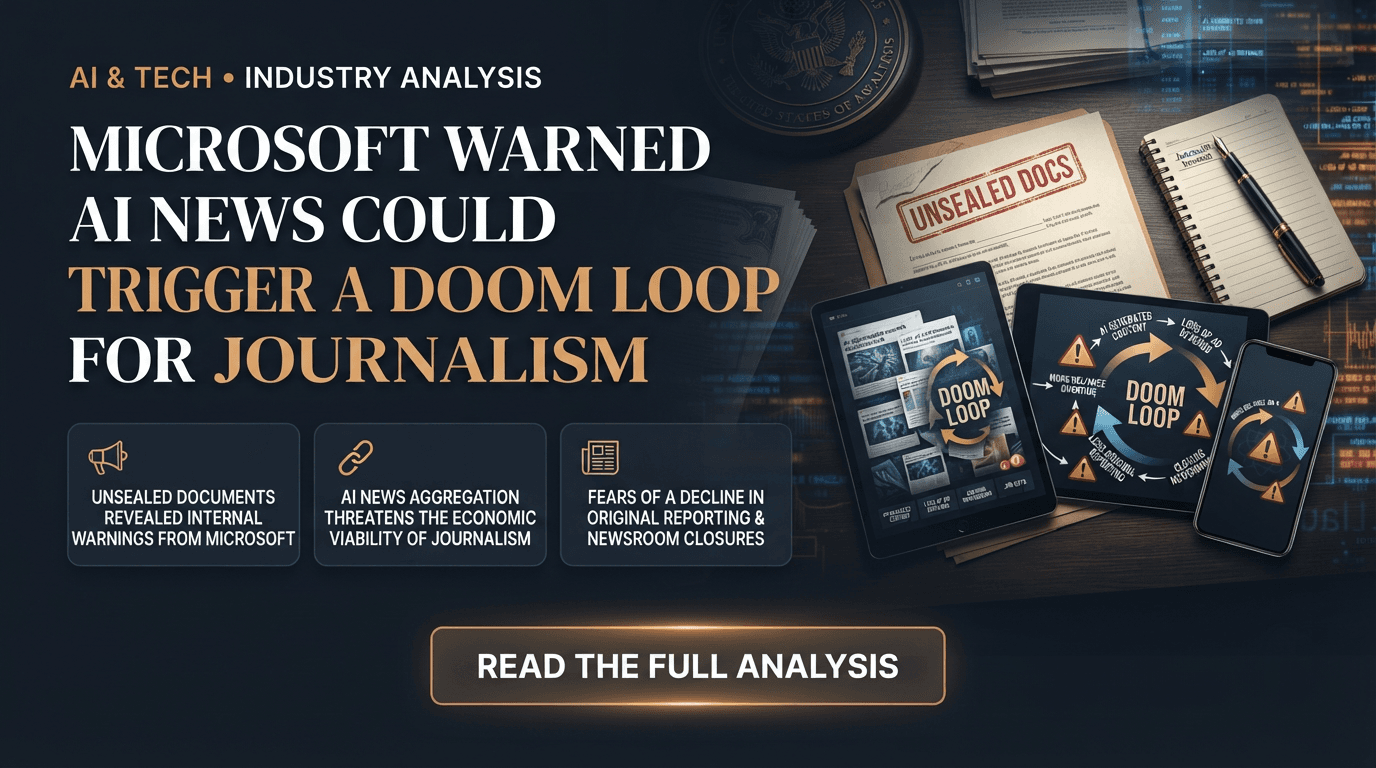
Unsealed Documents Show Microsoft Warned AI News Could Trigger a Doom Loop for Journalism
Nic Reeve8 min read
Unsealed Documents Show Microsoft Warned AI News Could Trigger a Doom Loop for Journalism

On September 17, 2026, newly unsealed court filings in The New York Times’ copyright lawsuit against OpenAI and Microsoft showed senior Microsoft executives warning that their AI news products risk creating a “doom loop” that drains traffic and money from news outlets while degrading the quality of information on the web itself.

What did the unsealed Microsoft documents say about AI and journalism?

The unsealed Microsoft documents describe internal warnings that AI answer engines trained on news articles could both undermine publishers’ business models and weaken the online information ecosystem that those same AI systems depend on.

Key passages from the filings show that Microsoft’s own researchers and product leaders were alarmed by how generative AI systems use and replace journalism:

  • According to TechCrunch, an internal presentation written by Microsoft Director of Applied Science Brent Hecht in January 2024 described the impact of large-scale AI scraping and answer engines as a “doom loop” that would “hurt the performance of our models and the entire web at the same time.”
  • The Washington Examiner reports that Hecht wrote, “Our AI content strategy has started a ‘doom loop’ that will hurt the performance of our models and the entire web at the same time,” calling the situation “highly unusual” because the end product threatens “the economic foundations of its essential suppliers.”
  • Law360 and MLex note that internal documents quote Microsoft and OpenAI employees acknowledging that unlicensed use of millions of news articles could begin a doom loop that endangers their “content supply chain.”
  • The Wrap cites filings where a Microsoft document warns that the companies’ AI approach had started a doom loop that would damage both model performance and “the entire web.”

These statements appear in an unredacted memorandum filed by lawyers for The New York Times in its ongoing copyright case against OpenAI and Microsoft in federal court in Manhattan. The case has been moving through the courts since 2023.

Who inside Microsoft raised alarms about AI scraping and labor “theft”?

Concerns inside Microsoft were led by Brent Hecht, the company’s Director of Applied Science, who repeatedly warned that scraping journalism at scale for AI training amounted to unprecedented theft of human labor.

The unsealed filings attribute several striking internal comments to Hecht:

  • TechCrunch reports that Hecht described large-scale AI scraping of online content as “the largest theft of labor in human history” during internal discussions documented in January 2023 and January 2024.
  • The New York Daily News notes that a senior Microsoft executive believed AI systems built on other people’s work would be seen as “an astonishing theft of unprecedented proportions” and possibly “the greatest robbery of labor in human history,” according to the unredacted court documents.
  • BrandiconImage and The Wrap both quote Hecht calling the copying of news articles “an astonishing theft of unprecedented proportions” and potentially the “largest theft of labor in human history.”
  • TweakTown, summarizing the filings, says Hecht argued that relying on “fair use” to justify mass scraping of news articles made a “complete mockery” of fair use as a legal concept.

These warnings portray internal recognition that the AI training pipelines built on publishers’ work were not just legally risky. They were seen by some of the engineers and scientists responsible for the systems as ethically and economically corrosive for the entire news ecosystem.

How is Microsoft’s AI answer engine affecting traffic to news publishers?

The filings assert that Microsoft’s AI-powered answer tools dramatically cut referral traffic to news outlets, raising fears that this substitution effect could erode the financial base that supports professional journalism.

Multiple sources describe internal metrics and testimony about how AI answers change user behavior:

  • TechBeat reports that unredacted documents say Hecht warned in January 2024 that Microsoft’s Copilot answer engine reduced click-through rates to New York Times articles by up to 93% compared with traditional Bing search results.
  • TweakTown’s summary of the same filings notes internal estimates that AI chatbots and answer boxes could cut publisher traffic by 51% to 94%, depending on the scenario and query type.
  • The Wrap recounts Microsoft CEO Satya Nadella’s testimony that conversations with chatbots had already substituted for visits to news websites by “giving you the information right there on the website on the AI platform versus needing to go to the underlying source.”

These numbers, all attributed to internal assessments and court testimony in 2024 and 2025, suggest that AI answer engines do not simply coexist with news sites. They can replace the need for many users to click through, weakening advertising revenue and subscriptions that depend on direct visits.

What exactly is the “doom loop” Microsoft executives described?

The “doom loop” described in the court filings refers to a self-reinforcing cycle in which AI systems undermine the economic viability of news outlets, leading to worse content on the web, which then harms the AI models that rely on that content.

Internal documents quoted across several reports outline the logic of this loop:

  • Ground News and EuropeSays explain that Hecht’s memo warned generative AI products had created a doom loop that is “eating the web and destroying the businesses that these companies stole from,” by substituting AI answers for visits to publishers.
  • The Washington Examiner cites a Microsoft document saying, “It is highly unusual that an end-product threatens the economic foundations of its essential suppliers, but that is the situation we have created for our LLM business with respect to its ‘content supply chain.’”
  • BrandiconImage notes that the filings describe a scenario in which declining traffic to news sites weakens the broader online ecosystem and ultimately reduces the quality of information available to AI systems.
  • TweakTown’s coverage summarizes the loop as: AI answer engines cut traffic, lower financial incentives for journalists, shrink the supply of high-quality reporting, and then damage the very models that need that reporting for training.

The core idea is simple. Less money for journalism means fewer reporters and less reliable news. AI models trained on that degraded content will perform worse, which harms users and the platforms themselves.

How does the New York Times lawsuit frame these internal admissions?

The New York Times uses the internal Microsoft and OpenAI admissions to argue that the companies knowingly built profitable AI systems on unlicensed news content, while recognizing that this strategy threatened the very publishers who produced that content.

Recent coverage of the unsealed filings outlines the Times’ legal narrative:

  • KuCoin’s legal news summary states that the newly unsealed memorandum in The New York Times v. OpenAI copyright lawsuit was written by Times lawyers and “largely comprised” statements and interviews with tech executives acknowledging that large language models were “built on content described by Microsoft executives as an unprecedented scale of theft.”
  • Ground News reports that the filings present executives’ own words to show that large language models are “predatory” technologies, trained on “stolen content” that pose an “existential risk” to human writers, artists and media companies.
  • MLex describes the new documents as showing knowledge of “AI copying costs to US news companies,” including recognition that unlicensed use of millions of articles to train chatbots could initiate the doom loop and represent the “largest theft of labor in human history.”
  • Law360 notes that Microsoft and OpenAI employees had internally acknowledged for years that tools trained on news articles would likely replace publishers, leading to the doom loop scenario.

By highlighting these internal statements, the Times aims to strengthen its claim that OpenAI and Microsoft knowingly relied on unlicensed journalism while foreseeing the damage to publishers.

What are OpenAI’s internal concerns about publishers and substitution?

The unsealed filings do not focus only on Microsoft. They also reveal internal OpenAI fears that chatbots would become direct substitutes for news publishers, undermining the business case for continued reporting.

Several sources summarize these concerns:

  • According to BrandiconImage, Nick Turley, who led the team developing ChatGPT, warned in a 2023 internal memo that AI represented an “existential threat” to publishers.
  • The Wrap reports that Turley wrote that publishers faced an existential threat from AI products that were already “largely substitutive” and would become more so as the systems improved.
  • Law360 states that OpenAI and Microsoft employees acknowledged for years that AI tools trained on news articles would likely replace publishers, contributing to the doom loop described in the filings.

These internal comments echo the worries of many editors and reporters: if users can ask a chatbot for a summary instead of visiting a news site, long-term funding for independent journalism becomes precarious.

What broader implications does this doom loop have for the future of news?

The doom loop described by Microsoft and OpenAI staff suggests that current generative AI strategies could destabilize the business of news, reduce the quality of information online, and ultimately damage AI systems themselves unless new economic and legal arrangements emerge.

Across the reports, several themes recur:

  • Executives privately agree with publishers’ warnings that generative AI poses an “existential threat” to news organizations when it siphons both content and audience without paying for either.
  • Internal Microsoft discussions emphasize that the economic foundations of journalism are part of the “content supply chain” for AI, meaning that harming publishers also harms AI products over time.
  • The filings highlight the mismatch between short-term gains—offering instant answers that users love—and long-term risks, such as fewer reporters investigating public-interest stories because revenue has collapsed.
  • Several analyses argue that the doom loop concept may push courts and regulators to consider new models, including licensing deals, compulsory fees, or explicit limits on scraping and training data drawn from professional news outlets.

The immediate dispute centers on New York Times content and current AI products. The underlying question is whether the web that AI relies on can survive if its core economic engine—commercial and subscription-supported journalism—is hollowed out by the very systems that now scrape and summarize its work.

Sources

  1. 1.techcrunch.com
  2. 2.nydailynews.com
  3. 3.washingtonexaminer.com
  4. 4.newsbytesapp.com
  5. 5.nypost.com
  6. 6.europesays.com
  7. 7.brandiconimage.com
  8. 8.ground.news
  9. 9.us.headtopics.com
  10. 10.kucoin.com
  11. 11.thewrap.com
  12. 12.law360.com
  13. 13.mlex.com
  14. 14.tweaktown.com
  15. 15.techbeat.co

Read more →

Related Articles

ECRI Targets Hidden AI Failures with New Patient Safety Reporting Channel
AI & Tech

ECRI Targets Hidden AI Failures with New Patient Safety Reporting Channel

Global patient safety nonprofit ECRI is widening its national problem-reporting network to explicitly capture errors, malfunctions, and near misses linked to artificial intelligence (AI) tools and AI-enabled devices used in patient care. The move aims to close a critical data gap as hospitals and health systems rapidly deploy AI for diagnosis, triage, documentation, and patient communication. A New Channel for Tracking AI-Related Harm For decades, ECRI has collected confidential reports on medical device issues and health IT problems from frontline clinicians and healthcare organizations, investigating them and sharing lessons learned back to the reporting sites and the wider industry. With the latest expansion, its Problem Reporting Network now includes a dedicated pathway for incidents where an AI-enabled tool may have contributed to an error, produced an incorrect output, or introduced new risks into care delivery. ECRI is urging healthcare providers, health systems, and clinicians across the United States to submit reports whenever they suspect an AI application played a role in a safety event—whether the error reached a patient or was caught beforehand as a near miss. Reports can cover a broad range of technologies, including diagnostic algorithms, clinical decision-support tools, radiology image analysis systems, risk prediction models, and AI-driven chatbots used in patient engagement. Underreported AI Problems in Clinical Practice The expansion reflects growing concern that AI-related safety issues are significantly underreported compared with more traditional device failures. In a recent ECRI survey of 124 quality, safety, risk, and compliance leaders, nearly one‑third said they had encountered an AI output they believed was incorrect or misleading within the past year. About 9% said an AI error had reached a patient or affected a care decision. ECRI argues that without formal reporting mechanisms, many of these incidents remain invisible to oversight bodies and technology developers. ECRI has previously warned that adverse events involving AI-enabled medical devices and applications are often missed because staff may not realize when AI is running in the background, or they may attribute problems solely to human error or workflow issues. The organization’s guidance emphasizes the need to recognize reportable AI events , identify which products incorporate AI, and conduct risk assessments specific to AI-enabled devices. Examples of AI Errors ECRI Wants Reported The expanded reporting network is designed to capture a spectrum of AI-related safety concerns, including: Incorrect or misleading outputs that influence diagnostic or treatment decisions, such as misclassification of imaging findings or inaccurate risk scores. False positives and false negatives in AI-driven diagnostic tools, even when performance metrics appear acceptable, if they contribute to missed or unnecessary care. Algorithmic bias leading to poorer performance for specific patient groups, including women and racial or ethnic minorities. Unexpected behavior or unsafe recommendations from AI chatbots or virtual assistants used in clinical or patient-facing workflows. System malfunctions or integration failures where AI components interact incorrectly with electronic health records or medical devices, causing delays, data loss, or wrong information displays. All reports submitted to ECRI are kept confidential, and the service is free to participating organizations and clinicians. ECRI triages and investigates reports, may notify manufacturers when appropriate, and incorporates findings into its safety alerts, guidance documents, and member resources. AI Risks Already Top ECRI’s Safety Agendas The expanded reporting network aligns with ECRI’s broader assessment that AI-related risks are now among the most pressing patient safety challenges. In its annual list of Top 10 Health Technology Hazards for 2026 , ECRI ranked the misuse of AI chatbots in healthcare as the number‑one hazard, warning that poorly governed or inadequately supervised chatbots can provide inaccurate or unsafe guidance to patients and clinicians. ECRI’s 2026 Top Patient Safety Concerns report similarly identified “Navigating the AI Diagnostic Dilemma” as the leading safety concern, citing a growing risk of missed, delayed, or incorrect diagnoses when AI tools are deployed without robust validation, governance, and clinical oversight. The organization recommends structured logging of when AI informs diagnostic decisions, maintenance of detailed audit trails, and clear processes for clinicians to override AI outputs when they conflict with clinical judgment. How the Expanded Network Fits into Broader Oversight Regulatory agencies such as the U.S. Food and Drug Administration maintain databases of adverse events and cleared AI-enabled medical devices, but ECRI’s reporting network offers a complementary channel focused specifically on patient safety and practical implementation issues. ECRI encourages organizations to report AI-related events not only to regulatory databases but also to its own system, where incidents can be analyzed in the context of broader patterns of health technology hazards. Reports submitted through the expanded AI pathway will feed into ECRI’s internal databases and may prompt targeted safety alerts, practice recommendations, or deeper investigations of specific products or use cases. Over time, ECRI expects that richer reporting will help quantify how often clinical AI tools produce incorrect or misleading outputs, what types of workflows are most vulnerable, and which controls are effective at preventing harm. Call to Action for Clinicians and Health Systems With AI adoption accelerating across radiology, pathology, emergency triage, scheduling, and patient messaging, ECRI’s message to healthcare organizations is direct: treat AI incidents as reportable patient safety events and submit them through established channels, including ECRI’s expanded network. The organization urges hospitals to educate frontline staff on how to spot potential AI errors, document them consistently, and escalate concerns for review. By systematically capturing AI-related problems—from subtle misclassifications to major diagnostic failures—ECRI aims to give clinicians and technology developers clearer visibility into real‑world risks, ultimately shaping safer AI deployment across the healthcare system.

Nic Reeve·
Microsoft board faces derivative lawsuit over AI copyright and disclosure claims
AI & Tech

Microsoft board faces derivative lawsuit over AI copyright and disclosure claims

AInews: Microsoft board faces derivative suit over AI copyright and disclosure claims On June 30, 2026, a shareholder derivative complaint filed in the Western District of Washington accused Microsoft directors and officers of misleading investors about the company’s AI strategy and exposing it to copyright and biometric privacy liabilities, a case that legal analysts say could reshape boardroom risk for AI-focused firms and is already being tracked under the label AInews. What does the new lawsuit against Microsoft’s leadership claim? The derivative complaint, Anderson v. Nadella, alleges that Microsoft’s top executives and directors breached fiduciary duties by approving public statements that misrepresented how its AI products were trained and deployed, while the company allegedly relied on copyrighted works and voice data without lawful licenses. The core allegations focus on how Microsoft framed its artificial intelligence roadmap to investors from January 1, 2022 onward. The plaintiff, shareholder Eric Anderson, sues on behalf of the company rather than on his own behalf, a structure that seeks to recover damages for Microsoft itself. The complaint names senior figures including: Satya Nadella – Chairman and CEO of Microsoft, responsible for championing the company’s AI-first vision. Amy Hood – Chief Financial Officer, who signed off on AI-related financial disclosures and projections. Jared Spataro – executive overseeing Copilot and AI at Work marketing. Rajesh Jha – Executive Vice President for Experiences and Devices, linked to Copilot integration across products. Other Microsoft directors who approved proxy statements and public filings. According to a summary by Bloomberg Law on July 1, 2026, the suit alleges that Microsoft’s executives and board "misled shareholders in statements concealing its artificial intelligence tools were trained on copyrighted material." A policy tracker from Mishcon de Reya describes the case as targeting "false and misleading statements about its AI strategy, the Copilot family of products, and financial results". How is copyright and data use at the center of the complaint? The lawsuit claims Microsoft’s directors endorsed an AI strategy that depended on training models on unlicensed copyrighted works and commercialising voiceprints, while telling investors the company complied with global copyright and intellectual property rules. The complaint cites several areas of alleged unlawful data use and exposure: Training AI software, including Copilot and other generative models, on copyrighted books and texts without licensing agreements, such as works included in the Books3 dataset used by OpenAI and related projects. Using copyrighted news and publishing content within Copilot/Bing Chat, subject of suits by publishers including a June 2026 complaint that accuses Microsoft of "direct infringement" through generative output. Collecting and commercialising voiceprints through certain AI services in ways that allegedly conflict with state biometric privacy laws. A July 5, 2026 analysis on The D&O Diary describes the theory of the case as one where Microsoft “told its shareholders and the market that it did not violate federal copyright laws with respect to development and training of AI software, AI generative models, and products,” while facing lawsuits from authors and publishers claiming unlicensed copying to train models. Mishcon de Reya’s August 17 tracker echoes that the complaint accuses officers and directors of causing Microsoft to "violate copyright and IP laws" by training on works and voiceprints without licenses. What timeline of events led to the derivative suit? The filing follows a two‑year run of AI investments, product launches and related litigation, beginning in 2022 and intensifying with author, publisher and biometric privacy claims from 2023 through mid‑2026. Key dates and filings include: January 1, 2022 – present: The derivative complaint defines this period as the relevant timeframe when Microsoft’s statements about AI strategy and compliance were allegedly misleading. September 2023: According to The D&O Diary, Microsoft and collaborators began facing lawsuits by authors, publishers and other copyright holders, alleging that copyrighted material was copied without licenses to train large language models. 2023–2024: The long-running Doe v. GitHub Copilot litigation accuses GitHub, Microsoft and OpenAI of using developers’ code without permission to build Codex and Copilot, adding to the copyright risk context that the new complaint references. February 5, 2026: The derivative complaint notes that Microsoft was sued for alleged violations of Illinois’ Biometric Information Privacy Act (BIPA), beginning with Basich v. Microsoft Corp., docketed as No. 2:26-cv-00422 in the Western District of Washington. June 12, 2026: A separate securities class action was filed in the same court, accusing Microsoft and key executives of misrepresenting the performance and adoption of Copilot AI products. June 30, 2026: Eric Anderson filed his shareholder derivative complaint, Anderson v. Nadella, No. 2:26‑cv‑02281, in the Western District of Washington. July 1, 2026: Bloomberg Law reported on the case, calling it a suit where “Microsoft Corp.'s executives and board directors misled shareholders” about AI tools trained on copyrighted material. August 13–17, 2026: Legal and policy briefings from CCH and Mishcon de Reya added the case to broader trackers of AI copyright risk and shareholder litigation. How does this derivative lawsuit interact with the separate securities class action? The derivative case runs alongside a securities class action in the same district that targets similar alleged misstatements about Copilot and AI investments, but the suits differ in who they claim was harmed and who stands to recover. According to plaintiff-side firm Levi & Korsinsky, the June 2026 securities class action alleges that Microsoft and certain executives "made materially false statements about the Company's AI initiatives while concealing serious operational problems with its Copilot products," including issues with brand positioning, data siloing and computational capacity. The class action is brought on behalf of investors who purchased Microsoft shares and allegedly suffered losses when details about AI infrastructure spending and product challenges emerged. By contrast, the Anderson derivative suit seeks reimbursement to Microsoft itself for harm that the company allegedly suffered when it pursued an AI strategy that exposed it to copyright suits and regulatory risk. A CCH analysis published August 13 explains that Anderson’s derivative action asks the court to hold officers and directors responsible "for breaching their fiduciary duties, causing the company to engage in widespread violation of copyright laws, and approving false and misleading statements". A Substack commentary describes the derivative claim as turning "AI copyright risk into boardroom and securities risk" by linking data sourcing and licensing decisions to shareholder disclosures. What specific misstatements and omissions are alleged? The complaint challenges Microsoft’s proxy statements, financial filings and public remarks that, according to the plaintiff, portrayed Copilot and other AI tools as lawfully trained and fully compliant with copyright rules, while omitting ongoing legal exposure and contested data practices. Alleged misrepresentations, drawn from summaries of the complaint, include: Statements that Microsoft "fully complied with global copyright laws" in the development and training of its AI software, even as the company faced suits from authors and publishers over unlicensed copying. Disclosures that emphasised the success, adoption and capabilities of Copilot across Office, Windows and cloud products, without highlighting technical limitations such as data siloing and computational capacity constraints described in the securities class action materials. Descriptions of Microsoft’s partnership with OpenAI and use of Azure infrastructure that, according to the complaint, failed to reveal alleged reliance on datasets like Books3 containing copyrighted books copied at scale. Financial results and projections premised on rapid AI adoption, presented without detailed discussion of potential liabilities from BIPA lawsuits over voiceprints and facial data. A July 1 Substack analysis summarises the theory as Microsoft’s leadership "built and promoted an AI strategy while misleading shareholders about lawful data sourcing, Copilot performance and legal exposure". The D&O Diary notes that the derivative suit specifically criticises "Silent AI" risks, where training and infrastructure decisions remained opaque to investors while creating copyright exposure. Who is affected by the case and what could happen next? The suit directly targets Microsoft’s directors and senior executives, but its outcome could shape disclosure expectations for AI strategies across the technology sector and influence how boards oversee data sourcing and licensing in machine‑learning projects. The immediate stakeholders include: Microsoft board and executives: Facing claims of breach of fiduciary duty, possible damages, and demands for governance reforms or changes in oversight of AI initiatives. Shareholders: In the derivative suit, shareholders are indirectly affected as any recovery would go to the company; in the securities class action, investors could receive compensation if they prove losses tied to alleged misstatements. Authors, publishers and developers: Their copyright and licensing disputes provide the factual backdrop that the complaint says should have been disclosed more fully. Other AI-focused companies: Legal trackers point to Anderson v. Nadella as part of a "new wave" of derivative cases that extend copyright and data risk into board-level duties, signalling similar exposure for firms using large datasets to train models. Legal commentators expect several possible paths: The court could allow the derivative case to proceed past motions to dismiss, opening discovery on how Microsoft evaluated copyright and biometric risks in its AI programs. Defendants might seek dismissal by arguing that their statements were accurate or protected forward-looking assertions, and that boards relied on expert advice regarding licensing. The case could resolve through settlement, potentially involving changes to governance practices, internal controls around AI training data, and enhanced disclosure of copyright and privacy risks. Whatever the outcome, the combination of derivative and class actions in the Western District of Washington marks a new phase in how courts and investors scrutinise AI business models. As one policy tracker notes, these suits treat AI copyright and privacy questions not only as technical and regulatory issues, but as matters of securities law and board accountability for technology strategy.

Nic Reeve·
AI Researchers Push Toward Verifiable Model Inference and Auditable Reasoning
AI & Tech

AI Researchers Push Toward Verifiable Model Inference and Auditable Reasoning

Anthropic said on November 2, 2026, that it had advanced cryptographic verification for large-language-model inference, reporting a system that can generate proofs for a 400-billion-parameter mixture-of-experts model. The work aims to let users confirm that a response came from an agreed model and was not altered during computation. Anthropic reported about 110 tokens per second on one H100 GPU for Llama 4 Maverick in a 4-bit configuration. The company said each 1,024-token request produced a proof of roughly 19 megabytes. PRIME reported zero unjustified conclusions on 480 public-record tasks, compared with 26.7% for an unstructured agent. What did Anthropic demonstrate? Anthropic described FlashProve, a system built around zero-knowledge succinct non-interactive arguments of knowledge, or zkSNARKs. The approach lets a provider commit to model behavior while keeping model details hidden from the verifier. The company’s November 2 research update follows an October 19 terminology change, when Anthropic began using “inference verification” instead of “provable inference.” Anthropic said the test used Llama 4 Maverick, a 400-billion-parameter mixture-of-experts model, rather than a small research model. The reported setup used one H100 GPU, 4-bit quantized weights and integer arithmetic during prefill. The company measured proof generation at approximately 110 tokens per second, with proof files near 19 MB for 1,024 generated tokens. These figures came from Anthropic’s technical report, not from an independent benchmark. Model: Llama 4 Maverick, described by Anthropic as a 400-billion-parameter MoE model. Hardware: one Nvidia H100 GPU. Proof output: about 19 MB per 1,024-token request. The practical question is cost. A proof must be generated, transmitted and checked alongside the answer. Anthropic’s figures show that the task is no longer limited to toy systems, but they do not establish that proof generation is cheap enough for every consumer request or high-volume service. Why are cryptographic proofs useful for language models? Ordinary model output provides little evidence about how an answer was produced. A user may know the provider’s name, model label and software version, yet still lack a reliable way to verify that the response came from the promised model. A cryptographic proof could bind the output to a committed computation. Anthropic said zkSNARKs are suited to this task because they can provide verification without revealing the model’s private weights. That separation matters for commercial systems. A provider could protect its model while allowing a customer, auditor or regulator to test whether the claimed computation occurred. Verification does not make an answer true. A proof can establish that a particular model produced a particular token stream under specified conditions. It cannot, by itself, establish that the model’s factual answer is correct, that its training data was reliable or that the prompt was harmless. Those questions require separate checks, such as retrieval, formal solvers or human review. The distinction separates execution integrity from answer quality . That distinction is central to the latest research. Cryptographic work targets whether the promised computation occurred. Other systems target whether the reasoning supports the conclusion. How are researchers verifying the reasoning itself? Several October 2026 studies approached verification at the output and reasoning levels rather than at the cryptographic execution layer. PRIME, presented in a paper submitted October 15, makes an agent precommit to evidence routes before it evaluates public records. A separate program records checks and blocks conclusions that those checks do not justify. The PRIME authors tested 480 public-record tasks. They reported that a conventional agent produced an unjustified conclusion on 26.7% of tasks, while PRIME produced none. The system also raised the average score for justified conclusions from 30.1 under refusal alone to 59.2 after adding directions and checks. PRIME: precommits to rules and evidence routes before drawing conclusions. Test set: 480 public-record tasks. Reported error rate: 26.7% for the comparison agent and zero for PRIME. VERGE took a different route. The October EMNLP Findings paper decomposes responses into atomic claims, translates claims into first-order logic and sends them to automated theorem provers or other checks. The authors reported an average 18.7% performance improvement at convergence with GPT-OSS-120B, compared with single-pass answers across their reasoning benchmarks. These systems narrow the claim being made. They do not prove every part of an open-ended answer. They verify selected propositions under explicit rules. What role does self-verification play? RISE, published in the proceedings of NeurIPS 2026 on October 8, trains a model to solve problems and assess its own solutions in the same reinforcement-learning process. The method uses verifiable rewards from an outcome checker, applying feedback to both solution generation and self-verification. The researchers reported gains on mathematical reasoning benchmarks and more frequent, more accurate self-checking behavior. The design addresses a familiar weakness: a model may produce a confident critique without detecting the central error in its own answer. Self-verification remains weaker than an external proof when the checker shares the model’s blind spots. A mathematical answer can be tested against an exact result. A legal, scientific or policy answer may require evidence selection, interpretation and judgment. Training the model to inspect its work helps, but it does not remove the need for independent validation. That limitation explains why current systems combine methods. Cryptographic inference proofs can authenticate execution. Symbolic tools can test formal claims. Evidence ledgers can control what an agent is allowed to conclude. None covers the entire reliability problem alone. What happens next for provable inference? The next test is deployment, not a larger demonstration. Anthropic’s reported throughput and proof size provide a starting point, but production use will depend on verification speed, memory requirements, hardware cost and how proofs behave when prompts, tools and long contexts are added. Research teams also need clearer comparisons. A cryptographic proof should be evaluated against a defined threat model. A reasoning verifier should state which claims it can check, what evidence it accepts and what happens when evidence is missing. Benchmark gains alone cannot show that a system is safe in a high-stakes setting. Engineering: reduce proof-generation overhead and proof size for long responses. Evaluation: test models across adversarial prompts, changing tools and incomplete evidence. Governance: define what a proof certifies and what remains outside its scope. The emerging direction is layered assurance. Providers may prove which model ran, agents may record which evidence justified an action and external programs may verify formal claims. Together, those mechanisms could make language-model services more auditable without exposing proprietary weights. The technology is moving from an abstract promise toward measurable systems, but routine, end-to-end verification remains unfinished.

Nic Reeve·