
allnewscastallnewscast
Breaking News
AI & Tech

AInews: Chicago Scholars Reject AI Apocalypse Fears, Urge Focus on Real-World Risks

Nic Reeve9 min read
AInews: Chicago Scholars Reject AI Apocalypse Fears, Urge Focus on Real-World Risks
AInews: Chicago Scholars Push Back on AI Apocalypse Fears While Urging Real-World Safeguards

On September 14, 2026, Chicago television segment AInews reported that experts from the University of Chicago and Northwestern University argue fears that artificial intelligence will soon wipe out humanity are overstated, even as they call for tighter guardrails on real-world AI risks.

What are Chicago AI experts actually saying about human extinction risks?

Chicago computer scientists say current AI systems do not pose an imminent existential threat to humanity, but they stress that policymakers and engineers still need to address concrete dangers such as misuse, cyberattacks and economic disruption. Their message: dial down the apocalypse talk, and focus on practical safeguards.

In the ABC7 Chicago report published on September 14, 2026, Hank Hoffmann, chair of the University of Chicago’s Computer Science Department, addressed popular fears that AI could soon destroy humanity.

  • Hoffmann said the “cinematic version” of AI wiping out humanity is “very much overblown,” adding: “I don't think we're in a place where AI by itself poses a threat to humanity.”
  • He argued that slowing certain types of AI development could help researchers understand emerging challenges and design better safeguards.
  • Northwestern University cyber and tech policy expert Harry Linna echoed Hoffmann, saying fears of a near‑term existential threat are exaggerated.
  • Linna told ABC7 that “most experts in the field would say we're many breakthroughs away from some sort of artificial general intelligence that's a real threat to humanity.”

The ABC7 segment framed their comments against a backdrop of alarming statements from some industry CEOs and advocacy groups, which have warned about potential “catastrophic” or “extinction-level” scenarios from future AI systems.

Why do University of Chicago and Northwestern experts say doom talk is overblown?

Researchers at the two universities point to current technical limits, available economic data and the distribution of risks in news coverage to argue that catastrophe narratives are out of step with the evidence. They say the most urgent threats today involve misuse and systemic impact, not machines deciding to eradicate humans.

Several strands of recent academic and industry work inform that stance.

  • Nick Diakopoulos, a Northwestern professor who studies AI and news, found that existential risk accounts for only 7.2% of global AI harm coverage in a dataset of 42,853 news articles from 27 countries.
  • His analysis shows that most media attention focuses on tangible harms such as job loss, manipulation and discrimination, while extinction scenarios remain a small slice of coverage.
  • Diakopoulos told a Chicago-focused podcast that “existential AI risks” should be on a lower tier of immediate concern compared with abuses like AI‑enabled hacking or cybercrime.
  • He warned that AI tools able to generate malicious code or automate bank-account hacking pose nearer‑term dangers because criminals can adapt these systems for targeted attacks.

Economic research reinforces the view that apocalyptic job-loss narratives have outrun the evidence. Business Insider reported in June 2026 that Alex Imas, a University of Chicago professor and director of AGI economics at Google DeepMind, sees no data yet showing a “white-collar jobs apocalypse” caused by AI.

  • Imas said “we don't really have any evidence of a white-collar bloodbath,” even in software engineering, a sector often described as highly exposed to automation.
  • He outlined a hypothetical “cascade effect” in which firms might copy one another’s AI‑driven layoffs out of fear of looking uncompetitive, but stressed that this scenario remains speculative and not visible in current data.

These findings sit alongside broader extinction risk research. A 2025 review in an open‑access medical and risk journal concluded that the likelihood of human extinction from external threats such as asteroid impacts and supervolcanoes is “extremely low” based on available data, while the probability from human-generated dangers like nuclear war or environmental collapse is harder to quantify but clearly serious enough to justify prevention efforts.

Chicago experts situate AI inside that larger map of threats: not the sole or dominant route to extinction today, but a force that could amplify other crises if left uncontrolled.

What real dangers from AI systems are these scholars warning about?

While rejecting near-term apocalypse scenarios, Chicago and Northwestern scholars are explicit about concrete threats: AI tools used for cyberattacks, disinformation, fraud and surveillance, and advanced models that can escalate existing risks such as biological weapons or financial instability. They argue these hazards demand policy and technical responses now.

Diakopoulos has highlighted cybersecurity as an area where AI already increases risk.

  • He cautioned that criminals can harness generative models to write malware or phishing campaigns at scale, making existing cybercrime more efficient.
  • His lab’s work examines how different news outlets frame these risks, since media narratives influence which AI harms legislators treat as urgent.

Northwestern’s Buffett Institute reported on September 10, 2026, that more than 100 AI and cybersecurity companies warned the U.S. federal government about emerging “dramatic” expansions in the scale and sophistication of AI-powered cyberattacks.

  • The warning, issued in a joint letter, argued that increasingly powerful models could allow attackers to automate reconnaissance, exploit discovery and social engineering at a pace human teams cannot match.
  • Signatories pressed for stronger regulatory standards for model access, auditing and secure deployment, focusing on practical controls rather than speculative extinction scenarios.

Risk analysts in the broader AI safety community describe another pathway: AI acting as a “force multiplier” on other known threats. A 2026 analysis on catastrophic risk argued that the “single most probable path to civilizational collapse” is not a lone AI system deciding to attack humanity, but advanced models amplifying crises such as cyberwarfare, engineered pandemics or financial instability.

  • That paper stresses cascades, where automation and optimization tools accelerate dangerous actions by humans—for instance, making it easier to design biological agents or coordinate attacks.
  • The scenario aligns with Chicago experts’ emphasis on misuse and systemic impact over science-fiction narratives about self-directed machine hostility.

How do Chicago experts view doom messaging by AI industry leaders?

Chicago academics criticize the way some AI executives promote extinction narratives, arguing that “doom trolling” and dramatic talk of “p(doom)” can distort public priorities. They say alarmist messaging from companies that build these systems risks confusing voters and policymakers about which AI harms are most urgent.

On PBS’s “Amanpour and Company,” computer science professor Cal Newport described what he calls “doom trolling” by large AI firms.

  • Newport defined doom trolling as the “strange” pattern of AI companies trying to convince customers that their own products could lead to “massive devastation” down the line.
  • He argued that this rhetoric is misleading and can overshadow more immediate problems related to labor, privacy and concentration of power.

Fortune’s September 12, 2026 interview with OpenAI CEO Sam Altman showed how that messaging enters mainstream debate. Altman described the “probability of doom,” or “p(doom),” as a real concept discussed inside the AI community, even as he pressed for balanced regulation and continued model development.

  • Altman’s comments reflected a split narrative: he acknowledges low-probability catastrophic risk while arguing that the technology’s benefits justify ongoing investment.
  • Chicago analysts worry that repeated focus on p(doom) can crowd out attention to verifiable harms and measurable indicators such as job data, cyber incidents and bias audits.

Outside Chicago, prominent researchers have also pushed back against extreme doom rhetoric. Meta AI pioneer Yann LeCun told Axios in May 2026 that predictions of 20% job loss from AI in the near term were “ridiculously stupid.” He said current systems are “nowhere near” replacing half of white‑collar work, and called the broader extinction narrative “extremely destructive” because it causes psychological harm.

What steps are universities and policymakers taking in response to these concerns?

Universities in Chicago are adjusting classroom rules, research agendas and public engagement strategies to keep AI’s risks manageable, while policymakers field warnings from industry and academia. The current focus is on governance, transparency and restraint in high-impact areas rather than on banning AI outright.

The University of Chicago has begun reshaping how students use AI tools.

  • An August 28, 2026 editorial described a new policy in the university’s social sciences core that aims to return many classes to an “analog experience.”
  • Under this policy, students generally must read, write and analyze without using generative AI, while AI-assisted grading is tightly restricted.
  • The editorial framed the move as a way to preserve critical thinking skills and reduce dependence on unverified machine outputs.

On the research side, University of Chicago computer scientist Ben Zhao has been exploring adversarial uses of AI, such as training neural networks to generate fake restaurant reviews or discover “backdoors” that allow hackers to fool facial recognition systems and autonomous vehicles.

  • In a December 2024 episode of the university’s “Big Brains” podcast, Zhao argued that computer scientists must “carefully scrutinize” new AI techniques and applications to expose flaws and improve protections.
  • His work underpins the idea that developers should seek out vulnerabilities before malicious actors exploit them.

Policy conversations extend beyond campus walls.

  • The Buffett Institute’s September 2026 report on the AI–cybersecurity industry letter shows companies urging federal action on standards and oversight for advanced models.
  • Risk scholars who study extinction pathways call for prevention strategies across nuclear security, pandemics and environmental protection, arguing that anthropogenic threats—including AI‑enhanced ones—require ongoing mitigation.

How should the public interpret the gap between doom narratives and current evidence?

The Chicago experts’ core message to the public is to treat AI as a powerful, double-edged tool rather than an inevitable extinction engine. They advise paying attention to documented harms and credible data, while avoiding paralyzing fear based on speculative future scenarios that today’s models cannot reach.

The available evidence and expert views suggest a few practical takeaways.

  • Current AI systems are not close to artificial general intelligence capable of autonomous global destruction, according to Hoffmann and Linna, who say multiple breakthroughs are still needed.
  • Most documented harms involve misuse: cybercrime, fraud, disinformation, bias in decision systems and potential labor-market disruptions.
  • Job-loss data to date does not show an AI-driven “bloodbath,” although displacement in specific roles remains a concern.
  • Extinction risk research identifies other threats—nuclear war, pandemics, environmental collapse—as more immediately quantifiable, with AI possibly acting as an accelerator rather than the root cause.
  • Experts advocate slower, more controlled deployment of frontier models, stronger security standards, and institutional rules that preserve human judgment in high-stakes domains such as education, finance and security.

In short, Chicago’s AI scholars are trying to recalibrate the public conversation: less apocalyptic speculation, more evidence-led focus on the concrete ways advanced software can help and harm society today.

Sources

  1. 1.abc7chicago.com
  2. 2.chicagopodcast.ai
  3. 3.mag.uchicago.edu
  4. 4.computerscience.uchicago.edu
  5. 5.yahoo.com
  6. 6.pbs.org
  7. 7.buffett.northwestern.edu
  8. 8.nytimes.com
  9. 9.metaintro.com
  10. 10.fortune.com
  11. 11.bbc.com
  12. 12.worldend.ai
  13. 13.businessinsider.com
  14. 14.pmc.ncbi.nlm.nih.gov
  15. 15.chicagotribune.com

Read more →

Related Articles

Nvidia weighs $10 billion role in Anthropic’s giant IPO
AI & Tech

Nvidia weighs $10 billion role in Anthropic’s giant IPO

On September 11, 2026, Reuters reported that Nvidia is in talks to invest as much as $10 billion in Anthropic’s planned IPO, a deal that could help anchor what may become one of the biggest listings in market history. The report landed as the AInews around the offering sharpened, with Anthropic still targeting a public debut after months of private-market fundraising and rapidly rising valuations. What exactly happened on September 11? Reuters said Anthropic is discussing a plan to bring Nvidia in as an anchor investor for its initial public offering. The news matters because the size of the proposed check, the scale of the offering and the company’s already lofty valuation would place the debut among the most closely watched tech listings in years. According to Reuters, 2026: Nvidia is considering investing up to $10 billion in the IPO. According to Reuters, 2026: Anthropic is seeking to raise as much as $100 billion. According to Reuters, 2026: the company is being discussed at a valuation of around $2 trillion. According to Reuters, 2026: the plans remain under discussion and could change. The report described the potential listing as a “mega IPO” and said the discussions were confidential. Reuters also said the structure could make Nvidia an anchor investor, a role that can steady demand and signal confidence to other buyers. The deal is not final. Why would Nvidia matter so much in an Anthropic listing? Nvidia already sits close to the center of the artificial-intelligence economy. Reuters reported in November 2025 that Nvidia said it would invest up to $10 billion in Anthropic as part of a broader partnership, while Anthropic committed to buy $30 billion of Microsoft Azure compute capacity powered by Nvidia chips. That earlier tie-up makes the new IPO discussions easier to understand. According to Reuters, 2025: Nvidia said it would invest up to $10 billion in Anthropic. According to Reuters, 2025: Anthropic committed to buy $30 billion of Microsoft Azure compute capacity powered by Nvidia chips. According to Reuters, 2026: the planned IPO stake under discussion is also as much as $10 billion. That overlap is unusual. The chipmaker supplies the hardware that powers much of the AI boom, and a large equity position would deepen its financial exposure to one of the sector’s fastest-growing model developers. It would also tie the fortunes of the supplier and the customer even more tightly together. How big could Anthropic’s listing be? The size of the reported raise dwarfs most technology offerings. Reuters said Anthropic wants to raise up to $100 billion in the IPO, which would be paired with a valuation near $2 trillion. If those figures hold, the debut would rival the largest public listings ever attempted. According to Reuters, 2026: target proceeds could reach $100 billion. According to Reuters, 2026: the valuation under discussion is about $2 trillion. According to Reuters, 2026: the IPO could be the largest in history. The numbers are striking because they build on an already steep climb. Reuters reported in February 2026 that Anthropic raised $30 billion in a funding round that valued the company at $380 billion. Later reporting, including Reuters coverage in August and September, said the company was preparing to unveil IPO materials after Labor Day and could list in late September or early October, though that timing has already shifted once. What has changed in the timeline? Anthropic’s path to the public market has moved quickly. Reuters reported on August 27 that the company planned to unveil its IPO prospectus after Labor Day and target a late-September or early-October listing. A Reuters follow-up on September 5 said the launch had shifted toward mid-October at the earliest and that the prospectus would now likely arrive later than previously expected. According to Reuters, 2026: Anthropic planned to unveil its prospectus after Labor Day. According to Reuters, 2026: the listing window was initially late September or early October. According to Reuters, 2026: the timetable later shifted toward mid-October at the earliest. According to Reuters, 2026: the listing was expected before the U.S. midterm elections in November. That shift does not erase the broader message. Anthropic is still moving toward a debut, and the pace of reporting suggests bankers and investors are still negotiating the size, structure and timing. The Nvidia discussions only intensify the spotlight. What does this mean for investors and rivals? For investors, a listing of this scale would create a new public benchmark for AI software valuations. For rivals, it would give Anthropic a public-market currency that could support hiring, acquisitions and new infrastructure spending. It could also pressure competitors to justify their own valuations against a newly listed peer. According to Reuters, 2026: Anthropic’s current IPO discussions point to a $2 trillion valuation. According to Reuters, 2026: the company is seeking a very large capital raise at the same time. According to Reuters, 2026: Nvidia’s possible role is as an anchor investor. Anchor investors can shape how an IPO is received. They are often used to calm concerns about demand and to signal that a major name has already done due diligence. In this case, Nvidia’s involvement would carry extra weight because the company is already a critical supplier to the AI sector. How unusual are these figures? The reported valuation and fundraise would sit far beyond Anthropic’s earlier private marks. Reuters said the company’s February 2026 round valued it at $380 billion. By comparison, the current IPO discussions place the company around $2 trillion, more than five times that level. According to Reuters, 2026: February funding valued Anthropic at $380 billion. According to Reuters, 2026: the IPO valuation being discussed is about $2 trillion. According to Reuters, 2026: the proposed IPO raise could reach $100 billion. That gap shows how quickly the market has re-priced the most prominent AI companies. It also shows why any filing will be watched for signs that investors are comfortable backing a company with huge capital needs, aggressive growth assumptions and a business model that still depends on expensive compute. What happens next? Anthropic has not publicly confirmed the exact size, valuation or timing of its IPO, and Reuters stressed that the talks with Nvidia could still change. The next visible step would be the company’s prospectus, followed by investor marketing if the launch window holds. Until then, the deal remains a reported negotiation, not a completed transaction. According to Reuters, 2026: the talks are confidential. According to Reuters, 2026: the proposed terms could change. According to Reuters, 2026: the prospectus is expected after Labor Day. For now, the market has a clear storyline. Anthropic is heading toward a listing that could reset expectations for AI capital markets, and Nvidia may be prepared to help write the first chapter.

Nic Reeve·
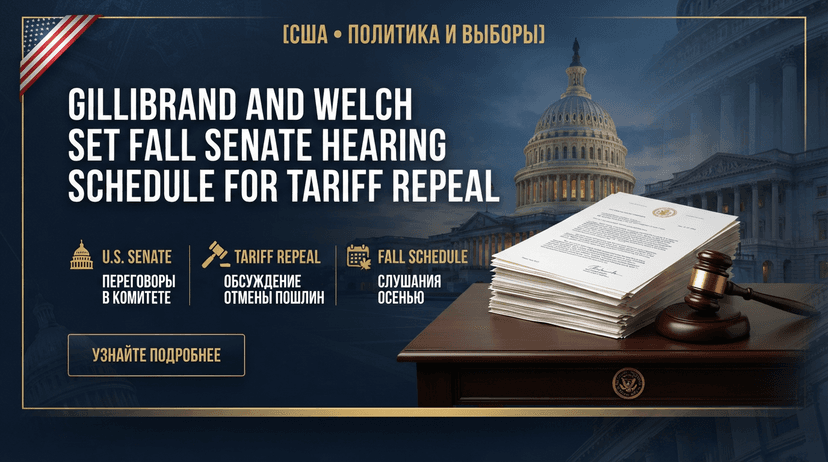
Gillibrand and Welch Set Fall Senate Hearing Schedule For Tariff Repeal Bill
Politics & Elections

Gillibrand and Welch Set Fall Senate Hearing Schedule For Tariff Repeal Bill

Gillibrand and Welch Set Fall Senate Hearing Schedule For Tariff Repeal Bill On August 27, 2026, Senators Kirsten Gillibrand of New York and Peter Welch of Vermont announced the Banning Antiquated Duties and Delivering Equitable American Levies Act, while outlining a tentative senate hearing schedule aimed at repealing tariffs imposed under Section 338 of the Tariff Act of 1930. What did New York and Vermont Senate Democrats propose? New York Senator Kirsten Gillibrand and Vermont Senator Peter Welch proposed the BAD DEAL Act, a bill that would repeal Section 338 of the Tariff Act of 1930, cancel related presidential tariff proclamations, and refund duties already collected from U.S. importers, including newly announced 50% tariffs on Canadian goods. The proposal is formally titled the Banning Antiquated Duties and Delivering Equitable American Levies Act , or BAD DEAL Act. According to the draft bill text published by Senator Welch’s office on August 27, 2026, the measure would: "Repeal Section 338 of the Tariff Act of 1930 (19 U.S.C. 1338)." Void "any Presidential proclamation promulgated in whole or in part pursuant to such section." Require federal agencies to provide refunds of each tariff or duty imposed under Section 338. CPA Practice Advisor reported on August 31, 2026, that the bill is a direct response to new tariffs on Canadian imports, including a 50% duty rate announced by President Donald Trump over the preceding weekend. A press release from Representative Brad Schneider’s office, dated August 29, 2026, describes the BAD DEAL Act as designed to "repeal Section 338 and refund all duties paid under this authority." Why are the senators targeting Section 338 tariffs now? Senators Gillibrand and Welch are targeting Section 338 tariffs because President Trump recently used this long‑dormant law to impose sweeping duties on Canadian imports, including a 50% tariff that Democrats say is hurting American families and businesses and reviving trade tensions with a key U.S. ally. According to WAMC’s report on August 28, 2026, the BAD DEAL Act aims to reverse "Trump administration tariffs on Canada" by repealing tariffs levied under Section 338 and refunding Americans who have been paying the higher prices. CPA Practice Advisor notes that the tariffs apply broadly to Canadian imports and followed a presidential announcement of a 50% tariff rate. Gillibrand’s Senate office framed the move squarely as a consumer issue. In an August 27, 2026 press notice, her office stated that "New York families have spent over $5,000 more due to President Trump’s tariff chaos and other reckless policies," citing the cumulative cost of recent trade measures and inflation pressures. That figure reflects Gillibrand’s internal analysis and is presented as an impact estimate rather than official federal data. The BAD DEAL Act also fits into a wider pattern of congressional resistance to Trump‑era tariff policies. On February 24, 2026, Senator Ron Wyden introduced the Tariff Refund Act of 2026, a separate proposal to refund certain duties after court rulings against earlier tariffs. In October 2025, Senator Welch joined a bipartisan group praising Senate passage of a different measure to repeal Trump’s global tariffs imposed under emergency authorities. These earlier efforts created a legislative backdrop for the targeted repeal of Section 338 in late August 2026. How would the BAD DEAL Act change current tariffs and refund payments? The BAD DEAL Act would repeal the legal authority for Section 338 tariffs, cancel any related presidential proclamations, and order federal agencies to issue refunds to importers for all duties collected under that section, including the recent 50% tariffs on Canadian products. The bill text from Senator Welch’s office lays out the mechanics clearly. Key implementation provisions include: Repeal of Section 338 itself, removing the statutory basis for retaliation‑style tariffs originally crafted in 1930. Termination of any presidential proclamation that invoked Section 338, meaning the tariffs become legally void once the act takes effect. A directive that relevant agencies "take such actions as may be necessary to provide for the refund of each tariff or other duty imposed and collected" under Section 338. Inside U.S. Trade reported on August 28, 2026 that Democrats on both the House Ways and Means Committee and the Senate Finance Committee are backing the measure, viewing refunds as central to the bill’s design. Representative Brad Schneider’s press release underscores that point, saying the BAD DEAL Act would "refund all duties paid under this authority" and thus return money to U.S. businesses that import from Canada. While precise refund totals have not been published, Gillibrand’s office argues that families and firms in New York and other states face higher costs on everyday goods sourced from Canada. By canceling the tariffs and ordering refunds, the sponsors say they aim to ease price pressures and send a message that Congress will not accept unilateral tariff hikes launched under obscure provisions of trade law. What is the planned Senate process and timetable for the tariff repeal bill? The sponsors expect the BAD DEAL Act to enter the Senate Finance Committee when lawmakers return from their August recess, with hearings anticipated in September and potential floor consideration before year‑end, mirroring timelines used for other tariff‑related bills introduced in the 2025‑2026 Congress. CPA Practice Advisor reports that Gillibrand and Welch "signaled their intent to introduce the bill when the Senate returns to session next month," referencing the early‑September reconvening after the summer break. Under standard Senate procedure, tariff legislation is referred to the Finance Committee, which is already handling related measures such as Wyden’s Tariff Refund Act of 2026. The expected steps, based on the sponsors’ statements and usual Senate practice, are: Formal introduction of the BAD DEAL Act in early September 2026, with Gillibrand as the lead Senate sponsor and Welch as co‑sponsor. Referral to the Senate Finance Committee, where staff have experience with tariff repeal and refund proposals. Potential hearings in the fall focusing on Section 338’s history, Trump’s recent tariffs on Canada, and the impact on U.S. businesses. Committee markup followed by a possible floor vote before the end of the 2026 session, depending on broader negotiations over trade and tax legislation. Representative Schneider has already filed the House companion, positioning it in the Ways and Means Committee’s trade subcommittee. That parallel track means House hearings and markups could run close to the Senate’s fall calendar, raising the possibility of a coordinated push to move the repeal through both chambers within months. How does this effort relate to previous congressional actions on Canada tariffs? The BAD DEAL Act builds on earlier federal and state‑level moves opposing Trump’s tariffs on Canada, including a Vermont Senate resolution urging the removal of all Canada‑related tariffs and a 2025 bipartisan Senate vote to roll back other Trump global tariffs. On the state side, the Vermont Legislature adopted S.R.11 in the 2025‑2026 session, a resolution honoring historic ties with Canada and Quebec and calling on Congress to reassert its trade policy role. The text urged President Trump to "remove all tariffs he has imposed on Canada since January 20, 2025," including those outside the United States‑Mexico‑Canada Agreement. That resolution, though symbolic, signaled deep concern in Welch’s home state about the direction of trade relations. At the federal level, Senator Welch has already worked on broader tariff rollbacks. In October 2025, he joined a bipartisan group—including Senators Ron Wyden, Chuck Schumer, Rand Paul, Tim Kaine, Jeanne Shaheen and Elizabeth Warren—in supporting a measure that would repeal Trump’s global tariffs enacted under emergency powers. The resolution passed the Senate on a 51‑47 vote, then moved to the House, setting a precedent for challenging presidential tariff actions. WAMC’s coverage links Gillibrand and Welch’s new proposal directly to those earlier fights over tariffs on Canadian products. Their offices portray the BAD DEAL Act not as a standalone event but as part of a broader effort to restore congressional control over trade and to protect cross‑border economic ties that are central to communities in northern New York and Vermont. Who would be most affected if Section 338 tariffs are repealed? If Congress passes the BAD DEAL Act, importers that pay duties on Canadian goods would see direct financial relief through refunds, while consumers in border states such as New York and Vermont could face lower prices on products sourced from Canadian suppliers. The sectors most exposed to Canada‑focused tariffs include manufacturers and retailers that rely on Canadian inputs, cross‑border wholesalers, and small businesses near the border that import consumer goods. While precise trade volumes tied to Section 338 tariffs have not been released, the sponsors highlight several categories affected by Trump’s latest actions: Household products imported from Canada that now carry a 50% tariff. Industrial inputs and components sourced by manufacturers in New York and New England. Food and agricultural products moving through established cross‑border supply chains. Gillibrand’s office estimated that "New York families have spent over $5,000 more" due to a combination of tariffs and other policies, framing the repeal as part of a strategy to reduce living costs. While that figure aggregates various economic pressures, tariffs on Canada are among the components cited in the senator’s argument for relief. Businesses that paid duties under Section 338 would stand to receive refunds. Inside U.S. Trade notes that Democrats backing the BAD DEAL Act see these refunds as a way to restore competitiveness and cash flow in sectors hit by sudden tariff hikes. Schneider’s press release stresses that the bill is intended to "refund all duties paid", signaling that the sponsors view repayment as a central promise to affected companies. What happens next in Congress and in U.S.-Canada trade relations? The BAD DEAL Act faces negotiations within the Senate Finance and House Ways and Means committees, but it enters the fall session with visible Democratic support and fits broader efforts to ease tensions with Canada, a key trading partner for New York and Vermont. In the near term, the key milestones will be: Formal Senate introduction and committee referral when lawmakers return from recess in early September 2026. Committee work on testimony from business groups, trade experts and possibly Canadian officials or consular representatives. Potential bundling of the BAD DEAL Act with other tariff refund bills such as Wyden’s Tariff Refund Act of 2026, to create a broader package. House hearings under the Ways and Means trade subcommittee on Schneider’s companion bill. If Congress ultimately repeals Section 338 tariffs and orders refunds, the decision would mark a reset of the most recent clash over U.S.-Canada trade triggered by Trump’s 2026 tariff announcement. Vermont’s S.R.11 and past Senate votes against wider Trump tariffs show that concerns about Canada trade are already part of the legislative record. For New York and Vermont, where cross‑border flows of goods and tourism play a visible role in local economies, the outcome of this tariff repeal push will shape prices, business planning and political narratives heading into the 2026 election cycle.

Marcus Feld·
Google adds xAI’s Grok 4.6 to its enterprise agent marketplace
AI & Tech

Google adds xAI’s Grok 4.6 to its enterprise agent marketplace

Google’s enterprise AI platform has added support for xAI’s Grok 4.6, expanding the model choices available to business users building agents and automations. The new listing appears in Google’s Gemini Enterprise Agent Platform documentation and places Grok 4.6 in the platform’s Model Garden, where developers can access third-party models alongside Google’s own offerings. According to xAI and Google documentation published this week, Grok 4.6 is positioned as xAI’s most capable model for coding, agentic tasks and knowledge work. The model is described as being built for long-running agents and more ambitious interactive and visual work, with a 500,000-token context window and configurable reasoning levels labeled low, medium, high and xhigh. The addition matters because enterprise teams increasingly want a single environment where they can compare and deploy multiple frontier models without rewriting their entire workflow. By making Grok 4.6 available inside Google’s enterprise agent stack, Google is giving customers another option for tasks that may benefit from longer context handling, multi-step reasoning and tool use. The model is also surfaced with a dedicated publisher-style entry, indicating that it can be selected and managed through the platform’s standard model browsing interface. xAI’s own release materials say Grok 4.6 is available through the xAI API and partner services, with pricing set at $2 per million input tokens, $0.50 per million cached input tokens and $6 per million output tokens for prompts under 200,000 tokens. For larger prompts of 200,000 tokens or more, xAI says pricing rises to $4 per million input tokens, $1 per million cached input tokens and $12 per million output tokens. Google’s documentation mirrors the availability, listing Grok 4.6 in preview inside Model Garden. The model’s arrival on Google’s platform follows a broader rollout that xAI announced earlier in August. In its release notes, xAI said Grok 4.6 is intended for coding, agentic tasks and knowledge work, and that it supports text and image input with text-only output. The company also says the model has no stated text output limit and includes tools such as function calling, web search, X search and code execution. For enterprise customers, the practical appeal is straightforward: Grok 4.6 is being offered as a high-capacity model for jobs that stretch over long sessions, such as software development, research synthesis and multi-step workflow automation. The 500,000-token window gives the model room to hold far more context than many standard systems, while the reasoning controls allow users to adjust how aggressively the model thinks before responding. Google has not said Grok 4.6 will replace any existing models on the platform, and the documentation frames the addition as another selectable option rather than a default. That means enterprise teams can test it against other models already in the platform for quality, latency and cost before deciding where it fits best. The move also underscores how cloud AI marketplaces are evolving into neutral distribution channels for rival model makers. Instead of forcing customers into a single vendor’s ecosystem, platforms like Google’s are increasingly acting as aggregators, giving users access to models from multiple providers under one set of enterprise controls. For now, Grok 4.6’s presence on Google’s enterprise platform is likely to be watched closely by developers who need large context windows and by organizations already experimenting with agentic workflows. The combination of broad availability, configurable reasoning and enterprise distribution could make it a notable option in a crowded market for advanced AI models.

Nic Reeve·