AInews Weekly: Education Gaps, Datacenter Surge and Rutgers Trust Study
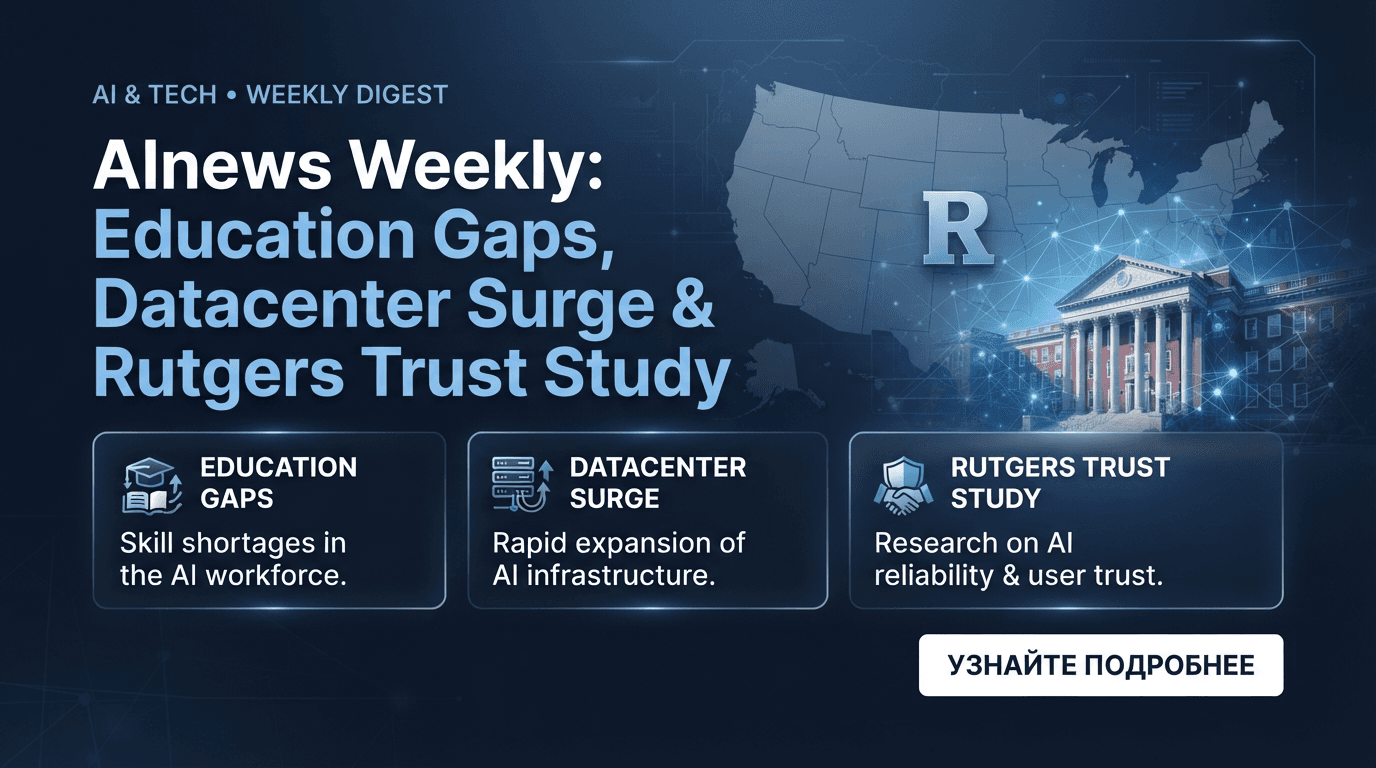
During the week of September 11, 2026, AInews stories ranged from a sweeping DataCamp survey on classroom AI use to fresh IDC numbers on infrastructure spending and new Rutgers research on public trust in automated decision systems, showing how fast artificial intelligence is spreading while core skills and guardrails struggle to keep pace.
What did DataCamp reveal about AI in classrooms in 2026?
DataCamp’s new “AI in Education” report, released on September 10, 2026, found that student use of AI tools is now near universal, while fluency and critical-thinking safeguards lag behind. The study surveyed more than 150 teachers and 150 students, highlighting a sharp divide between everyday AI use and formal guidance.
According to DataCamp’s 2026 AI in Education report, published via Business Wire and covered by the Las Vegas Sun, key findings include:
- Scope: More than 150 teachers and more than 150 students across different schools were surveyed about AI use and attitudes.
- Adoption: The report describes student AI adoption as effectively universal among respondents, meaning most students rely on AI tools in some form for schoolwork.
- Skills gap: DataCamp concludes that “massive gaps remain between AI adoption and fluency,” with many students using tools they do not fully understand.
- Critical thinking worries: Educators in the survey express concern that over‑reliance on AI may weaken students’ independent reasoning and writing skills.
- Policy uncertainty: Respondents report uneven or unclear school protocols for AI use, from plagiarism rules to allowed tools during assignments.
DataCamp positions itself as an AI and data upskilling platform and says the report is meant to give educators a baseline for how the “first AI‑native class,” graduating in 2026, is actually using automation in its daily work. The company argues that structured training in topics such as AI ethics, data literacy, and prompt design is now a prerequisite for meaningful classroom use rather than an optional add‑on.
Earlier in 2026, DataCamp pledged free AI training for one million teachers and students worldwide through its DataCamp Classrooms program, including courses in Python, SQL, Power BI and broader AI literacy. The September education report puts numbers and concern behind that pledge, framing it as a response to the specific gaps the survey identified.
How is DataCamp expanding AI tools and content for professionals and organizations?
DataCamp spent Q3 2026 pushing AI deeper into its corporate and professional learning products, from an expanded AI Tutor interface to AI Adoption Insights dashboards for team admins. The platform also rolled out new tracks tied to OpenAI models, Anthropic’s Claude, and LangChain‑based AI engineering training.
In its Q3 2026 roadmap webinar, summarized on DataCamp’s site, the company reported major content and feature milestones across the first half of the year:
- New content: More than 120 new courses, 21 new learning tracks, and support for 13 languages added in the first half of 2026.
- AI Tutor expansion: DataCamp renamed its “AI Native” learning mode to **AI Tutor** and began integrating Anthropic’s Claude and Claude Cowork directly into that experience.
- Infrastructure: A DataCamp MCP server connects Claude to the platform, letting admins manage learning plans and pull reports through natural‑language prompts.
- Analytics: “AI Adoption Insights” in Group Hub show how teams use AI tools day to day and benchmark that usage against other organizations.
- Specialized tracks: New tracks focus on Claude fundamentals, Claude for software engineers, and token cost management for developers, along with courses for Microsoft Fabric, Power Platform, Polars, and Apache Airflow.
- Certifications: A Python Developer Associate certification is live, with AI for Business, AI Agent Fundamentals, and AI Leadership credentials scheduled to round out the AI fluency lineup.
Earlier in the year, DataCamp also announced a partnership with LangChain to launch an “AI Engineering with LangChain” track, aimed at software developers who want to build production‑grade AI applications. That track is positioned as part of the broader move from basic prompt skills to full AI engineering, covering topics such as chaining tools, handling context windows, and monitoring model behavior.
The new courses build on DataCamp’s coverage of frontier models, including blog analysis of OpenAI’s GPT‑6 “Astra” launch and comparison pieces that try to map when developers should choose newer OpenAI systems over competitors like Anthropic’s Claude Fable 5.1. Together with AI Tutor and LangChain tracks, these updates show DataCamp targeting both the education market and working engineers with more intensive AI workflows.
What does IDC report about AI‑driven infrastructure and networking spending?
IDC’s latest infrastructure research points to sharp growth in networking hardware as organizations build out AI data centers. The firm highlights a 43.4% year‑over‑year surge in the Ethernet switch market to $18.9 billion in the second quarter of 2026, driven largely by AI training and inference workloads.
According to IDC’s August 2026 networking market blog post:
- Ethernet switch revenue rose 43.4% year over year in Q2 2026 to reach $18.9 billion, which IDC links directly to demand from AI datacenters.
- Most of this growth comes from high‑end switches deployed in hyperscale and large enterprise facilities running GPU‑dense AI clusters.
- IDC analysts argue that AI workloads are changing network design, pushing vendors toward higher port densities and new designs optimized for large‑scale parallel processing.
- The report suggests that spending on AI infrastructure is no longer experimental and is instead driving record‑level datacenter budgets across sectors.
Alongside networking, IDC’s resource center has highlighted moves such as NVIDIA’s acquisition of Hugging Face as part of a broader trend toward enterprise adoption of open models, with vendors racing to package open‑source and proprietary AI systems into consumable platforms. These combined trends show the business side of AI evolving beyond model releases into large hardware purchases, mergers and acquisitions, and long‑term infrastructure planning.
How is Rutgers working with AI in libraries, research, and public sentiment?
Rutgers University spent early September 2026 pushing both practical AI guidance and new research on public attitudes. The institution launched workshops through Rutgers Libraries on navigating AI tools and supported a Tech Xplore‑reported survey showing discomfort when AI makes decisions about people rather than simply assisting them.
Rutgers’ official IT site describes a growing university‑wide AI initiative, spanning healthcare, data science, and library services. Within that framework, Rutgers Libraries announced “Navigating AI” workshops on September 2, 2026, with goals that include:
- Teaching students and staff how to evaluate AI tools and outputs for reliability and bias.
- Explaining how generative models handle data, privacy, and attribution.
- Showing library users how to blend AI search or summarization tools with traditional academic research methods.
On September 9, 2026, Tech Xplore reported new Rutgers‑linked survey research into American attitudes toward artificial intelligence. The article states that:
- Survey participants are broadly comfortable with AI when it works as a tool they control, such as autocorrect or recommendation engines.
- Comfort levels drop sharply when AI shifts from assistance to decision‑making about people, for example in credit scoring, hiring, or predictive policing.
- Respondents express concern about transparency and fairness when AI systems make high‑stakes choices, even if they value the efficiency gains.
Rutgers’ Wireless Information Network Laboratory (WINLAB) is also using September to host back‑to‑back technical workshops focused on advanced networking testbeds, including COSMOS3 on September 17, 2026, where AI‑driven optimization and traffic management form part of the agenda. While infrastructure workshops may seem distant from public‑trust surveys and library training, they illustrate how AI work at Rutgers spans basic research, user education, and social impact.
What other notable AI developments rounded out this week’s landscape?
The broader AI week around September 11 included frontier‑model debates, open‑model consolidation, and new tools for monitoring how organizations actually use AI. These events connect the education stories from DataCamp, the infrastructure spike identified by IDC, and the trust questions raised by Rutgers.
Across various sources, notable developments included:
- Model launches: Commentators summarized the early September release of OpenAI’s GPT‑6 “Astra,” noting how the model’s arrival intensified discussion around data sovereignty and control in AI infrastructure.
- Marketplace consolidation: IDC’s coverage of NVIDIA’s move to acquire Hugging Face underscores how hardware vendors are seeking stronger positions in open‑model ecosystems used by enterprises.
- Usage analytics: DataCamp’s AI Adoption Insights aim to show organizations where AI is truly embedded in daily workflows, not just in pilot projects.
- Ethical guidance: Rutgers’ combination of public‑sentiment research and practical workshops highlight a growing institutional push to give ordinary users tools to judge when AI is being used appropriately.
The original weekly round‑up published by Solutions Review on September 12, 2026, framed these updates as a snapshot of how fast AI is moving into mainstream systems while educators, IT teams, and researchers scramble to manage its consequences. By pulling together survey data, infrastructure spending figures, and new teaching programs, this week’s news shows the spread of AI across technical, social, and institutional lines—and how far formal governance still has to go.