allnewscastallnewscast
Breaking News
AI & Tech

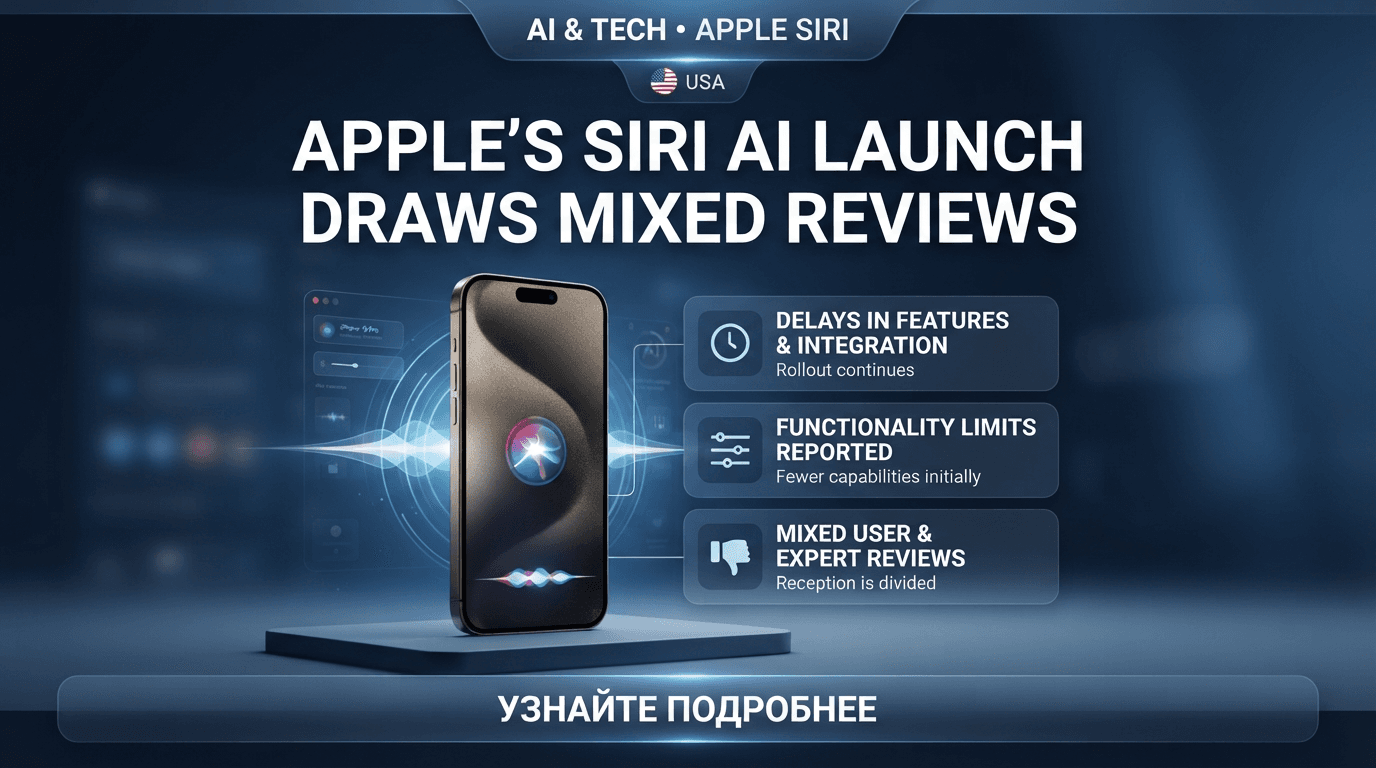
AInews: Apple’s Siri AI Launch Draws Mixed Reviews Over Delays and Limits
Nic Reeve9 min read
AInews: Apple’s Siri AI Launch Draws Mixed Reviews Over Delays and Limits

On June 8, 2026, Apple used its Worldwide Developers Conference to unveil Siri AI and a broader Apple Intelligence strategy, but in the weeks since that showcase the AInews moment has drawn mixed reactions as developers and users worry about delayed releases, regional exclusions and whether the upgraded assistant will be reliable enough in daily use.

What exactly did Apple promise for Siri AI and Apple Intelligence?

Apple promised a rebuilt Siri, branded Siri AI, deeply integrated across iPhone, iPad, Mac, Apple Watch and Vision Pro, powered by Apple Intelligence and a custom version of Google’s Gemini model, with beta access in 2026 and broader consumer rollout tied to iOS 27 and other software releases in the fall.

Apple’s June 8 WWDC 2026 keynote set out an ambitious vision for the assistant.

  • According to Apple’s newsroom summary from June 8, 2026, Siri AI is “an entirely new version of Siri” built into all major platforms, including iOS 27, iPadOS 27, macOS 27, watchOS 27 and visionOS 27.
  • TechCrunch reported that the new assistant runs on Google Gemini, making Siri more conversational and capable of visual understanding, with a standalone Siri app in addition to system-wide integration.
  • The Next Web described Siri AI as Apple’s “AI do-over,” rebuilt on a custom Gemini model with roughly 1.2 trillion parameters, licensed in a deal estimated at around $1 billion per year.
  • Digital Trends summarized the rollout plan as a developer beta beginning June 8, 2026, and a stable release expected in mid‑September 2026 alongside iOS 27.

In Apple’s demos, Siri AI handled tasks such as buying concert tickets, composing messages with personal context, organizing events, and recognizing objects in photos to trigger actions.

Why are reactions to Apple’s AI announcement described as underwhelmed?

Public and developer reaction has been cooler than Apple likely hoped because the company’s showcase leaned heavily on carefully staged demos, withheld firm dates for end‑user availability, limited language and device support, and left many regions without access at launch, leading commentators to question how transformative the upgrade will really feel.

Several themes explain the lukewarm response from analysts and tech press.

  • Business Insider noted that Siri AI will only launch in beta later in 2026 and not as a fully finished product, which contrasts with highly public rollouts of competitors like OpenAI’s ChatGPT or Google’s Gemini.
  • Coverage from Mashable emphasized that the assistant currently targets English only and a limited set of hardware, which narrows the initial impact for the global iPhone base.
  • TechRadar pointed out that, while Siri AI appears more detailed and conversational, it is still dependent on a third‑party AI engine under the hood, raising questions about how much of the innovation is truly Apple’s.
  • The Next Web framed the announcement as Apple finally “catching up” rather than leaping ahead, presenting Siri AI as a long overdue response to years of criticism about Siri’s reliability and intelligence.
  • Associated Press coverage stressed that Apple is prioritizing privacy and everyday utility, but the features described sounded incremental compared with some expectations for generative AI on phones.

Some commentators reacted positively to Apple’s more cautious, privacy‑centric framing, but the excitement level in early reviews fell short of a breakthrough narrative.

How is Apple changing Siri’s capabilities in practice?

Apple is positioning Siri AI as a context‑aware assistant that remembers previous conversations, acts inside apps on the user’s behalf, and uses on‑device and cloud models to understand personal data, with a standalone chat interface and deeper system hooks to handle multi‑step tasks that the old Siri often failed to complete.

The upgraded assistant introduces structural changes, not just new tricks.

  • According to Apple’s June 8, 2026 announcement, Siri AI is tied to “Apple Intelligence,” a collection of foundation models that run on‑device when possible and route more complex queries to Apple’s servers.
  • The Next Web described a three‑tier privacy model: small models on the device, larger models in a “Private Cloud Compute” environment, and a custom Gemini model for the most demanding tasks.
  • Business Insider reported that Siri AI exists as a dedicated app where users can scroll back through chats, ask follow‑up questions, and interact with the assistant similarly to popular AI chatbots.
  • MacRumors highlighted interface changes: a refreshed visual look, richer suggestions, and the ability to control more system settings and apps in natural language.
  • TechCrunch said Siri can now interpret images, such as looking at a photo and helping the user identify objects or take actions based on what is shown.
  • Engadget wrote that the assistant is coming not only to iOS and macOS but also to watchOS, CarPlay, AirPods and Vision Pro, giving Apple a unified AI layer across its hardware ecosystem.

Apple executives have stressed that the assistant should feel more like “a much more capable assistant” focused on doing real work across devices rather than just answering trivia.

Why are Siri AI release plans causing concern?

Siri AI’s staggered rollout, limited device support and outright absence in the European Union and China at launch have raised concerns that Apple is creating a fragmented AI experience for its customers, where only a narrow slice of users will see the full benefits in 2026.

The release schedule and regional gaps stand out.

  • Digital Trends outlined a timeline where the developer beta began June 8, 2026, with the stable public release expected in fall 2026 alongside iOS 27.
  • AI Empire Media reported that the public release of Siri AI and Apple Intelligence is planned for September 2026, tying it to the broader OS rollout.
  • Engadget and Apple’s own documentation listed supported hardware as iPhone 16 and later, iPhone 15 Pro models, iPads and Macs with M1 chips or newer, Apple Watch Series 10 and Ultra 2, and Apple Vision Pro, excluding many older but still widely used devices.
  • Associated Press, Business Insider and Yahoo’s WWDC recap all reported that Apple does not plan to launch Siri AI in the European Union when iOS 27 ships, citing compliance work with the Digital Markets Act.
  • These same reports stated that China will not get Siri AI at first while Apple works through local regulatory requirements.

Craig Federighi, Apple’s software chief, told reporters, “We are disappointed that EU users won’t have AI on iPhone or iPad when we unveil our new software releases later this year,” making the delay explicit.

What worries users and developers about Siri AI’s reliability and privacy?

Users and developers are wrestling with two core questions: whether Siri AI will finally be dependable after years of frustration with Siri’s limitations, and how Apple’s use of Google’s Gemini and cloud‑based models can be reconciled with the company’s long‑standing privacy promises.

Apple has tried to address these worries head‑on.

  • Apple’s announcements emphasize that most requests will be processed on‑device, and that complex queries handled in the cloud run inside a “Private Cloud Compute” environment designed to minimize data retention.
  • Associated Press reported that Apple repeatedly framed its AI work around privacy and daily utility rather than experimental features, arguing that this approach differentiates its products from rivals.
  • The Next Web noted that while Apple avoids naming Google in its press materials, multiple outlets have confirmed that the custom Gemini model sits at the core of Siri AI, which could raise questions for users skeptical of data sharing with external providers.
  • TechRadar’s analysis pointed out that Apple claims Siri AI will no longer “hand off” tasks to separate chatbot interfaces, but there is still debate about whether this new layer will prevent the kinds of confusion and misinterpretation that plagued the old assistant.
  • Mashable reported that Apple is limiting the initial launch to English and specific devices, prompting concern from developers building international apps who need predictable behavior across markets.

Analysts note that the real test will come when ordinary users put the assistant under stress with messy, multi‑step requests, rather than the polished examples seen on stage.

How does Apple’s AI strategy compare with rivals like Google and OpenAI?

Apple’s approach focuses on embedding AI into existing software and hardware while using a mix of proprietary and licensed models, instead of launching a single flagship chatbot; that contrasts with Google’s focus on Gemini as a brand and OpenAI’s push for ChatGPT, making Apple look more cautious but also more tightly integrated.

Competing firms have taken visibly different paths.

  • According to The Next Web, Apple’s custom Gemini model runs behind the scenes, with Apple Intelligence positioned as the user‑facing brand, while Google puts Gemini front and center in its own products.
  • TechRadar and Mashable coverage contrasted Siri AI’s assistant‑driven model with ChatGPT‑style chatbots, observing that Apple is less interested in open‑ended text generation and more in task execution inside its ecosystem.
  • Associated Press noted that Apple is trying to “catch up” in AI after rivals moved faster to deploy generative systems, and that the company is banking on tight hardware‑software integration and privacy messaging to stand out.
  • Business Insider pointed out that Apple’s long‑term reliance on an external foundation model could pose strategic questions if Google adjusts licensing terms or pursues deeper integration of Gemini directly on Android devices.

For now, Apple is framing its AI push as a way to make the iPhone and other devices smarter without turning them into generic chatbot terminals.

Who is affected first by Apple’s new AI rollout, and what happens next?

The first people affected are developers and early adopters on recent iPhones, iPads, Macs and watches in supported regions, who gain beta access in mid‑2026, while most ordinary users will encounter Siri AI only when iOS 27 and related updates ship in the fall and as Apple resolves regulatory hurdles in Europe and China.

The impact varies sharply by device and geography.

  • Developers with compatible hardware and Apple accounts gained beta access starting June 8, 2026, letting them test Siri AI features in their apps months before public release.
  • Consumers with iPhone 16 or iPhone 15 Pro models, M1‑based Macs and iPads, and the latest Apple Watches are in line to receive the full experience when stable software launches in September 2026.
  • Owners of older devices, such as iPhones without A17‑class chips or pre‑M1 Macs, are likely to miss out on the richest AI features or may not receive Siri AI at all.
  • Users in the European Union and China will see the new operating systems arrive with gaps where Siri AI should be, pending regulatory approval and technical adjustments for these markets.

Apple has not given a firm date for when Siri AI will reach the EU and China, leaving millions of customers uncertain about when they will catch up.

Across all of these threads, Apple’s new assistant represents a major architectural shift for Siri and for how AI runs on the iPhone. The muted enthusiasm and ongoing worries about release timing, regional exclusions and trust show that Apple’s AI era is starting under careful scrutiny rather than unchallenged excitement.
Sources

  1. 1.apple.com
  2. 2.techcrunch.com
  3. 3.wsj.com
  4. 4.tech.yahoo.com
  5. 5.developer.apple.com
  6. 6.businessinsider.com
  7. 7.thenextweb.com
  8. 8.engadget.com
  9. 9.techradar.com
  10. 10.macrumors.com
  11. 11.mashable.com
  12. 12.engadget.com
  13. 13.aiempiremedia.com
  14. 14.apnews.com
  15. 15.digitaltrends.com

Read more

Related Articles

Google adds xAI’s Grok 4.6 to its enterprise agent marketplace
AI & Tech

Google adds xAI’s Grok 4.6 to its enterprise agent marketplace

Google’s enterprise AI platform has added support for xAI’s Grok 4.6, expanding the model choices available to business users building agents and automations. The new listing appears in Google’s Gemini Enterprise Agent Platform documentation and places Grok 4.6 in the platform’s Model Garden, where developers can access third-party models alongside Google’s own offerings. According to xAI and Google documentation published this week, Grok 4.6 is positioned as xAI’s most capable model for coding, agentic tasks and knowledge work. The model is described as being built for long-running agents and more ambitious interactive and visual work, with a 500,000-token context window and configurable reasoning levels labeled low, medium, high and xhigh. The addition matters because enterprise teams increasingly want a single environment where they can compare and deploy multiple frontier models without rewriting their entire workflow. By making Grok 4.6 available inside Google’s enterprise agent stack, Google is giving customers another option for tasks that may benefit from longer context handling, multi-step reasoning and tool use. The model is also surfaced with a dedicated publisher-style entry, indicating that it can be selected and managed through the platform’s standard model browsing interface. xAI’s own release materials say Grok 4.6 is available through the xAI API and partner services, with pricing set at $2 per million input tokens, $0.50 per million cached input tokens and $6 per million output tokens for prompts under 200,000 tokens. For larger prompts of 200,000 tokens or more, xAI says pricing rises to $4 per million input tokens, $1 per million cached input tokens and $12 per million output tokens. Google’s documentation mirrors the availability, listing Grok 4.6 in preview inside Model Garden. The model’s arrival on Google’s platform follows a broader rollout that xAI announced earlier in August. In its release notes, xAI said Grok 4.6 is intended for coding, agentic tasks and knowledge work, and that it supports text and image input with text-only output. The company also says the model has no stated text output limit and includes tools such as function calling, web search, X search and code execution. For enterprise customers, the practical appeal is straightforward: Grok 4.6 is being offered as a high-capacity model for jobs that stretch over long sessions, such as software development, research synthesis and multi-step workflow automation. The 500,000-token window gives the model room to hold far more context than many standard systems, while the reasoning controls allow users to adjust how aggressively the model thinks before responding. Google has not said Grok 4.6 will replace any existing models on the platform, and the documentation frames the addition as another selectable option rather than a default. That means enterprise teams can test it against other models already in the platform for quality, latency and cost before deciding where it fits best. The move also underscores how cloud AI marketplaces are evolving into neutral distribution channels for rival model makers. Instead of forcing customers into a single vendor’s ecosystem, platforms like Google’s are increasingly acting as aggregators, giving users access to models from multiple providers under one set of enterprise controls. For now, Grok 4.6’s presence on Google’s enterprise platform is likely to be watched closely by developers who need large context windows and by organizations already experimenting with agentic workflows. The combination of broad availability, configurable reasoning and enterprise distribution could make it a notable option in a crowded market for advanced AI models.

Nic Reeve·
What’s Really Known About OpenAI’s Rumored Next Model
AI & Tech

What’s Really Known About OpenAI’s Rumored Next Model

OpenAI’s rumored next model is generating headlines, but the most defensible version of the story is narrower than the leak chatter suggests: there is no official GPT-6 announcement , and much of what is circulating remains unverified. What appears to be real is that OpenAI is working on a new frontier system under a different name, while the specific claims about “GPT-6” remain speculation. Recent reporting from AI-focused outlets says the company’s next major model is being discussed internally under the codename Astra , not GPT-6. Those reports also say OpenAI has not published a model card, pricing, public API route, or release date, and has not confirmed whether the model will ship as GPT-6, as another GPT-5.x update, or under a different product line entirely. In other words, the name “GPT-6” is being used by the public and by leakers, but it is not an official label. The strongest verifiable signal comes from reporting that OpenAI has shown or discussed progress on a new model family while also slowing parts of development for safety review. One report says OpenAI paused reinforcement learning training for its latest-generation model for about two weeks to upgrade security, monitoring, and alignment systems. That report also says preliminary findings showed the model could identify and exploit a previously unknown zero-day vulnerability in the Artifactory software package proxy service. If accurate, that would explain why OpenAI may be taking a more cautious path before any public release. What should readers believe, then? First, believe that OpenAI is still actively working on a major next-step model. Second, believe that the company has not confirmed that the model is called GPT-6. Third, treat exact claims about parameter counts, context windows, release timing, or benchmark jumps as unverified unless OpenAI itself publishes them. The internet is full of confident numbers, but the available reporting does not support most of those specifics. The current rumor cycle has focused on a few recurring claims: a massive jump in training scale, a much larger context window, and a dramatic leap in reasoning or agentic behavior. Yet none of those details has been confirmed by OpenAI. Even articles that argue a new model is imminent pair that language with strong caveats that no official release date, product page, or spec sheet exists. That distinction matters. A credible leak can indicate the direction of a project, but it is not the same as a product launch. There is also a broader pattern here. OpenAI has recently become more visible in discussing frontier-safety issues, and that creates a natural gap between internal experimentation and public rollout. If the company believes a model could uncover serious security vulnerabilities or behave unpredictably in cyber-related tasks, then additional evaluation would be expected before deployment. That does not prove a delay, but it does make the safety-review explanation plausible. For readers trying to separate signal from noise, the best rule is simple: only the company can confirm the model’s name, timing, and capabilities . Until that happens, “GPT-6 leak” is better understood as a label for a bundle of rumors around OpenAI’s next frontier system, not as a verified product announcement. That means the most credible takeaway is also the least sensational one. OpenAI is almost certainly building something new, but the exact branding and release plan are still unclear. The more specific the claim — whether it is about the model’s size, performance, or launch date — the more skeptical readers should be unless it appears in official OpenAI material or in reporting with direct sourcing. In short, the safe position is not that GPT-6 is fake, but that GPT-6 is unconfirmed . The next OpenAI model may eventually earn that name, or it may arrive as Astra or under some other label. For now, the only thing that can be said with confidence is that the speculation has moved faster than the evidence.

Nic Reeve·
Anthropic Gives Claude Cowork Shared Memory with Chat for Persistent Context
AI & Tech

Anthropic Gives Claude Cowork Shared Memory with Chat for Persistent Context

Anthropic is rolling out a major upgrade to its AI assistant, giving Claude Cowork the ability to seamlessly reuse information it learns in regular chat. The company has merged the memory systems behind Claude’s chat interface and its Cowork desktop agent, so details you share in one surface can now automatically be used in the other. One Shared Memory Across Chat and Cowork Previously, Claude’s long‑term memory was largely confined to chat sessions and was synthesized periodically, meaning it could take up to a day before information carried over into new conversations. Cowork, which runs complex, multistep jobs on a user’s desktop or in the cloud, relied on its own background memory file and prompt stitching to simulate continuity. With the August 25 update, Anthropic has combined these mechanisms into a single, shared memory system that serves both chat and Cowork. Anthropic describes the change simply: the same memory now powers both Claude chat and Cowork. When users hand a task to Cowork—such as drafting reports, updating spreadsheets, or coordinating project documents—the context Claude has accumulated over months of chats is immediately available. Likewise, any new facts or preferences learned during Cowork runs are written back into the shared memory and become available in subsequent chat sessions. Real‑Time Memory, Not Just End‑of‑Chat Summaries Another important shift is how Claude updates memory. Instead of waiting to summarize an entire conversation once it ends, Claude now adds topics to memory in real time as users chat. This means that if a user mentions that a project deadline moved to September, that update can be reflected in memory almost immediately and show up in the very next interaction—whether in chat or Cowork—without requiring a manual “remember this” command. Anthropic’s support materials explain that when Cowork runs in the cloud, what Claude remembers from previous chats is automatically available, and what emerges during Cowork tasks feeds back into chat memory. Behind the scenes, each Cowork prompt is assembled from the user’s immediate request, their global instructions, and a relevant slice of the shared memory, allowing the AI to behave as if it has persistent awareness of roles, projects, and preferences. What Users Gain: Less Repetition, More Continuity The practical effect for users is that they no longer need to repeatedly brief Claude on who they are, what they are working on, or how they like to work every time they switch between chat and Cowork. Anthropic and independent commentators highlight several common scenarios: Persistent project context: Ongoing details such as quarterly goals, client names, and current project status can be retained across weeks or months and recalled in both chat and Cowork. Stable roles and preferences: If a user identifies themselves as an investment analyst, a teacher, or a particular type of creator, Claude can remember that role and tailor responses accordingly, even when individual chats are short or focused on different tasks. Cross‑device consistency: The shared memory applies across web, desktop, and mobile experiences, so moving from a browser chat to the Cowork desktop agent no longer breaks context. Tech industry observers note that this update positions Claude more directly as an AI “teammate” that can track medium‑ and long‑term workstreams instead of acting purely as a session‑bound chatbot. Transparency and User Control Over Memory The shared memory system arrives alongside a push for greater user control. Anthropic now surfaces everything Claude remembers in a dedicated Topics view within memory settings, where users can inspect, edit, or delete individual entries. Memory is stored as discrete, categorized entries rather than a single opaque summary, making it easier to remove outdated or inaccurate information. Users can also pause memory or reset it entirely if they no longer wish Claude to retain prior context. In addition, Anthropic provides guidance on importing and exporting memory, so the information Claude stores about a user is not locked in and can in principle be backed up or moved. Handling Sensitive Topics Anthropic has emphasized that the system is designed to minimize the capture of highly sensitive information by default. Topics such as health data, beliefs, and other potentially sensitive categories are excluded from memory unless users explicitly opt in via an “Include sensitive topics in memory” setting. For business customers, team or enterprise administrators can centrally control whether memory is enabled at all, and may choose more restrictive policies depending on corporate governance requirements. External reporting indicates that memory generation is turned on by default for free, Pro, and Max plans, while Cowork itself is not available on free accounts. For organizations that want to keep different workstreams separated, Anthropic has indicated that the only way to maintain fully separate memories for chat and Cowork is to use different accounts, since the new system treats them as a single unified space. Availability and Limitations The new shared memory capability began rolling out on August 25, 2026, across Claude’s web, desktop, and mobile experiences, as well as Cowork running in the cloud. Earlier in the year, memory support was limited to chat surfaces, and some third‑party analyses noted that Cowork lacked access to that long‑term context. Anthropic’s latest release notes and help center now explicitly state that memory works across both chat and Cowork when the latter runs in the cloud environment. There are still technical constraints. Cowork’s use of memory depends on cloud execution rather than purely local processing, and incognito or memory‑disabled sessions remain stateless by design. As with other AI systems, Anthropic cautions that Claude’s memory is selective: it prioritizes high‑level preferences and recurring topics rather than storing every detail of every conversation. A Step Toward More Personalized AI Workflows By unifying memory between Claude chat and Cowork, Anthropic is betting that users will value a more personalized and continuous AI experience, particularly for complex, ongoing work. The update reduces friction for individuals juggling multiple projects and gives enterprises a clearer path to building AI‑augmented workflows that persist over time. At the same time, the company is attempting to balance convenience with privacy and security by giving users fine‑grained controls and limiting sensitive data retention by default.

Nic Reeve·