allnewscast
Breaking News
AI & Tech

Broadcom, Teradata and startup funding reshape AI news in early September

Nic Reeve8 min read
Broadcom, Teradata and startup funding reshape AI news in early September
Broadcom’s chip plans and startup funding headline AI news week of September 4

During the week of September 4, the AI news cycle was dominated by Broadcom’s aggressive artificial intelligence chip forecasts, Teradata’s push to embed AI agents into enterprise analytics, and a $550 million funding round that lifted startup Wonderful to a $5 billion valuation.

What did Broadcom announce about its AI chip business this week?

Broadcom projected rapid growth for its artificial intelligence chip revenue over the next two years and highlighted large infrastructure orders tied to custom accelerators for major cloud and AI customers, underscoring its ambition to challenge Nvidia’s leadership in data center silicon.

Broadcom’s latest outlook came during an investor call held in early September, in which chief executive Hock Tan laid out a series of aggressive targets for the company’s data center AI revenue.

  • According to The Star, Broadcom told investors its AI chip revenue could reach about US$115 billion in fiscal 2027 and around US$230 billion in fiscal 2028, reflecting expected demand from hyperscale cloud operators and AI model builders.
  • In the same report, Broadcom said AI chip revenue alone was projected at US$21.7 billion in the fourth quarter of its current fiscal year.
  • Earlier guidance described AI semiconductor revenue of US$6.2 billion in the fourth quarter of fiscal 2025, up 66% year-on-year, illustrating how quickly the company has been revising its forecasts upward.
  • Reuters reported in a September 4 earnings-related story that Broadcom had secured more than US$10 billion in AI infrastructure orders from a new customer for custom accelerators, helping push fiscal 2026 AI revenue growth “significantly” higher than 2025.

Those orders relate to what Broadcom describes as customized AI "XPU" accelerators, designed for large-scale training and inference workloads inside cloud data centers. The company already counts three major customers for these chips, and the newly converted client brings the total to four.

In the call covered by financial news desks, Tan said AI semiconductor revenue had grown for ten consecutive quarters, reaching US$5.2 billion in the third fiscal quarter of 2025, a 63% year-on-year increase. He also confirmed he intends to lead Broadcom through at least 2030, signalling continuity as the firm bets its future on AI infrastructure.

How is the market reacting to Broadcom’s AI strategy and earnings?

Analyst commentary during the week described a gap between Broadcom’s strong reported AI numbers and investor sentiment, with shares pressured despite revenue beats as markets digested ambitious longer-term guidance and spending plans around custom accelerators and data center networking.

An AI-focused market newsletter published on September 4 noted that Broadcom had beaten Wall Street expectations on its latest earnings report but that the stock fell about 5% after the release, continuing a pattern of post-earnings sell-offs despite repeated outperformance.

  • The newsletter reported that this pattern had erased roughly US$500 billion of Broadcom’s market value since June as investors questioned how sustainable the current trajectory is, given heavy capital needs and competitive pressure from Nvidia and other chipmakers.
  • Commentary cited Broadcom’s reliance on a small number of very large cloud and AI customers for its custom accelerators as both a strength, in terms of visibility, and a risk if any major client shifts strategy or adopts alternative hardware.

Despite the mixed stock reaction, both Reuters and regional business coverage highlighted that Broadcom sees AI-related chips as the primary engine of its growth over the rest of the decade, expecting demand for accelerators, networking silicon and related infrastructure to expand as more enterprises adopt generative and agentic AI systems.

What new AI product did Teradata launch for enterprises?

Teradata launched an enterprise-grade Data Analyst Agent in the Amazon Web Services Marketplace, offering AI-assisted, conversational analytics for customers that already run workloads on AWS and want to query complex data through natural language rather than traditional business intelligence interfaces.

Teradata, best known for its data warehousing and analytics platforms, announced the availability of its Data Analyst Agent in late July with follow-on coverage in early August, positioning the tool as part of its broader AI services strategy.

  • According to Teradata’s press release from July 30, the Data Analyst Agent brings AI-assisted conversational analytics into existing AWS environments and is sold through the AWS Marketplace under the Teradata AI Services label.
  • The agent is designed to understand natural language questions from business users, translate them into analytic queries across Teradata systems, and return explanations, charts or summaries without requiring SQL expertise.
  • Futurum Group’s analysis of Teradata’s second-quarter 2026 results described the product as a key part of a “hybrid AI strategy” aimed at embedding AI into both on-premises and cloud deployments, which the firm said is gaining traction with large enterprises.

Teradata’s second-quarter numbers underline why the company is leaning into AI-assisted analytics. Futurum Group reported that revenue for the quarter came in at US$410 million, slightly above consensus estimates and flat year-on-year, while profitability improved. A Yahoo Finance summary of the same period noted net income of US$46 million and a higher full-year earnings-per-share outlook.

Yahoo’s report linked those upgrades partly to the launch of the Data Analyst Agent in the AWS Marketplace, arguing that cost control, recurring cloud revenue and new AI-led services are reshaping Teradata’s business mix and appeal to investors that want exposure to enterprise AI adoption.

How did Wonderful’s latest funding round reshape the AI startup landscape?

Israeli-Dutch startup Wonderful closed a US$550 million Series C round at a US$5 billion valuation, more than doubling its valuation in under six months and signalling strong investor appetite for companies building operating systems and orchestration tools for enterprise AI agents.

The Series C round was announced on September 2 and drew coverage from Reuters, TechCrunch, Business Wire and Bloomberg, each describing slightly different angles on the same transaction.

  • Reuters reported that Wonderful’s valuation had risen from roughly US$2 billion to US$5 billion in less than six months as demand grew for its AI operating system among enterprises.
  • TechCrunch wrote that Wonderful raised US$550 million, with Insight Partners again leading the round and existing backers Index Ventures, IVP, Vine Ventures, 9Yards and Bessemer Venture Partners participating.
  • Business Wire’s release confirmed the US$5 billion valuation and listed Salesforce as a new investor, joining the prior venture firms.
  • Bloomberg’s coverage described Wonderful as building software that coordinates AI agents across an enterprise, casting the company as part of a trend toward “agentic” AI systems that perform business tasks rather than just answer questions.
  • Yahoo Finance’s technology section similarly framed Wonderful’s product as an “AI OS” that helps large companies become “AI-native” by connecting different models and agents to workflows like customer support and internal operations.

This latest round follows a Series B announced in March, when Wonderful raised US$150 million led by Insight Partners. TechFundingNews reported at the time that the company’s tools were aimed at increasing deployment rates for AI pilot projects, noting that many proofs-of-concept never reach production.

With fresh capital, Wonderful says it plans to expand engineering teams in Israel and the Netherlands, invest in security and governance features for its operating system, and grow its global go-to-market presence with partners like Salesforce to reach more large enterprises.

Who is affected by these AI business moves and what changes next?

The week’s developments affect cloud providers, enterprises and investors: Broadcom’s forecasts reflect rising hardware demand from hyperscale platforms, Teradata’s agent targets analysts and business users, and Wonderful’s funding highlights a growing ecosystem of companies that help large organizations run AI agents at scale.

For cloud and AI infrastructure buyers, Broadcom’s multi-year guidance suggests expanding choices in accelerator hardware and networking, which could influence pricing and availability for training and inference capacity as demand for large language models and enterprise agents grows.

  • Cloud providers and major AI labs appear central to Broadcom’s plans, with Reuters reporting at least US$10 billion in custom infrastructure orders from a newly signed customer presumed to be a leading AI platform.
  • Enterprises making long-term commitments to specific accelerator stacks may benefit from competition between Broadcom and Nvidia but face lock-in risks if each vendor’s custom chips require tailored software tooling.

Inside enterprises, Teradata’s Data Analyst Agent and Wonderful’s AI operating system target different layers of AI adoption. Teradata is focused on making existing analytic environments easier to query through conversational interfaces. Wonderful concentrates on orchestrating multiple agents and models to handle tasks across business functions.

  • Analysts and business managers who rely on Teradata’s platforms could see shorter turnaround times for data requests once natural language interfaces become common in their workflows.
  • Wonderful’s customers, many of them large organizations with fragmented data and AI pilots, gain a central system to coordinate customer support agents, back-office automation and other AI tools.
  • Investors exposed to these companies face different risk profiles: Broadcom and Teradata are established listed firms, while Wonderful’s backers are betting on a fast-growing startup in a still-evolving category.

Over the coming months, key milestones to watch include Broadcom’s ability to convert guidance into realized shipments and margins, Teradata’s success in monetizing AI agents within its installed base, and Wonderful’s progress in turning its expanded war chest into sustained revenue growth rather than just valuation headlines.

Sources

  1. 1.moomoo.com
  2. 2.techcrunch.com
  3. 3.thestar.com.my
  4. 4.reuters.com
  5. 5.teradata.com
  6. 6.businesswire.com
  7. 7.finance.yahoo.com
  8. 8.aibusinessweekly.net
  9. 9.bloomberg.com
  10. 10.techfundingnews.com
  11. 11.futurumgroup.com

Read more →

Related Articles

Motional–MIT CW-Net project brings AI focus to clearer robotaxi decision-making
AI & Tech

Motional–MIT CW-Net project brings AI focus to clearer robotaxi decision-making

Motional–MIT CW-Net project brings AInews focus to clearer robotaxi decision-making On 2 September 2026, researchers at MIT and autonomous vehicle company Motional unveiled a new system called the Concept-Wrapper Network (CW-Net) that lets a self-driving car explain its decisions in real time, a breakthrough that has quickly drawn global AInews attention. How does CW-Net help people understand self-driving car decisions? CW-Net converts a robotaxi’s opaque planning process into short, plain-language concepts such as “approaching stopped vehicle” or “close to cyclist,” and then forces the car’s planner to use those concepts when choosing its next move, so the explanation matches the true reason for the action. The work, described in a paper published in Nature on 2 September 2026, tackles one of autonomous driving’s core problems: black-box deep learning models that perform well but give passengers, safety drivers and regulators little insight into why a car accelerated, braked or swerved. According to MIT News, CW-Net is a “concept classifier” plugged into the middle of a self-driving car’s motion-planning network, where it maps raw sensor data to high-level concepts the model already relies on. The system then compels the planner’s final stage to make its trajectory decisions using those concepts, preserving driving performance while exposing the reasoning. As described by Motional, the explanations appear alongside the planned path in real time, giving safety drivers and passengers a running commentary on what the car believes is happening. News reports note that CW-Net’s concept labels include everyday traffic ideas such as “yielding to pedestrian,” “waiting at red light” and “emergency braking,” rather than mathematical features. This design grows out of a wider research track at MIT on “concept bottleneck” models, where AI systems are forced to think in human-understandable ideas before giving an output. A March 2026 MIT study on concept bottlenecks laid much of the groundwork for CW-Net’s approach, demonstrating that extracting concepts from existing models can improve both accuracy and clarity of explanations. What tests did MIT and Motional run on the new explainable AI system? The CW-Net team trained the system on a massive dataset of real-world driving scenes and then deployed it on Motional’s robotaxis, first on private tracks and then in simulations set in Las Vegas, to see whether humans could predict car behavior and detect mistakes more accurately. Reports describing the experiments outline a controlled evaluation campaign designed to answer a blunt question: does exposing the car’s reasoning through concepts make human overseers safer and more effective? According to one industry summary, CW-Net was trained on about 130 million labeled driving scenes, each tagged with concepts that describe the traffic situation, before being plugged into Motional’s planners. MIT News says CW-Net was deployed on a real autonomous test vehicle, where a human safety driver monitored both the car’s trajectory and the live explanation feed. In one private-track incident, cited in multiple reports, CW-Net revealed that the vehicle stopped due to “emergency braking” rather than “cyclist detected,” helping the safety driver recognise how a near collision could have occurred. Las Vegas–based simulations with non-expert users showed similar gains: participants who saw CW-Net explanations were better at predicting when the car might make a mistake or behave unexpectedly. These experiments build on earlier academic work. According to an open-access version of the paper dated March 2023, the original CW-Net concept already showed that concept-based explanations improved safety drivers’ mental models of the car, aligning human expectations with the vehicle’s internal decision process. Why does explainable AI matter for Motional’s robotaxi plans? Motional has committed to pull human safety operators from its commercial robotaxis by the end of 2026, making transparent and predictable AI behavior essential for regulators, partners and riders who must trust fully driverless service in cities such as Las Vegas. The company, formed as a joint venture between Hyundai Motor Group and Aptiv, has operated test fleets for years. It now seeks to move from supervised pilots to commercial driverless rides, at a time when public scrutiny of autonomous vehicle safety is rising. Tech industry coverage in January 2026 reported that Motional aims to start true driverless services by the end of the year, removing backup drivers from robotaxis after regulatory approval. Motional’s own communications describe CW-Net as part of opening “the brain of a self-driving car,” a way to show riders and regulators why the car responds to hazards or complex traffic situations. According to start-up focused outlets, the collaboration with MIT enables Motional engineers to debug failure cases more quickly, because they can see which concept the planner relied on when it made a poor decision. General technology news reports emphasise that clearer explanations could also ease liability questions after incidents, by documenting what the system detected and how it interpreted the scene. For city transportation agencies considering robotaxi partnerships, this interpretability could be as important as raw safety metrics. It gives them a tool to interrogate the system’s behaviour, instead of treating the AI stack as an inscrutable black box. What is different about CW-Net compared with earlier explainable AI methods? CW-Net does not bolt a separate explanation module on top of the planner. It reshapes the planner so that its internal reasoning is expressed in concepts that the explanation system uses directly, which researchers argue keeps the explanations causally faithful instead of decorative. Explainable AI has often relied on post-hoc tools that highlight parts of an image or sensor input after the fact, leaving open the risk that the visualisation is loosely correlated rather than truly driving the decision. The MIT–Motional work tries to tighten this link. MIT computer scientists have explored concept bottleneck models that force AI systems to make predictions using explicit concepts, which are then described in natural language by a large multimodal model. According to the March 2026 MIT study, this approach asks a specialised autoencoder to extract the most relevant features from a pretrained model and turn them into a compact set of concepts. Those concepts are then labelled and described using a multimodal language model, which is trained to recognise when each concept is present in a scene. CW-Net applies this family of ideas to motion planning for autonomous vehicles, translating dense sensor streams into labelled traffic concepts that both the planner and the explanation module share. By tightly coupling the explanations to the planner’s internal pathway, CW-Net aims to reduce what researchers call “concept leakage,” where explanations reference ideas that did not truly drive the model’s output. That distinction matters whenever a human must rely on the explanation for safety-critical decisions. Who worked on the project and how is it being published? The CW-Net research team spans MIT’s Computer Science and Artificial Intelligence Laboratory and Motional’s autonomous driving engineers, and their joint paper on explainable deep learning for self-driving cars was published in Nature in early September 2026, following prior conference and preprint versions. The collaboration reflects a broader trend of large autonomous vehicle programmes pairing in-house development with academic partnerships to tackle foundational AI questions such as interpretability, fairness and safety. MIT News credits researchers in CSAIL as lead authors of the concept-wrapper method, working directly with Motional’s robotics teams that deployed the system on test vehicles. Motional lists several of its senior scientists and executives, including its CEO, as collaborators on the Nature paper and co-authors of earlier work on explainable motion planning. A preprint version titled “Explainable deep learning improves human mental models of self-driving cars” first appeared online in March 2023, laying the scientific foundation for the Nature publication. Business and technology news sites highlight the paper’s placement in a high-profile journal as a signal that interpretability is becoming central to mainstream autonomous driving research, not just an academic curiosity. Publishing in a leading journal also opens the work to scrutiny from outside experts, from AI ethicists to transportation safety analysts, which could influence how regulators evaluate explainable systems in future autonomous vehicle rules. What comes next for explainable self-driving car AI? MIT and Motional say CW-Net is a step toward wider use of concept-based explanations in safety-critical AI. Future work will likely test the system in more cities, extend it to new driving scenarios and connect it with broader efforts to audit and stress-test AI models for bias and failure modes. Researchers already explore neighbouring ideas. MIT’s CSAIL has developed automated interpretability agents that probe neural networks using visual-language models, while concept bottleneck techniques continue to evolve for computer vision and robotics more broadly. A July 2024 report on MIT’s MAIA project describes a multimodal agent that designs experiments to understand how AI models behave, hinting at tools that could one day inspect systems like CW-Net for hidden flaws. Robotics conference previews from mid-2026 show MIT teams using large language models to help robots interpret complex instructions, reinforcing the idea that natural-language explanations will be a standard part of machine behaviour. Industry commentators expect Motional and peers to combine explainable planning with other safeguards such as diverse sensor fusion, redundant braking systems and independent failure analysis boards. As robotaxis roll out in more markets, transport agencies may request access to explanation logs from systems like CW-Net when reviewing incidents or granting permits. For everyday riders, the most visible change could be simple: when they sit in a driverless car and wonder “Why did it stop?” the car will be able to answer in clear language, drawing directly from the same concepts that guide its driving.

Nic Reeve·
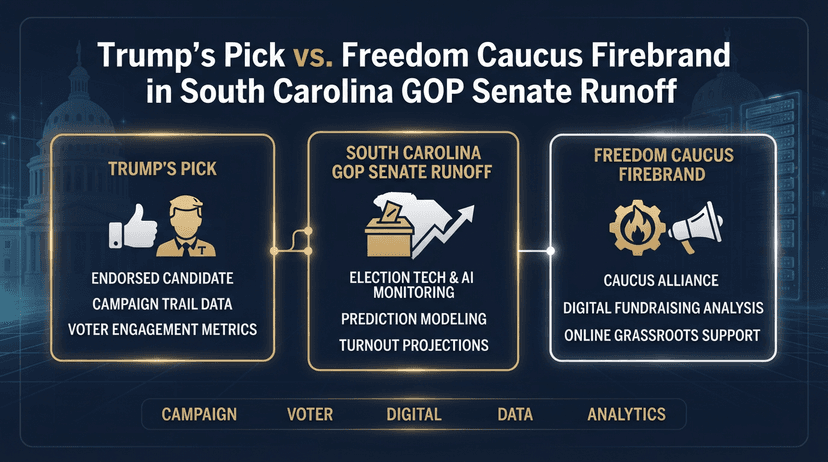
Trump Pick Faces Freedom Caucus Firebrand in South Carolina GOP Senate Runoff
AI & Tech

Trump Pick Faces Freedom Caucus Firebrand in South Carolina GOP Senate Runoff

South Carolina Republicans are heading into a fiercely contested August 25 runoff that will decide who carries the party’s banner for the U.S. Senate seat once held by the late Lindsey Graham. Sen. Darline Graham , his sister and the appointed incumbent, is locked in a tight race with Rep. Ralph Norman , a veteran House conservative, after neither candidate secured a majority in the August 11 special primary. The winner of the runoff will face Democrat Annie Andrews , a pediatrician and party nominee, in the November general election, making Tuesday’s vote the decisive Republican step in determining Lindsey Graham’s successor for a full six-year term. From Appointment to First Campaign: Darline Graham’s Bid to Keep the Seat Darline Graham was appointed on July 13, 2026, by Gov. Henry McMaster to fill the vacancy created by her brother’s sudden death, taking the Senate oath the following day. Before entering elected office, she served as commissioner of the South Carolina Commission for the Blind and worked as a vocational rehabilitation counselor, building a profile rooted in social services and disability advocacy. In the crowded, 10-candidate Republican special primary on August 11, Graham placed first but fell short of the 50 percent threshold required to avoid a runoff, winning roughly 32–33 percent of the vote. South Carolina law mandates a runoff when no contender surpasses an outright majority, sending Graham and Norman back to voters for a head-to-head contest. Graham’s campaign has emphasized continuity with her brother’s legacy, a focus on national security and support for military families, and her experience in state-level administration. Her allies argue that her appointment and subsequent elevation in the primary demonstrate a desire among voters for stability amid a rapid and unexpected transition. Ralph Norman’s Challenge from the Right Ralph Norman, who represents South Carolina’s 5th Congressional District, is a long-time member of the House Freedom Caucus and has built his political identity around hardline conservative positions on spending, immigration, and cultural issues. In the primary, Norman finished second with about 24–25 percent of the vote, securing his place in the runoff but underscoring the need to expand his base in a statewide race. Norman has framed the runoff as a choice between his record of legislative experience and Graham’s status as a newly appointed senator. In interviews, he has pointed to his years in Congress and business background, arguing that he is better prepared to navigate complex national debates and advance conservative priorities. On the campaign trail and in debates, Norman has cast himself as the more reliable champion of limited government and tighter border controls, while criticizing what he portrays as insider politics around Graham’s appointment and backing from party leaders. Trump’s Endorsement Becomes a Flashpoint The race gained national attention when former President Donald Trump endorsed Darline Graham in the runoff, aligning himself with the appointed incumbent rather than the Freedom Caucus stalwart. Trump’s support reflects a pattern in recent election cycles in which his endorsements have sometimes clashed with the preferences of local activists and hard-right factions. Norman has openly questioned the endorsement, calling it a “head scratcher” and noting his history of voting for Trump’s priorities in Congress. He has argued that his voting record and close alignment with Trump-era policies should make him the natural choice for the former president’s backing, suggesting that the decision was influenced by establishment figures eager to maintain continuity in the Senate seat. For Graham, the endorsement provides a powerful signal to GOP voters who remain loyal to Trump, potentially helping her consolidate support among primary voters wary of internal party conflict. Her campaign has treated the backing as validation of her commitment to the same conservative agenda her brother supported in the Senate. Debates, Jabs, and Competing Visions The closing days of the campaign have featured sharp exchanges between the two Republicans in televised debates and forums across the state. In a recent U.S. Senate debate covered by South Carolina Public Radio, Graham and Norman “exchanged jabs” while outlining competing visions for the party’s future. Graham leaned on her experience overseeing services for blind and disabled South Carolinians, promising to prioritize health care access, veterans’ services, and steady governance during a period of uncertainty following her brother’s death. Norman, meanwhile, pressed his case for a more confrontational approach to federal spending and executive power, positioning himself as the candidate best suited to challenge what he sees as overreach by Washington. Both candidates have pledged strong support for conservative judicial appointments and a robust national defense, often invoking Lindsey Graham’s long record on foreign policy and military issues. However, their rhetoric diverges on style: Graham presents herself as a steady hand and consensus-builder, while Norman appeals to GOP voters who prefer sharper ideological contrasts and a more combative tone in Washington. Runoff Mechanics and Voter Turnout Stakes Early voting for the runoff has been open in South Carolina in the days leading up to August 25, with polls available from 8:30 a.m. to 5 p.m. in counties across the state. On runoff day, polling places will operate from 7 a.m. to 7 p.m. , giving Republicans a 12-hour window to settle the intraparty contest. Given the relatively low turnout typical of runoff elections, both campaigns are focusing heavily on field operations and targeted outreach. Graham’s team is leaning on statewide name recognition and the emotional resonance of her brother’s legacy, while Norman’s campaign seeks to mobilize conservative grassroots networks that have powered his House wins. The Democratic nominee, Annie Andrews, has kept a relatively low profile during the GOP runoff but stands ready to frame the eventual Republican winner as out of step with mainstream voters on abortion, health care, and gun policy. Her campaign sees opportunity if the GOP emerges from the runoff divided or if the Trump endorsement becomes a liability in the general election. National Implications of a Statewide Contest Beyond South Carolina, the runoff is being watched as a test of the balance between Trump-aligned insiders and hardline House conservatives within the Republican Party. A Graham victory would underscore the continuing influence of Trump’s endorsements and party leaders in shaping Senate races, particularly when family ties and incumbency are in play. A Norman win, by contrast, would signal the strength of the Freedom Caucus wing and could embolden similar challenges to appointed or establishment-backed Republicans in other states. For South Carolina voters, the choice on August 25 will determine not only who replaces Lindsey Graham, but also which version of the GOP they want representing them in Washington.

Nic Reeve·
AI News: Universities Test Artificial Intelligence in Classrooms and Exams
AI & Tech

AI News: Universities Test Artificial Intelligence in Classrooms and Exams

AInews: Universities Put Artificial Intelligence to the Test in Classrooms and Exams On August 25, 2026, universities from the United States to Europe accelerated experiments with artificial intelligence in teaching and assessment, turning AInews into a daily reality for students as institutions test new rules, tools and ethics frameworks for higher education. How are universities testing AI in everyday student work? Universities are moving from ad‑hoc experimentation to structured pilots that build AI into normal coursework, rather than treating it purely as a cheating risk. Students are being asked to use tools like ChatGPT for assignments under clear disclosure rules, while some institutions now embed AI literacy courses before granting access. Recent experiments and policies include: According to aiX Weekly, dated August 19, 2026, the University of Colorado Colorado Springs (UCCS) opened ChatGPT Edu to all students on August 14, but only after they complete an AI‑literacy module in Canvas. According to the same aiX Weekly report, account provisioning at UCCS requires students to pass a short course covering prompt design, bias, hallucinations and data privacy. According to a Deseret Magazine feature from August 22, 2026, several U.S. universities now maintain a “lane” where professors design assignments that assume students will use generative AI, focusing grading on reasoning and source evaluation instead of raw text production. According to HumanizeThisAI’s March 18, 2026 policy survey, most accredited institutions now follow a “follow your instructor” framework where course syllabi specify whether AI is encouraged, restricted or prohibited for each assignment. These pilots share a pattern. AI is treated as a tool students must learn to handle critically. Policies require explicit acknowledgement of use, and instructors redesign tasks to assess judgment, not typing speed. What changes are being made to exams and assessment design? Assessment is where AI forces the largest redesign. Leading universities are testing hands‑on, oral and project‑based formats that make unauthorized AI use harder and move grading toward process, collaboration and application, rather than finished prose that a chatbot can generate. According to an MIT‑linked report covered by Forbes on August 25, 2026, a committee at the institute warned that generative AI can now credibly complete most typical undergraduate assignments. According to that same MIT report, recommendations include more in‑class work, practical labs, and assessments that require students to critique AI outputs, not just produce text. According to Deseret Magazine on August 22, 2026, some universities experiment with dual‑stage assignments: students submit an AI‑assisted draft, then revise it in class without devices, allowing instructors to compare the two versions. According to the May 15, 2026 Weekly AI in Higher Education report from the Learning Research and Development Center, the EU AI Act classifies AI used for student assessment, admissions screening and progress monitoring as “high‑risk,” requiring human oversight and transparency by August 2026. These moves respond to a practical reality. AI is strong at formulaic essays and problem sets. Assessment design now aims to test understanding that cannot be easily outsourced: oral explanations, original data analysis, and collaborative projects grounded in verifiable sources. Are universities still relying on AI-detection tools to police cheating? Use of AI‑detection software is falling as universities question its accuracy and fairness. Many institutions now emphasize disclosure rules and assignment redesign over trying to “catch” AI‑generated text, and some have formally disabled detection features in major plagiarism platforms. According to AHigherVision’s AI in Higher Education Daily Brief on August 27, 2026, the University of Nevada, Reno stopped relying on AI‑detection software as part of a broader reconsideration of its response to generative AI in coursework. According to HumanizeThisAI’s March 18, 2026 survey of university AI policies, at least 16 institutions had disabled Turnitin’s AI‑detection feature, with more expected to follow as renewal dates arrive in 2026. According to the same HumanizeThisAI report, the dominant approach is a syllabus‑based disclosure requirement combined with guidance on acceptable and unacceptable AI help, rather than full prohibition. Faculty complaints about false positives and biased detection against non‑native writers pushed this shift. Universities now argue that fair assessment must rest on transparent expectations and safer assignment design, not opaque algorithmic judgments about authorship. What new governance frameworks are shaping AI use in higher education? Major university systems are moving to system‑wide governance frameworks that set deadlines for local policies, mandate training and embed data‑protection and bias‑evaluation requirements. These frameworks aim to replace scattered course‑level rules with consistent obligations across teaching and research. According to the Weekly AI in Higher Education report released May 8, 2026, the State University of New York (SUNY) board adopted a system‑wide AI policy that requires all 64 campuses to create or update AI guidelines by December 31, 2026, with a possible two‑month extension. According to EdTech Magazine on June 26, 2026, the SUNY policy demands training on safe and responsible AI use for campus stakeholders, clarifies roles and responsibilities, and adds procurement safeguards to protect institutional data. According to the May 15, 2026 Weekly AI report, European universities face an August 2026 compliance deadline under the EU AI Act for high‑risk educational AI systems, including tools used for grading and admissions. According to aiX Weekly’s August 12, 2026 issue, EDUCAUSE released an AI literacy framework for higher education during spring 2026, outlining core competencies in critical evaluation, ethical use and technical understanding. These governance measures treat AI as an institutional infrastructure issue. They tie academic integrity, data protection and civil‑rights obligations together, making registrars, CIOs and provosts jointly responsible rather than leaving AI to individual instructors alone. How widespread is AI use among students and faculty now? Survey data show AI moving from curiosity to routine habit in higher education. Weekly use now reaches a majority of respondents in recent polls, and daily use is at its highest level since generative tools first entered campuses in early 2023. According to an August 25, 2026 briefing from AACRAO, weekly AI use in higher education exceeds 50 percent among surveyed students and staff. According to the same AACRAO report, daily use reached its highest level since spring 2023, when early ChatGPT experiments began on many campuses. According to aiX Weekly reports through August 2026, faculty adoption has shifted from isolated early adopters to department‑level initiatives, such as standardized AI assignment templates and shared literacy materials. AI is becoming part of the background of study life: used for drafting emails, checking code, summarizing readings and generating study questions. Policies now aim to regulate that ordinary usage rather than pretending it does not exist. What are leading institutions like MIT proposing for the future of college? MIT and peer institutions argue that generative AI forces a rethinking of core undergraduate structures. Their committees recommend redesigned curricula, new roles for hands‑on learning and clear, course‑specific AI rules embedded in syllabi rather than generic bans. According to the Washington Post’s August 25, 2026 coverage, an MIT committee warned that generative AI now credibly completes most standard undergraduate assignments, creating “massive, long‑term disruptions” in education. According to Forbes on August 25, 2026, MIT’s report calls for more project‑driven courses, explicit AI usage policies per class, and assessments that ask students to interrogate AI‑generated content as part of learning, not just avoid it. According to AHigherVision’s August 12, 2026 brief, MIT also released a governance package for scholarly content used in training generative models, with rules for consent, citation and opt‑outs. These proposals frame AI not only as a tool but as a structural force. If chatbots can handle routine work, MIT argues colleges should focus more intensely on creative inquiry, lab experimentation and public‑interest applications that demand human judgment. What new academic programs and roundtables are emerging around AI ethics and literacy? Higher education leaders are building new programs that treat AI itself as a subject of study. Institutions launch minors in critical AI studies, convene roundtables on assessment reform and embed mandatory literacy courses for incoming students. According to aiX Weekly on August 26, 2026, Oberlin College will start a Critical AI Studies minor in fall 2026, focusing on ethical, cultural, environmental, political and labor effects of AI. According to ETEducation’s report on a Pearson roundtable held August 7, 2026 in Hyderabad, higher education leaders there discussed assessment reform, faculty transformation and experiential learning in an “AI‑enabled future.” According to AHigherVision’s August 12, 2026 brief, Cornell University plans AI literacy requirements for all incoming students, integrating critical use of generative tools into general education. These initiatives mark a shift from treating AI as a narrow technical topic. They embed questions of power, labor and culture into the curriculum, so graduates can evaluate not only how to use AI, but whether and under which conditions it should be used. Who is most affected by the rapid expansion of AI in higher education? Students, faculty and administrators all experience the effects of AI experiments, but in different ways. Students face shifting rules between courses. Faculty confront pressure to redesign assignments quickly. Administrators manage compliance, procurement and public trust. Students: According to AACRAO’s August 25, 2026 data, over half of surveyed students now use AI weekly, which means policy changes affect daily study habits. According to HumanizeThisAI’s March 2026 policy survey, AI rules can change from class to class within a single semester, depending on each instructor’s stance. Faculty: According to aiX Weekly issues across August 2026, instructors are expected to articulate AI expectations in syllabi and to participate in literacy training themselves. According to the Pearson roundtable report, faculty transformation and support were central themes for leaders worried about workload and training gaps. Administrators: According to the SUNY policy analysis in EdTech Magazine, CIOs and registrars must balance fast adoption with data‑protection and bias safeguards embedded in procurement. According to the May 15, 2026 Weekly AI report, European university leaders must classify systems under the EU AI Act and document human‑oversight procedures, or risk non‑compliance. Across these roles, pressure mounts to act quickly without sacrificing fairness. The pace of AI tool development keeps increasing, while legal and ethical requirements grow stricter. Universities are learning in public, with students watching closely.

Nic Reeve·