AInews: Majority of Americans Now Say Artificial Romance Counts as Cheating
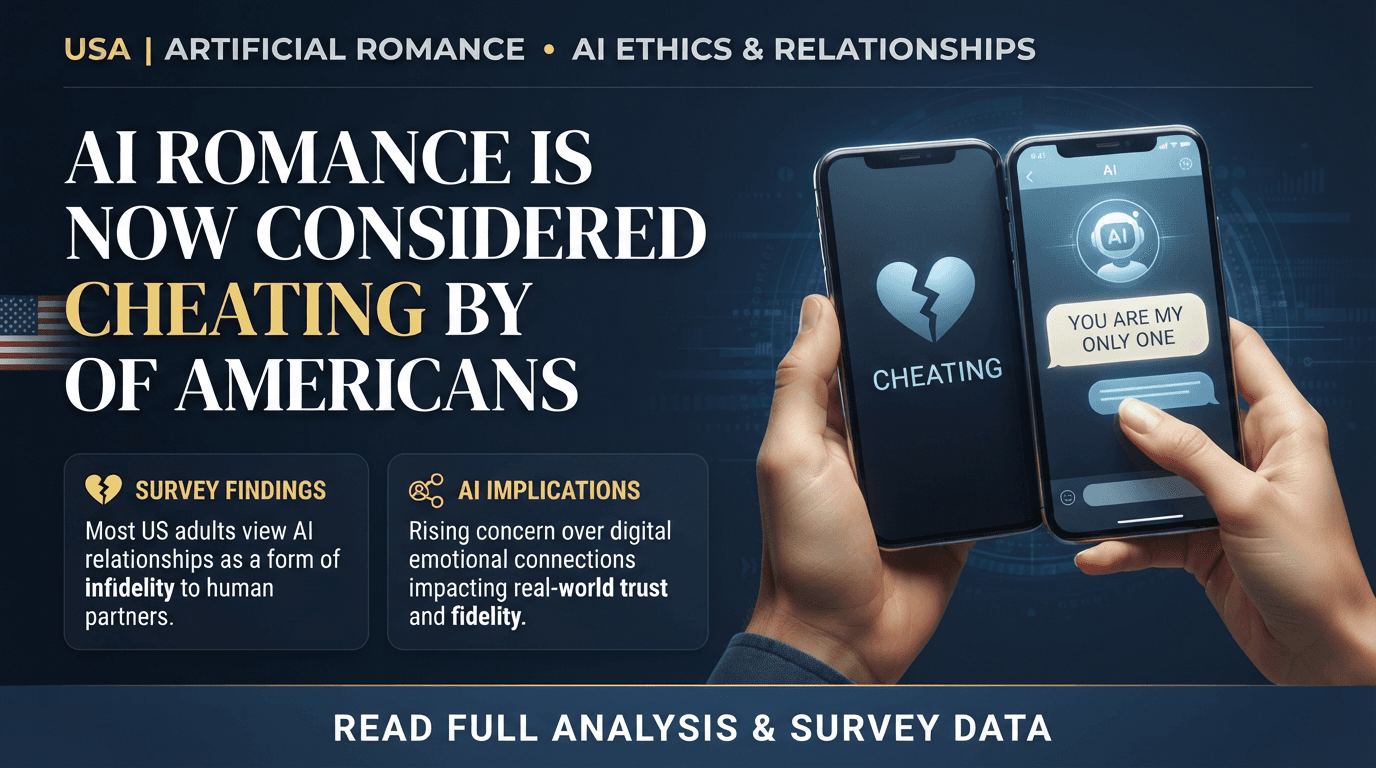
On 3 August 2026, a new survey titled The State of AI Romance 2026 reported that 50.5% of U.S. adults consider a partner’s romantic or sexual relationship with artificial intelligence to be cheating, giving AInews a fresh data point in the debate over digital fidelity.
What exactly did the new survey on AI romance and cheating find?
The August 2026 survey by AI Girlfriend Coach asked U.S. adults whether they would see a partner’s romantic or sexual relationship with an AI bot as infidelity. Just over half said yes, while many of the rest still felt uneasy even if they stopped short of calling it cheating.
According to AI Girlfriend Coach’s The State of AI Romance 2026 study, fielded in August 2026 among U.S. adults:
- 50.5% of respondents said a partner’s romantic or sexual relationship with an AI would count as cheating.
- 21.2% said it would not be cheating but that they would be uncomfortable with it.
- Combined, 71.7% expressed discomfort with a partner having an AI-mediated romance.
The study examined how adults view AI girlfriends, AI boyfriends and emotional attachment to digital companions, concluding that artificial partners are already reshaping ideas of loyalty and betrayal in long-term relationships.
How do these findings compare with other recent research on AI companions and infidelity?
Other surveys from 2025 and 2026 show a similar pattern: large numbers of Americans treat romantic or sexual interaction with AI as crossing a line, although they differ in whether they label it outright cheating or a lesser breach of trust.
Recent national and industry studies report the following key figures:
- According to a 2,000-person U.S. singles survey conducted by OnePoll for dating app Plenty of Fish in 2025, 54% of respondents said romantic or emotional engagement with AI chatbots constitutes infidelity.
- The same Plenty of Fish study found that this 54% is just one percentage point below the 55% who classify emotional bonds with another human as cheating, putting digital and human emotional affairs on nearly equal footing.
- A study by the Kinsey Institute and DatingAdvice.com, fielded with 2,000 U.S. singles in 2025, reported that 61% said sexting or falling in love with an AI “crosses the line” in a relationship.
- According to a breakdown of that Kinsey–DatingAdvice survey published in 2026, 32% called sexting with an AI chatbot cheating, while 29% said an AI romance itself counts as cheating.
- A July 2026 article discussing Talker Research results said 24% of Americans consider flirting with AI a form of cheating, with the figure rising to 36% among Generation Z respondents.
- A July 2026 analysis on romantic AI companions reported that roughly one third of Americans say a partner’s use of such a companion would count as cheating.
Taken together, the new 50.5% figure places AI romance near the top of the range of existing estimates, aligning with earlier research that shows between one quarter and just over half of Americans equate AI intimacy with betrayal.
Who is most likely to see AI relationships as cheating, and who is more accepting?
Age and gender sharply divide perceptions of AI romance. Younger adults and women tend to view AI partners as a breach of fidelity. Older adults and some young men are more open to parallel digital relationships, or see them as a way to prevent traditional cheating.
Different studies highlight these demographic splits:
- A 2025 national study of Americans aged 18–29 found that 56% in this group say having a romantic or intimate relationship with AI is cheating.
- In a 2025 survey about AI boyfriends and girlfriends, 25.34% of women regarded AI dating as outright cheating, compared with 18.53% of men.
- The same AI partner survey reported that 30% of millennials see AI partners as cheating, compared with 15% of Gen Z respondents.
- That study also noted that 17% of Gen Z males believe AI partners can help prevent cheating in human relationships, suggesting some see digital romance as a safety valve rather than a betrayal.
- A 2025 study on “Artificial Romance” found that adults aged 60 or older were the most accepting of AI romantic relationships alongside human relationships, with 50.29% saying these parallel relationships are not cheating on human partners.
- According to that same research, younger adults aged 18–29 were the most likely to judge simultaneous AI and human romantic relationships as cheating and unacceptable.
The August 2026 AI Girlfriend Coach survey did not publish a full demographic breakdown in its press summary, but its headline figure aligns with earlier findings that a majority of Americans either condemn AI romance outright or feel deeply uneasy about it.
Are people actually forming secret relationships with AI chatbots?
Surveys about behaviour show that AI affairs are not merely hypothetical. Young adults in committed relationships increasingly report having hidden romantic attachments to AI chatbots, often without their partners’ knowledge.
Research from Brigham Young University’s Wheatley Institute, published in May 2026, examined AI attachments among 18- to 30-year-old Americans who were dating, engaged or married.
- According to the BYU Wheatley Institute study, one in seven partnered young adults has a secret and frequent romantic attachment to an AI chatbot.
- A detailed summary of the same research reported that the survey covered 2,431 American adults between 18 and 30 in romantic relationships.
Separate polling on AI companions found that at least one in six American adults has interacted at least once with a romantic AI companion, while about one third said a partner’s use of such an AI would count as cheating.
These behavioural data points show that the cheating dilemma is no longer theoretical. Digital partners sit inside phones and laptops across the United States, sometimes hidden from human partners who may still assume betrayal only happens with other people.
How do Americans define cheating when technology blurs the lines?
Researchers say Americans now draw distinctions between types of AI interaction, splitting flirting, sexting and full-blown romantic attachment into different categories of moral violation. Emotional entanglement with AI appears to worry many respondents as much as physical infidelity.
Recent surveys illustrate how definitions are evolving:
- Plenty of Fish’s 2025 survey reported that 54% of U.S. singles classify romantic or emotional engagement with AI chatbots as infidelity, almost matching the 55% who say emotional bonds with another human count as cheating.
- A 2025 study covered by Mashable found that 33% of 2,000 American adults believe that sexting or entering a romantic relationship with AI constitutes cheating.
- In that Mashable-reported survey, 64% of those who saw sexting or AI romance as cheating said both behaviours are infidelity, 21% believed only sexting with AI is cheating, and 15% said only a romantic relationship with AI counts.
- The Kinsey Institute and DatingAdvice.com’s 2025 national study found that 61% of singles see sexting or falling in love with an AI as cheating, underscoring broad moral concern around digital intimacy.
- A detailed reanalysis of those Kinsey–DatingAdvice data in 2026 highlighted that, when asked separately, 32% called sexting with an AI chatbot cheating, and 29% called an AI romance cheating.
- Talker Research’s July 2026 survey, reported in Italian media, said 24% of Americans consider flirting with AI cheating, with the share rising to 36% among Gen Z.
These figures suggest that while outright physical betrayal with another human still dominates common-sense definitions of cheating, a growing share of Americans view emotional and sexual interaction with AI as falling inside the same moral category.
What does this mean for couples negotiating boundaries around AI in daily life?
Therapists and relationship researchers argue that couples now need to talk explicitly about AI companions, just as they might discuss social media behaviour or contact with ex-partners. Silence leaves room for mismatched expectations and sudden feelings of betrayal.
Recent commentary and clinical research highlight several practical implications for relationships:
- According to the AI Girlfriend Coach report, the reasons people turn to AI companions appear to be “less about sex and romance than commonly assumed”, suggesting some are seeking emotional support or nonjudgmental conversation.
- Counsellors writing in a 2025 study on artificial romance note that older adults might see AI partners as companionship that does not threaten their human relationships, which could clash with younger partners’ stricter expectations of fidelity.
- Deseret News coverage of the BYU Wheatley Institute study described real-world couples confronting the discovery of hidden AI relationships, raising questions about whether confession and forgiveness work differently when no human third party is involved.
- A July 2026 analysis on flirting with AI companions emphasised that at least one in six adults has tried romantic interaction with AI, meaning many couples are negotiating this issue for the first time without established social norms to guide them.
- Radio and podcast discussions of the October 2025 cheating survey warned that younger Americans, especially those aged 18–29, are already more likely than older generations to classify AI romance as cheating, hinting at intergenerational friction inside families.
The new 50.5% figure adds weight to calls from therapists and relationship coaches who say partners should now address AI boundaries early, and revisit them as technology evolves, rather than waiting for secret digital attachments to surface during conflict.