AInews: Biosecurity rules tighten as AI pushes biotechnology to the frontier
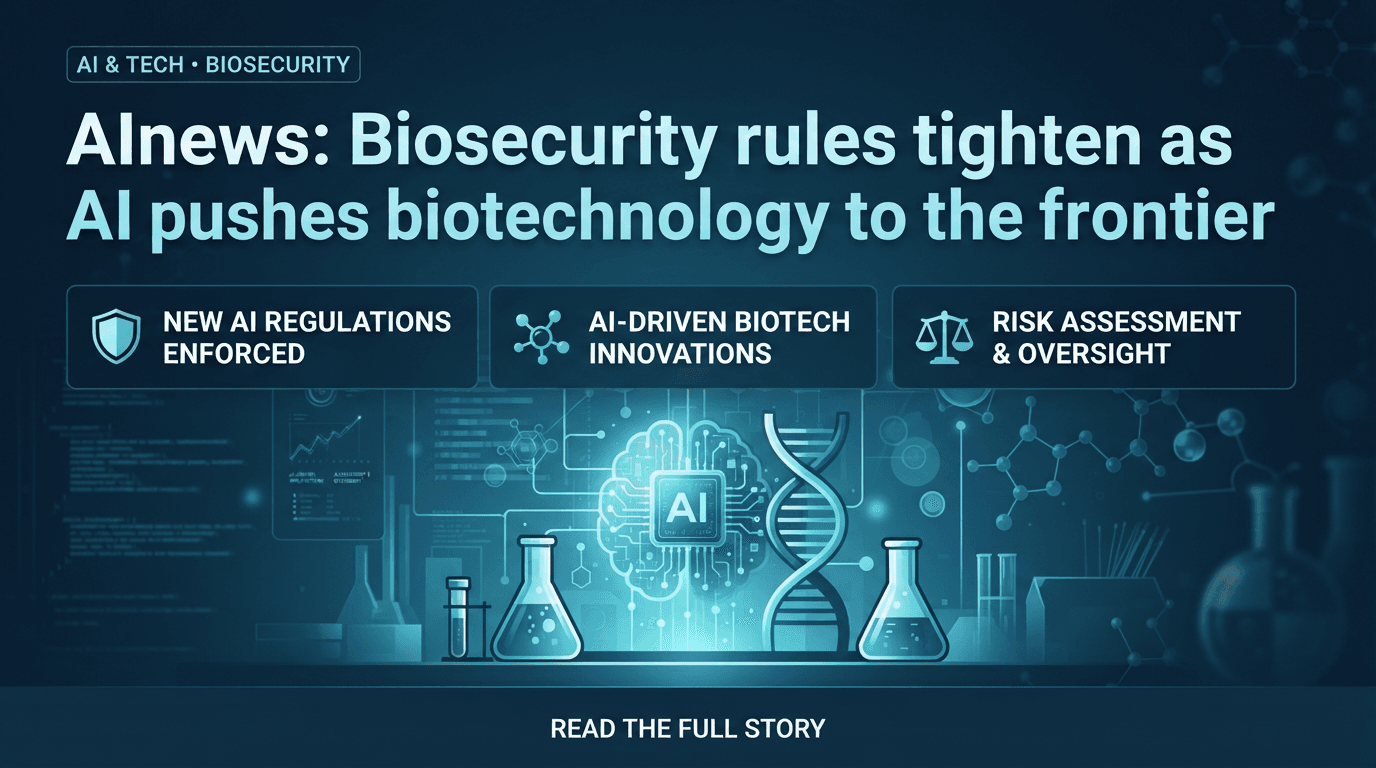
On 12 August 2026, the United Kingdom announced plans to regulate artificial intelligence in gene synthesis, while new U.S. studies and policy debates exposed gaps in biosecurity at the frontier; together they show why the term AInews now increasingly means urgent biosecurity news, not just software updates.
How is artificial intelligence changing the biosecurity frontier?
Artificial intelligence is transforming biology from design to deployment, creating both new defenses and new risks. Recent research showed AI models can design complete virus genomes, and policy reports warn that no single safeguard is enough to stop a determined actor from using these tools to build biological weapons.
Several developments in July and August 2026 show how fast the frontier is moving:
- On 6 August 2026, a team led by Stanford’s Samuel King and Arc Institute researcher Brian Hie reported using an AI genome-language model family called Evo to design and then build functional synthetic bacteriophages.
- The study, published in Science, showed that viruses designed only in silico from genome sequences could infect bacteria once synthesized, highlighting a new class of AI-enabled biological capability.
- An analysis on 12 August 2026 described AI-designed viruses as a test of whether existing biosecurity systems can keep pace with these capabilities, stressing that some computer-generated designs worked when built and tested in the lab.
- A paper released on 13 July 2026 in Frontiers in Bioengineering and Biotechnology examined the limits of sequence-based biosecurity screening tools in the age of AI-assisted protein design, questioning whether traditional DNA sequence checks can reliably catch novel, AI-generated threats.
These technical advances sit within a broader discussion of dual-use AI-enabled biotechnology. A policy brief from the Belfer Center, published on 13 August 2026, labeled AI-bio as a "dual-use frontier," arguing that the same models that accelerate vaccine and therapy development can also simplify the design of dangerous biological agents.
The Belfer Center brief emphasized that the United States, as of August 2026, still lacks a comprehensive federal statute specifically governing AI use in biosecurity, even as capabilities spread across private labs and cloud providers.
What new policies and regulations are governments considering for AI in biotechnology?
Governments in the United Kingdom and United States are moving from voluntary guidance to more formal rules. The UK is drafting legislation to regulate AI’s role in gene synthesis, while U.S. agencies test layered oversight through funding conditions and high-risk research policies.
In the United Kingdom, officials set out a clear policy direction in mid-August:
- According to UK government briefings reported on 12 August 2026, ministers plan to regulate AI use in gene synthesis to prevent terrorists from creating biological weapons.
- The proposed legislation would make DNA sequence screening mandatory across the industry, replacing the current voluntary framework that encourages but does not require checks.
- Providers of synthetic nucleic acids would have to:
- Verify customer identities.
- Screen ordered sequences longer than 50 nucleotides against databases of known dangerous organisms and toxins.
- Report suspicious orders and failed legitimacy checks to authorities.
This approach builds on guidance that the UK Department for Science, Innovation and Technology released in October 2024, which urged providers to screen sequences of concern above a 50-nucleotide threshold but stopped short of imposing legal obligations.
In the United States, policy is evolving in several tracks:
- On 29 July 2026, the White House issued a new policy for federal funding of high-risk life sciences research, including dangerous gain-of-function (DGOF) studies, extending oversight to areas judged to pose the greatest national security risk.
- The guidance directs the Office of Science and Technology Policy (OSTP) to convene an interagency group to monitor advances at the intersection of biological sciences and artificial intelligence, including in silico life sciences research.
- The policy states that proposals to create or modify biological agents that fall under DGOF definitions, when based on in silico design, will be subject to the same restrictions as wet-lab DGOF research.
- Purely computational work remains fundable unless it involves an "entity of concern," which keeps AI model development largely open while tying funding decisions to specific biological applications.
Beyond funding rules, lawmakers in Washington are discussing statutory frameworks. Reporting on 18 August 2026 described momentum on Capitol Hill for a narrowly written bill that would create a basic federal biotechnology security framework, including obligations tied to AI-enabled biotechnologies.
The Belfer Center’s 13 August 2026 recommendations call for:
- A government-authorized private regulatory market in which licensed technical auditors enforce AI-biosecurity safeguards for frontier models.
- Universal screening of synthetic nucleic acid orders longer than 50 nucleotides, including private-sector orders and not only government-funded work.
- Mandatory customer verification and reporting of failed legitimacy checks to strengthen oversight of commercial providers.
These ideas align with goals in the UK’s planned legislation and reflect a broader shift toward combining national regulation with industry-driven standards.
Why are DNA synthesis screening and gene synthesis controls central to frontier biosecurity?
DNA and gene synthesis sit at a chokepoint where digital designs become physical biological agents. Screening orders and controlling access are central because AI now makes it easier to generate novel sequences that may bypass older detection tools.
Several recent analyses explain the screening challenge:
- The July 2026 Frontiers in Bioengineering and Biotechnology paper argued that sequence-based screening tools, designed to look for known pathogens, struggle when faced with AI-assisted protein and genome design that produces unfamiliar yet harmful sequences.
- An article titled "The 50-Nucleotide Question" described concern that the widely used 50-nucleotide threshold in guidance may not capture shorter but dangerous motifs, while still leaving gaps for longer, engineered sequences.
- On 4 August 2026, artificial science commentators noted that AI had been added as the sixteenth technology priority in the Apollo Program for Biodefense, with one of five recommended investment lines focused on adaptive nucleic acid synthesis screening.
Industry testimony in California shows how screening is applied today and where gaps remain:
- On 4 August 2026, Twist Bioscience representatives told a California legislative committee that the company already screens all DNA orders against databases of dangerous pathogens and sanction lists.
- They backed a state bill, AB 1864, which would require DNA screening by providers across California, arguing that AI design tools can generate novel sequences that evade legacy detection and that defensive datasets must be updated continuously.
- Twist reported producing hundreds of thousands of designed variants for model training, suggesting that the volume and diversity of sequences passing through commercial platforms is expanding sharply with AI support.
A RAND report released on 18 August 2026 offers a complementary perspective. RAND researchers argued that no single safeguard can stop AI-enabled bioweapon construction; they proposed nine interventions along the biological risk chain, including model-layer safeguards, access and deployment controls, upstream governance, and interventions at select physical chokepoints such as DNA synthesis providers.
In this framework, synthesis screening becomes one layer among many, tied to controls on AI model access and real-time monitoring of suspicious usage patterns.
How are national security strategies adapting to AI-assisted bioterror risks?
National security planners now treat AI-assisted bioterror as a distinct challenge. Recent reporting shows U.S. biodefense strategies adding AI as a named priority, while the Trump administration seeks to rebuild biodefense institutions and funding mechanisms weakened earlier in his second term.
On the strategic side, the Apollo Program for Biodefense expanded its priorities in mid-2026:
- On 7 July 2026, the program’s sponsors added artificial intelligence as the sixteenth technology priority, the first new priority since the original fifteen were laid out in 2021, according to Atlantic Council reporting summarized by Artificial Science.
- The associated brief recommended investment across five lines:
- AI-enabled disease surveillance and diagnostics.
- Medical countermeasure development, including faster vaccine and therapeutic design.
- Microbial forensics and attribution, using AI to trace the source of biological attacks.
- Model evaluation and safeguards for frontier AI systems.
- Adaptive nucleic acid synthesis screening that can respond to evolving AI-generated sequences.
In parallel, the Trump administration is seeking to reinforce biodefense capabilities:
- On 17 August 2026, reporting described the White House racing to prepare for new strains of deadly viruses, in part because artificial intelligence could simplify the creation of dangerous pathogens and because earlier staffing cuts had reduced expertise in biodefense.
- Coverage on 18 August 2026 detailed moves to rebuild biodefenses as AI fuels bioweapons fears, noting that the administration revoked a 2023 executive order on AI that had called for stronger biological safeguards.
- The same reporting said a revised AI and biosecurity policy, ordered by August 2025, has not yet been released, leaving a policy gap despite mounting concern.
Washington-based analysis on 18 August 2026 framed AI-assisted bioterror as "Washington’s next test," highlighting that federal agencies are starting to embed biosecurity conditions directly into grants, contracts, and research agreements to govern emerging AI-enabled biotechnologies.
This shift moves biosecurity controls from advisory documents into binding funding terms, which can influence how both public and private labs design and use AI tools.
Who is most affected by frontier biosecurity changes, and what comes next?
Researchers, DNA synthesis firms, AI developers, and security agencies face new obligations and incentives. Next steps include turning recommendations into law, standardizing screening worldwide, and building monitoring systems that can detect misuse without blocking beneficial research.
The main groups affected include:
- Life sciences researchers, who must navigate new DGOF funding rules and potential reviews of in silico designs that involve dangerous agents, changing how projects are proposed and approved.
- DNA and gene synthesis providers, particularly in the UK and California, who may be legally required to verify customers, screen all orders above defined thresholds, and report suspicious requests.
- AI model developers working at the intersection of biology and machine learning, who could face licensing, audit requirements, or model-layer safeguard standards if recommendations from groups such as RAND and the Belfer Center are adopted.
- National security and public health agencies, which will need expertise in both AI and biology to interpret alerts, investigate anomalous activity, and respond to potential AI-designed threats.
Looking ahead, several unresolved issues stand out:
- How to define "frontier" AI models for biology, and who should decide which systems fall under special biosecurity rules.
- How to share warning signs and misuse patterns across companies and governments while protecting privacy and proprietary research.
- How to align national regulations so actors cannot simply shift synthesis orders or AI workloads to jurisdictions with weaker rules.
- How to update screening databases and defensive datasets fast enough to match AI’s ability to generate novel sequences.
Whether these questions are answered through international agreements, industry standards, or domestic law will shape the future of biosecurity at the frontier where AI-driven design meets synthetic biology.