
U.S. Targets Alleged CJNG Regional Chiefs in Michoacán With New Indictment
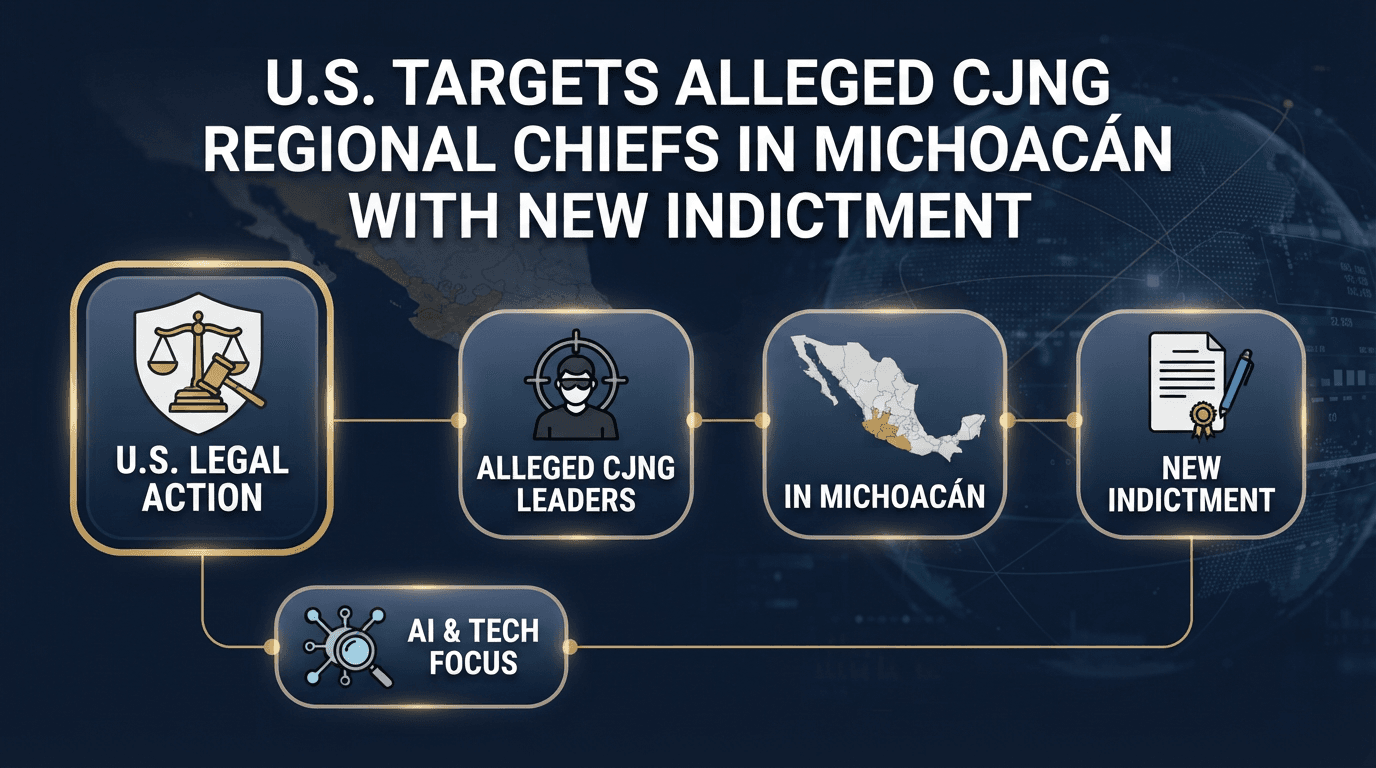
A federal grand jury in Washington, D.C., has indicted two Mexican brothers accused of serving as regional commanders for the Cártel de Jalisco Nueva Generación (CJNG) in the state of Michoacán, deepening the U.S. Justice Department’s campaign against one of Mexico’s most powerful criminal organizations.
The indictment, returned in the District of Columbia, charges Ramon Alvarez Ayala, 44, and Rafael Alvarez Ayala, 42, both Mexican nationals, with conspiracy to distribute cocaine and methamphetamine destined for the United States, along with a related firearm offense involving a machine gun. Prosecutors say the brothers, known by the aliases “R1” and “R2” and “Rafa,” operated as CJNG regional commanders in Michoacán and oversaw drug-trafficking activities that moved narcotics across the border.
Details of the Charges
According to U.S. court documents and Justice Department statements summarized in media reports, the Alvarez Ayala brothers are accused of participating in a conspiracy to manufacture and distribute significant quantities of drugs for importation into the United States. The indictment specifies quantities of five kilograms or more of cocaine and 500 grams or more of methamphetamine, thresholds that trigger some of the toughest mandatory minimum sentences under U.S. federal narcotics laws.
In addition to the drug-trafficking counts, the brothers face a firearms charge tied to the use and possession of a machine gun to further drug-trafficking crimes. Under U.S. law, using or carrying a firearm in relation to a drug-trafficking offense, particularly a weapon classified as a machine gun, can dramatically increase potential penalties, including mandatory consecutive prison terms.
Mexican outlet Proceso, citing the U.S. indictment, reports that the charges could expose the brothers to up to two consecutive life sentences if convicted on all counts, reflecting the severity with which U.S. authorities are treating alleged CJNG leadership figures.
Alleged Role Within CJNG in Michoacán
The Justice Department describes the Alvarez Ayala brothers as regional commanders of CJNG in Michoacán, a Pacific-coast state that has long been a strategic trafficking corridor and a battleground among rival criminal groups. As commanders, they are alleged to have coordinated production, storage, and transportation of cocaine and methamphetamine, relying on networks of local operatives to move drugs from labs and collection points in Mexico toward U.S. markets.
CJNG, formed in the late 2000s and led for years by Nemesio Rubén Oseguera Cervantes, known as “El Mencho,” has expanded aggressively into states like Michoacán, competing with other groups for control of smuggling routes and local extortion rackets. The indictment suggests that the Alvarez Ayala brothers were part of this expansion, overseeing operations that contributed to the cartel’s international supply chain.
U.S. and Mexican analysts have frequently noted that Michoacán’s rugged terrain and access to ports on the Pacific Ocean make it a key area for shipping precursor chemicals, manufacturing synthetic drugs such as methamphetamine, and exporting finished narcotics. The allegations against the Alvarez Ayala brothers fit into this wider pattern of CJNG exploiting regional geography to sustain large-scale trafficking operations.
Part of a Wider U.S. Offensive Against CJNG
The new indictment of the Alvarez Ayala brothers comes amid a broader U.S. campaign targeting CJNG’s leadership structure. Earlier in August 2026, the Justice Department announced five separate indictments against alleged high-ranking CJNG leaders, including close relatives and associates of El Mencho, accusing them of continuing to smuggle cocaine, methamphetamine and fentanyl into the United States.
Those August cases include charges against El Mencho’s former son-in-law, Julio Alberto Castillo Rodríguez, and his godson, Hugo Gonzalo Mendoza Gaytán, as well as other alleged senior figures described as overseers of major trafficking operations. The U.S. government has coupled these prosecutions with large reward offers, seeking to incentivize information leading to arrests and extraditions.
The Justice Department’s focus on CJNG has intensified in the wake of the reported death of El Mencho, who, according to U.S. officials and recent court records, was killed by Mexican forces earlier in 2026. With longstanding leaders dead, imprisoned, or facing trial, prosecutors say the cartel’s hierarchy is undergoing a turbulent transition, and they aim to disrupt successor networks before they can consolidate control.
Within this context, the case against the Alvarez Ayala brothers is presented as part of a coordinated strategy to dismantle regional command structures that keep CJNG’s logistics intact. By targeting commanders in Michoacán and other states, authorities hope to weaken the flow of narcotics and reduce the cartel’s ability to project violence.
Legal Process and Potential Penalties
The indictment in the District of Columbia is a formal charging document; it does not constitute a conviction, and the Alvarez Ayala brothers are presumed innocent unless and until proven guilty in a U.S. court. They would need to be arrested and brought before a U.S. judge—either through arrest in the United States or via extradition from Mexico—before the case could proceed to trial or a plea agreement.
Media reports summarizing the indictment emphasize the possibility that, if convicted, each brother could face multiple life sentences. The combination of drug quantities alleged in the conspiracy count and the machine-gun-related firearms charge leads to statutory penalties amounting to life imprisonment, with the potential for sentences to run consecutively.
In recent months, several senior CJNG figures have opted to plead guilty in U.S. courts, trading trial uncertainty for negotiated sentences. For example, reports note that Antonio Oseguera Cervantes, brother of El Mencho, pleaded guilty in July 2026 to similar conspiracy and firearms charges and now faces life in prison. Other co-founders and heavyweight associates have also signaled willingness to cooperate with U.S. authorities, which analysts say is gradually eroding CJNG’s organizational cohesion.
Implications for Security in Michoacán and Beyond
While the Alvarez Ayala indictment originates in Washington, its core allegations focus on criminal activity on the ground in Michoacán. If the brothers are apprehended and ultimately convicted, their removal from the field could alter local power balances, though experts caution that CJNG has often replaced detained commanders quickly.
For U.S. officials, the case underscores their view that CJNG remains a significant threat, capable of supplying large quantities of hard drugs despite ongoing enforcement operations. The targeting of regional commanders like the Alvarez Ayala brothers shows that U.S. prosecutors are not limiting their focus to the cartel’s top leaders but are increasingly pursuing mid- and upper-level operatives who ensure day-to-day continuity of trafficking networks.
As of late August 2026, the Alvarez Ayala brothers’ case is at the indictment stage, and many details—including their current whereabouts, the status of any extradition requests, and the evidence that will ultimately be presented in court—remain to be clarified through future legal proceedings. What is clear from the charges, however, is that U.S. authorities are seeking to hold alleged CJNG commanders accountable in American courts for the flow of drugs they say originates in Michoacán and ends in communities across the United States.