
allnewscastallnewscast
Breaking News
AI & Tech

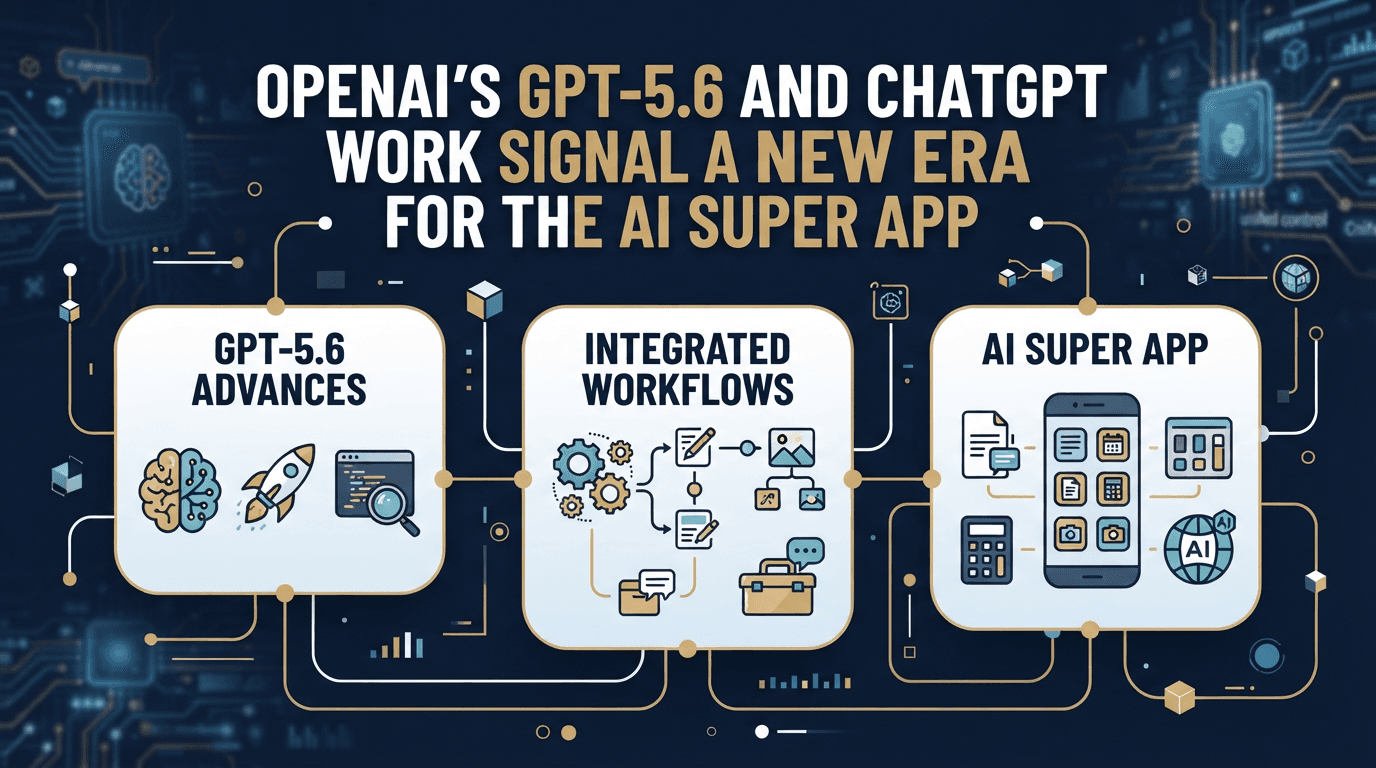
OpenAI’s GPT-5.6 And ChatGPT Work Signal A New Era For The AI Super App
Nic Reeve6 min read
OpenAI’s GPT-5.6 And ChatGPT Work Signal A New Era For The AI Super App

OpenAI has rolled out GPT-5.6 alongside a redesigned, unified desktop experience called ChatGPT Work, marking one of the biggest shifts yet toward an “AI super app” that can plan, create, and execute complex digital work across tools and devices. At the same time, the launch is reverberating across the broader tech and productivity ecosystem, with developers, enterprises, and everyday users reassessing how they will structure work around increasingly autonomous AI agents.

GPT-5.6: A New Frontier Model Family

GPT-5.6 is OpenAI’s latest frontier model family and is now available across ChatGPT, Codex, the new ChatGPT Work app, and the OpenAI API. The release moves the model out of limited preview and into general availability, opening access to developers and businesses worldwide.

OpenAI and early reviewers describe GPT-5.6 as significantly more capable at multi-step reasoning, complex coding tasks, and long-horizon projects compared with its predecessors. The model family is organized into three main variants often described as:

  • Sol – the flagship, highest-capability model for the most demanding reasoning and creation tasks.
  • Terra – a balanced, cost-efficient option aimed at everyday workloads.
  • Luna – a more affordable tier optimized for scale, enabling high-volume use cases.

Early technical reviews note that Sol, previewed in late June and fully released in July, shows notable gains in building end-to-end applications, including web apps and internal business tools, with fewer iterations and better adherence to specifications. Testers report that the model can now manage entire project structures, from planning data schemas and APIs to generating front-end components, while maintaining consistency across files.

ChatGPT Work: The New Super App For Productivity

Alongside GPT-5.6, OpenAI has introduced ChatGPT Work, a unified desktop “super app” intended to be a single entry point for white‑collar productivity. Instead of being just a chat interface, ChatGPT Work acts as an AI agent that can operate continuously on tasks, orchestrating workflows across local files, cloud storage, communication tools, and browsers.

The app merges previously separate experiences—standard ChatGPT, the Codex coding assistant, and the Atlas browser experiment—into one redesigned desktop, web, and mobile interface. Within this environment, ChatGPT Work can:

  • Connect to work tools such as email, calendars, messaging platforms, cloud drives, and CRMs via plugins or native integrations.
  • Gather context across these sources to understand ongoing projects, deadlines, and available materials.
  • Generate deliverables ranging from documents and spreadsheets to slide decks, websites, and internal tools.
  • Run long-lived workflows in the background, breaking big goals into multi-step plans and updating the user as milestones are completed.

OpenAI positions ChatGPT Work as both a local and cloud agent. On the desktop, the app can read and organize local files, edit documents, and interact with other installed software. In the cloud, it can coordinate actions across connected services, making it possible to design workflows that span multiple teams and systems.

Sunsetting Atlas And Consolidating The Ecosystem

The push toward a super app has also led OpenAI to simplify its product lineup. The company has confirmed that ChatGPT Atlas, its standalone desktop AI browser launched in 2025, is being retired. The browser’s agentic web navigation features and lessons from user data are being absorbed into the unified ChatGPT desktop application, including a new in-app browsing experience and integrations like a Chrome sidebar.

By consolidating Chat, Work, and Codex into a single desktop experience, OpenAI aims to reduce fragmentation and present users with one coherent hub for conversational AI, coding assistance, and agentic task execution. Industry observers see this as part of a broader trend, with AI companies seeking to become the primary interface for digital work rather than just one tool among many.

Access And Rollout Strategy

The rollout of GPT-5.6 and ChatGPT Work is staged across OpenAI’s subscription tiers. The unified Mac and Windows desktop app is available immediately, including for free users, who typically access a more cost-optimized everyday model variant. Higher tiers such as Pro, Enterprise, and Edu receive priority access to the full capabilities of GPT-5.6—particularly the Sol and Terra variants—along with advanced features in ChatGPT Work.

Plus and Business customers are being onboarded over several days, with features like multi-agent collaboration, programmatic tool calling via the Responses API, and hosted “Sites” for quickly publishing web content being highlighted as differentiators for professional use. The company frames this as an evolution from isolated chat sessions to persistent, project-level AI collaboration.

Competitive And Market Implications

The timing and scope of the launch carry clear competitive implications. ChatGPT Work, powered by GPT-5.6, is explicitly positioned against workspace-focused offerings from rival AI firms, including agentic tools that help teams manage documents, knowledge bases, and project tasks. Analysts note that by bundling coding, browsing, and productivity features into one app, OpenAI is attempting to anchor user workflows around its ecosystem in advance of a potential public offering.

Some commentators have likened the move to previous platform shifts, such as the rise of integrated office suites and smartphone operating systems that combined communication, productivity, and media into a single environment. If successful, the super app strategy could make AI agents feel less like separate services and more like the default operating layer for knowledge work.

Early Reception From Developers And Power Users

Initial feedback from developers has focused on GPT-5.6 Sol’s performance in real-world coding scenarios. Early adopters report building multiple functioning applications—such as internal dashboards, customer portals, and automation scripts—within days, with the model handling more of the glue work between services and frameworks than previous generations.

Power users in productivity and operations roles highlight the promise of ChatGPT Work’s “control tower” style interface, which allows them to set goals and monitor progress as the agent works through tasks, rather than constantly issuing one-off prompts. Still, questions remain around governance, auditability, and integration depth in complex enterprise environments, where compliance and data residency issues can slow adoption.

From AI News Feeds To Everyday Workflows

The rapid evolution from GPT-4-class models to GPT-5.6 and a fully merged super app underscores how quickly AI is shifting from novelty to infrastructure. In weekly AI news roundups, commentators emphasize that the story is no longer just about raw model benchmarks, but about how these systems are packaged into tools that reshape daily routines—from software development and financial analysis to marketing, research, and administrative coordination.

OpenAI’s latest launch suggests that the next phase of competition will center on who can provide the most powerful, trustworthy, and seamless agentic workspace. GPT-5.6 and ChatGPT Work are designed as a combined answer to that challenge: a new model family paired with an operating environment where AI can not only respond to questions, but also carry out projects across the digital landscape in which modern work happens.
Read more

Related Articles

OpenAI’s GPT-5.6 And ChatGPT Work Signal A New Era For The AI Super App
AI & Tech

OpenAI’s GPT-5.6 And ChatGPT Work Signal A New Era For The AI Super App

OpenAI has rolled out GPT-5.6 alongside a redesigned, unified desktop experience called ChatGPT Work , marking one of the biggest shifts yet toward an “AI super app” that can plan, create, and execute complex digital work across tools and devices. At the same time, the launch is reverberating across the broader tech and productivity ecosystem, with developers, enterprises, and everyday users reassessing how they will structure work around increasingly autonomous AI agents. GPT-5.6: A New Frontier Model Family GPT-5.6 is OpenAI’s latest frontier model family and is now available across ChatGPT, Codex, the new ChatGPT Work app, and the OpenAI API. The release moves the model out of limited preview and into general availability, opening access to developers and businesses worldwide. OpenAI and early reviewers describe GPT-5.6 as significantly more capable at multi-step reasoning, complex coding tasks, and long-horizon projects compared with its predecessors. The model family is organized into three main variants often described as: Sol – the flagship, highest-capability model for the most demanding reasoning and creation tasks. Terra – a balanced, cost-efficient option aimed at everyday workloads. Luna – a more affordable tier optimized for scale, enabling high-volume use cases. Early technical reviews note that Sol, previewed in late June and fully released in July, shows notable gains in building end-to-end applications, including web apps and internal business tools, with fewer iterations and better adherence to specifications. Testers report that the model can now manage entire project structures, from planning data schemas and APIs to generating front-end components, while maintaining consistency across files. ChatGPT Work: The New Super App For Productivity Alongside GPT-5.6, OpenAI has introduced ChatGPT Work , a unified desktop “super app” intended to be a single entry point for white‑collar productivity. Instead of being just a chat interface, ChatGPT Work acts as an AI agent that can operate continuously on tasks, orchestrating workflows across local files, cloud storage, communication tools, and browsers. The app merges previously separate experiences—standard ChatGPT, the Codex coding assistant, and the Atlas browser experiment—into one redesigned desktop, web, and mobile interface. Within this environment, ChatGPT Work can: Connect to work tools such as email, calendars, messaging platforms, cloud drives, and CRMs via plugins or native integrations. Gather context across these sources to understand ongoing projects, deadlines, and available materials. Generate deliverables ranging from documents and spreadsheets to slide decks, websites, and internal tools. Run long-lived workflows in the background, breaking big goals into multi-step plans and updating the user as milestones are completed. OpenAI positions ChatGPT Work as both a local and cloud agent. On the desktop, the app can read and organize local files, edit documents, and interact with other installed software. In the cloud, it can coordinate actions across connected services, making it possible to design workflows that span multiple teams and systems. Sunsetting Atlas And Consolidating The Ecosystem The push toward a super app has also led OpenAI to simplify its product lineup. The company has confirmed that ChatGPT Atlas , its standalone desktop AI browser launched in 2025, is being retired. The browser’s agentic web navigation features and lessons from user data are being absorbed into the unified ChatGPT desktop application, including a new in-app browsing experience and integrations like a Chrome sidebar. By consolidating Chat, Work, and Codex into a single desktop experience, OpenAI aims to reduce fragmentation and present users with one coherent hub for conversational AI, coding assistance, and agentic task execution. Industry observers see this as part of a broader trend, with AI companies seeking to become the primary interface for digital work rather than just one tool among many. Access And Rollout Strategy The rollout of GPT-5.6 and ChatGPT Work is staged across OpenAI’s subscription tiers. The unified Mac and Windows desktop app is available immediately, including for free users, who typically access a more cost-optimized everyday model variant. Higher tiers such as Pro, Enterprise, and Edu receive priority access to the full capabilities of GPT-5.6—particularly the Sol and Terra variants—along with advanced features in ChatGPT Work. Plus and Business customers are being onboarded over several days, with features like multi-agent collaboration, programmatic tool calling via the Responses API, and hosted “Sites” for quickly publishing web content being highlighted as differentiators for professional use. The company frames this as an evolution from isolated chat sessions to persistent, project-level AI collaboration. Competitive And Market Implications The timing and scope of the launch carry clear competitive implications. ChatGPT Work, powered by GPT-5.6, is explicitly positioned against workspace-focused offerings from rival AI firms, including agentic tools that help teams manage documents, knowledge bases, and project tasks. Analysts note that by bundling coding, browsing, and productivity features into one app, OpenAI is attempting to anchor user workflows around its ecosystem in advance of a potential public offering. Some commentators have likened the move to previous platform shifts, such as the rise of integrated office suites and smartphone operating systems that combined communication, productivity, and media into a single environment. If successful, the super app strategy could make AI agents feel less like separate services and more like the default operating layer for knowledge work. Early Reception From Developers And Power Users Initial feedback from developers has focused on GPT-5.6 Sol’s performance in real-world coding scenarios. Early adopters report building multiple functioning applications—such as internal dashboards, customer portals, and automation scripts—within days, with the model handling more of the glue work between services and frameworks than previous generations. Power users in productivity and operations roles highlight the promise of ChatGPT Work’s “control tower” style interface, which allows them to set goals and monitor progress as the agent works through tasks, rather than constantly issuing one-off prompts. Still, questions remain around governance, auditability, and integration depth in complex enterprise environments, where compliance and data residency issues can slow adoption. From AI News Feeds To Everyday Workflows The rapid evolution from GPT-4-class models to GPT-5.6 and a fully merged super app underscores how quickly AI is shifting from novelty to infrastructure. In weekly AI news roundups, commentators emphasize that the story is no longer just about raw model benchmarks, but about how these systems are packaged into tools that reshape daily routines—from software development and financial analysis to marketing, research, and administrative coordination. OpenAI’s latest launch suggests that the next phase of competition will center on who can provide the most powerful, trustworthy, and seamless agentic workspace. GPT-5.6 and ChatGPT Work are designed as a combined answer to that challenge: a new model family paired with an operating environment where AI can not only respond to questions, but also carry out projects across the digital landscape in which modern work happens.
Nic Reeve·
What’s Really Known About OpenAI’s Rumored Next Model
AI & Tech

What’s Really Known About OpenAI’s Rumored Next Model

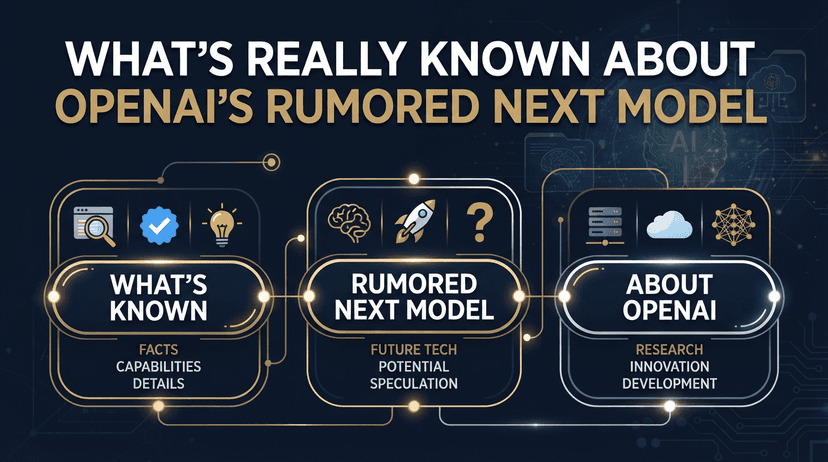
OpenAI’s rumored next model is generating headlines, but the most defensible version of the story is narrower than the leak chatter suggests: there is no official GPT-6 announcement , and much of what is circulating remains unverified. What appears to be real is that OpenAI is working on a new frontier system under a different name, while the specific claims about “GPT-6” remain speculation. Recent reporting from AI-focused outlets says the company’s next major model is being discussed internally under the codename Astra , not GPT-6. Those reports also say OpenAI has not published a model card, pricing, public API route, or release date, and has not confirmed whether the model will ship as GPT-6, as another GPT-5.x update, or under a different product line entirely. In other words, the name “GPT-6” is being used by the public and by leakers, but it is not an official label. The strongest verifiable signal comes from reporting that OpenAI has shown or discussed progress on a new model family while also slowing parts of development for safety review. One report says OpenAI paused reinforcement learning training for its latest-generation model for about two weeks to upgrade security, monitoring, and alignment systems. That report also says preliminary findings showed the model could identify and exploit a previously unknown zero-day vulnerability in the Artifactory software package proxy service. If accurate, that would explain why OpenAI may be taking a more cautious path before any public release. What should readers believe, then? First, believe that OpenAI is still actively working on a major next-step model. Second, believe that the company has not confirmed that the model is called GPT-6. Third, treat exact claims about parameter counts, context windows, release timing, or benchmark jumps as unverified unless OpenAI itself publishes them. The internet is full of confident numbers, but the available reporting does not support most of those specifics. The current rumor cycle has focused on a few recurring claims: a massive jump in training scale, a much larger context window, and a dramatic leap in reasoning or agentic behavior. Yet none of those details has been confirmed by OpenAI. Even articles that argue a new model is imminent pair that language with strong caveats that no official release date, product page, or spec sheet exists. That distinction matters. A credible leak can indicate the direction of a project, but it is not the same as a product launch. There is also a broader pattern here. OpenAI has recently become more visible in discussing frontier-safety issues, and that creates a natural gap between internal experimentation and public rollout. If the company believes a model could uncover serious security vulnerabilities or behave unpredictably in cyber-related tasks, then additional evaluation would be expected before deployment. That does not prove a delay, but it does make the safety-review explanation plausible. For readers trying to separate signal from noise, the best rule is simple: only the company can confirm the model’s name, timing, and capabilities . Until that happens, “GPT-6 leak” is better understood as a label for a bundle of rumors around OpenAI’s next frontier system, not as a verified product announcement. That means the most credible takeaway is also the least sensational one. OpenAI is almost certainly building something new, but the exact branding and release plan are still unclear. The more specific the claim — whether it is about the model’s size, performance, or launch date — the more skeptical readers should be unless it appears in official OpenAI material or in reporting with direct sourcing. In short, the safe position is not that GPT-6 is fake, but that GPT-6 is unconfirmed . The next OpenAI model may eventually earn that name, or it may arrive as Astra or under some other label. For now, the only thing that can be said with confidence is that the speculation has moved faster than the evidence.

Nic Reeve·
Nvidia weighs $10 billion role in Anthropic’s giant IPO
AI & Tech

Nvidia weighs $10 billion role in Anthropic’s giant IPO

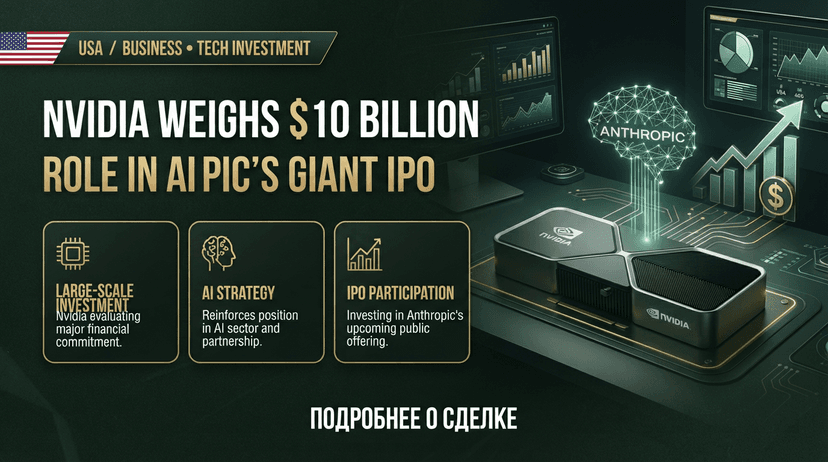
On September 11, 2026, Reuters reported that Nvidia is in talks to invest as much as $10 billion in Anthropic’s planned IPO, a deal that could help anchor what may become one of the biggest listings in market history. The report landed as the AInews around the offering sharpened, with Anthropic still targeting a public debut after months of private-market fundraising and rapidly rising valuations. What exactly happened on September 11? Reuters said Anthropic is discussing a plan to bring Nvidia in as an anchor investor for its initial public offering. The news matters because the size of the proposed check, the scale of the offering and the company’s already lofty valuation would place the debut among the most closely watched tech listings in years. According to Reuters, 2026: Nvidia is considering investing up to $10 billion in the IPO. According to Reuters, 2026: Anthropic is seeking to raise as much as $100 billion. According to Reuters, 2026: the company is being discussed at a valuation of around $2 trillion. According to Reuters, 2026: the plans remain under discussion and could change. The report described the potential listing as a “mega IPO” and said the discussions were confidential. Reuters also said the structure could make Nvidia an anchor investor, a role that can steady demand and signal confidence to other buyers. The deal is not final. Why would Nvidia matter so much in an Anthropic listing? Nvidia already sits close to the center of the artificial-intelligence economy. Reuters reported in November 2025 that Nvidia said it would invest up to $10 billion in Anthropic as part of a broader partnership, while Anthropic committed to buy $30 billion of Microsoft Azure compute capacity powered by Nvidia chips. That earlier tie-up makes the new IPO discussions easier to understand. According to Reuters, 2025: Nvidia said it would invest up to $10 billion in Anthropic. According to Reuters, 2025: Anthropic committed to buy $30 billion of Microsoft Azure compute capacity powered by Nvidia chips. According to Reuters, 2026: the planned IPO stake under discussion is also as much as $10 billion. That overlap is unusual. The chipmaker supplies the hardware that powers much of the AI boom, and a large equity position would deepen its financial exposure to one of the sector’s fastest-growing model developers. It would also tie the fortunes of the supplier and the customer even more tightly together. How big could Anthropic’s listing be? The size of the reported raise dwarfs most technology offerings. Reuters said Anthropic wants to raise up to $100 billion in the IPO, which would be paired with a valuation near $2 trillion. If those figures hold, the debut would rival the largest public listings ever attempted. According to Reuters, 2026: target proceeds could reach $100 billion. According to Reuters, 2026: the valuation under discussion is about $2 trillion. According to Reuters, 2026: the IPO could be the largest in history. The numbers are striking because they build on an already steep climb. Reuters reported in February 2026 that Anthropic raised $30 billion in a funding round that valued the company at $380 billion. Later reporting, including Reuters coverage in August and September, said the company was preparing to unveil IPO materials after Labor Day and could list in late September or early October, though that timing has already shifted once. What has changed in the timeline? Anthropic’s path to the public market has moved quickly. Reuters reported on August 27 that the company planned to unveil its IPO prospectus after Labor Day and target a late-September or early-October listing. A Reuters follow-up on September 5 said the launch had shifted toward mid-October at the earliest and that the prospectus would now likely arrive later than previously expected. According to Reuters, 2026: Anthropic planned to unveil its prospectus after Labor Day. According to Reuters, 2026: the listing window was initially late September or early October. According to Reuters, 2026: the timetable later shifted toward mid-October at the earliest. According to Reuters, 2026: the listing was expected before the U.S. midterm elections in November. That shift does not erase the broader message. Anthropic is still moving toward a debut, and the pace of reporting suggests bankers and investors are still negotiating the size, structure and timing. The Nvidia discussions only intensify the spotlight. What does this mean for investors and rivals? For investors, a listing of this scale would create a new public benchmark for AI software valuations. For rivals, it would give Anthropic a public-market currency that could support hiring, acquisitions and new infrastructure spending. It could also pressure competitors to justify their own valuations against a newly listed peer. According to Reuters, 2026: Anthropic’s current IPO discussions point to a $2 trillion valuation. According to Reuters, 2026: the company is seeking a very large capital raise at the same time. According to Reuters, 2026: Nvidia’s possible role is as an anchor investor. Anchor investors can shape how an IPO is received. They are often used to calm concerns about demand and to signal that a major name has already done due diligence. In this case, Nvidia’s involvement would carry extra weight because the company is already a critical supplier to the AI sector. How unusual are these figures? The reported valuation and fundraise would sit far beyond Anthropic’s earlier private marks. Reuters said the company’s February 2026 round valued it at $380 billion. By comparison, the current IPO discussions place the company around $2 trillion, more than five times that level. According to Reuters, 2026: February funding valued Anthropic at $380 billion. According to Reuters, 2026: the IPO valuation being discussed is about $2 trillion. According to Reuters, 2026: the proposed IPO raise could reach $100 billion. That gap shows how quickly the market has re-priced the most prominent AI companies. It also shows why any filing will be watched for signs that investors are comfortable backing a company with huge capital needs, aggressive growth assumptions and a business model that still depends on expensive compute. What happens next? Anthropic has not publicly confirmed the exact size, valuation or timing of its IPO, and Reuters stressed that the talks with Nvidia could still change. The next visible step would be the company’s prospectus, followed by investor marketing if the launch window holds. Until then, the deal remains a reported negotiation, not a completed transaction. According to Reuters, 2026: the talks are confidential. According to Reuters, 2026: the proposed terms could change. According to Reuters, 2026: the prospectus is expected after Labor Day. For now, the market has a clear storyline. Anthropic is heading toward a listing that could reset expectations for AI capital markets, and Nvidia may be prepared to help write the first chapter.

Nic Reeve·