Google’s Gemini and OpenAI’s ChatGPT Get Major Upgrades in August 2026
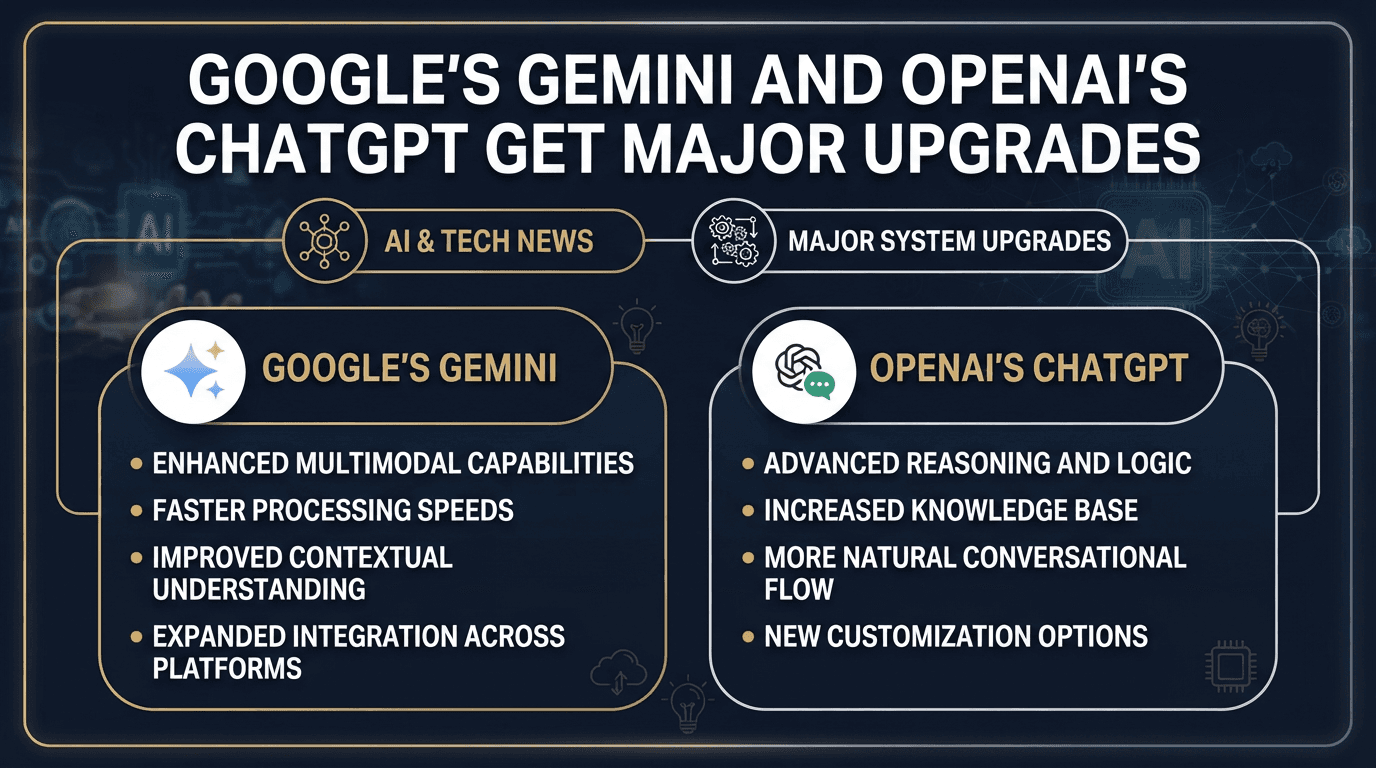
Artificial intelligence platforms from Google and OpenAI are undergoing rapid change in August 2026, with new model releases, pricing shifts and feature upgrades that signal how the next generation of AI assistants will be delivered to consumers and businesses.
Google Accelerates Gemini Rollout With New Flash Model
Google is expanding its Gemini family of models, focusing on efficient systems tailored for coding and automated workflows rather than only headline-grabbing flagship models.
On August 13, 2026, Google introduced Gemini 3.7 Flash, describing it as its latest AI model for software engineering support and agent-style business automation. The release comes just three weeks after Gemini 3.6 Flash, underscoring the rapid cadence at which Google is iterating its mid-tier “Flash” models.
Gemini 3.7 Flash is being positioned as a workhorse for developers and operations teams. According to Google’s developer documentation, the model offers substantial improvements in web development, software engineering and agentic workflows, and is classified as generally available for use through the Gemini API.
To encourage adoption, Google is discounting usage: through the end of 2026, Gemini 3.7 Flash is offered at an introductory rate of $0.75 per million input tokens and $3.75 per million output tokens, roughly half the cost of its 3.6 predecessor. The model is rolling out immediately to Gemini Spark, Google’s subscription-based AI agent service aimed at Pro and Ultra customers in more than 160 countries.
These changes build on earlier July announcements detailing Gemini 3.6 Flash, 3.5 Flash‑Lite and 3.5 Flash Cyber models, which were designed to balance efficiency and quality for scalable “agentic” workflows across Google’s products and cloud services.
Gemini Crosses a Billion Users as Pro Model Timeline Remains Unclear
Alongside the new model, Google is highlighting Gemini’s reach. In early August, CEO Sundar Pichai said that Gemini had surpassed 1 billion monthly active users, calling it the fastest‑growing product in the company’s history on that metric.
Usage is being driven both by consumer-facing Gemini interfaces and enterprise integrations. Google Cloud, for example, now uses Gemini powered tools to assist with code conversion in its Database Migration Service, translating stored procedures, triggers and custom functions from databases such as Oracle and SQL Server into PostgreSQL’s PL/pgSQL language.
Despite that growth, the status of Google’s flagship Gemini Pro remains uncertain. Industry reporting indicates that an anticipated Gemini 3.5 Pro release has been shelved internally, even as Flash-tier models become widely available across consumer products. Google has not publicly detailed timelines for higher-end Pro updates in the same way it has for Flash models.
OpenAI Revamps ChatGPT With GPT‑5.6 Models
OpenAI is simultaneously pushing a major upgrade to ChatGPT’s underlying models and user experience, focusing on more capable reasoning and broader access for free-tier users.
On August 6, 2026, OpenAI announced that GPT‑5.6 Luna will become the default model for Free and Go plans, replacing earlier versions used in the mass-market chatbot. Luna is designed as a general-purpose assistant for everyday conversations, and will soon be paired with a new Think button that lets users trigger more intensive reasoning on harder questions, subject to safety guardrails.
At the same time, Plus and Pro subscribers are receiving an updated GPT‑5.6 Sol model. This version introduces a slider that allows users to choose how much effort—and effectively how much computational “thinking”—ChatGPT applies to a response, trading speed against depth when necessary. OpenAI’s deployment safety documentation categorizes both Luna and Sol as high capability in cybersecurity and biological and chemical domains, reflecting ongoing scrutiny of advanced models in sensitive areas.
These upgrades are replacing GPT‑5.5 Instant in ChatGPT’s lineup and redefining what each subscription tier offers. Independent analysis of ChatGPT plans notes that the August change significantly increases the value of the free tier: Luna becomes the only model available to free accounts, but is paired with notable usability improvements.
Unlimited Text Chats and Expanded Automation for ChatGPT Users
A notable shift in OpenAI’s strategy is a decision to remove core rate limits on text conversations for non-paying users. Starting the week of August 10, free and Go accounts are scheduled to receive unlimited text chats with GPT‑5.6 Luna, although separate limits continue to apply to images, file uploads and other resource-intensive features.
OpenAI’s August release notes for ChatGPT add further refinements: the system now has a more accurate sense of a user’s local time, long conversations load more efficiently on the web, and interactive content can appear while it is still being generated, improving responsiveness.
On the productivity side, OpenAI is expanding its automation tools under the ChatGPT Work offering. Recent updates include webhook-triggered scheduled tasks, shared task management, and more flexible limits for free users. ChatGPT’s browser capabilities have also been extended to work on signed-in websites, with support for password managers and confirmations before consequential actions, allowing AI agents to safely complete workflows across services like Gmail, Slack and GitHub.
OpenAI is simultaneously retiring some legacy models and features from the consumer ChatGPT product. Support articles and release notes indicate that the o3 model will be removed from ChatGPT as of August 26, 2026, and GPT‑4.5 will be retired following earlier sunset dates. The official DALL·E GPT, used for image generation within ChatGPT, is scheduled for retirement on August 30, 2026, although these changes do not affect the separate API offerings.
Where LaMDA Fits in Google’s Current Strategy
Google’s earlier conversational AI model, LaMDA, is now largely overshadowed by the Gemini family in public announcements and developer materials. Recent update logs and product blogs focus almost exclusively on Gemini-branded models and agent services. While LaMDA played a central role in Google’s first wave of large language models, the company has effectively repositioned its AI story around Gemini, particularly in tools exposed to third-party developers.
Industry observers note that this represents not just a rebranding but a consolidation of research and product roadmaps under a single architecture, mirroring how OpenAI has centered its offerings on the GPT‑5.x series. In practice, users interact with Gemini-powered systems in Google products, while LaMDA persists mainly as a reference point in the history of conversational AI.
Competitive Outlook: Faster Iteration, Broader Access
Taken together, Google and OpenAI’s August moves highlight two intertwined trends in the AI industry: ever-faster iteration on core models and a push to make advanced capabilities available to wider audiences.
Google is betting that frequent updates to specialized models like Gemini 3.7 Flash, paired with discounted pricing and agent-focused services such as Gemini Spark, will attract developers and enterprises seeking reliable automation at scale. OpenAI, in turn, is using GPT‑5.6 Luna and Sol to raise the baseline quality of ChatGPT, while removing text-chat limits for free users and strengthening its automation tools through ChatGPT Work.
As both companies refine their AI assistants, the competition increasingly centers not only on raw model capability but also on safety frameworks, pricing, and the way these systems integrate into everyday tools—from cloud databases to email and code repositories. For users of ChatGPT and Gemini, the immediate impact this month is better models, more generous usage terms and an expanding set of task-oriented features woven into the platforms they already use.