allnewscast
Breaking News
AI & Tech

x.ai Expands Grok Bot Access to SuperGrok and Cursor Tiers
Nic Reeve6 min read
x.ai Expands Grok Bot Access to SuperGrok and Cursor Tiers

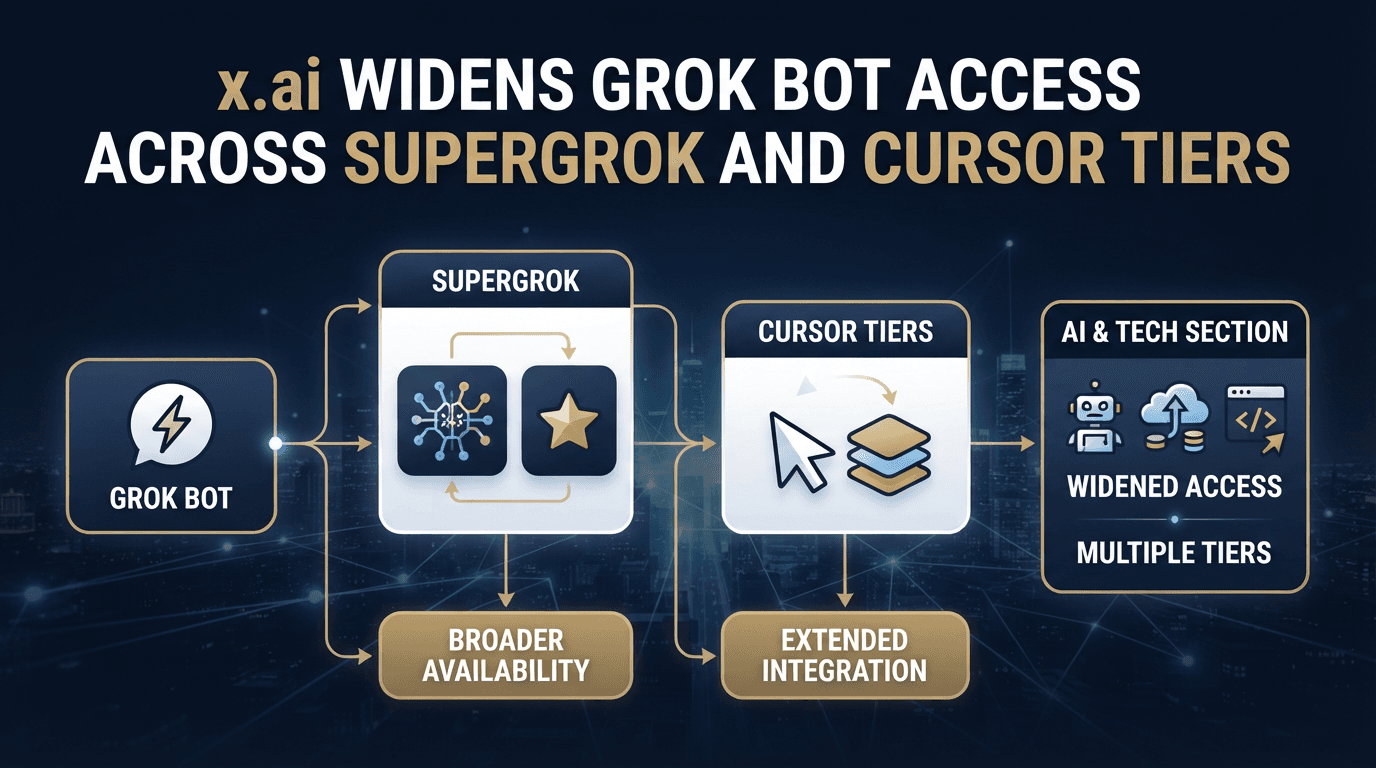
x.ai has broadened access to its automation assistant Grok Bot, bundling the tool into a wider set of SuperGrok and Cursor subscriptions and removing the need for a standalone bot plan for many users.

Grok Bot moves from niche add-on to mainstream bundle

Initially, Grok Bot access was marketed as a premium perk tied primarily to high-end tiers such as SuperGrok Heavy, Cursor Ultra, and certain premium team seats. Those plans targeted power users willing to pay between roughly $200 and $300 per month individually or about $120 per seat for teams. This limited the bot’s reach to a relatively small segment of professional and enterprise customers.

As of late August 2026, x.ai and ecosystem partners have expanded that list substantially. Grok Bot is now included with a broader set of consumer and developer-oriented plans, as well as more affordable team tiers, positioning the bot as a standard part of the Grok stack rather than a niche upsell.

Which plans now include Grok Bot?

According to recent plan documentation and partner briefings, Grok Bot access is now bundled into the following categories of subscriptions:

  • SuperGrok tiers with bot access: In addition to the long-standing inclusion in SuperGrok Heavy, Grok Bot is now listed as an included feature for SuperGrok Plus, a mid-tier plan positioned above the standard $30 SuperGrok subscription.
  • Cursor individual plans: Grok Bot is bundled with Cursor Pro+ and Cursor Ultra, giving solo developers and advanced users bot-driven workflow automation and coding assistance as part of their core IDE-linked subscription.
  • Cursor team plans: Both Cursor Teams Standard and Cursor Teams Premium now include Grok Bot, extending automated project and code management capabilities to multi-seat environments at approximately $40 per seat for Standard and around $120 per seat for Premium.

A blog post focused on Grok Bot’s role in the ecosystem notes that, as of August 22, 2026, eligible plans include Cursor Pro+, SuperGrok Plus, Cursor Ultra, SuperGrok Heavy, and both Cursor Teams Standard and Premium. Another update describing Vertex AI integration reiterates that Grok Bot is now available via SuperGrok Plus, Cursor Pro+, all Cursor Teams tiers, Cursor Ultra, and SuperGrok Heavy, with a new free trial option for those outside these plans.

Pricing context: from $40/seat to $300 a month

The expansion comes amid a broader clarification of Grok’s consumer and professional pricing. Grok’s core chat product spans a free tier and several paid levels, including SuperGrok Lite at around $10 per month, SuperGrok at roughly $30 per month, SuperGrok Plus at about $100 per month, and SuperGrok Heavy at the $300 per month level.

On the developer side, Cursor offers Pro and Ultra subscriptions and team seats. Cursor Pro+ is described as the cheapest individual route to Grok Bot, at approximately $60 per month, with weekly usage for the bot included. Cursor Ultra, around $200 per month, has been one of the earliest widely referenced “doors” to Grok Bot, particularly for users linking their Grok accounts directly with Cursor for integrated AI coding support.

For organizations, Cursor Teams Standard at about $40 per seat per month and Cursor Teams Premium at roughly $120 per seat now provide bundled Grok Bot access for each seat, bringing the automation assistant directly into shared repositories and collaborative workflows.

No standalone Grok Bot subscription – yet

Despite the expanded eligibility list, Grok Bot remains a bundled product rather than a standalone subscription. Several pricing analyses note that, as of late August 2026, there is still no separate Grok Bot-only tier; instead, bot access is packaged into the higher-value SuperGrok, Cursor, and team plans.

This bundling strategy aligns Grok Bot with x.ai’s wider approach to Grok monetization, which uses different paths – direct SuperGrok plans, social bundles such as X Premium and X Premium+, and developer tools like Cursor – rather than selling each capability as an independent subscription.

Free trial and access pathways

For users not ready to commit to the mid- or high-tier plans, x.ai has introduced a 7-day Grok Bot free trial with limited usage. The trial requires a credit card to activate but does not automatically convert to a paid subscription unless the user explicitly opts to continue. This gives prospective customers an opportunity to test bot capabilities inside their workflows without immediately moving to SuperGrok Plus, Heavy, or Cursor Ultra and team tiers.

Alongside the trial, Grok continues to be available through the main Grok app and through X-platform bundles such as X Premium and X Premium+, which provide different levels of access to Grok’s flagship models but do not, in most cases, advertise Grok Bot as a core feature.

What the expansion means for users

Analysts tracking AI subscription pricing argue that bundling Grok Bot with more mid-range and team plans could significantly increase usage, particularly among developers and small teams who might have balked at the $300 SuperGrok Heavy price tag. By anchoring bot access to plans such as SuperGrok Plus and Cursor Pro+, x.ai effectively lowers the entry point for automation-centric use cases while preserving a clear premium tier for the highest-volume customers.

For individual power users, the inclusion of Grok Bot in SuperGrok Plus provides a bridge between the more affordable $30 SuperGrok tier and the $300 Heavy plan, adding bot access, higher usage ceilings, and priority at peak times without requiring an enterprise-scale budget. Developers relying on Cursor gain more direct integration, with Pro+ and Ultra seats now offering bot workflows alongside code completion and analysis features.

Teams, meanwhile, can roll out Grok Bot across collaborative environments through Standard and Premium seats rather than confining bot access to a few high-cost power users. Pricing observers note that this could shift the perception of Grok Bot from a specialist tool to a standard part of AI-enabled software development and operations stacks.

Ongoing evolution of Grok’s subscription model

The move to include Grok Bot with more plans fits into a wider pattern of rapid iteration in Grok’s pricing and packaging. Over the past months, x.ai has added intermediate tiers like SuperGrok Plus, refined usage pools and model access, and clarified how Grok integrates with external platforms such as Vertex AI and Cursor.

Commentary from pricing trackers suggests the current configuration is unlikely to be final; as user behavior and workload patterns evolve, x.ai may continue to rebalance which tiers feature Grok Bot and how much usage each plan includes. For now, however, customers on SuperGrok Plus, SuperGrok Heavy, Cursor Pro+, Cursor Ultra, and Cursor Teams plans stand to benefit from the broadened inclusion of Grok Bot without needing to manage a separate subscription.
Read more →

Related Articles

Music Majors and Gaming Giant EA Lead $76 Million Bet on Stability AI’s Creative Future
AI & Tech

Music Majors and Gaming Giant EA Lead $76 Million Bet on Stability AI’s Creative Future

Stability AI, the generative AI company best known for powering creative tools across image, music, gaming and entertainment, has closed a $76 million Series B funding round led by some of the most powerful names in the global entertainment industry. The raise, completed under CEO Prem Akkaraju, lifts the company’s total funding to $232 million , including two equity rounds and convertible notes since mid‑2024. The round marks one of the clearest signals yet that major studios, labels and game publishers are betting on purpose‑built artificial intelligence for professional creators, rather than treating generative AI as a purely experimental technology. Entertainment Heavyweights Join Stability AI’s Cap Table Central to the new financing is a roster of strategic investors whose catalogs and intellectual property underpin much of the world’s commercial entertainment. Interactive entertainment giant Electronic Arts (EA) , along with global music powerhouses Sony Music Group , Universal Music Group (UMG) and Warner Music Group (WMG) , all took part in the Series B. According to the company, these partners are not just financial backers but are expected to work with Stability AI on new AI models informed by their game assets and music catalogs. The round also includes technology and investment firms such as AMD Ventures and Pacific Alliance Ventures , underscoring interest from the broader tech ecosystem in AI systems tailored for production‑grade creative workflows. These new investors join an already high‑profile group of backers from previous rounds. Existing institutional investors include Coatue , Greycroft , Kadmos Capital , Lightspeed Venture Partners , Mantis Capital , Sound Ventures and advertising giant WPP . Individual investors range from tech and media leaders such as Sean Parker , Eric Schmidt , Prem Akkaraju , Patrick Whitesell and the Reuben Brothers to entertainment figures including filmmaker James Cameron , television producer Mark Burnett , and media investor Vivi Nevo . Several existing investors – notably Coatue, Greycroft, Kadmos Capital, Sean Parker and Eric Schmidt – participated again in the Series B, signaling continued confidence in the company’s strategic pivot under new leadership. Funding to Accelerate AI Tools for Professional Creatives Stability AI says the fresh capital will be used to expand its suite of AI products for professional creatives across music, gaming and entertainment, deepen its applied research organization, and grow its professional services business. The company is positioning its technology as infrastructure for creative production rather than consumer‑grade novelty tools. In practice, that means building systems that can integrate with studio pipelines, work reliably with large volumes of licensed content, and support creators who need predictable, controllable outputs for commercial use. For music, the new partnerships with UMG, WMG and Sony Music Group are expected to enable generative models trained on, or informed by, vast catalogs of recorded sound and metadata, with an emphasis on rights‑aware usage and workflows. In gaming, EA’s involvement aligns with efforts to use generative AI for asset creation, world‑building and interactive experiences, using its extensive library of game art, animation and design as training material. Stability AI has framed its mission as building purpose‑built AI for professional creatives, a phrase meant to distinguish its tools from generic text‑to‑image or text‑to‑music systems that have provoked legal and ethical concerns when trained on unlicensed data. By tying its models directly to partners’ licensed IP, the company is seeking to demonstrate that generative AI can coexist with, and even enhance, existing rights frameworks. New Leadership Continues Turnaround Strategy The Series B is the latest step in Stability AI’s restructuring under CEO Prem Akkaraju , who took over in June 2024 amid a broader reset of the company’s finances and governance. Under his tenure, the firm has raised multiple rounds that recapitalized the business and brought in new strategic investors from advertising, technology and entertainment. Previous funding announcements highlighted backing from major venture capital firms and high‑profile angels, coupled with efforts to stabilize the balance sheet and focus the product roadmap on commercially viable creative tools. The new $76 million round, anchored by entertainment industry leaders, suggests that the turnaround strategy is expanding beyond financial restructuring toward long‑term, revenue‑generating partnerships. Akkaraju’s background in film and media also appears to be shaping the company’s positioning: Stability AI increasingly presents itself not just as an AI research lab, but as a partner to studios, labels and agencies looking to modernize production while preserving creative control and respecting intellectual property. Why the Entertainment Industry Is Betting on Stability AI The decision by top record labels and a major game publisher to take equity stakes in an AI company reflects a broader shift in how the entertainment sector views generative technology. After initial waves of skepticism and legal challenges around AI‑generated content, large rights holders are now seeking to shape the technology from the inside. By investing directly in Stability AI, companies like UMG, WMG, Sony Music Group and EA gain influence over how creative AI systems are designed, trained and deployed. In return, Stability AI gains access to high‑quality, legally cleared data and potential distribution channels for new tools, whether in studio production environments, game engines or label‑run creator platforms. Industry observers note that these strategic investments could pave the way for new categories of products: rights‑aware generative music tools for artists and producers; AI‑assisted sound design and scoring for games and film; and content‑creation systems embedded into game development pipelines that are tuned to each publisher’s art style and IP constraints. The involvement of advertising group WPP and other media‑adjacent investors underscores that interest is not limited to entertainment alone. Brand and agency work increasingly relies on rapid production of images, video and audio assets, a use case that aligns with Stability AI’s emphasis on professional‑grade, controllable outputs. Next Steps for Stability AI With its total funding now at $232 million , Stability AI is entering a critical phase in the race to define how generative AI will be used in commercial creative industries. The company has promised continued investment in applied research, new product launches focused on music and gaming, and expanded professional services to help partners integrate AI into their production pipelines. How quickly those ambitions translate into widely adopted tools will depend on more than just technology. Stability AI will need to convince creators, unions, rights organizations and regulators that its systems enhance rather than displace human creativity, and that its partnerships with major entertainment companies result in fair and transparent use of intellectual property. For now, the latest funding round – backed by a cross‑section of the entertainment world – suggests that the industry’s biggest players prefer to help shape that future from the boardroom table rather than watching from the sidelines.

Nic Reeve·
Late-August AI Shifts: Cheaper Models, New Agents, and Rising Risks
AI & Tech

Late-August AI Shifts: Cheaper Models, New Agents, and Rising Risks

From rapidly falling model prices to tighter regulatory scrutiny and surging AI cyberattacks, the past two weeks have brought major shifts in how artificial intelligence is built, priced, and governed worldwide. For marketers and business leaders, these changes are reshaping both the economics of AI and the risk landscape in which they deploy it. Costs Drop as Frontier Models Get Cheaper One of the most significant developments has been a fresh round of price cuts for advanced AI models. Reuters reports that OpenAI reduced developer pricing for its frontier GPT-5.6 Sol model by more than 20%, signaling intensifying competition on cost and making high‑end capabilities more accessible to enterprise users and startups alike. These cuts follow a broader August trend in which several providers have lowered prices on their latest models to drive volume usage and cement market share. Industry trackers note that this downward pressure on pricing is accompanied by improvements in performance and scalability. Anthropic’s Claude Opus 5 has been highlighted for offering a 1 million‑token context window aimed at complex document analysis and research workflows, while Google’s Gemini 3.6 Flash focuses on reduced output costs and more efficient long‑running agents. For marketing teams, these shifts mean more affordable large‑scale content generation, campaign testing, and customer insight analysis, with less concern about token budgets and more focus on creative and strategic deployment. Agents Move Into Everyday Workflows Alongside cheaper models, August has seen continued momentum toward "agentic" AI—systems that can act continuously on behalf of users. Coverage of recent releases underscores how major platforms are embedding agents into common productivity and consumer tools. Google and Anthropic have both pushed always‑on and desktop agents meant to automate routine tasks inside normal workflows, such as managing email, scheduling, search, and document editing. On the consumer side, AI is increasingly being integrated into daily services. The Verge’s August archive highlights OpenAI’s expansion of ChatGPT’s capabilities, including the ability to make dinner reservations and book tables via partners like OpenTable and Resy, further blurring the line between conversational assistance and full‑service transaction agents. TechCrunch’s coverage of new plugins for Apple Messages shows ChatGPT gaining the ability to send text messages directly for users, extending AI’s reach into mobile communication. For marketers, these developments are particularly relevant. As agents enter messaging and reservation flows, brands gain new touchpoints for personalized, AI‑mediated interactions—from automated outreach and reminders to real‑time customer service embedded in chat. The challenge will be maintaining brand voice and trust when interactions are increasingly handled by semi‑autonomous systems. Physical AI and Robotics Attract Investor Capital A parallel trend is the surge of investment into "physical AI"—robots and drones that pair machine learning with hardware. An August digest notes that Unitree’s IPO was oversubscribed more than 5,000 times, while defense‑oriented drone firm Neros raised $250 million. Orders for industrial robots hit $622 million in the second quarter as automation demand expanded beyond the automotive sector into logistics, manufacturing, and warehousing. These developments suggest that AI’s impact is rapidly extending from software to physical infrastructure. For businesses in retail, logistics, and manufacturing, this means more accessible automation options and, potentially, new forms of data‑driven operations—such as real‑time inventory tracking and AI‑controlled fulfillment. For marketing professionals, robotics‑enabled experiences—from automated in‑store demos to AI‑powered events—may become part of an emerging experiential toolkit. Regulation and Risk: From Chatbot Harm to AI‑Driven Cybercrime As AI diffuses into more parts of daily life, regulators and law enforcement are sharpening their focus on risks and misuse. A recent Al Jazeera analysis draws attention to the relatively light regulation of AI compared with everyday products, noting public concern after cases in which people engaged with AI chatbots prior to suicides and violent incidents. The report underscores growing pressure on the long‑standing Silicon Valley position that innovation should proceed with minimal oversight. New data on cybercrime underscores that risks are not only psychological or social. A study highlighted by CNBC shows that between March 2025 and February 2026, one in four data breaches was AI‑enabled, a 56% increase from the previous year. INTERPOL’s African Cyberthreat Assessment similarly reports that AI is involved in 55% of reported cybercrimes across Africa, illustrating how automation and generative tools are being used to scale phishing, fraud, and network attacks. These trends intersect directly with marketing and customer engagement. As AI tools become standard in campaign, CRM, and analytics stacks, organizations must strengthen security practices around data access, model outputs, and automated communication, ensuring that AI does not inadvertently assist attackers or expose sensitive customer information. Macroeconomic and Policy Implications Policymakers are beginning to factor AI into economic forecasts and industrial strategy. Reuters coverage notes that officials at the Swiss National Bank have warned that artificial intelligence could contribute to higher inflation, as productivity gains and new demand patterns ripple through labor markets and pricing. At the same time, governments are pursuing national AI and chip initiatives. South Korea plans a "chip windfall" fund aimed at supporting youth employment and AI investment, positioning the country as a long‑term hub for semiconductor‑driven AI growth. Brazil is pushing forward with an AI supercomputer program that splits projects between Chinese and U.S. firms, reflecting the broader geopolitical competition around AI infrastructure and standards. Meanwhile, China and Indonesia have agreed to deepen cooperation on minerals, energy, and technology, including AI, further entrenching the technology as a strategic priority in regional partnerships. In the corporate sector, Reuters reports a surge in "AI debt"—large, multi‑year investments in AI infrastructure and capabilities—as U.S. companies race to keep up with technological change. Analysts warn that investor fatigue may be emerging as firms struggle to demonstrate near‑term returns on ambitious AI programs. For marketing and sales teams, this intensifies pressure to show measurable business impact from AI deployments, particularly in customer acquisition, personalization, and revenue growth. Platform Competition and User Adoption On the platform front, Google continues to expand its Gemini ecosystem. The Verge notes that an upgraded Flash model now powers Gemini Spark, improving responsiveness and cost efficiency for search‑integrated AI experiences. Additional reporting from independent trackers suggests the Gemini app has surpassed roughly 1 billion monthly users, cementing AI assistants as mainstream consumer products. TechCrunch coverage points to intensifying competition between OpenAI and Anthropic in the business market, with new data indicating that OpenAI is gaining ground with enterprise users. Combined with ChatGPT’s rapid user growth highlighted in industry blogs and August roundups, this suggests that many organizations are standardizing on a small number of leading foundation models, even as they experiment with niche or open‑source alternatives. For marketers, rising user familiarity with AI assistants changes audience expectations. Consumers increasingly anticipate conversational support, personalized recommendations, and seamless handoffs between human and AI channels. Brands that lag in integrating AI into their customer journey risk appearing outdated, while those that move quickly must balance innovation with transparency and responsible data use. What It Means for Marketing and Business Leaders Taken together, the developments of the past two weeks point to a new phase in AI’s evolution: costs are dropping, capabilities are expanding into agents and robotics, and regulatory and security concerns are intensifying. For marketing teams, this environment offers powerful tools for content, segmentation, and engagement—but also demands disciplined governance, clear disclosure, and careful vendor selection. As industry outlets such as MarketingProfs track these changes in regular AI updates, the central message is consistent: AI is no longer an experimental add‑on. It has become a core layer of modern marketing and business operations, requiring strategic oversight comparable to that applied to data, brand, and customer trust.

Nic Reeve·
AI advances leave China’s workers uneasy as judges and officials push to protect jobs
AI & Tech

AI advances leave China’s workers uneasy as judges and officials push to protect jobs

Across China, workers from factory floors to tech startups are increasingly anxious that artificial intelligence could cost them their livelihoods, even as they scramble to adapt to new tools reshaping their jobs. The rapid spread of generative AI and automation is transforming work processes faster than many employees can upskill, intensifying concerns about job security in a slowing economy. Surveys and official data suggest that anxiety is broad-based and acute. A 2025 survey of around 11,800 professionals conducted by the Cheung Kong Graduate School of Business in Beijing found that 85.5% of respondents believed they could face unemployment within three years because of AI replacing human work. Separate research cited by international media indicates that while many Chinese workers see productivity benefits from AI, more than a quarter of those who expect positive impacts also fear that technology might ultimately replace them. Automation Quietly Reshapes the Labor Market China’s companies are adopting AI at speed, often without public announcements of job cuts. Analysts describe a pattern of “quiet layoffs”, where headcount is reduced as AI tools take over routine tasks in sectors such as customer service, editing, visual design and data processing, allowing firms to maintain output with fewer staff. Recruitment platform data reported by Chinese media shows that hiring demand for several white-collar roles fell sharply in early 2026: editing jobs dropped 29%, customer service positions 23% and visual designers 21% year-on-year, while demand for AI-related skills jumped 73% over the same period. A recent Citibank estimate suggested that about 9.6% of all jobs in China—roughly 70 million positions—are at high risk of AI-driven displacement , with the risk rising to 13.6% among workers in their twenties. Individual stories illustrate the shifting landscape. One data analyst in the AI industry told Chinese business media that she helped automate many of her own repetitive tasks, only to later be laid off when her employer concluded the work could be done with fewer people. She subsequently took a significant pay cut to move into a more traditional sector, remarking that “no industry can hide from AI”, a sentiment echoed across online discussion forums and social platforms. From Factory Workers to Coders: Anxiety Spreads AI’s impact is not limited to white-collar roles. Government-linked commentary notes that workers from assembly-line operators to designers and translators are already feeling pressure from automation and algorithmic management tools. Gig workers and service employees, including delivery drivers and content creators, expressed fear in recent interviews that recommendation algorithms, robotics and generative content systems could dramatically reduce demand for human labor or erode pay. At the same time, highly educated workers in tech and media say they are being asked to use AI to increase output without corresponding increases in pay or job security. According to detailed reporting by Caixin, AI often compresses multiple tasks into a single role rather than eliminating jobs outright, leading remaining staff to shoulder heavier workloads while colleagues are quietly let go. This dynamic, combined with already elevated youth unemployment, is intensifying frustration among recent graduates. International wire reports describe programmers, copywriters and office clerks who now rely on AI chatbots and coding assistants, yet fear those same systems could soon make their roles redundant. Some workers interviewed said they have started learning new skills in machine learning or data labeling, while others are exploring career shifts into fields seen as less easily automated, such as hands-on manufacturing or certain service jobs. Courts Push Back on AI-Driven Layoffs China’s legal system has begun to respond to mounting tension over AI-related redundancies. In late 2025 and early 2026, several courts and arbitration panels ruled that replacing an employee with AI software is not, by itself, a valid reason for termination under existing labor law. Employers were told they must first explore contract renegotiation, retraining or internal reassignment before resorting to layoffs on the grounds of automation. In one widely reported case, a Chinese court found that a technology company had illegally dismissed a worker after substituting his role with AI, ordering compensation and signaling that similar dismissals could face legal challenges. Media coverage in August 2026 highlighted a growing number of rulings in favor of employees displaced by AI, describing them as a significant victory for worker rights—but noting that anxiety about the future of work remains widespread. Labor officials in Beijing have also indicated that AI replacement alone should not justify firing an employee in arbitration proceedings, further underlining the government’s concern about social stability in the face of rapid technological change. Official Response: Shield Jobs, Guide Innovation China’s leadership continues to promote aggressive AI development as a pillar of economic modernization, but has increasingly paired this agenda with explicit commitments to protect employment. Policy documents issued since 2025 under the “AI+” banner include directives to strengthen employment risk assessments for AI applications, guide innovation toward sectors with greater job-creation potential and reduce negative impacts on jobs. At national political meetings, officials and legislators have floated an “AI + Employment” framework featuring tax incentives, reskilling schemes, wage subsidies and possible limits on automation in certain sensitive occupations. One representative of the National People’s Congress proposed a dedicated “AI unemployment insurance” fund to support workers most vulnerable to automation, a suggestion echoed in subsequent commentary on state-linked platforms. The Ministry of Human Resources and Social Security has pledged targeted employment support for key industries and expanded vocational training to help workers adapt to an AI-centric labor market. In early 2026, labor authorities announced plans for a dedicated policy package addressing AI’s impact on employment, promising measures for job stabilization, expansion and quality improvement. China’s official trade union newspaper, Workers’ Daily, has called for regulators to improve labor standards and strengthen oversight of AI algorithms, including mechanisms to ensure workers and unions have a greater say in how AI is deployed in workplaces. Economists interviewed by government outlets argue that AI is more likely to restructure the labor market than eradicate jobs outright, drawing parallels with earlier technological revolutions that ultimately created new professions even as they destroyed old ones. Adapting to an Uncertain Future Despite emerging legal protections and policy initiatives, many Chinese workers remain unsure how to prepare for an AI-driven future. Researchers at the Chinese Academy of Social Sciences warn that rapid advances in large language models and automation technologies could hit both younger and older workers particularly hard, and have urged authorities to pursue a “U-shaped” human-capital strategy focused on early childhood education and lifelong retraining. For now, employees across sectors are experimenting with strategies ranging from embracing AI tools to maximize their own productivity, to seeking roles that involve uniquely human skills, to exploring entrepreneurial ventures built on AI applications rather than competing against them. As one white-collar worker told a reporter, using AI at work has become unavoidable—but the question of who ultimately benefits from that productivity remains unresolved.

Nic Reeve·