allnewscastallnewscast
Breaking News
AI & Tech

x.ai Widens Grok Bot Access Across SuperGrok and Cursor Tiers
Nic Reeve6 min read
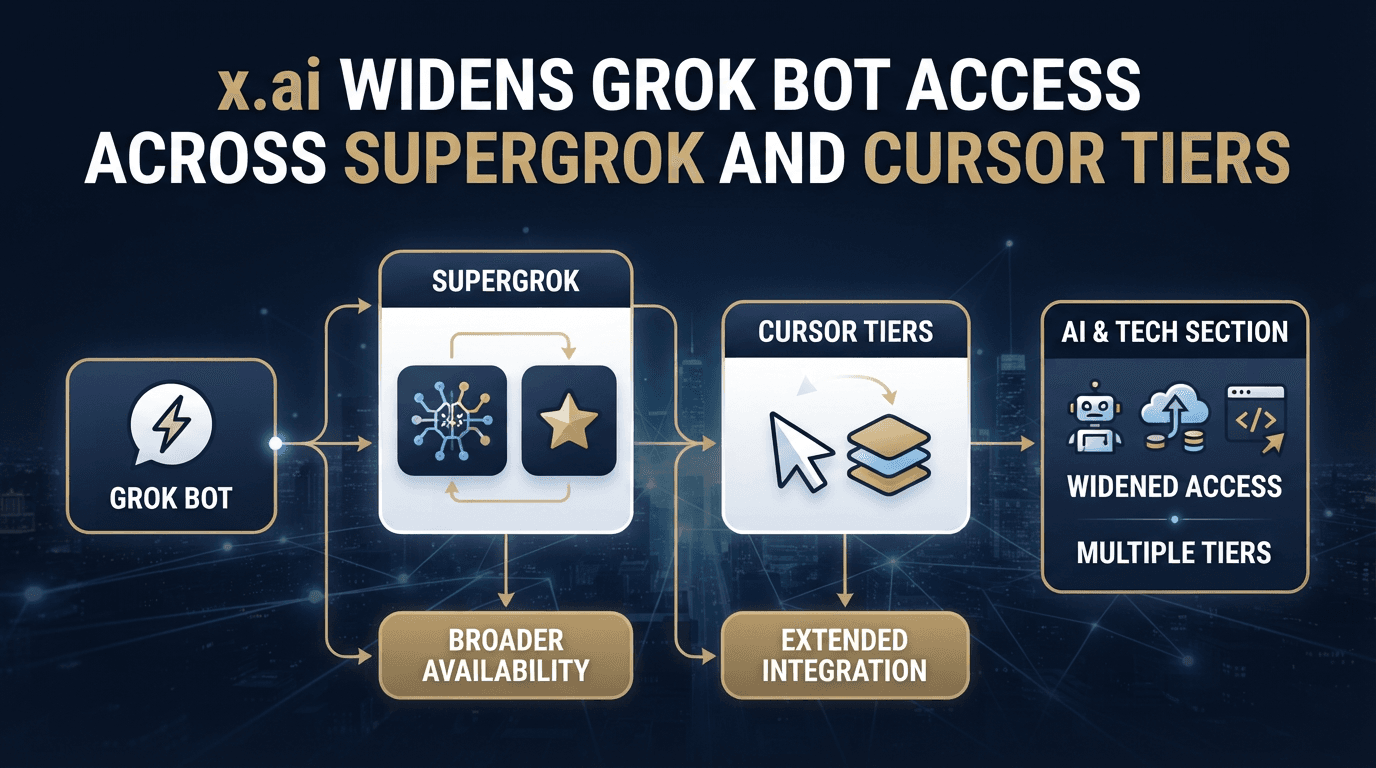
x.ai Widens Grok Bot Access Across SuperGrok and Cursor Tiers

x.ai has broadened access to its automation assistant Grok Bot, bundling the tool into a wider set of SuperGrok and Cursor subscriptions and removing the need for a standalone bot plan for many users.

Grok Bot moves from niche add-on to mainstream bundle

Initially, Grok Bot access was marketed as a premium perk tied primarily to high-end tiers such as SuperGrok Heavy, Cursor Ultra, and certain premium team seats. Those plans targeted power users willing to pay between roughly $200 and $300 per month individually or about $120 per seat for teams. This limited the bot’s reach to a relatively small segment of professional and enterprise customers.

As of late August 2026, x.ai and ecosystem partners have expanded that list substantially. Grok Bot is now included with a broader set of consumer and developer-oriented plans, as well as more affordable team tiers, positioning the bot as a standard part of the Grok stack rather than a niche upsell.

Which plans now include Grok Bot?

According to recent plan documentation and partner briefings, Grok Bot access is now bundled into the following categories of subscriptions:

  • SuperGrok tiers with bot access: In addition to the long-standing inclusion in SuperGrok Heavy, Grok Bot is now listed as an included feature for SuperGrok Plus, a mid-tier plan positioned above the standard $30 SuperGrok subscription.
  • Cursor individual plans: Grok Bot is bundled with Cursor Pro+ and Cursor Ultra, giving solo developers and advanced users bot-driven workflow automation and coding assistance as part of their core IDE-linked subscription.
  • Cursor team plans: Both Cursor Teams Standard and Cursor Teams Premium now include Grok Bot, extending automated project and code management capabilities to multi-seat environments at approximately $40 per seat for Standard and around $120 per seat for Premium.

A blog post focused on Grok Bot’s role in the ecosystem notes that, as of August 22, 2026, eligible plans include Cursor Pro+, SuperGrok Plus, Cursor Ultra, SuperGrok Heavy, and both Cursor Teams Standard and Premium. Another update describing Vertex AI integration reiterates that Grok Bot is now available via SuperGrok Plus, Cursor Pro+, all Cursor Teams tiers, Cursor Ultra, and SuperGrok Heavy, with a new free trial option for those outside these plans.

Pricing context: from $40/seat to $300 a month

The expansion comes amid a broader clarification of Grok’s consumer and professional pricing. Grok’s core chat product spans a free tier and several paid levels, including SuperGrok Lite at around $10 per month, SuperGrok at roughly $30 per month, SuperGrok Plus at about $100 per month, and SuperGrok Heavy at the $300 per month level.

On the developer side, Cursor offers Pro and Ultra subscriptions and team seats. Cursor Pro+ is described as the cheapest individual route to Grok Bot, at approximately $60 per month, with weekly usage for the bot included. Cursor Ultra, around $200 per month, has been one of the earliest widely referenced “doors” to Grok Bot, particularly for users linking their Grok accounts directly with Cursor for integrated AI coding support.

For organizations, Cursor Teams Standard at about $40 per seat per month and Cursor Teams Premium at roughly $120 per seat now provide bundled Grok Bot access for each seat, bringing the automation assistant directly into shared repositories and collaborative workflows.

No standalone Grok Bot subscription – yet

Despite the expanded eligibility list, Grok Bot remains a bundled product rather than a standalone subscription. Several pricing analyses note that, as of late August 2026, there is still no separate Grok Bot-only tier; instead, bot access is packaged into the higher-value SuperGrok, Cursor, and team plans.

This bundling strategy aligns Grok Bot with x.ai’s wider approach to Grok monetization, which uses different paths – direct SuperGrok plans, social bundles such as X Premium and X Premium+, and developer tools like Cursor – rather than selling each capability as an independent subscription.

Free trial and access pathways

For users not ready to commit to the mid- or high-tier plans, x.ai has introduced a 7-day Grok Bot free trial with limited usage. The trial requires a credit card to activate but does not automatically convert to a paid subscription unless the user explicitly opts to continue. This gives prospective customers an opportunity to test bot capabilities inside their workflows without immediately moving to SuperGrok Plus, Heavy, or Cursor Ultra and team tiers.

Alongside the trial, Grok continues to be available through the main Grok app and through X-platform bundles such as X Premium and X Premium+, which provide different levels of access to Grok’s flagship models but do not, in most cases, advertise Grok Bot as a core feature.

What the expansion means for users

Analysts tracking AI subscription pricing argue that bundling Grok Bot with more mid-range and team plans could significantly increase usage, particularly among developers and small teams who might have balked at the $300 SuperGrok Heavy price tag. By anchoring bot access to plans such as SuperGrok Plus and Cursor Pro+, x.ai effectively lowers the entry point for automation-centric use cases while preserving a clear premium tier for the highest-volume customers.

For individual power users, the inclusion of Grok Bot in SuperGrok Plus provides a bridge between the more affordable $30 SuperGrok tier and the $300 Heavy plan, adding bot access, higher usage ceilings, and priority at peak times without requiring an enterprise-scale budget. Developers relying on Cursor gain more direct integration, with Pro+ and Ultra seats now offering bot workflows alongside code completion and analysis features.

Teams, meanwhile, can roll out Grok Bot across collaborative environments through Standard and Premium seats rather than confining bot access to a few high-cost power users. Pricing observers note that this could shift the perception of Grok Bot from a specialist tool to a standard part of AI-enabled software development and operations stacks.

Ongoing evolution of Grok’s subscription model

The move to include Grok Bot with more plans fits into a wider pattern of rapid iteration in Grok’s pricing and packaging. Over the past months, x.ai has added intermediate tiers like SuperGrok Plus, refined usage pools and model access, and clarified how Grok integrates with external platforms such as Vertex AI and Cursor.

Commentary from pricing trackers suggests the current configuration is unlikely to be final; as user behavior and workload patterns evolve, x.ai may continue to rebalance which tiers feature Grok Bot and how much usage each plan includes. For now, however, customers on SuperGrok Plus, SuperGrok Heavy, Cursor Pro+, Cursor Ultra, and Cursor Teams plans stand to benefit from the broadened inclusion of Grok Bot without needing to manage a separate subscription.
Read more →

Related Articles

AInews: M&T Bank’s Tech Reboot Sets Stage for Enterprise‑Wide AI Rollout
AI & Tech

AInews: M&T Bank’s Tech Reboot Sets Stage for Enterprise‑Wide AI Rollout

On September 2, 2026, M&T Bank confirmed that it has deployed AI copilots and other enterprise tools to more than 15,000 employees as part of a broad expansion of enterprise artificial intelligence, capping a technology overhaul that began in 2018 and positioning the bank as a regional leader in data‑driven operations. How large is M&T Bank’s enterprise AI rollout? M&T Bank’s enterprise AI rollout now reaches the majority of its workforce. According to Yahoo Finance in September 2026, the bank has deployed AI copilots to over 15,000 employees, while Forbes reports that around 16,000 staff actively use generative AI tools for daily work as of August 2026. The expansion of AI tools inside M&T Bank is now one of the largest documented deployments in a U.S. regional bank. Key figures include: According to Forbes, August 2026: approximately 16,000 employees use generative AI tools across the enterprise. According to Yahoo Finance, September 2026: AI copilots support more than 15,000 employees in tasks such as call analysis, report drafting and code generation. According to ArtificialIntelligence‑News, September 2026: initial pilots involved about 800 employees before scaling across the organization. According to AIM Media House, December 2025: Microsoft 365 Copilot and Copilot Chat had been rolled out to roughly 17,000 employees by early 2025. Most of these tools run on Microsoft’s Copilot suite, delivered through M&T Bank’s modernized cloud and data architecture. Staff now access generative models through Office applications, internal chat interfaces and embedded features in existing business systems. What concrete AI use cases are live inside M&T Bank? M&T Bank is using enterprise AI in internal operations, risk management, software development and commercial credit monitoring, rather than front‑end customer interactions. These use cases combine Microsoft Copilot with specialist platforms from vendors like RDC.AI and Rich Data Co. According to Yahoo Finance and ArtificialIntelligence‑News, the current internal and risk‑oriented applications include: Analyzing call‑center conversations to identify customer needs and emerging portfolio risks. Drafting reports, internal communications and meeting summaries for employees across departments. Generating and reviewing software code to accelerate development and maintenance work. Spotting potential fraud patterns and strengthening cybersecurity monitoring. Beyond copilots, M&T has introduced domain‑specific AI platforms in commercial credit: According to the Banking Tech Awards USA showcase, May 2026: M&T Bank partnered with RDC.AI in 2025 to replace manual, rules‑based commercial credit monitoring with an AI‑driven continuous monitoring platform. The same source notes the platform supports over 1,200 relationship managers and credit associates, providing automated alerts on borrower risk and portfolio exposure. AIM Media House reports that M&T is also integrating Rich Data Co.’s decisioning platform via vendor nCino, and adopting Amperity’s customer data cloud to unify interactions and tailor communications across channels. These tools sit on top of the bank’s controlled data environment rather than feeding directly into unsupervised decisioning. What technology overhaul enabled M&T Bank’s current AI expansion? M&T Bank’s push into large‑scale AI follows a multi‑year effort to fix data and legacy systems first. The bank began a broad technology overhaul around 2018, rebuilding its data governance, cloud architecture and application landscape to support modern analytics and regulated AI adoption. Forbes describes how M&T “built a strong data foundation” in Buffalo that now underpins dozens of generative AI use cases across three pathways: enterprise fluency, embedded capabilities in existing applications and proprietary models. Key elements of that foundation include: According to Forbes, May 2025: an expanding portfolio of cloud‑based data products and ongoing retirement of legacy platforms. According to CDO Magazine, December 2025: a medallion architecture layered over cloud‑enabled data products, with clear accountability at each layer. According to Portfolio by BISA, September 2025: a central data repository called Edison, supported by lineage tools from Solidatus and Monte Carlo to track data movement. According to Windows Forum reporting, March 2026: a centralized cloud data strategy designed to create a unified “Customer 360” view and reduce reconciliation overhead by decommissioning legacy analytics tools. M&T Bank’s Chief Data Officer Andrew Foster has emphasized that trusted data is the prerequisite for generative AI. Portfolio by BISA quotes him saying that reliable lineage and governance are essential to controlling operational, compliance and reputational risk as AI use scales. How does M&T Bank govern data and AI across such a large deployment? M&T Bank has built AI governance on top of its data controls rather than treating it as a separate exercise. The bank uses a federated data model, medallion architecture and strict lineage tooling, and sequences AI projects to follow maturity in oversight and risk management. AIM Media House describes a stepwise blueprint for AI adoption at M&T Bank: Reset data governance, lineage and controls before major AI pilots. Run six‑month proofs of concept with tools like Microsoft Copilot before enterprise rollout. Deploy internal copilots widely, while keeping customer‑facing applications limited and heavily supervised. Layer in domain‑specific AI, such as commercial credit monitoring and customer‑data platforms, only where oversight frameworks are mature. Portfolio by BISA reports that Edison and lineage platforms help the bank trace data sources for AI outputs, supporting internal audits and regulator reviews. Windows Forum’s analysis of Western New York banks highlights M&T’s published AI policies, inventory of models and continuous monitoring with alerts for drift and anomalies as part of its risk controls. Which employees and business units are most affected by M&T Bank’s AI expansion? M&T Bank’s AI deployment affects office staff, technologists and risk professionals far more than frontline customers. Copilot access is wide across corporate functions, while specialized platforms target commercial credit teams and analytics groups using the bank’s cloud data environment. Based on reports from Yahoo Finance, Forbes and AIM Media House, the main groups using new AI tools include: Customer service and call‑center agents, who use AI to summarize calls and identify next‑best actions. Operations staff, who rely on copilots to draft emails, reports and meeting notes. Software engineers and technology teams, where copilots assist with coding, documentation and troubleshooting. Risk managers and credit associates, who use RDC.AI’s commercial credit monitoring platform. Marketing and analytics teams, who work with Amperity’s customer data cloud and Rich Data Co’s decisioning tools to refine targeting and product offers. AIM Media House quotes M&T’s data leadership stressing that the bank is “not going to the customer‑facing side yet” for broad generative AI use, underscoring a decision to focus on staff productivity and risk insights before AI touches customer decisions directly. What strategy guides M&T Bank’s AI investments and future plans? M&T Bank’s AI strategy combines three main pathways: expanding enterprise fluency, embedding AI into existing applications and building proprietary models using the bank’s own data, all within a regulated and inspection‑ready environment. Forbes reports that the three pathways are: Enterprise fluency, where around 16,000 employees experiment with generative tools to improve productivity and learn their capabilities. Embedded capabilities inside roughly 1,800 applications, many sourced from third‑party vendors, where targeted AI features support tasks like document review and risk scoring. Proprietary development of large language model and agentic solutions built around M&T’s data and processes. ArtificialIntelligence‑News reports that Chief Data Officer Andrew Foster and his team articulated a similar framework: general employee use of generative AI, AI embedded in existing systems and custom solutions aligned with M&T’s distinctive workflows. Forbes and CDO Magazine both describe a “slow to go fast” approach, in which careful groundwork in data, governance and culture enables faster scaling once controls are proven. Looking ahead, public comments and award submissions point to several likely next steps: According to Forbes, May 2025: continued expansion of cloud‑based data products and retirement of legacy platforms as AI demand grows. According to the Banking Tech Awards USA entry, May 2026: deeper integration of continuous AI monitoring in commercial credit, including new analytical measures of portfolio resilience. According to Yahoo Finance, September 2026: exploration of agentic AI for cybersecurity and fraud detection, building on existing detection use cases. How does M&T Bank’s AI journey compare with other regional banks? M&T Bank now stands out among regional banks in Western New York for its focus on centralized data strategy and broad internal AI adoption, while peers such as Five Star Bank are documented as concentrating on AI in specific product lines like indirect auto lending. Windows Forum summaries of local coverage describe two tracks in the region: M&T Bank invests in cloud data architecture, governed customer insights and large‑scale employee access to generative tools. Five Star Bank applies AI more narrowly to product‑level automation and credit decisioning, with smaller deployments. These comparisons show that M&T Bank is using its size and long technology overhaul to treat AI as a company‑wide capability rather than an isolated experiment, emphasizing data discipline and internal fluency before aggressive customer‑facing innovation.

Nic Reeve¡
Illinois State’s ‘End of the World’ Class Puts AI on Trial
AI & Tech

Illinois State’s ‘End of the World’ Class Puts AI on Trial

Students Confront AI Ethics in Illinois State’s ‘End of the World’ Classroom In a seminar room at Illinois State University (ISU), an apocalyptic thought experiment is helping students grapple with one of the most disruptive technologies of their lifetimes: artificial intelligence . Framed as “feminism at the end of the world,” the class invites students to imagine futures shaped by climate crisis, economic collapse, and runaway automation—and then ask what justice, care, and responsibility look like when AI is woven into every aspect of life. The course, titled WGS 391/491: Feminism at the End of the World , is taught by Dr. Jacklyn Weier in Illinois State’s Women’s, Gender, and Sexuality Studies program. Using speculative fiction, feminist theory, and contemporary reporting on AI, Weier’s students interrogate who benefits from emerging technologies and who is left more vulnerable when those tools are deployed in unequal societies. ‘End of the World’ as a Lens on AI Rather than treating AI as a neutral tool, the course positions it as a technology emerging in an already crisis-ridden world. Students consider scenarios in which climate disasters, pandemics, or authoritarian politics intersect with increasingly powerful AI systems. That apocalyptic framing, Weier explains in the Illinois State University News feature, is less about doomsday spectacle and more about clarity: it allows students to see existing inequalities—and the potential amplification of those inequalities—without the distractions of business-as-usual. Class discussions draw on questions such as: Who designs AI systems, and whose values are embedded in them? Which communities are most exposed when automated decision-making is used in policing, immigration, or social services? How might feminist and queer perspectives offer alternative models for building or governing AI, especially in times of crisis? Students are encouraged to treat AI not only as a technical system but as a social infrastructure: something that redistributes power, labor, and risk. That perspective resonates with broader concerns raised by scholars and civil-society groups about bias in algorithms, surveillance capitalism, and the concentration of AI capabilities in a small number of corporations. Illinois State’s Wider Debate Over AI in the Classroom The apocalyptic classroom arrives amid a campus-wide—and statewide—reckoning over how AI should be used in education. Illinois State has devoted increasing resources to helping faculty and students navigate generative AI tools like ChatGPT, Gemini, and Copilot, and to clarifying when such tools enhance learning and when they undermine it. In 2025, the university’s Office of the Cross Endowed Chair in the Scholarship of Teaching and Learning launched a grant program inviting faculty to study how generative AI is used or resisted in courses, and what that means for student learning, assessment, and equity. Those projects are structured around a central question: how is AI being integrated into higher education, and with what consequences for teaching and learning at ISU? Illinois State’s professional development arm has since published guidance for instructors on generative AI in the classroom. That guidance emphasizes transparency and critical engagement: instructors are urged to state clearly in their syllabi when AI use is permitted, explain why particular assignments prohibit AI, and design assessments that prioritize process, reflection, and local or experiential knowledge. Faculty workshops encourage instructors to have students critique AI-generated content, practice fact-checking, and reflect on where AI’s limitations become visible—especially when it comes to hallucinations, bias, and context. The goal is not to ban AI outright but to turn it into an object of analysis and a prompt for metacognition, much like what happens in Weier’s apocalyptic classroom. State Policy: AI Can Assist, But Not Replace, Human Teachers The conversations at Illinois State unfold against a backdrop of new laws in Illinois that specifically address AI in education. Recent legislation requires community colleges to ensure that courses are taught by qualified human faculty and explicitly prohibits using AI systems as the sole source of instruction in place of an instructor. At the same time, the law clarifies that faculty are allowed to use AI as a teaching tool—whether for generating practice problems, simulating scenarios, or tailoring feedback. Another measure directs the Illinois State Board of Education to develop statewide guidance on AI in K–12 settings. That guidance must explain how AI works, offer examples of instructional uses, address data privacy and security, and highlight the risk of unintended bias baked into AI products. It also calls on educators to explicitly teach responsible and ethical AI use, preparing students to evaluate automated systems rather than accept them uncritically. Illinois education officials have since released public-facing guidance that echoes those themes, stressing that AI should support, not supplant, human relationships in teaching and learning. The documents encourage schools to balance innovation with vigilance, especially when it comes to student data and the potential for algorithmic discrimination. An ‘Apocalyptic’ Syllabus Meets Real-World Tech Within this rapidly shifting policy and technological landscape, ISU’s “end of the world” class serves as a kind of laboratory. Students might read feminist science fiction that imagines AI governing resource distribution after climate collapse, and then compare those visions with real-world deployments of predictive analytics in disaster response or public assistance programs. Assignments invite students to bring news coverage, corporate marketing, and government documents into conversation with theoretical texts. For example, a student might juxtapose a tech company’s promise to use AI for equitable healthcare with reports of biased diagnostic algorithms, or analyze how AI-enhanced policing could change under conditions of social unrest or environmental migration. By situating AI in imagined end-times, Weier’s course asks students to strip away the sheen of inevitability that often accompanies innovation narratives. If AI is introduced into a fragile or unjust world, she asks, what safeguards and alternative designs would be needed to prevent it from reinforcing existing hierarchies—or making crises worse? Feminism, Care, and the Future of Work The feminist framing of the course pushes students to pay particular attention to care work, reproductive labor, and the often-invisible human effort that underlies technological systems. Discussion topics include: How AI may reshape care professions, from nursing to education, and what happens when emotional labor is automated or monitored. Who performs the ghost work of data labeling, content moderation, and user support that keeps AI systems running. How automation might intersect with gender, race, and class in future labor markets, especially under crisis conditions. What a more just AI ecosystem would require in terms of labor protections, democratic oversight, and alternative ownership models. Students are encouraged to imagine AI futures in which care, reciprocity, and mutual aid are central design principles rather than afterthoughts. In some projects, that means sketching out hypothetical policies for community-run data trusts or workers’ cooperatives overseeing AI tools in essential services. AI Education Beyond One Classroom Illinois State is also building technical capacity around AI. The university has promoted AI-focused professional development sessions for faculty, including workshops on demystifying AI for teaching and learning and on designing assignments that cannot easily be outsourced to generative tools. In 2026, ISU highlighted a new “AI + Robotics” initiative that introduces pre-service STEM educators to so-called physical AI—systems embedded in robots and other devices. The project, supported by an internal innovation grant, aims to help future teachers understand both the capabilities and limits of AI, and to translate abstract concepts into hands-on classroom activities. Another Illinois State faculty member, Dr. Elahe Javadi from the School of Information Technology, was selected for the inaugural cohort of NSF NAIRR AI Education Fellows. That national role positions ISU at the intersection of AI research and education policy, and underscores the university’s effort to engage with AI not only as an object of critique but as a field in which its faculty and students can lead. Questioning the Future, Not Just the Tools The apocalyptic classroom at Illinois State shows how humanities and social science courses can complement technical and policy efforts around AI. By combining speculative scenarios with rigorous critique, students learn to move beyond questions like “Is AI good or bad?” and toward more specific, grounded inquiries: Which AI, deployed where, under whose control, and with what safeguards? For Weier’s students, the end of the world is less a prophecy than a lens—a way to see clearly the stakes of technological change and the kinds of futures they are willing to build or resist. In that sense, Illinois State’s experiment in apocalyptic pedagogy offers a model for universities everywhere: treat AI not only as a tool to be mastered, but as a system whose power must be scrutinized, contested, and, where possible, redirected toward more just worlds.

Nic Reeve¡
Angie Nixon’s ICE ‘slave catcher’ remarks ignite Florida Senate race furor
AI & Tech

Angie Nixon’s ICE ‘slave catcher’ remarks ignite Florida Senate race furor

Florida Democratic Senate candidate Angie Nixon is facing intense criticism after a conservative outlet highlighted past comments in which she labeled U.S. Immigration and Customs Enforcement (ICE) officers “modern‑day slave catchers” and called federal immigration enforcement “state‑sanctioned violence.” The remarks have thrust Nixon’s abolitionist stance on ICE to the center of Florida’s high‑stakes 2026 Senate race. Background: a democratic socialist challenger in a deep‑red state Nixon, a state representative from Jacksonville and member of the Democratic Socialists of America, shocked political observers in August by winning the Democratic U.S. Senate primary in Republican‑dominated Florida. Her platform includes ending “mass incarceration,” “demilitarizing policing,” abolishing ICE, halting deportations and creating a pathway to citizenship for undocumented immigrants. According to reporting by the Washington Times , Nixon has used starkly confrontational language about immigration enforcement throughout her political rise, portraying ICE agents as “THUGS” and “kidnappers” and likening detention centers to “modern day concentration camps.” A separate compilation of her statements by Breitbart News emphasized her description of ICE officers as “modern‑day slave catchers” and her characterization of enforcement actions as “state‑sanctioned violence.” Nixon’s criticism of ICE and detention facilities Nixon’s rhetoric predates her Senate bid and is rooted in opposition to a major expansion of immigration detention in Florida. In 2025, she drew attention when she described planned ICE holding facilities in the Everglades and at Camp Blanding in Clay County as “modern day concentration camps” that echo the history of southern slavery. She argued that the proposed facilities — including a large detention complex along Alligator Alley — would “disappear” migrants and reprise “the worst chapters in our history.” In interviews, Nixon has tied her criticism to the racial history of the region, citing stories of enslaved children being fed to alligators as a symbol of past brutality and warning that contemporary detention policies reproduce patterns of dehumanization. She has also described current immigrant detention centers more broadly as “makeshift concentration camps” fueled by xenophobia. From ‘weaponized paramilitary force’ to ‘modern‑day slave catchers’ Nixon has expanded her critique of ICE beyond detention to the agency’s broader role in immigration enforcement. In recent media appearances, she claimed Republicans are “literally trying to kill” Black Americans and argued that ICE has been transformed into a “weaponized paramilitary force” designed to “terrorize us.” She contends that, after being created in the post‑9/11 reorganization of homeland security, ICE initially targeted Muslims and has since “morphed into this agency that goes after immigrants, that demonizes immigrants.” Her remarks highlighted by the Washington Times and Breitbart push this argument even further. Nixon called ICE officers “modern‑day slave catchers,” explicitly linking immigration enforcement to antebellum fugitive slave patrols. She has argued that the agency’s operations amount to “immigrant abduction” and warned that “Florida’s extremist Republican leaders have empowered ICE to conduct its largest immigrant abduction operations here,” framing the issue as both a humanitarian and economic threat to the state. Concerns about racial profiling and deadly encounters Nixon’s criticism is not limited to policy; she has repeatedly suggested that ICE agents racially profile and pose a lethal risk to Black communities. In a podcast interview cited by Mediaite, she said, “We’re Black, [ICE is] gonna profile us, too,” adding that agents “can’t tell the difference between an African‑American…or someone from Jamaica or Nigeria,” and warning that they “are going to escalate things and they are going to shoot and kill us.” She has referenced several incidents in which ICE officers shot individuals during enforcement operations, including a deadly encounter in Houston and another in Maine, as evidence that what she calls “state‑sanctioned violence” is already occurring. In public statements, Nixon argues that the cumulative effect of ICE actions in communities across the country is “fear, chaos, and death.” Push to end local ICE cooperation Nixon’s rhetoric underpins concrete policy demands. Earlier in August, she joined immigration advocates at a Miami news conference to urge the city commission to terminate its 287(g) agreement with ICE, which allows local law enforcement to collaborate with federal agents in identifying and detaining undocumented immigrants. She has described “mass incarceration and mass deportation” as “moral failures” and reiterated her commitment to abolishing ICE altogether. Her campaign website frames large‑scale enforcement operations as “immigrant abduction” and warns that Florida’s partnership with ICE could have severe humanitarian and economic consequences, particularly in sectors reliant on immigrant labor. ICE and conservative response: ‘equal opportunity deporter’ Nixon’s comparison of ICE agents to slave catchers has sparked a sharp backlash from conservatives and current and former immigration officials. Former acting ICE director Tom Homan, responding to her claims in a televised interview, called her allegation that ICE racially profiles Black people “ridiculous” and insisted, “We don’t arrest people based on the color of their skin.” Homan described himself as an “equal opportunity deporter,” arguing that ICE targets individuals based on immigration status and criminal records, not race. Conservative media have portrayed Nixon’s comments as extreme and anti‑law‑enforcement. Fox News highlighted her depiction of ICE as a “weaponized paramilitary force,” framing it as part of a broader narrative that Republicans are “literally trying to kill” Black Americans. Breitbart and the Washington Times emphasized her “modern‑day slave catchers” remark and her calls to abolish ICE, presenting them as indicative of a radical agenda out of step with Florida’s political mainstream. Historical analogies fuel polarizing immigration debate Nixon’s comparison of ICE agents to slave catchers taps into a broader debate among activists and scholars about the historical roots of contemporary enforcement. Some opinion writers have argued that 19th‑century slave catchers and modern ICE agents share “militarized tactics” and a focus on capturing targeted populations for detention and removal, drawing parallels between the Fugitive Slave Law of 1850 and post‑2002 immigration enforcement practices. Nixon’s language echoes these critiques, casting ICE’s presence in communities — including the use of unmarked vehicles and surprise raids — as reminiscent of historical “kidnappings.” Supporters of Nixon’s approach say such analogies are necessary to highlight what they see as systemic abuses and human rights concerns in immigration policy. Critics argue that equating federal officers with slave catchers is inflammatory and dismisses the agency’s stated mission of targeting serious offenders and enforcing immigration law. The clash illustrates how historical memory and racial justice rhetoric are increasingly shaping the political struggle over border security and deportation policy in the 2026 election cycle.

Nic Reeve¡