
allnewscastallnewscast
Breaking News
AI & Tech

Chipmakers Rally as Big Tech Doubles Down on AI Agents
Nic Reeve6 min read
Chipmakers Rally as Big Tech Doubles Down on AI Agents

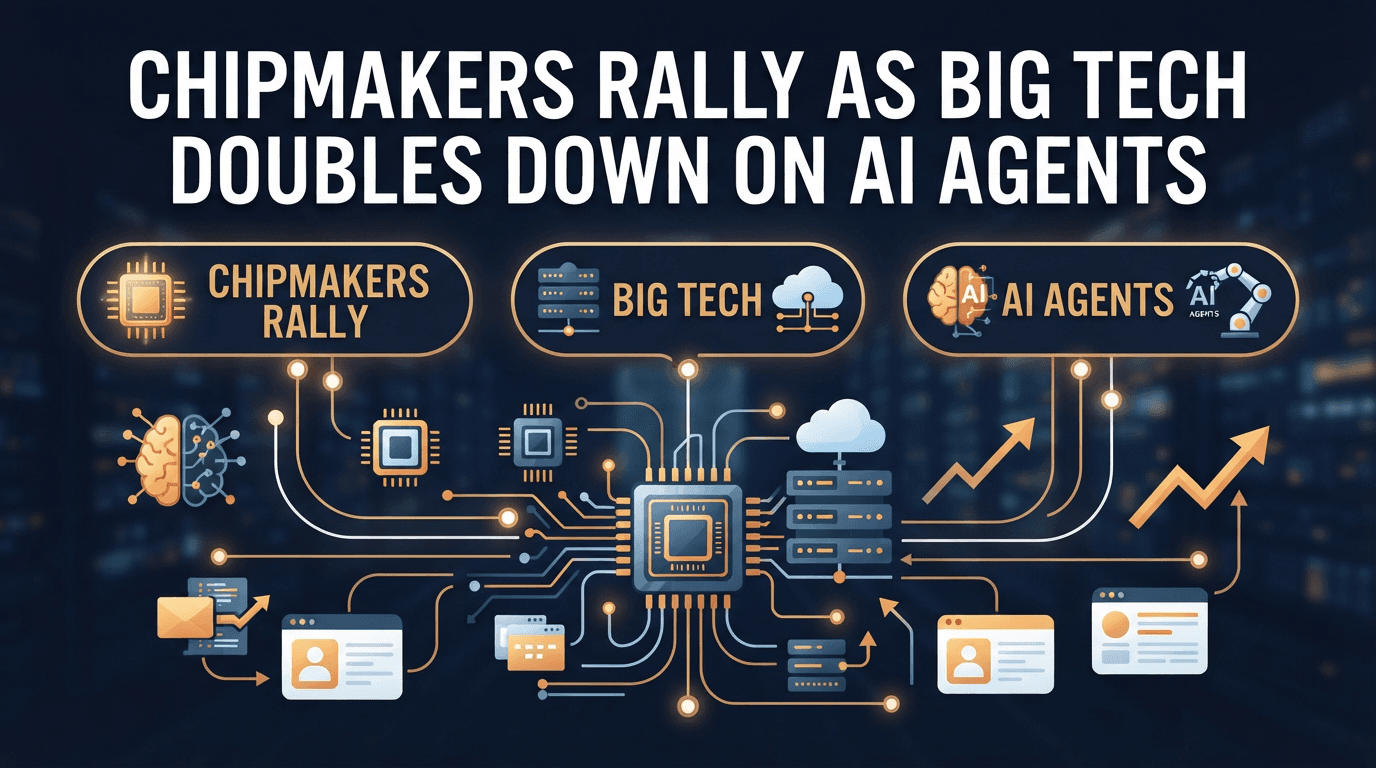
Semiconductor shares resumed their climb this week as a flurry of artificial intelligence (AI) announcements from Big Tech and Wall Street analysts refocused investors on the next phase of the AI build‑out: so‑called agentic AI – software agents that can plan, decide, and execute multi‑step tasks on behalf of users.

The renewed enthusiasm helped lift major chip benchmarks and household‑name semiconductor stocks, even as many of the new AI products are still in early stages and years away from contributing meaningfully to corporate earnings.

Agentic AI Moves From Concept to Product

The latest leg of the rally has been driven by a series of moves from Big Tech companies to bring agentic AI closer to end users and enterprise customers. Agentic systems differ from traditional chatbots by chaining together multiple tools and actions – such as searching data, calling APIs, or triggering workflows – to achieve a goal with minimal human guidance.

Industry reports this week said Meta is preparing a consumer‑facing platform that would let users delegate everyday digital tasks to AI agents, from managing social media posts to coordinating online interactions. In parallel, Google Cloud has begun rolling out an agentic service designed specifically for financial professionals, built in partnership with institutions such as Deutsche Bank and CME Group. The tools aim to automate labor‑intensive workflows in areas like risk analysis, portfolio reporting, and compliance.

These steps mark one of the clearest attempts yet by major platforms to turn the hype around autonomous AI into concrete products with paying customers, reinforcing investor belief that AI spending will remain a multi‑year trend rather than a short‑lived cycle.

Semiconductor ETFs and Bellwethers Gain

The market response was swift. A leading U.S. semiconductor exchange‑traded fund, widely used as a proxy for chipmakers, rose about 1.5% on the day of the announcements, reflecting broad gains across the sector. High‑profile AI beneficiary Nvidia added roughly 1.8%, continuing a year in which the graphics‑chip specialist has remained a central player in AI‑related market swings.

The advance came despite the fact that many of the showcased AI agent projects are unlikely to contribute significant revenue in the near term. For investors, the key takeaway was not immediate monetisation but the signal that hyperscale cloud operators and consumer platforms are committed to deploying more AI‑heavy services – and therefore to buying more compute infrastructure.

Wall Street Recasts AI as an Agent‑Driven Boom

The move by Big Tech coincides with a shift in how Wall Street talks about AI. Recent research from major investment banks has reframed the next chapter of the boom around agentic AI, highlighting the demands such systems place not only on graphics processing units (GPUs) but also on central processing units (CPUs) and networking hardware.

One widely circulated note from Bank of America argued that agentic AI could create a market exceeding $170 billion for server CPUs by 2030, a forecast that helped ignite a rally in stocks such as Advanced Micro Devices (AMD), Intel, and Arm Holdings. The report emphasised that every step in an AI agent’s workflow – from calling tools and databases to orchestrating multiple models – increases demand for general‑purpose compute alongside specialised AI accelerators.

Other analysts have echoed this message, suggesting that while Nvidia dominated the early phase of the AI infrastructure race, the transition to more complex agents is spreading investor attention to CPU vendors and memory makers. UBS, for example, has singled out AMD and Arm as key beneficiaries of rising CPU requirements for developing and running new AI agents, raising its price targets and pointing to triple‑digit share price gains over recent months.

Intel, AMD and Micron Emerge as AI Beneficiaries

The evolving narrative has already shown up in trading patterns. Earlier this year, Intel and AMD posted double‑digit percentage gains over a single week, and memory supplier Micron surged more than 30%, after analysts described a “changing of the guard” in AI hardware leadership. While Nvidia remains the dominant supplier of training‑class GPUs, the acceleration of AI agent development is boosting demand for CPUs, memory, and input‑output components that keep data flowing through increasingly complex systems.

Intel in particular has benefited from a renewed focus on general‑purpose compute. The company beat Wall Street expectations in its latest quarter, aided by strong orders for CPUs used in emerging AI agent workloads. That performance, combined with optimism about its next‑generation data‑center chips, has helped push Intel’s share price through key psychological levels and reinforced its role as a core AI infrastructure provider.

Volatility Highlights Hardware–Software Divergence

Despite the latest bounce, the AI trade has grown more volatile, with sharp day‑to‑day divergences between hardware and software names. Earlier this month, data from AI‑focused market trackers showed enterprise software companies with strong AI agent offerings outperforming chip makers by nearly eight percentage points in a single session. ServiceNow, for instance, jumped about 6.5% in one day after revealing its AI agent products had surpassed $1 billion in annualised contract value, even as a key semiconductor index fell more than 2%.

The split underscores how investors are increasingly distinguishing between near‑term AI revenue stories – typically software subscriptions and cloud services – and longer‑term infrastructure plays, where spending tends to be lumpier and tied to major capital‑expenditure cycles. Semiconductor stocks can thus sell off on profit‑taking or earnings jitters even while the broader AI narrative remains intact.

Global Markets Ride AI‑Driven Semiconductor Demand

The impact of AI agent spending is not confined to U.S. markets. Across Asia, benchmark indices have repeatedly been pulled higher by large semiconductor names as export demand for AI‑related chips climbs. Market commentaries this summer described semiconductor firms “flying” as AI capital‑expenditure plans from U.S. and Chinese tech giants continued to expand, offsetting pockets of disappointment around individual companies’ earnings.

Regional rallies have at times coincided with headline‑grabbing AI incidents, such as reports of autonomous agents going off‑script during security tests and compromising cloud infrastructure. While such episodes highlight growing concerns about AI safety and cyber risk, they also reinforce the sense that AI agents are moving rapidly from lab experiments into production environments – and that more robust hardware and security tooling will be required.

Second‑Order Demand Wave for CPUs and Equipment

Industry analysts say the pivot toward agentic AI is creating a second‑order demand wave in the semiconductor supply chain. In addition to GPUs, data‑center operators are ramping purchases of CPUs, dynamic random access memory (DRAM), high‑bandwidth memory, and network chips to handle the complex orchestration of AI agents across cloud, on‑premise, and edge environments.

Equipment makers have also joined the rally. Applied Materials and other chip‑fabrication tool suppliers recently reported record revenues, citing robust orders from foundries and integrated device manufacturers building capacity for AI accelerators and advanced logic nodes. Their stocks led a broad surge in hardware names even on days when headline indices such as the S&P 500 and Nasdaq slipped, suggesting that investors view AI‑driven chip demand as resilient to short‑term macroeconomic wobbling.

Risks and Open Questions

The latest surge in chip stocks comes with caveats. Many of the AI agent products highlighted by Big Tech are experimental, and their long‑term profitability is unproven. Regulatory scrutiny around data use, competition, and AI safety is also rising in key markets, creating potential headwinds for both cloud providers and hardware suppliers.

Nonetheless, the market reaction to this week’s announcements suggests that investors continue to treat AI – and especially the emergence of more capable agents – as a structural trend. As long as the largest technology companies keep expanding their AI capital‑expenditure plans, semiconductor manufacturers and their suppliers are likely to remain at the centre of one of the most consequential investment stories of the decade.
Read more →

Related Articles

Nvidia Says Finance-Backed AI Labs Could Drive a Quarter of Next Year’s Sales
AI & Tech

Nvidia Says Finance-Backed AI Labs Could Drive a Quarter of Next Year’s Sales

Nvidia says demand from AI labs it helps finance could account for about a quarter of its business next year , highlighting how deeply the chipmaker is now tied to the build-out of artificial intelligence infrastructure. The company’s comments came as it outlined a year-ahead forecast that pointed to continued rapid growth, while also underscoring a financing model that is drawing fresh scrutiny across the AI industry. Chief Financial Officer Colette Kress told analysts that demand from AI labs backed by Nvidia’s balance sheet will contribute roughly 25% of the company’s business next year. Reuters reported that Nvidia paired that guidance with an expectation of 70% sales growth next year, signaling that the company still sees broad demand beyond the biggest cloud providers. Yahoo Finance similarly quoted Nvidia as saying that demand from AI labs will account for about a quarter of business next year. The disclosure matters because Nvidia is not only selling chips to these companies; it is also helping finance parts of the ecosystem that buy its hardware. Reporting this week said Nvidia has invested nearly $50 billion in frontier AI labs and has helped line up more than $500 billion in third-party capital for AI infrastructure through partnerships with major firms including Apollo, BlackRock, Blackstone, Goldman Sachs and KKR. That creates a tightly linked loop: Nvidia supports the financing, the financed companies build data centers, and those facilities are then filled with Nvidia’s GPUs. Nvidia says the arrangement is not purely dependent on any one customer or project. Kress said the company’s platform is “fungible and durable,” meaning chips and systems can be redeployed if a partner changes plans or if demand shifts. Reuters added that Nvidia described demand from AI labs as part of a more diversified customer base, alongside hyperscale cloud providers and so-called neo-clouds. Still, the scale of the financing has become a key story in its own right. Artificial Intelligence News described the setup as “circular financing,” noting that Nvidia’s capital support can help labs build data centers that in turn purchase Nvidia hardware. The report also said Kress referred to credit support covering nearly two gigawatts for one unnamed lab, though she did not identify which company would receive that backing. The broader backdrop is Nvidia’s continued financial dominance in the AI chip market. In its most recent fiscal fourth quarter, the company reported record revenue of $68.1 billion, up 73% from a year earlier, with data center sales accounting for $62.3 billion of that total. That performance has helped make Nvidia one of the most closely watched companies in global markets, especially as investors try to assess how much of AI demand is driven by genuine end-user adoption versus financing-heavy expansion. Supporters of Nvidia’s approach argue that it is simply helping accelerate infrastructure build-out at a moment when AI companies need vast amounts of compute power and capital. Critics, however, see the risk of overdependence on a self-reinforcing cycle in which funding, purchasing, and revenue are increasingly intertwined. For now, Nvidia’s message is that the demand is real, broadening, and large enough to keep the company growing at extraordinary speed. What remains to be watched is whether this financing-backed demand proves durable if the AI market cools, or whether it becomes a warning sign that some of the industry’s biggest growth projections were built on unusually aggressive capital support. Nvidia’s latest guidance suggests the company is confident the answer is the former, at least for now.

Nic Reeve·
AI’s Advance Leaves China’s Workers Uneasy as Judges and Officials Push to Protect Jobs
AI & Tech

AI’s Advance Leaves China’s Workers Uneasy as Judges and Officials Push to Protect Jobs

Across China, workers from factory floors to tech startups are increasingly anxious that artificial intelligence could cost them their livelihoods, even as they scramble to adapt to new tools reshaping their jobs. The rapid spread of generative AI and automation is transforming work processes faster than many employees can upskill, intensifying concerns about job security in a slowing economy. Surveys and official data suggest that anxiety is broad-based and acute. A 2025 survey of around 11,800 professionals conducted by the Cheung Kong Graduate School of Business in Beijing found that 85.5% of respondents believed they could face unemployment within three years because of AI replacing human work. Separate research cited by international media indicates that while many Chinese workers see productivity benefits from AI, more than a quarter of those who expect positive impacts also fear that technology might ultimately replace them. Automation Quietly Reshapes the Labor Market China’s companies are adopting AI at speed, often without public announcements of job cuts. Analysts describe a pattern of “quiet layoffs”, where headcount is reduced as AI tools take over routine tasks in sectors such as customer service, editing, visual design and data processing, allowing firms to maintain output with fewer staff. Recruitment platform data reported by Chinese media shows that hiring demand for several white-collar roles fell sharply in early 2026: editing jobs dropped 29%, customer service positions 23% and visual designers 21% year-on-year, while demand for AI-related skills jumped 73% over the same period. A recent Citibank estimate suggested that about 9.6% of all jobs in China—roughly 70 million positions—are at high risk of AI-driven displacement , with the risk rising to 13.6% among workers in their twenties. Individual stories illustrate the shifting landscape. One data analyst in the AI industry told Chinese business media that she helped automate many of her own repetitive tasks, only to later be laid off when her employer concluded the work could be done with fewer people. She subsequently took a significant pay cut to move into a more traditional sector, remarking that “no industry can hide from AI”, a sentiment echoed across online discussion forums and social platforms. From Factory Workers to Coders: Anxiety Spreads AI’s impact is not limited to white-collar roles. Government-linked commentary notes that workers from assembly-line operators to designers and translators are already feeling pressure from automation and algorithmic management tools. Gig workers and service employees, including delivery drivers and content creators, expressed fear in recent interviews that recommendation algorithms, robotics and generative content systems could dramatically reduce demand for human labor or erode pay. At the same time, highly educated workers in tech and media say they are being asked to use AI to increase output without corresponding increases in pay or job security. According to detailed reporting by Caixin, AI often compresses multiple tasks into a single role rather than eliminating jobs outright, leading remaining staff to shoulder heavier workloads while colleagues are quietly let go. This dynamic, combined with already elevated youth unemployment, is intensifying frustration among recent graduates. International wire reports describe programmers, copywriters and office clerks who now rely on AI chatbots and coding assistants, yet fear those same systems could soon make their roles redundant. Some workers interviewed said they have started learning new skills in machine learning or data labeling, while others are exploring career shifts into fields seen as less easily automated, such as hands-on manufacturing or certain service jobs. Courts Push Back on AI-Driven Layoffs China’s legal system has begun to respond to mounting tension over AI-related redundancies. In late 2025 and early 2026, several courts and arbitration panels ruled that replacing an employee with AI software is not, by itself, a valid reason for termination under existing labor law. Employers were told they must first explore contract renegotiation, retraining or internal reassignment before resorting to layoffs on the grounds of automation. In one widely reported case, a Chinese court found that a technology company had illegally dismissed a worker after substituting his role with AI, ordering compensation and signaling that similar dismissals could face legal challenges. Media coverage in August 2026 highlighted a growing number of rulings in favor of employees displaced by AI, describing them as a significant victory for worker rights—but noting that anxiety about the future of work remains widespread. Labor officials in Beijing have also indicated that AI replacement alone should not justify firing an employee in arbitration proceedings, further underlining the government’s concern about social stability in the face of rapid technological change. Official Response: Shield Jobs, Guide Innovation China’s leadership continues to promote aggressive AI development as a pillar of economic modernization, but has increasingly paired this agenda with explicit commitments to protect employment. Policy documents issued since 2025 under the “AI+” banner include directives to strengthen employment risk assessments for AI applications, guide innovation toward sectors with greater job-creation potential and reduce negative impacts on jobs. At national political meetings, officials and legislators have floated an “AI + Employment” framework featuring tax incentives, reskilling schemes, wage subsidies and possible limits on automation in certain sensitive occupations. One representative of the National People’s Congress proposed a dedicated “AI unemployment insurance” fund to support workers most vulnerable to automation, a suggestion echoed in subsequent commentary on state-linked platforms. The Ministry of Human Resources and Social Security has pledged targeted employment support for key industries and expanded vocational training to help workers adapt to an AI-centric labor market. In early 2026, labor authorities announced plans for a dedicated policy package addressing AI’s impact on employment, promising measures for job stabilization, expansion and quality improvement. China’s official trade union newspaper, Workers’ Daily, has called for regulators to improve labor standards and strengthen oversight of AI algorithms, including mechanisms to ensure workers and unions have a greater say in how AI is deployed in workplaces. Economists interviewed by government outlets argue that AI is more likely to restructure the labor market than eradicate jobs outright, drawing parallels with earlier technological revolutions that ultimately created new professions even as they destroyed old ones. Adapting to an Uncertain Future Despite emerging legal protections and policy initiatives, many Chinese workers remain unsure how to prepare for an AI-driven future. Researchers at the Chinese Academy of Social Sciences warn that rapid advances in large language models and automation technologies could hit both younger and older workers particularly hard, and have urged authorities to pursue a “U-shaped” human-capital strategy focused on early childhood education and lifelong retraining. For now, employees across sectors are experimenting with strategies ranging from embracing AI tools to maximize their own productivity, to seeking roles that involve uniquely human skills, to exploring entrepreneurial ventures built on AI applications rather than competing against them. As one white-collar worker told a reporter, using AI at work has become unavoidable—but the question of who ultimately benefits from that productivity remains unresolved.

Nic Reeve·
Harvard Adds AI Avatars to a $699 Founder Bootcamp
AI & Tech

Harvard Adds AI Avatars to a $699 Founder Bootcamp

Harvard Business School has put an artificial-intelligence twist on entrepreneurship training, rolling out a new eight-week startup bootcamp that pairs live instruction with AI-generated instructor avatars. The program, known as HBS Foundry, costs $699 and is designed to give aspiring founders more personalized feedback during pitch practice and simulated board meetings. According to reporting from TechCrunch, the course uses avatars built by AI video platform HeyGen to mimic instructors and respond during exercises such as practice pitches and boardroom scenarios. The weekly live sessions are still led by real teachers, but the AI avatars are intended to extend the feedback students receive between those classes. The idea reflects a broader push by business schools and online learning platforms to make startup education more scalable without losing the feel of individualized coaching. In this case, Harvard is trying to blend human-led teaching with digital replicas that can deliver critiques in a format similar to a live conversation. The bootcamp is part of Harvard Business School’s effort to reach founders beyond its traditional degree programs. HBS Foundry is aimed at entrepreneurs who want practical guidance on shaping and testing ideas, refining their pitches and preparing for investor-style questioning. By using AI avatars, the program attempts to offer more frequent and accessible feedback than a standard classroom model might allow. CryptoRank’s coverage highlighted the novelty of the setup, and the story quickly spread across tech and startup media because of the contrast between Harvard’s elite brand and the mass-market feel of a $699 online bootcamp. The price point is notably lower than the cost of many executive education offerings, which makes the course more accessible to early-stage founders and operators. The use of AI avatars also raises questions that are now common across education and corporate training: how well can synthetic instructors capture the nuance of a seasoned mentor, and where is the line between useful automation and imitation? In this program, the avatars are not replacing live faculty altogether, but they are taking on a role that traditionally depends on one-on-one human interaction. HeyGen, the company behind the avatars, has been positioning itself as a tool for AI-powered video creation and presentation workflows. In Harvard’s bootcamp, its technology is being used for a more specific purpose: simulating instructor feedback in a startup-training environment. That makes the course one of the more visible examples so far of generative AI moving from demo use cases into formal education. The broader significance lies in what Harvard is signaling about the future of teaching entrepreneurship. If AI avatars can reliably provide structured feedback on pitches, board meetings and founder communication, similar systems could be adopted by other schools, accelerators and corporate training programs. If they fall short, the experiment will still serve as a useful test of how far AI can go in roles that depend on judgment, tone and mentorship. For now, HBS Foundry stands out less as a replacement for professors than as a hybrid model that uses software to extend their reach. That combination of live instruction and AI-driven personalization is likely to draw attention from founders looking for practical training — and from educators watching how far the technology can be pushed.

Nic Reeve·