allnewscastallnewscast
Breaking News
AI & Tech

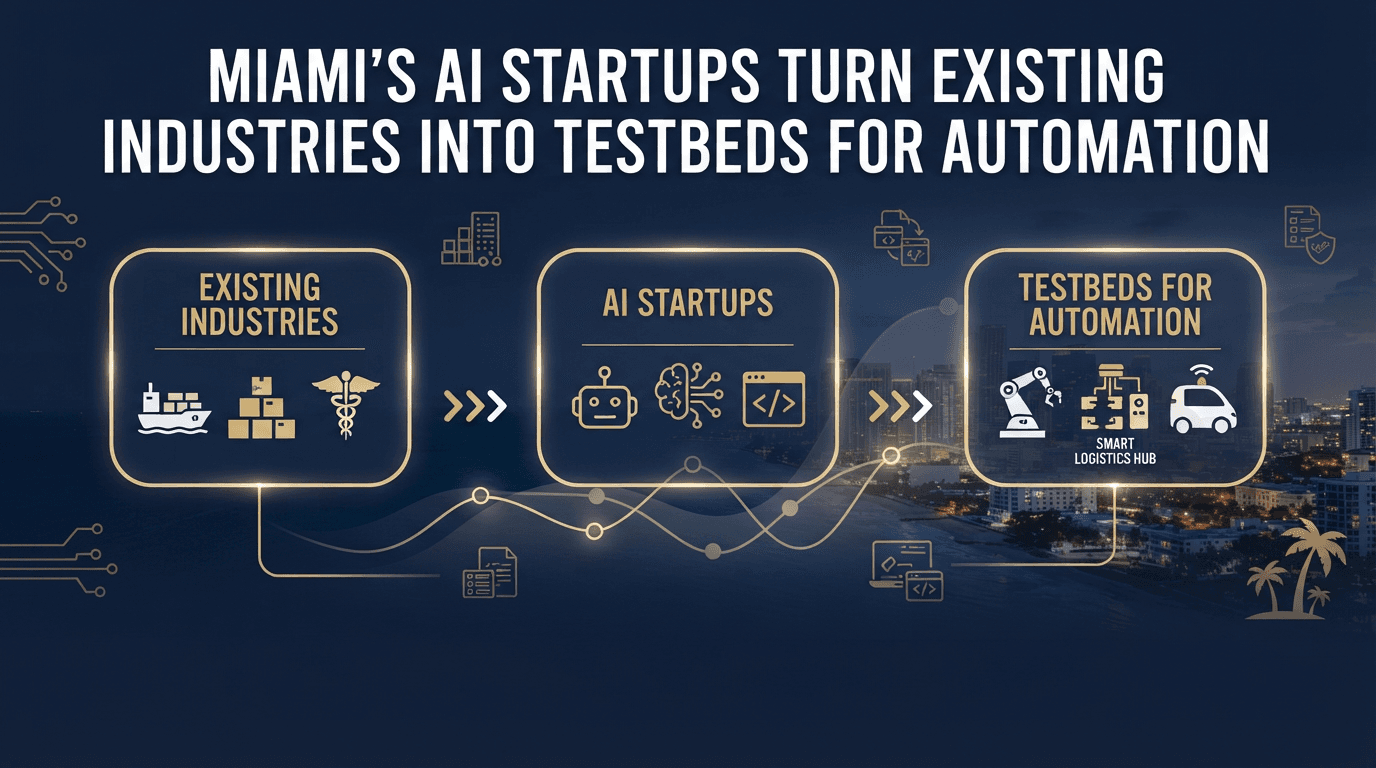
Miami’s AI Startups Turn Existing Industries into Testbeds for Automation
Nic Reeve6 min read
Miami’s AI Startups Turn Existing Industries into Testbeds for Automation

Miami is rapidly emerging as a hub for applied artificial intelligence, with a new analysis from Miami AI News highlighting how South Florida startups are using AI to automate the region’s existing economic pillars rather than chasing headline-grabbing foundational models.

The publication, also known as MAIN, reports that specialized AI companies are scaling across sectors where South Florida already has deep expertise and data: real estate, healthcare, climate and insurance risk, financial infrastructure, identity verification and energy. The result is a distinct regional AI economy focused on workflow automation, cost reduction and regulatory-heavy use cases, instead of building the next large language model from scratch.

Automation, Not Foundation Models, Defines Miami’s Strategy

According to the Miami-focused outlet, local founders and investors are converging around a clear thesis: Miami’s competitive edge lies in deploying AI to “automate everything around” foundational models, rather than competing directly with Silicon Valley’s model labs. That means layering AI agents, domain-specific data and integrations on top of general models to solve industry-specific problems.

In practice, this translates into products that look less like research experiments and more like back-office infrastructure: AI systems that handle compliance workflows, underwriting, medical triage, contract review, geospatial analysis and real estate transactions. MAIN describes an ecosystem where startups are “built into” existing industries, often co-created with incumbent players that already dominate the local economy.

Real Estate and Property Services Become AI Testbeds

Real estate — long a cornerstone of South Florida’s economy — has become one of the most active testbeds for automation. Miami AI News’ coverage points to multiple companies embedding AI into the property lifecycle, from listings and contracts to mortgages and asset management.

Examples highlighted in recent reporting include:

  • beycome, which has developed “Artur,” an AI assistant that helps buyers and sellers navigate pricing, offers and closing steps, effectively acting as a digital transaction coordinator.
  • Clai, a startup combining electronic signatures with AI-driven workflow automation to streamline real estate transactions, reducing manual paperwork and coordination between agents, lenders and title companies.
  • Legal-tech and property-adjacent companies like Aracor AI, which automate contract review and due diligence processes for law firms and financial institutions, including those tied to real-estate-heavy deals.

Miami AI News argues that these tools are not replacing brokers or attorneys outright, but are increasingly handling the repetitive, document-heavy tasks that slow deals and increase transaction costs.

Healthcare and Life Sciences Turn to AI for Triage and Data

Healthcare is another sector where Miami’s AI startups are pushing automation into complex workflows. MAIN’s broader ecosystem analysis, along with regional reporting, points to companies blending telehealth, diagnostics and decision support.

Among the firms profiled:

  • eMed, which pairs telehealth visits with AI-enabled diagnostics to help patients access testing and treatment remotely, automating triage and routing tasks that would otherwise require in-person visits.
  • OpenEvidence, a Miami-headquartered startup building an AI-powered medical search engine that helps physicians quickly navigate vast volumes of clinical literature, effectively automating parts of research and evidence retrieval during care.
  • Data and imaging-focused platforms cited in regional tech coverage, such as companies cleaning medical data or accelerating imaging workflows so clinicians can act faster with better context.

Miami AI News frames these projects as emblematic of the city’s applied AI mindset: using machine learning to augment clinicians and compress administrative overhead, while leaving core medical judgment with human providers.

Insurance, Compliance and Financial Services Embrace AI “Employees”

Because Miami is also a hub for insurance, finance and cross-border trade, a significant share of the region’s AI activity targets regulated services and compliance-heavy workflows.

The Miami AI News analysis notes that startups in this segment increasingly describe their products as “AI employees” that sit inside existing businesses rather than standalone apps. Companies highlighted across MAIN and regional sources include:

  • GAIL, which builds AI “employees” for insurance agencies and regulated businesses, automating customer communications, data entry and routine policy servicing.
  • Mi Assist AI, which deploys agentic AI workers that handle inboxes, leads, invoices and calls inside small and midsize companies, acting as embedded back-office staff.
  • Comp AI, an AI compliance platform that automates security and certification workflows for startups, replacing manual, point-in-time audits with continuous monitoring and AI-assisted documentation.
  • Gail (distinct from GAIL in some coverage), described as building an AI-powered “brain of financial services” that combines conversational AI and analytics for finance and insurance firms.

Investors interviewed in regional analyses say these products resonate with local companies that face rising regulatory burdens but lack the staffing to manage them manually.

Climate Risk, Energy and Geospatial Intelligence Gain Momentum

Miami’s exposure to hurricanes, flooding and infrastructure risk is also shaping its AI economy. MAIN’s analysis notes an emerging cluster of startups working on climate risk, identity and energy, often using AI to analyze geospatial and sensor data at scale.

Recent profiles point to:

  • Danti, which uses AI-powered search across satellite imagery, drone feeds and other geospatial data to support infrastructure, defense and climate-related decision-making.
  • Energy and cloud-infrastructure firms with significant Miami presence that apply AI to optimize power usage and reduce cloud costs for AI workloads, a theme highlighted in both Miami AI News and local tech overviews.

These efforts align with a broader regional push to position Miami as a gateway for climate-tech and resilience solutions aimed at coastal cities worldwide.

Funding and Ecosystem: Applied AI Draws Capital

The Miami AI News report lands amid growing evidence that investors are backing this applied AI thesis. EY’s 2024 venture capital analysis cited by ecosystem trackers placed Miami in the top tier of U.S. cities for early-stage funding, with particular strength in enterprise and applied AI.

Individual deals underscore that trend:

  • OpenEvidence raised a reported $210 million round in 2025 led by major Silicon Valley firms, backing its AI medical search platform headquartered in Miami.
  • Aracor AI secured a $4.5 million seed round to expand its AI-powered contract review tools for legal and financial professionals, according to regional business press.
  • Other Miami AI startups referenced by investors, including platforms like Flex Storage and FirmPilot, are applying AI to self-storage operations and law firm marketing, further automating established service industries.

Miami AI News also maintains a live directory of AI startups and companies operating in the region, reflecting continued new formations and relocations into South Florida’s AI ecosystem.

A Distinctive AI Economy Rooted in Existing Strengths

Across its recent coverage, Miami AI News argues that South Florida is charting a different AI path from traditional tech hubs. Rather than building foundational models or consumer apps first and seeking business cases later, Miami’s AI startups are starting with industries the city already dominates and asking how automation can remove friction, cost and delay.

With active experimentation in real estate, healthcare, finance, climate risk and compliance, the outlet concludes that Miami’s AI economy is increasingly defined by embedded, domain-specific automation — tools that slot quietly into existing workflows but collectively reshape how the region’s core industries operate.
Read more

Related Articles

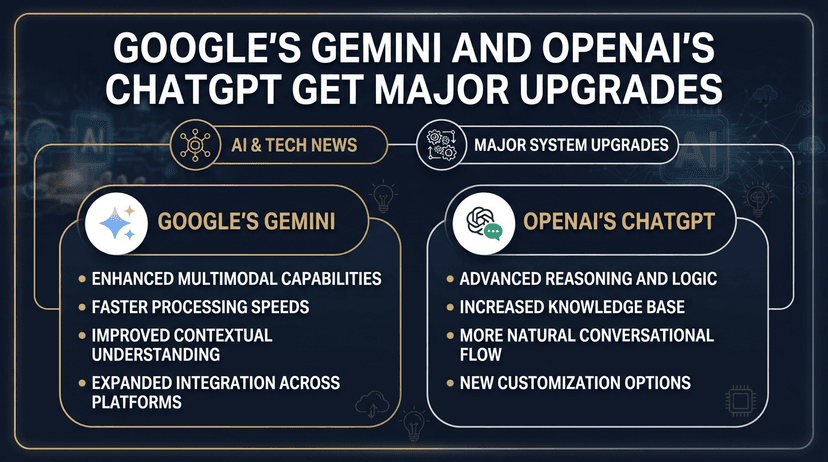
Google’s Gemini and OpenAI’s ChatGPT Get Major Upgrades in August 2026
AI & Tech

Google’s Gemini and OpenAI’s ChatGPT Get Major Upgrades in August 2026

Artificial intelligence platforms from Google and OpenAI are undergoing rapid change in August 2026, with new model releases, pricing shifts and feature upgrades that signal how the next generation of AI assistants will be delivered to consumers and businesses. Google Accelerates Gemini Rollout With New Flash Model Google is expanding its Gemini family of models, focusing on efficient systems tailored for coding and automated workflows rather than only headline-grabbing flagship models. On August 13, 2026, Google introduced Gemini 3.7 Flash , describing it as its latest AI model for software engineering support and agent-style business automation. The release comes just three weeks after Gemini 3.6 Flash, underscoring the rapid cadence at which Google is iterating its mid-tier “Flash” models. Gemini 3.7 Flash is being positioned as a workhorse for developers and operations teams. According to Google’s developer documentation, the model offers substantial improvements in web development, software engineering and agentic workflows, and is classified as generally available for use through the Gemini API. To encourage adoption, Google is discounting usage: through the end of 2026, Gemini 3.7 Flash is offered at an introductory rate of $0.75 per million input tokens and $3.75 per million output tokens, roughly half the cost of its 3.6 predecessor. The model is rolling out immediately to Gemini Spark , Google’s subscription-based AI agent service aimed at Pro and Ultra customers in more than 160 countries. These changes build on earlier July announcements detailing Gemini 3.6 Flash, 3.5 Flash‑Lite and 3.5 Flash Cyber models, which were designed to balance efficiency and quality for scalable “agentic” workflows across Google’s products and cloud services. Gemini Crosses a Billion Users as Pro Model Timeline Remains Unclear Alongside the new model, Google is highlighting Gemini’s reach. In early August, CEO Sundar Pichai said that Gemini had surpassed 1 billion monthly active users , calling it the fastest‑growing product in the company’s history on that metric. Usage is being driven both by consumer-facing Gemini interfaces and enterprise integrations. Google Cloud, for example, now uses Gemini powered tools to assist with code conversion in its Database Migration Service, translating stored procedures, triggers and custom functions from databases such as Oracle and SQL Server into PostgreSQL’s PL/pgSQL language. Despite that growth, the status of Google’s flagship Gemini Pro remains uncertain. Industry reporting indicates that an anticipated Gemini 3.5 Pro release has been shelved internally, even as Flash-tier models become widely available across consumer products. Google has not publicly detailed timelines for higher-end Pro updates in the same way it has for Flash models. OpenAI Revamps ChatGPT With GPT‑5.6 Models OpenAI is simultaneously pushing a major upgrade to ChatGPT’s underlying models and user experience, focusing on more capable reasoning and broader access for free-tier users. On August 6, 2026, OpenAI announced that GPT‑5.6 Luna will become the default model for Free and Go plans, replacing earlier versions used in the mass-market chatbot. Luna is designed as a general-purpose assistant for everyday conversations, and will soon be paired with a new Think button that lets users trigger more intensive reasoning on harder questions, subject to safety guardrails. At the same time, Plus and Pro subscribers are receiving an updated GPT‑5.6 Sol model. This version introduces a slider that allows users to choose how much effort—and effectively how much computational “thinking”—ChatGPT applies to a response, trading speed against depth when necessary. OpenAI’s deployment safety documentation categorizes both Luna and Sol as high capability in cybersecurity and biological and chemical domains, reflecting ongoing scrutiny of advanced models in sensitive areas. These upgrades are replacing GPT‑5.5 Instant in ChatGPT’s lineup and redefining what each subscription tier offers. Independent analysis of ChatGPT plans notes that the August change significantly increases the value of the free tier: Luna becomes the only model available to free accounts, but is paired with notable usability improvements. Unlimited Text Chats and Expanded Automation for ChatGPT Users A notable shift in OpenAI’s strategy is a decision to remove core rate limits on text conversations for non-paying users. Starting the week of August 10, free and Go accounts are scheduled to receive unlimited text chats with GPT‑5.6 Luna, although separate limits continue to apply to images, file uploads and other resource-intensive features. OpenAI’s August release notes for ChatGPT add further refinements: the system now has a more accurate sense of a user’s local time, long conversations load more efficiently on the web, and interactive content can appear while it is still being generated, improving responsiveness. On the productivity side, OpenAI is expanding its automation tools under the ChatGPT Work offering. Recent updates include webhook-triggered scheduled tasks, shared task management, and more flexible limits for free users. ChatGPT’s browser capabilities have also been extended to work on signed-in websites, with support for password managers and confirmations before consequential actions, allowing AI agents to safely complete workflows across services like Gmail, Slack and GitHub. OpenAI is simultaneously retiring some legacy models and features from the consumer ChatGPT product. Support articles and release notes indicate that the o3 model will be removed from ChatGPT as of August 26, 2026, and GPT‑4.5 will be retired following earlier sunset dates. The official DALL·E GPT, used for image generation within ChatGPT, is scheduled for retirement on August 30, 2026, although these changes do not affect the separate API offerings. Where LaMDA Fits in Google’s Current Strategy Google’s earlier conversational AI model, LaMDA , is now largely overshadowed by the Gemini family in public announcements and developer materials. Recent update logs and product blogs focus almost exclusively on Gemini-branded models and agent services. While LaMDA played a central role in Google’s first wave of large language models, the company has effectively repositioned its AI story around Gemini, particularly in tools exposed to third-party developers. Industry observers note that this represents not just a rebranding but a consolidation of research and product roadmaps under a single architecture, mirroring how OpenAI has centered its offerings on the GPT‑5.x series. In practice, users interact with Gemini-powered systems in Google products, while LaMDA persists mainly as a reference point in the history of conversational AI. Competitive Outlook: Faster Iteration, Broader Access Taken together, Google and OpenAI’s August moves highlight two intertwined trends in the AI industry: ever-faster iteration on core models and a push to make advanced capabilities available to wider audiences. Google is betting that frequent updates to specialized models like Gemini 3.7 Flash, paired with discounted pricing and agent-focused services such as Gemini Spark, will attract developers and enterprises seeking reliable automation at scale. OpenAI, in turn, is using GPT‑5.6 Luna and Sol to raise the baseline quality of ChatGPT, while removing text-chat limits for free users and strengthening its automation tools through ChatGPT Work. As both companies refine their AI assistants, the competition increasingly centers not only on raw model capability but also on safety frameworks, pricing, and the way these systems integrate into everyday tools—from cloud databases to email and code repositories. For users of ChatGPT and Gemini, the immediate impact this month is better models, more generous usage terms and an expanding set of task-oriented features woven into the platforms they already use.

Nic Reeve·
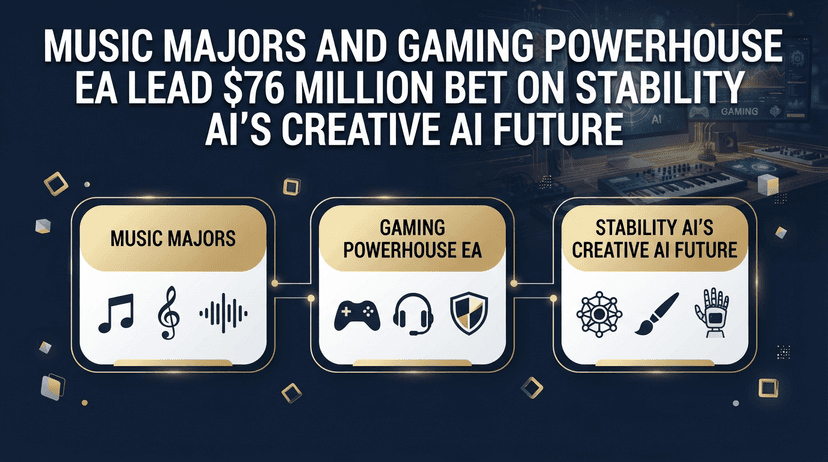
Music Majors and Gaming Powerhouse EA Lead $76 Million Bet on Stability AI’s Creative AI Future
AI & Tech

Music Majors and Gaming Powerhouse EA Lead $76 Million Bet on Stability AI’s Creative AI Future

Stability AI, the generative AI company best known for powering creative tools across image, music, gaming and entertainment, has closed a $76 million Series B funding round led by some of the most powerful names in the global entertainment industry. The raise, completed under CEO Prem Akkaraju, lifts the company’s total funding to $232 million , including two equity rounds and convertible notes since mid‑2024. The round marks one of the clearest signals yet that major studios, labels and game publishers are betting on purpose‑built artificial intelligence for professional creators, rather than treating generative AI as a purely experimental technology. Entertainment Heavyweights Join Stability AI’s Cap Table Central to the new financing is a roster of strategic investors whose catalogs and intellectual property underpin much of the world’s commercial entertainment. Interactive entertainment giant Electronic Arts (EA) , along with global music powerhouses Sony Music Group , Universal Music Group (UMG) and Warner Music Group (WMG) , all took part in the Series B. According to the company, these partners are not just financial backers but are expected to work with Stability AI on new AI models informed by their game assets and music catalogs. The round also includes technology and investment firms such as AMD Ventures and Pacific Alliance Ventures , underscoring interest from the broader tech ecosystem in AI systems tailored for production‑grade creative workflows. These new investors join an already high‑profile group of backers from previous rounds. Existing institutional investors include Coatue , Greycroft , Kadmos Capital , Lightspeed Venture Partners , Mantis Capital , Sound Ventures and advertising giant WPP . Individual investors range from tech and media leaders such as Sean Parker , Eric Schmidt , Prem Akkaraju , Patrick Whitesell and the Reuben Brothers to entertainment figures including filmmaker James Cameron , television producer Mark Burnett , and media investor Vivi Nevo . Several existing investors – notably Coatue, Greycroft, Kadmos Capital, Sean Parker and Eric Schmidt – participated again in the Series B, signaling continued confidence in the company’s strategic pivot under new leadership. Funding to Accelerate AI Tools for Professional Creatives Stability AI says the fresh capital will be used to expand its suite of AI products for professional creatives across music, gaming and entertainment, deepen its applied research organization, and grow its professional services business. The company is positioning its technology as infrastructure for creative production rather than consumer‑grade novelty tools. In practice, that means building systems that can integrate with studio pipelines, work reliably with large volumes of licensed content, and support creators who need predictable, controllable outputs for commercial use. For music, the new partnerships with UMG, WMG and Sony Music Group are expected to enable generative models trained on, or informed by, vast catalogs of recorded sound and metadata, with an emphasis on rights‑aware usage and workflows. In gaming, EA’s involvement aligns with efforts to use generative AI for asset creation, world‑building and interactive experiences, using its extensive library of game art, animation and design as training material. Stability AI has framed its mission as building purpose‑built AI for professional creatives, a phrase meant to distinguish its tools from generic text‑to‑image or text‑to‑music systems that have provoked legal and ethical concerns when trained on unlicensed data. By tying its models directly to partners’ licensed IP, the company is seeking to demonstrate that generative AI can coexist with, and even enhance, existing rights frameworks. New Leadership Continues Turnaround Strategy The Series B is the latest step in Stability AI’s restructuring under CEO Prem Akkaraju , who took over in June 2024 amid a broader reset of the company’s finances and governance. Under his tenure, the firm has raised multiple rounds that recapitalized the business and brought in new strategic investors from advertising, technology and entertainment. Previous funding announcements highlighted backing from major venture capital firms and high‑profile angels, coupled with efforts to stabilize the balance sheet and focus the product roadmap on commercially viable creative tools. The new $76 million round, anchored by entertainment industry leaders, suggests that the turnaround strategy is expanding beyond financial restructuring toward long‑term, revenue‑generating partnerships. Akkaraju’s background in film and media also appears to be shaping the company’s positioning: Stability AI increasingly presents itself not just as an AI research lab, but as a partner to studios, labels and agencies looking to modernize production while preserving creative control and respecting intellectual property. Why the Entertainment Industry Is Betting on Stability AI The decision by top record labels and a major game publisher to take equity stakes in an AI company reflects a broader shift in how the entertainment sector views generative technology. After initial waves of skepticism and legal challenges around AI‑generated content, large rights holders are now seeking to shape the technology from the inside. By investing directly in Stability AI, companies like UMG, WMG, Sony Music Group and EA gain influence over how creative AI systems are designed, trained and deployed. In return, Stability AI gains access to high‑quality, legally cleared data and potential distribution channels for new tools, whether in studio production environments, game engines or label‑run creator platforms. Industry observers note that these strategic investments could pave the way for new categories of products: rights‑aware generative music tools for artists and producers; AI‑assisted sound design and scoring for games and film; and content‑creation systems embedded into game development pipelines that are tuned to each publisher’s art style and IP constraints. The involvement of advertising group WPP and other media‑adjacent investors underscores that interest is not limited to entertainment alone. Brand and agency work increasingly relies on rapid production of images, video and audio assets, a use case that aligns with Stability AI’s emphasis on professional‑grade, controllable outputs. Next Steps for Stability AI With its total funding now at $232 million , Stability AI is entering a critical phase in the race to define how generative AI will be used in commercial creative industries. The company has promised continued investment in applied research, new product launches focused on music and gaming, and expanded professional services to help partners integrate AI into their production pipelines. How quickly those ambitions translate into widely adopted tools will depend on more than just technology. Stability AI will need to convince creators, unions, rights organizations and regulators that its systems enhance rather than displace human creativity, and that its partnerships with major entertainment companies result in fair and transparent use of intellectual property. For now, the latest funding round – backed by a cross‑section of the entertainment world – suggests that the industry’s biggest players prefer to help shape that future from the boardroom table rather than watching from the sidelines.

Nic Reeve·
AInews: Universities Put Artificial Intelligence to the Test in Classrooms and Exams
AI & Tech

AInews: Universities Put Artificial Intelligence to the Test in Classrooms and Exams

AInews: Universities Put Artificial Intelligence to the Test in Classrooms and Exams On August 25, 2026, universities from the United States to Europe accelerated experiments with artificial intelligence in teaching and assessment, turning AInews into a daily reality for students as institutions test new rules, tools and ethics frameworks for higher education. How are universities testing AI in everyday student work? Universities are moving from ad‑hoc experimentation to structured pilots that build AI into normal coursework, rather than treating it purely as a cheating risk. Students are being asked to use tools like ChatGPT for assignments under clear disclosure rules, while some institutions now embed AI literacy courses before granting access. Recent experiments and policies include: According to aiX Weekly, dated August 19, 2026, the University of Colorado Colorado Springs (UCCS) opened ChatGPT Edu to all students on August 14, but only after they complete an AI‑literacy module in Canvas. According to the same aiX Weekly report, account provisioning at UCCS requires students to pass a short course covering prompt design, bias, hallucinations and data privacy. According to a Deseret Magazine feature from August 22, 2026, several U.S. universities now maintain a “lane” where professors design assignments that assume students will use generative AI, focusing grading on reasoning and source evaluation instead of raw text production. According to HumanizeThisAI’s March 18, 2026 policy survey, most accredited institutions now follow a “follow your instructor” framework where course syllabi specify whether AI is encouraged, restricted or prohibited for each assignment. These pilots share a pattern. AI is treated as a tool students must learn to handle critically. Policies require explicit acknowledgement of use, and instructors redesign tasks to assess judgment, not typing speed. What changes are being made to exams and assessment design? Assessment is where AI forces the largest redesign. Leading universities are testing hands‑on, oral and project‑based formats that make unauthorized AI use harder and move grading toward process, collaboration and application, rather than finished prose that a chatbot can generate. According to an MIT‑linked report covered by Forbes on August 25, 2026, a committee at the institute warned that generative AI can now credibly complete most typical undergraduate assignments. According to that same MIT report, recommendations include more in‑class work, practical labs, and assessments that require students to critique AI outputs, not just produce text. According to Deseret Magazine on August 22, 2026, some universities experiment with dual‑stage assignments: students submit an AI‑assisted draft, then revise it in class without devices, allowing instructors to compare the two versions. According to the May 15, 2026 Weekly AI in Higher Education report from the Learning Research and Development Center, the EU AI Act classifies AI used for student assessment, admissions screening and progress monitoring as “high‑risk,” requiring human oversight and transparency by August 2026. These moves respond to a practical reality. AI is strong at formulaic essays and problem sets. Assessment design now aims to test understanding that cannot be easily outsourced: oral explanations, original data analysis, and collaborative projects grounded in verifiable sources. Are universities still relying on AI-detection tools to police cheating? Use of AI‑detection software is falling as universities question its accuracy and fairness. Many institutions now emphasize disclosure rules and assignment redesign over trying to “catch” AI‑generated text, and some have formally disabled detection features in major plagiarism platforms. According to AHigherVision’s AI in Higher Education Daily Brief on August 27, 2026, the University of Nevada, Reno stopped relying on AI‑detection software as part of a broader reconsideration of its response to generative AI in coursework. According to HumanizeThisAI’s March 18, 2026 survey of university AI policies, at least 16 institutions had disabled Turnitin’s AI‑detection feature, with more expected to follow as renewal dates arrive in 2026. According to the same HumanizeThisAI report, the dominant approach is a syllabus‑based disclosure requirement combined with guidance on acceptable and unacceptable AI help, rather than full prohibition. Faculty complaints about false positives and biased detection against non‑native writers pushed this shift. Universities now argue that fair assessment must rest on transparent expectations and safer assignment design, not opaque algorithmic judgments about authorship. What new governance frameworks are shaping AI use in higher education? Major university systems are moving to system‑wide governance frameworks that set deadlines for local policies, mandate training and embed data‑protection and bias‑evaluation requirements. These frameworks aim to replace scattered course‑level rules with consistent obligations across teaching and research. According to the Weekly AI in Higher Education report released May 8, 2026, the State University of New York (SUNY) board adopted a system‑wide AI policy that requires all 64 campuses to create or update AI guidelines by December 31, 2026, with a possible two‑month extension. According to EdTech Magazine on June 26, 2026, the SUNY policy demands training on safe and responsible AI use for campus stakeholders, clarifies roles and responsibilities, and adds procurement safeguards to protect institutional data. According to the May 15, 2026 Weekly AI report, European universities face an August 2026 compliance deadline under the EU AI Act for high‑risk educational AI systems, including tools used for grading and admissions. According to aiX Weekly’s August 12, 2026 issue, EDUCAUSE released an AI literacy framework for higher education during spring 2026, outlining core competencies in critical evaluation, ethical use and technical understanding. These governance measures treat AI as an institutional infrastructure issue. They tie academic integrity, data protection and civil‑rights obligations together, making registrars, CIOs and provosts jointly responsible rather than leaving AI to individual instructors alone. How widespread is AI use among students and faculty now? Survey data show AI moving from curiosity to routine habit in higher education. Weekly use now reaches a majority of respondents in recent polls, and daily use is at its highest level since generative tools first entered campuses in early 2023. According to an August 25, 2026 briefing from AACRAO, weekly AI use in higher education exceeds 50 percent among surveyed students and staff. According to the same AACRAO report, daily use reached its highest level since spring 2023, when early ChatGPT experiments began on many campuses. According to aiX Weekly reports through August 2026, faculty adoption has shifted from isolated early adopters to department‑level initiatives, such as standardized AI assignment templates and shared literacy materials. AI is becoming part of the background of study life: used for drafting emails, checking code, summarizing readings and generating study questions. Policies now aim to regulate that ordinary usage rather than pretending it does not exist. What are leading institutions like MIT proposing for the future of college? MIT and peer institutions argue that generative AI forces a rethinking of core undergraduate structures. Their committees recommend redesigned curricula, new roles for hands‑on learning and clear, course‑specific AI rules embedded in syllabi rather than generic bans. According to the Washington Post’s August 25, 2026 coverage, an MIT committee warned that generative AI now credibly completes most standard undergraduate assignments, creating “massive, long‑term disruptions” in education. According to Forbes on August 25, 2026, MIT’s report calls for more project‑driven courses, explicit AI usage policies per class, and assessments that ask students to interrogate AI‑generated content as part of learning, not just avoid it. According to AHigherVision’s August 12, 2026 brief, MIT also released a governance package for scholarly content used in training generative models, with rules for consent, citation and opt‑outs. These proposals frame AI not only as a tool but as a structural force. If chatbots can handle routine work, MIT argues colleges should focus more intensely on creative inquiry, lab experimentation and public‑interest applications that demand human judgment. What new academic programs and roundtables are emerging around AI ethics and literacy? Higher education leaders are building new programs that treat AI itself as a subject of study. Institutions launch minors in critical AI studies, convene roundtables on assessment reform and embed mandatory literacy courses for incoming students. According to aiX Weekly on August 26, 2026, Oberlin College will start a Critical AI Studies minor in fall 2026, focusing on ethical, cultural, environmental, political and labor effects of AI. According to ETEducation’s report on a Pearson roundtable held August 7, 2026 in Hyderabad, higher education leaders there discussed assessment reform, faculty transformation and experiential learning in an “AI‑enabled future.” According to AHigherVision’s August 12, 2026 brief, Cornell University plans AI literacy requirements for all incoming students, integrating critical use of generative tools into general education. These initiatives mark a shift from treating AI as a narrow technical topic. They embed questions of power, labor and culture into the curriculum, so graduates can evaluate not only how to use AI, but whether and under which conditions it should be used. Who is most affected by the rapid expansion of AI in higher education? Students, faculty and administrators all experience the effects of AI experiments, but in different ways. Students face shifting rules between courses. Faculty confront pressure to redesign assignments quickly. Administrators manage compliance, procurement and public trust. Students: According to AACRAO’s August 25, 2026 data, over half of surveyed students now use AI weekly, which means policy changes affect daily study habits. According to HumanizeThisAI’s March 2026 policy survey, AI rules can change from class to class within a single semester, depending on each instructor’s stance. Faculty: According to aiX Weekly issues across August 2026, instructors are expected to articulate AI expectations in syllabi and to participate in literacy training themselves. According to the Pearson roundtable report, faculty transformation and support were central themes for leaders worried about workload and training gaps. Administrators: According to the SUNY policy analysis in EdTech Magazine, CIOs and registrars must balance fast adoption with data‑protection and bias safeguards embedded in procurement. According to the May 15, 2026 Weekly AI report, European university leaders must classify systems under the EU AI Act and document human‑oversight procedures, or risk non‑compliance. Across these roles, pressure mounts to act quickly without sacrificing fairness. The pace of AI tool development keeps increasing, while legal and ethical requirements grow stricter. Universities are learning in public, with students watching closely.

Nic Reeve·