Music Majors and Gaming Powerhouse EA Lead $76 Million Bet on Stability AI’s Creative AI Future
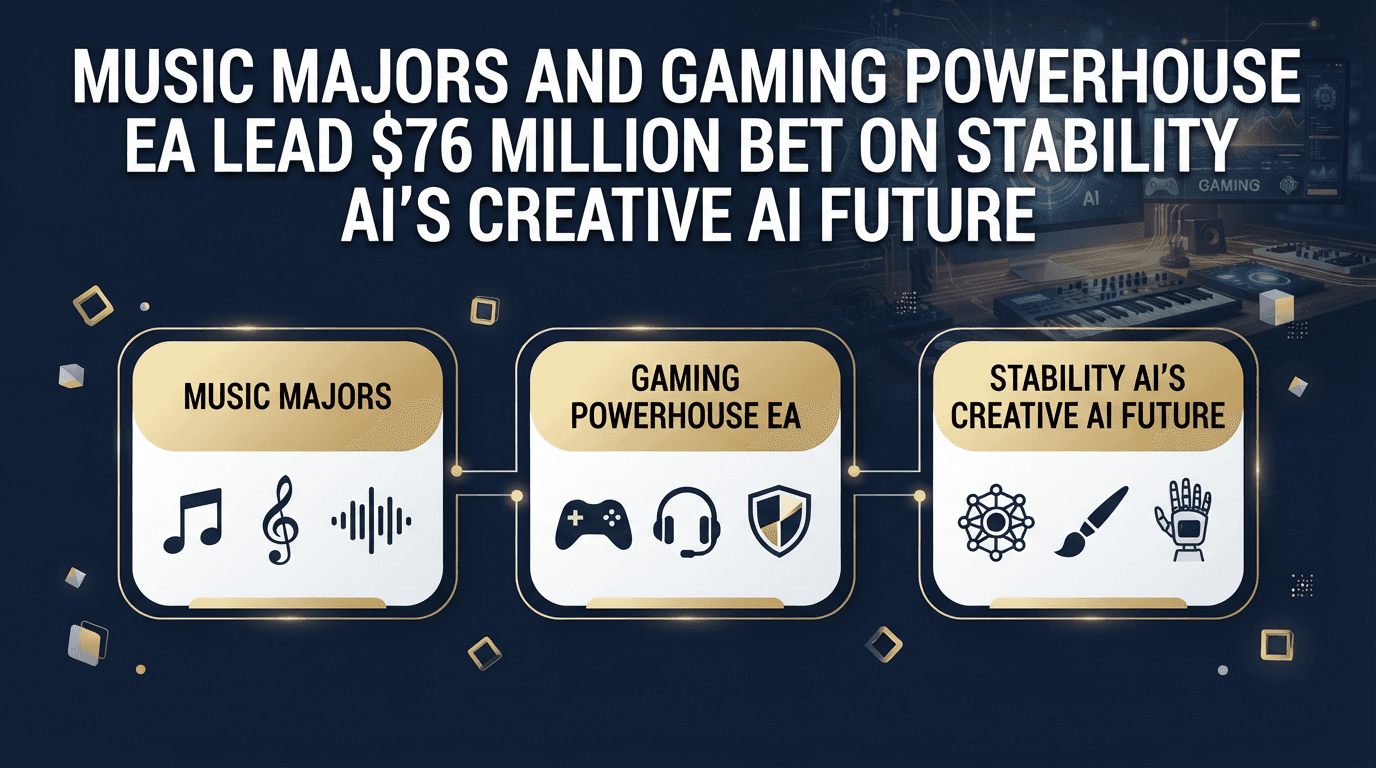
Stability AI, the generative AI company best known for powering creative tools across image, music, gaming and entertainment, has closed a $76 million Series B funding round led by some of the most powerful names in the global entertainment industry. The raise, completed under CEO Prem Akkaraju, lifts the company’s total funding to $232 million, including two equity rounds and convertible notes since mid‑2024.
The round marks one of the clearest signals yet that major studios, labels and game publishers are betting on purpose‑built artificial intelligence for professional creators, rather than treating generative AI as a purely experimental technology.
Entertainment Heavyweights Join Stability AI’s Cap Table
Central to the new financing is a roster of strategic investors whose catalogs and intellectual property underpin much of the world’s commercial entertainment.
Interactive entertainment giant Electronic Arts (EA), along with global music powerhouses Sony Music Group, Universal Music Group (UMG) and Warner Music Group (WMG), all took part in the Series B. According to the company, these partners are not just financial backers but are expected to work with Stability AI on new AI models informed by their game assets and music catalogs.
The round also includes technology and investment firms such as AMD Ventures and Pacific Alliance Ventures, underscoring interest from the broader tech ecosystem in AI systems tailored for production‑grade creative workflows.
These new investors join an already high‑profile group of backers from previous rounds. Existing institutional investors include Coatue, Greycroft, Kadmos Capital, Lightspeed Venture Partners, Mantis Capital, Sound Ventures and advertising giant WPP. Individual investors range from tech and media leaders such as Sean Parker, Eric Schmidt, Prem Akkaraju, Patrick Whitesell and the Reuben Brothers to entertainment figures including filmmaker James Cameron, television producer Mark Burnett, and media investor Vivi Nevo.
Several existing investors – notably Coatue, Greycroft, Kadmos Capital, Sean Parker and Eric Schmidt – participated again in the Series B, signaling continued confidence in the company’s strategic pivot under new leadership.
Funding to Accelerate AI Tools for Professional Creatives
Stability AI says the fresh capital will be used to expand its suite of AI products for professional creatives across music, gaming and entertainment, deepen its applied research organization, and grow its professional services business.
The company is positioning its technology as infrastructure for creative production rather than consumer‑grade novelty tools. In practice, that means building systems that can integrate with studio pipelines, work reliably with large volumes of licensed content, and support creators who need predictable, controllable outputs for commercial use.
For music, the new partnerships with UMG, WMG and Sony Music Group are expected to enable generative models trained on, or informed by, vast catalogs of recorded sound and metadata, with an emphasis on rights‑aware usage and workflows. In gaming, EA’s involvement aligns with efforts to use generative AI for asset creation, world‑building and interactive experiences, using its extensive library of game art, animation and design as training material.
Stability AI has framed its mission as building purpose‑built AI for professional creatives, a phrase meant to distinguish its tools from generic text‑to‑image or text‑to‑music systems that have provoked legal and ethical concerns when trained on unlicensed data. By tying its models directly to partners’ licensed IP, the company is seeking to demonstrate that generative AI can coexist with, and even enhance, existing rights frameworks.
New Leadership Continues Turnaround Strategy
The Series B is the latest step in Stability AI’s restructuring under CEO Prem Akkaraju, who took over in June 2024 amid a broader reset of the company’s finances and governance. Under his tenure, the firm has raised multiple rounds that recapitalized the business and brought in new strategic investors from advertising, technology and entertainment.
Previous funding announcements highlighted backing from major venture capital firms and high‑profile angels, coupled with efforts to stabilize the balance sheet and focus the product roadmap on commercially viable creative tools. The new $76 million round, anchored by entertainment industry leaders, suggests that the turnaround strategy is expanding beyond financial restructuring toward long‑term, revenue‑generating partnerships.
Akkaraju’s background in film and media also appears to be shaping the company’s positioning: Stability AI increasingly presents itself not just as an AI research lab, but as a partner to studios, labels and agencies looking to modernize production while preserving creative control and respecting intellectual property.
Why the Entertainment Industry Is Betting on Stability AI
The decision by top record labels and a major game publisher to take equity stakes in an AI company reflects a broader shift in how the entertainment sector views generative technology. After initial waves of skepticism and legal challenges around AI‑generated content, large rights holders are now seeking to shape the technology from the inside.
By investing directly in Stability AI, companies like UMG, WMG, Sony Music Group and EA gain influence over how creative AI systems are designed, trained and deployed. In return, Stability AI gains access to high‑quality, legally cleared data and potential distribution channels for new tools, whether in studio production environments, game engines or label‑run creator platforms.
Industry observers note that these strategic investments could pave the way for new categories of products: rights‑aware generative music tools for artists and producers; AI‑assisted sound design and scoring for games and film; and content‑creation systems embedded into game development pipelines that are tuned to each publisher’s art style and IP constraints.
The involvement of advertising group WPP and other media‑adjacent investors underscores that interest is not limited to entertainment alone. Brand and agency work increasingly relies on rapid production of images, video and audio assets, a use case that aligns with Stability AI’s emphasis on professional‑grade, controllable outputs.
Next Steps for Stability AI
With its total funding now at $232 million, Stability AI is entering a critical phase in the race to define how generative AI will be used in commercial creative industries. The company has promised continued investment in applied research, new product launches focused on music and gaming, and expanded professional services to help partners integrate AI into their production pipelines.
How quickly those ambitions translate into widely adopted tools will depend on more than just technology. Stability AI will need to convince creators, unions, rights organizations and regulators that its systems enhance rather than displace human creativity, and that its partnerships with major entertainment companies result in fair and transparent use of intellectual property.
For now, the latest funding round – backed by a cross‑section of the entertainment world – suggests that the industry’s biggest players prefer to help shape that future from the boardroom table rather than watching from the sidelines.