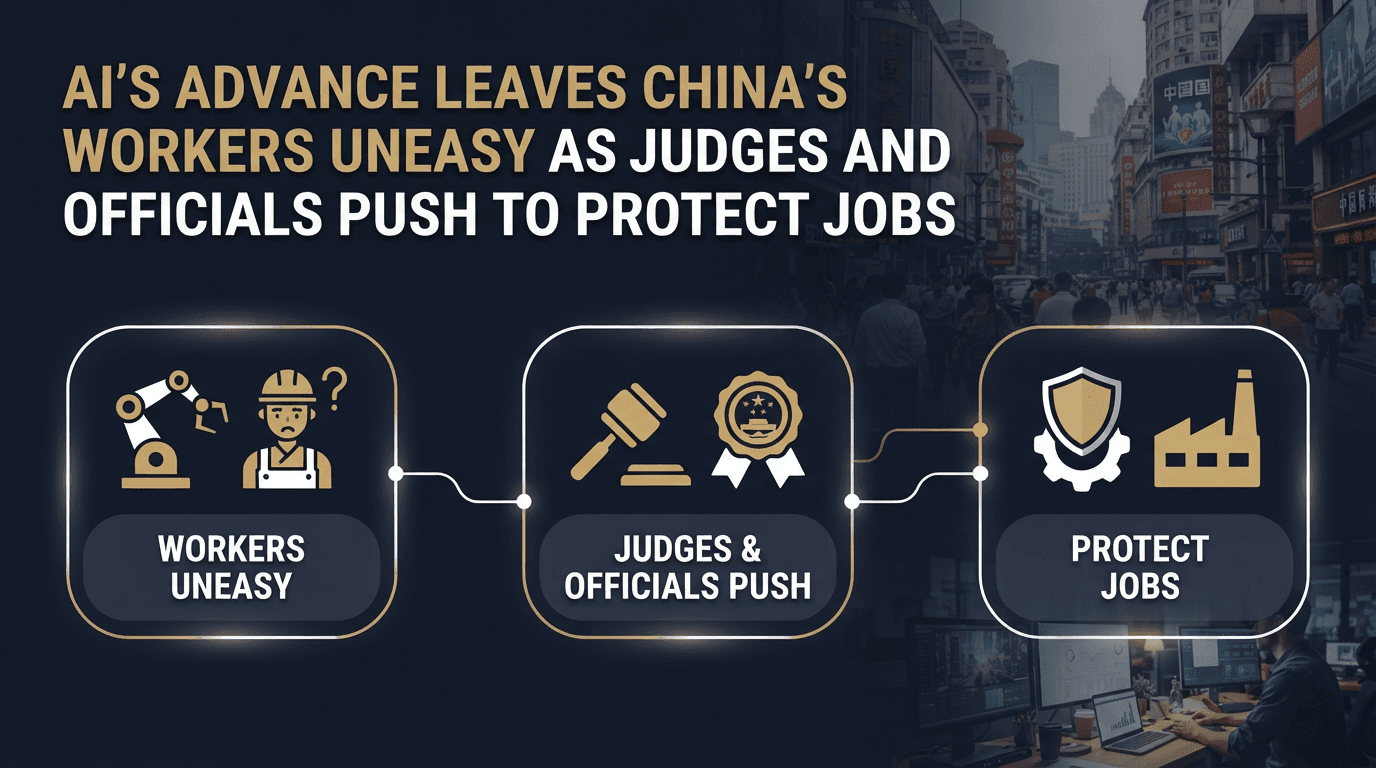
AI’s Advance Leaves China’s Workers Uneasy as Judges and Officials Push to Protect Jobs
Across China, workers from factory floors to tech startups are increasingly anxious that artificial intelligence could cost them their livelihoods, even as they scramble to adapt to new tools reshaping their jobs. The rapid spread of generative AI and automation is transforming work processes faster than many employees can upskill, intensifying concerns about job security in a slowing economy.
Surveys and official data suggest that anxiety is broad-based and acute. A 2025 survey of around 11,800 professionals conducted by the Cheung Kong Graduate School of Business in Beijing found that 85.5% of respondents believed they could face unemployment within three years because of AI replacing human work. Separate research cited by international media indicates that while many Chinese workers see productivity benefits from AI, more than a quarter of those who expect positive impacts also fear that technology might ultimately replace them.
Automation Quietly Reshapes the Labor Market
China’s companies are adopting AI at speed, often without public announcements of job cuts. Analysts describe a pattern of “quiet layoffs”, where headcount is reduced as AI tools take over routine tasks in sectors such as customer service, editing, visual design and data processing, allowing firms to maintain output with fewer staff.
Recruitment platform data reported by Chinese media shows that hiring demand for several white-collar roles fell sharply in early 2026: editing jobs dropped 29%, customer service positions 23% and visual designers 21% year-on-year, while demand for AI-related skills jumped 73% over the same period. A recent Citibank estimate suggested that about 9.6% of all jobs in China—roughly 70 million positions—are at high risk of AI-driven displacement, with the risk rising to 13.6% among workers in their twenties.
Individual stories illustrate the shifting landscape. One data analyst in the AI industry told Chinese business media that she helped automate many of her own repetitive tasks, only to later be laid off when her employer concluded the work could be done with fewer people. She subsequently took a significant pay cut to move into a more traditional sector, remarking that “no industry can hide from AI”, a sentiment echoed across online discussion forums and social platforms.
From Factory Workers to Coders: Anxiety Spreads
AI’s impact is not limited to white-collar roles. Government-linked commentary notes that workers from assembly-line operators to designers and translators are already feeling pressure from automation and algorithmic management tools. Gig workers and service employees, including delivery drivers and content creators, expressed fear in recent interviews that recommendation algorithms, robotics and generative content systems could dramatically reduce demand for human labor or erode pay.
At the same time, highly educated workers in tech and media say they are being asked to use AI to increase output without corresponding increases in pay or job security. According to detailed reporting by Caixin, AI often compresses multiple tasks into a single role rather than eliminating jobs outright, leading remaining staff to shoulder heavier workloads while colleagues are quietly let go. This dynamic, combined with already elevated youth unemployment, is intensifying frustration among recent graduates.
International wire reports describe programmers, copywriters and office clerks who now rely on AI chatbots and coding assistants, yet fear those same systems could soon make their roles redundant. Some workers interviewed said they have started learning new skills in machine learning or data labeling, while others are exploring career shifts into fields seen as less easily automated, such as hands-on manufacturing or certain service jobs.
Courts Push Back on AI-Driven Layoffs
China’s legal system has begun to respond to mounting tension over AI-related redundancies. In late 2025 and early 2026, several courts and arbitration panels ruled that replacing an employee with AI software is not, by itself, a valid reason for termination under existing labor law. Employers were told they must first explore contract renegotiation, retraining or internal reassignment before resorting to layoffs on the grounds of automation.
In one widely reported case, a Chinese court found that a technology company had illegally dismissed a worker after substituting his role with AI, ordering compensation and signaling that similar dismissals could face legal challenges. Media coverage in August 2026 highlighted a growing number of rulings in favor of employees displaced by AI, describing them as a significant victory for worker rights—but noting that anxiety about the future of work remains widespread.
Labor officials in Beijing have also indicated that AI replacement alone should not justify firing an employee in arbitration proceedings, further underlining the government’s concern about social stability in the face of rapid technological change.
Official Response: Shield Jobs, Guide Innovation
China’s leadership continues to promote aggressive AI development as a pillar of economic modernization, but has increasingly paired this agenda with explicit commitments to protect employment. Policy documents issued since 2025 under the “AI+” banner include directives to strengthen employment risk assessments for AI applications, guide innovation toward sectors with greater job-creation potential and reduce negative impacts on jobs.
At national political meetings, officials and legislators have floated an “AI + Employment” framework featuring tax incentives, reskilling schemes, wage subsidies and possible limits on automation in certain sensitive occupations. One representative of the National People’s Congress proposed a dedicated “AI unemployment insurance” fund to support workers most vulnerable to automation, a suggestion echoed in subsequent commentary on state-linked platforms.
The Ministry of Human Resources and Social Security has pledged targeted employment support for key industries and expanded vocational training to help workers adapt to an AI-centric labor market. In early 2026, labor authorities announced plans for a dedicated policy package addressing AI’s impact on employment, promising measures for job stabilization, expansion and quality improvement.
China’s official trade union newspaper, Workers’ Daily, has called for regulators to improve labor standards and strengthen oversight of AI algorithms, including mechanisms to ensure workers and unions have a greater say in how AI is deployed in workplaces. Economists interviewed by government outlets argue that AI is more likely to restructure the labor market than eradicate jobs outright, drawing parallels with earlier technological revolutions that ultimately created new professions even as they destroyed old ones.
Adapting to an Uncertain Future
Despite emerging legal protections and policy initiatives, many Chinese workers remain unsure how to prepare for an AI-driven future. Researchers at the Chinese Academy of Social Sciences warn that rapid advances in large language models and automation technologies could hit both younger and older workers particularly hard, and have urged authorities to pursue a “U-shaped” human-capital strategy focused on early childhood education and lifelong retraining.
For now, employees across sectors are experimenting with strategies ranging from embracing AI tools to maximize their own productivity, to seeking roles that involve uniquely human skills, to exploring entrepreneurial ventures built on AI applications rather than competing against them. As one white-collar worker told a reporter, using AI at work has become unavoidable—but the question of who ultimately benefits from that productivity remains unresolved.