Snowflake, Illumio and Pluralsight Shape a Busy Week in Enterprise AI
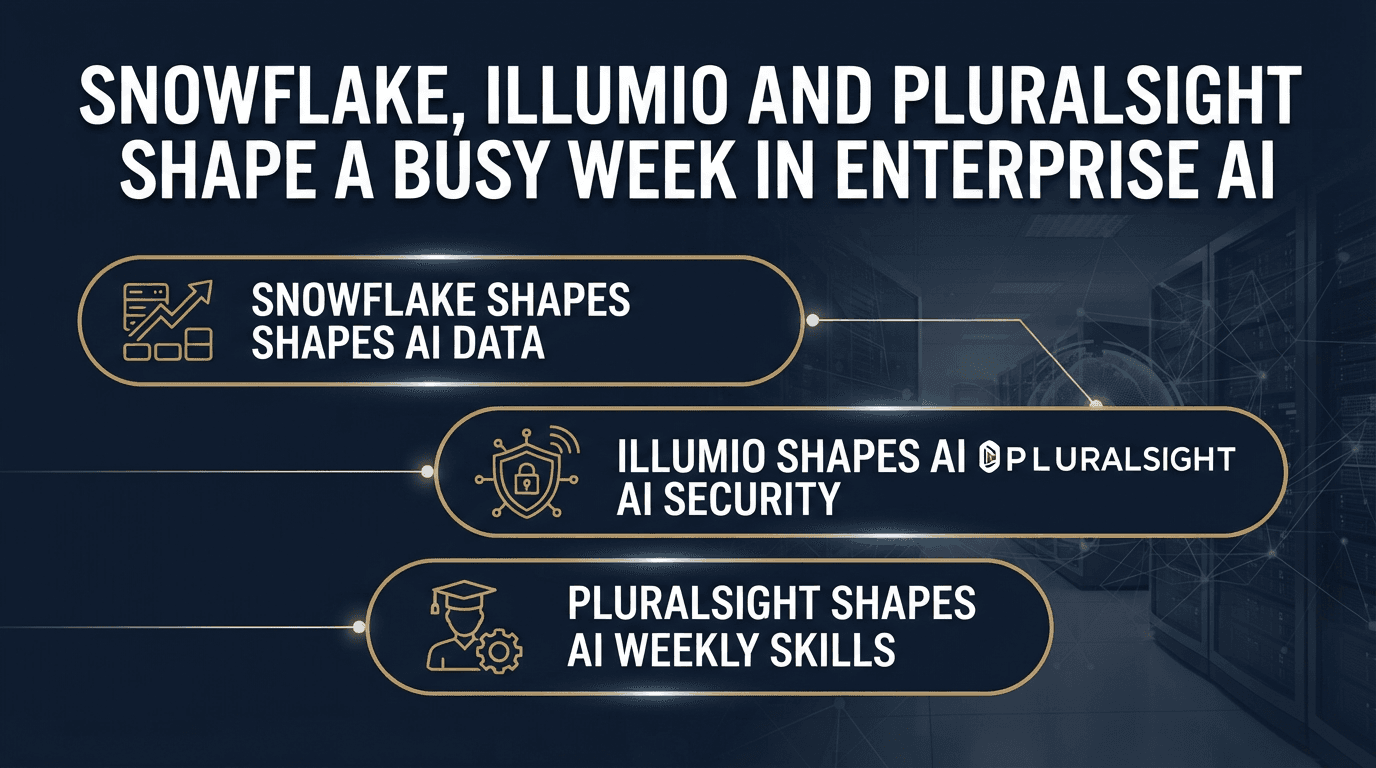
Snowflake’s newest AI features, an Illumio recognition, and a Pluralsight product update helped shape the week’s enterprise AI news cycle. Across the week of Aug. 21, vendors continued to push AI deeper into data platforms, security workflows, and technical training, with Snowflake’s release notes showing the clearest burst of product activity. Illumio also made headlines after being named a leader and customer favorite in microsegmentation, while Pluralsight drew attention through its inclusion in industry roundups covering AI training and skills tools.
Snowflake’s release cadence stood out most. On Aug. 20 and Aug. 21, the company added a series of AI and data features, including AI_EXTRACT and AI_PARSE_DOCUMENT support for client-side encrypted stages and network-restricted accounts, the Cortex Agent code execution tool in preview, and later Cortex AI_MULTI_EMBED for semantic video search. Snowflake also said sensitive data classification now supports AI mode in public preview and that CoCo automations in CLI and Snowsight are available in public preview.
The practical message from Snowflake’s update is straightforward: the company is broadening the set of tasks enterprises can automate inside its platform, from document extraction to agent execution and video search. That matters because many enterprise buyers are no longer asking whether AI can generate text; they are asking whether it can operate safely across governed data, restricted environments, and production workflows. Snowflake’s release notes suggest the company is positioning Cortex as a broader execution layer, not just a model wrapper.
Security remained a parallel theme in the week’s AI coverage. One widely discussed story circulating in the AI and security press described an AI-generated code change in a public Snowflake repository that allegedly introduced a script injection risk, followed by another AI agent detecting and exploiting the issue. While that account is notable for illustrating how AI tools can both create and catch vulnerabilities, it should be treated carefully as a brief report rather than a formal incident analysis. Even so, it underscored a broader concern: as enterprises adopt AI-assisted coding and automated review, they also need stronger guardrails around what those systems can change.
Illumio’s headline was more traditional, but still relevant to the AI-driven security conversation. The breach containment company announced on Aug. 18 that it had been named a Leader and Customer Favorite in The Forrester Wave: Microsegmentation Solutions, Q3 2026. Illumio has been emphasizing visibility and control in environments where workloads, including AI workloads, can move quickly across networks and cloud systems. In that context, the recognition is more than an accolade; it reinforces the company’s pitch that segmentation and containment are essential when organizations deploy more autonomous systems.
Pluralsight’s role in the week’s roundup was less about a single blockbuster announcement and more about its continuing place in the AI-skills market. Solutions Review’s weekly AI briefing grouped Pluralsight with other vendors making updates for teams that need to build, secure, and operationalize AI systems. That positioning reflects a broader market reality: as enterprise AI products mature, demand is rising for platforms that can train developers, cloud engineers, and security teams to use them effectively. Pluralsight’s business remains tied to that need for structured learning in fast-changing technical domains.
The week’s broader AI news also pointed to a fast-moving competitive environment. Reuters reported that OpenAI cut developer pricing for a frontier GPT-5.6 model by more than 20% on Aug. 21, a reminder that model access and inference economics remain central to vendor strategy. Reuters also noted other AI-related moves, including Nvidia’s investment in data center infrastructure and ongoing corporate pressure to balance AI spending with returns. Those developments help explain why enterprise vendors like Snowflake are racing to integrate model routing, governance, and automation directly into their platforms.
That broader market pressure is visible in Snowflake’s own product direction. Recent coverage highlighted the company’s dynamic model routing in Cortex AI Gateway, which lets enterprises choose among multiple models based on task needs, governance demands, and cost. For organizations adopting AI at scale, that kind of routing matters because it reduces dependence on a single model provider while giving IT teams more control over where data goes and how it is processed.
For security teams, the same week’s developments carried a familiar warning: automation changes the attack surface as quickly as it changes productivity. AI-assisted coding, model routing, document extraction, and agent execution can all reduce manual work, but they also create new opportunities for misconfiguration and abuse. Vendors such as Illumio are responding by emphasizing containment and microsegmentation, while vendors like Snowflake are focusing on governance features that keep more AI work inside controlled environments.
For enterprise buyers, the result is a clearer split in the market. Some vendors are competing on model performance and pricing, others on training and enablement, and others on containment and governance. The week of Aug. 21 showed that the strongest AI stories are no longer just about what models can do; they are about where those models run, how they are supervised, and who can safely trust them in production.