Illinois State’s ‘End of the World’ Class Puts AI on Trial
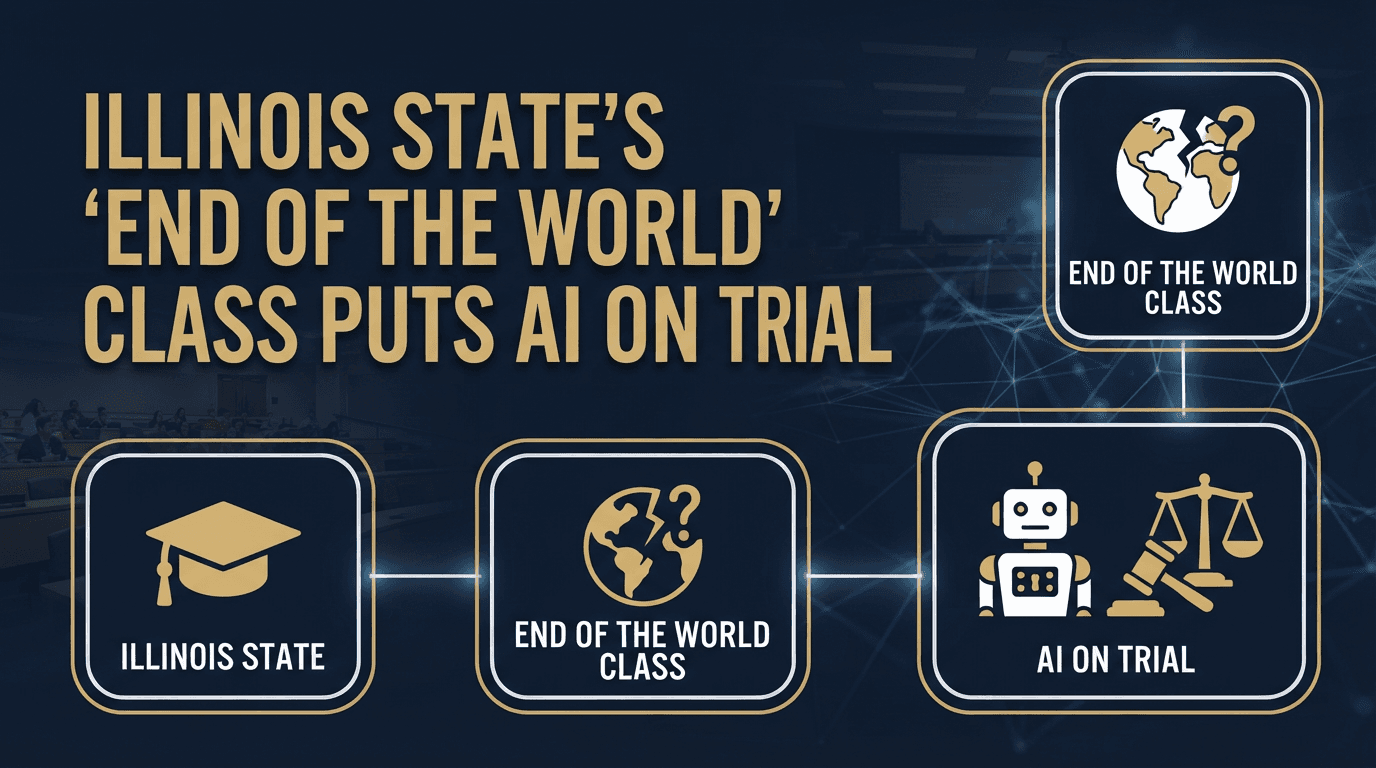
In a seminar room at Illinois State University (ISU), an apocalyptic thought experiment is helping students grapple with one of the most disruptive technologies of their lifetimes: artificial intelligence. Framed as “feminism at the end of the world,” the class invites students to imagine futures shaped by climate crisis, economic collapse, and runaway automation—and then ask what justice, care, and responsibility look like when AI is woven into every aspect of life.
The course, titled WGS 391/491: Feminism at the End of the World, is taught by Dr. Jacklyn Weier in Illinois State’s Women’s, Gender, and Sexuality Studies program. Using speculative fiction, feminist theory, and contemporary reporting on AI, Weier’s students interrogate who benefits from emerging technologies and who is left more vulnerable when those tools are deployed in unequal societies.
‘End of the World’ as a Lens on AI
Rather than treating AI as a neutral tool, the course positions it as a technology emerging in an already crisis-ridden world. Students consider scenarios in which climate disasters, pandemics, or authoritarian politics intersect with increasingly powerful AI systems. That apocalyptic framing, Weier explains in the Illinois State University News feature, is less about doomsday spectacle and more about clarity: it allows students to see existing inequalities—and the potential amplification of those inequalities—without the distractions of business-as-usual.
Class discussions draw on questions such as: Who designs AI systems, and whose values are embedded in them? Which communities are most exposed when automated decision-making is used in policing, immigration, or social services? How might feminist and queer perspectives offer alternative models for building or governing AI, especially in times of crisis?
Students are encouraged to treat AI not only as a technical system but as a social infrastructure: something that redistributes power, labor, and risk. That perspective resonates with broader concerns raised by scholars and civil-society groups about bias in algorithms, surveillance capitalism, and the concentration of AI capabilities in a small number of corporations.
Illinois State’s Wider Debate Over AI in the Classroom
The apocalyptic classroom arrives amid a campus-wide—and statewide—reckoning over how AI should be used in education. Illinois State has devoted increasing resources to helping faculty and students navigate generative AI tools like ChatGPT, Gemini, and Copilot, and to clarifying when such tools enhance learning and when they undermine it.
In 2025, the university’s Office of the Cross Endowed Chair in the Scholarship of Teaching and Learning launched a grant program inviting faculty to study how generative AI is used or resisted in courses, and what that means for student learning, assessment, and equity. Those projects are structured around a central question: how is AI being integrated into higher education, and with what consequences for teaching and learning at ISU?
Illinois State’s professional development arm has since published guidance for instructors on generative AI in the classroom. That guidance emphasizes transparency and critical engagement: instructors are urged to state clearly in their syllabi when AI use is permitted, explain why particular assignments prohibit AI, and design assessments that prioritize process, reflection, and local or experiential knowledge.
Faculty workshops encourage instructors to have students critique AI-generated content, practice fact-checking, and reflect on where AI’s limitations become visible—especially when it comes to hallucinations, bias, and context. The goal is not to ban AI outright but to turn it into an object of analysis and a prompt for metacognition, much like what happens in Weier’s apocalyptic classroom.
State Policy: AI Can Assist, But Not Replace, Human Teachers
The conversations at Illinois State unfold against a backdrop of new laws in Illinois that specifically address AI in education. Recent legislation requires community colleges to ensure that courses are taught by qualified human faculty and explicitly prohibits using AI systems as the sole source of instruction in place of an instructor. At the same time, the law clarifies that faculty are allowed to use AI as a teaching tool—whether for generating practice problems, simulating scenarios, or tailoring feedback.
Another measure directs the Illinois State Board of Education to develop statewide guidance on AI in K–12 settings. That guidance must explain how AI works, offer examples of instructional uses, address data privacy and security, and highlight the risk of unintended bias baked into AI products. It also calls on educators to explicitly teach responsible and ethical AI use, preparing students to evaluate automated systems rather than accept them uncritically.
Illinois education officials have since released public-facing guidance that echoes those themes, stressing that AI should support, not supplant, human relationships in teaching and learning. The documents encourage schools to balance innovation with vigilance, especially when it comes to student data and the potential for algorithmic discrimination.
An ‘Apocalyptic’ Syllabus Meets Real-World Tech
Within this rapidly shifting policy and technological landscape, ISU’s “end of the world” class serves as a kind of laboratory. Students might read feminist science fiction that imagines AI governing resource distribution after climate collapse, and then compare those visions with real-world deployments of predictive analytics in disaster response or public assistance programs.
Assignments invite students to bring news coverage, corporate marketing, and government documents into conversation with theoretical texts. For example, a student might juxtapose a tech company’s promise to use AI for equitable healthcare with reports of biased diagnostic algorithms, or analyze how AI-enhanced policing could change under conditions of social unrest or environmental migration.
By situating AI in imagined end-times, Weier’s course asks students to strip away the sheen of inevitability that often accompanies innovation narratives. If AI is introduced into a fragile or unjust world, she asks, what safeguards and alternative designs would be needed to prevent it from reinforcing existing hierarchies—or making crises worse?
Feminism, Care, and the Future of Work
The feminist framing of the course pushes students to pay particular attention to care work, reproductive labor, and the often-invisible human effort that underlies technological systems. Discussion topics include:
- How AI may reshape care professions, from nursing to education, and what happens when emotional labor is automated or monitored.
- Who performs the ghost work of data labeling, content moderation, and user support that keeps AI systems running.
- How automation might intersect with gender, race, and class in future labor markets, especially under crisis conditions.
- What a more just AI ecosystem would require in terms of labor protections, democratic oversight, and alternative ownership models.
Students are encouraged to imagine AI futures in which care, reciprocity, and mutual aid are central design principles rather than afterthoughts. In some projects, that means sketching out hypothetical policies for community-run data trusts or workers’ cooperatives overseeing AI tools in essential services.
AI Education Beyond One Classroom
Illinois State is also building technical capacity around AI. The university has promoted AI-focused professional development sessions for faculty, including workshops on demystifying AI for teaching and learning and on designing assignments that cannot easily be outsourced to generative tools.
In 2026, ISU highlighted a new “AI + Robotics” initiative that introduces pre-service STEM educators to so-called physical AI—systems embedded in robots and other devices. The project, supported by an internal innovation grant, aims to help future teachers understand both the capabilities and limits of AI, and to translate abstract concepts into hands-on classroom activities.
Another Illinois State faculty member, Dr. Elahe Javadi from the School of Information Technology, was selected for the inaugural cohort of NSF NAIRR AI Education Fellows. That national role positions ISU at the intersection of AI research and education policy, and underscores the university’s effort to engage with AI not only as an object of critique but as a field in which its faculty and students can lead.
Questioning the Future, Not Just the Tools
The apocalyptic classroom at Illinois State shows how humanities and social science courses can complement technical and policy efforts around AI. By combining speculative scenarios with rigorous critique, students learn to move beyond questions like “Is AI good or bad?” and toward more specific, grounded inquiries: Which AI, deployed where, under whose control, and with what safeguards?
For Weier’s students, the end of the world is less a prophecy than a lens—a way to see clearly the stakes of technological change and the kinds of futures they are willing to build or resist. In that sense, Illinois State’s experiment in apocalyptic pedagogy offers a model for universities everywhere: treat AI not only as a tool to be mastered, but as a system whose power must be scrutinized, contested, and, where possible, redirected toward more just worlds.