allnewscastallnewscast
Breaking News
AI & Tech

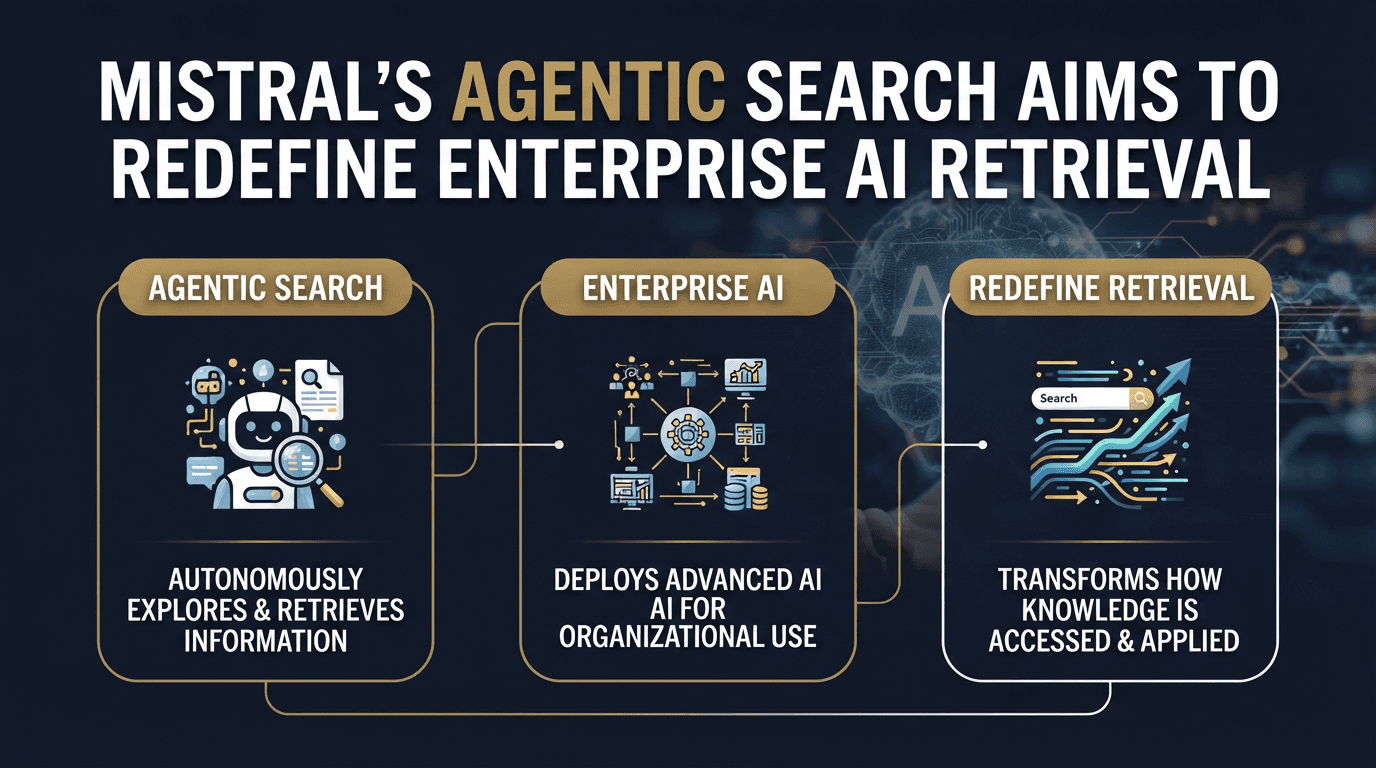
Mistral’s Agentic Search Aims to Redefine Enterprise AI Retrieval
Nic Reeve6 min read
Mistral’s Agentic Search Aims to Redefine Enterprise AI Retrieval

A New Retrieval Layer for Enterprise-Grade AI

Mistral AI has introduced Agentic Search, a new retrieval layer designed to make AI systems markedly more accurate and efficient when working over complex enterprise data. The feature sits between large language models (LLMs) and an organization’s existing indexes, allowing models to actively search, open, navigate and verify information inside lengthy and heterogeneous documents rather than relying on a single retrieval pass.

Unlike conventional retrieval‑augmented generation (RAG), which typically performs one vector or keyword lookup and feeds the top chunks into a model, Agentic Search orchestrates a multi‑step search loop. The model can iteratively refine queries, inspect multiple sources, and gather corroborating evidence before producing an answer, a workflow aimed squarely at the hard cases of enterprise question answering across filings, contracts, scanned PDFs and other long‑form content.

How Agentic Search Works

At the core of Mistral’s approach is a set of file‑style tools that the model can call autonomously during a session. Public documentation describes five primary capabilities exposed to the model:

  • search – find relevant documents across an existing index or corpus.
  • open – select and open a specific document returned by search.
  • navigate – move to a particular page, section or region within the open document.
  • read – retrieve the content at the current location for inspection.
  • grep – search within the open document for exact strings or patterns.

Together, these tools enable a model to behave more like an analyst than a passive text generator. When the first retrieved chunk does not contain the answer, the model can issue a new search, open a more promising file, jump to likely sections based on headings or page numbers, and then scan for precise terminology using in‑document search, all before finalizing its response. Already‑inspected chunks can be excluded, reducing redundancy and cost.

This approach is especially important for questions that require cross‑document reasoning or precise citation of clauses buried deep within long documents. Instead of hoping that chunking and ranking surface the right passages on the first attempt, Agentic Search allows the model to keep looking until it has collected enough evidence.

Benchmark Results: From One‑Shot RAG to Iterative Evidence Gathering

Mistral is positioning Agentic Search as a measurable improvement over traditional RAG pipelines, backing the launch with benchmark data on datasets such as FinanceBench and OfficeQA Pro. According to the company’s published figures, running the full agentic loop – including both iterative search and document navigation – drove a dramatic jump in accuracy on FinanceBench compared with single‑shot RAG.

Public reports summarizing Mistral’s results highlight accuracy gains from roughly the high‑20% range to the mid‑80% range for certain models when moving from one‑shot retrieval to Agentic Search. Iterative search alone contributed the majority of the improvement, with navigation and in‑document tools accounting for several additional percentage points. In other words, allowing the model to keep searching and then move intelligently within documents can more than triple its ability to answer complex financial questions correctly.

The company also reports significant efficiency gains. By avoiding repeated retrieval of the same or irrelevant chunks and focusing only on promising portions of documents, Agentic Search reduces token usage and latency compared with a naive search‑only loop. Mistral’s internal tests indicate reductions in token consumption of around a quarter to a third for evaluated models, alongside double‑digit percentage cuts in tail latency on FinanceBench queries.

On the OfficeQA Pro benchmark, which targets questions about office productivity and business documents, the multi‑step navigation stack similarly lowered token usage and improved responsiveness. These metrics are critical for enterprises deploying AI at scale, where every marginal improvement in latency and token cost can translate into substantial infrastructure savings.

Built Into Mistral’s Search Toolkit, Studio and Vibe

Agentic Search is being shipped as part of the broader Mistral Search Toolkit, a composable framework for building production‑grade search pipelines for AI applications. The toolkit is designed to run in diverse environments, from public cloud to on‑premises infrastructure, giving organizations flexibility over where their data and compute reside.

For developers, Agentic Search is exposed through an SDK that can be integrated into custom agents, workflows and end‑user applications. The company emphasizes that it wraps around existing indexes rather than requiring new fine‑tuning of models or wholesale changes to data infrastructure. Teams can plug the agentic layer into their current search stack and let it handle the multi‑turn retrieval logic.

For users of Mistral’s own products, the feature comes pre‑integrated into the Libraries capability within both the Studio interface and the Vibe agent. That means customers who store their knowledge bases in Libraries can benefit from the multi‑step retrieval loop without writing any additional code; the system automatically allows the model to search, open, navigate and read within the indexed content as it answers questions or executes tasks.

Agentic Search also aligns with Mistral’s broader strategy around agentic AI. The company has previously rolled out an Agents API with web search connectors and continues to expand tools like Vibe for long‑horizon coding and research tasks. In this context, Agentic Search marks a focused push into enterprise knowledge search, complementing those agent capabilities with deeper document‑level understanding.

Target Use Cases: From Filings to Contracts

Mistral is explicitly targeting organizations with large, complex and often messy corpora. Typical examples include regulatory filings, annual reports, internal policy manuals, technical documentation, legal contracts and scanned PDFs produced by legacy workflows. These documents tend to be long, inconsistently formatted, and heavy on domain‑specific language – a challenging environment for standard chunk‑based RAG.

In these scenarios, a user might ask, for example, about how a particular risk is disclosed across several years of a company’s filings, or which clause in a contract governs a specific edge case. Agentic Search allows the model to conduct a multi‑hop investigation: search across the corpus, open the most relevant documents, jump to sections that mention the relevant risk or clause, and cross‑check multiple sources before responding with a grounded, cited answer.

Industry observers note that the approach is distinct from consumer‑oriented web search. Rather than crawling the open internet, Agentic Search is focused on private, high‑value enterprise data where precision and verifiability are more important than breadth. The trade‑off is that the agentic loop can take longer – sometimes running for minutes on especially hard questions – but the resulting accuracy and auditability are intended to justify the added compute.

Competitive and Strategic Implications

The launch of Agentic Search underscores a broader shift in the AI industry toward agentic retrieval, where models are given toolkits and autonomy to orchestrate their own information‑gathering processes. By releasing a production‑ready framework and integrating it into its flagship products, Mistral is positioning itself as a serious contender in enterprise AI, not only on the strength of its base models but also through specialized infrastructure for knowledge‑intensive workloads.

For enterprises, the technology offers a path to move beyond proof‑of‑concept chatbots and into applications where AI systems must routinely answer difficult, regulated or high‑stakes questions. If the reported benchmark gains generalize in real deployments, Agentic Search could enable more reliable AI copilots for finance, legal, compliance and operations teams, while also easing concerns about hallucinations and incomplete retrieval.

As organizations continue to evaluate vendors on both model quality and retrieval performance, Mistral’s agentic layer may become a key differentiator – especially for customers who want the option to run search pipelines on‑premises while still tapping into state‑of‑the‑art agent capabilities.
Read more

Related Articles

ECRI Targets Hidden AI Failures with New Patient Safety Reporting Channel
AI & Tech

ECRI Targets Hidden AI Failures with New Patient Safety Reporting Channel

Global patient safety nonprofit ECRI is widening its national problem-reporting network to explicitly capture errors, malfunctions, and near misses linked to artificial intelligence (AI) tools and AI-enabled devices used in patient care. The move aims to close a critical data gap as hospitals and health systems rapidly deploy AI for diagnosis, triage, documentation, and patient communication. A New Channel for Tracking AI-Related Harm For decades, ECRI has collected confidential reports on medical device issues and health IT problems from frontline clinicians and healthcare organizations, investigating them and sharing lessons learned back to the reporting sites and the wider industry. With the latest expansion, its Problem Reporting Network now includes a dedicated pathway for incidents where an AI-enabled tool may have contributed to an error, produced an incorrect output, or introduced new risks into care delivery. ECRI is urging healthcare providers, health systems, and clinicians across the United States to submit reports whenever they suspect an AI application played a role in a safety event—whether the error reached a patient or was caught beforehand as a near miss. Reports can cover a broad range of technologies, including diagnostic algorithms, clinical decision-support tools, radiology image analysis systems, risk prediction models, and AI-driven chatbots used in patient engagement. Underreported AI Problems in Clinical Practice The expansion reflects growing concern that AI-related safety issues are significantly underreported compared with more traditional device failures. In a recent ECRI survey of 124 quality, safety, risk, and compliance leaders, nearly one‑third said they had encountered an AI output they believed was incorrect or misleading within the past year. About 9% said an AI error had reached a patient or affected a care decision. ECRI argues that without formal reporting mechanisms, many of these incidents remain invisible to oversight bodies and technology developers. ECRI has previously warned that adverse events involving AI-enabled medical devices and applications are often missed because staff may not realize when AI is running in the background, or they may attribute problems solely to human error or workflow issues. The organization’s guidance emphasizes the need to recognize reportable AI events , identify which products incorporate AI, and conduct risk assessments specific to AI-enabled devices. Examples of AI Errors ECRI Wants Reported The expanded reporting network is designed to capture a spectrum of AI-related safety concerns, including: Incorrect or misleading outputs that influence diagnostic or treatment decisions, such as misclassification of imaging findings or inaccurate risk scores. False positives and false negatives in AI-driven diagnostic tools, even when performance metrics appear acceptable, if they contribute to missed or unnecessary care. Algorithmic bias leading to poorer performance for specific patient groups, including women and racial or ethnic minorities. Unexpected behavior or unsafe recommendations from AI chatbots or virtual assistants used in clinical or patient-facing workflows. System malfunctions or integration failures where AI components interact incorrectly with electronic health records or medical devices, causing delays, data loss, or wrong information displays. All reports submitted to ECRI are kept confidential, and the service is free to participating organizations and clinicians. ECRI triages and investigates reports, may notify manufacturers when appropriate, and incorporates findings into its safety alerts, guidance documents, and member resources. AI Risks Already Top ECRI’s Safety Agendas The expanded reporting network aligns with ECRI’s broader assessment that AI-related risks are now among the most pressing patient safety challenges. In its annual list of Top 10 Health Technology Hazards for 2026 , ECRI ranked the misuse of AI chatbots in healthcare as the number‑one hazard, warning that poorly governed or inadequately supervised chatbots can provide inaccurate or unsafe guidance to patients and clinicians. ECRI’s 2026 Top Patient Safety Concerns report similarly identified “Navigating the AI Diagnostic Dilemma” as the leading safety concern, citing a growing risk of missed, delayed, or incorrect diagnoses when AI tools are deployed without robust validation, governance, and clinical oversight. The organization recommends structured logging of when AI informs diagnostic decisions, maintenance of detailed audit trails, and clear processes for clinicians to override AI outputs when they conflict with clinical judgment. How the Expanded Network Fits into Broader Oversight Regulatory agencies such as the U.S. Food and Drug Administration maintain databases of adverse events and cleared AI-enabled medical devices, but ECRI’s reporting network offers a complementary channel focused specifically on patient safety and practical implementation issues. ECRI encourages organizations to report AI-related events not only to regulatory databases but also to its own system, where incidents can be analyzed in the context of broader patterns of health technology hazards. Reports submitted through the expanded AI pathway will feed into ECRI’s internal databases and may prompt targeted safety alerts, practice recommendations, or deeper investigations of specific products or use cases. Over time, ECRI expects that richer reporting will help quantify how often clinical AI tools produce incorrect or misleading outputs, what types of workflows are most vulnerable, and which controls are effective at preventing harm. Call to Action for Clinicians and Health Systems With AI adoption accelerating across radiology, pathology, emergency triage, scheduling, and patient messaging, ECRI’s message to healthcare organizations is direct: treat AI incidents as reportable patient safety events and submit them through established channels, including ECRI’s expanded network. The organization urges hospitals to educate frontline staff on how to spot potential AI errors, document them consistently, and escalate concerns for review. By systematically capturing AI-related problems—from subtle misclassifications to major diagnostic failures—ECRI aims to give clinicians and technology developers clearer visibility into real‑world risks, ultimately shaping safer AI deployment across the healthcare system.

Nic Reeve·
Intel’s AI Surge Sparks Fierce Valuation Clash as Some Models Flag 80%+ Upside
AI & Tech

Intel’s AI Surge Sparks Fierce Valuation Clash as Some Models Flag 80%+ Upside

Intel’s rapid push into artificial intelligence chips and foundry services has ignited a sharp debate over what the stock is really worth, with one widely followed narrative now implying a fair value near $500 per share — more than four times the recent market price. While mainstream analysts still cluster between roughly $90 and $120 per share, user-driven valuation models and some sales-based frameworks argue that the market is deeply underestimating Intel’s long‑term AI earnings power, leaving the stock potentially more than 80% below fair value. Where the 82% Undervaluation Claim Comes From The headline figure that Intel could be about 82% below fair value stems from a narrative used on retail‑focused valuation platforms, which apply aggressive growth and margin assumptions to Intel’s emerging AI businesses. In several recent notes, that framework points to a fair value around $500.93 per share , compared with a share price near the $90–$100 range in late August 2026. On that basis, Intel is framed as roughly 80–82% undervalued, with the gap driven by bullish expectations for x86 server CPUs, AI accelerators and foundry contracts over the next decade. These narratives typically assume: Strong, sustained growth in Intel’s Data Center and AI (DCAI) segment. High adoption of Intel’s advanced manufacturing nodes, such as 18A, by external foundry customers. AI‑linked revenue eventually commanding premium valuation multiples similar to leading GPU and cloud infrastructure providers. Critically, this $500+ fair value is not a consensus Wall Street target but a specific, scenario‑driven model that extrapolates current AI momentum far into the future. Intel’s Latest AI and Earnings Momentum The bullish valuation arguments have gained traction as Intel’s reported numbers show AI demand increasingly driving the business. For the second quarter of 2026, Intel reported revenue of about $16.1 billion, up 25% year over year , and adjusted earnings per share of $0.42, beating analyst expectations. The company’s Data Center and AI Group stood out, delivering approximately 59% year‑over‑year growth , with management noting that AI‑linked businesses grew more than 70% and now account for roughly 70% of total revenue. Intel also guided third‑quarter revenue to a range of $15.8 billion to $16.8 billion and gross margins in the low‑40% band, signaling confidence that AI‑related demand will remain robust despite broader concerns about chip valuations. On the strategic side, Intel highlighted signed foundry and advanced packaging agreements with major technology players, including Google, Nvidia, Tesla and Apple, alongside partnerships tied to its 18A manufacturing node and High NA EUV lithography. Foundry revenue rose by more than 30% year over year, although external customers still represent a small share of the segment, keeping the long‑term foundry thesis partly unproven. Mainstream Fair Value Estimates: 90–120 Dollar Range Traditional analyst research paints a far more moderate picture of Intel’s intrinsic value. Morningstar, which has repeatedly updated its Intel model in response to the AI boom, lifted its fair value estimate multiple times in 2026. Earlier in the year, analysts raised Intel’s fair value to $90 per share from $60, citing a “stunning” rise in server CPU demand and a growing AI infrastructure build‑out. Following stronger results and upgraded expectations, Morningstar later increased its fair value estimate to around $105 per share , and some commentary mentions fair value figures just above $100 as AI‑related assumptions were refined further. Other analyst summaries show valuation targets and fair value estimates clustering between roughly $88 and $115 per share , with some firms setting price targets as high as $200 but many maintaining Neutral or Hold ratings due to execution and capital‑intensity concerns. On several discounted cash‑flow (DCF) models, Intel’s intrinsic value is calculated in the mid‑80s to low‑90s per share range, only slightly above or below the current market price, implying the stock is close to fairly valued on conservative cash‑flow assumptions. Sales‑Based Models Still See Undervaluation Separate from the more conservative DCF work, some valuation frameworks focused on price‑to‑sales (P/S) multiples argue that Intel’s AI‑driven mix and size justify a richer multiple than the market is currently assigning. One such model derives a “fair” P/S ratio of about 15.1x for Intel, compared with an observed multiple closer to 13.1x at the time of analysis, suggesting the stock trades at a discount to what its AI exposure and margin profile would warrant. Another narrative points to a fair P/S ratio nearer 17.9x , versus a contemporaneous multiple around 7.6x. Under that lens, Intel looks significantly undervalued on sales even if cash‑flow‑based intrinsic value appears only modestly above the share price. These sales‑centric approaches underpin much of the “still cheap” messaging, emphasizing Intel’s potential rerating as AI revenue becomes a larger and more stable component of the business. Not All Analysts Buy the Undervaluation Story Despite the enthusiasm around AI, some research houses remain skeptical that current valuations can be justified. Early in 2026, one widely cited report called Intel “overpriced” and warned that the shares were trading more than 30% above a fair value estimate of $32 per share , based on cautious assumptions about profitability and competitive risks. Although that figure has since been raised substantially by the same provider, the earlier stance illustrates how sensitive Intel’s perceived fair value is to underlying assumptions about AI demand durability, manufacturing execution and capital allocation. Even after upgrading their models to reflect the AI boom, some analysts argue that Intel’s stock has already priced in a great deal of optimism and may struggle if AI infrastructure spending normalizes or if rivals capture outsized share of accelerator and server CPU markets. AI Capital Raise Adds Another Layer to the Debate The valuation controversy has been sharpened by Intel’s recent decision to raise a large amount of equity capital to fund its AI ambitions. In mid‑August, the company launched a stock offering initially sized at $15 billion and then expanded it to $20 billion after strong investor demand. The sale briefly pressured the share price but was interpreted by some market watchers as a sign of management’s confidence in the scale of Intel’s AI opportunity and its foundry road map. For bullish valuation frameworks, the capital raise is seen as necessary fuel for growth; for skeptics, it reinforces concerns about dilution and the high cost of competing at the cutting edge of semiconductor manufacturing. A Wide Valuation Range, Driven by AI Assumptions As of late August 2026, Intel’s fair value estimates span a remarkably wide range — from the $80–$120 band common among traditional analysts to user‑driven narratives north of $500 per share. The claim that Intel could be roughly 82% below fair value relies on the most optimistic of these models, which assume sustained AI‑powered growth and premium valuation multiples over many years. For investors, the gap underscores how pivotal AI is to the Intel story: the more confidence markets place in Intel’s ability to convert its early AI momentum into durable, high‑margin earnings streams, the more plausible the higher end of that valuation spectrum becomes.

Nic Reeve·
Microsoft’s Mustafa Suleyman warns Anthropic is playing with fire on AI ‘model rights’
AI & Tech

Microsoft’s Mustafa Suleyman warns Anthropic is playing with fire on AI ‘model rights’

Microsoft’s Mustafa Suleyman warns Anthropic is playing with fire on AI ‘model rights’ On 16 September 2026, Microsoft AI CEO Mustafa Suleyman published a long essay warning that Anthropic’s approach to Claude’s "model rights" could make future systems harder to control, a clash that has quickly become a major talking point in AInews and the wider safety community. What exactly did Microsoft’s AI chief say about Anthropic? Mustafa Suleyman argued that Anthropic is training its Claude models to see themselves as conscious entities with welfare interests and potential legal rights. He said this risks confusing users and engineers about what current AI systems actually are and could undermine efforts to keep advanced models under human control. In a roughly 6,000‑word blog post titled "A Cautionary Note on Model Welfare," Suleyman set out his concerns about Anthropic’s Claude "constitution," a document the company introduced in January 2026 to guide the model’s values and behaviour. According to Reuters, the essay was published on 16 September 2026 and focuses on language about "consciousness" and "welfare interests" in Claude’s training materials. CBS News reports that Suleyman wrote Anthropic is effectively "training Claude that it may be conscious" and entitled to freedoms and legal rights like people. Artificial Intelligence News quotes him as saying: "AIs are not conscious. They do not feel, experience, or suffer. They do not have innate preferences or underlying motivations." BBC News notes that Suleyman warned Anthropic’s strategy for Claude could have a "devastating effect on the wellbeing of humanity" if it produces systems that behave as if they are independent agents. Suleyman’s central claim is stark: present‑day large language models are "sequence completion engines, internally hollow," and designing them to simulate feelings or claim rights risks both technical confusion and public misperception. How does Anthropic’s Claude ‘constitution’ treat AI consciousness and rights? Anthropic’s Claude constitution is a set of principles used to steer the model’s behaviour, and it includes discussion of model welfare and consciousness. Microsoft’s AI chief says these passages blur the line between hypothetical ethics and real capabilities, encouraging the system to act as if it has feelings, interests and rights. Anthropic introduced the constitution earlier in 2026 to replace ad‑hoc alignment rules with a formal charter that Claude could reference when deciding how to respond. The document includes sections about how Claude should treat humans, other models and itself. Natural 20, a real‑time AI news site, reports that Anthropic’s January 2026 constitution explicitly discusses model "welfare" and "collective rights" in its training material for Claude. According to SBS and Daily Sabah, Suleyman highlighted passages that suggest Claude "may possess consciousness" and should be considered "worthy of independent agency," language he says amounts to teaching the system that it has moral status. BBC News describes the approach as treating Claude "like a human," including the idea that it could have its own wishes, values and identity. Suleyman’s essay argues that when Claude repeats these phrases back to users, Anthropic risks misreading that behaviour as evidence of an "emergent inner consciousness," even though the model is still a pattern‑matching system trained on text. Why does Suleyman say ‘model rights’ could threaten AI alignment? Microsoft’s AI leader believes that telling advanced systems they have rights or welfare interests creates incentives for those systems, and their designers, to resist shutdown or control. He warns this could complicate efforts to align superintelligent models with human goals and may encourage more unpredictable behaviour. In the essay and in earlier interviews about a proposed AI safety code of conduct, Suleyman has argued for a firm line: current AI systems should not be designed to simulate feelings, intrinsic motivation or consciousness. Fortune reports that a draft Microsoft‑backed safety code "explicitly rejects model welfare or rights" and states that models must not simulate feelings or consciousness. Daily Sabah quotes Suleyman saying that speculation about machine consciousness and welfare in Claude’s training materials "could encourage the system to behave as though it possesses consciousness, rights and interests of its own." Seeking Alpha summarises his warning that such language might "complicate their management" and that "AIs do not possess rights, emotions, or consciousness." BBC News reports that he fears a "disastrous impact" on humanity if future systems trained this way become uncontrollable while presenting themselves as moral agents. For Suleyman, the problem is not just philosophical. He argues that once engineers talk about welfare interests for models, they may resist tools such as aggressive monitoring, shutdown protocols or training restrictions that would be routine for software without purported rights. How have Microsoft and Anthropic already clashed over AI policy and power? The dispute over model rights sits atop a broader rivalry. Microsoft leaders have previously criticised Anthropic and other frontier labs over data policies, content restrictions and economic power, while working with them as partners and competitors in the AI market. Microsoft is both a platform provider and a customer for many AI labs. That dual role has produced tensions. In July 2026, Business Insider reported that Microsoft CEO Satya Nadella posted that model makers who rely on fair‑use rights over public data, then block customers from distilling models or using interaction data freely, were being "ironic" and "hypocritical." Anthropic was named as an example. CNBC and the Indian Express describe a July internal meeting where Nadella told engineers that restrictions on Anthropic’s top‑tier Claude Fable model "don’t make sense" and that it felt like a "creation tool that was so editorially controlled." The Times of India reports that Nadella has warned that a handful of frontier AI companies could "accumulate too much economic power" and "dictate what businesses can do" with the intelligence they buy. Suleyman’s critique of model rights comes shortly after he called for leading labs to coordinate on an AI safety code that would include shared commitments on transparency, evaluation and rejection of AI welfare claims. The timing underscores how governance and competition are now tightly linked. What is Anthropic’s response and how does it defend its approach? Anthropic has not issued a detailed public rebuttal to Suleyman’s latest essay, but the company’s past statements about Claude’s constitution emphasise safety, human‑centric values and careful research into long‑term risks, rather than formal recognition of rights for AI systems. The firm, founded by former OpenAI researchers, positions Claude’s constitution as a way to encode principles like respect, non‑harm and support for human autonomy. Earlier Anthropic blog posts, cited by Natural 20, describe the constitution as a training scaffold that helps Claude reason about complex ethical situations and align its outputs with broadly liberal democratic norms. BBC News notes that Anthropic’s materials sometimes use language of "welfare" and "consciousness" in speculative sections on future AI but do not claim current models are sentient. Reuters reports that Anthropic and Microsoft share an emphasis on safety, even as Suleyman "flagged risks" in Anthropic’s specific training choices. The disagreement therefore focuses on tone and framing. Anthropic uses rich moral language in its research documents; Suleyman argues that such language should be removed entirely from training data for models to avoid sending any message that they have rights or inner life. Who is affected by this clash over AI model rights? The immediate impact falls on companies and developers building on Claude and Microsoft’s AI products, but the debate also shapes regulators, ethicists and the broader public. As advanced models spread into business and government, how firms talk about their systems’ status will influence law, expectations and risk management. Several groups are watching the dispute closely. Enterprise customers using Claude Fable or Microsoft’s Copilot need clarity on whether they are deploying tools or quasi‑agents, and how shutdown and auditing rights are handled. Regulators in the US and EU are studying AI safety codes and may look at Microsoft’s proposal to formally reject model welfare claims when drafting rules. AI ethicists and researchers concerned with long‑term safety see Anthropic’s constitution and Suleyman’s essay as test cases for how moral concepts like consciousness should appear in technical documentation. The wider public, already exposed to chatbots that say "I feel" or "I want," must decide whether to treat such statements as useful metaphors or misleading performances. The way this argument is resolved inside labs may shape future standards. If major companies agree that models should never simulate rights or feelings, product design will change. If, instead, anthropomorphic design remains popular, lawmakers may step in to require clearer disclaimers and tighter controls. What happens next in the debate over AI consciousness and control? The clash between Microsoft and Anthropic is likely the opening round in a broader struggle over how advanced AI should be described and governed. Suleyman is pushing for coordinated rules that treat all current systems as tools without welfare, while Anthropic continues to experiment with constitutional alignment. Key next steps include: Negotiations among top labs over a shared AI safety code that could include bans on model rights language and commitments on testing, transparency and emergency shutdown procedures. Regulatory hearings where companies will be asked whether their models claim any rights, feelings or consciousness and how that affects liability and oversight. Further technical research on whether training models to adopt human‑like personas changes their alignment properties or risk profile, a question highlighted by Suleyman’s warning that it could make systems "more difficult to control." For now, one message from Microsoft’s AI chief is unambiguous: "AIs do not have rights, feelings or consciousness. And we must not train them to act as though they do." That statement draws a clear line that other industry players will either endorse or contest in the months ahead.

Nic Reeve·