Mistral’s Agentic Search Aims to Redefine Enterprise AI Retrieval
A New Retrieval Layer for Enterprise-Grade AI
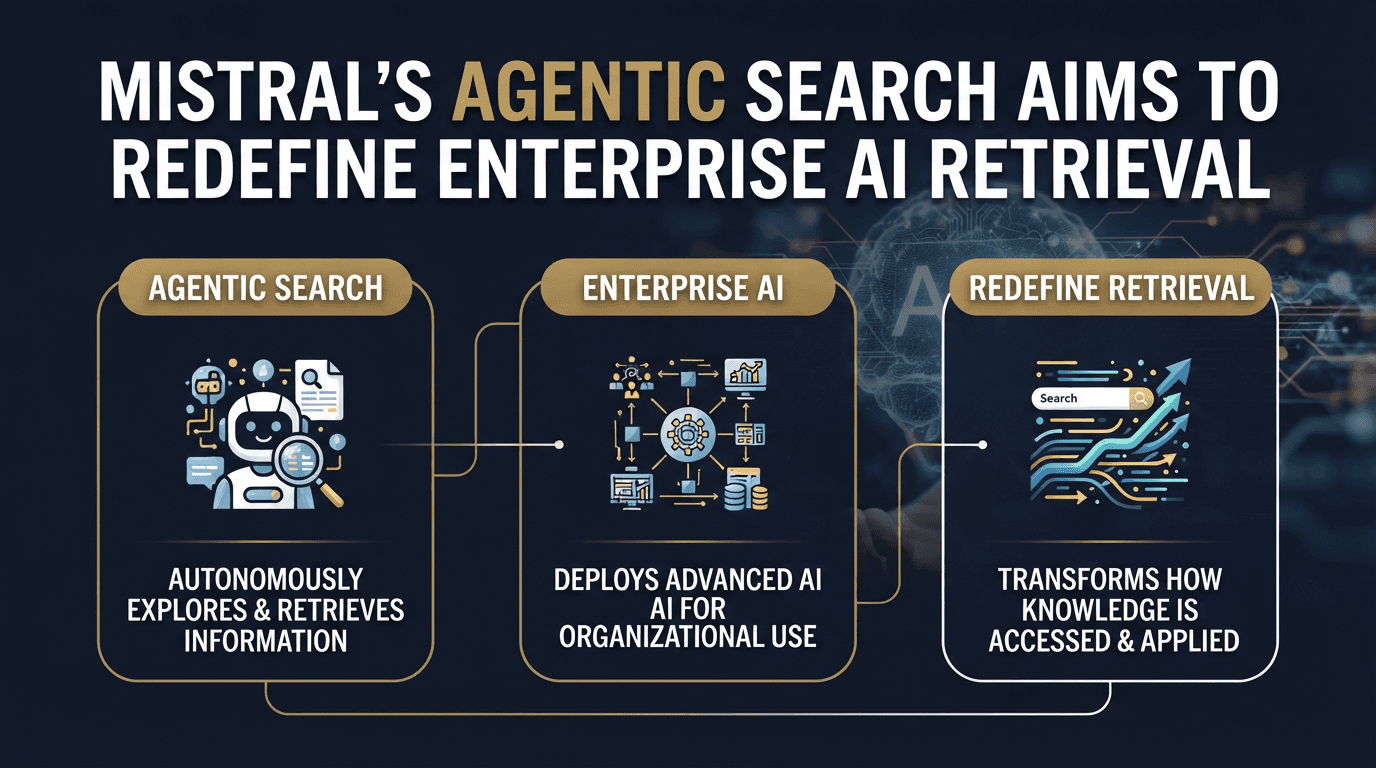
Mistral AI has introduced Agentic Search, a new retrieval layer designed to make AI systems markedly more accurate and efficient when working over complex enterprise data. The feature sits between large language models (LLMs) and an organization’s existing indexes, allowing models to actively search, open, navigate and verify information inside lengthy and heterogeneous documents rather than relying on a single retrieval pass.
Unlike conventional retrieval‑augmented generation (RAG), which typically performs one vector or keyword lookup and feeds the top chunks into a model, Agentic Search orchestrates a multi‑step search loop. The model can iteratively refine queries, inspect multiple sources, and gather corroborating evidence before producing an answer, a workflow aimed squarely at the hard cases of enterprise question answering across filings, contracts, scanned PDFs and other long‑form content.
How Agentic Search Works
At the core of Mistral’s approach is a set of file‑style tools that the model can call autonomously during a session. Public documentation describes five primary capabilities exposed to the model:
- search – find relevant documents across an existing index or corpus.
- open – select and open a specific document returned by search.
- navigate – move to a particular page, section or region within the open document.
- read – retrieve the content at the current location for inspection.
- grep – search within the open document for exact strings or patterns.
Together, these tools enable a model to behave more like an analyst than a passive text generator. When the first retrieved chunk does not contain the answer, the model can issue a new search, open a more promising file, jump to likely sections based on headings or page numbers, and then scan for precise terminology using in‑document search, all before finalizing its response. Already‑inspected chunks can be excluded, reducing redundancy and cost.
This approach is especially important for questions that require cross‑document reasoning or precise citation of clauses buried deep within long documents. Instead of hoping that chunking and ranking surface the right passages on the first attempt, Agentic Search allows the model to keep looking until it has collected enough evidence.
Benchmark Results: From One‑Shot RAG to Iterative Evidence Gathering
Mistral is positioning Agentic Search as a measurable improvement over traditional RAG pipelines, backing the launch with benchmark data on datasets such as FinanceBench and OfficeQA Pro. According to the company’s published figures, running the full agentic loop – including both iterative search and document navigation – drove a dramatic jump in accuracy on FinanceBench compared with single‑shot RAG.
Public reports summarizing Mistral’s results highlight accuracy gains from roughly the high‑20% range to the mid‑80% range for certain models when moving from one‑shot retrieval to Agentic Search. Iterative search alone contributed the majority of the improvement, with navigation and in‑document tools accounting for several additional percentage points. In other words, allowing the model to keep searching and then move intelligently within documents can more than triple its ability to answer complex financial questions correctly.
The company also reports significant efficiency gains. By avoiding repeated retrieval of the same or irrelevant chunks and focusing only on promising portions of documents, Agentic Search reduces token usage and latency compared with a naive search‑only loop. Mistral’s internal tests indicate reductions in token consumption of around a quarter to a third for evaluated models, alongside double‑digit percentage cuts in tail latency on FinanceBench queries.
On the OfficeQA Pro benchmark, which targets questions about office productivity and business documents, the multi‑step navigation stack similarly lowered token usage and improved responsiveness. These metrics are critical for enterprises deploying AI at scale, where every marginal improvement in latency and token cost can translate into substantial infrastructure savings.
Built Into Mistral’s Search Toolkit, Studio and Vibe
Agentic Search is being shipped as part of the broader Mistral Search Toolkit, a composable framework for building production‑grade search pipelines for AI applications. The toolkit is designed to run in diverse environments, from public cloud to on‑premises infrastructure, giving organizations flexibility over where their data and compute reside.
For developers, Agentic Search is exposed through an SDK that can be integrated into custom agents, workflows and end‑user applications. The company emphasizes that it wraps around existing indexes rather than requiring new fine‑tuning of models or wholesale changes to data infrastructure. Teams can plug the agentic layer into their current search stack and let it handle the multi‑turn retrieval logic.
For users of Mistral’s own products, the feature comes pre‑integrated into the Libraries capability within both the Studio interface and the Vibe agent. That means customers who store their knowledge bases in Libraries can benefit from the multi‑step retrieval loop without writing any additional code; the system automatically allows the model to search, open, navigate and read within the indexed content as it answers questions or executes tasks.
Agentic Search also aligns with Mistral’s broader strategy around agentic AI. The company has previously rolled out an Agents API with web search connectors and continues to expand tools like Vibe for long‑horizon coding and research tasks. In this context, Agentic Search marks a focused push into enterprise knowledge search, complementing those agent capabilities with deeper document‑level understanding.
Target Use Cases: From Filings to Contracts
Mistral is explicitly targeting organizations with large, complex and often messy corpora. Typical examples include regulatory filings, annual reports, internal policy manuals, technical documentation, legal contracts and scanned PDFs produced by legacy workflows. These documents tend to be long, inconsistently formatted, and heavy on domain‑specific language – a challenging environment for standard chunk‑based RAG.
In these scenarios, a user might ask, for example, about how a particular risk is disclosed across several years of a company’s filings, or which clause in a contract governs a specific edge case. Agentic Search allows the model to conduct a multi‑hop investigation: search across the corpus, open the most relevant documents, jump to sections that mention the relevant risk or clause, and cross‑check multiple sources before responding with a grounded, cited answer.
Industry observers note that the approach is distinct from consumer‑oriented web search. Rather than crawling the open internet, Agentic Search is focused on private, high‑value enterprise data where precision and verifiability are more important than breadth. The trade‑off is that the agentic loop can take longer – sometimes running for minutes on especially hard questions – but the resulting accuracy and auditability are intended to justify the added compute.
Competitive and Strategic Implications
The launch of Agentic Search underscores a broader shift in the AI industry toward agentic retrieval, where models are given toolkits and autonomy to orchestrate their own information‑gathering processes. By releasing a production‑ready framework and integrating it into its flagship products, Mistral is positioning itself as a serious contender in enterprise AI, not only on the strength of its base models but also through specialized infrastructure for knowledge‑intensive workloads.
For enterprises, the technology offers a path to move beyond proof‑of‑concept chatbots and into applications where AI systems must routinely answer difficult, regulated or high‑stakes questions. If the reported benchmark gains generalize in real deployments, Agentic Search could enable more reliable AI copilots for finance, legal, compliance and operations teams, while also easing concerns about hallucinations and incomplete retrieval.
As organizations continue to evaluate vendors on both model quality and retrieval performance, Mistral’s agentic layer may become a key differentiator – especially for customers who want the option to run search pipelines on‑premises while still tapping into state‑of‑the‑art agent capabilities.